
Table I
Aspergillus flavus isolates identity based on the BLAST NCBI data.
| Strain | Identity (%) |
|---|---|
| FZM1 | Aspergillus flavus strain A9 chromosome 3 (97.48%) |
| FAK45 | Aspergillus flavus strain A9 chromosome 3 (98.12%) |
| FSZ47 | Aspergillus flavus strain SU-16 chromosome 3 (99.37%) |
| FDY50 | Aspergillus flavus strain SU-16 chromosome 3 (99.67%) |
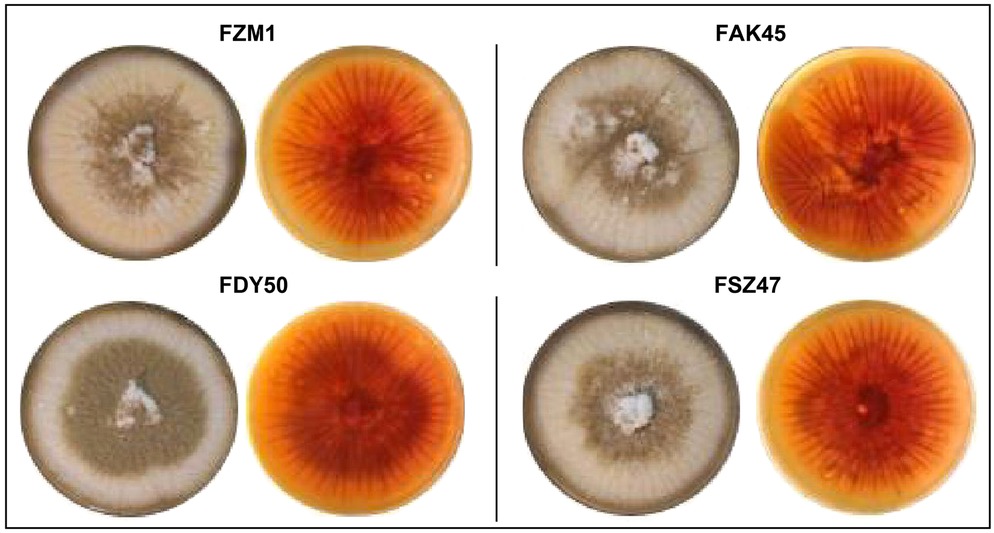
Fig. 1
Phenotypic characterization of A. flavus isolates grown on A. flavus/parasiticus agar (AFPA) medium. Colony color: white-green colony diameter 18 mm, colony reverse color: yellowish orange after seven days of incubation at 25°C.
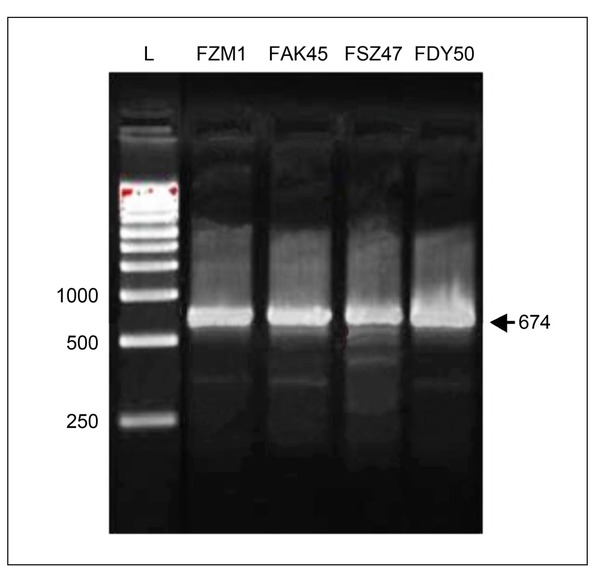
Fig. 2
PCR amplification of intergenic sequences of the four isolates. IGS-F and IGS-R primers were used for PCR amplification of the intergenic sequences in total DNA isolated from the four fungal isolates as described in Material and Methods. A total of 5 μl of each PCR product was separated in a 1.5% agarose gel by electrophoresis. Lane 1 kb ladder (L) DNA marker, Aspergillus flavus isolates are indicated on the top of each lane. The sizes of selected DNA fragments are indicated on the sides of the panels.
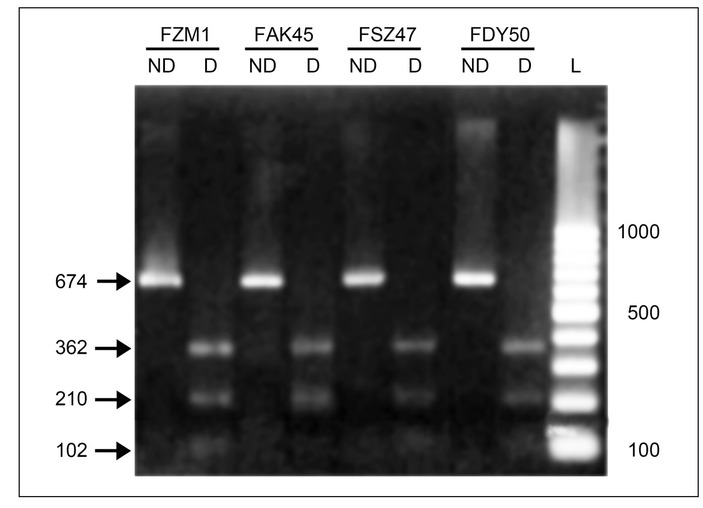
Fig. 3
PCR and RFLP analyses of fungal amplicons. A total of 5 μl of PCR products of each of the isolates (FZM1, FAK45, FSZ47 and FDY50) was digested with Bgl II restriction endonuclease as described in Materials and Methods. Nondigested (ND) and digested (D) products were loaded and separated by electrophoresis in a 2% agarose gel. A 100 bp DNA ladder (L) was used as molecular weight marker, the positions of 100, 500 and 1,000 bp fragments are indicated. Positions of the 362, 210 and 102 bp fragments generated by BglII digestion are indicated.
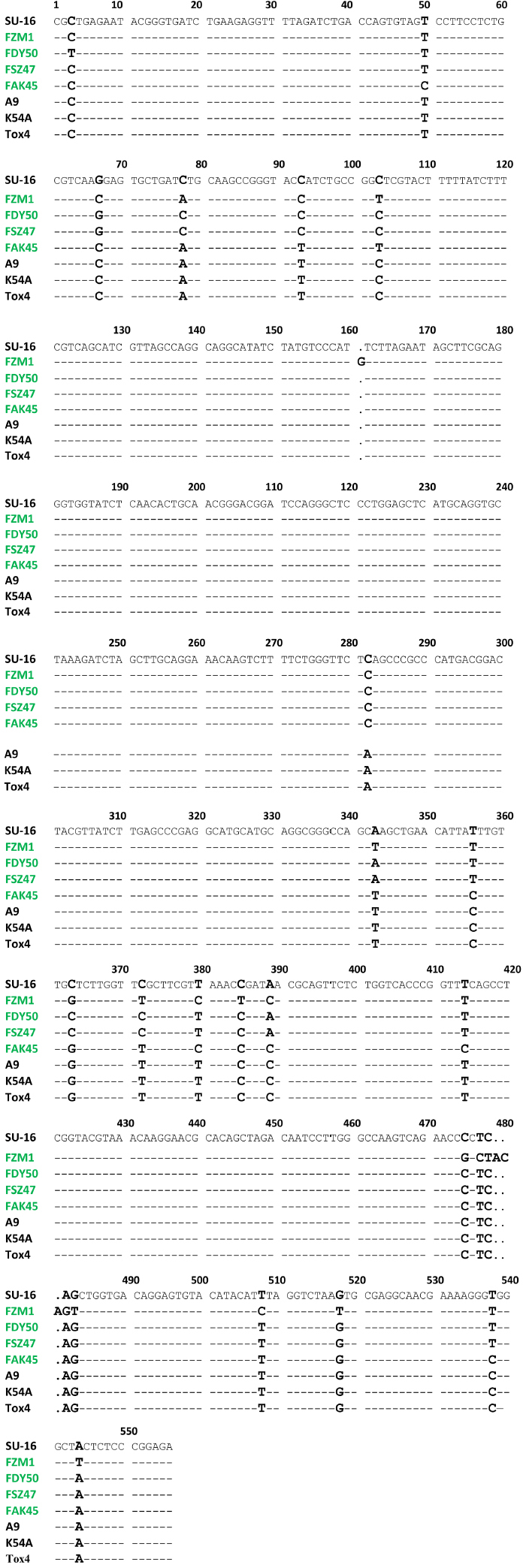
Fig. 4
Nucleotide sequence alignment of the four isolates with four reference strains. The names of the (.) four isolates are in green. Nucleotide sequence alignment was performed using Clustal software (–) represent similarity (.), represent deletion. Nucleotide changes are shown in bold font.
Table II
Genbank accession numbers of the Aspergillus flavus isolates.
| Isolate | Accession number | Strain |
|---|---|---|
| FZM1 | OL944584.1 | A. flavus strain FZM1 aflR-aflJ intergenic region, partial sequence |
| FAK45 | OL944586.1 | A. flavus strain FAK45 aflR-aflJ intergenic region, partial sequence |
| FSZ47 | OL944587.1 | A. flavus strain FSZ47 aflR-aflJ intergenic region, partial sequence |
| FDY50 | OL944588.1 | A. flavus strain FDY50 aflR-aflJ intergenic region, partial sequence |
Table III
Genbank accession numbers of the Aspergillus flavus reference strains.
| Accession number | Strain |
|---|---|
| CP051037.1 | A. flavus strain A9 chromosome 3 |
| CP051085.1 | A. flavus strain K54A chromosome 3 |
| CP051045.1 | A. flavus strain Tox4 chromosome 3 |
| CP047251.1 | A. flavus strain SU-16 chromosome 3 |
Table IV
Nucleotide variations in aflR-aflS(J) intergenic region sequences of Aspergillus flavus isolates.
| Nucleotide position | Nucleotide variation | Isolate |
|---|---|---|
| 103, 385, 478 | C with T (substitution) | FZM1: Aspergillus flavus strain FZM1 aflR-aflS(J) intergenic region, partial sequence |
| 161 | Insertion of G | |
| 380, 477, 508 | T with C (substitution) | |
| 475 | C with G (inversion) | |
| 479–481 | Insertion of ACA | |
| 482 | A with G (substitution) | |
| 483 | G with T (substitution) | |
| 544 | A with T (inversion) | |
| 50 | T with C (substitution) | FAK45: Aspergillus flavus strain FAK45 aflR-aflS(J) intergenic region, partial sequence |
| 103 | C with T (substitution) | |
| 3 | C with T (substitution) | FDY50: Aspergillus flavus strain aflR-aflS(J) intergenic region, partial sequence |
| 5, 28 | G with A (substitution) |
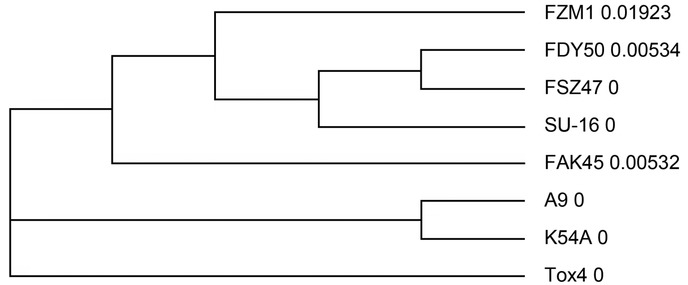
Fig. 5
Maximum Likelihood phylogenic tree showing the relationships between the examined A. flavus isolates and reference strains, based on aflR/aflS(J) intergenic sequence.