Have a personal or library account? Click to login
Bacterial Community Analysis and Potential Functions of Core Taxa in Different Parts of the Fungus Cantharellus cibarius Cover

Bacterial Community Analysis and Potential Functions of Core Taxa in Different Parts of the Fungus Cantharellus cibarius

Open Access
|Sep 2021

Figures & Tables

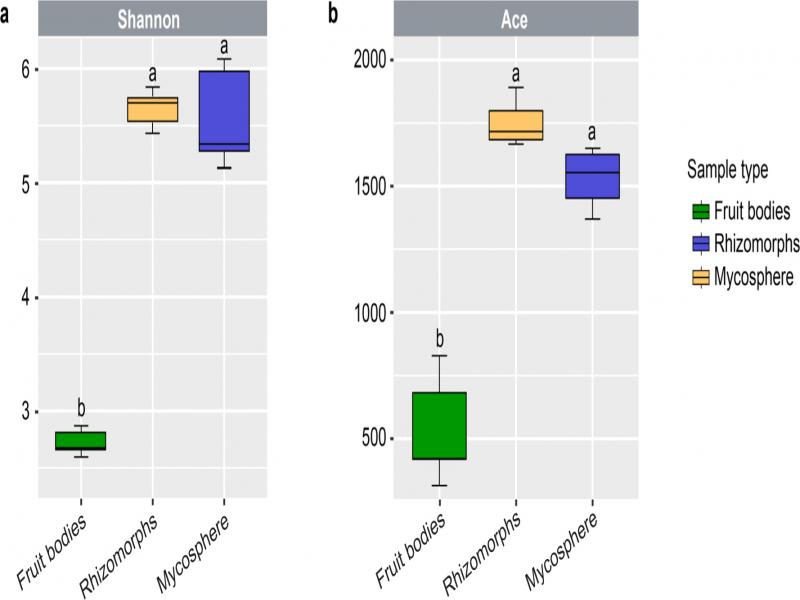
Fig. 1.

Alpha-diversity comparison among the fruit bodies, rhizomorphs of Cantharellus cibarius, and mycosphere samples based on a) the Shannon and b) Ace indexes using the 16S rRNA gene amplicons sequencing data. Samples with the same letter do not differ significantly by Tukey’s test at p > 0.05; samples with different letters are significantly different by Tukey’s test at p < 0.05. The center value of each sample represents the median for the different indexes.
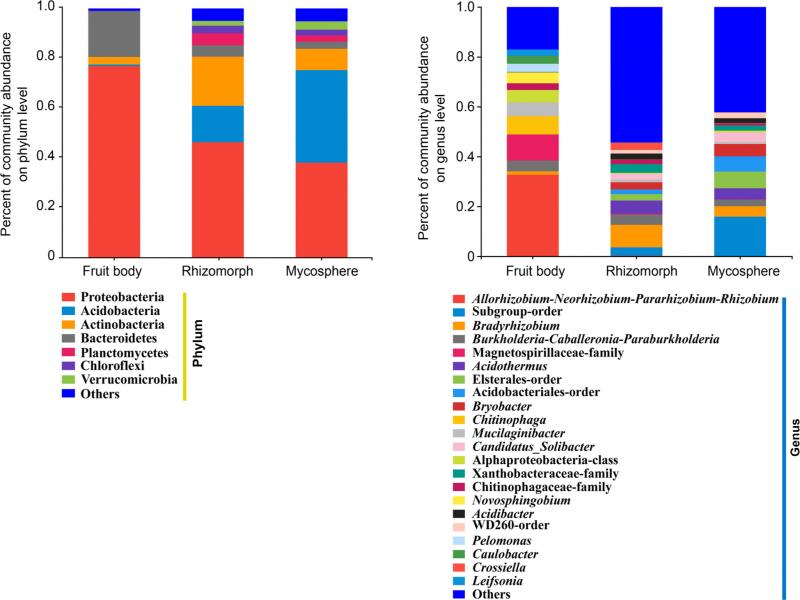

Fig. 2.

Bacterial communities of Cantharellus cibarius at a) the phylum and b) genus levels. Others represent all phyla or genera with less than 2% abundance. Each part was an average of five replicates.

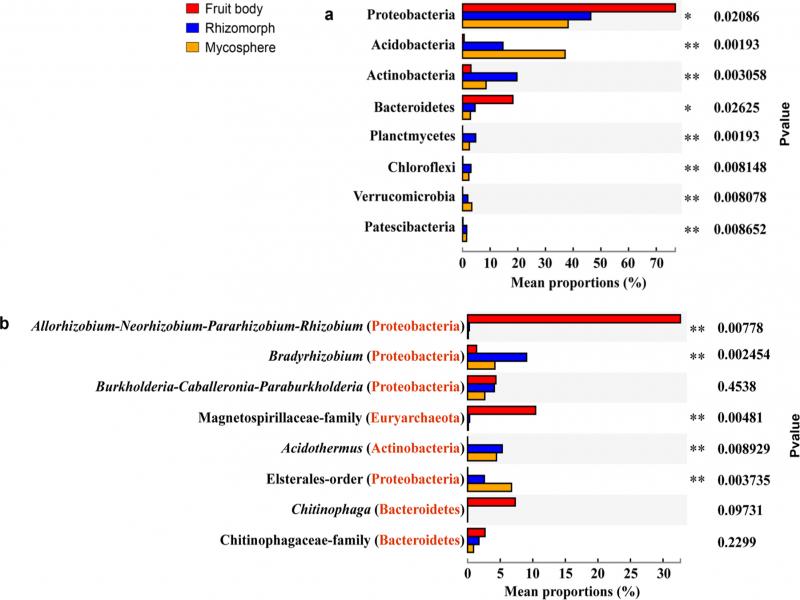
Fig. 3.

Statistical comparison of the relative abundance of microbiota among the three sampled parts of Cantharellus cibarius.Comparison of a) dominant phyla and b) dominant genera in the fruit bodies, rhizomorphs, and mycosphere samples. The y-axis represents names of taxa at the dominant phyla or genera level; the x-axis represents average relative abundance; colored columns represent different sampled parts of C. cibarius. Values on the far right are the p values, *0.01 < p ≤ 0.05, **0.001 < p ≤ 0.01, ***p ≤ 0.001.
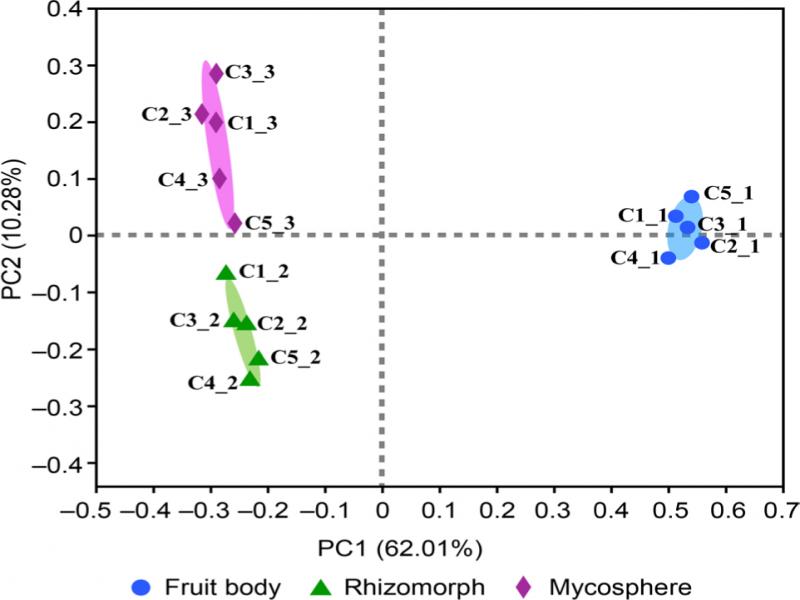

Fig. 4.

Principal coordinate analysis (PCoA) of microbial communities in three sampled parts of Cantharellus cibarius. Circles, triangles, and diamonds represent the fruit bodies, rhizomorphs, and mycosphere, respectively. Distances between symbols on the ordination plot reflect relative dissimilarities in community structures.
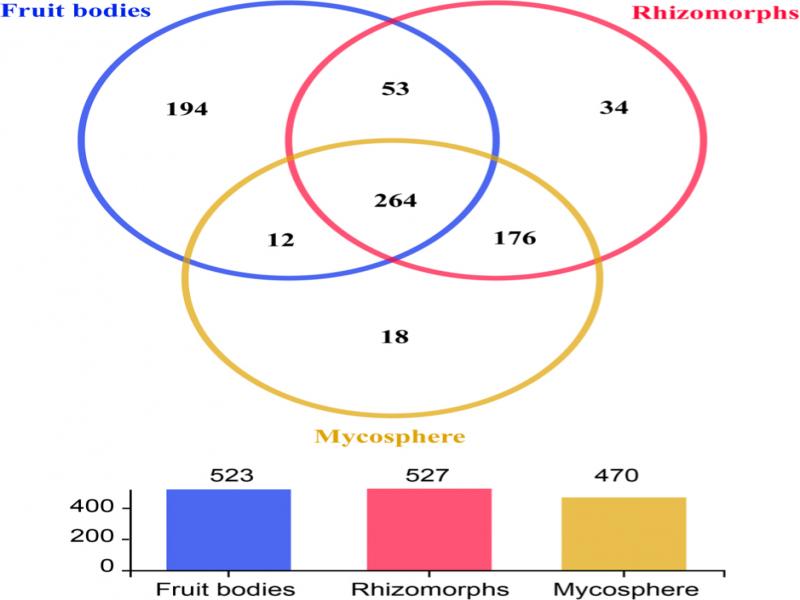

Fig. 5.

Shared and unique genera in fruit bodies, rhizomorphs, and mycosphere of Cantharellus cibarius. The bar chart shows the total number of genera (shared and unique) in each sample.
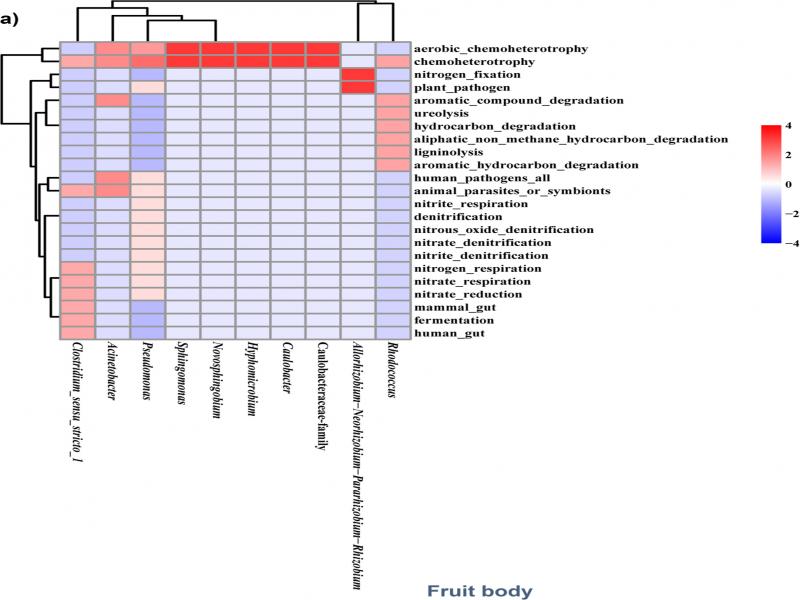

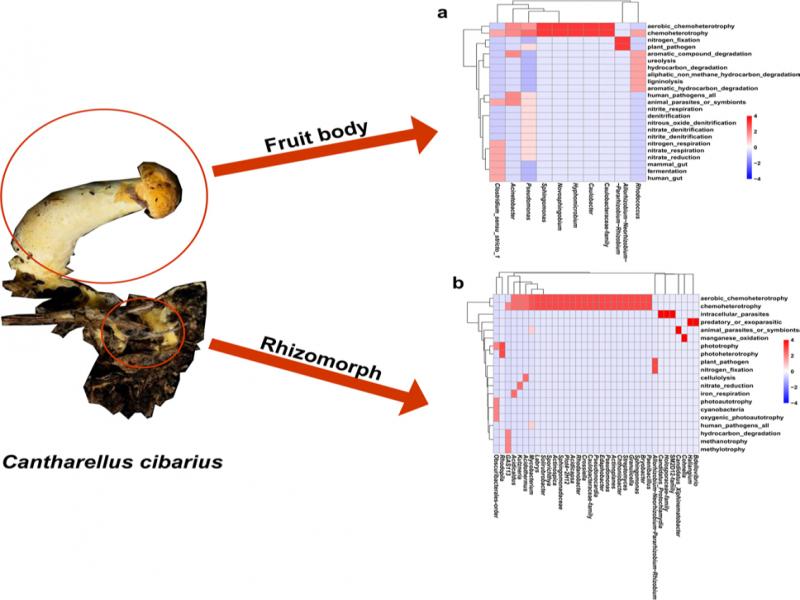
Fig. 6

(a) Heatmaps representing the differences in core bacterial group members and potential functions between a) fruit bodies and b) rhizomorphs of Cantharellus cibarius. The abscissa represents the members of the core bacterial group in each sampled part of C. cibarius, and the ordinate represents the potential functional types.
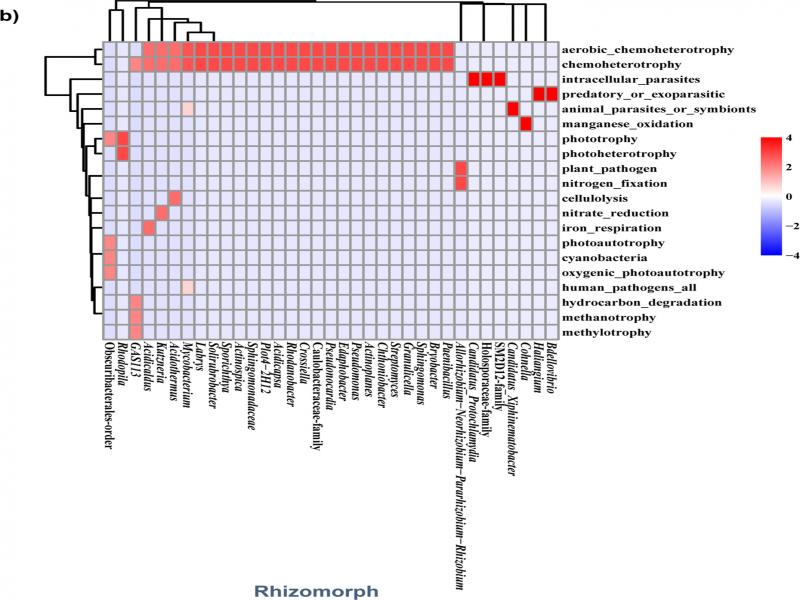

Fig. 6

(b) Heatmaps representing the differences in core bacterial group members and potential functions between a) fruit bodies and b) rhizomorphs of Cantharellus cibarius. The abscissa represents the members of the core bacterial group in each sampled part of C. cibarius, and the ordinate represents the potential functional types.

Top five abundant genera in the fruit body, rhizomorph, and mycosphere of Cantharellus cibarius_

Sample partsGenusRelative abundance (%)
Fruit bodyAllorhizobium-Neorhizobium-Pararhizobium-Rhizobium32.68
Magnetospirillaceae-family10.44
Chitinophaga7.31
Mucilaginibacter5.49
Bradyrhizobium1.37
RhizomorphBradyrhizobium9.06
Acidothermus5.32
Subgroup-order3.33
Elsterales-order2.57
Acidobacteriales-order1.88
Mycospherenorank_o Subgroup15.78
norank_o__Elsterales6.74
norank_o__Acidobacteriales6.11
Acidothermus4.43
Bradyrhizobium4.19
DOI: https://doi.org/10.33073/pjm-2021-035 | Journal eISSN: 2544-4646 | Journal ISSN: 1733-1331
Language: English
Page range: 373 - 385
Submitted on: Apr 17, 2021
Accepted on: Jul 25, 2021
Published on: Sep 17, 2021
Published by: Polish Society of Microbiologists
In partnership with: Paradigm Publishing Services
Publication frequency: 4 issues per year

© 2021 WEI GE, ZHI-YUAN ZHANG, CHUN-BO DONG, YAN-FENG HAN, SUNIL K. DESHMUKH, ZONG-QI LIANG, published by Polish Society of Microbiologists
This work is licensed under the Creative Commons Attribution-NonCommercial-NoDerivatives 4.0 License.