Introduction
Klebsiella pneumoniae is a critical multidrug-resistant (MDR) bacterium in humans responsible for numerous hospital infections linked to high morbidity and mortality since treatment options are limited (Navon-Venezia et al. 2017). K. pneumoniae from the family Enterobacteriaceae, occurs in the human and animal gastrointestinal tract microbiome. It is a commonly found opportunistic pathogen associated with the hospital environment and, overall, accountable for approximately a third of all Gram-negative infections. It has a role in extraintestinal infections, such as urinary tract infections, pneumonia, surgical site infections, cystitis, and life-threatening infections, including endocarditis and septicemia. It is also a significant cause of severe community-onset infections, such as necrotizing pneumonia, endogenous endophthalmitis, and pyogenic liver abscesses (Podschun and Ullmann 1998).
With the ever-growing antibiotic resistance, K. pneumoniae is a pathogen recognized for its antibiotic resistance; hence, it is categorized as an ESKAPE organism, besides other essential MDR pathogens (Boucher et al. 2009). The accumulation of ARGs by K. pneumoniae, by de novo mutations, is continuous under antibiotic selective pressure, and through the acquisition of plasmids and transferable genetic elements, it stimulates extensively drug-resistant (XDR) strains harboring a ‘super resistome’. In the past twenty years, many high-risk (HiR) MDR and XDR K. pneumoniae sequence types have appeared that exhibit great capacity of causing multicontinental outbreaks and continued global dissemination (Navon-Venezia et al. 2017).
Currently, the spread of carbapenem-resistant K. pneumoniae (CRKP) has become a severe problem in the molecular epidemiology of hospital infections.
Frequently, carbapenems serve as the last resort in the effective treatment of serious infections caused by multidrug-resistant bacteria. Enzymes that hydrolyze carbapenems, called carbapenemases, are the major cause of carbapenem resistance (Matsumura et al. 2017). The molecular classes A, B, and D carbapenemases are rapidly disseminated worldwide, challenging the treatment of Gram-negative infections (Nordmann and Poirel 2014). Recent reports have demonstrated that various carbapenem-hydrolyzing enzymes are disseminated worldwide in CRKP isolates. The fast evolution of carbapenem resistance quickly evolved in Enterobacteriaceae in the past decade and became a developing global threat. The majority of studies on antibiotic-resistant K. pneumoniae focus on characterizing carbapenemase producers (KPC, NDM, VIM, and OXA-48), various clonal groups or complexes (e.g., CG15, CG17, CG258, or CC147), and epidemic plasmids (IncA/C, IncFII, IncL/M, and IncN) that have been suggested to participate in their global expansion (Nordmann and Poirel 2014). Carbapenemase co-producers have been reported in distinct geographic locations: European countries (France, Germany, Greece, Italy, and Poland), Israel, the United States, China, and West Asia (Turkey) (Baraniak et al. 2011; Nordmann and Poirel 2014; Baraniak et al. 2015; Guo et al. 2016; Lee et al. 2016; Zautner et al. 2017; Bukavaz et al. 2018).
The majority of KPC-producing microorganisms also express β-lactamases and possess genes conferring resistance to other antimicrobials, i.e. aminoglycosides, fluoroquinolones, or co-trimoxazole (Nordmann and Poirel 2014). The resistance rates vary significantly across countries; MDR K. pneumoniae is endemic in Mediterranean countries, and Eastern and South-Western Europe. It stems from ESβL production in more than 50–60% strains, and non-susceptibility to third-generation cephalosporins, fluoroquinolones, and aminoglycosides (Navon-Venezia et al. 2017).
In 2011, the National Reference Center for Susceptibility Testing (NRCTS) and the KPC-PL Study Group published the first report from Poland that presented the molecular characteristics of K. pneumoniae producing KPC carbapenemases (Baraniak et al. 2011). Between 2011 and 2015, the bacteria caused 1,067 infection outbreaks; among them, 123 were caused by K. pneumoniae, and a higher number of outbreaks were reported from Masovian and Silesian voivodships (Baraniak et al. 2011). Poland belongs to the countries of the highest rate of K. pneumoniae isolates’ resistance to all groups of drugs subjected to monitoring, and these rates are twice as high as elsewhere in the European Union (EU)/European Economic Area (EEA). In these countries, resistant K. pneumoniae isolates consist on average 20.5% of all MDR multidrug-resistant strains (Bukavaz et al. 2018).
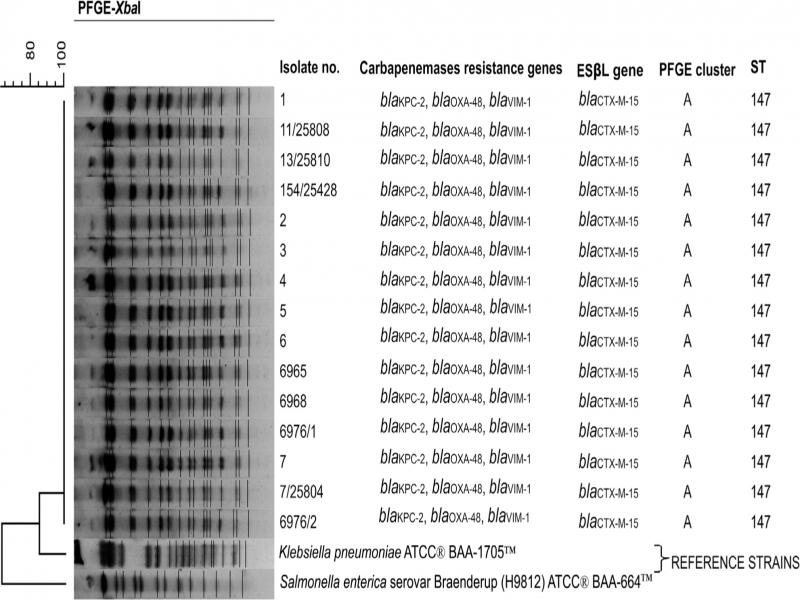
Given the abovementioned data and the increased frequency of isolation of CRKP strains from the hospital environment, we conducted a microbiological and molecular characterization of carbapenem-resistant K. pneumoniae isolates with emphasis on the antibiotic resistance profile, identification of ESβL genes, detection of carbapenemase genes, and the isolates’ genetic relationship.
Experimental
Materials and Methods
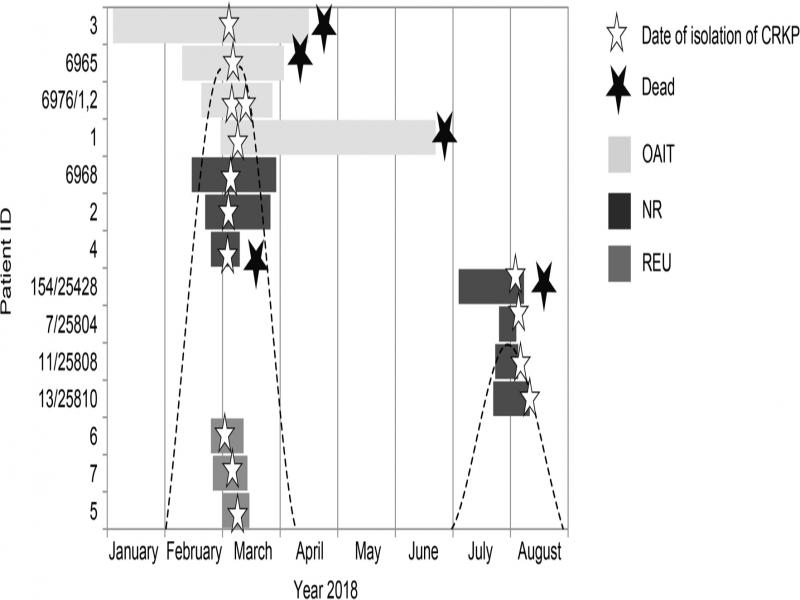
Hospital settings and sample collection. The study was performed in the Upper-Silesian Medical Centre of the Silesian Medical University in Katowice (GCM), one of the largest multi-profile medical centres, and one of the largest hospitals in Poland. The hospital consists of 24 departments and treats over 160 thousand patients per year. Between February and August 2018, 15 non-duplicate CPKP isolates were collected from fecal samples of 14 patients admitted to three hospital wards characterized below. The Department of Neurology with the Stroke Sub-department (NR) receives 1,750 admissions per year and has 14 rooms with 44 beds; the Department of Internal Medicine and Rheumatology (REU) receives 1,935 admissions per year and has 12 rooms with 37 beds, and the Department of Anaesthesia and Intensive Care (OAIT) receives 1,750 admissions per year and has five rooms with ten beds (Table I). A total of 505 Enterobacteriaceae isolates were obtained from the patients in these wards over one-year.
Table I
Demographic data and characteristics of the fourteen patients with K. pneumoniae co-producing KPC-2, OXA-48, VIM-1 and CTX-M-15 during the outbreak.
| Patient ID/Isolate no. | Age (years)/sex | Hospital ward(s) | Date of isolation | Type of specimen | Status (type) of colonization/infection | Duration of hospitalization (days) | Underlying conditions | Antimicrobial used prior to isolation of carbapenemase producer(s) | Antimicrobial used as treatment for infections | Outcome Alive/Dead | |||||||||||||||||||||
|---|---|---|---|---|---|---|---|---|---|---|---|---|---|---|---|---|---|---|---|---|---|---|---|---|---|---|---|---|---|---|---|
| 3 | 74/M | OAIT | 08/03/2018 | Rectal swab | Colonization | 03/01-14/04/2018 (102 days) | Abdominal Aortic Aneurysm (AAA) | Ciprofloxacin + Gentamycin + Itraconazole | Metronidazole | Dead | |||||||||||||||||||||
| 6965 | 60/F | OAIT | 28/02/2018 | Rectal swab | Colonization | 08/02-01/04/2018 (53 days) | Tuberculosis, Chronic Obstructive Pulmonary Disease (COPD) | Colistin + Voriconazole | – | Dead | |||||||||||||||||||||
| 6976/1 6976/2 | 45/M | OAIT | 01/03/2018 12/03/2018 | Rectal swab Blood | Colonization Bacteremia | 21/02-29/03/2018 (37 days) | Guillain-Barré Syndrome (GBS) | Colistin + Linezolid | Ampicillin/sulbactam + Amikacin | Alive | |||||||||||||||||||||
| 1 | 67/F | OAIT | 07/03/2018 | Rectal swab | Colonization | 02/03-29/06/2018 (112 days) | COPD, diabetes, hypertension | Ceftriaxone + Levofloxacin | – | Dead | |||||||||||||||||||||
| 6968 (index case) | 63/M | NR | 28/02/2018 | Rectal swab | Colonization | 16/02-31/03/2018 (44 days) | Hypertension, atherosclerosis | Ceftriaxone + Metronidazole | – | Alive | |||||||||||||||||||||
| 2 | 69/M | NR | 07/03/2018 | Rectal swab | Colonization | 23/02-28/03/2018 (34 days) | Post-stroke conditions | – | – | Alive | |||||||||||||||||||||
| 4 | 43/M | NR | 08/03/2018 | Rectal swab | Colonization | 26/02-12/03/2018 (15 days) | Hypertension | Ceftriaxone + Metronidazole | – | Dead | |||||||||||||||||||||
| 154/25428 | 61/M | NR | 30/07/2018 | Rectal swab | Colonization | 04/07-06/08/2018 (34 days) | Stroke | – | – | Dead | |||||||||||||||||||||
| 7/25804 | 70/M | NR | 04/08/2018 | Rectal swab | Colonization | 25/07-02/08/2018 (9 days) | Stroke | Amoxicillin/clavulanic acid | – | Alive | |||||||||||||||||||||
| 11/25808 | 50/F | NR | 04/08/2018 | Rectal swab | Colonization | 23/07-03/08/2018 (12 days) | Stroke | – | – | Alive | |||||||||||||||||||||
| 13/25810 | 77/M | NR | 04/08/2018 | Rectal swab | Colonization | 22/07-09/08/2018 (19 days) | Hypertension, ischemic heart disease | Amoxicillin/clavulanic acid | – | Alive | |||||||||||||||||||||
| 6 | 70/F | REU | 09/03/2018 | Rectal swab | Colonization | 26/02-14/03/2018 (17 days) | Diabetes, metastatic lung cancer | – | – | Alive | |||||||||||||||||||||
| 7 | 78/F | REU | 09/03/2018 | Rectal swab | Colonization | 27/02-16/03/2018(18 days) | Rheumatoid Arthritis (RA), hemorrhagic diathesis, coronary disease, peptic ulcer disease, hypertension, atherosclerosis, gout | Imipenem | Vancomycin | Alive | |||||||||||||||||||||
| 5 | 90/F | REU | 08/03/2018 | Rectal swab | Colonization | 03.03-17.03.2018 (14 days) | Atherosclerosis, acute arterial thrombosis of the lower extremity | Meropenem + Amikacin | – | Alive | |||||||||||||||||||||
| Patient ID/Isolate no. | 3 | 6965 | 6976/1 | 6976/2 | 1 | 6968 | 2 | 4 | 154/25428 | 7/25804 | 11/25808 | 13/25810 | 6 | 7 | 5 | ||||||||||||||||
|---|---|---|---|---|---|---|---|---|---|---|---|---|---|---|---|---|---|---|---|---|---|---|---|---|---|---|---|---|---|---|---|
| Antibiotics: | MIC (pg/ml) | R/I/S | MIC (pg/ml) | R/I/S | MIC (pg/ml) | R/I/S | MIC (pg/ml) | R/I/S | MIC (pg/ml) | R/I/S | MIC (pg/ml) | R/I/S | MIC (pg/ml) | R/I/S | MIC (pg/ml) | R/I/S | MIC (pg/ml) | R/I/S | MIC (pg/ml) | R/I/S | MIC (pg/ml) | R/I/S | MIC (pg/ml) | R/I/S | MIC (pg/ml) | R/I/S | MIC (pg/ml) | R/I/S | MIC (pg/ml) | R/I/S | |
| Penicillins | Amoxicillin/Clavulanic acid | >256 | R | >256 | R | >256 | R | >256 | R | >256 | R | >256 | R | >256 | R | >256 | R | >256 | R | >256 | R | >256 | R | >256 | R | >256 | R | >256 | R | >256 | R |
| Ampicillin | >256 | R | >256 | R | >256 | R | >256 | R | >256 | R | >256 | R | >256 | R | >256 | R | >256 | R | >256 | R | >256 | R | >256 | R | >256 | R | >256 | R | >256 | R | |
| Cephalosporins | Cefaclor | >256 | R | >256 | R | >256 | R | >256 | R | >256 | R | >256 | R | >256 | R | >256 | R | >256 | R | >256 | R | >256 | R | >256 | R | >256 | R | >256 | R | >256 | R |
| Cefuroxime | >256 | R | >256 | R | >256 | R | >256 | R | >256 | R | >256 | R | >256 | R | >256 | R | >256 | R | >256 | R | >256 | R | >256 | R | >256 | R | >256 | R | >256 | R | |
| Cefotaxime | >256 | R | >256 | R | >256 | R | >256 | R | >256 | R | >256 | R | >256 | R | >256 | R | >256 | R | >256 | R | >256 | R | >256 | R | >256 | R | >256 | R | >256 | R | |
| Cefotaxime/Cefotaxime + clavulanic acid | >16/>1 | R | >16/>1 | R | >16/>1 | R | >16/>1 | R | >16/>1 | R | >16/>1 | R | >16/>1 | R | >16/>1 | R | >16/>1 | R | >16/>1 | R | >16/>1 | R | >16/>1 | R | >16/>1 | R | >16/>1 | R | >16/>1 | R | |
| Ceftazidime | >256 | R | >256 | R | >256 | R | >256 | R | >256 | R | >256 | R | >256 | R | >256 | R | >256 | R | >256 | R | >256 | R | >256 | R | >256 | R | >256 | R | >256 | R | |
| Ceftazidime/Ceftazidime + clavulanic acid | >34/>4 | R | >34/>4 | R | >34/>4 | R | >34/>4 | R | >34/>4 | R | >34/>4 | R | 34/>4 | R | >34/>4 | R | >34/>4 | R | >34/>4 | R | >34/>4 | R | >34/>4 | R | >34/>4 | R | >34/>4 | R | >34/>4 | R | |
| Cefepime | >256 | R | >256 | R | >256 | R | >256 | R | >256 | R | >256 | R | >256 | R | >256 | R | >256 | R | >256 | R | >256 | R | >256 | R | >256 | R | >256 | R | >256 | R | |
| Carbapenems | Doripenem | >32 | R | 16 | R | >32 | R | >32 | R | >32 | R | >32 | R | >32 | R | >32 | R | >32 | R | >32 | R | >32 | R | >32 | R | >32 | R | >32 | R | >32 | R |
| Ertapenem | >32 | R | >32 | R | >32 | R | >32 | R | >32 | R | >32 | R | >32 | R | >32 | R | >32 | R | >32 | R | >32 | R | >32 | R | >32 | R | >32 | R | >32 | R | |
| Imipenem | >32 | R | >32 | R | 16 | R | 16 | R | >32 | R | >32 | R | >32 | R | >32 | R | >12 | R | 4 | S | 4 | S | 8 | I | >32 | R | >32 | R | >32 | R | |
| Meropenem | >32 | R | >32 | R | >32 | R | >32 | R | >32 | R | >32 | R | >32 | R | >32 | R | >32 | R | >32 | R | >32 | R | >32 | R | >32 | R | >32 | R | >32 | R | |
| Quinolone | Ciprofloxacin | >32 | R | >32 | R | >32 | R | >32 | R | >32 | R | >32 | R | >32 | R | >32 | R | >32 | R | >32 | R | >32 | R | >32 | R | >32 | R | >32 | R | >32 | R |
| Aminoglycosides | Amikacin | 4 | S | 8 | S | 32 | R | 32 | R | 8 | S | 12 | R | 6 | S | 4 | S | 8 | S | 8 | S | 8 | S | 8 | S | 12 | R | 6 | S | 6 | S |
| Gentamycin | 64 | R | 64 | R | 64 | R | 64 | R | 64 | R | 64 | R | 64 | R | 64 | R | 64 | R | 64 | R | 64 | R | 64 | R | 64 | R | 64 | R | 64 | R | |
| Netylmycin | 128 | R | 4 | I | 64 | R | 64 | R | 128 | R | 32 | R | 16 | R | 16 | R | 12 | R | 16 | R | 16 | R | 16 | R | 32 | R | 16 | R | 16 | R | |
| Tobramycin | 64 | R | 64 | R | 32 | R | 32 | R | 64 | R | 64 | R | 64 | R | 64 | R | 32 | R | 64 | R | 64 | R | 64 | R | 64 | R | 64 | R | 64 | R | |
| Other | Aztreonam | >256 | R | >256 | R | >256 | R | >256 | R | >256 | R | >256 | R | >256 | R | >256 | R | >256 | R | >256 | R | >256 | R | >256 | R | >256 | R | >256 | R | >256 | R |
| Colistin | 0.50 | S | 0.75 | S | 0.125 | S | 0.125 | S | 0.50 | S | 0.50 | S | 0.50 | S | 0.50 | S | 0.50 | S | 0.50 | S | 0.75 | S | 0.50 | S | 0.50 | S | 0.50 | S | 0.50 | S | |
| Tetracycline | 32 | R | 128 | R | 8 | R | 8 | R | 32 | R | 32 | R | 32 | R | 8 | R | >256 | R | >256 | R | >256 | R | >256 | R | 8 | R | 8 | R | 128 | R | |
| Tigecycline | 2 | R | 8 | R | 4 | R | 4 | R | 2 | R | 2 | R | 2 | R | 4 | R | 0.75 | R | 0.75 | R | 1.0 | R | 2 | R | 4 | R | 4 | R | 8 | R | |
| Trimethoprim/Sulfamethoxazole | >32 | R | >32 | R | >32 | R | >32 | R | >32 | R | >32 | R | >32 | R | >32 | R | >32 | R | >32 | R | >32 | R | >32 | R | >32 | R | >32 | R | >32 | R | |
| Fosfomycin | >256 | R | >256 | R | >256 | R | >256 | R | >256 | R | >256 | R | >256 | R | >256 | R | >256 | R | >256 | R | R>256 | R | >256 | R | >256 | R | >256 | R | >256 | R | |