
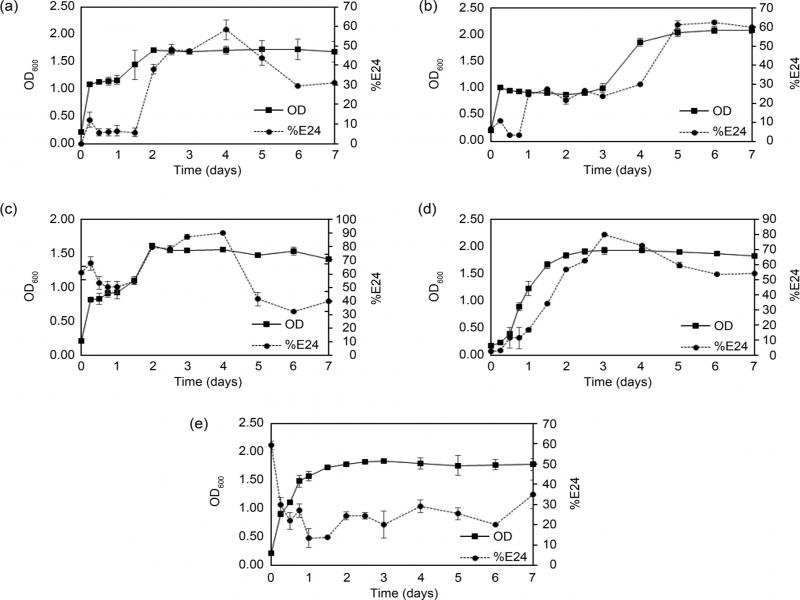
Fig. 1.
Growth of E. cloacae B14 using different carbon sources (solid lines with filled square markers) – (a) glucose; (b) sucrose; (c) maltose; (d) lactose and (e) glycerol. Emulsification activity (%E24) of cell-free supernatant obtained from those cultures are shown as dashed lines with filled circle markers. Error bars indicate standard deviations of triplicate data.
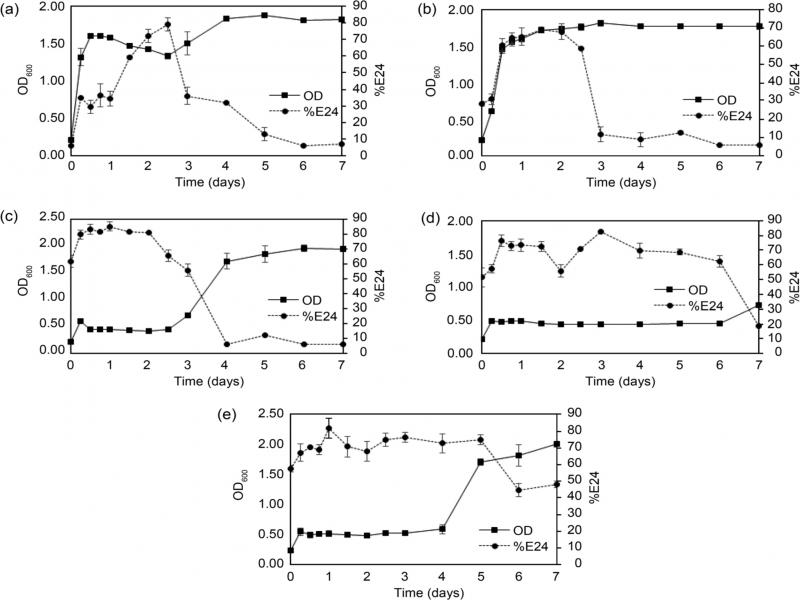
Fig. 2.
Growth of E. cloacae B14 on maltose using different nitrogen sources (solid lines with filled square markers) – (a) yeast extract; (b) urea; (c) NH4NO3; (d) NH4Cl and (e) (NH4)2SO4. Emulsification activity (%E24) of cell-free supernatant obtained from those cultures are shown as dashed lines with filled circle markers. Error bars indicate standard deviations of triplicate data.
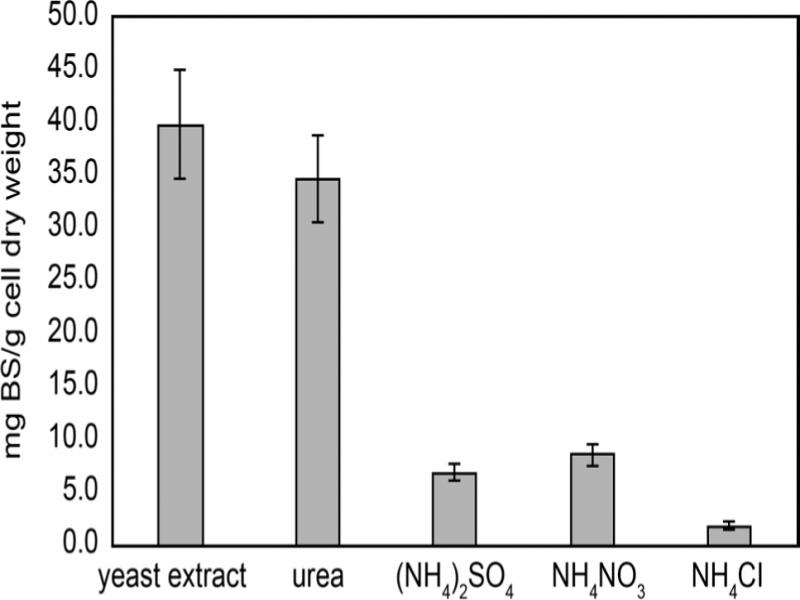
Fig. 3.
Biosurfactant yielded from E. cloacae B14 grown on maltose media with different nitrogen sources. Error bars indicate standard deviations of triplicate data.
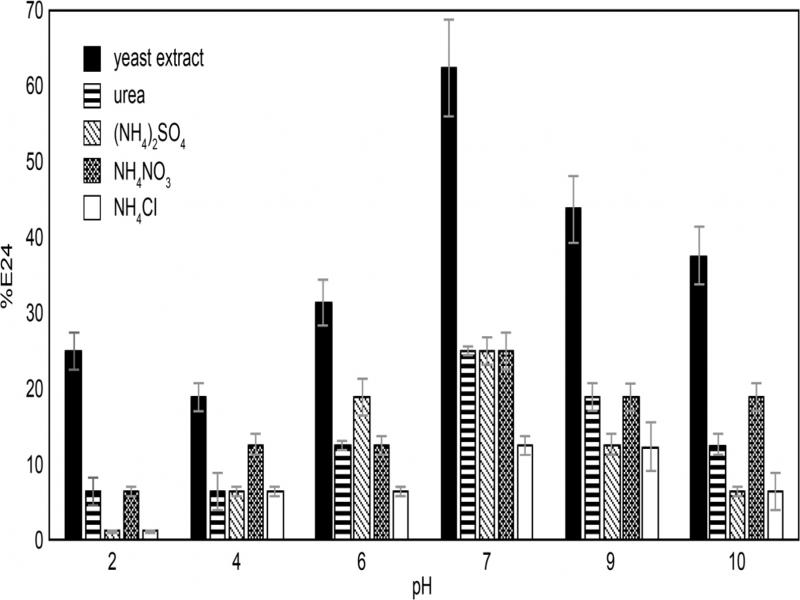
Fig. 4.
Stability of biosurfactant under a range of pH. Error bars indicate standard deviations of triplicate data.
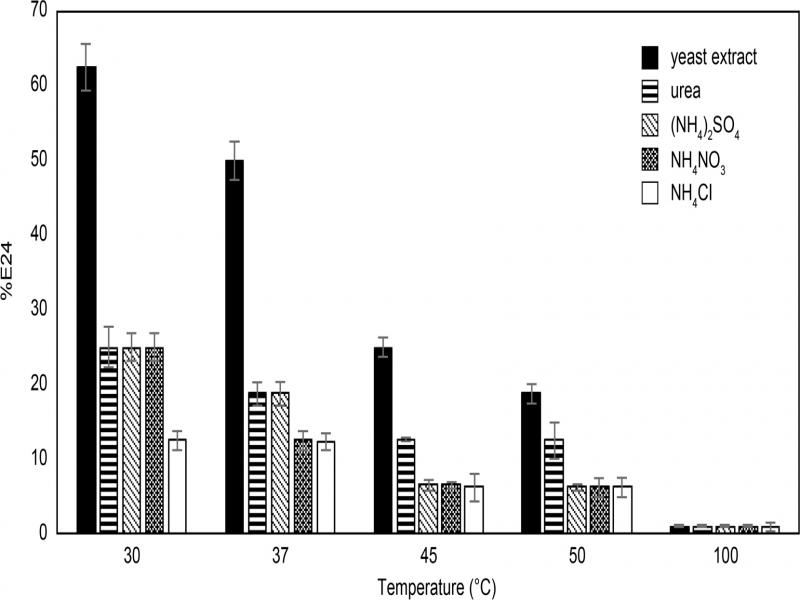
Fig. 5.
Stability of biosurfactant under a range of temperatures. Error bars indicate standard deviations of triplicate data.
Table I
Antimicrobial activity of cell-free supernatant of E. cloacae B14 against Gram-positive and Gram-negative pathogens using 30 µg/ml tetracycline as a control. Standard deviations were calculated from the data obtained from triplicate experiments.
| Pathogenic bacteria | Inhibition zone diameter (mm) ± standard deviation | |
|---|---|---|
| Cell-free supernatant of B14 cultures | Tetracycline 30 μg/ml (control) | |
| Gram-negative bacteria | ||
| Escherichia coli | 12.3 ± 1.1 | 21.1 ± 0.5 |
| Pseudomonas aeruginosa | 17.0 ± 1.4 | 20.0 ± 0.7 |
| Serratia marcescens | 9.7 ± 1.5 | 0.0 ± 0.0 |
| Gram-positive bacteria | ||
| Bacillus cereus | 20.7 ± 2.0 | 30.0 ± 2.0 |
| Bacillus subtilis | 22.0 ± 1.8 | 20.0 ± 1.1 |
| Staphylococcus aureus | 26.7 ± 2.1 | 30.0 ± 1.8 |
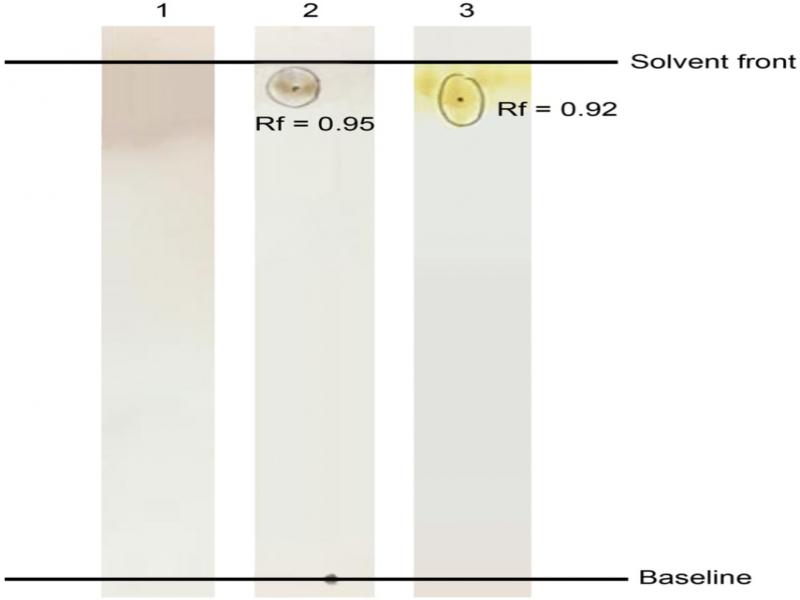
Fig. 6.
TLC analysis of the purified B14 BS obtained from an optimized culture. Samples on TLC plates were sprayed using ninhydrin solution (1); phenol-H2SO4 solution (2) and iodine vapor (3).
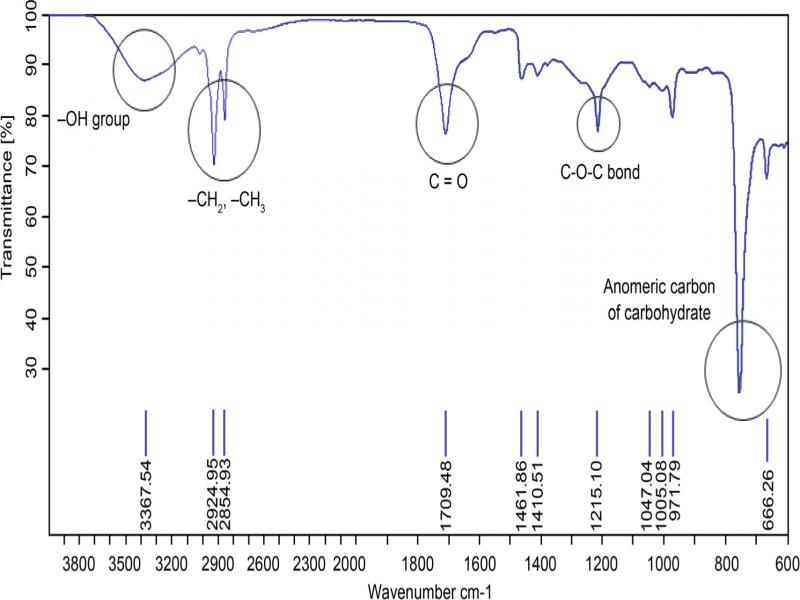
Fig. 7.
FTIR spectrum of the purified B14 biosurfactant.
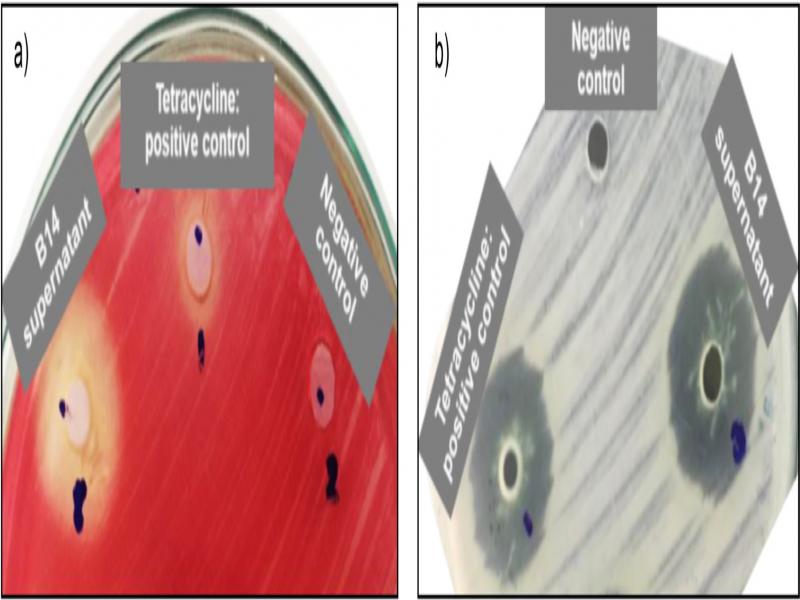
Fig. 8.
Antimicrobial activity of B14 supernatant compared to tetracycline (positive control) and non-inoculated medium (negative control) – a) the activity against S. marcescens and b) the activity against B. subtilis.