
Introduction
Russia’s attack on Ukraine in 2022 markedly altered both the security situation in Europe and public perceptions of it. This shift was particularly evident in the Nordic and Baltic countries, and especially in Sweden and Finland, where public opinion on NATO membership changed dramatically, ultimately leading both countries to apply for membership in 2022 (Forsberg, 2023; Persson & Widmalm, 2024). A key reason for this increased support was the belief that joining the alliance would strengthen deterrence and provide additional military protection (Forsberg, 2023). Previous research indicates that such confidence in the security NATO provides can also increase individuals’ willingness to defend their own country (Rostoks & Mieriņa, 2025). NATO membership, however, is not merely a matter of the protection afforded by a military alliance; it also obliges solidarity with other member states and a commitment to defend them if necessary (Vargulis, 2021). Yet little attention has been paid either to how membership shapes individuals’ willingness to defend their own country and their allies, or to the social identity processes that affect this.
Following this rationale, the article approaches defence willingness through the social identity approach (Tajfel & Turner, 1979; Turner et al., 1987) and self-efficacy theory (Bandura, 1977, 1982, 1997), investigating how identification with NATO relates to willingness to defend both one’s own country and other NATO allies in Finland. In doing so, it focuses on the role of collective defence efficacy – understood in this specific context as confidence in NATO’s collective ability to successfully defend its member states in the event of an external attack. While previous research has shown that social identification can heighten perceptions of a group’s collective efficacy, thereby strengthening individuals’ intention to act on the group’s behalf (e.g., Thomas et al., 2011), this has not previously been examined in the context of security organizations such as NATO.
We test a multigroup mediation model focusing on two groups with different relationships to national defence and NATO (Häkkinen & Salasuo, 2026; Kosonen et al., 2019; Riikonen et al., 2019): active reserve officers who are members of the Finnish Reserve Officers’ Federation, a voluntary organization that aims to develop members’ military skills (FROF, 2024), and civilian service transferees who completed military service but subsequently applied to transfer from the Finnish reserve to non-military service following Russia’s invasion of Ukraine in 2022. The former group comprises individuals keen to maintain and develop their military skills voluntarily; the latter, those who have chosen to disengage from the military. Despite these differences, we find that stronger identification with NATO fosters stronger perceptions of the alliance’s collective defence efficacy, which in turn shapes willingness to defend both Finland and NATO’s other members for both groups.
The article is structured as follows. In the next section, we outline the theoretical background to our research. After reviewing previous research on defence willingness, we give an account of the ways in which identification with superordinate identities has been shown to shape perceptions of outgroup members; we then describe how social identities can influence collective efficacy beliefs and action intentions. We then present the data and methods, followed by our results. We conclude by discussing these results and their implications.
Previous Research on Citizens’ Defence Willingness
Most previous research on defence willingness has been conducted from a national perspective, focusing on willingness to defend one’s own country (e.g., Hadar & Häkkinen, 2020; Inglehart et al., 2015; Persson & Widmalm, 2024; but see also Rostoks & Mieriņa, 2025; Weckman, 2025). The core meaning of willingness to defend, the idea of defending one’s own country, has often been linked to patriotic sentiments (e.g., Berglund, 2025; Berglund et al., 2022; Bērziņa & Zupa, 2021; Hart et al., 2022; Myyry, 2009). It has traditionally been seen as consisting of two aspects: supporting the armed defence of the country and being personally ready to undertake various national defence duties (Kosonen, 2019). It has also been understood as a communal value referring to care for the security of the wider community, encompassing, for example, the protection of the state, society, citizens, environment, culture, family, and loved ones (Kaarkoski et al., 2020; Kosonen, 2019).
Previous research has identified a range of individual- and national-level factors that shape people’s willingness to defend their country across diverse settings (e.g., Bērziņa & Zupa, 2021; Inglehart et al., 2015; Persson & Widmalm, 2024; Puranen, 2014; Sundberg & Gustavsson, 2025). These include demographic factors (e.g., gender and age), attitudinal factors (e.g., national pride and confidence in the armed forces), and past defence-related experiences (e.g., completed military service) (Anderson et al., 2020; Berglund et al., 2022; Puranen, 2014). Societal factors such as income equality and emancipatory culture have also been linked to defence willingness (Anderson et al., 2020; Inglehart et al., 2015), as have national identity and the sense of belonging to a nation (Myyry, 2009; Sundberg & Gustavsson, 2025). Although these studies demonstrate a link between social identity and defence willingness, this relationship has not yet been investigated in the context of international military alliances.
The will to defend must be understood as the product of intersecting social, historical, political, and cultural forces (Hart et al., 2022), with international relations, global events, and threat perceptions also playing a role. It has been argued, for example, that a key reason for the high degree of willingness to defend observed in the Nordic and Baltic states is their proximity to Russia and the elevated sense of threat this entails (Inglehart et al., 2015; Rostoks & Mieriņa, 2025; but see Persson & Widmalm, 2024). Yet other countries may function as sources of security as well as of threat. Research from Latvia suggests that the more confident citizens are that NATO would assist them in the event of an attack, the more willing they are to defend their country (Rostoks & Mieriņa, 2025). This establishes a relationship between confidence in NATO’s protective capacity and willingness to defend, but the antecedents of such confidence remain unexamined. Nor has prior work considered that confidence in NATO’s defence capacity might foster willingness to defend the broader alliance, and not only one’s own country.
In the context of NATO, membership is not only about security and reassurance for one’s own country; it is also about solidarity with other member states and a commitment to defend them if necessary (Vargulis, 2021). Within military alliances, the maintenance and enhancement of defence and security necessarily extend to the protection of allies (Kreps & Kriner, 2024; Weckman, 2025). Unity and solidarity beyond national borders, and the associated willingness to defend both one’s own country and those of allies, have been proposed as key components of NATO’s deterrence and defence posture (Vargulis, 2021). Even so, limited attention has been paid to the factors affecting people’s willingness to defend other NATO member states, or to the social identity processes underpinning these attitudes.
NATO as a Common Ingroup Identity Shaping Views on Collective Defence
It has been argued that NATO functions not only as a collective security organization but as a community unified by shared liberal values (Sjursen, 2004). Previous research suggests that the alliance has alternated between these two roles throughout its history, enabling it to adapt to changing global circumstances (Flockhart, 2024). Since Russia’s annexation of Crimea in 2014, NATO has been shown to have constructed for itself the identity of defender of the international rules-based order, while simultaneously emphasizing the need to expand its authority into the sphere of societal resilience in response to the perceived Russian threat (Beaumont et al., 2024). While these studies have shed light on the construction of NATO’s organizational identity, less attention has been paid to the cognitive and emotional significance that NATO membership holds for individuals and how this shapes their defence willingness.
NATO can offer its member states a shared and inclusive superordinate identity (i.e., a common ingroup identity; Gaertner & Dovidio, 2000) that citizens across these countries can identify with. Social identities are flexible and context-dependent, with different group memberships coming to the fore in different situations and varying in their subjective meaning and importance to the individual (e.g., Tajfel & Turner, 1979; Turner et al., 1987). Consequently, people are likely to ascribe different meanings to NATO and to differ in the extent to which they identify with it. The meaning and perceived importance of NATO can also vary across member states (NATO, 2024). For example, in the Baltic countries, NATO is widely perceived as crucial to national security (Rostoks & Mieriņa, 2025).
A common ingroup identity has the potential to reduce intergroup bias: when former outgroup members are recategorized as members of the same common ingroup, benefits previously reserved for ingroup members are extended to these individuals (Dovidio et al., 2007; Gaertner & Dovidio, 2000). Extensive evidence supports that common ingroup identities can improve intergroup relations by, for example, increasing cooperation (Gaertner et al., 1993) and positive outgroup attitudes (Riek et al., 2010), facilitating intergroup contact (Riikonen et al., 2024) and increasing prosocial behaviour towards former outgroup members (Lemay & Ryan, 2021).
As a collective security organization, NATO relies on solidarity between member states (Vargulis, 2021). This solidarity is reflected in Article 5, which treats an attack on one ally as an attack on all. Shared superordinate identities can provide the basis for such solidarity and mutual assistance (e.g., Drury et al., 2019; Politi et al., 2023; Reicher et al., 2006). Previous research has shown, for example, that sharing group membership with the target of help increases helping behaviour (Levine et al., 2005), as well as political support and helping intentions (Albayrak-Aydemir & Gleibs, 2024), and that perceptions of commonality are associated with greater political solidarity from one group towards another (Glasford & Calcagno, 2012). If other NATO member states are perceived as part of a more inclusive common ingroup, this should in turn facilitate solidarity and assistance towards them.
Since NATO is a political and military alliance whose key purpose is to support its members in the event any of them are attacked, solidarity within NATO primarily involves participation in the collective defence of any member state. While previous research has shown that commitment to Article 5’s collective security commitment (Kreps & Kriner, 2024) and a stronger sense of belonging to Europe (Weckman, 2025) are positively related to increased political support for defending a NATO ally, no research has yet explored the identity dynamics which influence individuals’ willingness to participate in the collective defence of another NATO member state. Based on the above-mentioned studies, we expect that identification with NATO relates to one’s willingness to act on behalf of the NATO community – that is, to provide support in the form of participation in the collective defence of an ally under attack.
NATO Identification, Collective Efficacy and Willingness to Defend NATO’s Borders
Identification with NATO may also relate to individuals’ confidence in NATO’s collective ability to successfully defend its member states in the event of an external attack (that is, its collective defence efficacy), thereby increasing their defence willingness. According to Bandura (1977, 1982), self-efficacy refers to the belief that one has the skills and resources to successfully carry out a particular action. This belief is strongly linked to behaviour: people tend to engage in actions they believe they can accomplish and avoid those they feel incapable of performing (Bandura, 1977). Collective self-efficacy, on the other hand, refers to a group’s perception that they may collectively and efficaciously “solve their problems and improve their lives through concerted effort” (Bandura, 1982, p. 143). Collective efficacy beliefs are context-specific and vary according to the challenge or threat in question (Bandura, 1982). When people believe that their group can achieve shared goals, they are more likely to act and contribute their own resources to address collective challenges (Bandura, 1997).
Empirical studies indicate that social identification can increase collective efficacy beliefs about the group (e.g., Stevenson et al., 2021; Thomas et al., 2011). Groups provide their members with social and psychological resources, making individuals more confident in their ability to cope with threats and challenges (e.g., Haslam et al., 2018). For example, community identification has been associated with increased perceptions of members’ ability to collectively cope with shared challenges (McNamara et al., 2013) and with its “collective confidence in contact” – that is, a belief in the whole community’s ability to have positive contact with outgroup members (Stevenson et al., 2021). These studies show that social identities shape perceptions of collective efficacy by fostering confidence that the group can manage with stressful or threatening situations through mutual support (e.g., Haslam & Reicher, 2006; McNamara et al., 2013).
By increasing collective efficacy beliefs, social identification can also increase action intentions on behalf of one’s group. Identification with a movement, for instance, has been associated with stronger beliefs in its collective efficacy, which in turn is associated with collective action intentions (Thomas et al., 2011). There is also evidence that common ingroup identities can increase group efficacy, thereby increasing willingness to engage in political action to improve the group’s conditions (Çakal et al., 2016). These studies demonstrate that social identification can strengthen confidence in a group’s ability to accomplish specific tasks, which in turn promotes individual engagement in such actions.
Previous research has examined collective efficacy beliefs in the context of various crises affecting entire communities, even the global population; villagers’ perceptions of their community’s collective efficacy to respond to natural disasters, for example, have been associated with individual preparedness (Yu et al., 2022), and young people’s perceived collective efficacy to address climate change has been linked to their pro-environmental behaviour intentions (Jugert et al., 2016). Together, these studies demonstrate the link between collective efficacy beliefs and both behaviour and action intentions in crises.
Drawing on this research, this study investigates collective efficacy beliefs in the context of NATO (specifically, collective defence efficacy). In such contexts, where coordinated group action is essential, a sense of collective efficacy can be crucial in shaping individual responses (Bandura, 1982). If individuals have confidence in their group’s collective ability to successfully accomplish a task, they are more likely to individually participate in that particular action (Bandura, 1997). Identification with NATO can be the basis of such beliefs, which in turn can increase willingness to defend both one’s own country and other NATO member states in the case of an attack.
Previous research in the context of national defence has shown that confidence in the armed forces (e.g., Anderson et al., 2020) and confidence that NATO would provide military assistance to one’s country if needed (Rostoks & Mieriņa, 2025) are both related to willingness to defend one’s country. However, whereas general trust in the reliability of the armed forces (e.g., Berglund et al., 2022; Myyry, 2009; Puranen, 2014) or reassurance derived from the expectation of allied support (Rostoks & Mieriņa, 2025) relate primarily to feelings of safety and protection, our concept of collective defence efficacy refers to the shared belief that NATO member states, as a community, can collectively defend their borders. This emphasises confidence in a joint capacity to act and achieve a common goal, which in other contexts has been linked to action intentions and behaviour (e.g., Jugert et al., 2016; Yu et al., 2022), rather than reliance on assistance from others. To our knowledge, collective efficacy beliefs and their relation to willingness to participate in national and collective defence have not yet been studied in the context of a military alliance.
Research Hypotheses
Based on the theoretical framework outlined in the previous sections, this study tests a multigroup mediation model examining the association between identification with NATO and willingness to defend both Finland and other NATO member states. Our data were collected from active reserve officers and civilian service transferees in Finland. We tested three hypotheses (H1, H2, and H3) with a multigroup approach:
H1: First, we hypothesized that stronger identification with NATO would be positively associated with willingness to defend other NATO member states (see, e.g., Albayrak-Aydemir & Gleibs, 2024; Levine et al., 2005; Politi et al., 2023).
H2: Second, we expected collective defence efficacy to partially account for this effect: stronger identification with NATO would increase collective defence efficacy beliefs (see, e.g., McNamara et al., 2013; Stevenson et al., 2021), which would, in turn, increase willingness to defend other NATO member states (see, e.g., Çakal et al., 2016; Jugert et al., 2016).
H3: Third, we expected an indirect effect of NATO identification on willingness to defend Finland: stronger NATO identification would increase collective defence efficacy, which would, in turn, increase willingness to defend Finland (see, e.g., Çakal et al., 2016; Rostoks & Mieriņa, 2025). See Figure 1.
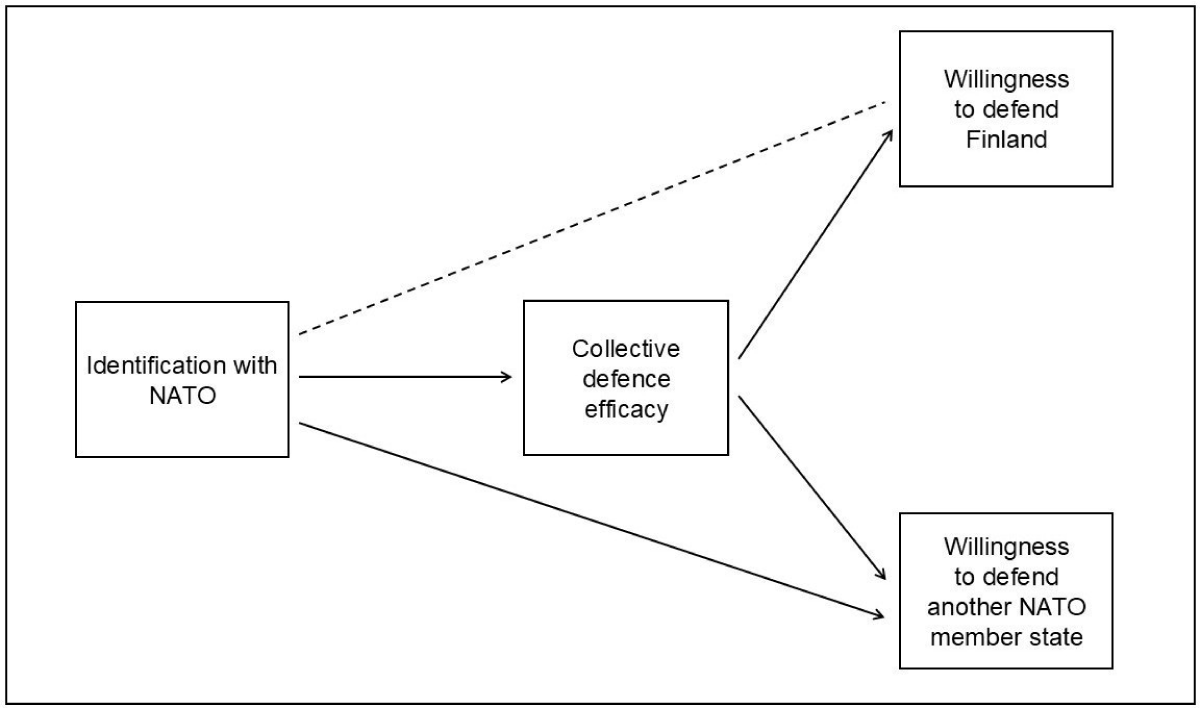
Figure 1
Conceptual model.
Note. Solid lines indicate the hypothesized relationships; the dashed line, a relationship expected to be non-significant.
We investigate this process from the point of view of active reserve officers, who are part of a voluntary organization for reserve officers, and civilian service transferees who have applied for transfer to non-military service since 2022 in Finland. While Finns’ willingness to defend the country reached a new all-time high of 83% after Russia’s invasion of Ukraine in 2022 (ABDI, 2024), a record number of reservists chose to leave the reserve and disengage from military defence nonetheless (YLE, 2023). We focused on these civilian service transferees whose relationship to national defence became more critical in response to the changed security environment and, in contrast, on reserve officers who are actively engaged in national defence activities and whose relationship to national defence tends to be positive and more stable (see Häkkinen & Salasuo, 2026; Riikonen et al., 2019).
While public opinion studies have shown that Finns generally have positive attitudes towards NATO (ABDI, 2025; Wass et al., 2025), they leave the underlying mechanisms related to NATO and defence willingness largely unexplored. Our aim was to shed light on these mechanisms through these two groups with different but actively considered relationships to national defence and NATO (Häkkinen & Salasuo, 2026; Kosonen et al., 2019; Riikonen et al., 2019). Although we did not expect differences in the structural paths between these groups, we anticipated that the strength of these associations might vary. Specifically, given the civilian service transferees’ strong reaction to the changed security environment, the relationships among the studied variables were expected to be more pronounced in this group.
Research Context
The context of this study is Finland, a small North European country with a population of approximately 5.6 million people (Statistics Finland, 2026). Finland’s geopolitical position, a neighbour to Russia which fought the Soviet Union during the Second World War, constitutes a central factor that shapes both the organization of national defence and citizens’ attitudes towards national defence (Jouko, 2026; Kaarkoski et al., 2024; Kosonen, 2019). Finnish national defence has been developed over decades with the aim of maintaining readiness for conventional warfare in inter-state conflicts without joining a military alliance. Since the 1920s, Finnish defence policy has been based on general conscription and a population highly willing to defend the country. Participation in conscript service has traditionally been valued and has tied citizens and families to national defence and Finland across generations, helping to maintain a high level of willingness to defend the country (Bontenbal et al., 2025; Kaarkoski & Häkkinen, 2022; Riikonen et al., 2025).
Every male citizen aged between 18 and 60 must participate in Finland’s military defence by completing either military or non-military service before turning 30; female citizens may apply for voluntary military service (Conscription Act, 1438/2007). Refusal of all forms of service is punished with imprisonment. Approximately 62–65% of each male age cohort completes military service, 6–7% completes non-military service, and around 30% is discharged, typically due to health-related reasons (Finnish Defence Forces Statistics, 2024).
In Finland, opinion polls indicate that willingness to defend the country has consistently remained above 70% since the 1990s (with few exceptions), rising to over 80% in 2022–2023 (ABDI, 2024). Having developed within the context of broader historical and societal developments, this high degree of willingness constitutes an important part of national identity (Hadar & Häkkinen, 2020; Häkkinen & Kaarkoski, 2024); indeed, it is regarded as a civic responsibility (Riikonen et al., 2019). Finnish conceptions of willingness to defend have been nation-centric and rooted in the idea of defending the Finnish state, society, people and values within its borders (Myyry, 2009; Kaarkoski et al., 2020; Kosonen, 2019).
Finns’ opinion on NATO membership changed after Russia’s invasion of Ukraine in 2022, an event which prompted Finland to abandon its long-term neutrality policy and seek NATO membership (Forsberg, 2023). Before the attack, only about a quarter of Finns typically supported NATO membership (ABDI, 2021). During the spring of 2022, the situation changed significantly, when almost 70% of the public suddenly expressed support for NATO membership (ABDI, 2022). Russia’s attack on Ukraine in 2022 triggered fears of Russian revanchism among its western neighbours (Aunesluoma, 2024, pp. 135–137) and revived historical anxieties in Finland (Olsson, 2024; Kaarkoski et al., 2024). Memories of the Second World War, when Finland defended itself against the Soviet Union, underscored a sense of urgency among the Finnish people that the nation should never again face Russia alone (Arter, 2022). Thus, strengthening deterrence and gaining military protection from the alliance were important reasons for Finnish citizens to support NATO membership (Forsberg, 2023).
Method
Participants and Procedure
The data derive from a non-probability, self-selected sample collected through an online survey from reserve officers (members of the Finnish Reserve Officers’ Federation) in April 2024 and from civilian service transferees in August 2024. In total, the sample included 4,273 respondents: 3,466 reserve officers (age: M = 56.65 years, SD = 16.97) and 807 civilian service transferees (age: M = 37.75 years, SD = 8.76). Of all respondents, 97.7% were men, 2.0% women, and 0.3% reported a gender outside the binary categories of man and woman. This gender distribution reflects the gendered nature of Finnish national defence (see, e.g., Tallberg, 2009). As participation was self-selected, the sample represents those who chose to participate and may thus not be representative of either group. While representative samples are important for obtaining unbiased population estimates, this study primarily seeks to shed light on the theoretical relevance of the social identity processes related to national and collective defence.
Data collection was organized in cooperation with the Finnish Reserve Officers’ Federation and the Non-Military Service Centre. The Finnish Reserve Officers’ Federation, a voluntary organization that aims to develop its members’ military skills, leadership and readiness (FROF, 2024), sent an email with a research invitation and a link to the survey to its members. Similarly, the Non-Military Service Centre sent an email with a research invitation and a link to the survey to all individuals who applied for transfer to non-military service from the reserve after Russia attacked Ukraine in 2022. Research permission was obtained for this purpose, and the invitations included data protection plans. Informed consent was obtained from all participants.
Among civilian service transferees, 48.1% had applied for transfer and were in the process of completing their supplementary service, 41.8% had already completed or were in the process of completing their supplementary service, and 10.1% reported being in a different situation, such as exemption due to age, health issues or residence abroad. Data from the two groups were combined for analysis. The study is part of the PURE2 research project of the Finnish National Defence University which examines Finnish reservists’ defence willingness in a militarily allied Finland (see also Häkkinen & Salasuo, 2026).
Measures
We measured identification with NATO with five items. Two were adapted from Doosje, Ellemers and Spears (1995): “I feel strong ties with citizens of NATO member countries” and “I identify with other citizens of NATO member countries.” One item was adapted from Doosje and colleagues (1998): “Being a member of the community of NATO member countries is an important part of how I see myself.” Two items were adapted from Leach and colleagues (2008): “I have a lot in common with the average citizen of a NATO member country” and “Citizens of NATO member countries have a lot in common with each other.”1 The items were measured on a seven-point scale (1 = strongly disagree, 7 = strongly agree). They had a high level of internal consistency (α = .96, ω = .96).
We measured collective defence efficacy with two items adapted from Chayinska, Minescu and McGarty (2017): “I think that the citizens of NATO member countries can defend the borders of NATO together” and “NATO member countries as a collective can accomplish a lot in ensuring the security of member states.” The items were measured on a seven-point scale (1 = strongly disagree, 7 = strongly agree). They had a high level of internal consistency (α = .93).
We measured willingness to participate in the national defence of Finland with one item adapted from ABDI (2024): “If Finland was attacked, I would be willing to take part in different tasks of national defence according to my skills and capabilities” (1 = strongly disagree, 7 = strongly agree).
We measured willingness to participate in the collective defence of another NATO member state with one item adapted from ABDI (2024): “If another NATO member country was attacked, I would be willing to take part in different tasks of that member country’s defence according to my skills and capabilities” (1 = strongly disagree, 7 = strongly agree).
Analytical Strategy
We used Mplus statistical software version 8.7 to test our multigroup mediation model (Muthén & Muthén, 2017); our model’s direct, indirect and total effects were tested with a full information maximum likelihood estimation and a bootstrapping approach (Shrout & Bolger, 2002). Missing data ranged from 1.9% to 4.5%. Three participants had missing data on all variables and were consequently excluded from the analysis. The remaining missing data was handled using a full information maximum likelihood estimation. We conducted the multigroup analysis according to the instructions by Muthén and colleagues (2017): we first tested a fully constrained model and inspected modification indices to identify group differences in path coefficients before freeing parameter restrictions one by one. We used standardized root mean square residual (SRMR), comparative fit index (CFI), and root mean square error of approximation (RMSEA) as the model’s fit indicators; SRMR < .08, CFI > .95 and RMSEA < .06 signal a good fit (Hu & Bentler 1999). Age, gender, education, political orientation and national identification with Finland2 were controlled for in the analysis based on previous findings that these may impact people’s attitudes towards national defence (ABDI, 2025; Myyry, 2009) and Finland’s NATO membership (Wass et al., 2025). The control variables were included in mediator and outcome equations. We report both standardized and unstandardized estimates.
Results
Means, standard deviations, and correlations of the study variables are presented in Table 1. Compared with civilian service transferees, reserve officers identified more strongly with NATO (F(1, 4079) = 2253.24, p < .001, η² = .36), had greater confidence in NATO’s collective efficacy in defending its member states (F(1, 4189) = 2878.25, p < .001, η² = .41), and reported greater willingness to defend both Finland (F(1, 4119) = 4305.50, p < .001, η² = .51) and other NATO member states (F(1, 4096) = 3697.70, p < .001, η² = .47).
Table 1
Descriptive and Correlational Analyses Among Reserve Officers and Civilian Service Transferees.
| M | SD | 1 | 2 | 3 | |
|---|---|---|---|---|---|
| Reserve officers (N = 3466) | |||||
| Identification with NATO | 4.50 | 1.24 | – | ||
| Collective defence efficacy | 6.32 | .86 | .451*** | – | |
| Willingness to defend Finland | 6.82 | .73 | .094*** | .153*** | – |
| Willingness to defend another NATO member state | 5.74 | 1.52 | .403*** | .339*** | .224*** |
| Civilian service transferees (N = 804) | |||||
| Identification with NATO | 2.08 | 1.33 | – | ||
| Collective defence efficacy | 3.65 | 2.27 | .571*** | – | |
| Willingness to defend Finland | 3.68 | 2.31 | .318*** | .394*** | – |
| Willingness to defend another NATO member state | 1.95 | 1.71 | .593*** | .550*** | .481*** |
[i] Note. N = 4,270. *** p < .001.
For both respondent groups, all correlations were positive and significant. All correlation coefficients differed significantly between the two groups: identification with NATO and collective defence efficacy (F(1) = 10.63, p = .001, η² = .00), identification with NATO and willingness to defend Finland (F(1) = 33.07, p < .001, η² = .01), identification with NATO and willingness to defend another NATO member state (F(1) = 30.13, p < .001, η² = .01), collective defence efficacy and willingness to defend Finland (F(1) = 34.58, p < .001, η² = .01), collective defence efficacy and willingness to defend another NATO member state (F(1) = 34.40, p < .001, η² = .01), and willingness to defend Finland and willingness to defend another NATO member state (F(1) = 41.84, p < .001, η² = .01). All correlations were stronger for civilian service transferees, suggesting that the associations between the variables were more consistent and pronounced in this group than among reserve officers.
We began by testing a fully constrained multigroup mediation model, in which all hypothesised paths were constrained to be equal between reserve officers and civilian service transferees. This model showed poor fit (χ²(21) = 341.81, p < .001, CFI = .89, RMSEA = .09, SRMR = .05), suggesting differences between the groups in the modelled associations. We then freed the equality constraints on the hypothesised paths, based on modification indices and our theoretical expectation that the strength of the paths would vary between the groups. In the final model, all hypothesized paths were allowed to vary between the groups. All effects of the control variables were constrained to be equal across the two groups to maintain parsimony, since no hypotheses regarding group differences in these effects were specified and the controls were included only to adjust the main effects. The final model showed good fit (χ²(16) = 101.03, p < .001, CFI = .97, RMSEA = .05, SRMR = .02). Given the large sample size, the significant χ² statistic was expected (e.g., MacCallum et al., 1996).
Our three hypotheses were supported in the following ways.
In support of H1, identification with NATO was positively and significantly associated with willingness to defend another NATO member state directly for both reserve officers and civilian service transferees.
In support of H2, identification with NATO had a positive and significant indirect association with willingness to defend another NATO member state through collective defence efficacy for both groups. Identification was positively and significantly associated with collective defence efficacy, which in turn was positively and significantly associated with willingness to defend other NATO member countries.
In support of H3, NATO identification had a positive and significant indirect association with willingness to defend Finland through collective defence efficacy for both groups. Identification with NATO was positively and significantly associated with collective defence efficacy, as noted above, which in turn was positively and significantly associated with willingness to defend Finland.
The final model’s direct, indirect and total effects controlling for age, gender, education, political orientation and national identification are presented in Table 2 below.3
Table 2
Multigroup Mediation Analysis.
| Reserve officers (N = 3466) | CIVILIAN SERVICE TRANSFEREES (N = 804) | |||||||
|---|---|---|---|---|---|---|---|---|
| b | SE | 95% CI | β | b | SE | 95% CI | β | |
| Direct effects | ||||||||
| NATO identification ➔ willingness to defend Finland | .01 | .01 | [–.023, .033] | .01 | .01 | .01 | [–.023, .033] | .00 |
| NATO identification ➔ willingness to defend another NATO member state | .39*** | .03 | [.339, .445] | .32*** | .50*** | .06 | [.394, .614] | .39*** |
| NATO identification ➔ collective efficacy | .29*** | .02 | [.261, .326] | .43*** | .88*** | .06 | [.755, 1.008] | .51*** |
| Collective efficacy ➔ willingness to defend Finland | .07** | .03 | [.022, .119] | .08** | .37*** | .04 | [.294, .436] | .37*** |
| Collective efficacy ➔ willingness to defend another NATO member state | .34*** | .04 | [.260, .415] | .19*** | .24*** | .03 | [.183, .300] | .32*** |
| Indirect effects | ||||||||
| NATO identification ➔ collective efficacy ➔ willingness to defend Finland | .02** | .01 | [.006, .035] | .04** | .32*** | .04 | [.241, .402] | .19*** |
| NATO identification ➔ collective efficacy ➔ willingness to defend another NATO member state | .10*** | .01 | [.072, .126] | .08*** | .21*** | .03 | [.156, .270] | .16*** |
| Total effects | ||||||||
| Total effect on willingness to defend Finland | .03 | .01 | [–.002, .053] | .04 | .33*** | .04 | [.245, .408] | .19*** |
| Total effect on willingness to defend another NATO member state | .49*** | .03 | [.441, .540] | .40*** | .72*** | .05 | [.622, .812] | .55*** |
[i] Note. N = 4270. ** p < .01 *** p < .001.
While the total effect of identification with NATO on willingness to defend another NATO member state was positive and significant for both groups, the total effect of identification on willingness to defend Finland was only significant for civilian service transferees (see Table 2). Although all paths were positive and significant for both groups, significant differences occurred in the strength of the associations between the groups in all unconstrained paths according to the Wald test.4 There were also significant differences between the groups in the strength of the indirect effects of identification with NATO on willingness to defend Finland (W[1] = 70.00, p < .001) and on willingness to defend another NATO member state (W[1] = 16.68, p < .001) as well as in the total effects of identification with NATO on willingness to defend Finland (W[1] = 70.00, p < .001) and on willingness to defend another NATO member state (W[1] = 27.56, p < .001). Notably, all associations of the model were stronger for civilian service transferees than for reserve officers (see Table 2). There was also a positive and significant residual covariance between willingness to defend Finland and willingness to defend another NATO member state for both groups in the model (reserve officers: b = .18, SE = .02, p < .001; civilian service transferees: b = .91, SE = .10, p < .001); see Figure 2.
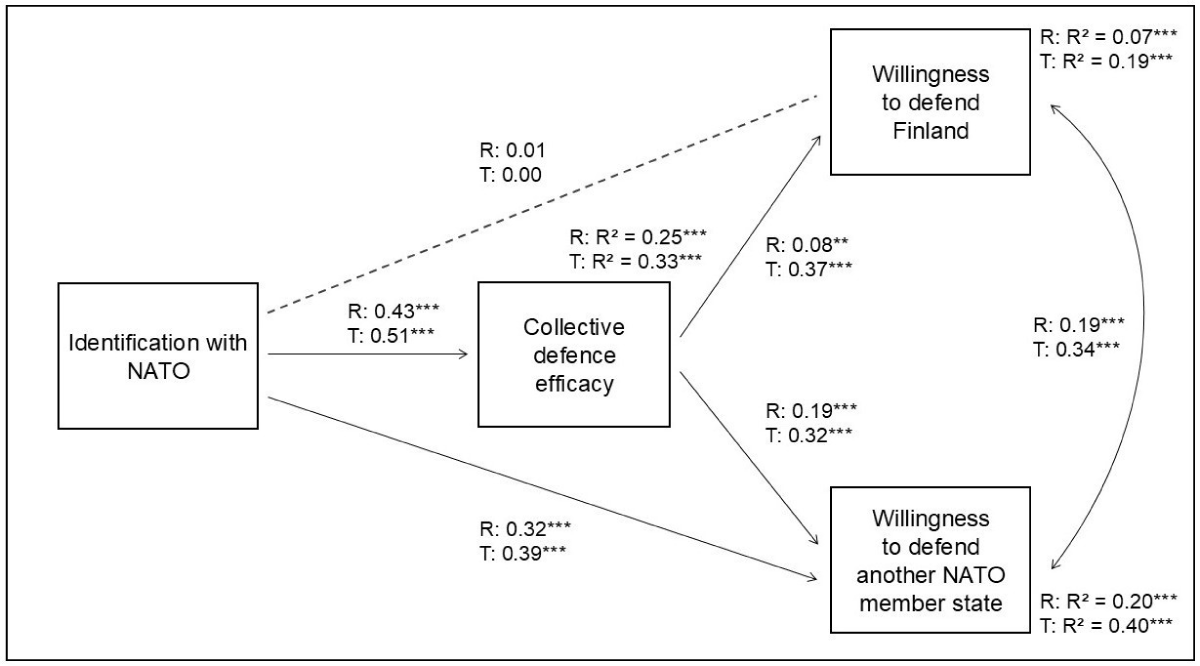
Figure 2
Multigroup Mediation Model.
Note. N = 4270. Standardized coefficients reported separately for reserve officers (R, N = 3466) and civilian service transferees (T, N = 804). ** p < .01 *** p < .001.
Discussion
Our aim was to examine how identification with NATO relates to willingness to defend both one’s own country and other NATO member states. We introduced the concept of collective defence efficacy – confidence in NATO’s ability to defend its member states successfully in the event of external attack – and examined its mediating role in this relationship. We employed a multigroup approach to compare active reserve officers and civilian service transferees. We showed that identification with NATO was positively associated with willingness to defend another NATO member state under attack, both directly and indirectly through perceived collective defence efficacy. We further showed that identification with NATO was indirectly associated with willingness to defend one’s own country via collective defence efficacy. All model associations were positive and significant for both reserve officers and civilian service transferees.
First, this study supports previous research on the social identity processes underlying collective efficacy beliefs and related action intentions and behaviours (e.g., Çakal et al., 2016; Stevenson et al., 2021; Thomas et al., 2011). It extends this line of research by examining these beliefs in the context of security organizations and international military cooperation – a domain not previously explored. Our results suggest that NATO as a community can provide its members with confidence that they can effectively protect the alliance’s borders together, thereby increasing their intentions to participate in defence of both their own state and other NATO allies.
This is important given that collective efficacy beliefs have been consistently linked to action intentions and behaviour across a range of contexts (e.g., Jugert et al., 2016; Yu et al., 2022). As wars and other international crises require a group-level response, we argue that the concept of collective defence efficacy has much to offer for future research seeking to enhance understanding of people’s views and attitudes towards the collective defence of individual nation states and international communities such as NATO and the EU. Our findings suggest that collective defence efficacy may play an important role in shaping attitudes and behavioural intentions in the current security environment marked by increased geopolitical tensions and uncertainty. The concept may also be applied flexibly to the study of different collective actors and security contexts.
Second, our results shed light on the previously under-investigated topic of how identification with a military alliance can shape perceptions of other members of the alliance. Our study suggests that NATO can serve as a common ingroup identity (Gaertner & Dovidio, 2000) for citizens of NATO member states, fostering solidarity among allies and increasing willingness to participate in the collective defence of another NATO member state. This occurred via two routes: identification with NATO was positively related to people’s willingness to defend another NATO member state directly, presumably through a shared sense of identity and solidarity; and, further, identification with NATO was positively related to people’s willingness to defend another NATO member state indirectly, via increased perceptions of collective defence efficacy. This demonstrates that perceiving other NATO allies as part of a more inclusive common ingroup can promote solidarity and helping behaviours, expressed in this context as participation in their collective defence if needed.
Third, our results demonstrate that identification with intergovernmental organizations, such as the military alliance of NATO, can also shape people’s perspectives on their willingness to defend their own country. While previous research including Myyry (2009) and Sundberg and Gustavsson (2025) has shown national identities to be related to defence willingness, our findings indicate that identification with NATO similarly influences this willingness through increased perceptions of NATO’s collective defence efficacy. Our study contributes to existing scholarship demonstrating the link between confidence provided by NATO and defence willingness (Rostoks & Mieriņa, 2025) by revealing that identification with NATO can serve as a basis for such positive expectations about the alliance’s capability to defend its member states. Confidence that, with NATO’s support, one’s country will succeed in national defence then serves to bolster action intentions. In other words, individuals’ perceptions of NATO and their sense of belonging to the alliance can influence their views on national defence. There is no guarantee that the currently positive public opinion of NATO in the Nordic and Baltic countries (e.g., Berglund, 2025; NATO, 2024; Persson & Widmalm, 2024; Wass et al., 2025) will continue. Future shifts in public opinion regarding the alliance may also be reflected in citizens’ attitudes towards both national and collective defence; if, for instance, identification with NATO weakens and confidence in its collective defence efficacy diminishes, individuals’ willingness to personally participate in national defence may also decline.
Fourth, our multigroup analysis showed that all hypothesized paths in the model were positive and significant for both active reserve officers and civilian service transferees. This indicates that the NATO-related social identity processes operated similarly across two groups holding very different views on national defence, as the mean differences between the groups in our study make clear. The model’s associations were, however, consistently stronger among civilian service transferees. This likely reflects the composition of our sample, which includes individuals who applied to transfer to civilian service after Russia’s invasion of Ukraine in 2022 and Finland’s subsequent NATO membership. Because these individuals actively sought to disengage from military defence following those events, it is unsurprising that the associations are stronger for them. While reserve officers have likely also been affected, they typically show strong defence motivation and had engaged in defence-related activities before the war (Riikonen et al., 2019). This reading is supported by our finding that, on average, reserve officers reported greater willingness to defend than civilian service transferees, consistent with previous qualitative research (Kosonen et al., 2019; Riikonen et al., 2019).
Naturally, our study has limitations. First, we collected data in Finland, a small North European country that has only been a member of NATO since 2023, and from two groups whose relationship to national defence can be considered actively deliberated (either active attendance or refusal; see, for example, Kaarkoski et al., 2024; Kosonen et al., 2019; Riikonen et al., 2019). Furthermore, we used a self-selected non-probability sample, which raises the possibility of selection bias: individuals with stronger views may have wanted to participate in the research. This naturally limits the generalizability of our findings. Future research should employ a general population sample to examine whether the examined social identity processes apply more broadly in Finland. Future research should also investigate these processes in other NATO member countries as attitudes towards NATO differ across member states (NATO, 2024). For example, although the examined social identity processes may appear similar in the Nordic and Baltic countries, where the current security environment resembles that of Finland, they may manifest differently in NATO member states where the security situation is perceived as less threatening and NATO membership as less significant for security.
Second, our study design was cross-sectional. We cannot, therefore, draw firm conclusions about the direction of the relationships between study variables. And it is also plausible that collective efficacy beliefs may facilitate the emergence of social identity (e.g., Thomas et al., 2011), or that individuals more willing to participate in Finland’s national defence have greater confidence in NATO’s collective defence efficacy, and thus identify more strongly with NATO. Future experimental or longitudinal research is needed to verify the causal directions. This research could also delve deeper into the relationship between willingness to defend one’s own country and willingness to defend other NATO allies, and whether and how these concepts may temporally precede one another.
Our findings highlight NATO’s role in shaping perspectives on both national and collective defence. The results suggest that, within the military alliance, NATO should be understood as a social identity linked to attitudes toward national defence and defence cooperation. Future research on defence-related values and attitudes should therefore continue to investigate NATO’s influence. It would also be valuable to explore other social identity processes related to NATO, such as the conditions under which people are willing to support other member states and the identity dynamics involved.
Notes
[3] The Finnish translations for these items were adapted from Riikonen and colleagues’ (2024) Appendix D.
[5] The effects of the control variables were constrained to be equal between the groups and are thus reported jointly. Age had a significant but very small effect on collective defence efficacy (b = –.01, SE = .00, p < .001), willingness to defend Finland (b = –.01, SE = .00, p < .001), and willingness to defend another NATO member state (b = –.00, SE = .00, p = .033). Having a higher education also had a significant but very small effect on collective defence efficacy (b = .03, SE = .01, p = .007), but no other significant effects. Men were more willing to defend another NATO member state than women and gender minorities (b = –.55, SE = .16, p < .001), but there were no other gender differences. A more right-leaning political orientation was associated with greater willingness to defend another NATO member state (b = .03, SE = .01, p = .020), but had no other significant effects. National identification had a positive and significant relationship with collective defence efficacy (b = .18, SE = .02, p < .001) and willingness to defend Finland (b = .19, SE = .03, p < .001), but not with willingness to defend another NATO member state.
[6] Significant differences occurred between the groups in the associations between identification and collective defence efficacy (W(1) = 122.21, p < .001), identification and willingness to defend another NATO member state (W(1) = 5.34, p = .021), collective defence efficacy and willingness to defend Finland (W(1) = 62.13, p < .001), and collective defence efficacy and willingness to defend another NATO member state (W(1) = 5.53, p = .019).
Acknowledgements
We would like to thank Helena Kilpeläinen for her valuable contribution to the data collection and Kaatuneiden Muistosäätiö and Maanpuolustuskorkeakoulun tukisäätiö for funding the research. We further thank the Finnish Reserve Officers’ Federation and the Non-military Service Centre for their cooperation throughout the data collection process.
Data Accessibility Statement
The data that support the findings of this study are available from the corresponding author upon reasonable request.
Author Contributions
Reetta Riikonen: conceptualization; formal analysis; investigation; methodology; writing – original draft; writing – review and editing. Miina Kaarkoski: conceptualization; funding acquisition; investigation; project administration; writing – original draft; writing – review and editing.