
Introduction
For over seven decades, NATO has presented itself as a unified front against common threats. Beneath the surface of unity and the principle of collective defense, however, lies a more complicated reality. Member countries hold profoundly different views about how to practice security policy under the U.S. nuclear umbrella. Understanding this diversity of preferences, especially in the nuclear domain, is essential for maintaining alliance cohesion as new members join NATO and questions arise about the credibility of the United States’ extended deterrence commitments.
Russia’s 2022 full-scale invasion of Ukraine and its accompanying nuclear threats have brought NATO’s heterogeneity into full view (Bollfrass & Herzog, 2022). These events have exposed differing approaches within NATO to deterrence, risk tolerance, and responses to attempted nuclear coercion. For instance, Poland has pushed for an expanded U.S. military presence and discussed hosting nuclear weapons, while Germany has expressed caution about escalation risks; France has emphasized strategic autonomy, but Hungary and Slovakia have maintained relatively close ties with Russia, despite their NATO membership. In the High North, previously non-aligned Finland and Sweden have become the alliance’s newest members (Alberque & Schreer, 2022). Nordic enlargement shifts NATO’s nuclear politics northward.
Recent debate has highlighted the importance of these varied responses. Since early 2025, scholars and policy analysts have openly debated whether Europe should continue to rely primarily on U.S. extended deterrence, move toward a more autonomous European nuclear arrangement, or muddle through amid uncertainty about Washington’s long-term commitments.1 These discussions underscore the timeliness of our argument and the relevance of explaining why NATO states favor different responses to the uncertain future of European security.
In this sense, perhaps NATO is a victim of its own success. By achieving its central Cold War objective of outlasting the Soviet Union, the alliance removed the single unifying threat that once aligned all members. The absence of a uniformly perceived existential danger from Russia has produced asymmetry in how allies interpret Moscow and its nuclear scaremongering. For some, Russia remains an urgent, near-border military threat that demands maximal deterrence; for others, Russia is a manageable actor and important trading partner.
Divergent responses within NATO raise critical questions. How, for example, is such variation to be explained? How do states balance their desire for nuclear protection against their fear of entrapment in conflicts not of their choosing? To answer these questions, we present a typological theory that identifies four distinct categories of nuclear alliance members. These categories are based on two key variables: vulnerability to a nuclear adversary and relative military spending/capacity. This typology is necessary because treating alliances as monolithic can obscure pivotal political dynamics within them. Even when allies face the same adversary and operate under the same formal security umbrella, they do not confront identical risks or possess identical resources (Kunertova & Schmitt, 2025). As a result, they need not converge on the same preferred responses to deterrence, reassurance, escalation, or burden-sharing. Analyses that flatten this heterogeneity risk misreading both intra-alliance politics and the range of options that allied states may find attractive.
Our typology addresses this problem by identifying the structural differences among allies that help explain why some prioritize reinforcement of U.S. commitments, others seek greater autonomy, and others remain more open to accommodation. We do not assume that stronger nuclear deterrence is the optimal response to every security challenge, seeking, rather, to explain why allies in different geopolitical positions favor different ways of managing nuclear risk.
We demonstrate the explanatory power of our framework by surveying over 10,000 members of the public across ten current NATO states about questions of nuclear alliance management.2 As NATO confronts renewed great power competition (Larsen, 2022), effective management requires acknowledging varying geopolitical types. Doing so is crucial for designing flexible mechanisms that accommodate members’ diverse threat perceptions, risk tolerances, and strategic priorities.
Small States and Nuclear Insecurity
Nuclear Alliance Risks
Scholarly literature on small states has traditionally been pessimistic about their influence on international security (Fox, 1959; Handel, 1981; Rothstein, 1968). The end of the Cold War, however, changed the prevailing tone. Over time, most analysts concluded that small states no longer faced existential threats that rendered them helpless, especially in the European context (Sharman, 2015; Maas, 2017). A prominent author even diagnosed that “small states that faced invasion in the past seem little concerned about traditional interstate security” (Long, 2022). The focus thus turned to these states as mediators and in other roles in conflict resolution (Eriksson, 2015; Herzog, 2021). The escalation of hostilities between Russia and Ukraine in 2022 altered these views once again. Scholars have shifted toward studying the possibilities and limits of small states’ ability to pursue their security goals. The field is now revisiting previous explanations, pointing to limited military capabilities as a constraint on providing security “solely through their own actions” (Jesse & Dreyer, 2016). These dynamics are especially salient in the High North, where relatively small Nordic states are adjacent to Russia, a major nuclear-armed adversary.
In the European context, academic studies on small states’ military influence usually center on the dense network of security institutions. Included here are NATO, European Union security organs, and the Organization for Security and Cooperation in Europe, among others. These organizations have shaped small states’ interests and strategies, prompting them to join, support, and strengthen such institutions (Rickli, 2008). Within these structures, there has long been a special emphasis on cooperation regarding nuclear weapons. But not all nuclear alliances are alike. Some nuclear security guarantees, such as those that the United States offers to NATO and South Korea, involve formal treaty commitments that may trigger intervention on behalf of an embattled ally. Other arrangements are informal, such as promises made by the United States to defend Taiwan from aggression by China, or to Saudi Arabia if Iran acquires nuclear capabilities. Some nuclear alliances are bilateral, while others are multilateral. Some involve nuclear sharing, “tripwires,” and robust joint planning, while others are vague when referring to the nuclear domain. Furthermore, even allies with similar formal nuclear security guarantees may take different approaches to nuclear deterrence and assurance.
These diverse approaches to nuclear issues among alliance members diverge from the homogeneity expected by the dominant capability aggregation model. Much scholarship on alliances – nuclear and otherwise – argues that the primary benefit of these security arrangements is the pooling of resources to deter adversaries (Waltz, 1979; Walt, 1987; Mercer, 1996). There is, accordingly, a tendency to overemphasize consensus within alliances, as they need to overcome collective action problems. Although each alliance member contributes to implementing a purportedly consensual decision, the burden often falls most heavily on the strongest state – the patron (Morrow, 1991). This is especially true in nuclear alliances, where the patron offers the protection of its nuclear umbrella, while partners might assist with delivery systems, defenses, complementary conventional capabilities, or other supplementary forces.
Patrons in resource-aggregating alliances build a reputation for reliability by assisting other allies (Press, 2005). By doing so, they demonstrate their commitment to collective defense (Snyder, 1984; Weitsman, 2014). For threats of collective defense to function as an effective deterrent, patrons must have the ability and willingness to assist their partners (Huth, 1988; Mattes, 2012; Weisiger & Yarhi-Milo, 2015; Harvey & Mitton, 2016; LeVeck & Narang, 2017; Lupton, 2020). Improving resource aggregation may be particularly important for alliance members facing intense security threats.
From this dominant viewpoint, most alliance members should have similar strategies. Allies should want to see their partners commit resources to the alliance and – during moments of crisis, especially – take costly actions to demonstrate their resolve to fight (Fearon, 1997; Kydd, 2000; Lupton, 2018a). While scholars disagree on how a reputation for resolve is established, and how long such a reputation might endure, the literature generally agrees that allies should seek greater contributions from their patron to bolster the alliance’s collective strength (Tingley & Walter, 2011; Jackson, 2016; Crescenzi, 2018). In particular, weaker allies should want more powerful patrons to use, provide, or demonstrate military capabilities (Lanoszka et al., 2020; Blankenship & Lin-Greenberg, 2022).
This argument also speaks to classic debates on balancing and bandwagoning in alliance politics. States can respond to danger through internal balancing – that is, by building their own capabilities – or external balancing – by strengthening security cooperation with partners (Waltz, 1979; Walt, 1987). Much of the literature effectively assumes that allies confronted by a common adversary will converge on some mixture of these behaviors. Our argument departs from that expectation. We contend that alliance members’ structural positions generate systematic variation in whether they are most inclined toward internal balancing, external balancing, or more ambivalent strategies involving balancing within the alliance, alongside accommodating adversaries.
This strategy may be especially beneficial to cost-sensitive states. By free-riding on the protection provided by their patron, they may be able to evade some of the financial burdens of defense (Murdoch & Sandler, 1984; Palmer, 1990; Plümper & Neumayer, 2015). This may be particularly salient in the nuclear realm, where the economic, security, and reputational costs of alternatives to extended deterrence may be prohibitive. Moreover, nuclear deterrence may stave off large-scale conflict, allowing allies under the nuclear umbrella to be more content with limited domestic military capabilities.
However, there are challenges to this one-size-fits-all approach. After all, there are risks entailed in alliance participation that may shape how states engage with their partners. For example, states in multilateral security arrangements may be concerned about being entrapped and dragged into conflicts by other members of their own alliance. Even within alliances, members may differ in their evaluations and prioritizations of threats (Béraud-Sudreau & Giegerich, 2018; Yeo, 2020). This can lead to diverging preferences about when and how to respond to developments in the international security environment. Preference divergence may be especially prominent in tense geopolitical moments, when some alliance members prioritize strengthening deterrence, while others focus on avoiding escalation (Sukin & Lanoszka, 2024).
This explains why states may not always seek greater commitments from their fellow alliance members. Risk-averse members may prefer more caution. They may fear that attempts by risk-tolerant members to deter will be misinterpreted by adversaries as aggressive, thereby risking dangerous escalation (Snyder, 1984). This logic can affect how states interpret their patron’s commitments. In some cases, patrons may appear too risk-tolerant, leading their partners to fear that they will initiate conflict or overreact to crises (Sukin, 2020). These concerns may be especially prevalent in nuclear alliances, where the costs of inadvertent escalation are high. Concerns about escalation may lead allies to ask for their patrons’ restraint (Kertzer, 2016; Steele, 2019).
States may worry that their patron will demand resources and support for its ventures worldwide. Entrapment concerns may therefore explain some of the variance in allies’ views. For example, Henry (2020) notes that while allies may want more direct commitments from their patron, they may not support their patron initiating or escalating wars abroad. In some cases, this may mean that allies prefer that their patrons abandon other partners (Gates & Terasawa, 1992; Allison et al., 2022). States may also be worried about overstretch, perceiving trade-offs between a patron’s commitment to their own interests versus those in other alliances (Krebs & Spindel, 2018; Simón, 2022). These risks create pressures for alliance members to maintain a degree of independence from their partners.
How do states make trade-offs between the varying risks inherent to nuclear alliances? We argue that vulnerability to a nuclear adversary and relative military spending/capacity shape how states prioritize the different demands of deterrence and reassurance. These features influence where states sit within their alliances and, in turn, which approaches they might take to manage the demands of their arrangements. Assessing these trade-offs becomes increasingly pressing at geopolitical junctures emerging from major crises or transitions. In the introduction to this special collection, Målfrid Braut-Hegghammer and Ian Bowers (2026) focus on constraints that may affect smaller countries’ strategies for addressing a perceived erosion of U.S. extended deterrence. Following their lead, this article provides a framework for understanding the difficult choices that allies face when investing in – or pivoting away from – their alliances at such inflection points.
Geopolitical Types
To understand heterogeneity within nuclear alliances, we present a typological theory. As in other typological work in political science, we emphasize analytic disaggregation. Rather than treating superficially similar cases as strategically equivalent, typologies clarify how variation across cases generates distinct political behaviors and policy preferences (George & Bennett, 2005).3
We identify four core geopolitical “types” that describe the positions of states within nuclear alliances. Two structural dimensions determine these types: vulnerability to a nuclear adversary and relative military spending/capacity. Our expectation is that these dimensions shape which alliance-management strategies states find most appealing. Because states occupy different positions within an alliance, they face different mixes of abandonment, entrapment, escalation, and burden-sharing risks. As a result, they tend to favor different tactics for managing the nuclear threat environment.
Table 1 outlines the four geopolitical types. In this article, we focus on the implications of this framework for understanding similarities and divergences in NATO states’ approaches to managing U.S. extended nuclear deterrence in Europe. Applied to the High North, the framework illustrates the diversity of states’ positions within NATO. Our framework places Finland among frontliners, Sweden among subordinates with rising capabilities, and Denmark and Norway as subordinates with high interoperability. Iceland remains a special, particularly subordinate case, given its lack of standing armed forces.
Table 1
Geopolitical Types.
| HIGH VULNERABILITY TO A NUCLEAR ADVERSARY | LOW VULNERABILITY TO A NUCLEAR ADVERSARY | |
|---|---|---|
| High Relative Military Spending/Capacity | Frontliners | Influencers |
| Low Relative Military Spending/Capacity | Hedgers | Subordinates |
We focus on two key characteristics of states. The first is vulnerability to a nuclear adversary and its coercive tactics. By “vulnerability,” we mean a state’s degree of direct exposure to pressure from a nuclear-armed opponent within the alliance theater. In the NATO context, this is shaped above all by proximity to the eastern flank, where geographic closeness to the Ukraine war theater heightens the immediacy of exposure to Russian coercion. Highly vulnerable states face stronger pressures to manage acute deterrence and escalation risks. States with lower vulnerability may place greater weight on other alliance dynamics, such as avoiding entrapment, limiting costs, or increasing their political influence within the alliance. Note that even states with lower relative vulnerability than some of their alliance partners may still be vulnerable, nonetheless, as the alliance as a whole faces significant security threats from Russia.
The second characteristic is relative military spending/capacity. Here, we are not concerned with raw national resources alone, but with the degree to which a state has translated those resources into usable autonomous military capacity. This includes sustained defense investment, major conventional capabilities, and, where relevant, independent strategic assets. States that have already made substantial military investments have more flexible options for internal balancing and often carry greater weight within the alliance. States with weaker prior investment, by contrast, are more dependent on external balancing and face greater path dependence when attempting to expand or reorient their military posture (Kühn, 2025).
Together, these two characteristics yield four distinct categories of alliance members at any given time.4 We code these categories theoretically and ordinally, recognizing the complexity of positioning in a regional security environment, rather than deriving them from a single quantitative threshold. Appendix A provides a detailed case-by-case justification for the coding of all ten countries. Read through the lens of classic alliance theory, the categories discussed herein also imply different combinations of internal balancing, external balancing, and sometimes, selective bandwagoning.
The first category is frontliners: states highly vulnerable to a nuclear adversary that have made serious investments in autonomous military capacity. They are credible contributors within their alliances and, even independently, can resist quick submission to an adversary’s demands. Frontliners have a strong and immediate demand for nuclear deterrence, which will meaningfully shape their preferences. They may share a border with a nuclear-armed adversary, have a contested history with that adversary, or be particularly vulnerable to tensions or crises. Publics in frontline states should have significant concerns about deterring an adversary from meddling in their affairs or engaging in outright aggression.
Frontline dynamics may be particularly salient in today’s political environment, marked by Russia’s revisionism and its full-scale invasion of neighboring Ukraine. NATO’s frontline states may fear such aggression against themselves and see the nuclear umbrella as essential to their security. In this study, we assess Poland’s preferences as a frontline state. While other frontline states such as the Baltics and Finland are not included in this study, they may be of interest for further scholarship. We expect frontline states to be primarily concerned with strengthening nuclear deterrence through enhanced capabilities and closer relationships with their nuclear patron.
Second, states that are highly vulnerable to a nuclear adversary but have made comparatively weak investments in autonomous military capacity may be referred to as hedgers. Hedgers may be unable to resist interference by adversaries and may instead develop sympathetic or even cooperative relationships with adversaries (Williams et al., 2012). For these states, closeness with the adversary may serve as a “hedge” against aggression and may even enable a possible exit from their counterbalancing alliance in existential situations.
There are few hedgers in NATO, in part because the alliance has been attentive to the risks of admitting those who may face the intense political pressures that lead to hedging. States like Hungary and Slovakia (the latter included in our study) sit on the fringes of NATO in part because of their affinity with Russian interests. They may employ highly contradictory tactics and strategies, aiming to “fence-sit” between the positions of opposing great powers. Hedgers are therefore distinctive because they may simultaneously pursue attenuated forms of balancing and elements of bandwagoning. While they value alliance protection, they may also seek reassurance from the adversary through accommodation, restraint, or partial alignment.
Third, influencer states combine lower vulnerability to a nuclear adversary with relatively high military spending/capacity. States such as France, Turkey, and the United Kingdom may be confident in their ability to shape alliance politics because they possess their own nuclear arsenals or large standing militaries. In addition, their geographic distance from Russia may provide an extra layer of protection. With their greater autonomous military capacity, these states may be relatively secure in their position within their alliances and may therefore be less compelled to strengthen their existing security arrangements so much as invest in strategic autonomy.
Compared to states with lower military spending/capacity, influencers may feel more empowered to attempt to shape U.S. policy to reduce nuclear alliance risks. For example, they often have the strength to influence the abandonment and entrapment risks associated with nuclear alliances. Influencers may be well-positioned to jump-start investments in domestic military capabilities to address an evolving threat environment. Their investments in the military-industrial sector may also give them greater leverage in their alliances. Though they may wish to strengthen their position vis-à-vis the United States, they are generally not beholden to serving Washington’s interests.
Finally, subordinates such as Germany and Italy combine lower vulnerability with lower relative military spending/capacity. They have not translated their broader national resources into the kind of autonomous military capacity that would allow them to deter adversaries independently. Shifting resources toward greater operational military capacity would also be slow and costly for these states. However, because they also lack intense risks stemming from immediate competition with a nuclear adversary, their security dynamics are complex. While they cannot afford to be abandoned by their nuclear patron, they also have a lower demand for nuclear deterrence than other recipients of security guarantees.
The odds are low that subordinates will be the primary targets of adversarial aggression. Instead, they may be more concerned about how their relationship with the nuclear patron – for example, through the hosting of “tripwire” U.S. forces or forward-deployed nuclear weapons – exposes them to escalation risks in the event of a conflict. That is, these states may be particularly concerned about entrapment in the patron’s external conflicts or by the patron’s reckless behavior toward adversaries. Therefore, subordinate states may be inclined to manage their alliances by reducing their exposure to nuclear risk and weakening their ties to their patron.
In the following section, we outline our approach to testing how NATO states of each geopolitical type handle the risks they face as members of a nuclear alliance. We then present the results of an original ten-country survey, demonstrating that geopolitical type is a fundamental determinant of nuclear preferences.
Methodology
On the Role of Public Opinion
In this study, we evaluate how publics in current NATO member states perceive and wish to manage their roles in the transatlantic alliance. We provide new insights into the risks NATO citizens identify in the nuclear domain. We assess preferred options for managing these risks under the U.S. nuclear umbrella.
Public opinion is often a key indicator of the health of a security partnership. Analysts worry that declining public confidence in U.S. security guarantees – in NATO, East Asia, and elsewhere – could harm alignment between Washington and its allies (Friedhoff, 2020; Thomson et al., 2023). Public opinion can significantly strain alliances, since anti-Americanism has ramifications for the international order and the quality of alliances (Katzenstein & Keohane, 2007; Markovits, 2007). Moreover, as Hasini Ransala Liyanage (2026) explains in this special collection, reluctant or noncooperative publics can limit the type of commitments a country agrees to, in turn affecting responses from a nuclear patron.
Publics also tend to have strong and consistent preferences on major geopolitical issues, such as their country’s relationship with the United States (Jentleson, 1992; Kertzer, 2023). As a result, public views can strengthen or weaken the overall character of an alliance. Public attitudes and activism have long been salient in the U.S. alliance network, from West German resistance to hosting intermediate-range missiles to anti-American protests in Okinawa over U.S. military bases. Because of the significant role alliances play in politics, and in particular the outsized role of U.S. influence, publics in U.S. allies are likely to view their relationship with Washington as highly salient.
In many U.S. allies, orientation toward the United States is a key marker of one’s political leanings. Critics contend that leaders can be immune from adverse public attitudes about their alliances if a sufficiently strong counter-elite consensus exists. Yet such immunity may not persist in today’s highly polarized environment, where leaders are increasingly responsive to vocal populations (Kreps, 2010). In the past, elites may have had more consistently positive views of the United States, sometimes irrespective of the sentiment of the mass public and across party lines. But in recent years, the rise of inwardly focused populism and the intensity of polarization have given greater voice to elite critics of U.S. alliance dynamics.
Indeed, scholarship shows that public opinion can influence foreign policy, including in the security domain. Hawkish interests pressure politicians to adopt aggressive stances, and dovish sentiments constrain decision-makers via audience costs and rally effects (Lee, 1977; Tomz, 2007; Weeks, 2008; Chu & Recchia, 2022). This influence can even affect elite thinking regarding the use of nuclear weapons (Smetana et al., 2025). In addition, public views shape media coverage; generate lobbying, protests, and activism; affect internal military thinking; and play a role in party politics (Risse-Kappen, 1991; Tomz et al., 2020; Lin-Greenberg, 2021; Kertzer, 2022). Public opinion therefore offers insight into the domestic foundations of foreign policy preferences. It is another domestic factor driving small states’ changing approaches to extended deterrence, complementing the attention Målfrid Braut-Hegghammer and Lauren E. Hagstrom (2026) give to internal politics in their article in this special collection.
Scholars have frequently employed surveys to investigate alliance commitments.5 Because surveys can probe the psychological foundations of political behavior, they may provide accurate measures of perceptual concepts like resolve, credibility, and reassurance. By looking at individuals, we can understand the logic and thought processes that shape political preferences and decision-making. In this way, public opinion studies provide insight into the so-called “microfoundations” of politics (Kertzer, 2017).
Survey Design
For this study, we conducted a novel public opinion survey in ten current NATO member states (N = 10,484). We asked questions about nuclear and defense strategy to assess how the citizens of NATO states prefer to manage their security under the U.S. nuclear umbrella. Our study allows us to identify support for different tactics of nuclear alliance management. This work provides valuable observational data on public preferences.
We fielded our survey in June 2023, conducting simultaneous public opinion surveys in ten states with the internet sampling firm Cint and its subsidiary Lucid. Using representative quotas based on age and gender, we assessed public opinion in each country under study.6 We collected additional demographic data, including respondents’ education level, political ideology, veteran status, income, and policy experience. Our sample exhibits significant variation along these demographic lines, enabling us to evaluate the correlation between these characteristics and beliefs about nuclear policy.
Table 2 depicts the geographical breakdown of respondents in our overall sample and the pre-assigned geopolitical type of each state. We selected these countries to encompass a broad geographic scope, with variations in economic strength, political leadership, military capabilities, and other factors that may influence policy positions within nuclear alliances. Our sample includes two nuclear-armed states, as well as host states of U.S. tactical nuclear weapon deployments (Kristensen & Korda, 2023). Likewise, we include states that lack nuclear weapons on their territory, as well as two states where nuclear sharing is currently under consideration (Poland and Sweden).
Table 2
Survey Respondent Pool Composition.
| STATE | NUMBER OF RESPONDENTS | TYPE |
|---|---|---|
| Belgium | 815 | Subordinate |
| Czech Republic | 819 | Subordinate |
| France | 1,136 | Influencer |
| Germany | 1,069 | Subordinate |
| Italy | 1,402 | Subordinate |
| Poland | 1,101 | Frontliner |
| Slovakia | 863 | Hedger |
| Sweden | 813 | Subordinate |
| Turkey | 1,088 | Influencer |
| United Kingdom | 1,378 | Influencer |
| Total | 10,484 |
Crucially, it is important to note that public attitudes toward state identity within an alliance are time-sensitive. They continuously react and adapt to informational inputs. Some states are thus more archetypal of a category than others. Over time, states may move between types. The potential for this movement requires NATO and the United States – as NATO’s nuclear-armed patron – to be cognizant of both interstate and intrastate differences within the alliance. For the purposes of this analysis, we assign each country to a geopolitical type based on its structural position within the NATO-centered security environment at the time our survey was conducted. The coding logic is described and documented in Appendix A.
Our sampling strategy is ideal for answering the research questions under consideration for at least five reasons. First, quota-based representative samples collected by Cint/Lucid are well-established as a credible source of data for scientific studies. They perform comparably or favorably to alternative sources of data (Coppock & McClellan, 2019; Peyton et al., 2022). Second, gender and age correlate with political demographics, such as ideology and party affiliation (Lohr, 2021). Stratification on these covariates has thus become an effective and frequently used sampling strategy in political science research. Third, quotas convey various advantages, though at the cost of forgoing some benefits of equal probability random sampling. They are more economical and help ensure appropriate representation of males and the elderly, groups usually underrepresented in random internet or telephone sampling (Sanders et al., 2007; Yeager et al., 2011). Fourth, although survey quality varies across locations – for example, respondent pools are larger and more diverse in the United Kingdom than in Slovakia – we use various standard quality controls to ensure that we have attentive and legitimate respondents in each of our samples.7 Fifth, we fielded the survey at a time of unusually high nuclear salience, due mainly to Russia’s nuclear threats during the Russo–Ukrainian War. Respondents are more likely to provide true and thoughtful opinions when answering high-salience questions. The timing of our survey enables us to capitalize on a real-world “treatment” of nuclear risk, which differs from past work that has used hypothetical experiments to temporarily manipulate respondents’ perceptions.
Unlike studies that isolate public opinion on a narrow slice of nuclear policy, we asked respondents about eleven different policy options that states can use to manage nuclear risks within their alliances. Five policies aim to strengthen extended nuclear deterrence, while six aim to avoid entrapment in the nuclear realm. Each policy is evaluated separately, such that none are mutually exclusive. We use binary variables that indicate whether respondents supported or opposed each policy.
Respondents were first queried about whether their country should strengthen its independent military capabilities in both the conventional and nuclear domains. They were also asked to evaluate U.S. nuclear sharing, providing their preferences regarding whether the United States should forward deploy additional nuclear weapons to the European theater or scale back such deployments. These questions indicate how respondents prioritize the risks and benefits of the capabilities of their national armed forces and those of the United States. They provide a measure of respondents’ concerns with strengthening NATO’s deterrent capabilities. Respondents may also express a preference for strengthening coordination over extended deterrence by increasing joint nuclear contingency planning with Washington.
The survey also included questions about conventional military coordination. Respondents indicated whether they would support further U.S. force deployments in their country, which could act as tripwire troops to enhance the American commitment. Conversely, respondents weighed in on whether they believe that their country should reduce its reliance on the U.S. military. On the more extreme end, respondents could indicate a preference to withdraw from NATO entirely or to reorient their country’s foreign policy to establish closer relations with Russia. Finally, we assess respondents’ attitudes about two different approaches emphasizing normative constraints: the Treaty on the Prohibition of Nuclear Weapons (TPNW) and the adoption of a no-first-use policy by the United States.
In addition, we collected information about respondents’ assessments of their security environment. We measured respondents’ attitudes toward different actors, including the United States and Russia.8 We also asked questions about how respondents view the U.S. military. We collected additional demographic information as well, as these factors are likely to correlate with general foreign policy beliefs and attitudes toward NATO.
Results
Diverging Risk Prioritization
How do citizens of NATO states prefer to manage the risks of their nuclear threat environment? We argue that various types of alliance members will face different risks and pressures. In particular, we expect that the balance of concerns about strengthening nuclear credibility versus avoiding nuclear entrapment will vary. To this end, we evaluate respondents’ views about the U.S. military. We asked respondents to rate whether they believe the U.S. military is “responsive to the will of allies” and “overly aggressive,” and we compare respondents’ beliefs across geopolitical types. Figure 1 shows these results.
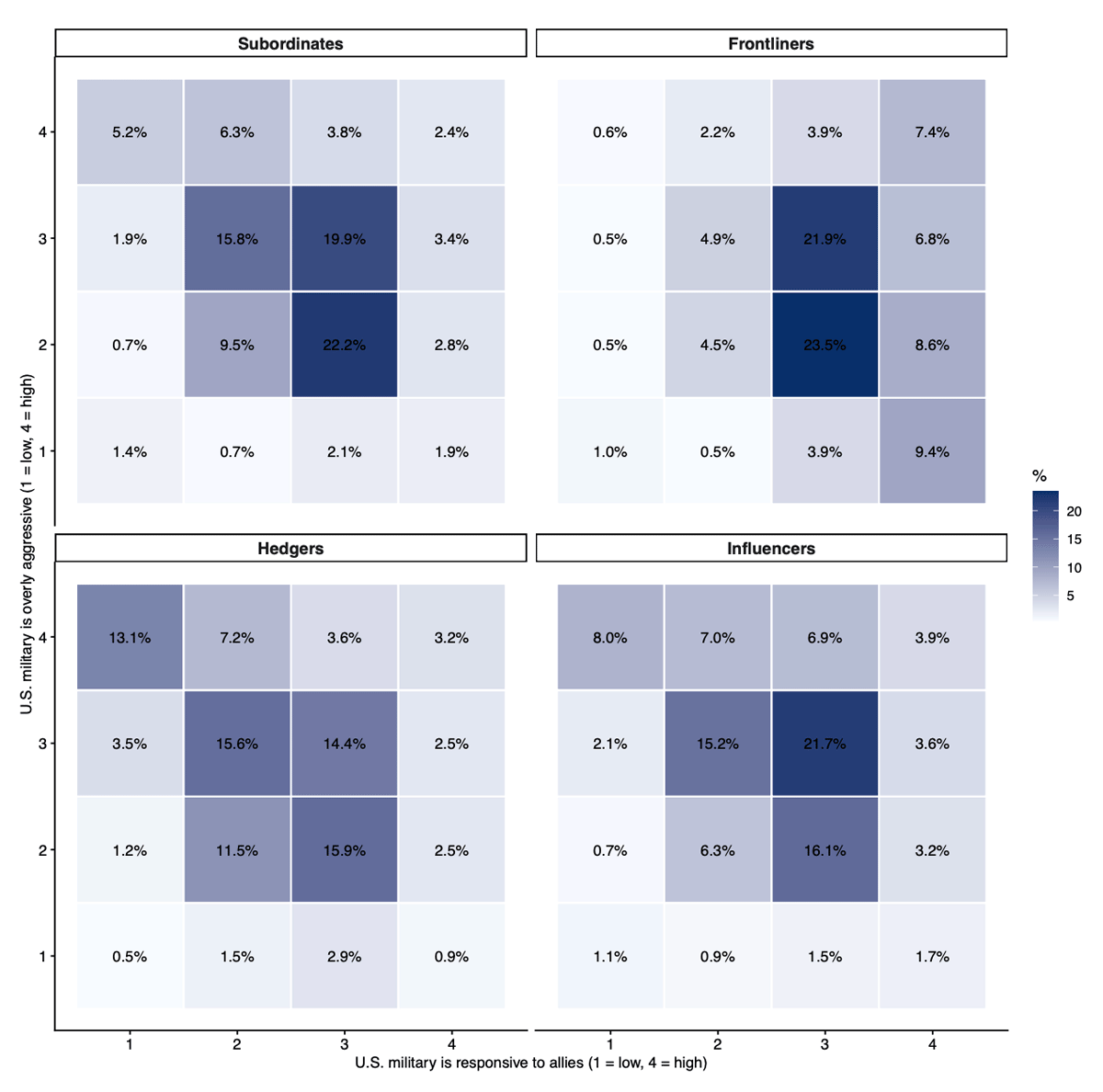
Figure 1
Views on U.S. Military by Geopolitical Type.
We find that respondents vary in the degree to which they are concerned about entrapment risks. Respondents in influencer states are most concerned about entrapment risks, followed by respondents in hedger states. Those in influencer states can prioritize entrapment risks because their greater autonomous military capacity gives them greater capacity for independent deterrence. At the same time, the greater military capacity of influencer states makes them more likely targets in any escalation of conflict and more likely to face demands for protection from their allies. Hedgers may be highly concerned about entrapment because their interests sometimes tend not to align with those of their allies; despite their high exposure to adversary threats, their position between great powers may make them especially wary of aggravating adversaries. By contrast, respondents in frontline states are least concerned about entrapment. This may reflect their relative risk tolerance resulting from the intensity of their threat environment.
Respondents also vary in their beliefs about the degree to which U.S. interests align with their preferences. Those from frontline states are particularly confident that the United States is attentive to its allies’ preferences. This view could reflect a real or desired closeness with U.S. interests. In contrast, those from hedger states are skeptical of the claim that Washington is concerned with the well-being of its allies. This likely reflects their divergent preferences from Washington. Differences between hedgers and frontliners highlight a key alliance challenge: Patrons must navigate heterogeneous preferences and varying risk tolerances among their allies. Finding an optimal balance may be very difficult (Sukin et al., 2026a). In the Nordic states, this tension manifests as simultaneous public support for credible deterrence and sensitivity to entrapment risks associated with nuclear signaling toward Moscow.
Alliance-Management Preferences
Alliance risk priorities vary by geopolitical type (Herzog & Kunertova, 2024). This leads to a number of different preferences concerning how the various challenges of nuclear alliances are best addressed. In this section, we compare citizens’ interests across NATO states regarding policies that could strengthen deterrence or reduce the risks of entrapment and nuclear escalation. We provide linear probability models that assess how citizenship in a frontline, hedger, influencer, or subordinate state correlates with preferences for different alliance-management strategies. We control for various demographic characteristics of respondents, such as age, gender, education, income, and career experience. Regarding career experience, we include variables indicating whether respondents served in the military and whether they have worked in law, national security, government, or international organizations. These experiences may provide some respondents with a deeper understanding of the issues and political trade-offs inherent in the various alliance-management policies.
Figure 2 shows how respondents across the four geopolitical types evaluate five policies that could strengthen deterrence: investing in greater conventional military capabilities, horizontal or vertical nuclear proliferation (depending on the state’s current nuclear status), increasing U.S. force deployments, expanding U.S. nuclear sharing, and improving nuclear planning coordination with the United States. The base category in these models is respondents in subordinate states. In comparison, we find that those in frontline states strongly prioritize policies that improve both the capability and resolve components of nuclear deterrence. In contrast, respondents from hedger states are less likely to support each of these deterrence-strengthening policies. Respondents in influencer states have more mixed preferences. Compared to those from subordinate states, they are more likely to prefer independent capabilities, whether nuclear or conventional, and to prefer strategies to improve their alliance leverage, such as taking a greater role in NATO’s nuclear planning. However, they are comparatively cautious about relying on the United States. They are more likely to oppose additional U.S. force deployments in their country and are no more likely to support additional U.S. nuclear deployments to Europe.
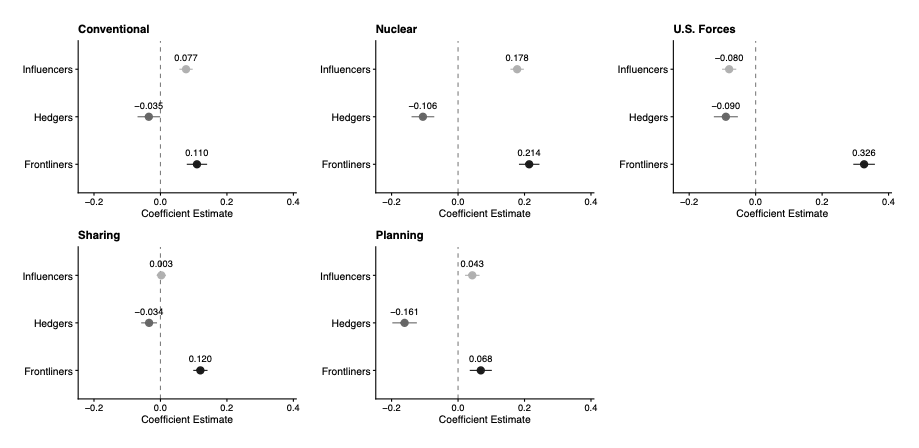
Figure 2
Alliance-Management Policies that Strengthen Deterrence.
Note: The figure shows coefficient estimates with 95% confidence intervals. The reference category is respondents in subordinate states. See Appendix C for full regression results.
These patterns persist when considering alliance-management policies that are not geared toward strengthening deterrence. States may instead manage their relationships within the alliance by seeking to weaken, exit, or circumvent them. Regarding nuclear weapons, states may prioritize normative constraints over nuclear deterrence, seeing them as an alternative pathway to reducing the possibility of a nuclear exchange. Figure 3 shows how respondents across geopolitical types evaluate these options. We assess respondents’ interest in the withdrawal of U.S. nuclear weapons from Europe, a realignment of their country’s interests toward greater security cooperation with Russia, reducing reliance on the U.S. military, exiting the U.S. nuclear security umbrella by leaving NATO, joining the TPNW, and encouraging the United States to adopt a no-first-use nuclear posture. For our analysis, we again use linear probability models that include demographic controls.
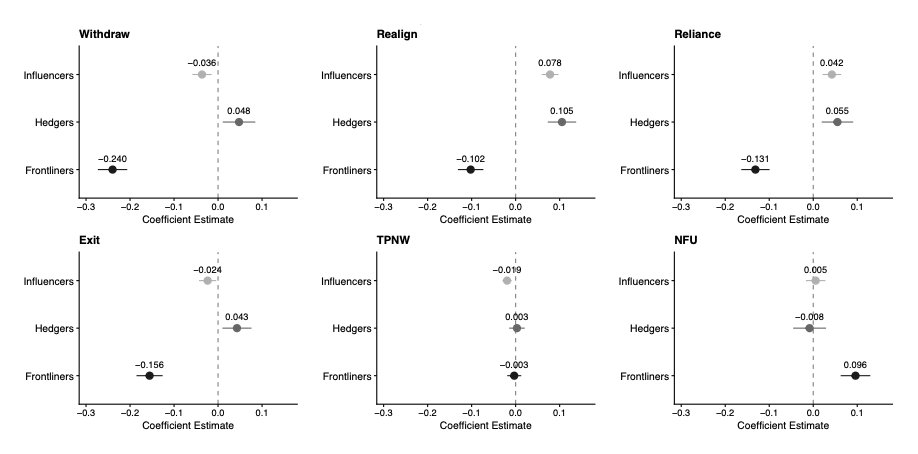
Figure 3
Alliance-Management Policies that Reduce Alliance and Nuclear Risks.
Note: The figure depicts coefficient estimates with 95% confidence intervals. The reference category is respondents in subordinate states. See Appendix C for full regression results.
We find that respondents in frontline states are generally opposed to policies that could weaken nuclear deterrence or their relationship with their patron. Compared to respondents in subordinate states, those in frontline states are less likely to want the United States to withdraw nuclear weapons from Europe or to want their government to exit from NATO. They are also more opposed to realignment toward Russia and more favorable toward continued reliance on the U.S. military. However, frontliners’ high vulnerability to a nuclear adversary also contributes to public interest in alternative policies to reduce the chances of nuclear escalation. For example, respondents in frontline states are generally supportive of the TPNW and of a no-first-use policy, despite their reliance on the nuclear umbrella.
In comparison, respondents in hedger states are relatively open to options that may weaken their relationship with the United States. They are more supportive of scaling down nuclear sharing, increasing coordination with Russia, and exiting from NATO. They are more likely to believe that their country should reduce its reliance on the U.S. military, and they are supportive of both the TPNW and a no-first-use policy.
Those in influencer states prioritize both military independence and nuclear deterrence. While they are more supportive of nuclear sharing than respondents from hedgers or subordinates, they are similar to those in hedger states in their openness to reconciliation with Russia and to reduced reliance on the U.S. military. For hedger states, these policies may serve as a safeguard against being caught in the crossfire of greater powers. In contrast, those in influencer states may have greater faith in their government’s ability to directly manage relations with an adversary with less reliance on the United States as an intermediary. This can be seen in the differences between hedger and influencer preferences regarding NATO membership. Respondents in hedger states are more open to withdrawing from NATO, whereas respondents from influencer states strongly support continued membership. The leadership of influencer states in the nuclear deterrence domain may also be evident in their opposition to the TPNW.
Intra-Alliance Variation
Figure 4 provides a further examination of nuclear preferences. We find significant cross-national variation in respondents’ interest in policy options designed to manage nuclear and alliance risks. The results show particular interest in deterrence-strengthening policies among Polish (frontline) respondents and in independent military policy among British, French, and Turkish (influencer) respondents. In addition, we find that respondents from Slovakia (a hedger state) show reluctance toward sustained cooperation with the United States.
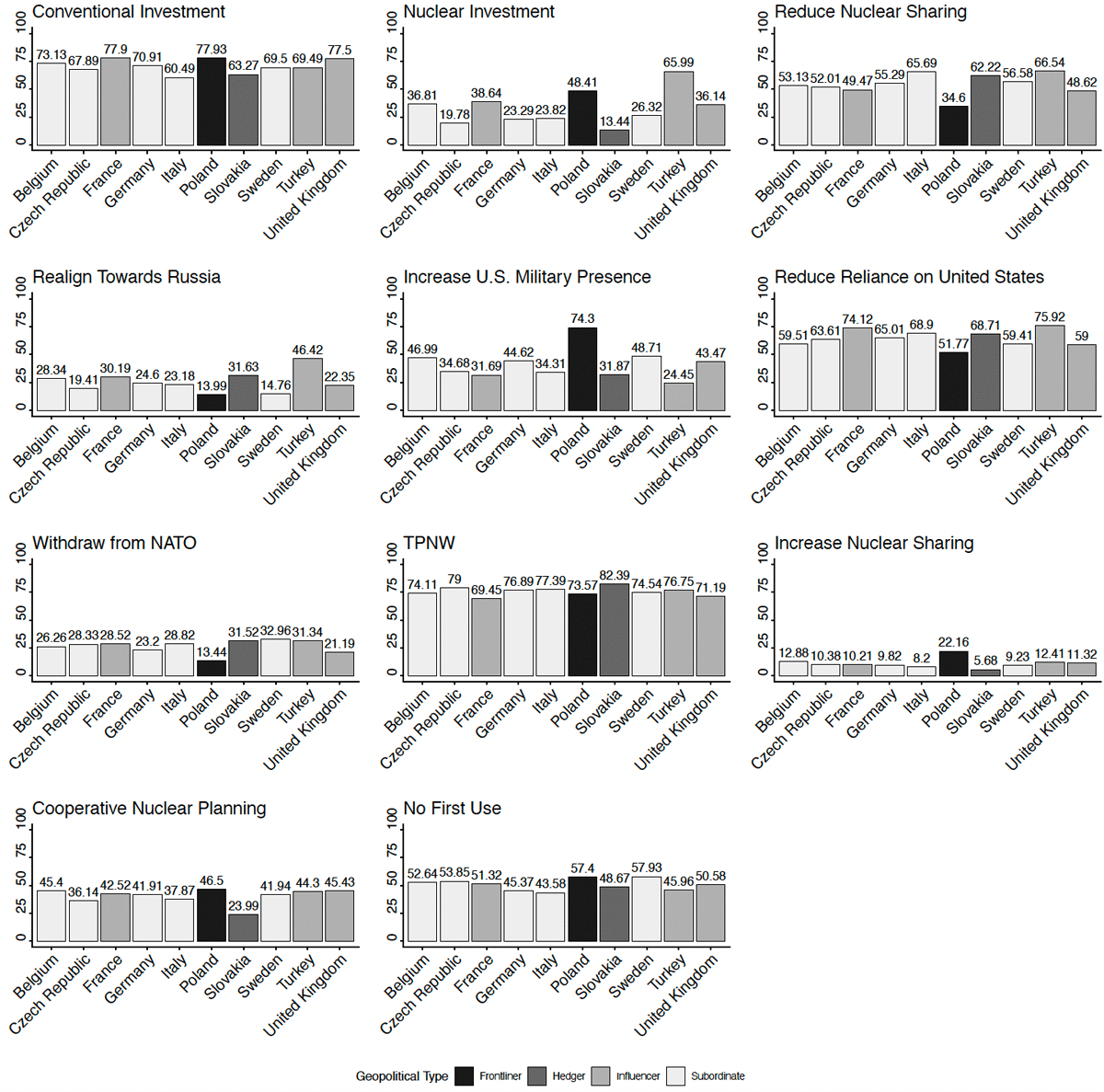
Figure 4
Percent Support for Policies to Manage Alliance and Nuclear Risks.
Respondents in France, Poland, and Sweden are most supportive of additional investment in their country’s conventional military capabilities. Subordinate Sweden’s support for conventional weapons investments aligns with broader High North concerns, where improved air–maritime denial and interoperable surveillance capabilities are the priority. Respondents in Belgium, France, Poland, Turkey, and the United Kingdom are most supportive of developing new or additional nuclear capabilities. Several of these countries already possess strong militaries or occupy influential positions within NATO. In comparison, respondents from states with lower military spending/capacity, such as the Czech Republic, Germany, and Italy, are more reluctant to start costly new military programs. Our attention to the public’s role in supporting military investments complements the articles by Fabian Hoffmann (2026) and Jamie Withorne (2026) in this special collection. While both focus on how small states can acquire or improve their military capabilities to gain leverage within an alliance, Hoffmann highlights the risks and Withorne focuses on the benefits of this strategy. Notably, our survey was conducted in 2023, but additional burden-sharing pressures placed on the alliance by the U.S. government since this time have prodded some subordinate states – such as Germany – to overcome domestic opposition to major new military spending initiatives.
When it comes to nuclear sharing, support is highest in Poland, likely due to the intense nuclear risks stemming from its frontline status. In comparison, respondents from many other states in the alliance express concerns about nuclear sharing, instead preferring that the United States reduce the number of nuclear weapons it maintains in Europe. Moreover, a majority of respondents do not want their country to have a greater role in NATO nuclear planning. Since, as Matti Pesu (2026) argues in this special collection, small countries tend to rely on clustering strategies to increase their influence in NATO’s decision-making, this finding prompts scholars and policymakers to explore the tension between publics and elites. The finding also raises questions for existing scholarship that argues for the importance of nuclear capabilities in determining the credibility of nuclear extended deterrence and reassurance.
The majority of respondents across the sample appear to be interested in normative strategies that reduce their exposure to nuclear confrontation. They are highly supportive of the TPNW and generally supportive of a U.S. no-first-use posture. They might prefer these policies because they believe that they will reduce the general level of nuclear risk. And, as Tytti Erästö and Wilfred Wan (2026) explain in this special collection, nuclear escalation risks and challenges to nuclear crisis stability might increase as NATO members adopt new military postures and procurement policies.
Additionally, respondents in Poland show particular interest in developing a close relationship with the United States. They strongly favor an increased U.S. military presence in their country and are the most likely respondents to oppose reducing reliance on the United States. In contrast, respondents elsewhere appear to be relatively more concerned with entrapment and escalation risks. Most support reducing their country’s reliance on the U.S. military, and few approve of an increased American presence on their territory.
Yet support for NATO overall remains strong. Only a minority of respondents support an exit from the transatlantic alliance. Even in states that have adopted a hedging strategy, like Slovakia, the majority of respondents oppose greater military cooperation with Russia.
Implications for Geopolitical Alignment
Hedger states attempt to balance between major powers such as the United States and Russia. In Figure 5, we assess respondents’ orientation toward both countries. The figure displays an ordinal four-point measure of how favorably respondents view Washington and Moscow. We see notable differences across the different geopolitical types. Respondents from frontline states show lower favorability toward Russia and higher favorability toward the United States. In contrast, respondents from hedger states are less favorable toward the United States and more favorable toward Russia. This analysis points to an important challenge for allies in how to reconcile disparate interests: Nordic public choices, for example, are filtered through Arctic stability concerns. Reassurance cues toward Russia can, in fact, coexist within the alliance alongside preferences for coordination with Washington on nuclear contingencies.
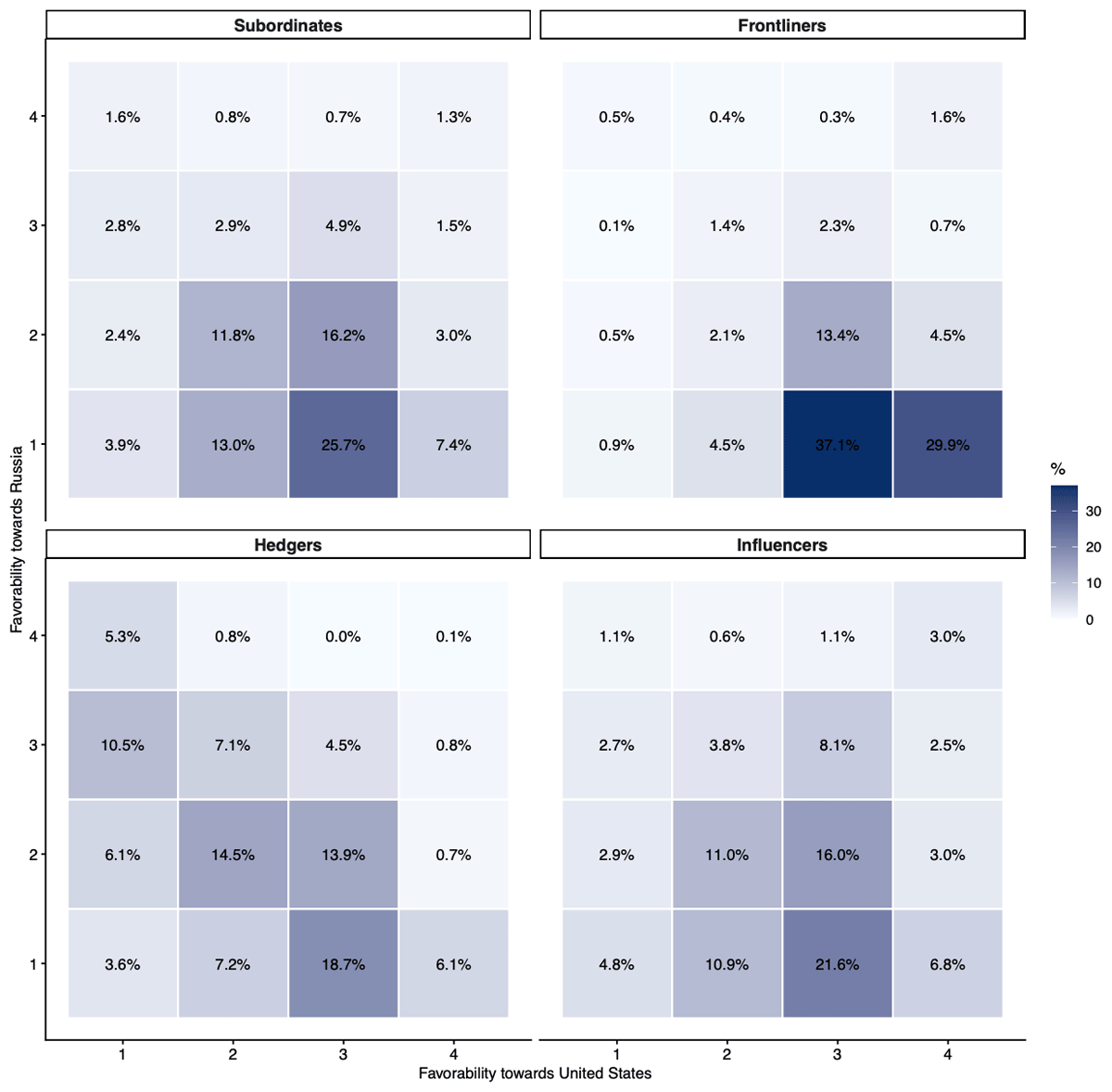
Figure 5
Geopolitical Alignment by Type.
Conclusion
We offer a typological theory to understand variation in how members of nuclear alliances manage their security environments. Heterogeneity arises from two structural dimensions: states’ vulnerability to a nuclear adversary and their relative military spending/capacity. These characteristics jointly determine a state’s geopolitical “type,” which we code theoretically based on states’ structural positions within the NATO-centered security environment. We identify four distinct types of states within the NATO alliance – frontliners, hedgers, influencers, and subordinates – and, drawing on an original public opinion survey, we show that these types correlate with different policy preferences for managing nuclear risk. Our analysis demonstrates that our typology captures systematic and meaningful variation in alliance-management preferences.
For effective alliance management, NATO must acknowledge that intra-alliance cohesion depends on reconciling distinct threat perceptions and risk tolerances among members. To do this, the alliance should prioritize adaptive mechanisms, such as consultation, as well as flexible strategic arrangements that recognize NATO members’ different strengths and interests. Understanding intra-alliance heterogeneity is a missing piece in the scholarly alliance literature and an imperative for policymakers. This could provide valuable guidance to the alliance, such as translating heterogeneity into policy practice in the High North by pairing enhanced nuclear consultation with Arctic confidence-building for regional stability.
Our typology provides a systematic framework for understanding why Washington’s allies respond differently to the growing challenges to the credibility of U.S. extended deterrence. Each of the types we present faces different pressures and priorities and will thus prefer different options for managing alliance risks and nuclear threats. Anxieties about U.S. commitments emerge over a potential reluctance to defend allies, either because Washington might not be willing to use all necessary means to protect its partners or because it now appears to see less value in keeping its promises.
In this respect, our typology might also shed light on the nuclear preferences of non-NATO European countries. The article by Alexander Sorg and Liviu Horovitz (2026) in this special collection examines the Belarusian perspective on extended deterrence, paying close attention to perceived risk exposure in Minsk. Future research could explore how other nuclear protégés balance nuclear alliance risks. Comparative extensions to other alliance systems – particularly in the Indo-Pacific – could test our typology’s external validity and generalizability. New work studying the NATO alliance could also prove useful, as our survey’s geographic scope – though diverse – does not capture all members.
Our findings also speak to longstanding debates on balancing and bandwagoning by showing that alliance members do not respond uniformly to common threats. Instead, allies’ geopolitical positions within NATO shape whether they are more likely to pursue internal balancing, external balancing, strategic autonomy, or partial accommodation of the adversary. Frontliners are most likely to combine internal and external balancing, given their close exposure to current wartime tensions and to Russia. Subordinates rely more heavily on external balancing, being less able to convert resources into autonomous military capacity, even as they remain vulnerable to abandonment. Influencers are better positioned to reduce their reliance on U.S. commitments and pursue greater strategic autonomy. Hedgers, by contrast, may combine continued participation in the alliance with partial accommodation of the adversary, including elements of bandwagoning. U.S. leaders must therefore tailor reassurance strategies to allies occupying different geopolitical positions. More generally, these findings suggest that debates over nuclear policy cannot be reduced to a simple choice for or against deterrence. Allies in different geopolitical positions face different trade-offs among deterrence, reassurance, escalation management, and autonomy.
This article therefore helps explain why current debates over Europe’s nuclear future have not converged on a single preferred solution across NATO. Our argument thus contributes not only to the literature on nuclear alliances, but also to broader theories of how weaker states manage danger within asymmetric security relationships.
We highlight a counterintuitive degree of variation in NATO’s nuclear approaches. In the alliance politics literature, the dominant capability aggregation model assumes alliance members will have relatively homogeneous and coherent nuclear security cooperation preferences. In contrast, we find a diversity of positions within NATO. Some countries even present seemingly contradictory positions. For example, there is very high support for the TPNW across NATO members, including those that otherwise appear to rely significantly on the nuclear umbrella to address vulnerabilities. Even publics in allies that consider nuclear sharing a deterrence-strengthening policy support the TPNW. This finding aligns with recent research on public opinion on nuclear politics, which suggests that individuals often back seemingly contradictory options for reducing nuclear dangers. For example, they may see both deterrence and disarmament as viable responses to nuclear risks (Sukin et al., 2026b).
Future research should further interrogate the microfoundations of nuclear alliance politics. Longitudinal and experimental studies could further illuminate how alliance-management preferences form and evolve. Additionally, bridging public opinion-based evidence with studies of elite preferences would clarify the domestic foundations of strategic choices. Public opinion provides an indispensable, but incomplete, window into alliance politics.
Overall, this article offers insights into variation among alliance members’ threat management strategies. It does so by linking variation in states’ relative military spending/capacity to their threat environments. While NATO’s strength lies in its unity, recognizing the alliance’s vast diversity would make it more resilient.
Additional Files
The additional files for this article can be found as follows:
Appendix C
Regression Results for Alliance-Management Preferences. DOI: https://doi.org/10.31374/sjms.509.s3
Notes
[1] A number of contributions illustrate the breadth of this debate. See, for example, Bell and Hoffmann (2025); Cameron (2025); Freedman (2025); Sorg (2025).
[2] Sweden joined NATO in March 2024, while our survey was conducted in June 2023. Sweden was at the time moving forward in the accession process, which Stockholm officially began in May 2022.
[3] For examples of typological approaches that emphasize the costs of conflating heterogeneous cases, see Staniland (2012); Narang (2014); Bell (2021).
[4] This typological logic parallels other issue areas. Research on environmental treaties classifies states according to their vulnerabilities and adjustment costs (Sprinz & Vaahtoranta, 1994). Nuclear proliferation literature distinguishes among strategies such as hedging, seeking security umbrellas, and other responses to threats (Narang, 2022).
[5] On reassurance between adversaries, see Lupton (2018b); Yarhi-Milo et al. (2018); Cebul et al. (2021). On reassurance between allies, see Ko (2019); Allison et al. (2022); Sukin and Lanoszka (2024).
[6] We achieved cross-national sample representativeness in terms of age. In a few cases, the gender distribution of respondents falls outside the expected sampling margin of error relative to census benchmarks.
[7] We drop respondents flagged as illegitimate users, such as those trying to retake the survey, those completing it in a highly unrealistic timeframe, and those failing the CAPTCHA test. Our analysis excludes partial responses. We also include a simple attention check; respondents who failed the attention check were unable to complete the survey. While many studies include inattentive respondents, we preemptively remove inattentive survey takers from our sample due to concerns about the legitimacy and quality of respondent pools in some of the countries under study. However, just because respondents are human and attentive does not necessarily mean they are knowledgeable. We therefore measure respondents’ self-reported knowledge of foreign policy.
Acknowledgements
All authors contributed equally. We thank Målfrid Braut-Hegghammer, Ian Bowers, Do Young Lee, and all contributing authors in this special collection for their feedback. We thank Alexander K. Bollfrass, Ludovica Castelli, Eliza Gheorghe, Annabelle Gouttebroze, Kate Hampton, Emilija Krysen, Dominika Kunertova, Alexander Lanoszka, Adrian Matak, Ulrika Möller, Toby Nowacki, Michal Smetana, and Sanne Verschuren for their assistance with survey translation and localization. Any errors are the authors’ own.