
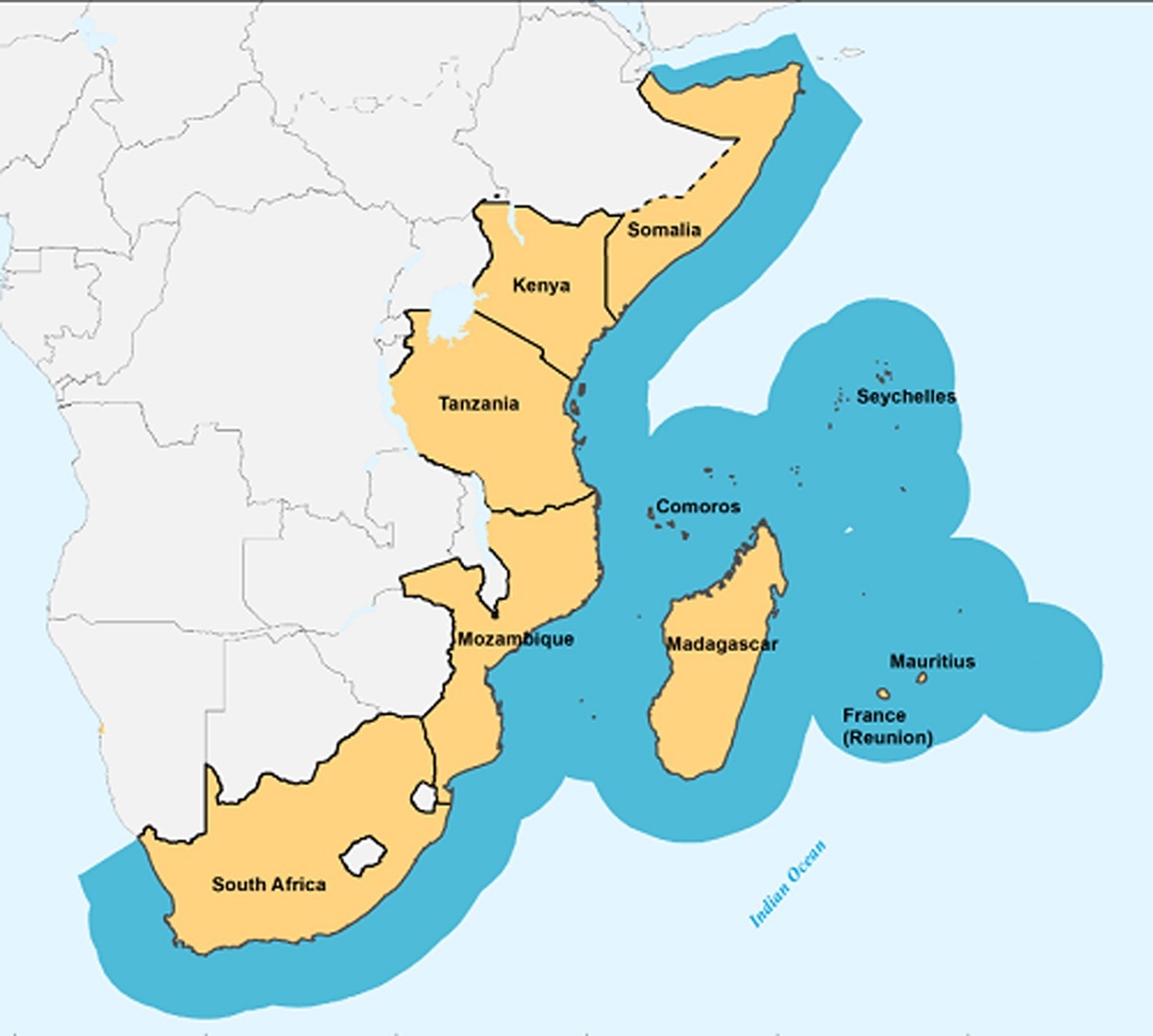
Figure 1
Map of Western Indian Ocean.
Note. UNEP/Nairobi Convention Secretariat, 2009.
Table 1
Table of Four Criteria Applied to the Comparative Analysis.
| CRITERIA | DETAILS |
|---|---|
| Communication orientation | Whether communication is primarily inward-facing, supporting cohesion, trust and coordination among members or outward-facing, supporting legitimacy, donor alignment and external recognition. This dimension captures the balance between internal coordination and external positioning. |
| Narrative framing | The main narratives through which threats, roles and ownership are constructed, particularly the balance between the “African solutions to African problems” register and the depoliticized shared-threat register. It examines how these narratives are communicated and reflected across framework outputs and by member states and partners. |
| Institutional anchoring | How communication is embedded in institutional structures, mandates, plans and resources, or treated as a secondary function. This indicates the extent to which communication is institutionally supported and linked to legitimacy. |
| Observable Coordination outcomes | Practical coordination effects associated with communication, including agreements, MoUs, liaison arrangements, joint exercises and operations, and sustained participation. These provide a counterweight to institutional self-description. |
Table 2
Comparative Analysis Table of RMSA and DCoC-JA.
| PARAMETERS | RMSA (REGIONAL MARITIME SECURITY ARCHITECTURE) | DCoC-JA (DJIBOUTI CODE OF CONDUCT/JEDDAH AMENDMENT) |
|---|---|---|
| Foundational purpose | A holistic, multi-dimensional framework designed to detect, deter, and respond to a broad range of illicit maritime activities and crimes across the WIO through coordinated information sharing, joint operations and African-led regional cooperation. | A regional framework designed to address piracy and a broad range of transnational maritime crimes across the WIO, GoA, and Red Sea through information sharing, capacity building, coordinated responses, and regional cooperation. |
| Geographical scope and membership | WIO (island and coastal states); seven signatory states with provision for expansion | WIO, GoA, and Red Sea: 21 signatory states (as of late 2025) across 3 sub-regions |
| Institutional anchor | IOC as implementer, Secretariat of the RMSA Steering Committee and normative anchor | IMO as Secretariat and normative anchor |
| Legal status/Institutional basis | Two binding regional agreements on information sharing and joint operations | Non-legally binding political commitment |
| Operational coordination mechanisms | RMIFC and RCOC, national maritime centres and ILOs | National Focal Points, Information Sharing Network, Capacity-Building Matrix, Working Groups |
| External support and partnerships | EU (primary donor), EU NAVFOR, IFC-IOR, IFC Singapore, UNODC, Interpol, IMO… bilateral partners (UK, India, United States, etc.). | EU, United States, Denmark, India, UNODC, UNITAR, industry actors and other international organisations. |
| Donor structure | Highly concentrated (primarily EU-funded). | Diversified support from EU, United States, Denmark, India, UNODC, UNITAR, industry and other partners. |
| Strategic communication orientation | Predominantly inward-facing: operational communication, trust-building and shared regional understanding, complemented by selective external communication. | Outward-facing and multi-level: internal consensus-building combined with external engagement, visibility and partner mobilization. |
| Communication modalities | Operational information exchange, exercises, workshops, ministerial conferences and reports; limited public communication through IOC/RMIFC channels. | Communiqués, engagement strategies, working groups, high-level meetings, donor forums, Communication and Visibility Plan, and digital communication. |
| Contribution to regional agency and legitimacy | Reinforces African agency through operational coordination and the central role of coastal and island States, while integrating external support without displacing regional leadership. | Balances regional ownership with international engagement, enabling diverse members to articulate shared priorities and engage collectively with external partners. |
| Internal/external communication | Internal communication builds trust, coordination and shared operational understanding; external communication projects African-led regional priorities and strengthens partnerships. | Developed communication architecture but comparatively weaker operational consolidation. |
| Communication and operations relationships | Strong operational coupling but limited external visibility. | Communication architecture more developed than operational implementation. |
| Overall equilibrium/Vulnerability | Relatively stable but fragile: rooted in operational practice, but constrained by fragmented communication and concentrated donor dependence. | More narratively robust but operationally fragile: supported by broad legitimacy and partnerships, but vulnerable to uneven implementation. |
[i] Note: Source: author.
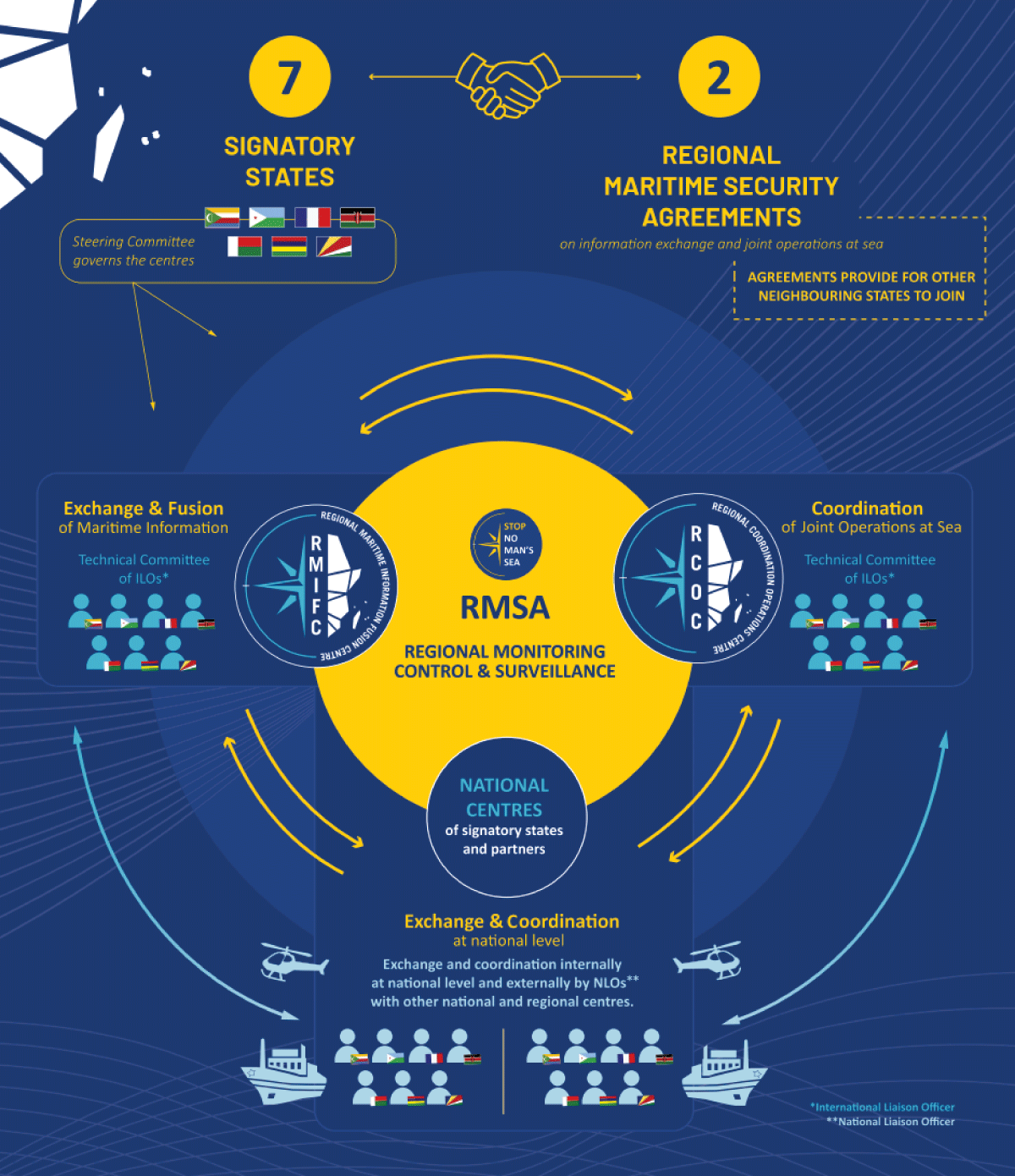
Figure 2
Overview of the Roles of the RMIFC and RCOC Within the Architecture.
Note. © Policy Brief: Strengthening maritime security in the Western Indian Ocean. Indian Ocean Commission. Mohabeer, R., & Sullivan de Estrada, K. (2019).
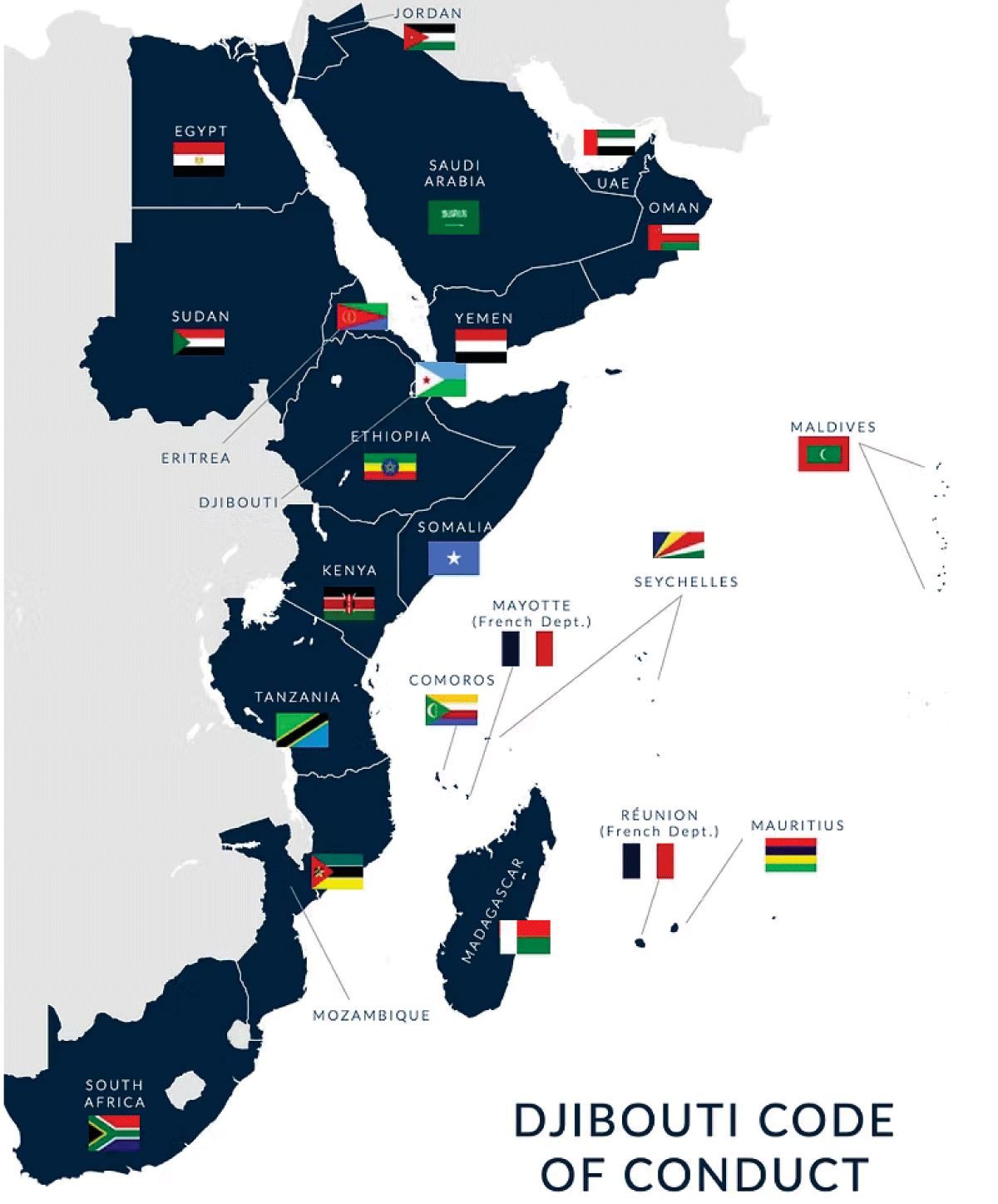
Figure 3
Map of DCoC Member States.
Note. © Stable Seas, 2020.
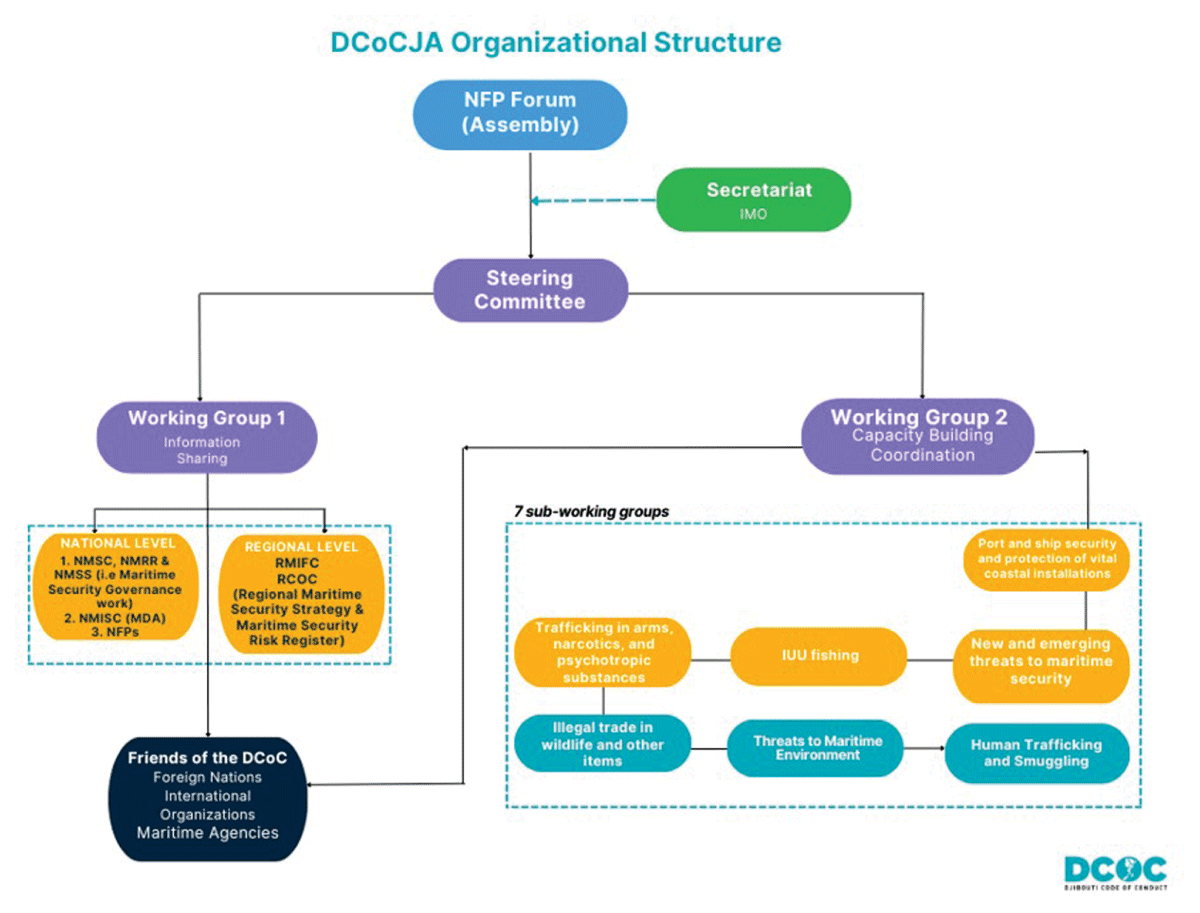
Figure 4
DCoC-JA Organizational Structure.
Note. © Doc Ref: DCoC(JA)-NFPs-HLM RSA 2023.