
Introduction
According to the International Farm Comparison Network (IFCN) report for 2023, a persistent global milk shortage has been observed for the last ten years (IFCN, 2024). This raises serious concerns and confirms the critical need for sustainable solutions that would allow for increased milk production, but would also take into account economic profitability, social responsibility, and environmental protection.
Sustainability is essential for the long-term economic growth of the dairy industry, especially for the European Union countries that apply the provisions of the common agricultural policy (CAP) and the European Green Deal. According to the USDA (2024) report, strengthening the EU's environmental and climate change mitigation policies may require additional investments and further reduce the profitability of dairy farming, which will negatively affect farmers' decisions to continue production and, as a result, reduce the supply of raw milk for processing. In May 2024, the European Union, due to farmers' concerns, partially weakened or postponed the implementation of new environmental and climate change mitigation regulations (Regulation, 2024b). It also extended duty-free and quota-free access for Ukrainian agricultural products to the EU market until June 5, 2025 (Regulation, 2024a).
Another challenge for the dairy industry in 2022 was a drastic increase in world milk prices by an average of 25.5% to USD 63.3 per 100 kg in sweetened condensed milk (IFCN, 2024). High milk price indices translated into domestic milk prices in most countries of the world. The average price of raw milk in the EU in 2022 increased by 35.1% compared to 2021. Among the EU Member States that are the main milk producers, milk price increases in 2022 were higher than average in the Netherlands (+47.0%), Poland (+46.9%), and Germany (+44.8%) (Eurostat, 2023).
This situation was caused not only by the continuous increase in feed, fertilizer and energy prices, low availability of milk in most countries of the world, as well as the outbreak of the war in Ukraine. The disruption of grain supply chains from Ukraine was one of the factors in the increase in world prices for animal feed. The current tensions regarding milk prices over the past decade show that market liberalization and globalization, the interdependence of international markets can increase milk market instability and price volatility (IFCN, 2024). In this context, it is interesting to analyze the comparative competitive advantages of the dairy industry for both Poland and Ukraine.
The aim of the article is to identify the competitive position in foreign trade of selected, main products of the dairy industry of Poland and Ukraine between 2021 and 2023, taking into account current challenges: the outbreak of war in 2022 and price disruptions in the milk and dairy products market between 2022 and 2023.
Previously conducted studies have shown that Ukraine lost most of its comparative advantages in trade in agri-food products (except for grains and oils) to Poland between 2005 and 2015. Ukraine supplies markets mainly with raw materials and is a fairly significant consumer of high-value-added production (Horin & Krzyżanowski, 2016).
The analysis of the competitive position of Poland and Ukraine in mutual trade so far has shown that Poland has comparative advantages in exports to Ukraine in 12 product groups (the highest indicators: live animals, meat and offal, vegetables, fruit, processed vegetables and fruits, cereal products and confectionery), while Ukraine was competitive on the Polish market in the export of 10 product groups (the highest indicators: oil seeds and fruits, processed vegetables and fruits, vegetable and animal fats and oils, waste and feed, cereals) (Kosior et al., 2017). In this respect, this study is pioneering, as it will allow for the assessment of the comparative advantages of Poland and Ukraine in the export of selected, main dairy products (liquid milk and cream, condensed and powdered milk, yoghurts and fermented drinks, whey, butter and milk fats, cheeses and curds), which can be used to create a development strategy for the trade directions of the Polish dairy industry.
Material and Methods
The research used statistical data from the database of the Statistical Office of the European Communities (Eurostat), Statistics Poland and the State Statistical Service of Ukraine (PSSU). The analysis covered: 1) the number of cows and their milk yield in Poland, the EU and Ukraine; 2) the dynamics of milk production in Poland and Ukraine; 3) production, export, and import of the main dairy products classified according to the Combined Nomenclature of Foreign Trade (CN) (liquid milk and cream, condensed and powdered milk, yoghurts and fermented drinks, whey, butter and milk fats, cheeses and curds) in Poland and Ukraine (United Nations, 2000). The subject of the research were the production and trade results of the Polish and Ukrainian dairy industries. The time frame for the analysis of the competitiveness level, determined by the outbreak of the war in Ukraine in 2022, covered the years 2021 and 2023.
To assess the level of mutual competitiveness of the Polish and Ukrainian dairy industries on foreign markets (EU and non-EU), the trade coverage (TC) index, indicators of revealed comparative advantages, including the relative revealed comparative export advantage index (XRCA), the relative import penetration index (MRCA), and the relative trade advantage index (RTA) (Table 1).
Table 1.
Selected indicators of the analysis of the level of mutual competitiveness of the Polish and Ukrainian dairy industries on international markets
Tabela 1. Wybrane wskaźniki analizy poziomu wzajemnej konkurencyjności polskiej i ukraińskiej branży mleczarskiej na rynkach międzynarodowych
| Indicators / Wskaźniki | Formula / Wzór | Specification / Wyszczególnienie |
|---|---|---|
| TC (Trade Coverage) | The foreign trade coverage ratio shows the export specialization of a given country in the analyzed sector, product, or product group. / Współczynnik pokrycia handlu zagranicznego pokazuje eksportową specjalizację danego kraju w zakresie analizowanego sektora, produktu lub grupy produktów. | |
| XRCA (Relative Revealed Comparative Export Advantage Index) | The relative revealed comparative export advantage index is the ratio of two quotients: the ratio of exports of a specific dairy product in a given country to the exports of that product by the EU (EU and non-EU) and the ratio of exports of dairy products (excluding the given product) in a given country to all exports of dairy products by the EU (EU and non-EU). / Indeks relatywnej komparatywnej przewagi eksportu jest stosunkiem dwóch ilorazów: stosunku eksportu określonego produktu mleczarstwa w danym kraju do eksportu tego produktu przez UE (unijny i pozaunijny) oraz stosunku eksportu produktów mlecznych (z wyłączeniem danego produktu) w danym kraju do ogółu eksportu produktów mlecznych przez UE (unijny i pozaunijny). | |
| MRCA (Relative Import Penetration Index) | The relative import penetration index is the ratio of two quotients: the ratio of imports of a specific dairy product in a given country to imports of that product by the EU (EU and non-EU) and the ratio of imports of dairy products (excluding the given product) in a given country to total imports of dairy products by the EU (EU and non-EU). / Indeks relatywnej chłonności importu jest stosunkiem dwóch ilorazów: stosunku importu określonego produktu mleczarstwa w danym kraju do importu tego produktu przez UE (unijny i pozaunijny) oraz stosunku importu produktów mlecznych (z wyłączeniem danego produktu) w danym kraju do ogółu importu produktów mlecznych przez UE (unijny i pozaunijny). | |
| RTA (Relative Trade Advantage Index) | RTAik = XRCAik − MRCAik | The relative trade advantage index shows the competitive advantage and is the difference between the relative comparative export advantage index and the relative import penetration index. / Indeks relatywnej przewagi handlu wykazuje przewagę konkurencyjną i stanowi różnicę pomiędzy indeksem relatywnej komparatywnej przewagi eksportu a indeksem relatywnej chłonności importu. |
[i] where: X – export; M – import; i, j – product categories; k, m – countries / gdzie: X – eksport, M – import, i, j – kategorie produktów; k, m – kraje
[ii] Source: author's own elaboration based on Vollrath (1989).
[iii] Źródło: opracowano na podstawie: Vollrath (1989).
The TC coefficient > 100 means that the country in question has a relative advantage over its partners (Vollrath, 1989). When considering only the exports and imports of the country in question, the TC indicator is a measure of “internal” comparative advantage, but when used together with the indicators discussed below, it becomes a more useful tool for analyzing competitiveness (Pawlak, 2013).
An approach to the analysis of revealed comparative advantages based on the concept of Balassa (1965) and the XRCA, MRCA, and RTA indicators modified by Vollrath (1989). The essence of the RCA indicator is based on the assumption that a country's comparative advantages are reflected in the structure of foreign trade. The use of the Vollrath method is considered more precise, because XRCA measures eliminate the problem of double counting products (Pawlak, 2013). When the RTA indicator ≥ 0, and the XRCA indicator ≥ 1, it indicates high competitiveness (+), when the RTA indicator < 0, and the MRCA indicator ≥ 1, the country in question shows a lack of competitiveness (–). In other cases, the results of the analysis are not so clear (+/−) (Frohberg, 2000).
It is known that the competitiveness indicator is relative and to determine it, one can only compare products of the same type. Based on the above, the XRCA, MRCA, and RTA indicators were used to assess the market competitiveness of selected, main products of the dairy industry in Poland and Ukraine on international markets.
Literature Review
Competition (from Latin concurrentia – rivalry) is a basic economic category, which is why this issue has gained the attention of a wide range of famous economists. There are many interpretations of the concept of competition. According to Knight (1935), competition is the process of rivalry between a large number of independent producers and buyers of a given product, which gives everyone the opportunity to trade with specific entities and choose, from their point of view, the best conditions from among those proposed to satisfy their economic interests. Schumpeter (1933) claimed that competition is a rivalry between the old and the new. He saw entrepreneurial profit as the result of dynamic changes in the economy that occur as a result of innovative activity. The effect of competition is competitiveness, which indicates how companies compete on the market for the favor of customers (Beyer, 2012).
The diversity of competitiveness definitions is justified by the wide scope of research and the adopted level of analysis: micro-, meso-, and macroeconomic, among which one can distinguish international, national, regional, sectoral, or enterprise competitiveness (Daszkiewicz, 2008). Stankiewicz (2000) believes that enterprise competitiveness is a system co-created by four elements: competitive potential, competitive advantage, competitive instruments, competitive position. The competitiveness of an agricultural holding results from the ability to adapt to changes in the environment, which allows for more effective achievement of goals in relation to other agricultural producers (Nowak, 2016). An agricultural holding is considered competitive when it provides the farmer with at least parity income, positive management income and a positive net investment rate (Ziętara, 2014).
The Organisation for Economic Cooperation and Development (OECD, 2008, p. 89) defines competitiveness as a “measure of a country's advantage or weakness in selling its products on international markets.” At the national level, competitiveness is understood as the degree to which the state and state institutions support entrepreneurship and create an environment and use appropriate instruments that support starting and running a business (Piotrowska, 2019). The competitiveness of Polish producers is defined as the ability of domestic producers to locate on foreign markets and the ability to develop exports (Szczepaniak, 2008).
In highly developed and developing countries, a special role is assigned to the relationship between competitiveness and innovation and to increasing the role of innovation in creating the so-called sustainable competitiveness (Mytelka, 1999; Wysokińska, 2002). For dairy industry producers, technological competitiveness and innovation development are of fundamental importance, as they enable them to achieve and maintain sustainable competitiveness in the distribution of goods on international markets.
Research has shown that the dairy industry is characterized by a high level of competition between existing economic entities (Gralak et al., 2022). This determines the need to implement modern development strategies for dairy companies and to improve and adapt the range of dairy products to the needs of consumers. Changes in the competitive environment of dairy industry enterprises and the environmental regulations that apply to them require the creation of the ability to quickly respond to changes and adapt to the challenges of domestic and global markets.
The Potential of the Polish Dairy Industry in the Context of the EU-27
The European Union is a significant producer of milk and dairy products, and its Member States are integrated in a common market organization (CMO). All EU countries produce milk, the share of which in the total agricultural production is significant. EU farms produced 160.8 million tons of cow's milk in 2023. The main milk producers are Germany, France, Poland, the Netherlands, and Italy. Together they account for almost 64% of cow's milk production in the EU, with Poland accounting for almost 10% (Eurostat, 2023) (Figure 1).
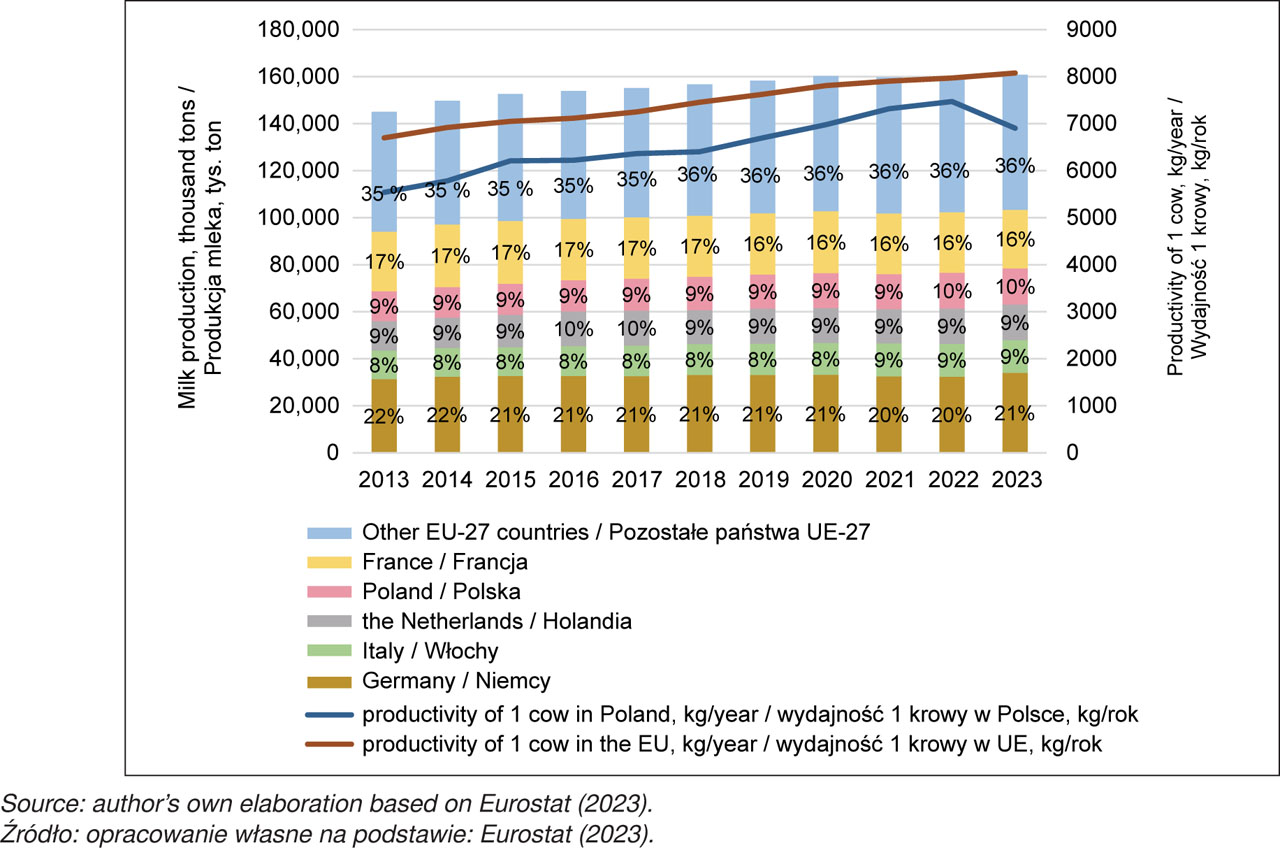
Figure 1.
Milk production and cow productivity in EU countries between 2013 and 2023
Wykres 1. Produkcja mleka oraz wydajność krów w państwach UE w latach 2013–2023
The number of dairy cows in the EU-27 has been decreasing in recent years, but the productivity per cow is increasing. In 2023, there were 19.7 million dairy cows, 1.7% less than in 2022, but the average productivity per cow in 2023 increased by 2.7%. In Poland, the number of cows increased by 1.5% in 2023 compared to the previous year and reached 2.2 million head, and the productivity per cow increased by 1.5%. Self-sufficiency in milk production in the EU-27 and in Poland is at a very high level, and in 2023 compared to 2022 in the EU-27 increased by 1.7% to 116.2%, and in Poland it increased by 0.9% to 123.5% (Eurostat, 2023). The number of dairies in Poland has been decreasing in recent years, but their processing capacity has been increasing (Table 2).
Table 2.
Key indicators of the Polish dairy industry
Tabela 2. Kluczowe wskaźniki branży mleczarskiej Polski
| Specification / Wyszczególnienie | 2021 | 2022 | 2023 | Change in value 2023 to 2021 / Zmiana wartości 2023 do 2021 | |
|---|---|---|---|---|---|
| unit of measure / jednostka miary | 2021 = 100 | ||||
| Processing companies, units / Przedsiębiorstwa przetwórcze, jednostki | 143 | 136 | 134 | −9 | 93.7 |
| Milk production, million tons / Produkcja mleka, mln ton | 14.9 | 15.2 | 15.5 | +0.6 | 104.0 |
| Milk processing, million tons / Przetwórstwo mleka, mln ton | 12.2 | 12.5 | 12.7 | +0.5 | 104.1 |
| % | 81.9 | 82.2 | 82.0 | +0.1 | – |
| Production of main dairy products / Produkcja głównych przetworów mlecznych: | |||||
| – liquid milk, thousand tons / mleko płynne, tys. ton | 3,755.5 | 3,825.8 | 3,678.3 | −77.2 | 97.9 |
| – butter, thousand tons / masło, tys. ton | 241.2 | 251.5 | 267.0 | +25.8 | 110.7 |
| – cheese, thousand tons / sery, tys. ton | 993.0 | 945.2 | 1,001.4 | +8.4 | 100.8 |
| – milk powder, thousand tons / mleko w proszku, tys. ton | 207.0 | 209.5 | 211.7 | +4.7 | 102.3 |
| – condensed milk, thousand tons / mleko skondensowane, tys. ton | 44.5 | 44.7 | 43.7 | −0.8 | 98.2 |
| Milk consumption per capita, kg / Konsumpcja mleka na osobę, kg | 251 | 262 | 276 | +25 | 110.0 |
[i] Source: author's own elaboration based on GUS (2024), Szajner (2024).
[ii] Źródło: opracowanie własne na podstawie: GUS (2024), Szajner (2024).
In 2023, the number of processing plants decreased by 9 units (by 6.3%) compared to 2021, but the amount of processed milk increased by 0.5 million tons and reached 82%. This was supported by an increase in milk production by 0.6 million tons (by 4.0%) in 2023 compared to 2021. In the analyzed period, the production of butter (by 10.7%), milk powder (by 2.6%), cheese (0.8%) increased, the production of condensed milk (by 1.8%) and liquid milk (by 2.1%) decreased slightly. On average, in 2023 compared to 2021, the production of the main dairy products in Poland decreased by only 0.2%, and the share in EU production did not change and remained at 8.9% (Eurostat, 2023). Milk consumption per person in Poland in 2023 compared to 2021 increased by 10.0% to 276 kg.
Poland's exports in 2023 compared to 2022 decreased by 8.3% to EUR 3.3 billion, and imports decreased by 3.1% to EUR 1.7 billion. The domestic dairy industry maintained a positive trade balance, but the positive balance in terms of quantity decreased by 20.0 thousand tons (in raw material equivalent), and in monetary equivalent by EUR 0.3 billion (GUS, 2024). The reason for the decline in the trade balance year-on-year was the increase in domestic demand and the decrease in world and EU prices of dairy products (Szajner, 2024).
In the geographical structure of Polish exports in 2023, the share of EU Member States was 62.8%, the share of the Commonwealth of Independent States (CIS) and Central and Eastern Europe was 4.3%, the share of developing countries was 18.3%, the share of developed countries was 14.6%. The main importers from outside the EU in 2023 were: Algeria (EUR 153.6 million), Great Britain (EUR 158.9 million), China (EUR 93.9 million), the United States (EUR 89.4 million), and Ukraine (EUR 114.7 million) (KOWR, 2024). In the geographical structure of Polish imports in 2023, the share of EU Member States was 94.4%, the share of CIS and Central and Eastern Europe was 2.3%, the share of developed countries was 3.3%. In 2023, Ukraine exported dairy products worth EUR 32.0 million to Poland (KOWR, 2024). In 2023, the export of individual commodity groups of dairy products, compared to 2021, showed different trends (Table 3). The increase in export in quantity equivalent concerned condensed and powdered milk, yoghurts and fermented drinks, butter and milk fats. The decrease in export in quantity equivalent concerned liquid milk and cream, whey, cheeses and cottage cheeses, ice cream, casein. On average in 2023, the quantity of export increased by 12.5% (227.2 thousand tons) and in value terms a higher increase was observed by 24.9% (EUR 653.4 million).
Table 3.
Polish dairy exports between 2021 and 2023
Tabela 3. Polski eksport produktów mlecznych w latach 2021–2023
| Specification / Wyszczególnienie | 2021 | 2022 | 2023 | Change in value 2023 to 2021 (2021 = 100) / Zmiana wartości 2023 do 2021 (2021 = 100) | ||||
|---|---|---|---|---|---|---|---|---|
| thousand tons / tys. ton | mln EUR | thousand tons / tys. ton | mln EUR | thousand tons / tys. ton | mln EUR | thousand tons / tys. ton | mln EUR | |
| Fluid milk and cream / Mleko płynne i śmietana | 877.7 | 521.3 | 843.8 | 706.4 | 836.3 | 569.8 | 95.3 | 109.3 |
| Condensed and powdered milk / Mleko skondensowane i w proszku | 139.5 | 337.2 | 367.0 | 522.1 | 398.1 | 422.1 | 285.4 | 125.2 |
| Yogurts and fermented drinks / Jogurty i napoje fermentowane | 115.9 | 142.0 | 131.4 | 190.0 | 133.5 | 216.4 | 115.2 | 152.4 |
| Whey / Serwatka | 233.4 | 214.2 | 221.9 | 259.9 | 215.9 | 185.1 | 92.5 | 86.4 |
| Butter and milk fats / Masło i tłuszcze mleczne | 49.4 | 210.2 | 74.6 | 475.7 | 74.7 | 375.0 | 151.2 | 178.4 |
| Cheese and curds / Sery i twarogi | 288.4 | 925.6 | 279.1 | 1149.4 | 281.8 | 1152.5 | 97.7 | 124.5 |
| Ice-cream / Lody | 111.7 | 257.8 | 109.9 | 286.8 | 103.7 | 345.6 | 92.8 | 134.1 |
| Casein / Kazeina | 2.6 | 19.9 | 1.9 | 21.0 | 1.8 | 15.1 | 69.2 | 75.9 |
| Total / Razem | 1,818.6 | 2,628.2 | 2,029.6 | 3,611.3 | 2,045.8 | 3,281.6 | 112.5 | 124.9 |
[i] Source: author's own elaboration based on Eurostat (2023), KOWR (2024).
[ii] Źródło: opracowanie własne na podstawie danych: Eurostat (2023), KOWR (2024).
In 2023, compared to 2021, in terms of quantity, imports of liquid milk and cream increased by 6.4%, condensed and powdered milk by 13.9%, cheeses and curds by 8.8%, casein by 2.8% (Table 4). On average, a decrease in imports was recorded by 1.8% (13.0 thousand tons), due to a decrease in exports of yoghurts and fermented beverages by 5.4%, whey by 26.8%, butter and milk fats by 33.0%, ice cream by 7.4%. In terms of value, imports in 2023 compared to 2022 increased significantly by 30.6% (by EUR 403.1 million).
Table 4.
Polish import of dairy products between 2021 and 2023
Tabela 4. Polski import produktów mlecznych w latach 2021–2023
| Specification / Wyszczególnienie | 2021 | 2022 | 2023 | Change in value 2023 to 2021 (2021 = 100) / Zmiana wartości 2023 do 2021 (2021 = 100) | ||||
|---|---|---|---|---|---|---|---|---|
| thousand tons / tys. ton | mln EUR | thousand tons / tys. ton | mln EUR | thousand tons / tys. ton | mln EUR | thousand tons / tys. ton | mln EUR | |
| Fluid milk and cream / Mleko płynne i śmietana | 202.8 | 193.2 | 211.4 | 292.8 | 215.7 | 277.3 | 106.4 | 143.5 |
| Condensed and powdered milk / Mleko skondensowane i w proszku | 118.9 | 233.6 | 126.2 | 355.5 | 135.4 | 320.3 | 113.9 | 137.1 |
| Yogurts and fermented drinks / Jogurty i napoje fermentowane | 61.2 | 81.2 | 60.5 | 91.9 | 57.9 | 95.6 | 94.6 | 117.7 |
| Whey / Serwatka | 130.8 | 75.5 | 106.6 | 85.6 | 95.7 | 67.3 | 73.2 | 89.1 |
| Butter and milk fats / Masło i tłuszcze mleczne | 32.4 | 131.3 | 27.0 | 174.6 | 21.7 | 124.1 | 67.0 | 94.5 |
| Cheese and curds / Sery i twarogi | 108.7 | 426.8 | 108.0 | 543.3 | 118.3 | 606.4 | 108.8 | 142.1 |
| Ice-cream / Lody | 43.3 | 98.5 | 38.9 | 105.5 | 40.1 | 139.8 | 92.6 | 141.9 |
| Casein / Kazeina | 10.6 | 75.8 | 12.4 | 125.1 | 10.9 | 88.2 | 102.8 | 116.4 |
| Total / Razem | 708.7 | 1,315.9 | 691.0 | 1,774.3 | 695.7 | 1,719.0 | 98.2 | 130.6 |
[i] Source: author's own elaboration based on Eurostat (2023), KOWR (2024).
[ii] Źródło: opracowanie własne na podstawie: Eurostat (2023), KOWR (2024).
The significant increase in exports and imports in value terms was the result of higher transaction prices, primarily the prices of liquid milk and cream, condensed and powdered milk, whey, butter and milk fats, casein. In 2023, highly processed dairy products accounted for 63.5% of the commodity structure of Polish dairy exports. This confirms the fact that the Polish dairy industry creates products with high added value and effectively uses production factor resources.
The Potential of the Ukrainian Dairy Industry
The dairy industry of Ukraine is in crisis, the main symptom of which is the reduction in the cow population over the last thirty years (Figure 2).
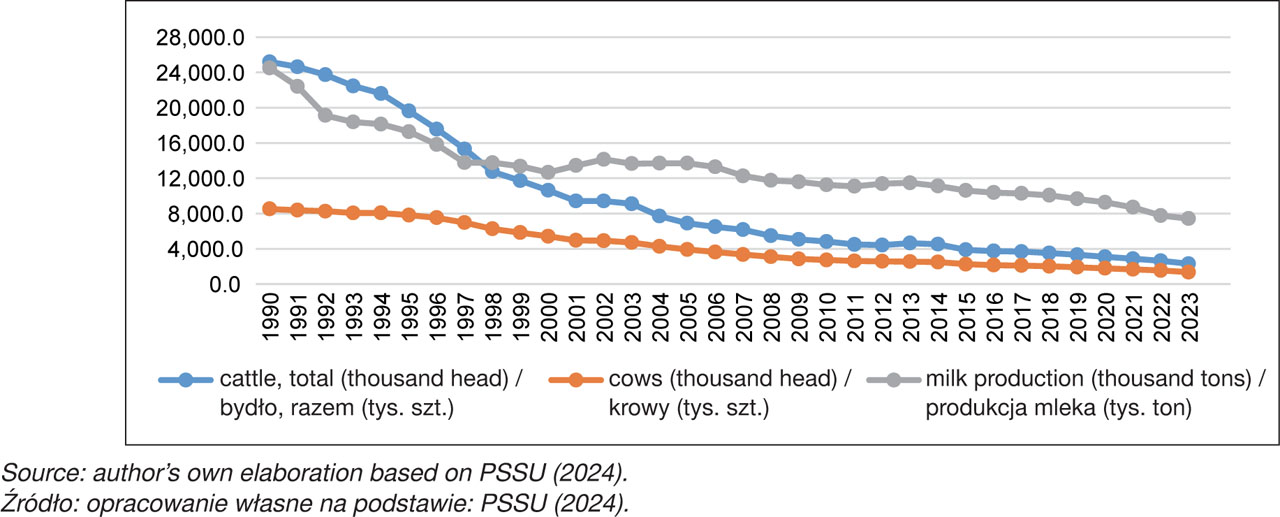
Figure 2.
Number of cattle, dairy cows, and milk production in Ukraine from 1990 to 2023
Wykres 2. Liczba bydła, krów mlecznych oraz produkcja mleka w Ukrainie, 1990–2023
In 2023, compared to 1990, the number of cows decreased by more than five times, and milk production by two thirds. Currently, milk in Ukraine is produced by agricultural enterprises, farms, and households. Despite a significant decrease in the number of cows in Ukrainian enterprises and farms, the volume of milk production between 2015 and 2023 practically did not change and oscillated between 2.67 and 2.77 million tons. This was facilitated by a significant increase in the productivity of cows kept in agricultural enterprises, which increased by 56.8% between 2010 and 2023 from 4.4 thousand kg of milk per cow in 2010 to 7.6 thousand kg of milk per cow in 2023 (see Figure 2).
The increase in productivity was facilitated by the use of modern, innovative production practices by commercial-scale agricultural enterprises. The productivity of cows in households in the 1990–2023 period was lower on average by 18–35% than the productivity of cows in agricultural enterprises (PSSU, 2024).
Households use inefficient traditional methods (high labor intensity), which is partially compensated by a cheaper production model (low own costs). Previous studies have established a direct correlation between the size of the cow herd and the profitability of dairy farming, which explains the concentration processes in the dairy industry that have been taking place in Ukraine since 2010 (Tulush et al., 2023).
In 2022, 140 enterprises had permits for the production of dairy products (Table 5). With the beginning of hostilities in February 2022, Ukrainian dairy processing lost 39 plants in the Kharkiv, Luhansk, Donetsk, Kherson, Mykolaiv, Sumy, and Zaporizhia regions (UDEU, 2024). Out of 140 processing plants, as of December 1, 2022, only 73 units were operating in Ukraine with a total production capacity of 4.9 million tons of raw milk per year. The processing capacity of dairies was secured by raw milk only by 55.0%, and the level of industrial milk processing in Ukraine in 2023 was at the level of 39.2% (PSSU, 2024).
Table 5.
Key indicators of the dairy industry of Ukraine
Tabela 5. Kluczowe wskaźniki branży mleczarskiej Ukrainy
| Specification / Wyszczególnienie | 2021 | 2022 | 2023 | Change in value 2023 to 2021/ Zmiana wartości 2023 do 2021 | |
|---|---|---|---|---|---|
| unit of measure / jednostka miary | 2021 = 100 | ||||
| Processing companies, units / Przedsiębiorstwa przetwórcze, jednostka | 178 | 140 | 112 | −66 | 62.9 |
| Milk production, million tons / Produkcja mleka, mln ton | 8.7 | 7.6 | 7.4 | −1.3 | 85.1 |
| Milk processing, million tons / Przetwórstwo mleka, mln ton | 3.2 | 2.7 | 2.9 | −0.3 | 90.6 |
| % | 36.8 | 35.5 | 39.2 | +2.4 | – |
| Production of main dairy products: / Produkcja głównych przetworów mlecznych: | |||||
| – liquid milk, thousand tons / mleko płynne, tys. ton | 1,046.0 | 771.0 | 820.0 | −226.0 | 78.4 |
| – butter, thousand tons / masło, tys. ton | 77.2 | 70.6 | 68.3 | −8.9 | 88.5 |
| – cheese, thousand tons / sery, tys. ton | 111.2 | 89.0 | 88.4 | −22.8 | 79.5 |
| – milk powder, thousand tons / mleko w proszku, tys. ton | 34.1 | 34.0 | 29.7 | −4.4 | 87.1 |
| – condensed milk, thousand tons / mleko skondensowane, tys. ton | 75.8 | 60.0 | 62.0 | −13.8 | 81.8 |
| Milk consumption per capita, kg / Konsumpcja mleka na osobę, kg | 201.5 | 200.0 | 198.0 | −3.5 | 98.3 |
[i] Source: author's own elaboration based on PSSU (2024).
[ii] Źródło: opracowanie własne na podstawie: PSSU (2024).
The low share of industrial milk processing in Ukraine is due to the specifics of its production structure, namely the large share of households (62% of total milk production). Households are self-sufficient, and the milk produced is mainly consumed by families or sold locally. Therefore, the share of households in industrial milk processing is only 6.8%, and that of agricultural enterprises accounts for 91.1% (PSSU, 2024). As a result, the reduction in milk production in households did not significantly affect the production of dairy products in industrial quantities.
In 2023, compared to 2021, the consumption of dairy products in terms of milk decreased by 1,427 thousand tons. The level of milk consumption per person in Ukraine is 29.2% lower compared to a similar indicator in the EU (Eurostat, 2023), and 28.3% lower compared to Poland (GUS, 2024). The reason for this is not only the outbreak of war and population migration, but also the decrease in the purchasing power of Ukrainians (PSSU, 2024). The self-sufficiency rate in the milk market in 2023 was 89.0%, which is 2.0 p.p. less than in 2021. The decrease in consumption did not mitigate the decrease in the self-sufficiency rate, because the latter is a consequence of a deep reduction in the cow herd as a result of restructuring processes.
Ukrainian regulations on the safety and quality of milk and dairy products are harmonized with European legislation (MPAiŻU, 2019). According to Ukrainian quality regulations, raw milk materials are divided into classes: extra, higher, first, second, and technical milk (PSTU, 2019). In 2023, agricultural enterprises produced 82.0% of milk of the extra and higher classes, households produced almost exclusively first class milk – 81.7% (PSSU, 2024). This indicates that milk produced in households is of lower quality due to the veterinary and/or sanitary practices used and cannot be processed in dairies. The main Ukrainian producers of dairy products (as well as international corporations) use modern technologies in production, e.g., fresh milk technology (pasteurization of milk at a low temperature of about 75°C for 30 seconds, which allows to preserve vitamins and useful microflora) and a quality and food safety management system that complies with the requirements of international standards ISO 9001 and ISO 22000 (UDEU, 2024).
The Ukrainian dairy industry mainly meets the needs of domestic markets, and only a small part of dairy products (5% of total milk production) is sold on foreign markets. In 2022, regardless of the beginning of hostilities, the Ukrainian dairy industry maintained a positive trade balance (+117 thousand tons). The main reason for this was a drastic decrease in consumption due to the large wave of migration of war refugees. In 2023, compared to 2022, exports decreased by 28.3%, and imports increased by 7.2%. As a result, the Ukrainian dairy industry remained a net importer with a result of 59 thousand tons (PSSU, 2024). The deterioration of the foreign trade balance in 2023 was influenced by a significant decrease in milk production (by 15.2%) compared to the pre-war 2021 and an increase in consumption. According to data from September 2023, about 1 million citizens returned to Ukraine from abroad (IOM, 2023). Traditional products of Ukrainian dairy exports are exchange products – butter, whey powder, casein, cheeses, and condensed and powdered milk (Table 6).
Table 6.
Ukrainian dairy exports between 2021 and 2023
Tabela 6. Ukraiński eksport przetworów mlecznych w latach 2021–2023
| Specification / Wyszczególnienie | 2021 | 2022 | 2023 | Change in value 2023 to 2021 (2021 = 100) / Zmiana wartości 2023 do 2021 (2021 = 100) | ||||
|---|---|---|---|---|---|---|---|---|
| thousand tons / tys. ton | mln EUR | thousand tons / tys. ton | mln EUR | thousand tons / tys. ton | mln EUR | thousand tons/ tys. ton | mln EUR | |
| Fluid milk and cream / Mleko płynne i śmietana | 14.9 | 8.9 | 29.4 | 16.7 | 28.3 | 15.4 | 189.9 | 173.0 |
| Condensed and powdered milk / Mleko skondensowane i w proszku | 22.4 | 49.1 | 26.7 | 91.8 | 27.7 | 63.6 | 123.7 | 129.5 |
| Yogurts and fermented drinks / Jogurty i napoje fermentowane | 5.5 | 7.4 | 3.1 | 4.8 | 3.4 | 3.9 | 61.8 | 52.7 |
| Whey / Serwatka | 22.2 | 19.5 | 15.3 | 16.1 | 16.2 | 10.5 | 73.0 | 53.8 |
| Butter and milk fats / Masło i tłuszcze mleczne | 10.9 | 44.7 | 14.1 | 83.3 | 6.3 | 31.7 | 57.8 | 70.9 |
| Cheese and curds / Sery i twarogi | 6.9 | 22.8 | 9.0 | 43.1 | 8.9 | 37.1 | 129.0 | 162.7 |
| Total / Razem | 82.8 | 152.4 | 97.6 | 255.8 | 90.8 | 162.2 | 109.7 | 106.4 |
| Total, raw milk equivalent / Razem, w przeliczeniu na mleko surowe | 369.0 | 519.0 | 372.0 | 100.8 | ||||
[i] Source: author's own elaboration based on PSSU (2024).
[ii] Źródło: opracowanie własne na podstawie: PSSU (2024).
Ukrainian exports of butter and milk fats in 2022 increased by 86.4% compared to 2021 to EUR 83.3 million, which allowed Ukraine to take first place among the countries supplying this product to the EU, even surpassing New Zealand (OEC, 2023). However, already in 2023 the export of butter and milk fats decreased to EUR 31.7 million. In 2023, compared to 2021, the export of liquid milk and cream, condensed milk, cheeses and cottage cheese increased. Currently, Ukrainian dairy products have access to the markets of EU countries, as well as countries such as Canada, Japan, South Korea, Great Britain, China, the countries of the Persian Gulf, and African countries. It is planned to open 11 more markets, including Chile, Indonesia, India, Costa Rica, Colombia, Brazil, Venezuela, etc. (PSUBŻiOK, 2024).
In the pre-war period, the geographical structure of Ukrainian dairy exports was dominated by the European Union (40–42%); in other regions, the export volume was distributed quite evenly: South America – 7%, Africa – 6%, Southeast Asia – 8%, the Middle East – 10%, China and East Asia – 14%, CIS – 17%. In 2022, not only the absolute dominance of dairy exports to the EU countries and the cessation of trade with Russia and Belarus was observed, but also a significant decrease in exports to the countries of Asia, Africa, and America. In 2023, Ukraine, out of the total export volume, exported 34.0% of dairy products to Moldova. Significant volumes were sold to Poland (8.0%), China (4.0%), Kazakhstan (3%) (PSSU, 2024).
EU imports of dairy products are actively spreading on the Ukrainian market. As a result of the decline in Ukrainian domestic production of dairy products, the import volume in 2023 compared to 2022 increased by 8.1% to the level of EUR 244.3 million (Table 7).
Table 7.
Ukrainian imports of dairy products between 2021 and 2023
Tabela 7. Ukraiński import przetworów mlecznych w latach 2021–2023
| Specification / Wyszczególnienie | 2021 | 2022 | 2023 | Change in value 2023 to 2021 (2021 = 100) / Zmiana wartości 2023 do 2021 (2021 = 100) | ||||
|---|---|---|---|---|---|---|---|---|
| thousand tons / tys. ton | mln EUR | thousand tons / tys. ton | mln EUR | thousand tons / tys. ton | mln EUR | thousand tons / tys. ton | mln EUR | |
| Fluid milk and cream / Mleko płynne i śmietana | 14.4 | 12.5 | 9.4 | 8.7 | 5.1 | 5.6 | 35.4 | 44.8 |
| Condensed and powdered milk / Mleko skondensowane i w proszku | 7.8 | 18.1 | 1.2 | 4.1 | 1.3 | 4.4 | 16.7 | 24.3 |
| Yogurts and fermented drinks / Jogurty i napoje fermentowane | 14.0 | 17.1 | 9.5 | 15.0 | 8.7 | 17.0 | 62.1 | 99.4 |
| Whey / Serwatka | 9.6 | 10.5 | 4.9 | 7.1 | 6.9 | 12.1 | 71.9 | 115.2 |
| Butter and milk fats / Masło i tłuszcze mleczne | 9.1 | 39.9 | 1.1 | 8.2 | 1.7 | 9.4 | 18.7 | 23.6 |
| Cheese and curds / Sery i twarogi | 55.2 | 232.6 | 33.8 | 182.9 | 33.7 | 195.8 | 61.1 | 84.2 |
| Total / Razem | 110.1 | 330.7 | 59.9 | 226.0 | 57.4 | 244.3 | 52.1 | 73.9 |
| Total, raw milk equivalent / Razem, w przeliczeniu na mleko surowe | 781.0 | 402.0 | 431.0 | 55.2 | ||||
[i] Source: author's own elaboration based on PSSU (2024).
[ii] Źródło: opracowanie własne na podstawie: PSSU (2024).
Ukraine's imports from the European Union countries in 2023 amounted to almost 98.7% of the total import. The largest amount of dairy products to Ukraine was exported by Poland (29,062.4 tons, 48.8%), Germany (10,681.7 tons, 17.9%), the Netherlands (3,932.2 tons, 6.6%), Belgium (3,540.2 tons, 5.9%), France (1,876.8 tons, 3.2%).
Foreign trade in dairy products of Ukraine shows a low share of exports in the production of dairy products and a low level of milk processing. This confirms the fact that the share of the Ukrainian dairy industry in the creation of products with high added value is very low, and the resources of production factors are used inefficiently.
The Competitive Position of Polish and Ukrainian Producers of Dairy Products on International Markets
The analysis of the competitiveness of Poland and Ukraine in trade in dairy products on international markets is based on the verification of indicators described by equations in Table 1 and concerns liquid milk and cream, condensed and powdered milk, yoghurts and fermented drinks, whey, butter and milk fats (Table 8).
Table 8.
Indicators of foreign trade competitiveness of selected dairy products of Poland and Ukraine between 2021 and 2023
Tabela 8. Wskaźniki konkurencyjności handlu zagranicznego wybranych produktów mlecznych Polski i Ukrainy w latach 2021–2023
| Dairy products / Produkty mleczne | Years / Lata | Poland / Polska | Ukraine / Ukraina | ||||||||
|---|---|---|---|---|---|---|---|---|---|---|---|
| TC | XRCA | MRCA | RTA | Evaluation / Ocena | TC | XRCA | MRCA | RTA | Evaluation / Ocena | ||
| Fluid milk and cream / Mleko płynne i śmietana | 2021 | 432.8 | 2.22 | 0.97 | 1.25 | + | 103.5 | 0.52 | 0.37 | 0.15 | +/− |
| 2023 | 387.7 | 1.67 | 1.12 | 0.55 | + | 554.9 | 1.09 | 0.24 | 0.85 | + | |
| Condensed and powdered milk / Mleko skondensowane i w proszku | 2021 | 117.3 | 1.53 | 3.14 | −1.61 | − | 287.2 | 6.84 | 1.50 | 5.34 | + |
| 2023 | 294.0 | 4.77 | 4.61 | 0.16 | + | 2,130.8 | 8.67 | 0.44 | 8.23 | + | |
| Yogurts and fermented drinks / Jogurty i napoje fermentowane | 2021 | 189.4 | 0.58 | 0.80 | −0.22 | − | 39.3 | 0.60 | 1.24 | −0.64 | − |
| 2023 | 230.6 | 0.60 | 0.76 | −0.16 | − | 39.1 | 0.33 | 1.49 | −1.16 | − | |
| Whey / Serwatka | 2021 | 178.4 | 2.97 | 4.13 | −1.16 | +/− | 231.3 | 7.39 | 1.74 | 5.65 | + |
| 2023 | 225.6 | 2.21 | 3.11 | −0.90 | +/− | 234.8 | 4.06 | 2.66 | 1.40 | + | |
| Butter and milk fats / Masło i tłuszcze mleczne | 2021 | 152.5 | 0.63 | 1.09 | −0.46 | − | 119.8 | 3.41 | 2.05 | 1.36 | + |
| 2023 | 344.2 | 2.73 | 0.75 | 1.98 | + | 370.6 | 1.79 | 0.71 | 1.08 | + | |
| Cheese and curds / Sery i twarogi | 2021 | 265.3 | 0.85 | 0.82 | 0.03 | +/− | 12.5 | 0.41 | 4.56 | −4.15 | − |
| 2023 | 238.2 | 0.68 | 0.85 | −0.17 | − | 26.4 | 0.46 | 6.04 | −5.58 | − | |
[i] Source: author's own calculations based on Eurostat (2024), GUS (2024), PSSU (2024).
[ii] Źródło: obliczenia własne na podstawie: Eurostat (2024), GUS (2024), PSSU (2024).
It can be stated that the Polish and Ukrainian dairy industries have a relative advantage over their partners on international markets, as evidenced by the TC coefficient indicators > 100 for liquid milk and cream, condensed and powdered milk, whey, butter and milk fats. Ukraine does not have a relative competitive advantage in the production of yoghurts and fermented drinks, as well as cheeses and cottage cheeses.
The existence of competitive advantages, as well as the occurrence of mutual competition between Polish and Ukrainian producers in the dairy industry, is indicated by XRCA indicators greater than 1 and a positive RTA indicator for the following products: liquid milk and cream, condensed and powdered milk, whey, butter and milk fats. Between 2021 and 2023, Poland had high comparative advantages in international trade in dairy products. In 2023, compared to 2021, the Polish dairy industry improved its competitive position for condensed and powdered milk and for butter and milk fats, but there was a deterioration in the competitive position for liquid milk and cream, cheeses and cottage cheeses.
The competitive position of the Ukrainian dairy industry in relation to Poland is assessed as moderately high. In 2023, compared to 2021, Ukraine improved its competitive position for liquid milk and cream and for condensed and powdered milk, but competitiveness deteriorated for whey and for butter and milk fats. Ukraine had higher comparative advantages than Poland on international markets in the case of trade in butter and milk fat, condensed and powdered milk, whey, which indicates a high or very high level of their mutual competitiveness. Poland has greater competitive advantages than Ukraine in the production of liquid milk and cream. There is no mutual competition between Poland and Ukraine in trade in cheeses and curds, as well as yoghurts and fermented drinks, as evidenced by MRCA indicators greater than 1 and a negative RTA indicator.
Results and Discussion
The analysis of milk and dairy production in Poland and Ukraine has shown that the Polish dairy industry is at a relatively higher level of development. Compared to Ukraine, the number of dairy cows in Poland is 848 thousand more, milk production is 5.5 million tons (73.3%) higher, and the average milk yield per cow is 1207 kg higher per year. The volume of raw milk material processed in the Polish dairy industry is 4.5 times higher than in Ukraine (10.1 million tons), which is primarily a consequence of the structure and production specialization of farms.
Poland is a major producer and exporter of dairy products among EU countries, recording a high self-sufficiency rate in milk production, an increase in the volume of supply, and a positive balance of dairy production turnover. However, Poland's production potential is not fully utilized, because the average milk yield of cows is lower than the EU average. Technological and breeding progress will contribute to the growth of dairy cow productivity, which will increase the volume and profitability of milk production. The introduction of innovations and new technologies will allow the Polish dairy industry to remain competitive and adapt to the changing dairy market (Polska Izba Mleka et al., 2025).
Milk production in Ukraine, including dairy products, does not meet the demand of the domestic market, as evidenced by low self-sufficiency. Ukraine has great potential for the development of dairy production, as evidenced by the number of cows kept in the early 1990s, favorable climatic conditions, and the ability to produce sufficient amounts of feed for cattle. The processing potential of the Ukrainian dairy industry is not fully utilized, which is largely influenced by the structure of farms that produce milk (a large share of households), the underload of processing plants with raw materials and the negative balance of foreign trade in dairy products.
It is quite difficult for Ukrainian dairy products to compete with dairy products from Polish producers, whose prices are comparable, despite the superior quality. The absence of price competitiveness affects the decrease in foreign sales.
The analysis of the XRCA index showed that there is a group of dairy products in which Ukraine had higher comparative advantages in exports than Poland (condensed and powdered milk, whey, and to a lesser extent butter and milk fats), which indicates a high or very high level of their mutual competitiveness in this area of trade. The basis of the new Export Strategy of Ukraine is to increase the added value of Ukrainian products through the development of processing and marketing in individual processing industries (CMU, 2024). The potential development (increase in milk production and processing level) of Ukrainian dairy industry may be one of the challenges for the Polish dairy industry.
Another challenge for Poland may be the rapid adaptation of producers and processors (especially large-scale ones) in Ukraine to trade conditions and EU standards. Ukrainian exporters have proven their ability to take advantage of market conditions in 2022 (as the butter trade clearly illustrates), and leading Ukrainian dairy producers are already using modern production technologies. The effect of increasing Ukrainian dairy production and its inflow in large quantities may be price disruptions in the agri-food markets of EU countries (mainly countries directly bordering Ukraine) and a decrease in the profitability of dairy production. As a result, some processing enterprises may decide not to continue their activities.
At the same time, opening the EU market for Ukraine may also open up new opportunities and chances for dairy producers. In the context of the Polish dairy industry, the main opportunities may be: reducing the cost of milk production by increasing the supply of cheaper raw materials of plant origin used as animal feed (this may result in an increase in milk production in Poland); expansion of Polish branded dairy products to the Ukrainian market; investments of Polish businesses in the Ukrainian agri-food market; development of transport and storage infrastructure in Poland.
Conclusions
The dairy industry of Poland, as well as Ukraine, occupies an important place in the economy and is an industry of strategic importance, ensuring food security and social stability of the country. Poland is completely self-sufficient in terms of dairy products, unlike Ukraine, which is struggling with a shortage of milk and its low quality. The outbreak of war in 2022 led to even greater problems in the dairy industry of Ukraine.
Ukraine is in the process of adapting to the requirements of EU law (including sustainable development), which, combined with the losses and destruction of war, will require significant investments. Adaptation to the sanitary standards set by the EU and post-war reconstruction will lead to a significant reduction in the existing differences in production costs and prices of raw materials in Ukraine. This will reduce the risk of excessive competition between Ukraine and the EU countries, especially in neighboring countries.
The Polish and Ukrainian dairy industries have opportunities to cooperate at the production stage (investments of Polish businesses in the Ukrainian market of agri-food products) and in trade in dairy products (combining the efforts of both countries in searching for new sales markets in third countries). This will enable deepening horizontal ties at the level of associations and agri-food producers of Poland and Ukraine.
Wstęp
Według raportu International Farm Comparison Network (IFCN) za rok 2023, przez ostatnie dziesięć lat obserwowany jest trwały światowy niedobór mleka (IFCN, 2024). To budzi poważne obawy oraz potwierdza krytyczną potrzebę zrównoważonych rozwiązań, które umożliwiłyby zwiększenie produkcji mleka, ale także uwzględniłyby rentowność ekonomiczną, odpowiedzialność społeczną i ochronę środowiskową.
Dla długotrwałego wzrostu gospodarczego branży mleczarskiej zrównoważony rozwój ma zasadnicze znaczenie, szczególnie dla państw Unii Europejskiej, które stosują przepisy wspólnej polityki rolnej (WPR) i Europejskiego Zielonego Ładu. Według raportu USDA (2024) wzmocnienie polityki UE w zakresie ochrony środowiska i łagodzenia zmian klimatu może wymagać dodatkowych inwestycji i jeszcze bardziej obniżyć rentowność chowu bydła mlecznego, co negatywnie wpłynie na decyzje rolników o kontynuowaniu produkcji, a wskutek tego – zmniejszy się podaż mleka surowego dla przetwórstwa. W maju 2024 r. Unia Europejska, z powodu obaw rolników, częściowo osłabiła lub przełożyła wdrażanie nowych przepisów w zakresie ochrony środowiska i łagodzenia zmian klimatu (Regulation, 2024b). Przedłużyła również bezcłowy i bezkwotowy dostęp dla ukraińskich produktów rolnych do rynku UE do 5 czerwca 2025 r. (Regulation, 2024a).
Kolejnym wyzwaniem dla branży mleczarskiej w 2022 r. był drastyczny wzrost światowych cen mleka średnio o 25,5% do poziomu 63,3 USD/100 kg w przeliczeniu na mleko skondensowane słodzone (IFCN, 2024). Wysokie wskaźniki cen mleka przełożyły się na krajowe ceny mleka w większości krajów świata. Średnia cena surowego mleka w UE w 2022 r. wzrosła o 35,1% w porównaniu z rokiem 2021. Spośród państw członkowskich UE, które są głównymi producentami mleka, wzrosty cen mleka w 2022 r. były wyższe niż średnia unijna w Holandii (+47,0%), Polsce (+46,9%) i Niemczech (+44,8%) (Eurostat, 2023).
Do takiej sytuacji doprowadził nie tylko ciągły wzrost cen pasz, nawozów i energii, niska dostępność mleka w większości krajów świata, a także wybuch wojny w Ukrainie. Zakłócenie łańcuchów dostaw zbóż z Ukrainy, było jednym z czynników wzrostu cen światowych na pasze dla zwierząt. Obecne napięcia dotyczące cen mleka w ciągu ostatniej dekady pokazują, że liberalizacja rynków oraz globalizacja i zależności rynków międzynarodowych mogą zwiększyć niestabilność rynku mleka i zmienność cen (IFCN, 2024).
W tym kontekście interesująca staje się analiza porównawcza przewag konkurencyjnych branży mleczarskiej zarówno dla Polski, jak i dla Ukrainy.
Celem artykułu jest zidentyfikowanie pozycji konkurencyjnej w handlu zagranicznym wybranych, głównych artykułów branży mleczarskiej Polski i Ukrainy w latach 2021 i 2023, biorąc pod uwagę aktualne wyzwania: wybuch wojny w 2022 r. oraz zakłócenia cenowe na rynku mleka i produktów mlecznych w latach 2022–2023.
Przeprowadzone wcześniej badania wykazały, że Ukraina wobec Polski w latach 2005–2015 straciła większość swoich przewag komparatywnych w handlu produktami rolno-spożywczymi (oprócz zbóż i olejów). Ukraina dostarcza na rynki głównie surowce i jest dość znacznym konsumentem produkcji o wysokiej wartości dodanej (Horin i Krzyżanowski, 2016).
Dotychczasowa analiza pozycji konkurencyjnej Polski i Ukrainy we wzajemnym handlu wykazała, że Polska posiada przewagi komparatywne w eksporcie na Ukrainę w 12 grupach produktów (najwyższe wskaźniki: zwierzęta żywe, mięso i podroby, warzywa, owoce, przetwory z warzyw i owoców, przetwory zbożowe i wyroby cukiernicze), z kolei Ukraina była konkurencyjna na rynku polskim w eksporcie 10 grup produktów (najwyższe wskaźniki: nasiona i owoce oleiste, przetwory z warzyw i owoców, tłuszcze i oleje roślinne oraz zwierzęce, odpady i pasze, zboża) (Kosior i in., 2017). Pod tym względem niniejsze badanie jest pionierskie, ponieważ pozwoli ocenić przewagi komparatywne Polski i Ukrainy w eksporcie wybranych, głównych przetworów mlecznych (mleko płynne i śmietana, mleko skondensowane i w proszku, jogurty i napoje fermentowane, serwatka, masło i tłuszcze mleczne, sery i twarogi), co może służyć do tworzenia strategii rozwoju kierunków handlowych polskiej branży mleczarskiej.
Materiał i metody
W badaniach wykorzystano dane statystyczne pochodzące z bazy Urzędu Statystycznego Wspólnot Europejskich (Eurostat), Głównego Urzędu Statystycznego Polski oraz Państwowej Służby Statystycznej Ukrainy (PSSU). Analizą objęto: 1) pogłowie krów oraz ich wydajność mleczną w Polsce, w UE i w Ukrainie; 2) dynamikę produkcji mleka w Polsce i w Ukrainie; 3) produkcję, eksport oraz import głównych przetworów mlecznych, sklasyfikowanych według Scalonej Nomenklatury Towarowej Handlu Zagranicznego CN (Combined Nomenclature) (mleko płynne i śmietana, mleko skondensowane i w proszku, jogurty i napoje fermentowane, serwatka, masło i tłuszcze mleczne, sery i twarogi) w Polsce i w Ukrainie (United Nations, 2000). Przedmiotem badań były wyniki produkcyjne oraz handlowe polskiej i ukraińskiej branży mleczarskiej. Zakres czasowy analizy poziomu konkurencyjności, wyznaczony momentem wybuchu wojny w Ukrainie w 2022 r., dotyczył lat 2021 i 2023.
Do oceny poziomu wzajemnej konkurencyjności polskiej i ukraińskiej branży mleczarskiej na rynkach zagranicznych (unijnym i pozaunijnym) wykorzystano wskaźnik pokrycia importu eksportem (TC), wskaźniki ujawnionych przewag komparatywnych, w tym indeks relatywnej komparatywnej przewagi eksportu (XRCA), indeks relatywnej chłonności importu (MRCA) i indeks relatywnej przewagi handlu (RTA) (tab. 1).
Współczynnik TC > 100 oznacza, że badany kraj dysponuje względną przewagą nad partnerami (Vollrath, 1989). Uwzględniając wyłącznie eksport i import analizowanego kraju, wskaźnik TC jest miarą „wewnętrznej” przewagi komparatywnej, jednak zastosowany łącznie z omawianymi poniżej wskaźnikami staje się „bardziej użytecznym narzędziem analizy konkurencyjności” (Pawlak, 2013, s. 335).
Podejście do analizy ujawnionych przewag komparatywnych zbudowane zostało na koncepcji Balassy (1965) oraz na zmodyfikowanych przez Vollratha (1989) wskaźnikach XRCA, MRCA i RTA. Istota wskaźnika RCA opiera się na założeniu, że przewagi komparatywne kraju znajdują odzwierciedlenie w strukturze handlu zagranicznego. Stosowanie metody Vollratha ocenia się jako bardziej precyzyjne, ponieważ mierniki XRCA eliminują problem podwójnego liczenia produktów (Pawlak, 2013). Kiedy wskaźnik RTA ≥ 0, a wskaźnik XRCA ≥ 1, świadczy to o wysokiej konkurencyjności (+), gdy wskaźnik RTA < 0, a MRCA ≥ 1, badany kraj wykazuje brak konkurencyjności (–). W pozostałych przypadkach wyniki analizy nie są tak jednoznaczne (+/−) (Frohberg, 2000).
Wiadomo, że wskaźnik konkurencyjności jest względny i aby go określić, można porównać tylko produkty tego samego typu. Na podstawie powyższego wskaźniki XRCA, MRCA i RTA zostały wykorzystane do oceny konkurencyjności rynkowej wybranych, głównych produktów branży mleczarskiej Polski i Ukrainy na rynkach międzynarodowych.
Przegląd literatury
Konkurencja (łac. concurrentia – współzawodnictwo, rywalizacja) jest podstawową kategorią ekonomiczną, w związku z czym ta kwestia była w centrum uwagi szerokiego grona znanych ekonomistów. Istnieje wiele interpretacji pojęcia konkurencji. Według Knighta (1935) konkurencja to proces rywalizacji dużej liczby niezależnych producentów i nabywców danego produktu, co daje każdemu możliwość handlowania z określonymi jednostkami i wyboru, z jego punktu widzenia, najlepszych warunków spośród zaproponowanych w celu zaspokojenia jego interesów ekonomicznych. Schumpeter (1933) twierdził, że konkurencja jest rywalizacją starego z nowym. Zysk przedsiębiorcy postrzegał jako wynik dynamicznych zmian w gospodarce, jakie zachodzą na skutek działalności innowacyjnej. Efektem konkurencji jest konkurencyjność, która wskazuje, w jaki sposób przedsiębiorstwa rywalizują na rynku o przychylność klientów (Beyer, 2012).
Różnorodność definicji konkurencyjności uzasadniona jest szerokim zakresem badań oraz przyjętym poziomem analizy: mikro-, mezo- i makroekonomicznej, wśród których można wyodrębnić konkurencyjność międzynarodową, narodową, regionalną, sektorową czy też konkurencyjność przedsiębiorstw (Daszkiewicz, 2008). Stankiewicz (2000) uważa, że konkurencyjność przedsiębiorstw to system współtworzony przez cztery elementy: potencjał konkurencyjności, przewagę konkurencyjną, instrumenty konkurowania, pozycję konkurencyjną. Konkurencyjność gospodarstwa rolnego wynika z umiejętności przystosowania się do zmian zachodzących w otoczeniu, która pozwala na skuteczniejsze osiąganie celów w stosunku do innych producentów rolnych (Nowak, 2016). Przedsiębiorstwo rolnicze jest uważane za konkurencyjne wtedy, gdy zapewnia rolnikowi uzyskanie przynajmniej dochodu parytetowego, dodatniego dochodu z zarządzania i dodatniej stopy inwestowania netto (Ziętara, 2014).
Organizacja Współpracy Gospodarczej i Rozwoju (OECD, 2008) określa konkurencyjność jako miarę przewagi lub słabości kraju w sprzedaży jego produktów na rynkach międzynarodowych. Na poziomie krajowym konkurencyjność jest rozumiana jako stopień, w jakim państwo i instytucje państwowe sprzyjają przedsiębiorczości oraz tworzą środowisko i stosują odpowiednie instrumenty, które wspierają zakładanie i prowadzenie działalności gospodarczej (Piotrowska, 2019). Konkurencyjność polskich producentów jest definiowana jako „zdolność lokowania się krajowych producentów na rynkach zagranicznych i zdolność rozwijania eksportu” (Szczepaniak, 2008, s. 116).
W krajach wysoko rozwiniętych, jak i rozwijających się, szczególną rolę przypisuje się relacjom między konkurencyjnością i innowacyjnością oraz zwiększeniu roli innowacji w kreowaniu tzw. trwałej konkurencyjności (sustaining competitiveness) (Mytelka, 1999; Wysokińska, 2002). Dla producentów branży mleczarskiej konkurencyjność technologiczna oraz rozwój innowacji mają zasadnicze znaczenie, ponieważ umożliwiają im uzyskiwać oraz utrzymywać trwałą konkurencyjność w sferze dystrybucji towarów na rynkach międzynarodowych.
Badania wykazały, że przemysł mleczarski charakteryzuje się wysokim poziomem konkurencji pomiędzy istniejącymi podmiotami gospodarczymi (Gralak i in., 2022). Determinuje to konieczność wdrażania nowoczesnych strategii rozwoju firm mleczarskich oraz doskonalenia i adaptacji asortymentu produktów mlecznych do potrzeb konsumentów. Zmiany otoczenia konkurencyjnego przedsiębiorstw przemysłu mleczarskiego oraz obowiązujące ich przepisy ekologiczne wymagają kreowania umiejętności szybkiego reagowania na zachodzące zmiany i adaptacji do wyzwań rynków krajowych i globalnych.
Potencjał polskiej branży mleczarskiej na tle UE-27
Unia Europejska jest znaczącym producentem mleka i przetworów mlecznych, a jej państwa członkowskie są zintegrowane we wspólnej organizacji rynku (WOR). Wszystkie kraje UE produkują mleko, którego udział w całej produkcji rolnej ma istotne znaczenie. Gospodarstwa rolne UE w 2023 r. wyprodukowały 160,8 mln ton mleka krowiego. Głównymi producentami mleka są: Niemcy, Francja, Polska, Holandia i Włochy. Razem odpowiadają za niemal 64% produkcji mleka krowiego w UE, w tym Polska prawie za 10% (Eurostat, 2023) (wykr. 1).
Pogłowie krów mlecznych w UE-27 w ostatnich latach zmniejsza się, ale rośnie wydajność od jednej krowy. W 2023 r. było 19,7 mln krów mlecznych, o 1,7% mniej niż w 2022 r., ale średnia wydajność od jednej krowy w 2023 r. wzrosła o 2,7%. W Polsce w 2023 r. pogłowie krów wzrosło o 1,5% w porównaniu z rokiem poprzednim i osiągnęło poziom 2,2 mln sztuk, a wydajność od jednej krowy wzrosła o 1,5%. Samowystarczalność produkcji mleka w UE-27 oraz w Polsce jest na bardzo wysokim poziomie i w 2023 r., w porównaniu z rokiem 2022, w UE-27 wzrosła o 1,7% do poziomu 116,2%, a w Polsce wzrosła o 0,9% do poziomu 123,5% (Eurostat, 2023). Liczba mleczarni w Polsce w ostatnich latach zmniejsza się, ale wzrasta ich moc przetwórcza (tab. 2).
W 2023 r. liczba zakładów przetwórczych w porównaniu z rokiem 2021 zmniejszyła się o 9 jednostek (o 6,3%), ale ilość przetworzonego mleka zwiększyła się o 0,5 mln ton i osiągnęła poziom 82%. Sprzyjał temu w 2023 r. w porównaniu do roku 2021, wzrost produkcji mleka o 0,6 mln ton (o 4,0%). W analizowanym okresie zwiększyła się produkcja masła (o 10,7%), mleka w proszku (o 2,6%), serów (0,8%), nieznacznie spadła produkcja mleka skondensowanego (o 1,8%) oraz mleka płynnego (o 2,1%). Średnio w 2023 r., w porównaniu z rokiem 2021, produkcja głównych przetworów mlecznych w Polsce spadła tylko o 0,2%, a udział w produkcji unijnej się nie zmienił i pozostał na poziomie 8,9% (Eurostat, 2023). Konsumpcja mleka na osobę w Polsce w 2023 r. w porównaniu z 2021 r. wzrosła o 10,0% do 276 kg.
Eksport Polski w 2023 r. w porównaniu z 2022 r. spadł o 8,3% do poziomu 3,3 mld EUR, a import spadł o 3,1% do poziomu 1,7 mld EUR. Krajowa branża mleczarska pozostała eksporterem netto, ale dodatnie saldo w ujęciu ilościowym zmniejszyło się o 20,0 tys. ton (w ekwiwalencie surowca), a w ekwiwalencie pieniężnym – o 0,3 mld EUR (GUS, 2024). Przyczyną spadku bilansu handlowego rok do roku był wzrost wewnętrznego popytu oraz spadek światowych i unijnych cen produktów mlecznych (Szajner, 2024).
W strukturze geograficznej polskiego eksportu z 2023 r. udział krajów członkowskich UE wynosił 62,8%, udział Wspólnoty Niepodległych Państw (WNP) oraz Europy Środkowo-Wschodniej 4,3%, udział państw rozwijających się 18,3%, udział krajów rozwiniętych 14,6%. Wśród głównych importerów spoza UE w 2023 r. były: Algieria (153,6 mln EUR), Wielka Brytania (158,9 mln EUR), Chiny (93,9 mln EUR), Stany Zjednoczone (89,4 mln EUR) oraz Ukraina (114,7 mln EUR) (KOWR, 2024). W strukturze geograficznej polskiego importu w roku 2023 udział krajów członkowskich UE wynosił 94,4%, udział państw WNP oraz Europy Środkowo-Wschodniej 2,3%, udział krajów rozwiniętych 3,3%. W 2023 r. Ukraina wyeksportowała do Polski produkty mleczne o wartości 32,0 mln EUR (KOWR, 2024).
W 2023 r. eksport poszczególnych grup towarowych produktów mlecznych, w porównaniu z 2021 r., wykazywał zróżnicowane tendencje (tab. 3). Wzrost wywozu w ekwiwalencie ilościowym dotyczył mleka skondensowanego i w proszku, jogurtów i napojów fermentowanych, masła i tłuszczów mlecznych. Spadek wywozu w ekwiwalencie ilościowym dotyczył mleka płynnego i śmietany, serwatki, serów i twarogów, lodów, kazeiny. Średnio w 2023 r. ilość eksportu wzrosła – o 12,5% (227,2 tys. ton), a w ujęciach wartościowych był obserwowany wyższy wzrost o 24,9% (653,4 mln EUR).
W 2023 r., w porównaniu z rokiem 2021, w ujęciu ilościowym zwiększył się import mleka płynnego i śmietany o 6,4%, mleka skondensowanego i w proszku o 13,9%, serów i twarogów o 8,8%, kazeiny o 2,8% (tab. 4). Średnio był odnotowany spadek importu o 1,8% (13,0 tys. ton), poprzez spadek wywozu jogurtów i napojów fermentowanych o 5,4%, serwatki o 26,8%, masła i tłuszczów mlecznych o 33,0%, lodów o 7,4%. W ujęciu wartościowym import w 2023 r. w porównaniu z rokiem 2022 znacznie wzrósł – o 30,6% (o 403,1 mln EUR).
Znaczny wzrost eksportu i importu w ujęciach wartościowych był wynikiem wyższych cen transakcyjnych, przede wszystkim cen mleka płynnego i śmietany, mleka skondensowanego i w proszku, serwatki, masła i tłuszczów mlecznych, kazeiny. W 2023 r. produkty mleczne o wysokim stopniu przetworzenia stanowiły 63,5% w strukturze towarowej polskiego eksportu przetworów mlecznych. To potwierdza fakt, że polska branża mleczarska tworzy produkty o wysokiej wartości dodanej i efektywnie wykorzystuje zasoby czynników produkcji.
Potencjał ukraińskiej branży mleczarskiej
Przemysł mleczarski Ukrainy znajduje się w kryzysie, którego głównym objawem jest zmniejszenie pogłowia krów na przestrzeni ostatnich trzydziestu lat (wykr. 2).
W 2023 r. w porównaniu do 1990 r. liczba krów zmniejszyła się ponad pięciokrotnie, a produkcja mleka o dwie trzecie. Obecnie mleko w Ukrainie produkowane jest przez przedsiębiorstwa rolne, gospodarstwa rolne oraz gospodarstwa domowe. Pomimo znacznego spadku pogłowia krów w ukraińskich przedsiębiorstwach oraz gospodarstwach rolnych, wielkość produkcji mleka w latach 2015–2023 praktycznie nie uległa zmianie i oscylowała w granicach 2,67–2,77 mln ton. Sprzyjał temu znaczny wzrost wydajności krów utrzymywanych w przedsiębiorstwach rolnych, która w latach 2010–2023 wzrosła o 56,8% – z 4,4 tys. kg mleka na krowę w 2010 r. do 7,6 tys. kg mleka na krowę w 2023 r. (por. wykr. 2).
Wzrostowi wydajności sprzyjało stosowanie nowoczesnych, innowacyjnych praktyk produkcyjnych przez wielkotowarowe przedsiębiorstwa rolne.
Wydajność krów w gospodarstwach domowych w okresie lat 1990–2023 była niższa średnio o 18–35% od wydajności krów w przedsiębiorstwach rolnych (PSSU, 2024). Gospodarstwa domowe stosują nieefektywne tradycyjne metody (wysoka pracochłonność), co częściowo rekompensuje tańszy model produkcji (niskie koszty własne). Prowadzone wcześniej badania wykazały bezpośrednią korelację między wielkością pogłowia krów a rentownością mleczarstwa, co wyjaśnia zachodzące w Ukrainie od 2010 r. procesy koncentracji w branży mleczarskiej (Tulush i in., 2023).
W 2022 r. pozwolenia na produkcję przetworów mlecznych posiadało 140 zakładów (tab. 5). Wraz z początkiem działań wojennych w lutym 2022 r. ukraińskie przetwórstwo mleczne straciło 39 zakładów w obwodach: charkowskim, ługańskim, donieckim, chersońskim, mikołajowskim, sumskim i zaporoskim (UDEU, 2024). Ze 140 zakładów przetwórczych na dzień 1 grudnia 2022 r w Ukrainie działały tylko 73 jednostki o łącznej mocy produkcyjnej 4,9 mln ton surowców rocznie. Moce przetwórcze mleczarń zabezpieczone były surowcem mlecznym tylko w 55,0%, a poziom przemysłowego przetwórstwa mleka w Ukrainie w 2023 r. kształtował się na poziomie 39,2% (PSSU, 2024).
Niski udział przemysłowego przetwórstwa mleka w Ukrainie wynika ze specyfiki struktury jego produkcji, a mianowicie z dużego udziału gospodarstw domowych (62% całkowitej produkcji mleka). Gospodarstwa domowe mają charakter samowystarczalny, a produkowane mleko jest głównie spożywane przez rodziny lub sprzedawane lokalnie. Dlatego udział gospodarstw domowych w przemysłowym przetwórstwie mleka wynosi zaledwie 6,8%, a przedsiębiorstw rolnych 91,1% (PSSU, 2024). Wskutek tego, zmniejszenie produkcji mleka w gospodarstwach domowych nie wpłynęło znacząco na produkcję przetworów mlecznych w ilościach przemysłowych.
W 2023 r. w porównaniu z 2021 r. konsumpcja przetworów mlecznych w przeliczeniu na mleko spadła o 1 427 tys. ton. Poziom spożycia mleka na osobę w Ukrainie jest niższy o 29,2% w porównaniu z podobnym wskaźnikiem w UE (Eurostat, 2023), i o 28,3% niższy w porównaniu z Polską (GUS, 2024). Powodem tego jest nie tylko wybuch wojny i migracja ludności, ale także spadek siły nabywczej Ukraińców (PSSU, 2024). Wskaźnik samowystarczalności na rynku mleka w roku 2023 wynosił 89,0%, czyli o 2,0 pkt proc. mniej niż w roku 2021. Spadek konsumpcji nie złagodził spadku wskaźnika samowystarczalności, ponieważ ten drugi jest konsekwencją głębokiej redukcji pogłowia krów w wyniku procesów restrukturyzacyjnych.
Ukraińskie przepisy, dotyczące bezpieczeństwa i jakości mleka oraz przetworów mlecznych są zharmonizowane z ustawodawstwem europejskim (MPAiŻU, 2019). Surowiec mleczny według ukraińskich przepisów jakościowych jest podzielony na klasy: „ekstra”, „wyższa”, „pierwsza”, „druga” oraz mleko techniczne (PSTU, 2019). Przedsiębiorstwa rolne w 2023 r. wytwarzały 82,0% mleka klasy „extra” i klasy „wyższej”, gospodarstwa domowe wytwarzały niemal wyłącznie mleko klasy „pierwszej” – 81,7% (PSSU, 2024). To świadczy o tym, że mleko produkowane w gospodarstwach domowych jest gorszej jakości ze względu na stosowane praktyki weterynaryjne i/lub sanitarne i nie może być przetwarzane w mleczarniach. Główni ukraińscy producenci przetworów mlecznych (jak również korporacje międzynarodowe) stosują nowoczesne technologie w produkcji, np. fresh milk technology (pasteryzacja mleka w niskiej temperaturze ok. 75°C w ciągu 30 sekund, co pozwala zachować witaminy i użyteczną mikroflorę) oraz system zarządzania jakością i bezpieczeństwem żywności zgodny z wymaganiami międzynarodowych norm ISO 9001 i ISO 22000 (UDEU, 2024).
Ukraińska branża mleczarska zaspokaja głównie potrzeby rynków wewnętrznych i tylko nieznaczna część przetworów mlecznych (5% produkcji mleka ogółem) jest sprzedawana na rynkach zagranicznych. W 2022 r., bez względu na początek działań wojennych, ukraińskie mleczarstwo pozostało eksporterem netto (+117 tys. ton). Głównym powodem tego był drastyczny spadek konsumpcji przez wielką falę migracji uchodźców wojennych. W 2023 r. w porównaniu z 2022 r. eksport zmniejszył się o 28,3%, a import zwiększył się o 7,2%. W rezultacie ukraińska branża mleczarska pozostała importerem netto z wynikiem 59 tys. ton (PSSU, 2024). Na pogorszenie bilansu handlu zagranicznego w 2023 r. wpłynął znaczący spadek produkcji mleka (o 15,2%) w porównaniu z przedwojennym 2021 r. oraz wzrost konsumpcji. Według danych z września 2023 r., do Ukrainy z zagranicy wróciło około 1 mln obywateli (IOM, 2023). Tradycyjnymi produktami ukraińskiego eksportu mleczarstwa są produkty giełdowe – masło, serwatka w proszku, kazeina, sery oraz mleko skondensowane i w proszku (tab. 6).
Ukraiński eksport masła i tłuszczów mlecznych w 2022 r. wzrósł w porównaniu z 2021 r. o 86,4% do poziomu 83,3 mln EUR, co pozwoliło Ukrainie zająć pierwsze miejsce wśród krajów dostarczających ten produkt do UE, wyprzedzając nawet Nową Zelandię (OEC, 2023). Ale już w 2023 r. eksport masła i tłuszczów mlecznych spadł do poziomu 31,7 mln EUR. W 2023 r. w porównaniu z 2021 r. wzrósł eksport mleka płynnego i śmietany, mleka skondensowanego, serów i twarogów. Obecnie ukraińskie przetwory mleczne mają dostęp do rynków krajów UE, a także takich krajów, jak: Kanada, Japonia, Korea Płd., Wielka Brytania, Chiny, kraje Zatoki Perskiej i kraje afrykańskie. Planowane są otwarcia 11 kolejnych rynków, w tym: Chile, Indonezja, Indie, Kostaryka, Kolumbia, Brazylia, Wenezuela itp. (PSUBŻiOK, 2024).
W okresie przedwojennym w strukturze geograficznej eksportu ukraińskich przetworów mlecznych dominowała Unia Europejska (40–42%); w pozostałych regionach wolumen eksportu rozkładał się dość równomiernie: Ameryka Południowa – 7%, Afryka – 6%, Azja Południowo-Wschodnia – 8%, Bliski Wschód – 10%, Chiny i Azja Wschodnia – 14%, WNP – 17%. W 2022 r. zaobserwowano nie tylko absolutną dominację eksportu produktów mleczarskich do krajów UE i zaprzestanie handlu z Rosją i Białorusią, ale także znaczny spadek eksportu do krajów Azji, Afryki i Ameryki. W 2023 r. Ukraina z całkowitego wolumenu eksportu, wyeksportowała do Mołdawii 34,0% przetworów mlecznych. Znaczące wolumeny były sprzedawane do Polski (8,0%), do Chin (4,0%), Kazachstanu (3%) (PSSU, 2024).
Na rynku ukraińskim aktywnie rozprzestrzenia się unijny import produktów mlecznych. W wyniku spadku ukraińskiej krajowej produkcji przetworów mlecznych, wolumen importu w 2023 r. w porównaniu z 2022 r. wzrósł o 8,1% do poziomu 244,3 mln EUR (tab. 7).
Import Ukrainy z państw Unii Europejskiej w 2023 r. wyniósł prawie 98,7% całości importu. Najwięcej przetworów mlecznych do Ukrainy wyeksportowała Polska (29 062,4 t, 48,8%), Niemcy (10 681,7 t, 17,9%), Holandia (3932,2 t, 6,6%), Belgia (3540,2 t, 5,9%), Francja (1876,8 t, 3,2%).
Handel zagraniczny przetworami mlecznymi Ukrainy pokazuje niski udział eksportu w produkcji przetworów mlecznych oraz niski poziom przetwarzania mleka. To potwierdza fakt, że udział ukraińskiej branży mleczarskiej w tworzeniu produktów o wysokiej wartości dodanej jest bardzo niski, a zasoby czynników produkcji są wykorzystane nieefektywnie.
Pozycja konkurencyjna polskich i ukraińskich producentów produktów mlecznych na rynkach międzynarodowych
Analiza konkurencyjności Polski i Ukrainy w handlu produktami mlecznymi na rynkach międzynarodowych opiera się na weryfikacji wskaźników opisanych równaniami w tabeli 1 i dotyczy mleka płynnego i śmietany, mleka skondensowanego i w proszku, jogurtów i napojów fermentowanych, serwatki, masła i tłuszczów mlecznych (tab. 8).
Można stwierdzić, że polska i ukraińska branża mleczarska na rynkach międzynarodowych dysponuje względną przewagą nad partnerami, o czym świadczą wskaźniki współczynnika TC > 100 dla mleka płynnego i śmietany, mleka skondensowanego i w proszku, serwatki, masła i tłuszczów mlecznych. Ukraina nie dysponuje względną przewagą konkurencyjną w produkcji jogurtów i napojów fermentowanych oraz serów i twarogów.
Na istnienie przewag konkurencyjnych, a także występowanie wzajemnej konkurencji polskich i ukraińskich producentów w branży mleczarskiej wskazują wskaźniki XRCA większe od 1 oraz dodatni wskaźnik RTA dotyczący następujących wyrobów: mleko płynne i śmietana, mleko skondensowane i w proszku, serwatka, masło i tłuszcze mleczne. W latach 2021–2023 Polska miała wysokie przewagi komparatywne w międzynarodowym handlu przetworami mlecznymi. W 2023 r. w porównaniu z rokiem 2021 polska branża mleczarska polepszyła swoją pozycję konkurencyjną dla mleka skondensowanego i w proszku oraz dla masła i tłuszczów mlecznych, ale nastąpiło pogorszenie pozycji konkurencyjnej dla mleka płynnego i śmietany, serów i twarogów. Pozycja konkurencyjna ukraińskiej branży mleczarskiej wobec polskiej jest oceniana, jako umiarkowanie wysoka. W 2023 r. w porównaniu z rokiem 2021 Ukraina polepszyła swoją pozycję konkurencyjną dla mleka płynnego i śmietany oraz dla mleka skondensowanego i w proszku, ale konkurencyjność pogorszyła się dla serwatki oraz dla masła i tłuszczów mlecznych.
Ukraina posiada wyższe od Polski przewagi komparatywne na rynkach międzynarodowych w przypadku handlu masłem i tłuszczem mlecznym, mlekiem skondensowanym i w proszku, serwatką, co świadczy o wysokim lub bardzo wysokim poziomie ich wzajemnej konkurencyjności. Większe przewagi konkurencyjne od Ukrainy Polska ma w produkcji mleka płynnego i śmietany. Wzajemna konkurencja pomiędzy Polską a Ukrainą nie występuje w handlu serami i twarogami oraz jogurtami i napojami fermentowanymi, o czym świadczą wskaźniki MRCA większe od 1 oraz ujemny wskaźnik RTA.
Wyniki i dyskusja
Przeprowadzona analiza produkcji mleka i przetworów mlecznych w Polsce i w Ukrainie wykazała, że polska branża mleczarska znajduje się na relatywnie wyższym poziomie rozwoju. W porównaniu z Ukrainą, pogłowie krów mlecznych Polski jest większe o 848 tys. szt., produkcja produkcja mleka wyższa o 8,1 mln ton (o 108,5%) lub (o 2,1 razy), a średnia wydajność od jednej krowy wyższa o 1207 kg mleka rocznie. Wolumen przetwórstwa surowca mlecznego polskiej branży mleczarskiej jest wyższy od ukraińskiej 4,5 razy (o 10,1 mln ton), co jest przede wszystkim konsekwencją struktury i specjalizacji produkcyjnej gospodarstw rolnych.
Polska jest liczącym się producentem i eksporterem produktów mlecznych wśród państw unijnych, odnotowując wysoki wskaźnik samowystarczalności w produkcji mleka, wzrost wolumenu podaży oraz dodatnie saldo obrotów produkcji mleczarskiej. Ale potencjał produkcyjny Polski nie jest w pełni wykorzystany, ponieważ średnia wydajność mleczna krów jest mniejsza niż średnia w UE. Postęp technologiczny i hodowlany będzie sprzyjał wzrostowi wydajności krów mlecznych, wskutek czego wzrośnie wolumen oraz opłacalność produkcji mleka. Wprowadzanie innowacji i nowych technologii pozwoli polskiemu przemysłowi mleczarskiemu zachować konkurencyjność i zdolność dostosowania się do zmieniającego się rynku mleczarskiego (Polska Izba Mleka i in., 2025).
Produkcja mleka w Ukrainie, w tym przetworów mlecznych nie pokrywa zapotrzebowania rynku wewnętrznego, co skutkuje niską samowystarczalnością. Ukraina ma duży potencjał do rozwoju mleczarstwa, o czym świadczy ilość utrzymywanych krów na początku lat 90., sprzyjające warunki klimatyczne oraz możliwość produkowania wystarczającej ilości paszy dla bydła. Potencjał przetwórczy branży mleczarskiej Ukrainy nie jest w pełni wykorzystywany, na co wpływa w dużym stopniu struktura gospodarstw, jakie produkują mleko (duży udział gospodarstw domowych), niedociążenie zakładów przetwórczych surowcem oraz ujemne saldo handlu zagranicznego produktami mlecznymi.
Ukraińskim przetworom mlecznym dość trudno konkurować z nabiałem polskich producentów, którego cena jest prawie na tym samym poziomie przy wyższej jakości. Brak przewagi cenowej wpływa na spadek sprzedaży zagranicznej.
Analiza wskaźnika XRCA wykazała, że istnieje grupa produktów mlecznych, w przypadku których Ukraina posiada wyższe od Polski przewagi komparatywne w eksporcie (mleko skondensowane i w proszku, serwatka, w mniejszym stopniu masło i tłuszcze mleczne), co świadczy o wysokim lub bardzo wysokim poziomie ich wzajemnej konkurencyjności w tym obszarze handlu. Podstawą nowej Strategii Eksportowej Ukrainy jest zwiększenie wartości dodanej ukraińskich produktów poprzez rozwój przetwórstwa i marketingu w poszczególnych branżach przetwórczych (CMU, 2024). Potencjalny rozwój (wzrost produkcji mleka i poziomu przetwórstwa) ukraińskiego mleczarstwa może być jednym z wyzwań dla polskiej branży mleczarskiej.
Kolejnym wyzwaniem dla Polski może być szybkie dostosowywanie się producentów i przetwórców (szczególnie wielkotowarowych) w Ukrainie do warunków handlowych oraz do standardów UE. Ukraińscy eksporterzy udowodnili swoją umiejętność w wykorzystaniu warunków rynkowych w 2022 r. (co jaskrawo ilustruje handel masłem), a wiodący ukraińscy producenci przetworów mlecznych już stosują nowoczesne technologie produkcji. Skutkiem zwiększenia ukraińskiej produkcji mleczarskiej i jej napływu w dużych ilościach mogą być zakłócenia cenowe na rynkach rolno-spożywczych państw unijnych (głównie krajów bezpośrednio graniczących z Ukrainą) oraz spadek opłacalności produkcji mleczarstwa. W rezultacie część przedsiębiorstw przetwórczych może zrezygnować z kontynuowania działalności.
Jednocześnie otwarcie rynku UE dla Ukrainy może również otworzyć nowe możliwości oraz szanse dla producentów przetworów mlecznych. W kontekście polskiej branży mleczarskiej, głównymi szansami mogą być: obniżenie kosztu produkcji mleka przez wzrost podaży tańszych surowców pochodzenia roślinnego, wykorzystywanych jako pasza dla zwierząt (skutkiem tego może być wzrost produkcji mleka w Polsce); ekspansja na ukraiński rynek polskich, markowych przetworów mlecznych; inwestycje polskiego biznesu w ukraiński rynek rolno-spożywczy; rozwój infrastruktury transportowej i magazynowej w Polsce.
Wnioski
Branża mleczarska Polski, jak również, Ukrainy, zajmuje ważne miejsce w gospodarce i jest przemysłem o znaczeniu strategicznym, zapewniającym bezpieczeństwo żywnościowe i stabilność społeczną kraju. Polska jest całkowicie samowystarczalna pod względem produktów mlecznych, w przeciwieństwie do Ukrainy, która boryka się z niedoborem mleka oraz jego niską jakością. Wybuch wojny w 2022 r. doprowadził do jeszcze większych problemów w branży mleczarskiej Ukrainy.
Ukraina jest w trakcie dostosowywania się do wymogów prawa UE (w tym do rozwoju zrównoważonego), co w połączeniu ze stratami i zniszczeniami wojennymi, będzie wymagać znacznych inwestycji. Dostosowywanie się do standardów sanitarnych ustalonych przez UE oraz odbudowa powojenna doprowadzi do znacznego zmniejszenia istniejących różnic kosztów produkcji oraz cen surowców w Ukrainie. To zmniejszy ryzyko nadmiernej konkurencji pomiędzy Ukrainą a państwami UE, zwłaszcza w krajach sąsiadujących.
Polska i ukraińska branża mleczarska mają możliwości do współpracy na etapie produkcji (inwestycje polskiego biznesu w ukraiński rynek przetworów rolno-spożywczych) i w handlu przetworami mlecznymi (połączenie wysiłku obu państw w poszukiwaniu nowych rynków zbytu w krajach trzecich). Umożliwi to pogłębienie powiązań horyzontalnych na poziomie stowarzyszeń oraz producentów rolno-spożywczych Polski i Ukrainy.