

I. Introduction
European Union law and its norms have been heavily assimilated into the legal codes of every EU Member State. The impact and extent of EU law on national statutes is exemplified by the following statement, which can be found in the foreword to almost every legislative act in the Czech Republic: ‘this law incorporates relevant norms of the European Union.’ The respective footnote thereto provides a list of directives the Czech act transposes and regulations to which it adapts. In 2022, the European Union adopted approximately 1,786 binding legislative and non-legislative acts. 1 Multiply this sample year by the more than 60 years of existence of the European Union and its forerunner the European Communities, and it is evident that the number of EU laws enacted into national law could run into the tens of thousands. 2 Recently the United Kingdom performed an audit of the EU laws on its statute books while removing EU laws as part of its internal Brexit process, and concluded that there were more than 1,400 additional EU laws embedded in the UK’s body of laws that the UK government had not previously been aware of . 3
The Court of Justice of the European Union (hereinafter referred to as the ‘CJEU’) is the final adjudicator on the validity and interpretation of EU laws. 4 Consequently, it would be expected that the number of preliminary questions to the CJEU would reflect both its role and the increased number of laws added by the EU. In contrast to the thousands of EU acts that have been passed, courts in the Czech Republic have on average only referred 5.5 questions per year to the CJEU. 5 The purpose of this article is to uncover and understand why so few preliminary questions come from the Czech Republic.
First, I analyse the number of preliminary questions referred by Czech courts and how the Czech Republic stands in comparison to other Member States (section 2). Secondly, I try to extract three potential reasons for the low number of preliminary questions referred by Czech courts (section 3). Based on my own personal professional experience, and from analysis of the publicly available data, I conclude that these reasons may include lack of understanding of the relevance of EU law, the nature of preliminary questions, and the restrictive definition of a court or tribunal under Art. 267 TFEU.
Prior to concluding this article, I posit a question of whether the low number of preliminary questions coming from the Czech Republic is in any way to its detriment (section 4). I am of the opinion that it does not have to be a detriment, but only if national judges are able to interpret and apply EU law in a sufficiently due and correct manner. In this regard, I also outline guidance for national judges and legal professionals as they look to interpret EU law. Before I delve more deeply into the subject matter, I would like the reader to keep in mind the following caveat and adage, which has been reaffirmed by my research: a simple question does not reveal simple answers.
II. How does the Czech Republic Compare to Other EU Member States?
Based on the above-mentioned rate of 5.5 preliminary questions per year, in absolute numbers, it appears that the Czech Republic provides only a handful of questions to the CJEU. But can it be definitively established that the Czech Republic tables fewer preliminary questions compared to other EU Member States? EU Member States substantially differ in their geographic size, population, judicial systems, and culture, and these factors influence their respective absolute numbers. Therefore, it can be misleading to simply compare the number of preliminary questions coming out of EU Member States.
However, I am persuaded that a comparison partly based on nations of analogous criteria constitutes an important element of any assessment. I would not be able to confidently answer the question without first understanding whether the low number of preliminary questions emanating from the Czech Republic is an exception or a common occurrence in similar EU Member States. Therefore, to facilitate this comparative approach, I have decided not to evaluate all EU Member States, but to refine my focus to include those nations that most closely mirror the Czech Republic. Thus, the selection criteria for nations in this comparative group includes EU countries that are a part of the CEE Region and/or are nations that mirror the Czech Republic’s terms of European Union accession and membership.
In the table below, I have compared statistics from 2017–2021 of EU Member States in the CEE Region that have a physical proximity to the Czech Republic. 6 Poland and Romania are difficult to compare, as their populations, at 40 and 19 million, respectively 7, are much larger than the Czech Republic’s, which stands at 10 million 8. However, the number of preliminary questions coming from these two states is much more significant than the difference between their respective populations. Hungary, Bulgaria, and Austria have similar overall population sizes to that of the Czech Republic. The number of preliminary questions coming from these EU Member States is substantially higher than those from the Czech Republic. 9 In contrast, the CEE nations of Croatia and Slovakia, which individually have less than half the population of the Czech Republic, each nation referred more than half of the number of preliminary questions between 2017 and 2021 than the Czech Republic did in that same period. The number of questions from these two EU nations is around two-thirds of the amount from the Czech Republic.
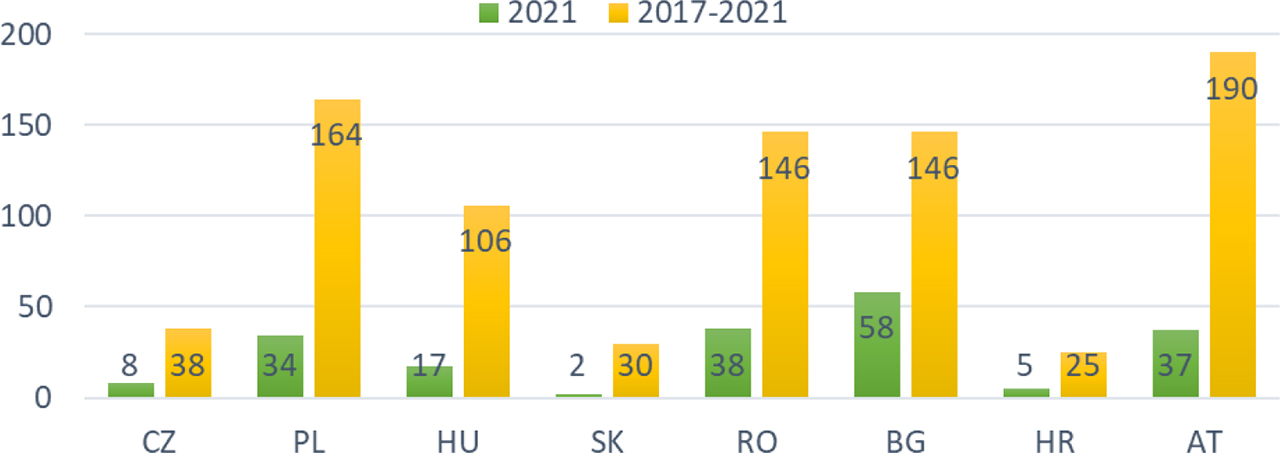
Figure 1:
the CEE Overview for 2021 and for the 5 years between 2017 and 2021 10
Austria, though it is located in Central Europe, has had a longer relationship with the European Union compared to the other CEE EU Member States in the graph, and this may dilute the rationale for its inclusion. However, I have additionally reflected upon how many preliminary questions emanated from Austria within the first 19 years of its membership to the European Union. Within the first 19 years of its membership, courts in Austria referred 429 preliminary questions to the CJEU, which averages to approximately 22.5 preliminary questions per year. This is in stark contrast to the 5.5 preliminary questions that Czech courts have referred per year.
One can argue that the preliminary questions referred by more established EU Member States cemented the path of interpretation and the application of EU law for newer EU Member States. This constitutes the acte eclairé and supports the position that Czech courts do not need to seek clarification from the CJEU, as clarity has already been provided. 11 Even though there may be an element of truth to this position, I do not fully agree with this perception and its conclusion. The body of European law is perpetually evolving, and despite attempts to enact better regulation, European Union institutions still produce large amounts of harmonised norms every year that require interpretation by the CJEU. Additionally, the CJEU’s public approach and tone have demonstrated its ability to change its mind. This is exemplified by the Café Hag case, 12 in which the Advocate General Jacobs stated that ‘[t]he Court has consistently recognized its power to depart from previous decisions, as for example by making it clear that national courts may refer again questions on which the Court has already ruled.’ 13
As a next step, I have reflected upon on how the Czech Republic compares to other Member States that joined the European Union in 2004.
As set out in the graph above, I have found that among the nations that joined the EU in 2004, some of which have comparatively small populations, almost all have referred more preliminary questions per capita to the CJEU than the Czech Republic. 14
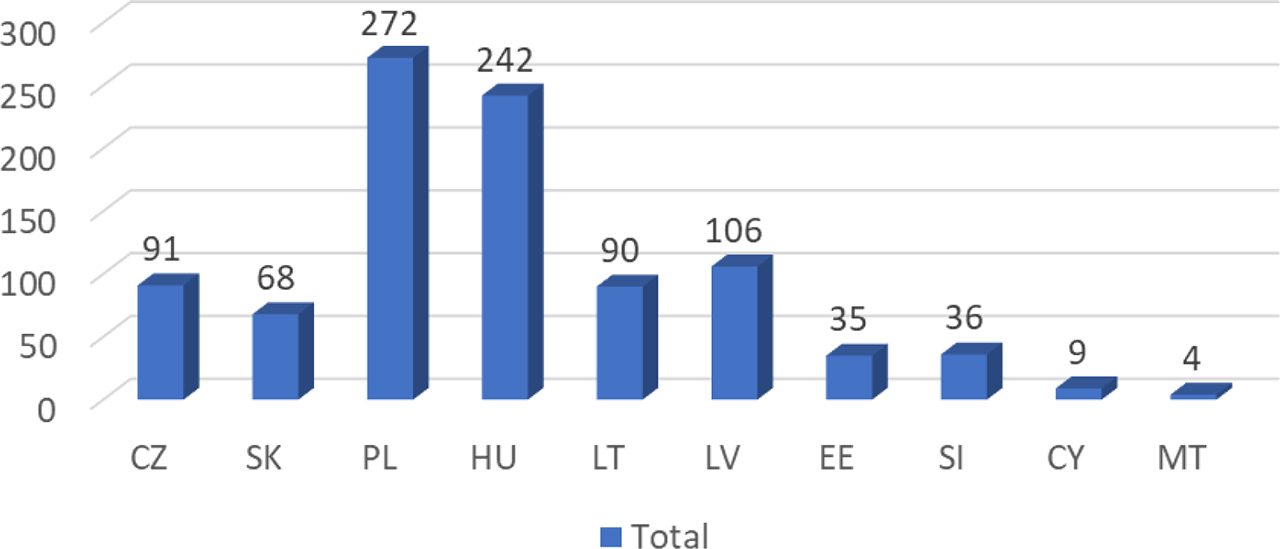
Figure 2:
Number of preliminary questions (2004 – 2021) from EU Member States that joined the EU in 2004
From the overview above, it is conclusive that only a few preliminary questions have emanated from the Czech Republic compared to the other EU Member States that joined in 2004. I will now elaborate on the possible reasons for this phenomenon, which makes the Czech Republic atypical.
2.1. Overview of Czech Preliminary Questions in the Last Six Years
Before I present the reasons as to why so few preliminary questions come from the Czech Republic, I would like to first examine how questions arise in the Czech Republic, using a sampling of questions submitted by Czech courts between 2017 and 2022.
Table 1:
Total number of preliminary questions referred to the CJEU from all Member States and the number of preliminary questions coming from the Czech Republic
| Years | 2017 | 2018 | 2019 | 2020 | 2021 | 2022 |
|---|---|---|---|---|---|---|
| Total CJEU | 533 | 568 | 641 | 557 | 567 | ? 15 |
| CZ | 4 | 12 | 5 | 9 | 8 | 13 |
In the course of the Czech Republic’s 19 years of European Union membership, half of the total number of preliminary questions have been referred in the past six years. 16 Czech preliminary questions have predominantly dealt with taxation, transport, governing law, internal markets, and competition. Of the 51 preliminary questions, the vast majority have related to the interpretation of directives. Only a small number of these preliminary questions focused on the interpretation of EU Treaties.
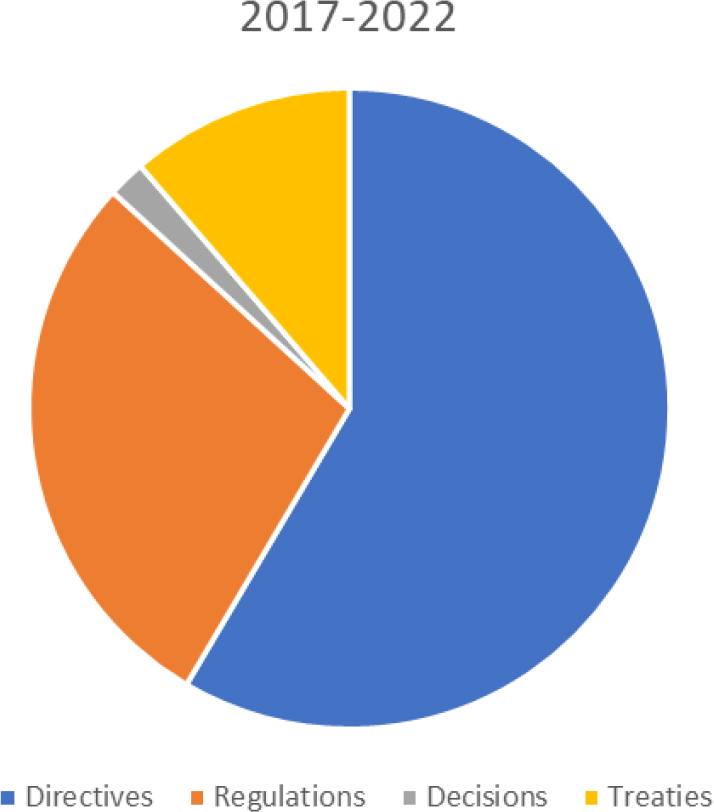
Figure 3:
EU norms subjected to the preliminary questions coming from the Czech Republic in 2017–2022 17
According to Article 267 of the TFEU, if a preliminary question is raised in a case pending before a EU Member State’s court or tribunal, and there is no (ad hoc) judicial remedy against its decisions, that particular court or tribunal shall bring the matter before the CJEU. Therefore, it could rightly be assumed that the two Supreme Courts in the Czech Republic are the main bodies that refer preliminary questions. Although Czech Supreme Courts have been given the theoretical pride of place in this area, they share this pedestal with the courts of first instance in the Czech Republic. 18 If we compare Czech courts individually, the Supreme Administrative Court is court that refers the most preliminary questions. 19 This seems to be the case in general, as during the last six years the Supreme Administrative Court has referred 14 out of the 51 preliminary questions coming from the Czech courts. 20
III. Potential Reasons for the Lack of Preliminary Questions
Multiple polls have been conducted on attitudes towards the EU and its institutions; however, I have found no relevant polls examining attitudes about the role of the CJEU. What statistics and evidence can help explain the reasons as to why there are so few preliminary questions from the Czech Republic? As rightly stated by Vikarská and Dřínovská, an important factor is the ad hoc motivations of individual judges. 21 I look forward to the two authors’ findings in their anticipated research on judicial dialogue within the European setting. This research will include interviews with Czech Supreme Court judges, who will share their experiences related to particular decisions that saw preliminary questions submitted, or not submitted, to the CJEU. Until this research is published, I admit that any potential explanation of the lack of preliminary questions coming from the Czech Republic might be slightly more anecdotal in nature and based on a subjective understanding of available data. Nevertheless, from my own research and professional experience, I have identified three potential factors, which I will focus on in the following paragraphs.
3.1. Lack of Appreciation or Understanding of EU Law’s Relevance in the Czech Republic
In my more than 15 years of legal experience, as both an attorney and as an in-house legal practitioner, I have routinely found negative or at best lukewarm attitudes towards EU laws in most of my legal colleagues and clients. The Czech Republic is regarded as one of the most EU-sceptical EU nations, perennially appearing at the bottom of ranked surveys of general attitudes towards the EU. According to research published in 2019 by the Pew Research Center, ‘[w]hile more people see the EU in a positive light than not, in the UK, Greece, the Czech Republic and France, these countries also have sizable portions of the public – more than four-in-ten – that voice negative opinions.’ 22 One of the key drivers of this negative attitude is the perception that there are no discernible benefits for Czech citizens from EU Membership. 23
According to quite-recent polls, it seems that current events such as the COVID pandemic, the war in Ukraine and its related energy crisis, and the Brexit process and its impact on the United Kingdom have all led to an increase in positive attitudes about the EU in the Czech Republic. 24 However, this positive shift has not been tangible enough to alter the overall ranking of the Czech Republic in comparison to other EU Member States with regards to its attitudes towards the EU. This negativity manifests itself in individual actions, such as the removal of EU stickers, and in the media, with Czech tabloid stories that fuel anti-EU attitudes by portraying the EU as a destroyer of the Czech production of spreadable butter, Czech rum, and a provider of diktats on issues such as the permissible size of cucumbers. 25
Czech legal professionals, and their clients’ knowledge and understanding of the EU, mirror the society from which they originate, and the extent to which this subject is taught at schools and universities. Simultaneously, understanding the relevance of EU law, and harmonising interpretations between the CJEU and the Czech judiciary (which have the same or slightly better levels of EU knowledge), conflicts with the need to refer preliminary questions to the CJEU. 26 Over the past 6 years, Czech preliminary questions were only referred to the CJEU after either the Czech Constitutional Court or the Supreme Administrative Court indicated that the lower courts should have originally referred them. 27 In their failure to engage with the CJEU from the beginning, they may have breached the constitutional right to a lawful judge and fair trial. 28
EU law is understood to provide the bulk of most national laws; however, once an EU law is incorporated into Czech law, a perception arises that Czech law and jurisprudence take precedence. 29 This perception means that many falsely believe that once an EU law has been incorporated into Czech law, the role of the EU has been forfeited and can be ignored to a large degree.
An added objective of EU harmonisation was to institute a level playing field for rules in all EU Member States, with laws applied consistently no matter where an individual resides in the EU. 30 Such an aim expects and assumes that national legal orders will adapt to the new harmonised rules and adjust their own rules, national practices, and even legal thinking to that new system.
However, in reality, the opposite outcome has largely occurred. I have noted the tendency to adjust EU laws to fit the already existing national legal order, thus pursuing a ‘national mindset’ in the interpretation and application of EU law by legal professionals. In everyday life, EU directives are mostly overlooked, as they are perceived to lack impact until they are transposed into national law. Additionally, EU regulations and decisions are usually adapted to fit to existing national practices, and thus interpreted in a way in which a nation’s body of laws is comprehended. 31 These misconceptions may explain why most Czech preliminary questions, at least within the past 6 years, have dealt with the interpretation of EU directives, even though the number of EU regulations is much higher. 32 It draws me to an interim conclusion that a preliminary question by the national court deciding on a matter is usually made when there is a noticeable discrepancy between the EU directive and its national transposed version, and/or when the national transposition is unclear. 33
3.2. Preliminary Rulings ‘Only’ Interpret the EU Law
In conjunction with the previous factor, the second potential reason for low number of preliminary questions from the Czech Republic could be due to the understanding of the role and purpose of preliminary questions. According to Art. 267 TFEU, the purpose of a preliminary question is twofold. First, the question may address the interpretation of EU Treaties and/or the actions and acts of EU institutions, bodies, offices, or agencies. Second, preliminary rulings can decide on the validity of the acts by EU institutions, bodies, offices or agencies. The whole system is framed and functions around cooperation between national courts and the CJEU. 34 When a national court is deciding on a disputed matter, if the court finds that EU law applies and considers that a preliminary question is necessary to enable it to pass judgment, it may request that the CJEU provide a guiding ruling. 35 Once the CJEU answers a preliminary question, the national court reopens the proceeding and decides upon the dispute. The CJEU is not involved in the dispute and does not decide on the finality of the matter.
As Matthias Derlén and Johan Lindholm have pointed out, the division of labour between national bodies and the CJEU is, in theory, quite straightforward. 36 The role of the CJEU is ‘to provide the national court with an answer which will be of use to it and enable it to determine the case before it.’ 37 Such cooperation between the national courts and the CJEU requires the national court to understand the purpose of the preliminary question and its ability to correctly apply the interpreted EU law to the case before the court. In some cases, guidance can be quite clear, and so it is evident as to how the national court should proceed. However, in many cases, a rather thorough analysis of the preliminary ruling is required in order for the national court to decide how to apply it correctly. 38 The unifying function of uniform CJEU interpretation depends on the ability and willingness of national courts to correctly apply the CJEU’s rulings. 39
The arduous process of analysing preliminary rulings can be further complicated by the way CJEU judgments are structured, and meaning can be lost in translation. 40 The CJEU decides in chambers on the final text of the preliminary ruling, reflecting compromises reached during the court’s deliberations. 41 This process means that it is not uncommon that with some preliminary rulings, it is not clear how the CJEU reached its conclusions. 42 In cases where the CJEU follows the opinion of the Advocate General, their analysis serves as helpful guidance toward understanding the ruling itself. With preliminary questions, the language of the proceeding is in the same language of the referring court. 43 However, the decision is usually drafted in French – the language of the CJEU – and the language of the proceeding becomes a simple translation. As Michal Bobek aptly remarked, ‘[t]he equality of languages in the European Union is a myth. It has always been, be it in a Europe of six or in one of twenty-seven. It has been a noble dream, though: a political vision of Europe in which everyone speaks their own language but, at the same time, they are able to understand each other. Unfortunately, that dream already proved to be infeasible within the First Book of Moses.’ 44 Even the best translation is not free from errors and misunderstandings, and the act of translation can dilute the nuance of what is being communicated. As CJEU Judge Sacha Prechal set out, ‘approximately 30% of the time for delivering a judgement goes into translation. So basically, after deduction of the ‘translation time,’ a preliminary reference takes about 10 months. Language complicates life at the Court, that is for sure, in terms of time and in terms of understanding.’ 45 When this issue is combined with the use of EU terminology, which is often not familiar to national legal professionals, preliminary rulings can sound cumbersome and not particularly user-friendly.
A second interim conclusion I have come to is that the reluctance to refer preliminary questions can be viewed as the result of the characteristics of the preliminary ruling, which can trigger an arduous process for national judges when they interpret and apply the ruling towards the facts of the case. Undoubtedly, this is not a factor only Czech judges have to deal with. However, it can noticeably contribute to the low numbers of Czech preliminary questions when combined with the first factor (to the low appreciation of the relevance of EU law and language, and the complexity of the content of the CJEU’s judgments).
3.3. Restrictive Notion of a ‘Court or Tribunal’
Following on from the first two potential reasons, which were slightly more Czech-centric, the third issue can be seen across much of Europe and is related to how a court or tribunal has come to be defined for the purposes of preliminary questions and how that applies to authorities in EU Member States. According to Art. 267 TFEU, only a court or tribunal of an EU Member State is entitled to refer a preliminary question to the CJEU. It stems from the nature of preliminary rulings, which constitute indirect procedure, and its primary aim, which is to help national courts to correctly interpret EU law. 46 Even though Meyer argues that the CJEU does not claim a monopoly on the interpretation of EU law, 47 it undoubtedly unifies the interpretation of the EU body of laws in all EU Member States. 48
Therefore, it was essential from the outset of the origins of the CJEU to define a national court or tribunal so that a preliminary question can be referred appropriately. The CJEU has established certain institutional criteria that a body must fulfil to be regarded as a court or tribunal within the meaning of Art. 267 TFEU. This includes criteria such as whether the entity is established by law, and whether is permanent; has compulsory jurisdiction; has inter partes procedure; applies the rule of law; and whether it is independent. 49 These factors have been consistently used on an ad hoc basis whenever the CJEU has had to decide on the admissibility of a preliminary question referred by a body that was not a ‘typical’ court or tribunal of an EU Member State.
The broadening of EU regulations, which today cover growing areas of often highly specialised fields – from financial services, to telecommunications, to energy, transport and so on – triggered the need for the establishment of specialised EU and national supervisory authorities that monitor and provide oversight on relevant stakeholders and their compliance with newly harmonised rules. 50 Of the 23 preliminary questions referred by Czech courts of first instance in the last 6 years, in 14 instances a specialized Czech national body, often including an appeal within that body, had itself previously decided on the matter. De facto, the national court deciding on the dispute then plays a role of second instance if the plaintiff is not satisfied with how the national supervisory body has set out to resolve the matter. Thus, it is not surprising that those national supervisory and regulatory bodies that usually first decide on matters and disputes within a particular field would also wish to refer to the CJEU a preliminary question on the interpretation of EU legislation.
It is evident that some national supervisory bodies do not fulfil all the key criteria, especially in regard to independence, meaning that they cannot be regarded as a court or tribunal under Art. 267 TFEU. However, with some national bodies, the issue of meeting the criteria is not so categorical. Recently the CJEU had to decide on the admissibility of a preliminary question brought by the Czech Transport Infrastructure Access Authority (‘TIAA’). 51 The request for a preliminary ruling in this case mainly concerned the interpretation of Directive 2012/34/EU of the European Parliament and of the Council of 21 November 2012, establishing a single European railway area that regulates access to the EU train network and certain related facilities. The dispute arose between a railway-infrastructure entity in the Czech Republic, which had laid down conditions for access to the network and certain related facilities, and a railway undertaking CityRail, a.s., which challenged those conditions with the TIAA. The TIAA had doubts as to whether the conditions were compatible with Directive 2012/34/EU, and thus decided to pause the proceedings and refer preliminary questions to the CJEU. As the TIAA is not classified as a court within the judicial system of the Czech Republic, the CJEU had to decide on the admissibility of such a preliminary question vis-a-vis whether the question had been referred by a court of tribunal within the meaning and criteria of Art. 267 TFEU.
The TIAA, as a national regulatory body for the railway sector, originates from Directive 2012/34/EU, which declares, ‘this body shall be a stand-alone authority which is, in organisational, functional, hierarchical and decision-making terms, legally distinct and independent from any other public or private entity. It shall also be independent in its organisation, funding decisions, legal structure and decision-making from any infrastructure manager, charging body, allocation body or applicant. It shall furthermore be functionally independent from any competent authority involved in the award of a public service contract.’ 52 Further, ‘Member States shall ensure that the regulatory body is staffed and managed in a way that guarantees its independence.’ 53 Therefore, the TIAA considered itself to be in compliance with all the criteria defining a court or tribunal under Art. 267 TFEU. Simultaneously, it referred to the Westbahn Management case, in which the CJEU admitted a preliminary question from a similar regulatory body for the Austrian railway sector, the Schienen-Control Kommission (Railway Supervisory Board). 54
However, the CJEU, via its Grand Chamber, reconsidered this, and further expanded upon the existing doctrine in relation to the determination of a court or tribunal for the purposes of preliminary rulings. As a result, the CJEU declared that to determine whether a body may refer a case to the CJEU, it needs to fulfil criteria relating both to the constitution of that body and to its function: ‘In that regard, a national body may be classified as a ‘court or tribunal’, within the meaning of Article 267 TFEU, when it is performing judicial functions, but not when exercising other functions, inter alia functions of an administrative nature.’ 55
It is true that the request for simultaneous fulfilment of functional criteria is not a complete novelty, 56 but the decision-making practice of the CJEU has not been fully consistent in this regard, and this is exemplified especially in the decision in the Westbahn Management case, where the CJEU considered only the institutional criteria of the regulatory body in Austria. 57
Based on the judgment in the CityRail case, an administrative body wishing to refer a preliminary question to the CJEU must not only verify the institutional criteria, but also ‘ascertain the specific nature of the functions which it exercises in the particular legal context in which it is called upon to make a reference’ to the CJEU. 58 The first layer of an assessment is an examination to understand if the entity meets the basic criteria: whether the body is established by law, is a permanent body, has compulsory jurisdiction, has inter partes proceedings before it, applies the law, and/or is independent.
The second layer of an assessment considers the respective procedures before the institutions, in the context of when they wish to refer a judicial or administrative question for a preliminary ruling. However, the administrative and judicial functions of regulatory bodies cannot always be easily distinguished. Based on the guidance given by the Advocate General, the following questions may help an entity to conclude whether it can, in an ad hoc proceeding, be regarded as a body performing judicial functions, or if its functions are administrative in nature. 59 These guidelines include:
– Whether the body is empowered to act on its own accord;
– Whether its function is to review the legality of a decision, or to adopt a position, for the first time, on a complaint made by an individual;
– Whether it acts as a specialist administrative body, and if it can exercise power to impose penalties in matters falling within its competence and remit;
– Whether it can decide on matters by performing non-judicial functions, such as functions of an administrative nature;
– Whether its decisions can be appealed to its President;
– And lastly, whether the decisions of the body and its President are open to review before an administrative court in which the body would have the status of a defendant or an interested party.
3.3.1. More Work for Traditional Ruling Bodies, and a Potential Catch-22
Based on the restrictive interpretation of a court or tribunal within the meaning of Art. 267 TFEU, it is apparent that the majority of preliminary questions are generally referred by traditionally defined courts established within the legal judicial system of an EU Member State. In principle, if a preliminary question concerns the interpretation of EU law and is referred by a court or tribunal of an EU Member State, the CJEU is obliged to answer. However, to do so, the CJEU needs to obtain specific information from the referring court, such as a summary of the subject matter of the dispute, and the relevant findings of fact; the tenor of national provisions applicable in the case; and a statement as to what prompted the referring court to refer the preliminary question. 60 As preliminary rulings are not supposed to be of a hypothetical nature, the CJEU cannot rule on a preliminary question if it does not have the factual, technical or legal knowledge that is required to provide a well-founded answer. 61 With that in mind, there is a complex question as to how much the CJEU can rely on the analysis of the administrative authority alone, and is inherently considered an ‘expert’ in its regulatory area, having dealt with the matter in the first place.
This issue was on display in relation to a matter once again concerning a railway dispute that was handled at first in front of the TIAA. The decision of the TIAA was subsequently challenged before a District Court in Prague 1. The TIAA proposed that the court refer a preliminary question to the CJEU, and supplemented that request with the formulation of a question and a statement of rationales, on which the court heavily relied and simply forwarded to the CJEU. The CJEU found such an approach to be inadmissible, stating that a ‘document that was supposed to represent the justification of these questions, but in which it simply reproduces the argumentation presented by the Authority. …the referring court merely copied and forwarded to the Court a brief and lacunae summary of the applicable national law, which was additionally provided to it by an entity not participating in the proceedings before it’ (translated from Czech). 62
The CJEU argued that ‘[a]ccording to the Court’s settled case-law, the procedure established by Article 267 TFEU is an instrument of cooperation between the Court of Justice and national courts, by means of which the Court provides the national courts with the interpretation of EU law which they need to give in order to resolve the dispute before them. In the context of that cooperation, it is for the national court before which the dispute in the main proceedings has been brought, which alone has precise knowledge of the facts of the case and must assume responsibility for the subsequent judicial decision, to determine both the need for a preliminary ruling in order to enable it to deliver judgment and the relevance of the questions which it submits to the Court.’ 63
With a view toward ensuring the impartiality of judicial proceedings from the actions of administrative bodies, I fully concur with the CJEU’s rejection. Nevertheless, I would not conclude that parties to the main proceeding should not or cannot ask courts to refer preliminary questions and supplement their requests with the potential wording of the question and other vital information, which the referring court will need to provide to the CJEU. To me, the verdict simply means that in the end it is the referring court that remains responsible for the form and content of the preliminary question. Thus, the court cannot fully rely on the requests of others without its own proper assessment, especially if it is requested by an administrative authority deciding on the matter in the first instance.
But what role does this play in the lack of preliminary questions coming to the CJEU from the Czech Republic? As elaborated above, one of the potential ways to increase the number of preliminary questions is to improve understanding of EU law and its application at a national level in the Czech Republic. A better understanding could be achieved with the formation of specialized bodies focusing solely on national and EU regulation in particular fields. As mentioned, some bodies are established based on EU norms, such as the TIAA. However, these types of bodies will generally not be regarded as courts or tribunals within the meaning of Art. 267 TFEU when deciding on disputes, even when a relevance and need for the application of EU legislation exists.
I do not have a clear opinion as to whether administrative bodies should be entitled to table preliminary questions. On one hand, it may speed up the process for individuals if administrative bodies could obtain the required interpretation of EU law needed for ad hoc cases. However, any entitlement could also lead to an avalanche of requests to the CJEU and a shift in the distinction between executive and judicial powers. Under the current wording of Art. 267 TFEU, within the current understanding of preliminary rulings as an instrument of cooperation between the CJEU and national courts, 64 it does not seem feasible. However, the aforementioned cases, and the CJEU’s decision limiting the ability of national bodies to raise preliminary questions, could help to solidify the general narrative in the contingent of the Czech Republic that is EU-sceptic or sees little merit in engaging with the CJEU.
3.3.2. Preliminary Rulings Are Not a Closed Game for Parties
At this point, I would like to briefly address one potential misunderstanding about preliminary rulings when Art. 267 TFEU is examined without any consideration of its context. As explained above, under Art. 267 TFEU, only a court or a tribunal of an EU Member State can refer a question and start a dialogue with the CJEU about the interpretation or validity of EU norms. However, a national court does not take an active part once the preliminary question is tabled. As van Gestel and de Poorter summarise, ‘the preliminary reference procedure does not represent a dialogue going (much) beyond one side asking questions, while the other side tries to answer them,’ 65 which in some aspects almost contradicts the proclaimed cooperation between the CJEU and national courts on which the preliminary rulings should be based. 66 Instead, the parties involved in the dispute that is before the referring court can play a vital role in shaping the CJEU’s judgments. A party to the proceedings before the national court that refers a question for a preliminary ruling becomes a participant (defined as ‘the party to the main proceeding’) before the CJEU, and may submit written and oral observations on the question referred for a preliminary ruling. 67 Even though it is not the participant’s responsibility to comment, to submit an observation is recommended for the following reasons:
The interpretation given by the CJEU will be binding on the referring court, which will then continue the proceedings to which the participant is a party. Although the CJEU mainly interprets EU law and does not deal with specific cases (which is the remit of the national court), its interpretation can provide clear guidance as to how the referring court should subsequently rule. The CJEU’s preliminary ruling is binding erga omnes. With its interpretative power, the CJEU effectively completes EU law. 68
Further, the interpretation is binding on all EU Member States. If, for example, it may be inferred from the preliminary ruling that a transposition of a relevant directive in an EU Member State does not correspond to the interpretation made by the CJEU, the EU Member State should remedy this situation post-haste. 69
Finally, there is a propensity for international bodies like the CJEU to become isolated from events at a national level. The facts of a case are provided by the referring court, which should be more fully informed about it due to its localized setting. It is therefore appropriate for parties to the main proceeding to indicate to the CJEU harmful and or unintended results that could come from an only partially-informed interpretation of EU law.
IV. Is An Increase in Preliminary Questions Even Warranted?
When considering the reasons for the low number of preliminary questions from the Czech Republic, one may question whether there is a need for an increase in the first place. One of the main purposes of a preliminary ruling is to unify the interpretation, and correspondingly the application, of EU law in all EU Member States. 70 Without the interpretative monopoly of the CJEU, national courts and bodies would almost certainly come to understand EU laws differently, especially against the background of diverse national legal frameworks and cultures. In a way, the Köbler doctrine was developed to prevent divergence in judicial decisions based on questions of EU law. 71
It does not mean that national courts and bodies cannot interpret and apply EU law in and of themselves. On the contrary, the basic principles of EU law, such as direct effect and harmonious interpretation, apply to all national bodies bound by EU law due to its primacy. I agree with Vikarská and Dřínovská, who observe that the lack of preliminary questions coming from the Czech Republic could actually mean that Czech judges have a high level of insight into EU norms, so that any help from Luxembourg would be superfluous. 72 It follows, however, that providing an accurate assessment of EU law its application in ad hoc cases requires a profound comprehension of EU law system, its specific nature, and its interpretative methods.
Should lower courts in EU Member States wish to avoid referral of preliminary questions while assuring the due application of EU law, judges could consider the following checklist when looking to interpret EU norms. 73 Due to the theoretically-equal 24 official languages in the EU, linguistic interpretation cannot have primacy, even though it is commonly used in Member States when interpreting the national rules. 74 The determining factor is to understand the aim and purpose of the relevant EU norm. 75 When interpreting EU norms, it is imperative not to forget the Preamble and Recitals as potentially informative about their aim and purpose. Even though they are not binding, they provide priceless insights into the need and rationale for harmonisation, and norms’ relationships with other EU laws. Every EU norm must refer to its legal basis (the article of Treaties in case of legislative acts, or the secondary/tertiary EU norm in case of non-legislative acts), which provides the framework and limits to its adoption, and thus to its interpretation as well. Any norm of lower legal authority can never contradict a norm of higher authority and its aims.
Basic principles stemming from Treaties or the Charter can provide further guidance in the interpretation of norms. Judgments from the CJEU are one of the main sources for interpretation of EU norms. The relevance of CJEU judgements does not relate to the particular provision in question, but to the whole piece of legislation or the regulated area, as EU law does not exist in a silo. Finally, yet importantly, historical context can be an important factor and guide. A comparison of the original and newly adopted EU norms with those they replaced can illuminate the direction the EU started from and is moving toward. 76
V. Conclusion
Undoubtedly, EU law is becoming more and more prevalent in EU Member States as it becomes intertwined and embedded with national law. As many national laws originate in EU norms, a nation’s ability for amendment is constrained. As a result, unified comprehension and interpretation of EU law is vital. Still, the number of preliminary questions coming from Czech courts seems disproportionately low when compared to similar EU Member States. There may be many reasons for this phenomenon, even related to the ad hoc circumstances of a case. In my analysis, I have extracted three possible overarching factors encompassing the overall trend, such as the lack of understanding of the relevance of EU law, the role of preliminary rulings, and the notion of a court within the meaning of Art. 267 TFEU. To paraphrase Kierkegaard, hypothesis must be made forward, but can only be understood looking backwards. Thus, only time will tell if I was right or wrong in my above conclusions. 77