
Have a personal or library account? Click to login
Teaching intersection analysis to students with low vision Cover

Teaching intersection analysis to students with low vision

Open Access
|Dec 2023

Figures & Tables

Figure 1.

A) Schematic of a risk analysis diagram of a simple two-way plus-shaped intersection controlled by stop signs. B) Risks associated with the initial crossing from the southeast to the northeast corner of the intersection. C) Risks associated with the crossing from the northeast to the northwest corner of the intersection to reach the destination.

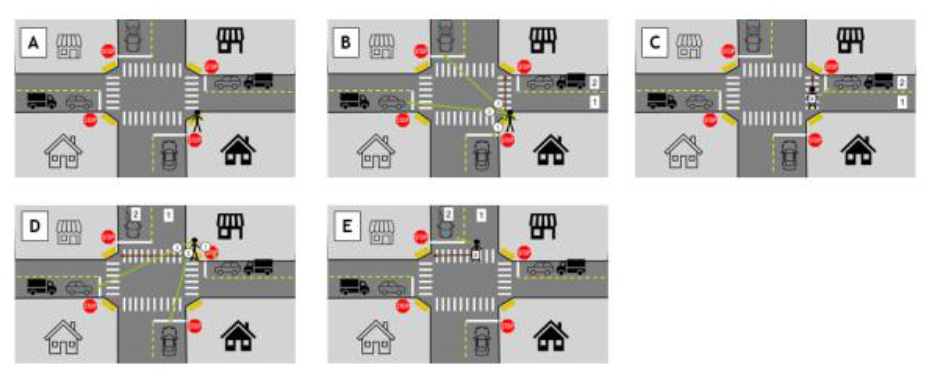
Figure 2.

A) Schematic of a risk analysis diagram of a complex two-way offset intersection controlled by stop signs and road markings. B) Risks associated with the crossing from the southeast to the northeast corner of the intersection. C) Risks associated with the crossing from the northeast to the northwest corner of the intersection to reach the destination.

Figure 3.

A) Schematic of a visual scanning plan of a simple two-way plus-shaped intersection controlled by stop signs. B) Visual scanning plan at the initial crossing on the southeast corner of the intersection; scanning plan ordered from 1 to 3. C) Visual scanning indicated after beginning the crossing (indicated by an X) before entering the second part of the crossing heading north. D) Visual scanning plan at the second crossing on the northeast corner of the intersection; scanning plan ordered from 1 to 3. E) Visual scanning indicated after beginning the crossing (indicated by an X) before entering the second part of the crossing headed west towards the destination.
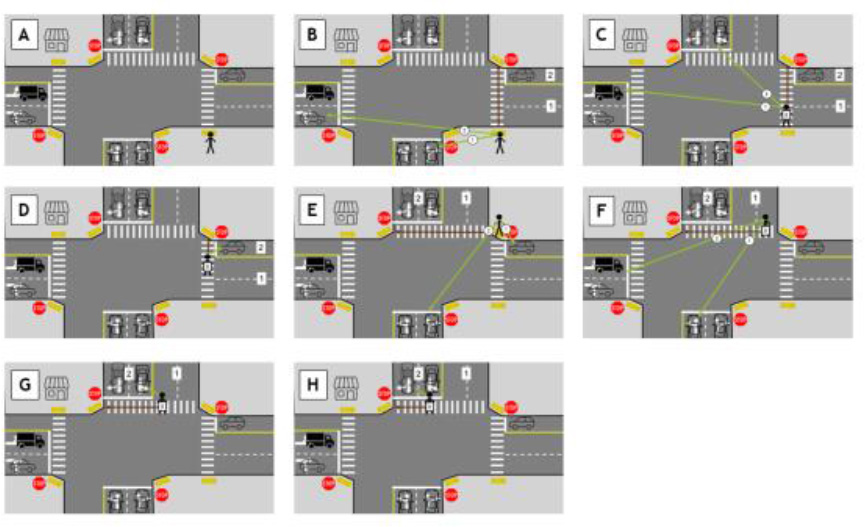

Figure 4.

A) Schematic of a visual scanning plan of a complex two-way offset intersection controlled by stop signs and road markings. B) Visual scanning plan at the initial crossing on the southeast corner of the intersection; scanning plan ordered from 1 to 2. C) Visual scanning plan in the first lane of the first part of the crossing (indicated by an X) heading north; scanning plan ordered from 1 to 2. D) Visual scanning plan in the second lane of the first part of the crossing (indicated by an X) heading north before entering the 2nd part of the crossing. E) Visual scanning plan at the second crossing on the northeast corner of the intersection; scanning plan ordered from 1 to 2. F) Visual scanning plan in the first lane of the second crossing in first part of the crossing (indicated by an X) heading west; scanning ordered from 1 to 2. G) Visual scanning plan in the second lane of the second crossing in the first part of the crossing (indicated by an X) heading west. H) Visual scanning plan in the first lane of the second crossing in the second part of the crossing (indicated by an X) heading west towards the destination.
Language: English
Accepted on: Nov 14, 2023
Published on: Dec 28, 2023
Published by: Guide Dogs NSW/ACT
In partnership with: Paradigm Publishing Services
Publication frequency: 1 issue per year

© 2023 Joseph P Nemargut, published by Guide Dogs NSW/ACT
This work is licensed under the Creative Commons Attribution-NonCommercial-NoDerivatives 4.0 License.