
Table 1.
Key Indicators from FAA-AST.
| FAA-AST Key Indicators | Sub-Categories |
|---|---|
| Purpose of travel in space |
|
| Industrial Complexity |
|
| Current Safety Level |
|
| Voluntary Safety Reporting |
|
| FAA status FAA expertise in human spaceflight safety |
|
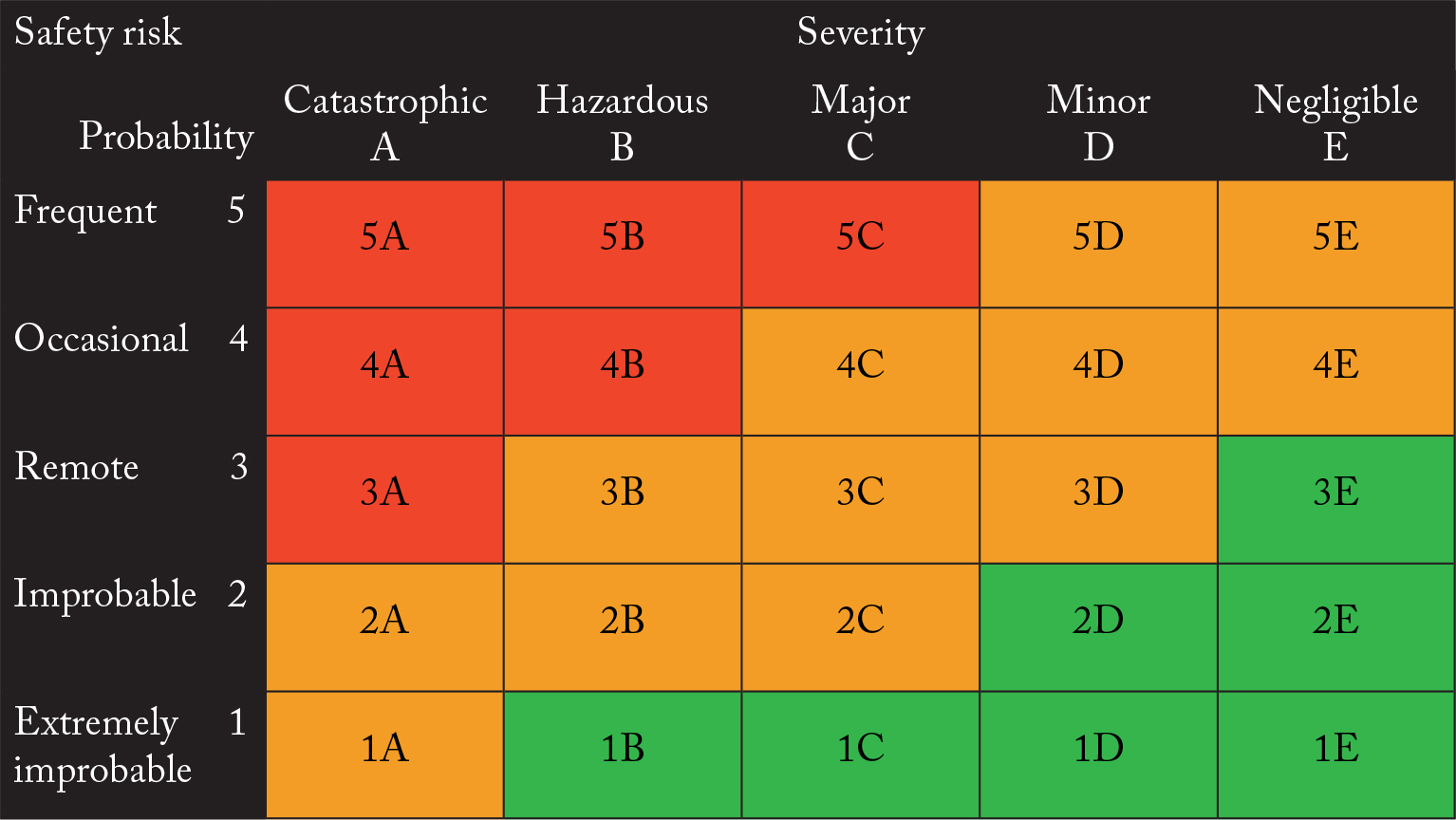
Fig. 1.
ICAO risk matrix.
Table 2.
Severity values explained.
| Severity | Explanation | Value |
|---|---|---|
| Catastrophic | Space vehicle destroyed, multiple deaths | A |
| Hazardous | Major damage, serious injury | B |
| Major | Serious incident, injury to persons | C |
| Minor | Minor incident | D |
| Negligible | Few consequences | E |
Table 3.
Probability values explained.
| Probability | V |
|---|---|
| Frequent | 5 |
| Occasional | 4 |
| Remote | 3 |
| Improbable | 2 |
| Extremely improbable | 1 |
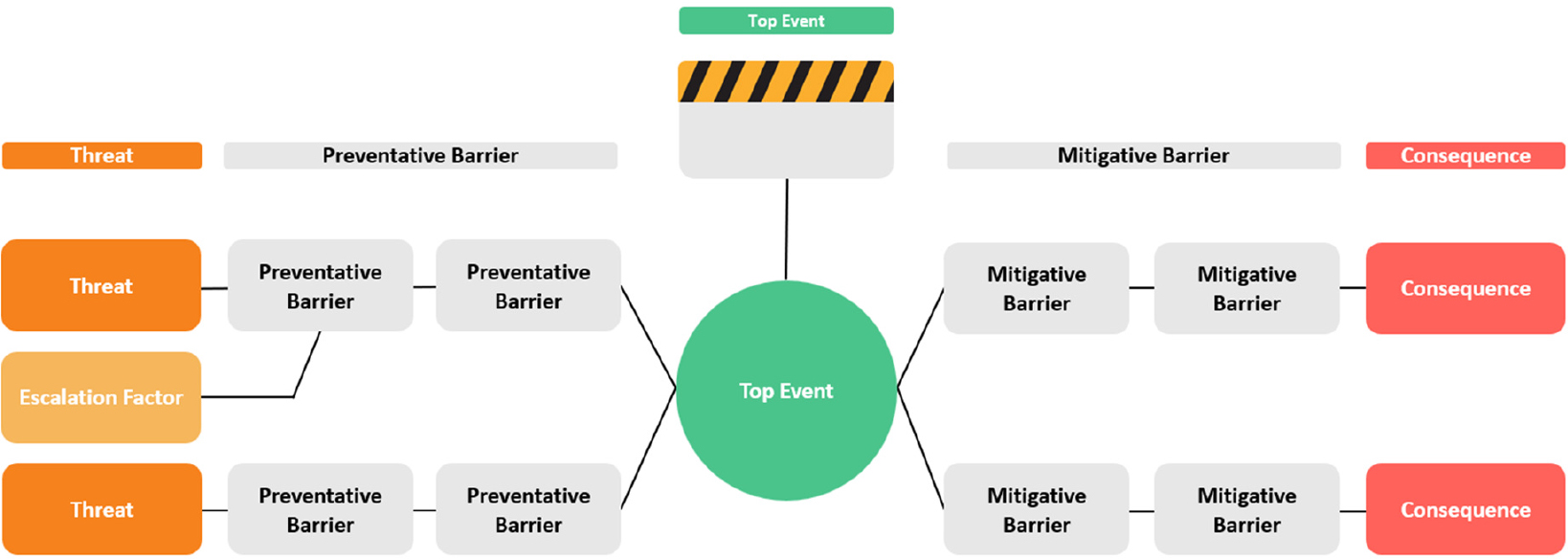
Fig. 2.
Example of a Bowtie representation [20].
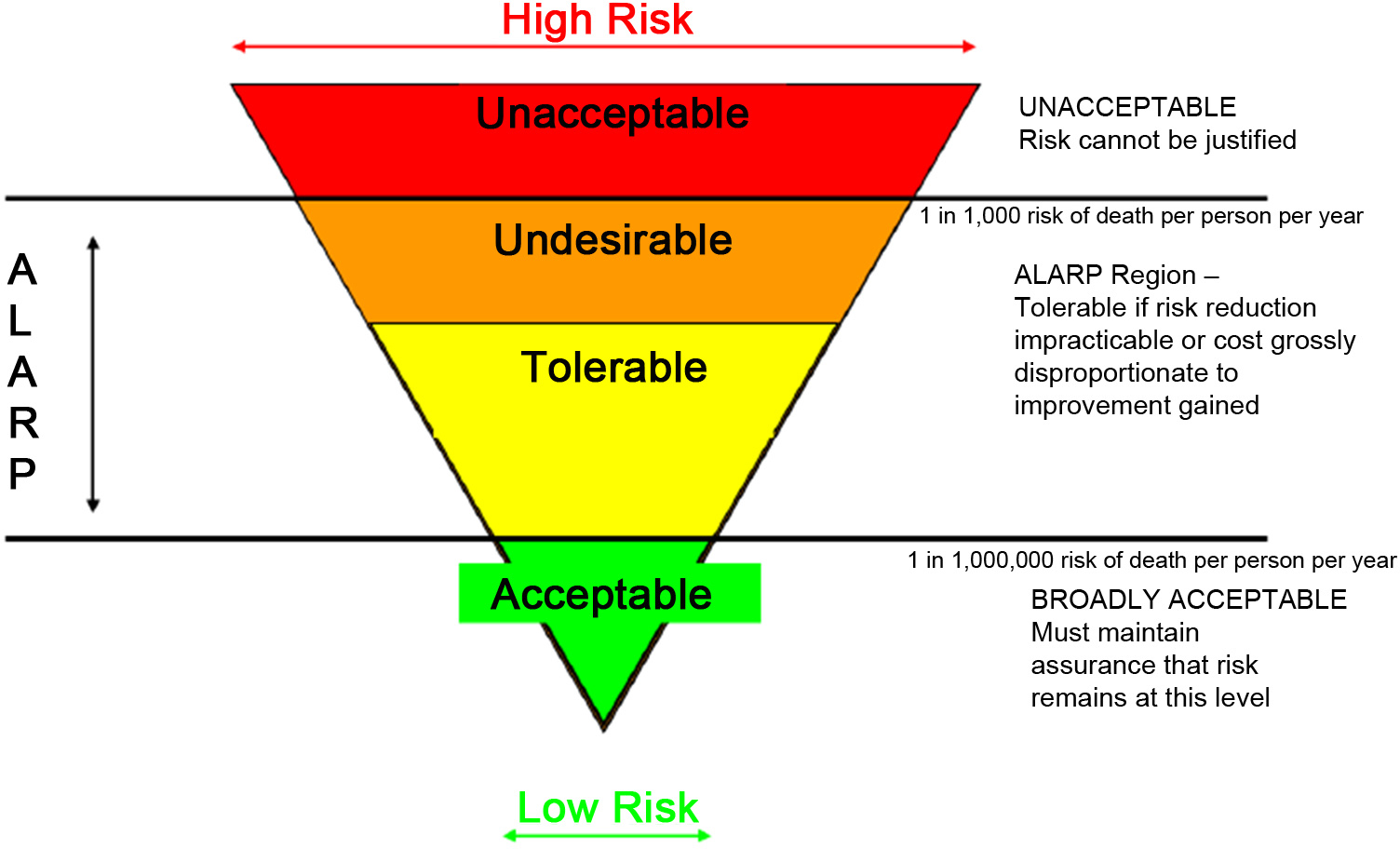
Fig. 3.
ALARP triangle depicting tolerability [5].
Table 4.
List of hazards in suborbital spaceflight.
| Blue Origin | |
|---|---|
| LOC-I | × |
| LOC-G | × |
| CFIT | |
| In-flight explosion | × |
| MAC | × |
| Loss of pressurisation | × |
| Parachute system failure | × |
| Escape system failure | × |
| Falling debris after the failure of spacecraft | × |
| Flight path trajectory deviation | × |
| Atmospheric pollution | × |
| Crew Incapacitation | |
| Uncontrolled fire/Smoke on board | × |
| Structural failure | × |
| Human radiation exposure | × |
| Passengers requiring medical assistance in flight | × |
| Hijack (Cyber/Physical) | × |
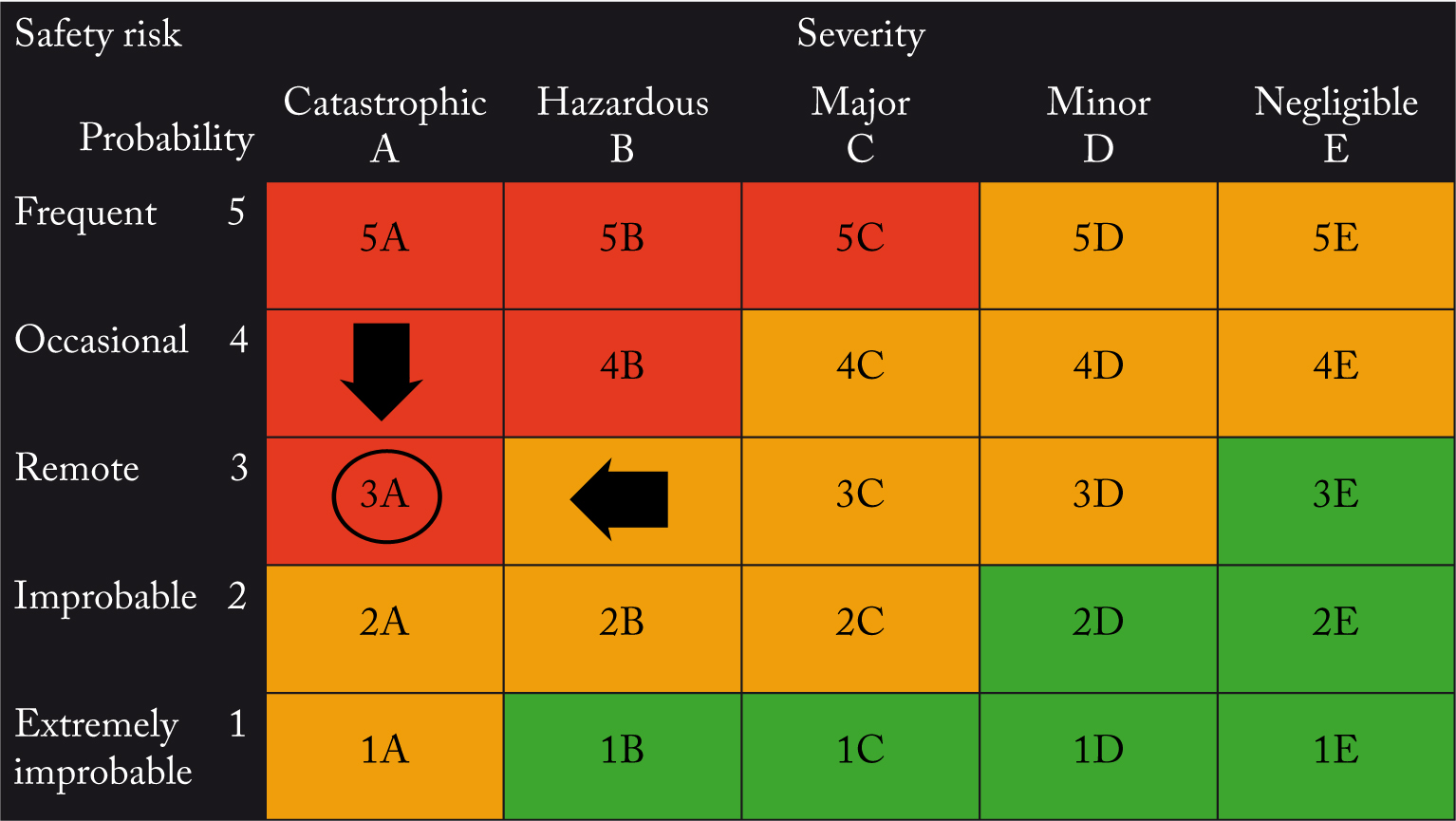
Fig. 4.
Loss of pressurization classification [21].
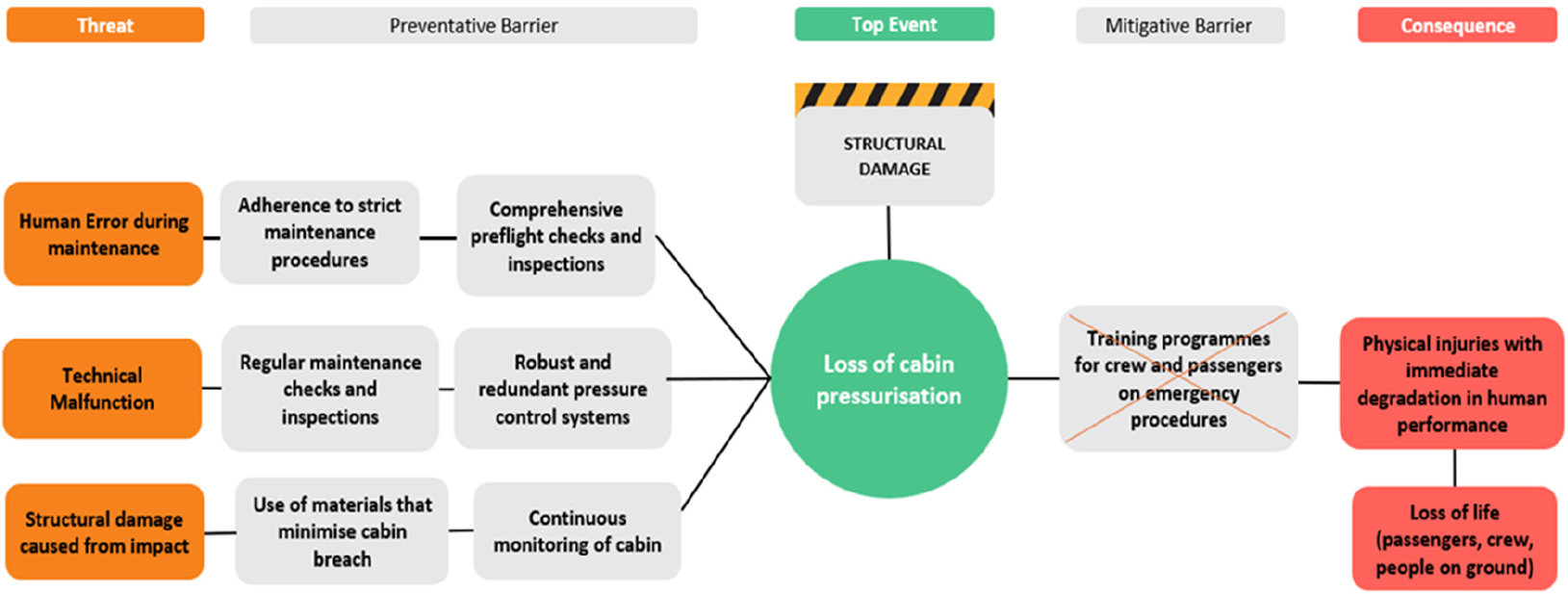
Fig. 5.
Bowtie representation of loss-of-pressurization risk for Blue Origin (current state).
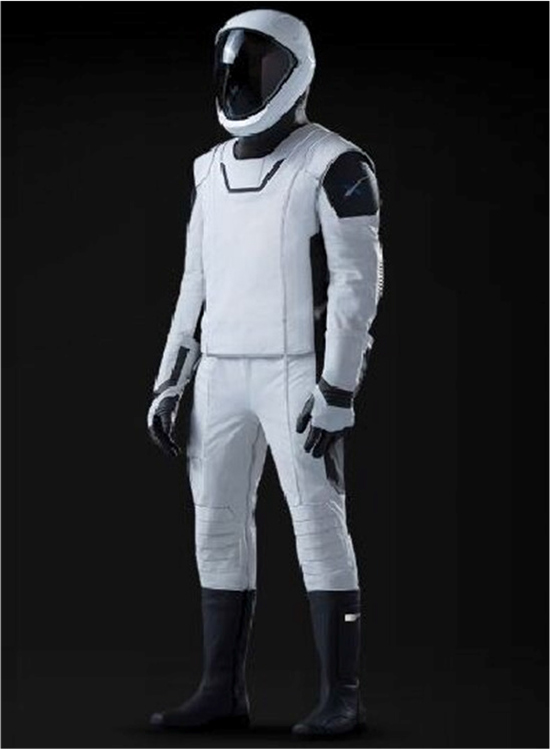
Fig. 6.
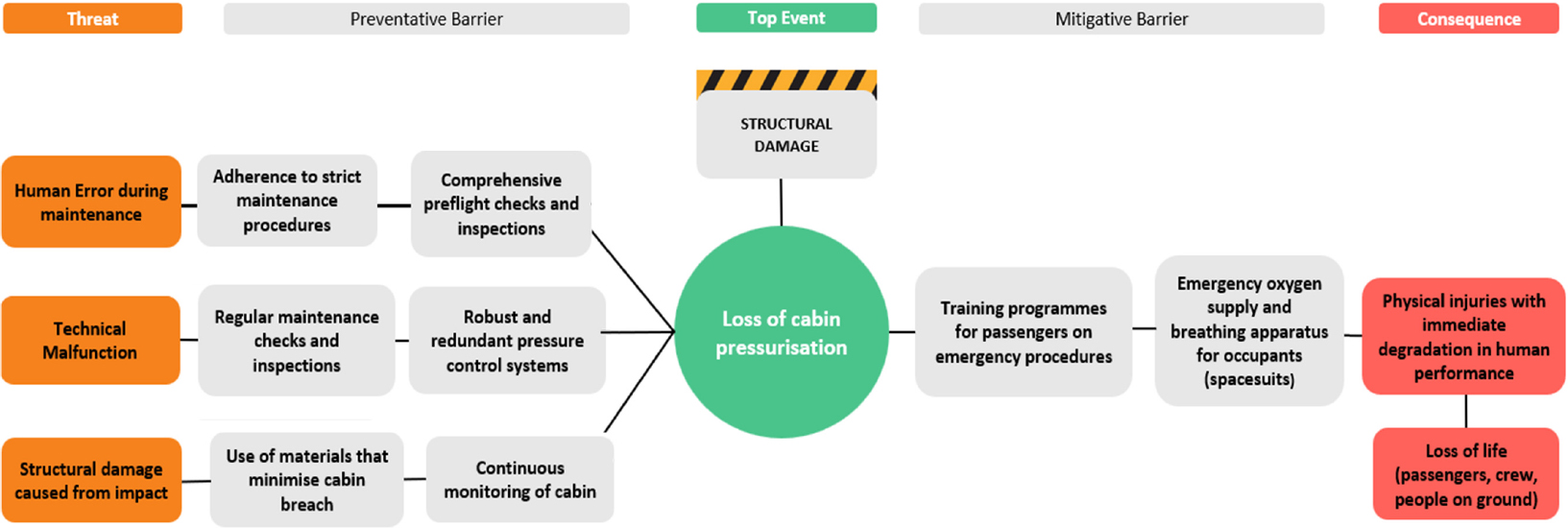
Fig. 7.
Loss-of-pressurization scenario: conceptual configuration following introduction of spacesuits.
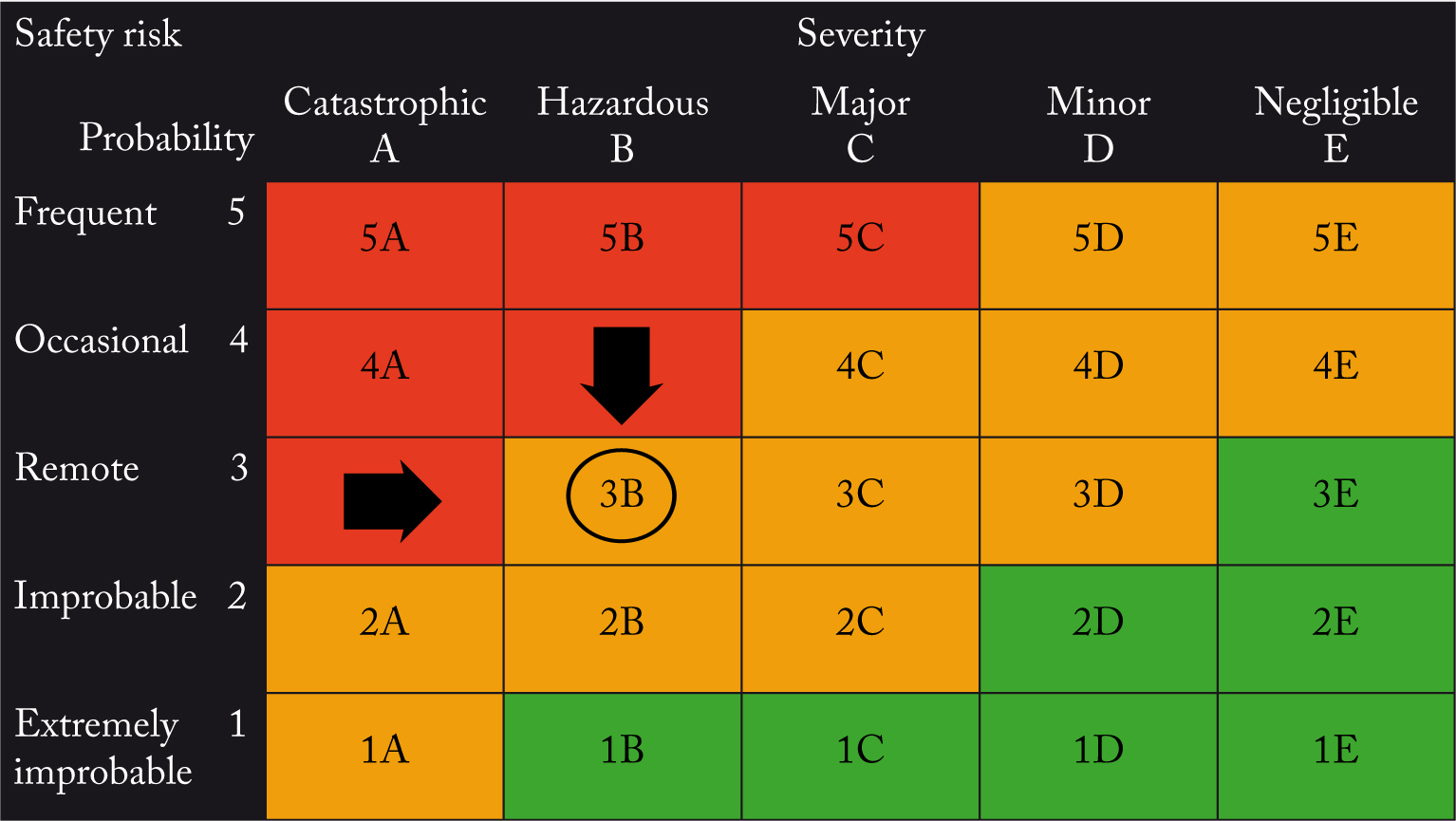
Fig. 8.
Loss-of-pressurization classification (following spacesuit introduction).
Table 5.
FAA-AST Implementation plan.
| Recommendations | Justification | Timeline |
|---|---|---|
| Temporarily suspend the carriage of spaceflight participants on suborbital flights pending further safety evaluation and movement of risks toward ALARP. | Outstanding questions remain regarding vehicle certification, health implications for space participants, underdefined manufacturing standards, adequacy of training, availability of spacesuits, and the scope of legal protection for spaceflight participants in the event of an accident occurs. | 6 to 12 months |
| Seek legal consultation to review the waiver regime and explore solutions through which insurance coverage might be enabled for parties involved directly/indirectly. | The current waiver structure limits avenues for spaceflight participants to seek legal recourse should operators deviate from the protected operational environment and an incident/accident occurs; there is no legal coverage for protecting the public from falling debris, only precautions taken by the operator | 6 to 12 months |
| Encourage suborbital operators to incorporate the ALARP and CBA methodology for risk assessments. | As shown in the risk assessment above, the proposed methodology assists in defining the boundaries between safety and cost-effectiveness. | Immediate effect through an directive issued to operators |
| Change the medical requirement to Class I for pilots operating suborbital vehicles. | Class I medical evaluations are stricter, including regular evaluations able to quickly detect latent health conditions. | Immediate effect |
| Require safety-related information sharing through mandatory reporting of occurrences that will be available for other operators to see (excluding sensitive data) | In aviation, such information-sharing has been proven to enhance safety and focus the attention of operators on precautions and mitigative actions. | 1 to 3 months |
| Resume suborbital tourism flights and accept spaceflight participants only if the above recommendations have been met and ALARP has been demonstrated effectively. | Enhancing safety records through proper risk mitigations can protect human occupant safety, public safety, and operators’ reputations. | After 12 months |