
1. INTRODUCTION
Today, numerous forecasts address the development of marine vessels, aviation, and automotive technologies for the period up to 2030–2035. The authors of these forecasts – various research centers and organizations – often construct them not solely on anticipated advances in science and technology or on the feasibility of practical implementation, but rather on the threats and challenges of the present moment [1, 2].
A forecast describing the expected characteristics of a future technical system must reflect the most critical directions of technological development. Moreover, these characteristics must be attainable: if they cannot be realized in practice, the forecast loses its value and becomes less a scientific result than a work of speculative fiction. It is precisely here that the need arises for a systematic approach to scientifically substantiating the parametric configuration of a promising technical system or aircraft.
Innovative technological development has become especially important. However, choosing a promising equipment concept solely on the basis of existing R&D is not always reliable. Such an approach is inadequate for forward-looking equipment development and comparative assessment for several reasons:
The priorities adopted in its creation are unknown.
It inherits the shortcomings characteristic of the design school – developers, technologists, testers, etc. – responsible for its development.
An already implemented system reflects past requirements, shaped by the tactical and technical assumptions made at the time of its development.
It should be emphasized that no widely accepted, standardized approach has yet been established for assessing the technical level of aviation equipment. Existing comparison methods are diverse and often inconsistent. Therefore, it is essential to develop a comparative methodology for evaluating equipment samples that avoids the shortcomings listed above.
2. LITERATURE REVIEW AND PROBLEM STATEMENT
The practical application of modern hindsight analysis is grounded in principles clearly articulated in the works of M. Nadin, R. Bradley McKay, and P. McKiernan [3, 4]. These authors emphasize that the past is not an isolated, static state; rather, it is inherently connected to the future. On the other hand, decision-making based solely on retrospective indicators often produces errors in assessing future prospects. Therefore, only the combined use of retrospective data and foresight indicators makes it possible to balance objective historical information with inherently non-deterministic future scenarios.
These insights have been widely adopted in the aviation industry. The development of advanced methods for managing the efficiency and safety of aviation systems [5, 6], as well as the creation of machine-learning and expert systems [7, 8], are just some of the practical applications of the principles formulated by Nadin, McKay, and McKiernan. However, particular attention must be paid to research focused on methods and approaches that employ hindsight analysis to evaluate aircraft performance for various purposes and according to diverse criteria. Studies such as [9–11] examine the practical use of hindsight analysis to ensure aviation-equipment reliability and to optimize maintenance processes. A core principle evident across these works is the active integration of available retrospective data with newly acquired information to build and refine predictive models of future indicators – such as component life, resource consumption, or the number of service failures.
Another important application of hindsight analysis is presented in works [12–14], which explore the use of digital twins for a wide range of tasks involving the design, operation, maintenance, and safety of aviation equipment. In these studies, hindsight analysis plays a key role in validating digital-twin models and training them on retrospective datasets. Despite these advances, the reviewed approaches generally use hindsight analysis as an auxiliary tool. Moreover, many of the proposed solutions are difficult to adapt to other tasks or lack general applicability. Nevertheless, there exists a class of problems in which hindsight analysis serves as the primary basis for decisions and conclusions – and these problems are formalizable. For example, paper [15] presents a methodology for analyzing aircraft flight characteristics by processing large datasets to improve the accuracy of comparative assessments when selecting among several aircraft alternatives. The method uses algorithms to compare aircraft performance under real operating conditions and extracts patterns across parameters such as speed, altitude, and fuel consumption.
Similarly, works [16, 17] address the problem of aircraft selection using multicriteria decision-making methods applied to manned [16] and unmanned [17] aircraft. These studies show that an integrated approach significantly increases the validity of engineering decisions. However, the need to operate with numerous specialized models often increases the risk of error – such as in airline fleet-formation decisions. To mitigate this, attempts have been made to strengthen selection validity by introducing complex, aggregated indicators derived from model analysis [18].
To a certain extent, the present work continues the line of research initiated by the authors in [18]. Consequently, the development of methods and approaches for applying hindsight analysis to evaluate the performance and suitability of aircraft for various purposes and according to multiple criteria constitutes a relevant and important scientific and technical task.
3. STUDY OBJECTIVE AND RESEARCH TASKS
The objective of this article is to enhance the method for comparing samples of aviation technology through the formalization of retrospective analysis of indicators and characteristics derived from hindsight data. The main research tasks are as follows:
to substantiate a method for comparing aircraft samples;
to develop a transport-system indicator for determining the forecasted parameters and characteristics of passenger and transport aircraft.
4. METHODS
To substantiate a method for comparing samples of aviation technology, a set of requirements can be formulated. These requirements may be summarized as follows:
The method should focus not on current or achieved performance, but on the prospective level of indicators that characterize the sample.
The method should be universal, forming a scientific and methodological foundation that allows for the evaluation and comparison of virtually any sample or type of equipment.
The method should enable comparison and analysis at all stages of the product life cycle.
The method must be practically implementable.
The method should support long-term forecasting of indicators for newly developed or previously developed products, in order to determine directions for further innovative development.
This method has been developed and successfully applied to several complex technical systems [19–21]. It is based on the concept of the degree of rationality as applied to the indicators of a specific equipment object. An object is regarded as rational if its configuration enables it to perform typical tasks efficiently, with equal or lower expenditure of technical resources and cost. At the same time, the object must demonstrate technological maturity and meet requirements for reliability, ergonomics, and operating conditions. Accordingly, comparing different equipment samples requires comparing their indicators with rational values, as well as assessing manufacturability and reliability [21, 22].
The structure of any parameter describing a property of a technical object can generally be represented as the ratio of the useful effect to the costs required to obtain that effect. Since each parameter evaluates only one property of the object, and the notion of “cost” may obscure the technical essence, it is more appropriate to use the corresponding indicators and characteristics of the equipment instead of direct cost terms. It should be noted that cost is not included in any parameter, as it neither affects nor reflects the intrinsic quality of the technical system. For many products, price is known, but it is influenced by numerous external factors often unrelated to the technical level of the sample. Therefore, price should be considered only at the final stage of analysis – when selecting a manufacturer or evaluating market prospects.
The assessment of the technical perfection of an object is based on dimensionless relations that depend only indirectly on operating modes and system characteristics. In general, the perfection of a technical system can be evaluated as a combination of quantitative and qualitative indicators.
where:RTS is the indicator of the system’s perfection in terms of the degree of rationality;
RT is the indicator of the degree of technical perfection, characterizing the quantitative parameters of the system;
RQ is an indicator that characterizes the qualitative properties of the system.
In accordance with the definition of a parameter reflecting the properties of an object, RT is determined by the expression:
where RTi is the i-th indicator, which is the ratio of the numerical value (Pi) of the i-th indicator to the characterizing the degree of rationality of the i-th indicator.It follows from expression (2) that the value of the indicator of technical perfection RT for a system composed of elements and subsystems – whose properties are defined by the rational values of their indicators – is quantitatively equal to the number of indicators n that characterize the analyzed system.
The ratio which appears in (2) can take the following values:
Inequality (3) corresponds to a case in which the indicator of the analyzed technical system is below its rational value. In this situation, the element or subsystem characterized by this indicator requires appropriate technical measures to bring it into alignment with the rational value. Equality (5) indicates that the indicator corresponds to its rational value, i.e., . Finally, inequality (4) indicates the presence of a “reserve” for this indicator – meaning that this element or subsystem is characterized by indicators “ahead of their time”, satisfying higher requirements than those currently imposed.
Many researchers note that the quantitative evaluation of qualitative indicators presents well-known challenges. The search for appropriate methodological solutions – and, more broadly, for a general framework for the quantitative assessment of qualitative indicators – constitutes a distinct scientific direction. In this study, a simplified approach is adopted: if a given property is inherent in the system, the corresponding indicator is assigned the value “1”; otherwise, it is assigned “0.”
Thus, the analyzed technical system is characterized by three values:
an indicator of the level of technical perfection;
an indicator of the quality level;
an indicator of technical perfection in terms of the degree of rationality.
Based on these estimates, different samples can be compared with one another. Such a comparison is more objective because it does not rely on a reference or baseline sample which, while possessing certain advantages, typically also exhibits several drawbacks, including:
the influence of a particular design school;
time constraints imposed during development;
the level of production technology;
material and financial constraints;
the level of training of developers and operating personnel.
Determining the numerical values of the rational indicators of a complex technical system is therefore a key stage in applying the method for assessing the level of technical perfection according to the degree of rationality.
It is well known that a complex technical system composed entirely of optimal components (systems, subsystems, elements) is not, in itself, optimal. Nevertheless, in designing such systems, it is natural for the engineer to seek the best conceivable solution – one that satisfies as many requirements as possible to the highest degree. This aspiration is limited by the fact that many requirements contradict one another or even prove mutually exclusive. As a result, the final configuration of a technological system is typically defined by a compromise, in which certain indicators are sacrificed to improve others. The extent to which such sacrifices are justified becomes evident only through operation and practical use of the equipment.
At the same time, it would be counterproductive to constrain designers by requiring the full realization of every available technical achievement. Since not all technological advances can be incorporated into a single practical sample, we consider rational indicators, taken in their entirety, to describe an idealized system. These indicators may reflect the latest scientific and technological achievements or represent forward-looking, prospective capabilities. Given the internal contradictions among such requirements, this model is purely ideal – indeed, in most cases, impossible to realize. However, each indicator, taken individually, defines a target level worth striving for and serves as a non-relative benchmark, independent of any specific sample, technology, or developmental trend.
Depending on the goals and tasks of the analysis, rational indicators may be formulated:
on the basis of review, analysis, and statistical processing of data on the latest achievements and concepts in the aviation industry, related fields, and science and technology more broadly;
on the basis of formulated requirements for advanced or prospective system configurations;
on the basis of conditions defined for tender evaluations by importers.
The latter two sources should incorporate and transform the first, while taking into account relevant constraints and objectives.
Hierarchical structural analysis provides a systematic procedure for representing a complex technical system as a hierarchy of elements that determine its properties. The essence of this method lies in decomposing the system into simpler components and conducting a step-by-step, pairwise comparison of the system’s indicators with their rational (i.e., ideal) values for a system of its complexity and functional purpose. The resulting combination of indicators is regarded as rational for the complex technical system.
Let there be n indicators characterizing the properties at the k-th hierarchical level of a complex technical system. According to the method of comparison by degree of rationality, comparing each of the n indicators with its corresponding rational value yields n estimates Rki at the k-th hierarchical level. Each Rk characterizes the relative level of the corresponding indicator. For clarity of analysis, it is convenient to present the results in the form of a histogram (Fig. 1).
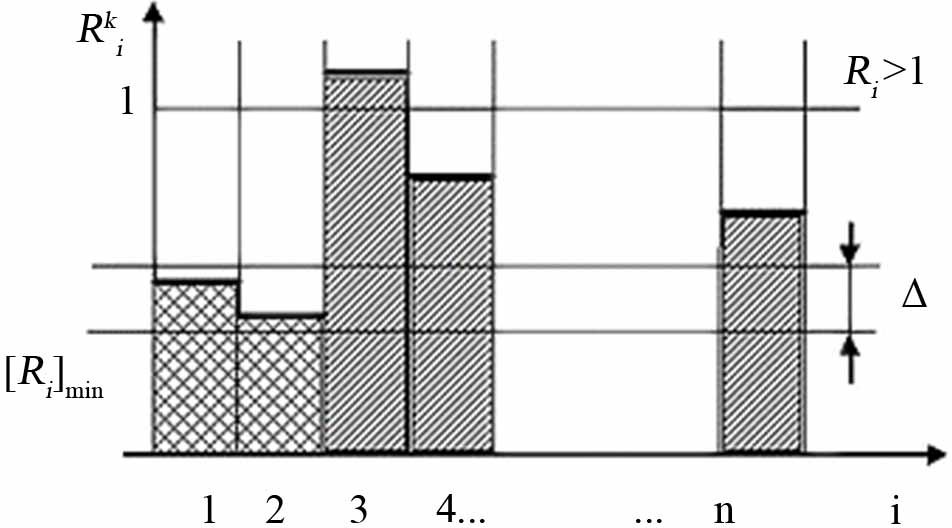
Fig. 1.
Histogram of indicator scores.
This form of presenting the results makes it possible:
to identify the weakest properties;
to determine the properties for which there is a reserve when Rki <1;
to assess the general level of the subsystem characterized by this set of indicators.
The weakest property of the subsystem is the one that has the lowest value of Rki. Furthermore, by defining a certain interval,
one can identify a group of properties whose level is insufficient. For such properties, the values Rki fall within the range:The properties identified in this way are of particular interest from the standpoint of developing measures for their improvement. However, such measures should only be undertaken after a thorough and comprehensive assessment of the relative importance (weight) of these properties. It is necessary to determine their influence on the characteristics of the object as a whole, taking into account the possible integrative effect – which may be positive (an increase in a property without adverse consequences) or negative (an increase in one or a group of properties leading to a decrease in others).
The overall level of a subsystem characterized by n indicators is determined by their sum. Since the value of this sum equals n for a rational system, the following ratio provides a relative assessment of the part of the structure described by n indicators at the k-th hierarchical level:
This procedure is applied to all indicators – both simple and composite. Based on the analysis of the results, one can identify the structural elements that lower the subsystem’s overall level, those that possess a reserve, and the general performance level of each subsystem. The development of subsystems is guided by the objective of achieving the highest possible efficiency of the object as an integrated system, in accordance with established priorities – often even at the expense of optimizing individual subsystems.
To support such design decisions, a scientific and methodological framework is needed, along with the necessary initial information, enabling evaluation of how changes in subsystem indicators influence the overall technical level and efficiency of the system.
5. RESULTS
Using the method of comparing aircraft samples described above, a decomposition of the hierarchical structure of the complex technical system (CTS) of the “aircraft” type was conducted. Each subsystem includes elements characterized by both individual parameters and integral characteristics. Thus, at the highest hierarchical level, the CTS is represented by complex indicators and criteria [21].
For transport and passenger aircraft (A/C), this approach can be implemented using the previously developed indicator of the transport system (TS) of the NTS [23]:
where:Mpayload is the mass of the commercial payload;
Mtake-off is the maximum take-off weight;
Lrun-up is the length of the run-up;
Vmax is the maximum flight speed;
P0 is the take-off thrust of the propulsion.
The study used data from existing and prospective transport and passenger aircraft projects [24–27]. A fragment of the constructed database is presented in Table 1.
Table 1.
Fragment of the database of existing and prospective passenger aircraft.
| No. | Aircraft name | Mtake-off, kg | Mpayload, kg | Vmax, km/h | Lrun-up, m | P0, N | NTS/1000, N×s |
|---|---|---|---|---|---|---|---|
| 1 | L-410 | 6400 | 1490 | 300 | 830 | 12179.86 | 25.852 |
| 2 | An-26-100 | 23800 | 5500 | 540 | 870 | 27654.75 | 34.259 |
| 3 | An-38-100 | 9500 | 2500 | 405 | 500 | 19613.30 | 17.842 |
| 4 | An-74TK-200 | 36500 | 10000 | 700 | 1300 | 127530.00 | 171.953 |
| 5 | An-140-100A | 21000 | 6000 | 540 | 752 | 27458.62 | 27.313 |
| 6 | An-148-100A | 36800 | 9000 | 870 | 1560 | 131454.00 | 178.064 |
| 7 | Il-86 | 210000 | 42000 | 950 | 2800 | 510120.00 | 1202.809 |
| 8 | Il-96-300 | 250000 | 38600 | 910 | 2600 | 627840.00 | 1516.861 |
| 9 | DC-10-40 | 259460 | 48330 | 980 | 2800 | 706320.00 | 1642.151 |
| 10 | Boeing 707-200adv | 95029 | 18600 | 980 | 3030 | 337464.00 | 839.162 |
| 11 | Boeing 737-100 | 47170 | 13150 | 896 | 1290 | 122193.40 | 126.881 |
| 12 | Boeing 737-200 | 52390 | 15400 | 876 | 2058 | 129099.60 | 214.142 |
| 13 | Boeing 737-200adv | 53070 | 15420 | 910 | 1990 | 137340.00 | 213.071 |
| 14 | Boeing 737-300 | 63300 | 15400 | 850 | 2012 | 196003.80 | 351.079 |
| 15 | Boeing 737-400 | 68000 | 19400 | 850 | 2356 | 209345.40 | 414.713 |
| 16 | Boeing 737-500 | 60600 | 15200 | 910 | 1830 | 178149.60 | 268.397 |
| 17 | Boeing 737-600 | 65500 | 15600 | 910 | 1860 | 202086.00 | 314.678 |
| 18 | Boeing 737-700 | 70100 | 17600 | 910 | 1680 | 215427.60 | 297.859 |
| 19 | Boeing 737-800 | 79000 | 21300 | 910 | 2241 | 234066.60 | 421.006 |
| 20 | Boeing 737-900ER | 85100 | 22300 | 910 | 2450 | 240541.20 | 477.908 |
| 21 | Boeing 737-MAX8 | 82200 | 21000 | 925 | 2450 | 260946.00 | 514.582 |
| 22 | Douglas DC-8-63 | 162390 | 30725 | 950 | 2700 | 338080.00 | 779.060 |
| 23 | Boeing 747-SP | 299380 | 41600 | 940 | 2160 | 889600.00 | 1760.140 |
| 24 | Boeing 767-200ER | 175500 | 35500 | 910 | 2600 | 515221.20 | 1174.293 |
| 25 | Boeing 777-200ER | 297560 | 51250 | 945 | 3000 | 833850.00 | 2191.214 |
| 26 | Boeing 777-200LR | 347800 | 50850 | 945 | 2900 | 979038.00 | 2565.190 |
| 27 | Boeing 777-300 | 299370 | 66050 | 945 | 3700 | 802458.00 | 2448.702 |
| 28 | Boeing 777-300ER | 351800 | 68500 | 945 | 3300 | 1024164.00 | 2880.066 |
| 29 | Boeing 787-8 | 228000 | 43300 | 956 | 3100 | 568980.00 | 1494.627 |
| 30 | Boeing 787-9 | 254000 | 55030 | 956 | 2900 | 640000.00 | 1520.807 |
| 31 | Boeing 787-10 | 227900 | 41050 | 956 | 2750 | 680000.00 | 1603.735 |
| 32 | Tu-334-100 | 47900 | 12000 | 880 | 1900 | 147150.00 | 238.117 |
| 33 | Tu-204-100 | 103000 | 21000 | 920 | 2150 | 313920.00 | 584.045 |
| 34 | Tu-204-120 | 105000 | 27000 | 920 | 1900 | 378666.00 | 580.935 |
| 35 | Tu-154M | 100000 | 18000 | 935 | 2300 | 323730.00 | 653.000 |
| 36 | Airbus A320 | 78000 | 19500 | 890 | 2100 | 235440.00 | 416.649 |
| 37 | Airbus A321 | 93500 | 25000 | 890 | 2180 | 294300.00 | 528.124 |
| 38 | Airbus A319 | 75500 | 17500 | 890 | 1520 | 209934.00 | 275.434 |
| 39 | Airbus A320 NEO | 79000 | 20000 | 890 | 2050 | 241326.00 | 415.138 |
| 40 | Airbus A321 NEO | 93500 | 21200 | 890 | 1980 | 294300.00 | 506.282 |
| 41 | Airbus A319 NEO | 75500 | 17800 | 890 | 1520 | 215820.00 | 281.692 |
| 42 | Airbus A340-300 | 275000 | 51250 | 913 | 3000 | 667080.00 | 1783.441 |
| 43 | Airbus A350-900 | 280000 | 53000 | 945 | 2600 | 750000.00 | 1672.902 |
| 44 | Concept with PD-35 | 200000 | 35500 | 850 | 2750 | 686700.00 | 1827.329 |
| 45 | Concept DPP | 200000 | 35500 | 850 | 2750 | 431640.00 | 1148.607 |
| 46 | Concept with Rolls-Royce TREND XWB | 200000 | 35500 | 850 | 2750 | 843660.00 | 2245.004 |
| 47 | SAX-40 (3x DPP) | 156000 | 27950 | 850 | 2500 | 450000.00 | 1086.397 |
A dependency NTS = f (Mtake-off) described by the function is constructed:
Fig. 2 presents this dependence.
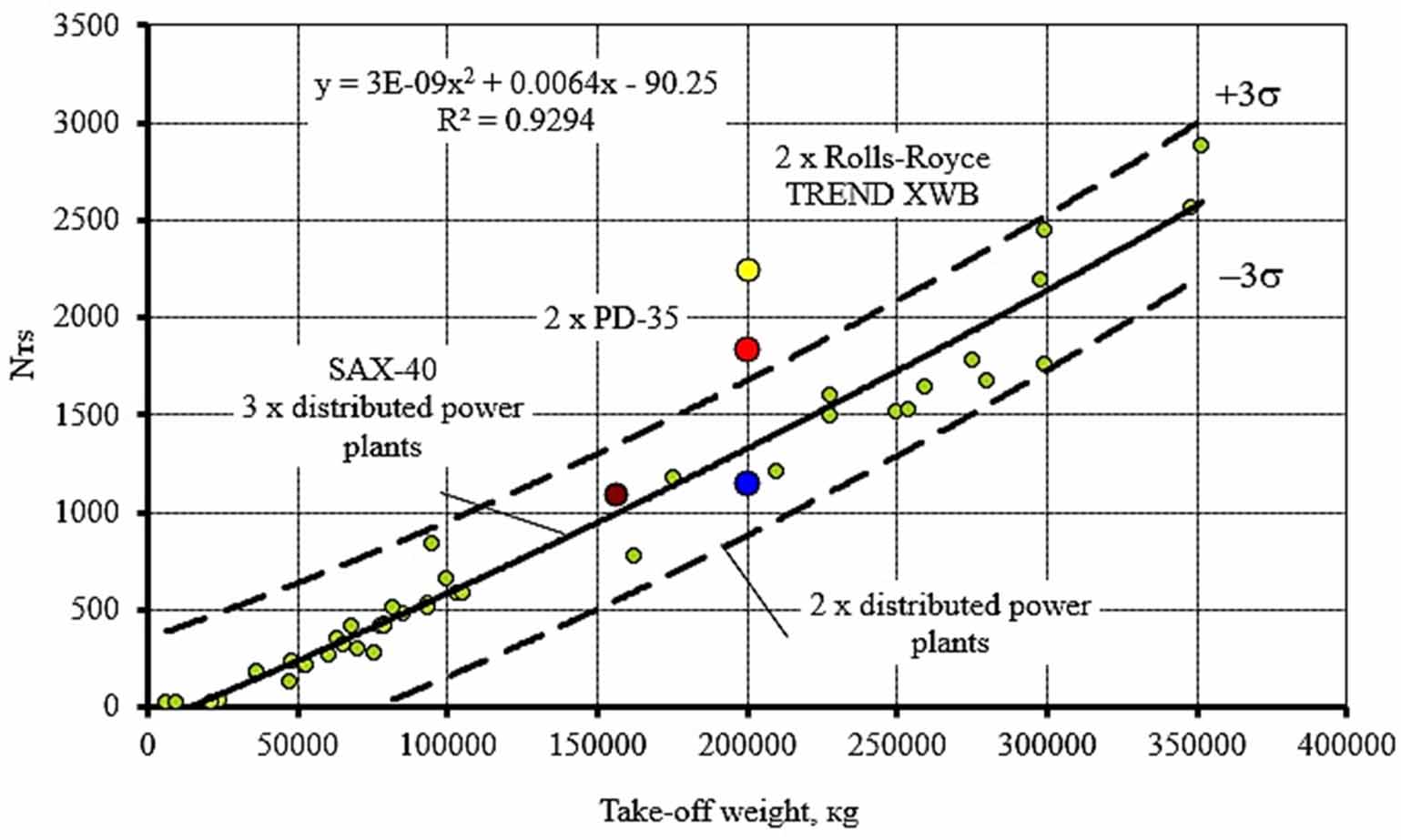
Fig. 2.
Dependency NTS = f (Mtake-off) for passenger aircraft.
It should be emphasized that this dependence, taking into account the standard deviation σ of the obtained NTS values from the mean during interpolation, represents a band within which the combinations of flight-performance characteristics corresponding to the current state of the art are located. Because the aircraft included in the database are already implemented designs, their combinations of flight-performance indicators do not require proof of feasibility or reliability.
Therefore, NTS = f (Mtake-off) ± k · σ shown in Fig. 2, represents the hindsight envelope for this class of equipment. Using the transport-system indicator calculated for new (prospective) aircraft, one can determine whether a predicted design is a qualitatively new solution or simply another feasible combination of known indicators. If the NTS value for a prospective sample goes beyond the band NTS = f (Mtake-off) ± k · σ, where k=1, 2, …, then in any case this is a new solution. Moreover, the best design will be the one for which, with the same value of Mtake-off, the NTS indicator is lower.
The value of the NTS indicator determined for a prospective sample makes it possible to evaluate combinations of basic indicators and therefore define directions for forward design studies. However, it should be noted that this procedure is an inverse problem: mathematically, infinitely many combinations of parameters can correspond to a given indicator. At this stage, to reasonably restrict the number of admissible combinations, it is appropriate to use additional hindsight dependencies – such as take-off weight vs. payload for transport and passenger aircraft (Figs. 3 and 4), weight return vs. take-off weight (Fig. 5), or passenger-seat mass MPS vs. passenger capacity (Fig. 6). In addition, ICAO noise and emissions requirements [28, 29] should be applied as further constraints.
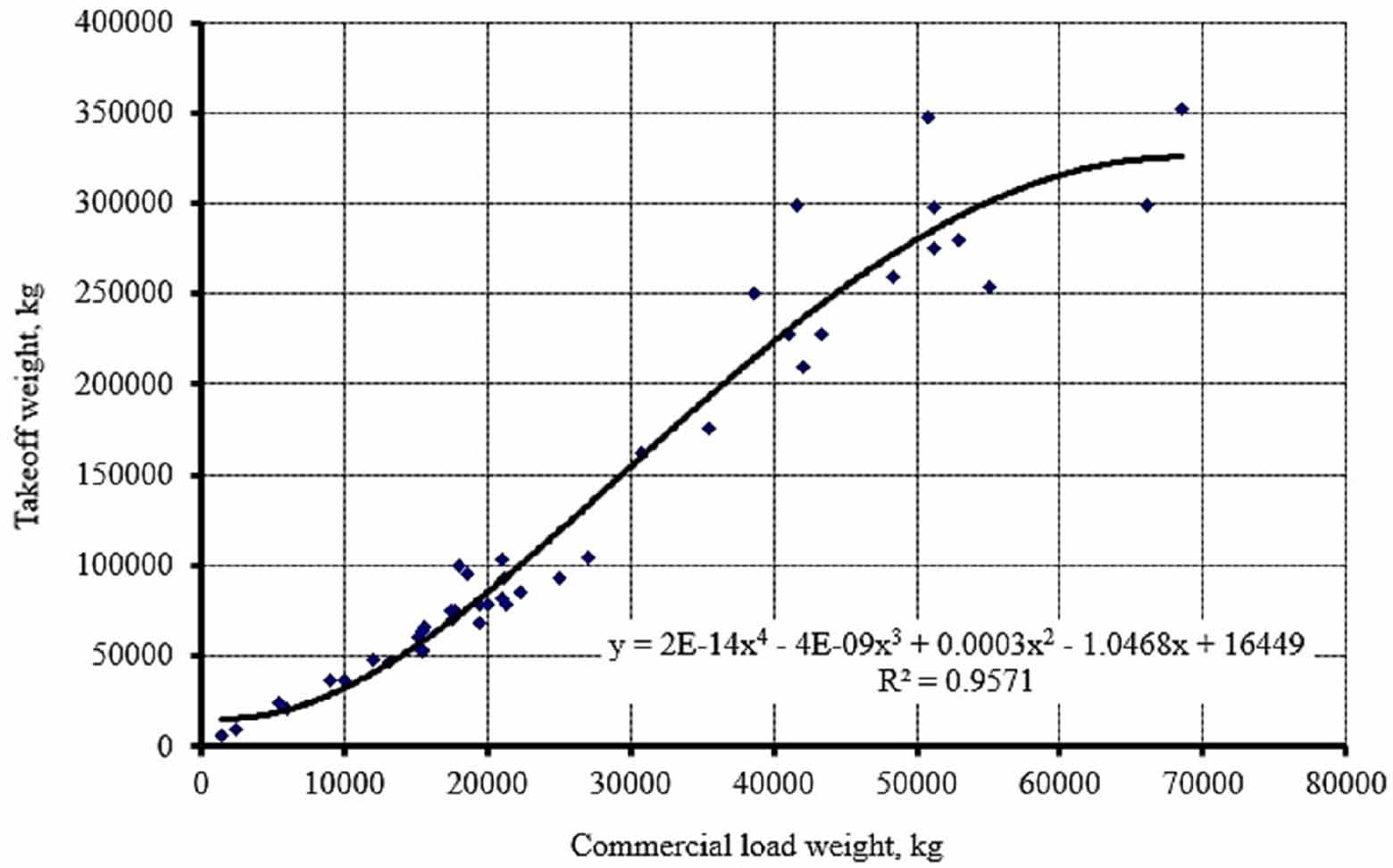
Fig. 3.
Dependency Mpayload = f (Mtake-off) for passenger aircraft.
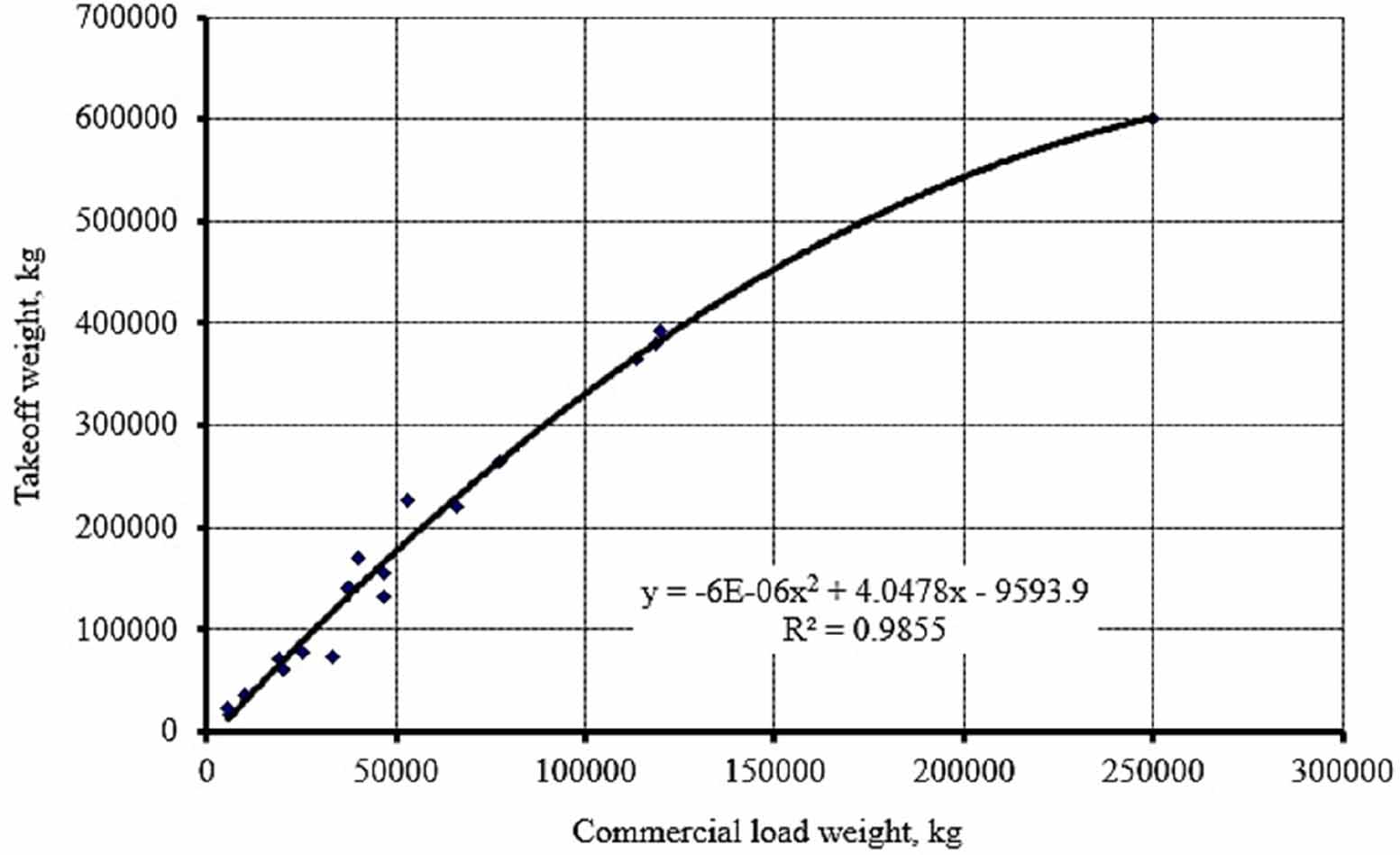
Fig. 4.
Dependency Mpayload = f (Mtake-off) for transport aircraft.
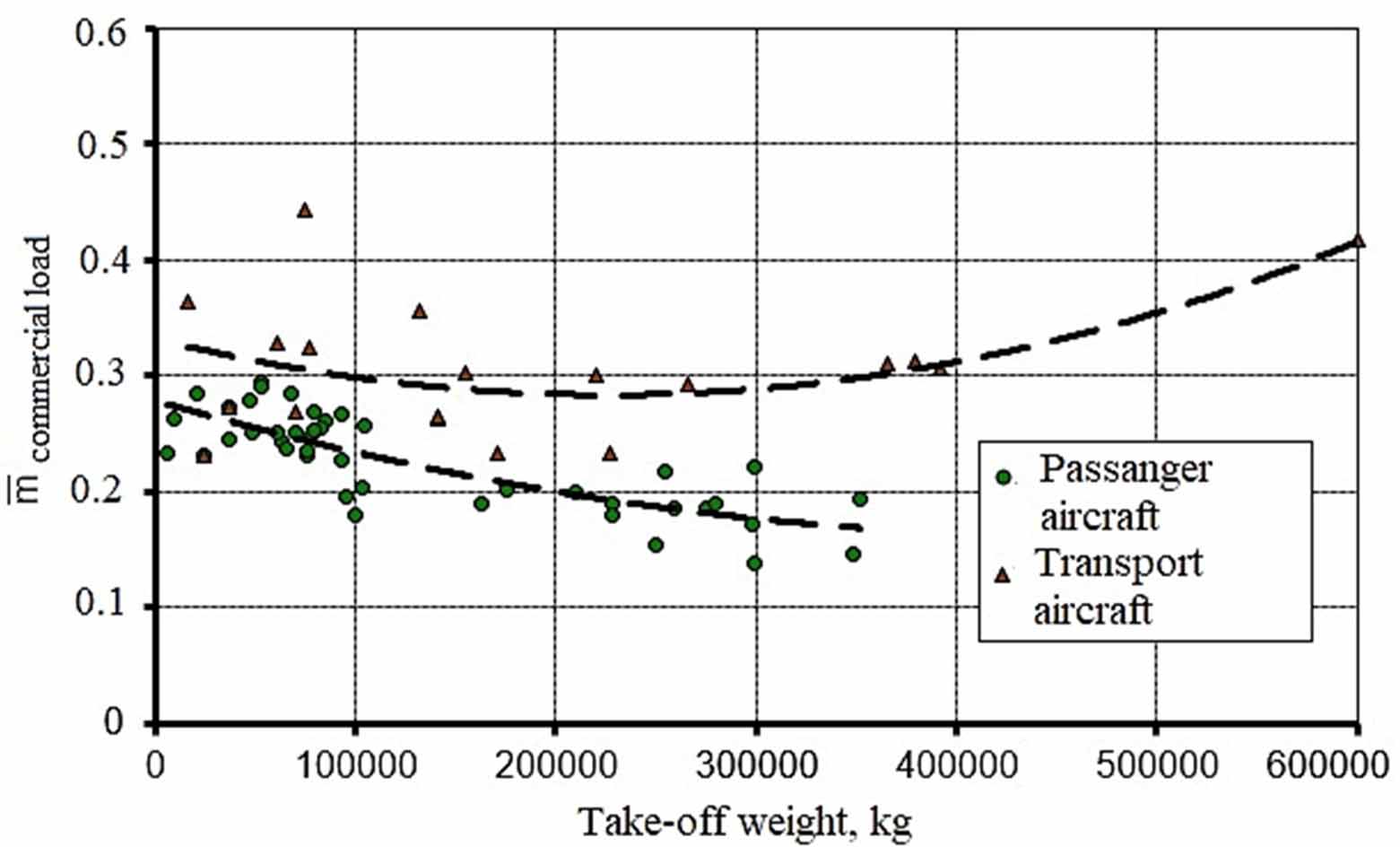
Fig. 5.
Dependency for passenger aircraft.
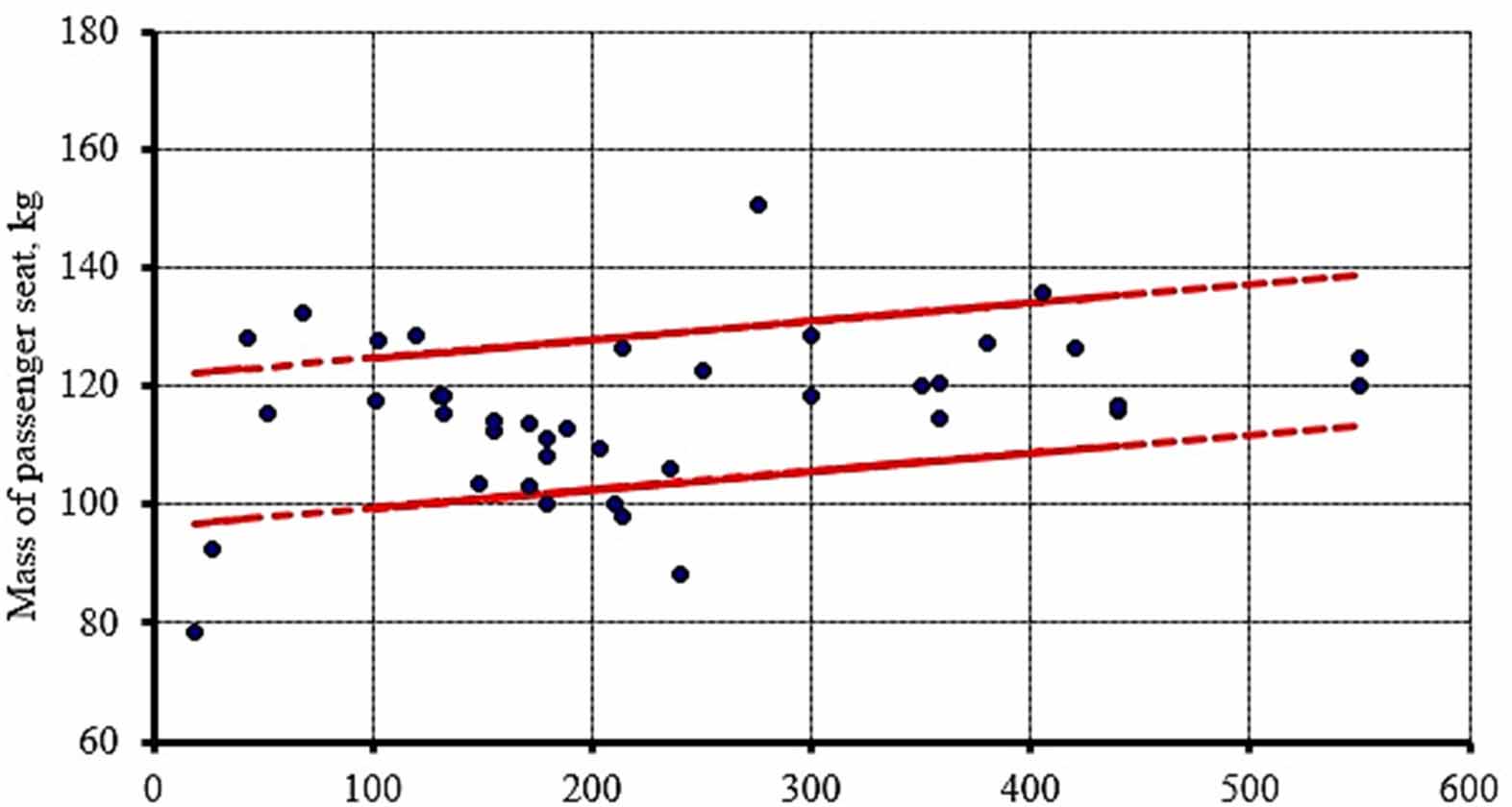
Fig. 6.
Dependency MPS = f (Npass) for passenger aircraft.
When determining the aggregate indicators for the power plant, it is useful to use the dependence of the engine thrust on the takeoff weight of the aircraft (Fig. 7), as well as the indicator of integration of the propulsion and the airframe of the aircraft [21].
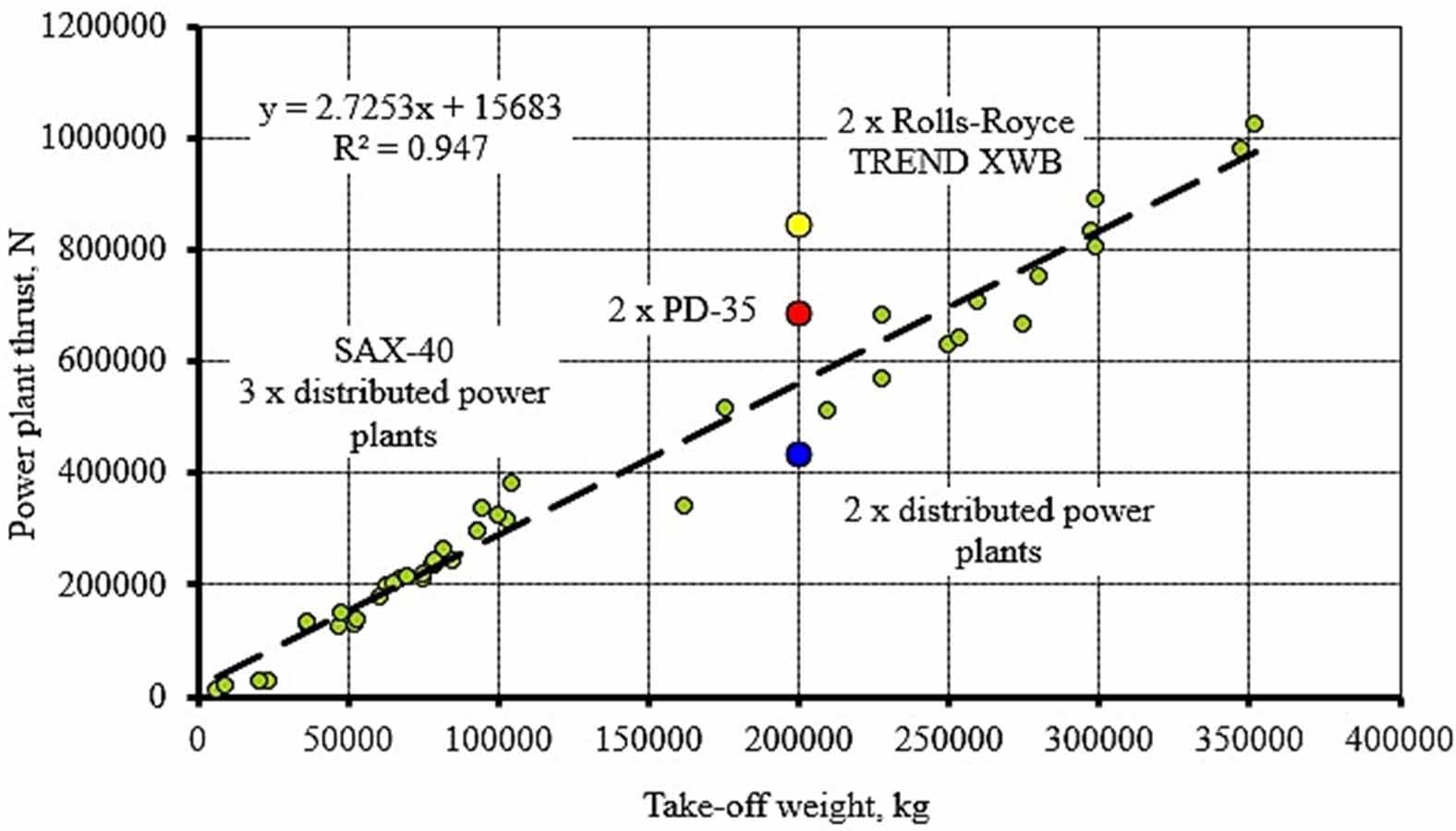
Fig. 7.
Dependency P0PP = f(Mtake-off) existing and prospective passenger aircraft.
Today, a wide variety of indicators and criteria are used to assess the technical perfection of aircraft. This diversity results from the need to take into account the full range of customer requirements for each specific aircraft type. For every project, a distinct set of criteria and constraints may be selected.
6. DISCUSSION
The results presented show that the tasks of the upper and lower hierarchical levels are often solved largely independently. For example, an engine may be developed as a standalone subsystem and, according to the developers’ criteria, may exhibit excellent technical characteristics. However, when integrated into the airframe, the declared flight-performance parameters are not always achieved. This suggests that common approaches, indicators, and criteria for comparing options should be applied consistently when designing subsystems of an aircraft. Yet today, given the substantial number of feedback interconnections among subsystems, this is still insufficient. For this reason, generalized indicators have been introduced at intermediate hierarchical levels; when indicators at higher or lower levels change, these generalized indicators should at minimum confirm that subsystem properties have not deteriorated.
More broadly, in the absence of a unified approach to evaluating design options or comparing technical objects, designers often rely on particular indicators that reflect the perspective of specific decision-makers regarding a subsystem or object [30]. This reality further underscores the need to develop a unified approach for analyzing design alternatives and comparing samples. A single, consistent method should serve as an instrument for ensuring system-level design principles and for assessing the resulting aircraft. At the forecasting stage, however, direct application of such a method is difficult due to uncertainty regarding the degree of novelty and the incorporation of advanced technologies at the time the forecast is made.
Intuitively, solving this problem requires reliance on two foundations:
a formally described representation of the achieved level for this class of equipment – which constitutes the content of the hindsight component in Foresight-type forecasts;
an integrative (or at least composite) indicator that characterizes the principal properties of a sample within a class or type and is derived from the hierarchical structure of indicators describing a complex technical system.
In this study, the analysis focused on civil aviation. However, hindsight analysis and foresight forecasting must also account for advanced technologies developed in military aviation [31, 32]. It is well known that the most sophisticated and costly technologies often originate in military aviation and other defense sectors, due to their strategic importance, high research and development costs, and stringent requirements for reliability and combat capability. Breakthrough technologies – such as stealth systems, UAV swarming, satellite navigation and communications, and advanced materials – are typically implemented first in military aircraft. Some of these solutions are subsequently adapted for civil use.
Therefore, for the sake of completeness and to advance the proposed scientific and methodological approach, future research should investigate the application of hindsight analysis and foresight forecasting to technological development in military aviation.
7. CONCLUSIONS
This paper has presented and substantiated a method for comparing samples of aviation equipment. The method has a general scientific and methodological basis for determining rational parameters, characteristics, indicators, and related values. Using integrative indicators for transport and passenger aircraft, a systematic approach has been developed to assess the degree of rationality of indicators for forecasted prospective aircraft in these categories. The hindsight envelope for this class of aircraft has been formalized on the basis of the transport-system indicator.
A transport-system indicator was developed to determine the forecasted parameters and characteristics of passenger and transport aircraft. As the achieved levels of aircraft and subsystem characteristics evolve, the constructed functional dependence can be supplemented with indicators from newly implemented projects, reflecting the ongoing development of this class of aircraft. In the development of foresight technologies, it is therefore advisable to estimate prospective values of integral indicators.