
1. INTRODUCTION
Excessive depletion of fossil fuel reserves and growing environmental concerns have created an urgent need to explore alternative energy sources for aircraft. This has prompted various stakeholders in the aerospace industry to study the technology of hybrid electric propulsion systems (HEPSs) and fully electric vehicles. Reducing greenhouse gas emissions and their environmental impact remains a central challenge in the development of next-generation aircraft propulsion technologies. However, other factors are also becoming increasingly important – notably the financial and operational vulnerability of aviation to geopolitical instability. Military conflicts involving major oil- and gas-producing states have repeatedly disrupted fuel supply chains, resulting in shortages and steep price increases. In this context, the development of hybrid propulsion architectures offers a strategic opportunity to reduce dependence on conventional fuels and to lower operating costs.
Forecasts indicate that global air-transport demand will continue to rise, with passenger traffic expected to grow by 6% worldwide [1, 2] and by up to 48% in Asia by 2035 [3]. Aviation plays a major role in global economic, social, and cultural development, but it also exerts a considerable environmental impact. The sector accounts for roughly 2% of total transport-sector fuel consumption, while its contribution to greenhouse gas emissions across all modes of transportation is estimated at around 13% [4]. Without substantial reductions in fossil-fuel use, the projected expansion of air travel risks a corresponding and unsustainable rise in emissions.
In this context, transport airships represent a promising alternative. Due to their low fuel consumption and inherent buoyancy, airships offer significantly greater environmental friendliness than fixed-wing aircraft or helicopters. One of their principal advantages is exceptionally low energy cost: airships can remain aloft for extended periods without refueling, and their operating expenses are markedly lower than those of conventional aircraft [5]. They combine desirable characteristics of both ships and aircraft – higher speeds than maritime vessels, lower vibration levels than airplanes, independence from sea conditions, and no requirement for long runways. These properties enable the transportation of heavy cargo to remote or difficult-to-access regions.
Airships also generate minimal air and water pollution and can perform missions for which traditional aircraft or helicopters are poorly suited. Their low noise, limited vibration, and minimal accelerations make them ideal platforms for surveillance, monitoring, and long-endurance patrolling. For these reasons, assessing and justifying the feasibility of transport airships – particularly when equipped with hybrid propulsion systems – constitutes a timely and important scientific and engineering task.
2. LITERATURE REVIEW AND PROBLEM STATEMENT
Transport airships of large and super-large carrying capacity have been developed in many countries, including the United Kingdom (SkyKitten by ATG), Germany (ZET by Zeppelin) [6], and the United States (AEROS by Lockheed Martin) [7]. A key trend in modern airship development is the shift toward hybrid airship configurations, which address many of the limitations of classical designs and offer broader applicability in transport and economic operations – particularly in remote regions lacking permanent road infrastructure or reliable links with industrial centers. In hybrid configurations, the conventional airship structure is augmented with high-thrust propulsive units, improving controllability, simplifying ballast management, and increasing overall payload capacity. These concepts are often referred to as quadrotor heavy-lift airships, emphasizing their fundamental distinction from classical buoyant aircraft [8].
Historically, the main challenges in airship development have included large physical dimensions, limited maneuverability, vulnerability to adverse weather, structural complexity, high operating costs, and safety issues associated with hydrogen use. Airships also generally maintain lower cruise speeds than aircraft and require large hangars for storage and maintenance. Nevertheless, recent studies have demonstrated the ongoing relevance and strong future potential of transport airships. The foundational theory of airship flight is presented in [9], which outlines the key principles of performance estimation and structural design. Contemporary research focuses on new airship configurations, technological advancements, and comparative assessments of airships relative to other aircraft, with particular attention to operational safety and mission suitability.
According to the analysis in [10], airships and railways represent relatively low-emission transport options compared with automobiles and aircraft. Unlike railways, hybrid airships require minimal ground infrastructure. Among airship types, lifting-body dynastats are particularly well suited for implementing different degrees of propulsion-system hybridization due to their favorable surface-to-volume ratio. The authors of [10] investigate hybrid propulsion systems combining conventional engines with electric motors and compare their performance against traditional configurations. They formulate an objective function based on envelope volume to determine the optimal tri-lobed dynastat configuration capable of transporting a 10-ton payload over 500 km under specified operating conditions. The design space is evaluated using projected future battery technologies with specific energies between 250 and 750 Wh/kg. Three power-source scenarios are analyzed: fuel alone, fuel + batteries, and fuel + batteries + solar arrays. The results indicate that a fully electric airship with zero carbon emissions is feasible, though it requires a significantly longer envelope (+18%) and a much higher total volume (+63%) compared with the baseline configuration. A fully electric system supplemented by solar arrays reduces payload capacity by up to 27.6%, while batteries alone represent approximately 17.2% of the takeoff mass – compared with only ~1% for fuel in a conventional system. These findings show that hybrid propulsion architectures offer a favorable compromise, enabling reductions in environmental impact while avoiding the severe mass penalties associated with fully electric designs. In general, hybrid airships can achieve greenhouse-gas emission levels per passenger comparable to rail transport.
Finally, based on comparative analyses of transportation modes (Figs. 1 and 2), airships demonstrate clear advantages in transporting oversized and heavy cargo that cannot be accommodated by modern aircraft due to dimensional or weight constraints.
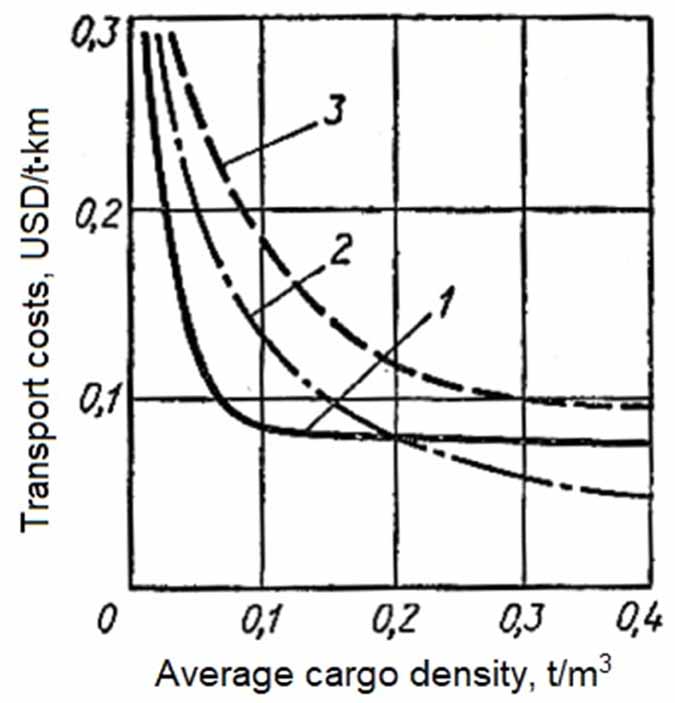
Fig. 1.
Dependence of transport costs on the average cargo density [9]: 1 – airships; 2 – ground transport; 3 – cargo planes.
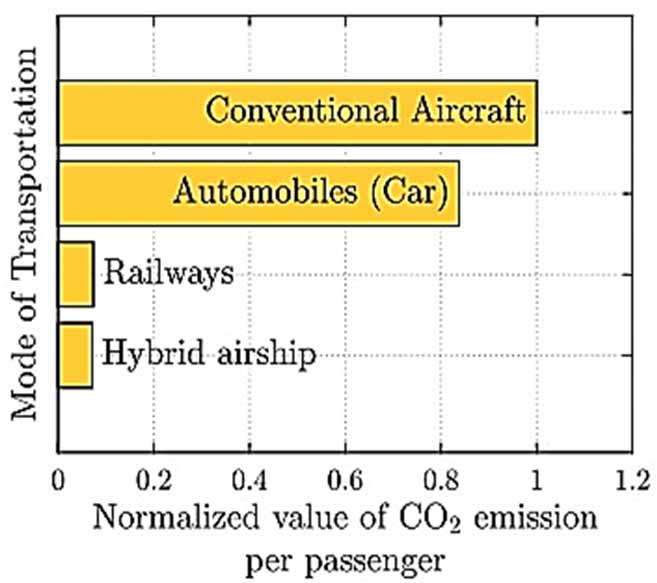
Fig. 2.
CO2 emissions per passenger for different modes of transportation [10].
Hybrid airships are increasingly promoted as efficient aerial platforms for a wide range of applications, including heavy cargo transportation, communications, scientific missions, and long-endurance observation and surveillance in the stratosphere. Since the mid-20th century, hybrid airship technologies have advanced considerably and now offer several operational advantages over conventional buoyant aircraft [11]. Recent research examines hybrid airship design concepts in detail, summarizes the state of the art, and outlines major technological milestones in their development. Current literature also classifies the main types of hybrid airships and describes their distinctive features. Among the various configurations, dynastat-type hybrid airships are regarded as the most promising due to their structural simplicity and suitability for both civilian and military applications. Two dynastat subtypes – winged-hull and multiple-hull configurations – are typically analyzed in depth. Key aspects of conceptual design, including aerodynamics, dynamics, overall performance, thermal behavior, structural considerations, and optimization methods, are extensively discussed in recent review papers.
Hybrid propulsion system (PS) technologies also enable partial or complete mitigation of noise emissions [12]. The scientific literature offers numerous proposals aimed at reducing aviation’s dependence on traditional fossil fuels. Much of the existing research [13] examines the use of solar energy harvested through photovoltaic arrays as a renewable power source for aircraft. While this approach has yielded promising results for unmanned aerial vehicles (UAVs) [14, 15], it remains impractical for large commercial aircraft due to the limited available surface area for solar panels. Consequently, current investigations focus on alternative energy sources – biofuels, advanced batteries, hydrogen, and fuel cells – for aircraft equipped with hybrid electric propulsion systems (HEPSs) [16].
In [17], the authors analyze the energy and thermal characteristics of an airship under varying flight attitudes. They develop a solar-radiation and thermal-response model to evaluate output power under different thermal environments. Using the Fluent computational fluid dynamics software, they investigate the thermal behavior of airships at various pitch angles and assess how geometric parameters influence the optimal orientation for solar energy absorption. The results indicate that pitchangle variations significantly affect both airship surface temperature and airflow distribution. These findings provide valuable insights for selecting operational strategies and optimizing the performance of high-altitude airships.
The authors of paper [18] review the research and development of various airship types. The study begins with an overview of the early history of non-rigid, semi-rigid, and rigid airships, followed by a discussion of modeling approaches, structural analysis techniques, and simulation methods used in airship development. The optimization of hull geometry is briefly addressed, with particular emphasis placed on structural aspects of airship modeling.
Despite their potential benefits, cargo airships remain largely conceptual. Study [19] investigates the factors shaping demand for cargo-airship services from the perspective of transport-logistics specialists. An online selection experiment was conducted to evaluate preferences among four transport modes: road, rail, maritime, and airship. Key decision parameters included cost, time, reliability, and service frequency. The willingness to pay for cargo-airship services – expressed as dollars per ton per hour of time saved – was estimated at 23 USD. Conservative projections suggest that potential market share in Australia’s domestic freight sector varies by airship model: the LMH-1 may capture approximately 8%, whereas the ARH50 could reach as high as 25%.
Paper [20] introduces a novel concept for a stratospheric airship employing a triple-gasbag configuration to mitigate super-pressure caused by solar heating during diurnal station-keeping. The design exploits the gas–liquid phase change to regulate differential pressure, and a comparative analysis identifies ammonia as the optimal working fluid for this purpose. Steady-state simulations show that conventional airships are unable to adequately reduce super-pressure from solar superheat, whereas the proposed triple-gasbag configuration can reduce super-pressure by more than 45% by varying the ammonia volume fraction from 10% to 0% at constant altitude. To capture the rapid temperature and pressure growth at sunrise, the authors develop a coupled dynamic model describing the transient thermodynamic and kinetic behavior of the triple-gasbag system.
In paper [21], the “Buzuk” project is presented, incorporating several new technical solutions that expand the operational possibilities of airships relative to aircraft. A key innovation is the Precision Airship Catch System, designed to enable safe landings even under severe wind conditions. The authors note that this system may also support the development of advanced piloting techniques for extreme environments.
In the 21st century, airships are re-emerging in the aviation market, driven by rising demand for long-distance cargo transport, the intrinsic environmental advantages of buoyant flight, and significant progress in engineering, materials, and manufacturing technologies [22]. Paper [23] examines the niche occupied by airships between air and sea transport, highlighting their inherent advantages and operational limitations. The authors review the economics of airship transportation based on historical performance and contemporary designs and conclude with a discussion of two potential long-haul applications.
The aim of paper [24] is to provide a comprehensive review of modern airship development, covering dynamic and aerodynamic modeling, conceptual-design and optimization methods, structural-design and manufacturing technologies, and contemporary energy-system solutions. The review begins with a concise historical overview, followed by an assessment of both traditional and unconventional airship configurations, including existing operational designs and conceptual prototypes.
Study [25] compares airships of various designs with conventional transport aircraft of the same period. The comparison includes mission types with ranges of 555 km (regional), 3700 km (transcontinental), and 9250 km (intercontinental). Selected results from the study are summarized in Table 1.
Table 1.
Comparison of aircraft fuel efficiency.
| Range, km | Aircraft | Fuel weight, kg | Payload weight, kg | Gross take-off weight, kg | Cargo weight to gross takeoff weight ratio, kg/kg | Fuel weight to gross take-off weight ratio kg/kg | Fuel efficiency, g/kg/km |
|---|---|---|---|---|---|---|---|
| 555 | Classic airship for short range mission | 1362 | 21792 | 45400 | 0.48 | 0.03 | 0.1126 |
| 555 | B737-200 | 5448 | 15890 | 48124 | 0.33 | 0.11 | 0.6178 |
| 3700 | Classic airship for transcontinental mission | 13620 | 78088 | 227000 | 0.34 | 0.06 | 0.0471 |
| 3700 | L1011-500 | 41768 | 44038 | 195220 | 0.23 | 0.21 | 0.2563 |
| 9250 | Classic airship for intercontinental mission | 58112 | 204300 | 454000 | 0.45 | 0.13 | 0.0308 |
| 9250 | B747-200 | 148912 | 59020 | 372280 | 0.16 | 0.40 | 0.2728 |
The table employs the concept of a classic airship, understood as a buoyant, controllable aircraft with an ellipsoidal, streamlined envelope and aerodynamic control surfaces – rudders and stabilizers – mounted at the tail. This classical configuration provides longitudinal controllability and stability, enabling the airship to maintain a desired heading regardless of ambient wind conditions.
Modern airships typically employ piston engines, both gasoline and diesel, within their propulsion systems. The thermal efficiency of such engines ranges from 30% to 45%. State-of-the-art marine diesel engines can achieve efficiencies of up to 50%, but their size and mass make them unsuitable for airship applications. In contrast, fuel cells can reach thermal efficiencies of approximately 70%. Consequently, hybridization of the propulsion system (PS) represents a promising approach for reducing overall system mass while increasing transport efficiency.
Studies [26, 27] analyze hybrid airships as highly effective transport platforms due to their long endurance, large payload capacity, expanded fuel reserves, and improved environmental performance. These works identify hybrid airships – both manned and unmanned – as a new and emerging form of aerial transportation. Supported by advanced modeling tools such as Multidisciplinary Design Optimization (MDO) and high-fidelity CFD methods, hybrid airships are projected to become operationally viable in the near future.
Paper [28] proposes a design methodology for evaluating the feasibility of a winged hybrid airship powered by solar energy. The methodology integrates five key disciplines – geometry, aerodynamics, environmental modeling, energy systems, and structural design – into a unified optimization framework. Fourteen design variables were selected to size the envelope, wing, and solar-panel layout. The optimization is constrained by weight and energy balance. Two configurations were evaluated: a conventional airship and a winged hybrid airship. Simulations were performed for four representative days of the year to assess seasonal performance variations. The results satisfy all imposed constraints, but indicate that the winged hybrid configuration does not offer significant advantages over the conventional design.
Despite extensive studies on hybrid configurations, modern literature still lacks comprehensive research on advanced, hydrogen-based energy systems for airships. In particular, the design of modern, safe, and sustainable powerplants – such as fuel-cell-based hybrid systems – remains insufficiently explored, leaving a critical gap in current airship propulsion research.
3. STUDY OBJECTIVE AND RESEARCH TASKS
The objective of this study is to substantiate the concept of a transport airship equipped with a hybrid propulsion system (PS) based on fuel-cell technology. To achieve this objective, the following research tasks are defined;
To justify the operational advantages of transport airships in contemporary and future flight applications;
To develop a schematic layout of the energy system for a fuel-cell-based hybrid propulsion system intended for a transport airship.
4. METHODS
This study employs a combination of statistical analysis, mathematical modeling, airship-design methodologies, and production technologies for advanced power systems. Attention is given to modern hydrogen-based energy technologies, including fuel-cell integration methods for hybrid propulsion architectures.
5. RESULTS
5.1. Justification of the advantages of using transport airships
Based on the review of available literature and analysis of the technical and economic characteristics of transport-airship projects [29–31], a comparative assessment was performed between airships, existing transport aircraft, and a heavy-lift helicopter (Table 1). The comparison includes airships of small, medium, and large payload capacity.
Table 1.
Technical and economic characteristics of air vehicles.
| Air vehicle type | Helicopter | Aircraft | Airship class | ||||||
|---|---|---|---|---|---|---|---|---|---|
| Mi-26 | B747-400F | A330-300P2F | C-5B Galaxy | An-124 | 1 | 2 | 3 | 4 | |
| Airship body volume, thousand m3 | 26 | 60 | 60 | 352 | |||||
| Take-off weight, t | 49.5 | 396.9 | 242 | 379.7 | 405 | 25.4 | 57 | 70.9 | 332 |
| Weight of commercial load, t | 20 | 112.6 | 63 | 118 | 120 | 58*** | up to 25 | 30–40 | up to 200 |
| Cruising speed, km/h | 180–255 | 908 | 910 | 860890 | 800850 | 115140 | 110145 | 140170 | 125165 |
| Flight range, km | 400–600 | 8230 | 6850 | 44405500 | 4500 | 2000 | 3000 | 1000 | 5000 |
| Patrolling time | up to 5 days | up to 15 days | |||||||
| Hourly fuel consumption, kg/h | 2540 | 10700 | 6310 | 9960 | 13000 | 40–70* 150300** | 90–150* 245490** | 490–540 980** | 980–1220 1860** |
| Fuel efficiency, g/t·km | 660 | 110 | 102 | 125 | 130 | 145230 | 90–160 | 105170 | 45–80 |
| Flight-hour cost, USD/hour | 14000 | 29400 | 8350 | 34200 | 22600 | 450600 | 650–1100 | 800–1400 | 23002900 |
| Cargo transportation cost, USD/t·km | 3.9 | 1.5 | 0.86 | 1.81 | 0.24 | 0.450.85 | 0.18–0.35 | 0.150.27 | 0.08–0.15 |
Table 1 shows that multipurpose and transport airships with payload capacities from 5 to 200 tons are 2–3 times more economical than airplanes and 10–20 times more economical than helicopters in terms of cost per ton-kilometer. For specialized missions—such as door-to-door delivery of heavy or oversized cargo, forest-fire detection and suppression, or maritime-border surveillance—airships are, on average, 5–10 times more economical than the heavier-than-air vehicles performing similar tasks.
The high structural efficiency of modern airship designs, combined with their low fuel consumption, provides a substantial advantage in terms of mass utilization. One kilogram of airship structural mass can carry 2–2.5 kilograms of commercial payload, which is 3–6 times higher than the corresponding metric for fixed-wing aircraft and helicopters. Importantly, airships with such high weight efficiency can be constructed for very large payload values, whereas contemporary heavier-than-air aircraft face strict structural and regulatory limitations at extreme take-off weights.
Airships also possess two inherent flight-safety characteristics. First, they exhibit static stability at low or zero airspeeds, because the center of aerostatic lift is located above the center of mass. Second, their primary lifting force—the aerostatic or Archimedean force—is independent of the propulsion system, since buoyancy does not depend on flight speed. Together, these characteristics contribute to what may be termed the natural safety of airships: even a complete failure of all engines and control systems is not catastrophic.
In terms of compliance with ICAO environmental requirements, airships offer exceptionally high environmental performance. They produce minimal emissions from hydrocarbon fuel combustion, generate low noise levels, and require ground infrastructure that imposes only a negligible anthropogenic impact on the surrounding environment. Their large surface area and substantial internal volume also make them well suited for the use of environmentally friendly energy sources such as solar energy and hydrogen. Airships have ample envelope surface for photovoltaic installations and sufficient internal volume to store both liquefied and gaseous hydrogen.
The advantages of hydrogen technologies for airships include their environmental friendliness, substantial reduction in carbon emissions, high energy efficiency, increased cargo capacity, and lower transportation costs relative to traditional aircraft. Hydrogen enables the development of zero-emission air transport, supporting environmentally sustainable cargo delivery and enabling long-range flights with minimal energy consumption, particularly when combined with solar-energy harvesting. However, the development and implementation of modern hydrogen-based energy systems remain a significant scientific and engineering challenge, and their feasibility ultimately depends on the conceptual architecture of the transport airship.
5.2. Scheme of the power system of a hybrid PS for a transport airship
Considering the current state of airship technology, this study proposes a concept for a transport airship equipped with a hybrid propulsion system (PS) based on solid oxide fuel cells (SOFCs). SOFCs are an attractive option for aviation applications because they combine high efficiency with environmental advantages and possess several distinctive characteristics:
1) SOFCs have a fully solid-state structure, which eliminates corrosion and electrolyte-loss problems typical of systems that use liquid electrolytes, thereby enabling long-term, reliable operation.
2) Their high operating temperatures (800–1000°C) remove the need for preciousmetal catalysts and allow the direct use of natural gas, synthesis gas, or hydrocarbons, simplifying the overall fuel-cell system.
3) SOFCs generate high-temperature waste heat that can be effectively used in combined-cycle arrangements with gas or steam turbines, substantially increasing the total efficiency of power generation.
In the proposed hybrid configuration, a gas turbine engine (GTE) operates as an auxiliary power unit. The GTE supplies compressed air required for SOFC operation, preheats both the fuel cells and the incoming fuel, drives an auxiliary generator, and enables the recycling of reaction products within the fuel-cell system. Fig. 3 illustrates the schematic layout of the hybrid SOFC–GTE power system.
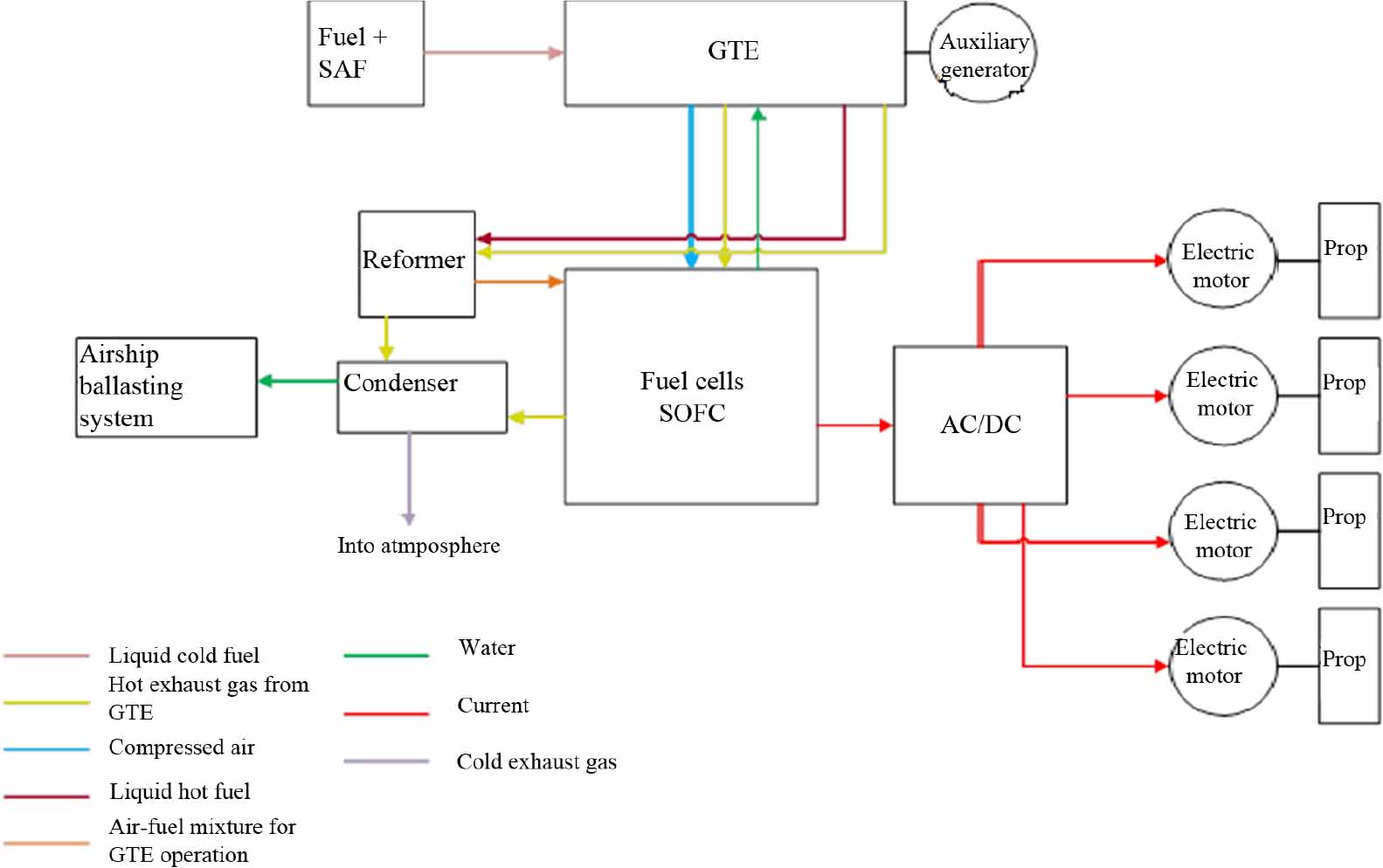
Fig. 3.
Schematic diagram of power system of a hybrid PS for a transport airship.
As shown in Fig. 3, liquid fuel blended with sustainable aviation fuel (SAF) is supplied from the aircraft tanks to the auxiliary GTE, where it is split into two streams. The first stream powers the GTE combustion chamber, while the second stream is routed through the GTE for cooling the compressor casing, turbine, and nozzle. This second stream is preheated in the process and then directed to the reformer, where it undergoes further conversion into fuel suitable for SOFC operation.
The auxiliary GTE includes a compressor driven by a dedicated turbine. The compressor supplies the compressed air needed for SOFC reactions. A starter-generator connected to the GTE gas-generator rotor serves as an auxiliary electrical generator for the airship’s systems, particularly during phases when full SOFC power is not required.
The hot exhaust gases of the GTE are directed to the reformer and SOFC stack to raise them to their operating temperatures. To enhance GTE turbine performance, the combustion chamber can be supplied with water produced as a byproduct of SOFC operation. Water injection increases the mass flow rate of the working fluid, improving turbine efficiency and simultaneously reducing NOx emissions.
Inside the preheated SOFCs, the oxidized and reformed fuel undergoes electrochemical reaction, generating electrical energy. This electrical power is supplied to the airship’s electrical system, where it is converted to the required parameters for the main electric motors and other onboard electrical subsystems. The electric motors drive the propellers, providing the main propulsive force.
The combined exhaust from the reformer and the SOFCs is routed through a condenser, where water vapor is removed. The condensed water is collected and transferred to the airship’s ballasting system, enabling compensation for the mass of consumed liquid fuel. This reduces the amount of balancing gas required during flight. The remaining cooled exhaust gas, now containing minimal water vapor, is released into the atmosphere.
Recent studies on SOFC technology demonstrate promising trends toward higher specific power and lower specific weight. However, it is unlikely that SOFC performance will match that of modern aviation gas turbines in the near term. Current hybrid propulsion concepts generally result in increased system mass and volume compared with conventional GTE-based systems, which for aircraft typically leads to either higher take-off weights or reduced payload capacity. For airships, however, these large masses and dimensions are far less critical, and the higher thermal efficiency of SOFC-based hybrid systems offers major advantages in reducing fuel consumption.
Consequently, implementing SOFC-based hybrid propulsion in transport airships can significantly decrease greenhouse gas emissions per kilogram of transported cargo and reduce dependence on imported hydrocarbon fuels, particularly in the European region.
6. DISCUSSION
The development of hybrid propulsion systems (PSs) for airships presents a number of technical challenges related to achieving high efficiency, reliability, and safety while minimizing system weight and overall dimensions. The main difficulties arise from the integration of multiple propulsion sources — electric motors, gas turbine engines (GTEs), and hydrogen-based systems — as well as from the need to optimize cooling, manage power distribution, and ensure uninterrupted operation of all subsystems.
When conducting comparative assessments, several factors must be taken into account. Airships can achieve a significantly higher annual utilization rate — up to 6000 operating hours per year — and provide long operational ranges. They are also advantageous for transporting low-density cargo and loads that, due to their size or weight, cannot be accommodated by modern aircraft at all. For many missions involving super-heavy, indivisible, or oversized cargo, transportation speed is not the primary parameter; instead, payload capacity, endurance, and range play the decisive roles.
It has been established that the cruising speeds of airships still exceed those of ground transportation. Numerous studies indicate that for cargo densities below 0.4 t/m3, airship transport becomes more economical than aircraft, and for densities below 0.2 t/m3, it is more economical than ground transport [8, 9]. Another factor contributing to the higher operational intensity of airships is that aircraft perform a greater number of short flights, requiring proportionally more ground handling time. Airships, in contrast, require far fewer takeoff and landing cycles, and some maintenance operations may even be carried out during flight, thereby reducing downtime.
It should be noted that conclusions about transportation cost-effectiveness drawn solely from direct operating costs are often incomplete, since capital expenditures and indirect operational expenses are not always included. These additional cost categories can significantly influence the final economic result. For a fully reliable assessment, all costs must be evaluated within the framework of a specific transport program, taking into account cargo type and volume, distribution across transportation distances, characteristics of transport routes, and operational constraints. Consequently, cost-effectiveness conclusions obtained for one set of conditions cannot be universally applied to others, and generalized statements should be avoided.
From an aerodynamic standpoint, the geometry of the airship’s envelope must minimize turbulence and drag while providing the required lift, speed, and altitude capabilities. Although a spherical shape yields the lowest structural mass for a given lift capacity, numerous experiments have demonstrated its excessive aerodynamic resistance. This is why classical airships adopt elongated, streamlined, axisymmetric shapes. This consideration underscores the importance of continued research into innovative airship-design concepts and their influence on aerodynamic performance and flight dynamics.
Given the ongoing hybridization of airship propulsion systems and the emergence of new structural concepts proposed by various companies, it becomes essential to investigate how innovative airship geometries interact with advanced hybrid energy systems based on green technologies. Understanding the combined influence of envelope design, aerodynamic characteristics, and fuel-cell-based hybrid PS architecture is crucial for developing the next generation of efficient, environmentally sustainable transport airships.
7. CONCLUSIONS
This analysis of the technical and economic characteristics of airships has highlighted several substantial advantages of their use as transport vehicles. Airships offer significantly lower acquisition costs for comparable cruising speeds and payload capacities relative to airplanes and helicopters. Their cost per ton-kilometer is also many times lower than that of heavier-than-air vehicles. In addition, airships provide higher operating speeds than road and rail transport and offer a technically achievable payload capacity that exceeds that of all other transport modes. They impose no practical restrictions on cargo dimensions or geometry and can transport oversized or indivisible loads that conventional aircraft cannot accommodate.
Airships can operate on direct “point-to-point” routes, hover over a designated location at a specified altitude, and perform door-to-door delivery without reliance on ground infrastructure. They do not require runways, airfields, or helipads, and can remain airborne for extended periods — weeks or even months — while allowing refueling and crew changes in flight. Their dependence on weather and climatic conditions is relatively low, and their environmental impact is minimal due to low noise levels, low specific energy consumption, and correspondingly low emissions of combustion products.
The analysis of airship operations demonstrates that the propulsion system is a critical element of the aircraft. The implementation of the proposed hybrid power system based on fuel-cell technology enables the airship to achieve environmental performance consistent with modern regulatory requirements. The research results indicate that hybrid-powered airships represent a promising pathway toward greener aviation. With appropriate design and energy-system integration, airships can approach fully electric operation with zero carbon emissions.
Conventional hybrid airships could be converted to fully electric configurations by reducing payload weight by approximately 50%, and future advances in battery technology may significantly improve payload capacity. Fuel-cell systems provide an additional promising option for next-generation electric airships, offering high efficiency, reduced emissions, and the potential for long-range, low-energy flight.
Overall, the findings of this study support the conclusion that a hybrid propulsion system based on fuel cells is a viable and forward-looking solution for sustainable transport airships.