
1. INTRODUCTION
The need to create competitive aircraft propulsion systems (PS) on the global engine-building market imposes new technical requirements on both the improvement of existing aircraft engines and the development of new ones. Enterprises that design and manufacture gas turbine engines (GTE) therefore place great emphasis on further increasing the efficiency of current engines by creating more effective and reliable versions. As is well known, combat aircraft have undergone several stages of development and refinement. Aircraft currently in development differ significantly from their predecessors not only in performance, but also in their operating characteristics, design features, equipment, and armament [1]. In this context, subsequent aircraft versions, driven by technological progress, will undergo numerous changes – both in terms of increased design complexity and reduced production costs. Concepts for future combat aircraft incorporate not only new technical solutions in the design of the airframe, systems, and subsystems, but also the use of more advanced materials, innovations, and manufacturing processes [2].
It should be noted that the afterburning and non-afterburning PSs currently installed on aircraft have reached their performance limits, despite the use of the most advanced materials in their design. This creates an objective need to develop new aircraft engines capable of powering sixth-generation fighters. The most likely trend in this area is the development of three-stream variable-cycle engines, which are expected to improve both thrust and specific fuel consumption. In addition, achieving hypersonic speeds will require the creation and installation of variable-cycle combined engines equipped with both turbojet and ramjet ducts. The development of propulsion systems operating on alternative fuels, such as hydrogen, is also entirely feasible.
An analysis of the main trends in the development of state-of-the-art aircraft and their gas-turbine propulsion systems (GTE) shows that current requirements focus on increasing the efficiency of the working process under design conditions, as well as reducing the weight of the main engine components [3]. Due to the trend toward reducing the axial dimensions of afterburning turbofan engines, the interfaces between the mixing chamber, afterburner, and exhaust section have become less distinct, since the processes characteristic of these components continue until the gas exits the nozzle. Therefore, it is advisable to consider these components together, and their combination will be referred to as the afterburning exhaust section (AES).
Currently, empirical methods dominate the development of afterburning exhaust sections. Designing an AES of optimal configuration requires long and costly experimentation [4]. Distortions in velocity, pressure, temperature, and turbulence kinetic energy significantly influence the flow and mixing of gas streams. Similarly, uneven distributions of oxygen and fuel strongly affect fuel–air mixture formation. To organize an optimal working process in the AES, additional information is therefore required on the spatial distribution of these parameters within the afterburner.
It is well known that the development of combat aviation is moving toward greater efficiency and versatility, which includes creating new types of aircraft, improving weapons systems, and increasing stealth. Key areas include the development of unmanned aircraft, reducing radar, infrared, acoustic, and optical signatures, increasing maneuverability and speed, and integrating technological innovations such as artificial intelligence and advanced materials [5]. As a result, the rapid improvement of gas turbine engine performance in recent years has increased the power-to-weight ratio of the working medium, leading to reduced geometric dimensions of the engine flow path and, in particular, the AES. However, shortening the afterburner leads to a decrease in combustion efficiency. Consequently, organizing the working process in the AES is an important scientific and technological objective, closely linked to meeting the performance requirements of the aircraft on which the afterburning engine will be installed. To develop effective AES designs, it is necessary to consider their current characteristics, analyze global trends in afterburner design, and forecast the parametric concept of AES for advanced aircraft.
The development of aircraft turbojet engines with afterburner combustion chambers (GTE with AES) is a key factor shaping the evolution and combat capabilities of modern fighter aircraft. Power plants capable of operating in afterburner mode provide the necessary thrust increase to execute high-energy maneuvers, achieve maximum flight speeds (including supersonic), and reduce acceleration time. In high-tech confrontations, the parameters of engines equipped with AES become decisive in securing an advantage in flight energy.
A special place in propulsion system design is occupied by the AES. Its efficiency – reflected in indicators such as the degree of forcing – directly influences specific fuel consumption, thrust characteristics, and the overall energy and economic efficiency of the aircraft. AES technologies represent one of the most science-intensive and critical components affecting an aircraft’s ability to deliver high flight and technical performance when deploying aviation weapons.
Despite significant achievements in designing new engine generations, there is a lack of comprehensive, unified criteria in open sources that would allow an objective assessment of technological trends or enable effective comparison of AES performance across different classes and generations of engines. Standard industry parameters (e.g., specific thrust, thrust-to-weight ratio) do not always allow for a full evaluation of AES contribution to the aircraft’s combat potential, as they fail to capture energy, economic, and integrative aspects simultaneously. This creates a research gap in the field of objective criteria assessment and hinders the identification of dominant technological trends.
The relevance of this study is further reinforced by the need to trace the evolution of afterburner technologies from early turbojet engines (TJE), such as the R-13 and J85, to modern turbofan engines. Including TJEs in the analysis is methodologically justified, as it allows for a retrospective comparison of technological solutions for the AES – an element common to both types of power plants.
2. LITERATURE REVIEW AND PROBLEM STATEMENT
With the continuous increase in aircraft engine power requirements, the integrated afterburner must also operate under higher temperature, pressure, bypass ratio, and Mach number conditions. This leads to a range of issues, including fuel autoignition and increased total pressure loss, which ultimately affect the thermal state and combustion characteristics of the fuel–air mixture. Among these parameters, the trend toward increasing the bypass ratio is particularly evident [6]. The bypass ratio of the afterburner typically varies with the engine bypass ratio. However, due to the requirements of supersonic flight in military aircraft, propulsion system drag, fuel consumption, thrust-to-weight ratio, and burnout velocity at high airspeeds restrict the afterburner bypass ratio to no more than 1.0 [7]. Currently, various aircraft employ different afterburner designs – for example, the F404 on the F/A-18 Hornet [8], RD-33 on the MiG-29 [9], AL-31F on the Su-27 [10], F100 on the F-15 Eagle and F-16 [11], F119 on the F-22 Raptor [12], and F135 on the F-35 Lightning II [13], among others. In addition, variable-cycle engine designs have been proposed to increase the bypass ratio and thereby improve specific fuel consumption at low flight speeds [14]. Variable-cycle engines are considered the most rational propulsion units for next-generation fighters because of their fuel efficiency and wide operating range [1, 6]. Thus, studying the working processes of afterburners for military aircraft remains a current scientific and technical challenge, requiring detailed prediction and identification of global technological trends in the development of propulsion systems with afterburning turbofan engines.
To improve afterburner performance across a wide range of bypass ratio conditions, a new afterburner integrated with a mixer and flame-holder strut was proposed in [15]. The characteristics of this afterburner under varying bypass ratios were studied using numerical simulations based on the RANS CFD software suite. The results showed that the mixing patterns of the air and gas flows changed as the bypass ratio increased. The integrated afterburner achieved mixing primarily through the formation of a recirculation region in the wake of the flame-holder struts. Within the bypass ratio range of 0.1 to 0.9, both the mixing efficiency and the total pressure loss gradually increased with the bypass ratio. At a bypass ratio of 0.5, the combustion efficiency reached its maximum value of 0.954 and then gradually declined. Cold air at the mixer outlet on both sides of the strut formed a recirculation zone in the rear section of the strut, which enhanced the thermal mixing efficiency of the integrated afterburner. The thermal mixing efficiency increased with rising bypass ratio and flight altitude.
The research in [16] focused on applying theoretical and computational methods to simulate the performance and efficiency of an afterburning gas turbine engine. The effects of changes in Mach number and flight altitude Hf on afterburning engine performance were examined. The influence of variations in compressor pressure ratio and turbine inlet temperature on the afterburner outlet temperature was also demonstrated. The obtained results show the optimal pressure ratio under the maximum-thrust limitation for a turbojet engine operating at M = 0.8 and Hf = 10,000 m.
The combustion efficiency of an afterburner is influenced by numerous factors and their interactions – these include fuel properties, reaction kinetics, aerothermodynamic conditions (pressure, temperature, and velocity of the mixture entering the afterburner), and geometric factors such as the shape and dimensions of the flame holder or diffuser. All engine performance parameters are interdependent, and improving one parameter may negatively affect others. In jet engines, afterburner efficiency is maximized when combustion occurs at the highest possible pressure and temperature, followed by expansion of the gases to ambient pressure. However, because the oxygen content of the air decreases after passing through the main combustion chamber, and because combustion does not occur in highly compressed air, afterburner combustion efficiency is lower than that of the main combustor. Efficiency in the afterburner also decreases with increasing altitude, due to the reduction in inlet pressure.
Historically, various studies have examined the flow field and operational characteristics of engine afterburner sections, focusing on how configuration changes affect combustion performance. Reducing the diameter of the flame-holder V-gutter, for example, caused a significant loss in afterburner efficiency. The authors of [17] studied the effects of inlet turbulence intensity and flow angles on chemically reacting turbulent flow, analyzing temperature variations around the V-gutter flame holder within the duct in detail. The authors of [18] investigated high-frequency combustion instabilities using a radial V-gutter flame holder, simulating the operating conditions of a modern afterburner. In all these studies, the geometry of the flame holder (a simple V-gutter) and fuel spray bars was relatively basic, and the flow-field characteristics downstream of the exhaust nozzle were not examined in detail.
In articles [19–21], an afterburning turbojet for military aircraft was examined. A mathematical model was developed based on the fundamental equations of nonlinear flow motion in the engine and afterburner. A new form of the model equations was obtained by linearizing them using the finite-difference method, converting them into a dimensionless form after appropriate processing, and then applying the Laplace transform. Using a matrix formulation, the mathematical model of the engine was constructed, and its inlet and outlet parameters related to afterburning operation were determined. Changes in the main coefficients of the afterburning turbofan model (the time constant and the steady-state constant) were investigated across the temperature range corresponding to the afterburning rating and at different flight altitudes. The studies showed that pressure and temperature are the two primary parameters influencing the overall efficiency of an afterburning turbofan engine. The research also included numerical validation of the analytical results using MATLAB, followed by visual verification with GasTurb. GasTurb was additionally used to analyze the 3D diagrams.
In study [22], the trapped-vortex combustion mode was combined with the integrated combustion mode, and a new type of integrated combustion chamber with various cavities was proposed. By integrating the flame holder with the structural strut, a lightweight configuration could be achieved. The trapped-vortex combustion mode enables high combustion efficiency across a wide range of inflow conditions and fuel–air ratios. Using the experimental setup, the flow field and combustion characteristics – including ignition behavior, combustion efficiency, outlet temperature distribution, and wall-cooling performance – were thoroughly analyzed. Fuel droplets injected by conventional nozzles were shown to vaporize and mix with the main airflow over a short distance. The feasibility of the new combustion mode was fully confirmed.
In addition to studies on the efficiency of the fuel–air combustion process, calculations are also carried out to assess the environmental impact of hazardous emissions from afterburners. Harmful emissions from aircraft engines are primarily associated with the release of particles of very small diameter. However, research results related specifically to afterburner operation are scarce in the literature. Article [23] presents an analysis of particle emissions from an afterburning engine of a military aircraft. Despite a substantial increase in fuel consumption, the particulate-matter mass emission index was found to be more than sixty times higher than at 100% engine thrust. In [24], component integration is presented as a new concept for afterburner design – a significant trend in current development studies. The authors propose a flame holder with an internal conical cavity for an integrated afterburner. Experimental and numerical investigations were conducted to evaluate ignition performance under various pneumatic conditions. The results show that a stable flame can be achieved in the cavity of the integrated afterburner over a wide range of flow conditions. Notably, an appropriate cone expansion angle contributes to improved ignition and flame stability. The experimental outcomes were compared, and an optimal configuration was identified that reduces the ignition time, corresponding to an increase in ignition speed. In addition, the use of a dual fuel line effectively expands the ignition range.
In [25], a variable-cycle engine (VCE) is investigated as a candidate for meeting the multi-mission requirements of military aircraft. This concept addresses the limitations of conventional low-bypass mixed turbofan engines, as the VCE incorporates different thermodynamic cycles (turbojet and turbofan) within a single system. In the study, the parametric equations for the components of the VCE model are derived using the cyclic equations of a mixed-flow afterburning turbofan engine. The energetic performance of the developed VCE is then compared with that of the F100-PW-100. A second-law analysis is also performed for the VCE model and compared with the results for the F100 engine under non-standard conditions, with flight altitude (9–20 km) and Mach number (0.3–1.9) varying. For these comparisons, thermodynamic data (pressure, temperature, mass flow rate, etc.) for the main engine components are obtained from the GasTurb program for the specified flight conditions. This study provides insight into how the working cycle affects engine performance and sustainability parameters.
In [26], reliable ignition, flame holding, and efficient combustion for an afterburner designed for variable-cycle engines are investigated. In this work, air-entraining components are closely coupled with cavity-strut structures to simulate the variable-cycle conditions experienced by an afterburner in a VCE. Lean ignition, blowout behavior, and combustion characteristics with air-entrainment functionality are examined experimentally. The results show that air entrainment can compensate for strut-induced disruptions to the cavity flow patterns, expand the ignitable region, and increase the Mach number of the flammable mixture. Increasing the air-entrainment intensity accelerates flame-front growth but also increases flame fluctuations, caused by flame quenching under strong turbulence. The expansion of the cavity flame cone toward the main stream intensifies as air-entrainment increases, raising the combustion-chamber temperature by more than 200 K.
In study [27], a new integrated afterburner ignitor was developed to enhance the thrust of military aircraft engines. The afterburner employed an integrated strut–cavity–injector structure. To improve ignition performance, a new plasma jet igniter was designed and optimized for use in this integrated configuration. The effects of traditional spark igniters and plasma jet igniters on afterburner ignition processes and ignition characteristics were examined. Experimental results show that the strut–cavity–injector combination can achieve stable combustion, and that plasma ignition significantly improves ignition performance. Compared with conventional spark ignition, plasma ignition reduced the ignition delay time by 67 ms. In addition, ignition delay decreased with increasing inlet velocity and decreasing excess air coefficient. This study demonstrates an effective and practical method for applying plasma ignition in aircraft afterburners and indicates strong potential for engineering applications.
In [28], a new ultra-compact combustion mode was proposed to further improve configuration compactness while enhancing flow and combustion characteristics. The relationships between flow behavior, combustion performance, and combustion-chamber configuration were investigated numerically, and the computational model was experimentally validated. The study focuses on configuration factors of combustion-chamber components in the main combustion zone, including the main flame holder, radial cavity, fuel injector, and diffusion channel. The results indicate that rapid fuel–air mixing and high combustion efficiency can be achieved within an ultra-compact volume and at high air-injection velocities. The use of a streamlined flame holder with a radial cavity, combined with the integration of a simple fuel injector into the flame holder, proved highly effective in improving both configuration compactness and combustion characteristics without increasing flow resistance.
In [29–31], a series of experimental studies was conducted on flame holding under the operating conditions of a scramjet afterburner. The experimental and computational results showed that the propagation of the flame or combustion zone from the cavity into the main flow not only surpasses the traditional diffusion process, but also the convection process associated with extended recirculation regions. A direct fuel-injection scheme into the cavity was used to deliver fuel to the recirculation zone and maintain stability during transient ignition. The studies emphasized that understanding flame-stabilization mechanisms under such conditions is of considerable importance.
In [32, 33], processes involving hydrogen injection into the combustion zone were investigated. Recommendations were provided for ensuring effective recirculation flow in the strut region to maintain stable flame holding and efficient gas-flow mixing.
The performance and stability of the propulsion system of the F-35B aircraft equipped with the F135-PW-600 engine were simulated and analyzed in [34]. The PROOSIS software was used to develop an overall performance model of the engine operating process based on the component method, including the combustion chamber. The stability of each component was analyzed during typical flight missions involving conversions between different engine and aircraft operating modes. The results are of significant importance for the development of control laws for the F-35B with the F135-PW-600 engine.
In study [35], calculations for the afterburner of the GE J79 engine are presented, including both analytical and computational results. The analyses are performed with a 4 cm distance between the spray bar and the vee-gutter. Considering geometric constraints, one-dimensional combustion-process calculations are carried out, and detailed geometry is modeled in SolidWorks CAD before being transferred to the ANSYS environment. The ANSYS afterburner flow-analysis software is used to examine afterburner operation in cold conditions (i.e., without combustion), employing compressible, viscous flow modeling and the standard k–epsilon turbulence model. The results show that afterburner length has a significant effect on combustion performance, with the improvement primarily attributable to the mixing effects induced by the vee-gutter on the flow structure.
In [36], the turbulent-flow characteristics in the afterburner section and gas flow through the exhaust nozzle of a low-bypass-ratio turbofan engine are analyzed using computational fluid dynamics (CFD). The analysis simulates afterburner operation under four different flight conditions: engine ground running (standard sea level), Mach 0.8 at 5 km altitude, Mach 1.5 at 5 km altitude, and Mach 0.8 at 11 km altitude. Combustion was found to be stable and efficient in the afterburner under all conditions. The length and diameter of the exhaust plume increased with rising Mach number and altitude due to higher nozzle exit pressure. Conversely, the combustion-flame length decreased with altitude as a result of reduced oxygen content. The exhaust nozzle was over-expanded during ground operation but under-expanded at higher Mach numbers and altitudes. The calculated thrust, total pressure, and temperature values in the afterburner showed good agreement with experimental results.
Complex failure mechanisms are known to challenges for fault diagnosis and troubleshooting of the afterburner combustion chamber as an engine component. Study [37] applies typical fault-tree analysis in combination with computational fluid dynamics (CFD). A hybrid fault-diagnosis architecture is proposed that integrates traditional observer-based fault diagnosis with fault-tree methods to enable online detection of critical failures. Simulations and verification on an afterburner test bench confirm the feasibility and effectiveness of this approach.
Thus, the analysis of the literature shows that most in-depth research on afterburner development remains confidential within aviation companies. Official scientific sources do not disclose details regarding the development trends of combat aviation, in which afterburners are used to significantly increase thrust – particularly during supersonic flight and for reducing takeoff distance. Authors also do not reveal emerging concepts such as hybrid engines and variable-cycle engines, which require adaptation of design approaches and technologies. Nearly all published studies focus on improving component efficiency, reducing weight, and enhancing the environmental performance of combustion chambers. No information is available regarding the application of new combustion chambers in other technological sectors, such as power plants for aerospace vehicles or in-space propulsion. Therefore, detailed analysis and identification of global technological trends in the evolution of propulsion systems with afterburners constitute a relevant scientific and technical task.
3. STUDY OBJECTIVE AND TASKS
The objective of this study is to analyze and substantiate the main technological and parametric trends in the development of GTEs with afterburning chambers, using a developed set of efficiency criteria. To achieve this, three key criteria were selected and applied, addressing the energy, economic, and integrated aspects of propulsion-system performance. To fulfill this objective, the following tasks must be carried out:
1. To form a representative sample of combat aircraft equipped with afterburning (turbojet) turbofan engines, covering technological generations (from the second half of the 20th century to the present), thrust classes, and major global design schools (USA, Europe, USSR/Russia, and other countries).
2. To establish comprehensive indicators for the quantitative assessment of the efficiency and constructive refinement of the AES as part of afterburning (turbojet) turbofan engines.
3. To calculate the values of the developed efficiency indicators for propulsion systems with AES for the selected sample of combat aircraft, based on available aircraft and engine performance data.
4. To identify and substantiate, on the basis of the analysis, the main technological trends in the development of afterburning turbofan engines.
The scientific novelty of this study lies in the development and validation of a system of three independent criteria that allow a quantitative assessment of different aspects of afterburner efficiency, as well as in the formation of a total normalized efficiency indicator derived from averaging the individual criteria.
The practical value of the findings lies in the fact that the developed criteria and the identified trends can be used by design engineers when assessing, selecting, and justifying the most promising parameters and design solutions for afterburning chambers in new and modernized aviation turbine engines equipped with afterburners.
4. RESEARCH METHODS
To achieve the research objective and accomplish the stated tasks, the methods of analysis and synthesis, comparative analysis, statistical analysis, and graphical representation were employed.
Analysis was used at the initial stage to examine existing approaches to evaluating aircraft engine efficiency and to collect and systematize performance data for aircraft and their propulsion systems from open sources. Synthesis was applied to develop new composite efficiency indicators by combining basic engine parameters (thrust, weight, airflow rate, dimensions, specific fuel consumption, etc.) into more informative, integrated measures that provide a generalized assessment.
Comparative analysis was used to compare the calculated efficiency indicators among aircraft from different technological generations, thrust classes, and design schools. This made it possible to identify the relative advantages and limitations of the examined systems.
Statistical methods and time-series analysis were applied as follows:
Time-series analysis was used to study the dynamics of each criterion over time (represented by the serial number of the aircraft, correlating with its development year), enabling the tracing of propulsion-system efficiency evolution.
The grouping method was used to classify the sample according to a key parameter – the afterburning thrust of the engines (<50 kN, 50–100 kN, >100 kN). This made it possible to conduct a more detailed technological-trend analysis and identify development patterns characteristic of each category.
Trend-line construction (regression analysis) was used to visualize and quantify general tendencies within each data group. Linear and exponential approximations were applied to generalize the dynamics of indicator changes despite considerable scatter in individual values, allowing conclusions about the overall direction of technological progress.
The graphical method was used to visualize the results in the form of scatter plots with superimposed trend lines. Graphical representation enabled a clear demonstration of dependencies, comparison of dynamics across categories, identification of key patterns, and detection of individual aircraft that significantly deviate from or exceed the general trend.
5. RESULTS
5.1. Formation of a representative sampling of combat aircraft in the world
To conduct a comparative analysis and identify technological trends, a representative sample was formed, consisting of 22 well-known 3rd-, 4th-, and 5th-generation aircraft equipped with afterburning gas-turbine engines. The sample includes aircraft of various roles (fighters, bombers, combat trainers) and represents the major global design schools (Table 1).
Table 1.
Aircraft Included in the Study: Purpose and Main Technical Characteristics.
| Aircraft | Purpose | Year in Service | Engines (Number & Type) | Engine Weight (kg) | Thrust (AFB), kN | Max Takeoff Weight (kg) | Thrust-to-Weight Ratio (AFB) | SFC (AFB), kg/N·h |
|---|---|---|---|---|---|---|---|---|
| T-38 Talon | CTA | 1961 | 2 × J85-GE-5A | 265 | 17.12 | 5670 | 6.58 | 0.224 |
| F-5B | CTA | 1964 | 2 × J85-GE-13 | 271 | 18.15 | 9298 | 6.82 | 0.227 |
| Su-15 | FI | 1967 | 2 × Tumansky R-13 | 1205 | 64.7 | 17900 | 5.47 | 0.213 |
| SEPECAT Jaguar | AA | 1973 | 2 × Adour Mk 102 | 700 | 30.89 | 15700 | 4.49 | 0.265 |
| F-15 Eagle | F | 1976 | 2 × F100 | 1375 | 106 | 30845 | 7.85 | 0.2161 |
| F-16 Fighting Falcon | MRF | 1978 | 1 × F100 | 1375 | 106 | 19200 | 7.85 | 0.2161 |
| Tornado | MRFB | 1979 | 2 × RB199 | 900 | 71.13 | 28000 | 8.05 | 0.2651 |
| F/A-18A/B Hornet | MRF | 1983 | 2 × F404 | 980 | 71.2 | 25400 | 7.40 | 0.177 |
| MiG-29 | MRF | 1983 | 2 × RD-33-2S | 1040 | 83 | 18000 | 8.13 | 0.214 |
| Mirage 2000 | MRF | 1984 | SNECMA M53 | 1470 | 88.2 | 17000 | 6.11 | 0.209 |
| Su-27 | F | 1985 | 2 × AL-31F | 1530 | 122.4 | 30450 | 8.15 | 0.196 |
| B-1B Lancer | SB | 1986 | 4 × F101 | 1815 | 133.4 | 216400 | 7.49 | 0.2243 |
| AIDC F-CK-1 Ching-kuo | MRF | 1994 | 2 × F125 | 900 | 42 | 12200 | 4.75 | 0.21 |
| Rafale | MRF | 2001 | 2 × M88 | 897 | 75.62 | 24500 | 8.59 | 0.1733 |
| Eurofighter Typhoon | MRF | 2003 | 2 × EJ200 | 989 | 90 | 23500 | 9.27 | 0.1764 |
| F-22 Raptor | MRF | 2005 | 2 × F-119 | 1769 | 155.6 | 38000 | 8.96 | 0.221 |
| Hongdu L-15 | CTA | 2013 | 2 × AI-222-25F | 440 | 42 | 9500 | 9.73 | 0.19 |
| Su-35S | MRF | 2014 | 2 × AL-41F1C | 1608 | 140 | 34500 | 8.87 | 0.192 |
| HAL Tejas | MRF | 2015 | 1 × GTX-35VS | 1180 | 81 | 15500 | 6.99 | 0.207 |
| F-35 Lightning II | MRF | 2015 | 1 × F-135 | 1701 | 191.3 | 31751 | 11.46 | 0.198 |
| Mitsubishi X-2 Shinshin | F | 2016 | 2xIHI XF-5 | 1420 | 122 | - | 8.75 | - |
| Su-57 | MRF | 2020 | 2 × AL-41F1 | 1700 | 160 | 37000 | 9.59 | 0.19 |
For calculations and comparative analysis, a database of technical characteristics of aircraft and their propulsion systems from the 3rd, 4th, and 5th generations was compiled. The data presented in Table 1 are generalized and collected from open and reference sources, particularly from [8–13, 38–41].
Since some aircraft operated with different engine modifications throughout their service life, the basic or most common serial versions of each aircraft and engine were selected for calculations. All characteristics – such as “Thrust (Afterburner), kN,” “Air Consumption, kg/s,” and “Engine Mass, kg” – correspond to the specified propulsion-system modification. Data on the years of entry into service were taken from [8–13, 38–41] and publicly available resources.
It should be noted that the sample includes aircraft equipped with both turbofan and turbojet engines (e.g., the R-13 on the Su-15 and the J85 on the T-38 and F-5B). To ensure a deeper retrospective analysis and enable comparison of technological solutions in afterburners across different generations, the inclusion of these turbojet engines was deemed justified. Therefore, the analysis focuses on the shared afterburner technology present in both engine types.
In the subsequent text, to correctly describe the entire sample, the broader term AES will be used for generalizations.
Based on data from open sources, the key performance characteristics of the aircraft and their propulsion systems were collected and systematized. For further analysis, all aircraft were grouped according to the afterburning thrust of a single engine. The summarized input data and the calculated values of several intermediate criteria are presented in Table 1.
5.2. Formation of indicators for evaluating the efficiency of AES as part of the PS
This study presents the results of calculating and analyzing the developed indicators and criteria used to evaluate the efficiency of propulsion systems (PS) with an afterburning exhaust section (AES). For each indicator, a graphical representation is provided showing the dependence of its value on the aircraft’s conventional year of development. Trend analysis is also performed for different afterburner thrust classes.
The first criterion reflects the thrust-to-weight ratio “ensured” by each kilogram of air passing through the engine per second. It evaluates how efficiently the engine achieves high specific power (thrust-to-weight ratio) relative to its air-mass flow rate. The indicator is defined as follows (N·s/kg2):
where engine thrust-to-weight ratio at “Maximum Afterburner” rating;RengMax A/B – engine thrust at “Maximum Afterburner” rating, N;
WA/C,T/O – aircraft weight at takeoff, kg;
Gair Σ – total air-mass flow through the engine, kg/s.
A high value of K 1 indicates a highly advanced engine that is both lightweight and capable of producing high thrust (Reng Max ) without requiring an excessive air-mass flow rate. Such performance may reflect a high compressor pressure ratio, elevated operating temperatures, and highly optimized aerodynamics. Conversely, a low K 1 value may indicate that the engine is heavy for the thrust it produces, or that it requires a very large air-flow rate in order to achieve its thrust level.
The second criterion, K 2, is intended for a comprehensive assessment of the efficiency of an aircraft gas-turbine engine with an AES. It reflects how effectively the engine produces thrust at afterburning rating relative to its own weight (i.e., its intrinsic thrust-to-weight ratio), while simultaneously accounting for its fuel efficiency (specific fuel consumption) at the same rating:
where μeng Max A/B – engine thrust-to-weight ratio at “Maximum Afterburner” rating;SFCMax A/B – specific fuel consumption at “Maximum Afterburner” rating, kg/N·h.
The K 2 criterion, although calculated through the thrust-to-weight ratio, is very close in both its units of measurement and its physical meaning to the specific fuel impulse in afterburner operation. A high specific impulse indicates that the engine produces more thrust per kilogram of fuel over a given period of time. To ensure the correctness of the K 2 calculation, the units SFCMax A/B must be expressed in a consistent form so that the resulting coefficient has a coherent and comparable dimension.
A high K 2 value is indicative of a propulsion system with strong specific performance characteristics: the engine has a high thrust-to-weight ratio and at the same time shows a low specific fuel consumption at afterburning rating. This combination reflects a high technological level and advanced refinement of the engine design. Conversely, a low K 2 value may indicate one or more unfavorable features: the engine may have a low thrust-to-weight ratio, a high specific fuel consumption at afterburning rating, or a combination of these factors, both of which reduce the overall value of the criterion.
The K 2 indicator is important for evaluating not only the absolute thrust produced by the engine, but also its efficiency in terms of logistical factors (fuel consumption) and the weight characteristics of the propulsion system itself. Together, these parameters determine the feasibility and effectiveness of its practical use. The K 2 indicator highlights a key aspect of engine efficiency: not only how much thrust the engine can generate, but also the “cost” of this thrust in terms of fuel consumed. At the same time, it reflects the degree of design refinement, which is captured through the engine’s own weight. Thus, K 2 provides a comprehensive assessment of how efficiently the engine produces thrust relative to its fuel consumption and its structural weight at the afterburning rating. This makes it an important indicator for evaluating the overall design quality and energy efficiency of the propulsion system.
Analysis of the K 1 and K 2 indicators makes it possible to evaluate key aspects of engine advancement. However, for a more comprehensive assessment that reflects the efficiency of propulsion systems with an AES within the context of a specific aircraft, an integral indicator is required – one that additionally accounts for the weight efficiency of the platform itself. Such an indicator is the complex AES efficiency indicator, which synthesizes all major aspects: the engine thrust-to-weight ratio, the efficiency of air-flow utilization, the fuel efficiency at afterburning ratings, and the weight perfection of the aircraft (Waircraft). The formula for the K 3 indicator indicators while additionally incorporating the aircraft’s weight and maximum flight speed. The indicator is calculated using the following formula (N2·m·h/(kg·s)):
where: n – number of engines;Vmax – maximum flight airspeed of the aircraft, m/s;
Wcombat load – combat load, kg.
The proposed K 3 indicator is the most comprehensive of the three, as it synthesizes the key characteristics of both the propulsion system and the aircraft platform to provide a generalized assessment of overall aircraft-system efficiency. A high K 3 value indicates an aircraft system with high specific energy efficiency. Such an aircraft combines high maximum airspeed, substantial combat load, powerful yet lightweight propulsion, and moderate maximum takeoff weight with good fuel efficiency. Conversely, a low K 3 value reflects a less optimal balance of these characteristics, which may result from a high aircraft weight, low propulsion efficiency, limited airspeed, or a small combat load.
5.3. Calculation of the developed PS efficiency indicator values for the combat aircraft sample
Using the computed K 1 values for the aircraft sample, a graph was generated to illustrate the dependence of this indicator on the given aircraft’s development year for platforms employing the relevant AES configuration (Fig. 1).
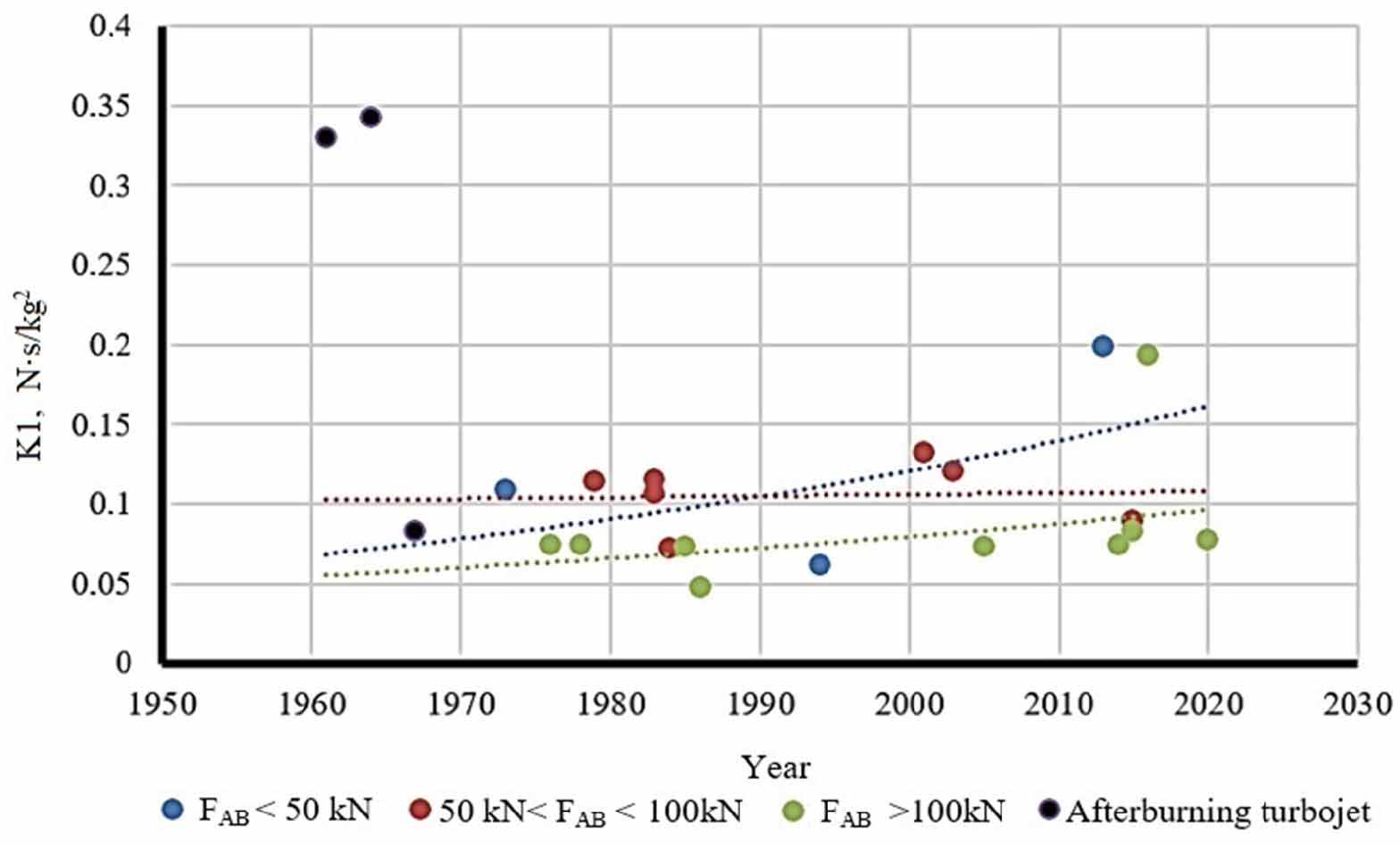
Fig. 1.
K 1 plotted by year of aircraft development.
The turbofan engines in the sample (Su-15, T-38, F-5B) exhibit significantly different results, and therefore no trend line was constructed for this group. The T-38 (K 1 ≈ 0.33) and F-5B (K 1 ≈ 0.34) demonstrate exceptionally high values. This indicates that their J85 engines were not only lightweight and capable of producing high thrust, but also achieved this performance with a very low air-mass flow rate. In contrast, the Su-15 (K 1 ≈ 0.08), shows a relatively low K 1 indicator. Although its R-13 engine had a good thrust-to-weight ratio, it required a substantial air-mass flow rate (66 kg/s), which significantly worsened the K 1 value.
For low-thrust engines (<50 kN), significant progress is observed. The early Jaguar (K 1 ≈ 0.108) is significantly inferior to the modern Hongdu L-15 (K 1 ≈ 0.199). This indicates that new light-weight engines (e.g. AI-222F) achieve high thrust-to-weight ratios with relatively lower air-mass flow rates compared to their predecessors.
Medium thrust engines (50-100 kN), on the other hand, show stagnation or only very slow progress. The value for the Mirage 2000 (K 1 ≈ 0.07) is even lower than those for the F/A-18 (K 1 ≈ 0.115), and the state-of-the-art HAL Tejas (K 1≈ 0.09) does not demonstrate any breakthrough in this respect. This may be due to the fact that, for this engine class, increases in thrust-to-weight ratio have been accompanied by proportional increases in air-mass flow rate, keeping their ratio effectively unchanged.
High-thrust engines (>100 kN), in turn, show little or no major progress, although their performance remains stable at a certain level. The values for the F-15/F-16 (K 1 ≈ 0.074), Su-27 (K 1 ≈ 0.073), F-22 (K 1 ≈ 0.073), Su-35S (K 1 ≈ 0.074), and Su-57 (K 1 ≈ 0.077) are almost identical. This suggests that a design equilibrium has been reached for this class of engines, where higher thrust-to-weight ratios necessarily require higher air-flow rates. The one partial exception is the F-35 (K 1 ≈ 0.082), which shows a slightly (albeit not radically) higher value.
Using the computed K 2 values for the aircraft sample, a graph was generated to illustrate the dependence of this indicator on each aircraft’s development year for platforms employing the corresponding AES configuration (Fig. 2). Aircraft with low afterburning thrust (FAB < 50 kN) are marked with blue dots.
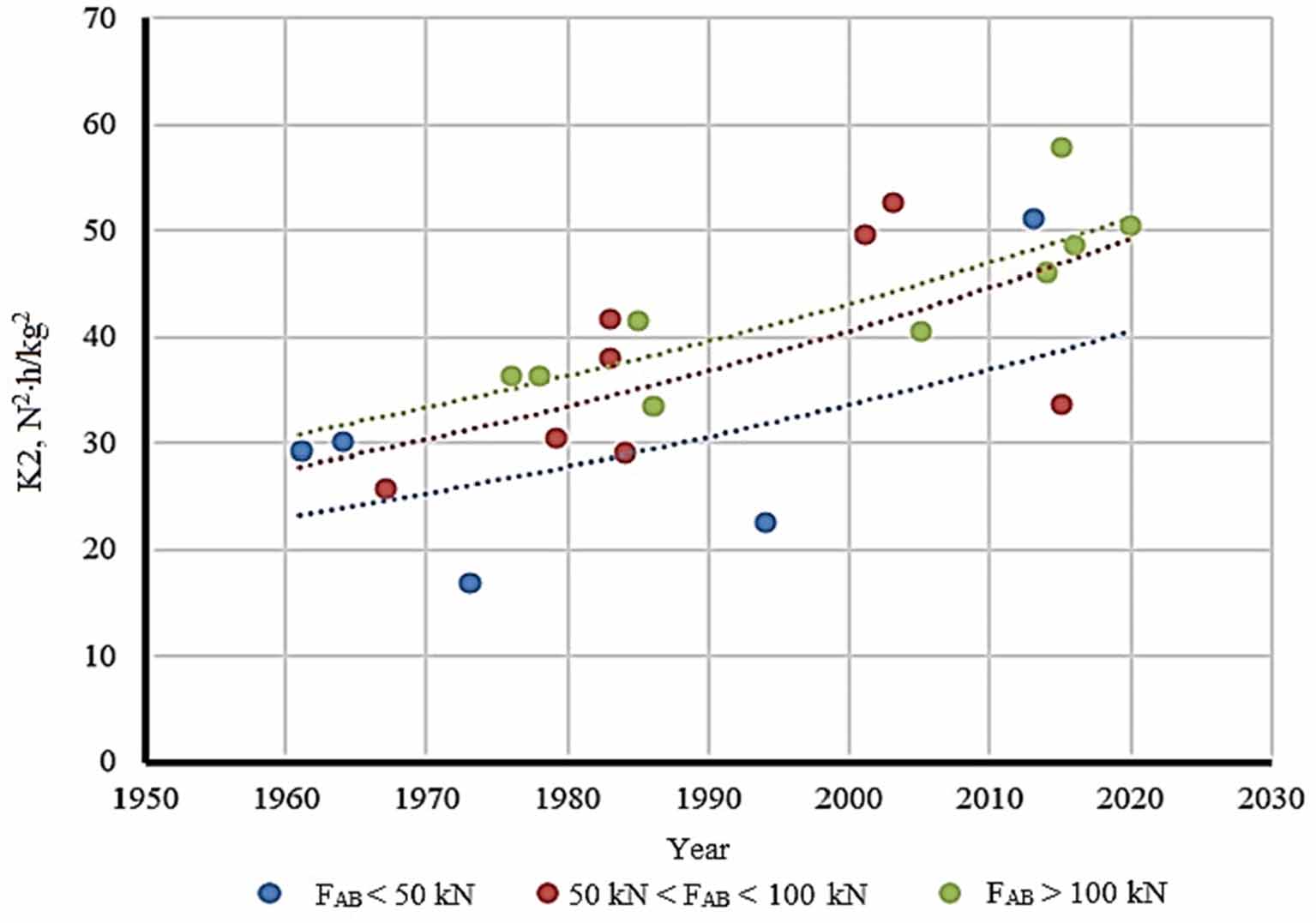
Fig. 2.
K 2 plotted by year of aircraft development.
For aircraft with low afterburning thrust (FAB < 50 kN, blue dots) a moderate upward trend is observed: the trend line slopes upward, and although the data show considerable scatter, there is a clear overall improvement. The K 2 values in this category begin at relatively low levels (T-38 Talon ~29, F-5B ~30) and increase noticeably for later aircraft (AIDC F-CK-1 ~22, Hongdu L-15 ~51), again with significant scatter. This dynamic indicates that, over time, low-thrust engines have progressively improved their thrust-to-weight ratio and/or fuel efficiency at afterburning rating.
For aircraft with medium afterburning thrust (50 kN < FAB < 100 kN, red dots), a clear upward trend is also evident. The trend line rises steadily, with K 2 values increasing from approximately 25–30 for early representatives (e.g., Su-15) to 50–55 for more recent designs (Rafale, Eurofighter). This reflects consistent and meaningful progress in optimizing the “thrust-to-weight ratio/fuel efficiency” balance for this widely used engine class.
For aircraft with high afterburning thrust (FAB > 100 kN, green dots), the upward trend is the strongest of all categories. The exponentially tapered trend line rises steeply. K 2 values increase from moderate levels (F-15/F-16 ≈ 36) to very high values for state-of-the-art heavy aircraft (F-35 ≈ 58). This indicates that the most powerful engines have achieved the greatest advances in increasing thrust-to-weight ratio and/or reducing specific fuel consumption at afterburning rating.
Using the computed K 3 values for the aircraft sample, a graph was generated to illustrate the dependence of this indicator on each aircraft’s development year for platforms employing the corresponding AES configuration (Fig. 3).
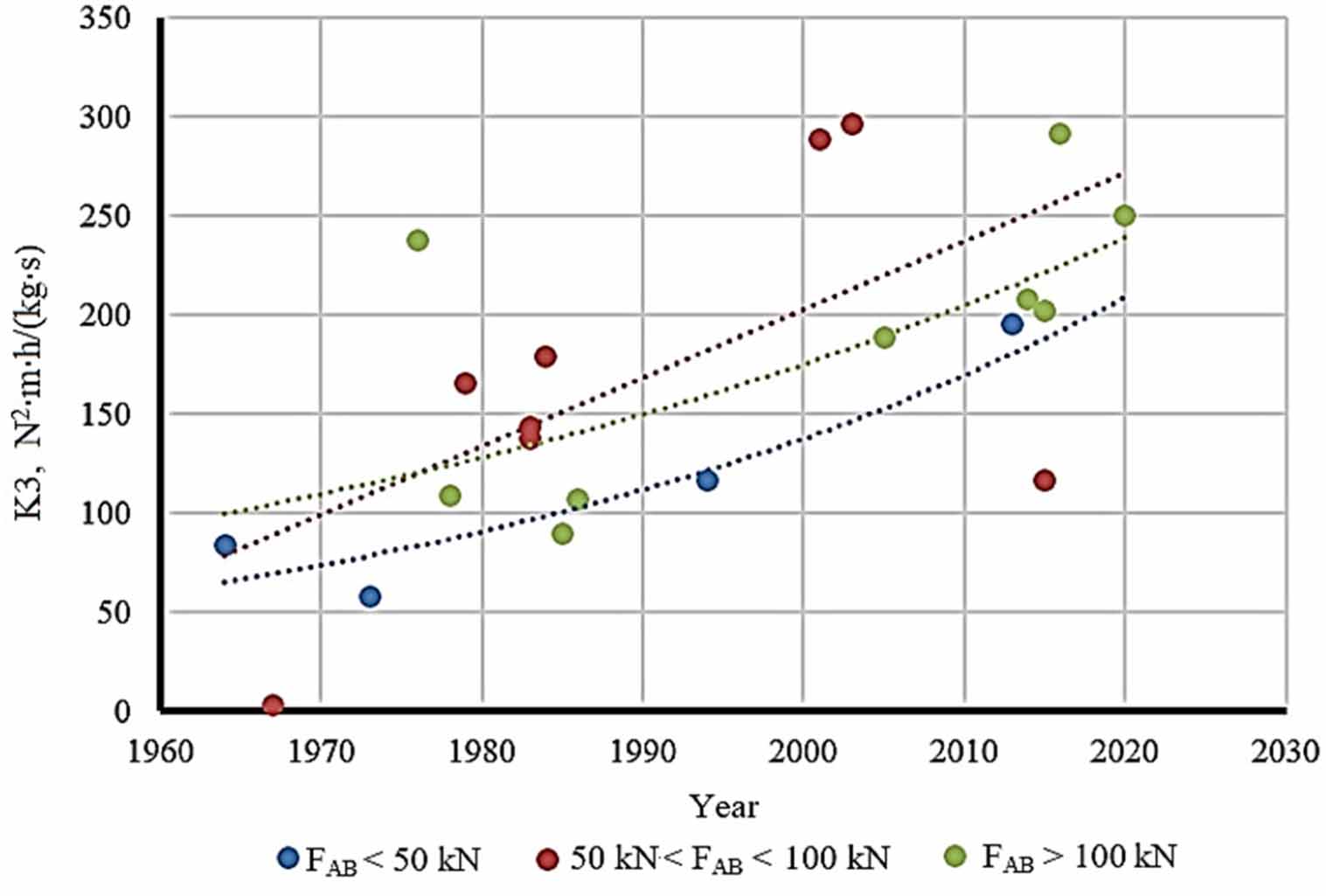
Fig. 3.
K 3 plotted by year of aircraft development.
For aircraft with low afterburning thrust (FAB < 50 kN, blue dots), a clear upward trend is observed. The trend line slopes upward, and although the initial K 3 values are very low, the indicator shows substantial growth for later aircraft (e.g., the T-38 and F-5B exhibit relatively high values for their time, and the Hongdu L-15 demonstrates especially strong performance). This dynamic indicates that the combined combat potential of light aircraft has increased significantly over the years.
For aircraft with medium afterburning thrust (50 kN < FAB < 100 kN, red dots), a pronounced and rapid upward trend is also evident, with the trend line rising steeply. The K3 values increase consistently from early representatives to state-of-the-art models. This reflects substantial and sustained progress in enhancing the overall combat potential of this widely used class of fighters.
For aircraft with high afterburning thrust (FAB > 100 kN, green dots), a general upward trend is likewise observed. Although some scatter is present, the overall direction of the trend line remains positive, indicating improvement in the integrated characteristics even for the most powerful aircraft in the sample.
6. DISCUSSION
The analysis of the three complex efficiency criteria makes it possible to identify not only general technological trends, but also key engineering trade-offs and shifts in design priorities for propulsion systems used in combat aircraft.
Firstly, the analysis of the K 1 criterion reveals important trends in the design refinement of aircraft engines. The absolute leaders according to this indicator are the early GE J85 turbojet engines (T-38, F-5B). These engines demonstrate a remarkable ability to achieve a high thrust-to-weight ratio with minimal air-mass flow, making them exceptionally efficient in terms of this metric. Among turbofan engines, the most substantial progress in increasing K1 is observed in the low-thrust category, where modern designs (e.g., the engine powering the Hongdu L-15) have achieved notably high values, indicating significant improvements in their aerodynamic and thermodynamic design quality.
For medium- and high-thrust engines (50–100 kN and >100 kN), which power the primary fighters of the 4th and 5th generations, the K 1 indicator has remained virtually unchanged for several decades. This stability suggests that a mature design trade-off has been reached: increases in thrust-to-weight ratio necessarily require proportional increases in air-flow rate, keeping their ratio at an established technological equilibrium. Thus, the K 1 indicator serves as an effective tool for illustrating not universal linear growth, but rather specialization and evolving priorities in engine design, as well as for highlighting unique and outstanding engineering solutions.
Secondly, analysis of the K 2 indicator reveals a clear upward trend across all three thrust categories examined. This reflects substantial and sustained technological progress in developing engines that are simultaneously lighter and more powerful and/or more fuel-efficient at afterburning rating. The most rapid improvement is observed among high-thrust engines, where state-of-the-art powerplants (for example, the F135 engine used on the F-35) achieve the highest efficiency values according to this criterion. This underscores the conclusion that design efforts have been successfully directed toward enhancing both the specific power and the fuel efficiency of engines across all classes of combat aircraft. The K 2 indicator enables a comprehensive assessment of how efficiently an engine generates thrust relative to its own weight and its fuel consumption at afterburning rating, making it an important measure of overall structural and energy refinement.
Thirdly, the time-dependent trends of the K 3 indicator demonstrate a clear upward trajectory across all three thrust categories. This provides strong evidence of sustained technological progress in both aircraft and engine engineering, directed at enhancing overall combat effectiveness. Improvements in engine thrust-to-weight ratio, maximum airspeed, and combat load capacity, combined with reductions in specific fuel consumption, have collectively outweighed the counteracting influence of steadily rising maximum take-off weights. The most rapid growth is observed in the medium-thrust category, underscoring the focus of developers on optimizing this most widely produced class of multi-role fighters. Modern aircraft in all categories exhibit a markedly higher specific combat potential than their predecessors. The K 3 indicator thus serves as a valuable integrative metric, enabling a quantitative comparison of aircraft systems of different generations and classes in terms of their resultant combat effectiveness.
For the purpose of summarizing the results and enabling a more vivid comparison, the values of the three selected criteria (K 1, K 2, K 3) were normalized and subsequently averaged. This procedure produced a single total normalized efficiency indicator, Knorm , which provides a comprehensive metric for positioning each aircraft within the full sample set (Fig. 4). To generalize and ensure comparability between aircraft – and to reduce the individual criteria (K 1, K 2, K 3) to a single dimensionless form – normalization was performed on a 0-to-1 scale. In this study, the division-by-maximum method was applied. This method compares the actual value of a given aircraft’s indicator with the maximum (reference) value observed in the sample. The use of a theoretical zero baseline enables an unambiguous assessment of relative efficiency:
corresponds to Ki, max , the best value of the given criterion recorded in the studied sample (i.e. the reference aircraft);
0 corresponds to theoretical zero efficiency for that criterion
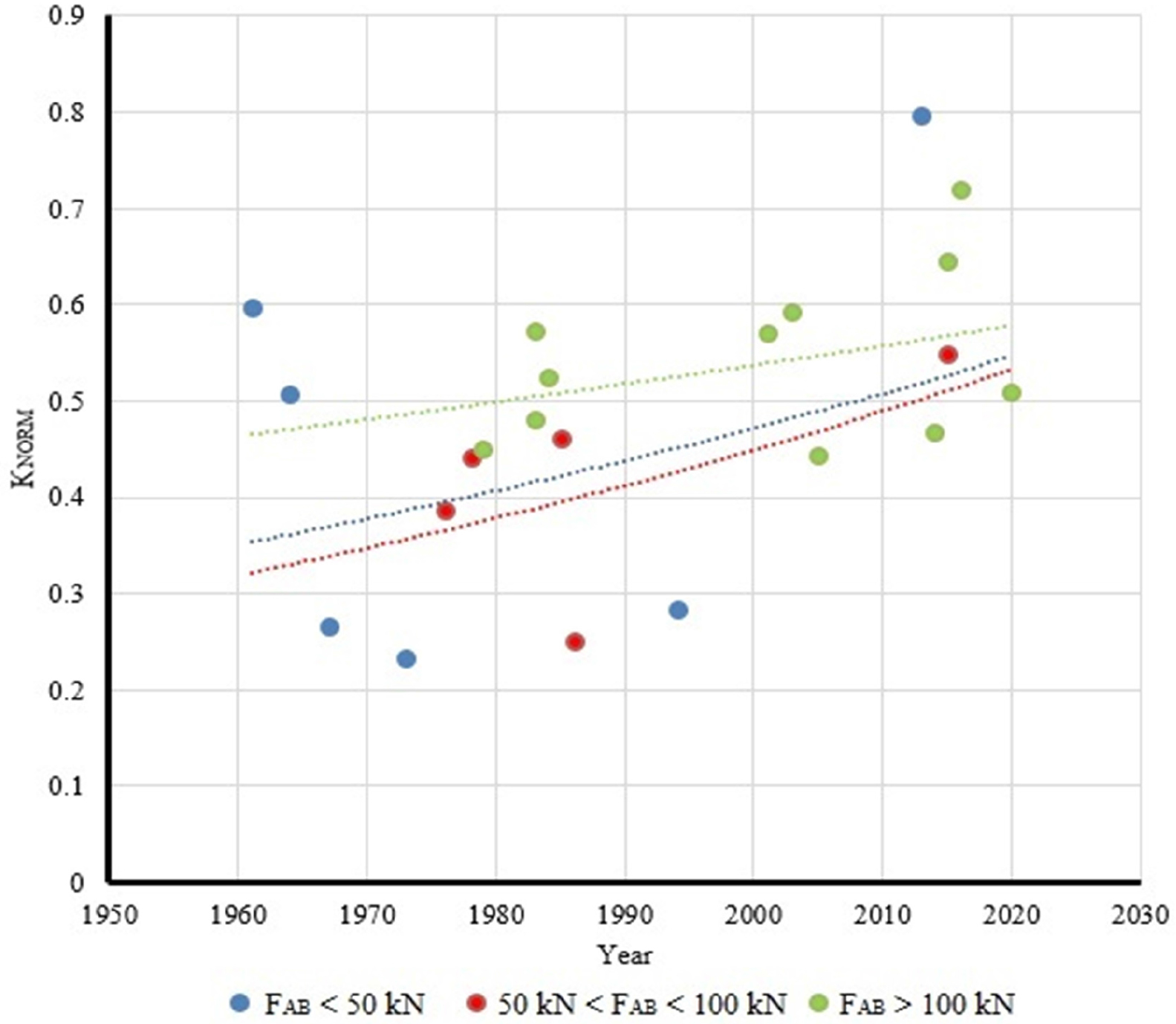
Fig. 4.
KNORM plotted by year of aircraft development.
Because all real aircraft in the sample have non-zero efficiency according to the specified criteria, no aircraft receives a normalized value of 0. Their indicators are distributed in the range from > 0 to 1.
Furthermore, each individual criterion (Ki ) was normalized according to the following formula:
To obtain a single integral indicator, the normalized values of the three criteria are averaged:
Thus, the analysis of the total normalized values confirms the overall trend toward increasing the comprehensive efficiency of afterburning systems across all thrust classes, albeit with different rates of improvement. The most substantial progress is observed in low- and medium-thrust aircraft, whereas for the highest-power propulsion systems the efficiency growth is more moderate. These findings make it possible to draw generalized conclusions about the key technological trends in the development of aircraft engines equipped with afterburners.
Category FAB < 50 kN. The trend line for this category has the steepest upward slope of all three groups, indicating the fastest growth of the total normalized efficiency indicator over the years of development. This pronounced dynamic is primarily driven by the strong contrast between early and late representatives: aircraft developed more recently show markedly higher values than many of their predecessors. The exponential trend clearly reflects the substantial improvement in integral efficiency achieved by later designs. This demonstrates that even with limited absolute thrust, modern platforms – most notably the Hongdu L-15 – are capable of reaching very high efficiency according to the selected criteria. It is also worth noting that early-generation aircraft in this group, such as the T-38 Talon and F-5B, exhibit relatively high normalized values for their time, which confirms the strength of their design solutions.
Category 50 kN < FAB < 100 kN. The trend line for this category also exhibits a clear upward slope, indicating a steady and accelerated increase in the total normalized efficiency indicator as newer aircraft appear. Values begin at comparatively modest levels for early representatives and rise consistently toward the highest values observed in advanced 4th- and 4+-generation aircraft. This stable upward trend confirms the continuous and effective refinement of afterburner system technology within this widely used and operationally significant thrust class of fighters.
Category FAB > 100 kN. The trend line for this category also slopes upward, but it is noticeably less steep than in the other two groups and visually approximates an almost linear increase. This indicates that, although overall progress is evident, the rate of improvement in integral efficiency for the highest-power propulsion units has been more moderate. The trend dynamics are strongly influenced by individual aircraft: the lowest value in the group is associated with the B-1B Lancer strategic bomber – an expected outcome given its mission profile and design priorities, which differ significantly from those of fighters. Conversely, the high normalized values demonstrated by 5th-generation aircraft such as the F-35 and the Mitsubishi X-2 Shinshin at the end of the chronological sequence confirm a positive trajectory and substantial technological progress in modern high-thrust propulsion systems.
When analyzing the obtained KNORM values and individual criteria, several deviations from the expected linear trend – “the newer the generation, the better the indicator” – were identified. These deviations have clear engineering explanations. The relatively high K 1 values for early turbojet-powered aircraft (Su-15, F-5B) stem from the fact that they employ TJEs. Such engines feature high gas temperatures at the inlet to the afterburner and relatively low air mass flow, which artificially raises the K1 criterion compared with modern dual-circuit TFEs, whose large cold bypass airflow inherently reduces the indicator. Conversely, the lower K 1 values observed for several 5th-generation aircraft (e.g., F-22, F-35) are partly attributable to stealth-driven design priorities that outweigh maximum afterburner efficiency. Restrictions imposed by low-observability requirements – such as the rectangular nozzle of the F-22 and the need to reduce exhaust gas temperature to lower infrared signature – negatively affect the pressure recovery coefficient and therefore the effectiveness of the afterburner.
The convergence of the trend lines for different generations of aircraft (e.g., 3rd, 4th, and 5th) toward a similar final KNORM value indicates that the integral efficiency indicators of the AES – evaluated through criteria K 1, K 2, and K 3 – are approaching a practical technological limit. This convergence reflects underlying physical constraints such as maximum allowable cycle temperature, stoichiometric combustion limits, and pressure recovery in the afterburner. As a result, despite ongoing technological improvements and rising development costs, each successive generation of engines gains progressively smaller increases in overall integral efficiency compared with its predecessors.
The alignment of the curves also illustrates a shift in design philosophy: modern (5th-generation) engines prioritize balance and integration with the airframe rather than maximizing thrust at any cost, as was typical of earlier generations. Improvements in K 1 are intentionally traded for gains in K 2 (fuel economy, range) and K 3 (stealth, weight optimization), leading to the smoothing and leveling of the final integral indicator KNORM .
The technological advantage of current engines lies less in increasing the numerator (thrust) and more in reducing the denominator (mass, SFC) and achieving an optimal balance among all three criteria. The convergence of the trend lines confirms that the complex KNORM indicator functions as an adequate and robust integral metric; if it were not, the trend lines would be irregular or divergent.
Accurate performance prediction for afterburning engines requires detailed knowledge of AES operating parameters. Since such data are typically withheld by engine manufacturers, future research will focus on analyzing available parameters and characteristics of afterburning units in modern GTEs, which will enable further refinement of the observed trend lines.
7. CONCLUSIONS
This study set out to identify global technological trends in the evolution of propulsion systems with afterburning turbofan engines. All research tasks were completed, and the following conclusions were reached:
A representative dataset of combat aircraft equipped with afterburning turbojet and turbofan engines was compiled, covering technological developments from the late 20th century to the present day. The thrust ranges of engines designed by major international engineering schools were analyzed. A set of comprehensive indicators was developed to quantitatively assess AES efficiency and design refinement. Together, the indicators K 1, K 2, and K 3 provide an effective measure of engine thermogasdynamic performance (K 1), mass–energy and fuel efficiency (K 2), and the overall effectiveness of the “aircraft–engine” system (K 3).
Efficiency indicators for propulsion systems with AES were calculated and their evolution over time examined, allowing key technological trends in the development of afterburning turbofan engines to be identified. The analysis showed that improvements in PS efficiency are nonlinear and strongly dependent on engine thrust class:
- Low- and medium-thrust engines (< 100 kN) demonstrate the most consistent and substantial gains across the integral indicators. This reflects the high effectiveness of optimization efforts for light and medium aircraft.
- High-thrust engines (> 100 kN) exhibit more complex trends. Although these engines show clear progress in efficiency (K 2), this is often offset by the considerable increase in aircraft platform weight – particularly in 5th-generation designs – resulting in more moderate growth or partial stagnation in the other indicators (K 1, K 3). This highlights a shift in design priorities toward expanded functionality such as reduced signature, extended range, and improved weapons capabilities.
A general trend toward convergence of integral efficiency across thrust classes was observed. Analysis of the total normalized efficiency indicator (KNORM ) shows that differences in efficiency between aircraft of different thrust categories diminish over time. This suggests that the field has reached a stage of technological maturity in which thrust class is no longer the primary determinant of overall efficiency. Instead, the balanced integration of the “aircraft–engine” system – taking into account aerodynamic, structural, operational, and stealth-related requirements – plays a decisive role.
The KNORM analysis clearly shows that the technological development of TFEs with afterburners does not follow a linear progression. In particular, the results demonstrate that the newest models (5th generation) do not always achieve the highest values for individual criteria (K 1, K 2). This reflects a shift in design priorities – from maximizing net thrust (typical of 3rd-generation engines) to meeting more complex requirements such as high efficiency in cruising modes and the reduction of radar and infrared signatures (stealth).
The study also showed that certain design features of the AES introduced to meet low-visibility requirements may negatively affect the pressure recovery coefficient, which in turn leads to a relative decrease in the K 1 indicator compared with some 4th-generation aircraft that were not subject to such strict constraints.
The strong influence of the K 2 criterion (economic efficiency) on the final KNORM indicator confirms a key trend in modern aviation: the rising importance of fuel efficiency and extended range, even in afterburning modes. Aircraft that achieved the most favorable balance between thrust and specific fuel consumption obtained the highest positions in the final ranking, highlighting that today’s technological advantage is defined by an optimal balance between energy performance and fuel economy.
The identified trends point to the need for further improvement of AES design toward the integration of variable-cycle systems or adaptive nozzle technologies. Such solutions would allow engines to effectively balance maximum afterburner impulse with minimized losses in cruising modes, while simultaneously meeting strict low-visibility requirements.
The proposed methodology can be applied to assess the impact of new technological solutions on complex efficiency indicators. Promising areas of further research include the quantitative evaluation of propulsion motivators, infrared-stealth technologies, and variable-cycle engines (VCEs), which will broaden understanding of the engineering trade-offs shaping future propulsion-system designs.