

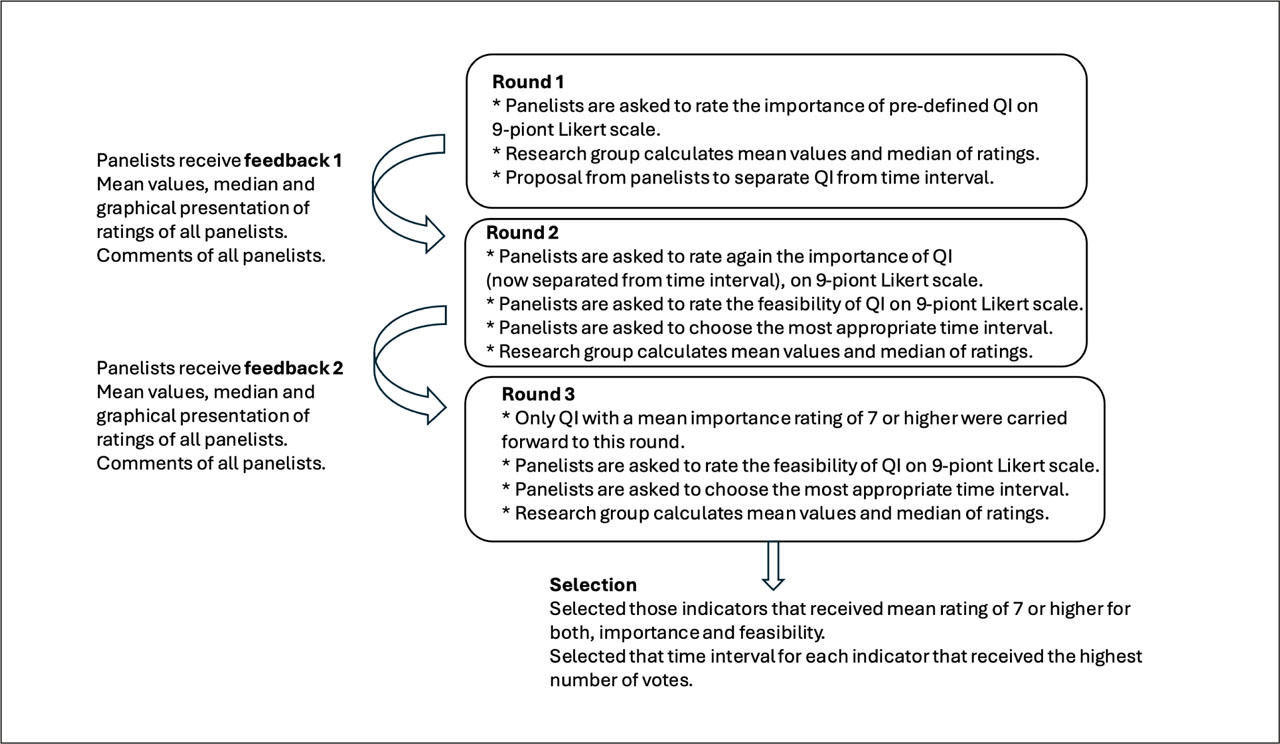
Figure 1.
Summary of the study process.
Table 1.
Characteristics of panel members.
| No. | Gender | Specialty | Experience | Area of expertise | Region in Slovenia |
|---|---|---|---|---|---|
| 1 | F | GP/FM | E | Experience in CTWC | Posavska |
| 2 | F | GP/FM | L | Working in CTWC | Koroška |
| 3 | F | GP/FM | M | Working in CTWC | Osrednjeslovenska |
| 4 | F | GP/FM | E | Working in CTWC | Osrednjeslovenska |
| 5 | M | GP/FM | E | Working in CTWC | Primorska |
| 6 | F | GP/FM | M | Experience in CTWC | Osrednjeslovenska |
| 7 | F | paediatrician | L | Working in CDU | Osrednjeslovenska |
| 8 | F | GP/FM | M | Quality assurance | Osrednjeslovenska |
| 9 | F | GP/FM | L | Quality assurance | Osrednjeslovenska |
| 10 | F | GP/FM | L | Quality assurance | Osrednjeslovenska |
| 11 | F | GP, emergency medicine specialist | M | Quality assurance | Osrednjeslovenska |
| 12 | M | GP/FM | M | Quality assurance | Osrednjeslovenska |
| 13 | F | GP/FM | L | Quality assurance | Osrednjeslovenska |
| 14 | M | GP/FM | M | Quality assurance | Gorenjska |
| 15 | M | GP/FM | L | Quality assurance | Zasavska |
Table 2.
List of validated quality indicators with appropriate time intervals.
| A note in the documentation | |
| 1. | Record whether the person is involved in any form of social integration (specify type). |
| 2. | Record parameters for chronic diseases as monitored. |
| 3. | Record contact details of a relative or caregiver. |
| 4. | Record of the person responsible for decision-making if the person with ID is (or will be) unable to give consent. |
| 5. | Record inclusion in a registered nurse programme (»referenčna ambulanta«). |
| 6. | Record tetanus vaccination in the last 10 years (or refusal). |
| 7. | Record pneumococcal vaccination in accordance with national recommendations (or refusal). |
| 8. | Record vaccination against Haemophilus influenzae and hepatitis B (or refusal). |
| 9. | Record vaccination against tick-borne meningoencephalitis in accordance with national recommendations (or refusal). |
| Every 12 months | |
| LIFESTYLE FACTORS | |
| 1. | Record regular monitoring of digestion, including discussion of constipation. |
| LIFESTYLE ADVICE | |
| 1. | Record a discussion on physical activity. |
| 2. | For smokers, record a discussion on smoking cessation. |
| 3. | For non-smokers, record a discussion on the harmful effects of smoking. |
| 4. | Record a discussion on the harmful effects of alcohol consumption. |
| CLINICAL OUTCOMES | |
| 1. | For people aged over 16 years with no chronic medical conditions: record blood pressure measurement. |
| 2. | For people with a chronic medical condition: record blood pressure measurement. |
| 3. | Record blood glucose measurement. |
| 4. | For people with epilepsy: record a discussion on medication uses and measures required during and after a seizure. |
| 5. | For people taking psychotropic drugs: record referral to a neurologist to assess the justification of therapy. |
| ONGOING CARE | |
| 1. | Record regular review of drug therapy, including indications, dosage, frequency, and adherence. |
| PREVENTIVE MEDICINE | |
| 1. | Record vaccination against seasonal influenza (or refusal). |
| Every 24 months | |
| LIFESTYLE FACTORS | |
| 1. | Record smoking status for people aged over 16 years. |
| 2. | Record alcohol consumption status for people aged over 16 years with no chronic condition. |
| 3. | Record body mass, BMI, or waist circumference for people aged over 16 years. |
| CLINICAL OUTCOMES | |
| 1. | Record a preventive check-up for all people aged over 16 years. |
| 2. | Record TSH level. |
| 3. | For people with Down syndrome or risk constellations: record TSH level. |
| 4. | For people aged over 40 years: record referral to an ophthalmologist (to assess vision and rule out glaucoma). |
| 5. | For people with Down syndrome aged over 30 years: record a referral to an ophthalmologist (to assess vision and rule out glaucoma). |
| 6. | Record referral to a neurologist for any person with ID who has epilepsy. |
| ADMINISTRATION | |
| 1. | Record updated social history: place of residence, caregiver, income? |
| PREVENTIVE MEDICINE | |
| 1. | Record participation (or non-participation) in the Dora1 screening programme and follow-up actions where there is no response. |
| 2. | Record participation (or non-participation) in the Zora2 screening programme and follow-up actions where there is no response. |
| 3. | Record participation (or non-participation) in the Svit3 screening programme and follow-up actions where there is no response. |
Table 3.
Comparison of quality indicators (QIs) for primary care in the general population without chronic disease in Slovenia and QIs for people with intellectual disability (ID) in Slovenia.
| Quality indicator | General population in Slovenia | People with ID in Slovenia |
|---|---|---|
| Smoking | Check every 5 years for people aged over 30 years. | Check every 2 years for people aged over 16 years. |
| For smokers, record a discussion on smoking cessation annually. | ||
| For non-smokers, record a discussion on the harmful effects of smoking annually. | ||
| Alcohol consumption | Check every 5 years for people aged over 30 years. | Check every 2 years for people aged over 16 years. |
| For people with ID, record a discussion on the harmful effects of alcohol consumption annually. | ||
| Tetanus vaccination | Regular revaccination against tetanus. | Record tetanus vaccination within the last 10 years (or refusal). |
| Cardiovascular risk assessment | Every 5 years for people aged over 30 years. | Every 24 months, perform a preventive check-up for people with ID aged over 16 years. |
| FRAX index | Every 5 years. | / |
| Chronic diseases | Maintain a list of chronic diagnoses. | Monitor parameters for chronic diseases appropriately. |
Table 4.
Comparison of QIs in international recommendations and QIs validated for people with ID in Slovenia.
| QI | Canada | New South Wales | Slovenia |
|---|---|---|---|
| Oral health | Dentist every 6 months | Dentist annually | Rated important but not feasible |
| Vision | Refer once before 40 years (30 years for DS), then every 2 years | Every 5 years after 45 years (30 years for DS) | Every 2 years after 40 years (30 years for DS) |
| Hearing | Every 5 years after 45 years (3 years for DS) | Every 5 years after 45 years (3 years for DS) | Rated important but not feasible |
| Nutrition risk | Annual counselling | Annually | Rated not important |
| Constipation | / | “Treat proactively” | Record discussion annually |
| Epilepsy | Regular reassessment; education | Record frequency, therapy, and side effects annually; neurologist referral annually | Record medication and seizure behaviour annually; neurologist referral every 24 months |
| Thyroid | Screen every 1–3 years (more often for DS) | Every 3–5 years (annually for DS) | TSH every 24 months |
| GERD/H. pylori | Screen GERD; test for H. pylori if symptomatic | Emphasised, without specific recommendations | Testing for H. pylori rated not important |
| Osteoporosis | Screen high-risk from age 19 years | Annual Vit D and Ca | Screening rated important but not feasible; Vit D/Ca not important |
| Immunisations | Hib and pneumococcus | NHMRC guidelines; hep A/B; annual influenza; every 5 years for pneumococcus for people with chronic diseases | Record vaccinations/refusal; H. influenzae and hepatitis B; tetanus every 10 years; pneumococcus and TBE per national recommendations; influenza annually |
| Screening programmes | Annually review of screening participation | Record inclusion in Dora, Zora, Svit every 2 years | |
| Medication review | Every 3 months | Every 3–6 months | Review annually. |
| Physical activity | Promote healthy living | 30 min/day most days | Discussion annually; BMI/waist every 24 months |
| Genetics | Refer if cause unknown | Consider in adults without a diagnosis | / |
| Women’s health | As for the general population; annual review of menstrual history / menopause symptoms | ||
| STDs/abuse | Screen sexual practices; education | / | HPV immunisation rated important but not feasible |
| Smoking/alcohol | / | Annual review and advice | Status every 2 years; annual discussion on harmful effects |
| Mental health, difficult behaviours | Assess levels of adaptive functioning | Assess for underlying physical or external factors in behavioural change | Annual neurologist referral for psychotropic drugs; depression screening rated important but not feasible |
| Justify psychotropic drug use annually | |||
| When behavioural problems or a psychiatric diagnosis, assess possible physical, environmental, and emotional factors | |||
| Dementia | Baseline assessment at 40 years | Emphasised, without specific recommendations | Screening after 40 years rated not important |
| Comprehensive assessment | Screen CVD earlier | Annually | Inclusion in a registered nurse programme; preventive check every 2 years; annual BP and glucose |
| Contact | Record guardian and social history annually | Record caregiver contact details; social history every 2 years | |
| Abuse/neglect | Screen annually for abuse/neglect and report | Rated important but not feasible | |
| Informed consent | Encourage advance planning; assign legal substitute decision-makers | Identify responsible person annually | Record responsible person |
| Social inclusion | Record inclusion |