

1. INTRODUCTION
People with intellectual disability (ID) represent 1–3% of the population, with higher prevalence in low- and middle-income countries (1). Individuals with ID exhibit varying levels of intellectual functioning and adaptive behaviour compared with the general population (2). These differences affect multiple aspects of life, including healthcare – partly due to limited ability to communicate needs (3, 4) and partly due to stigma (5, 6).
In many European countries, most healthcare for people with ID is delivered in primary care (7). In Slovenia, a network of Child Development Units (CDU) provides multidisciplinary care for children with special needs, including ID (8). Children are referred to these units by primary care paediatricians and are followed up there until adulthood.
Some adults with ID enter Centres for Training, Work, and Care (CTWC), which are residential institutions with a general practitioner (GP) and a multidisciplinary team. Others remain at home and visit GPs in community health centres, where multidisciplinary care is not integrated. These people access services through the same system as the general population, resulting in infrequent appointments. As people with ID are dispersed among GPs nationwide, most GPs rarely encounter them and therefore have limited experience in providing care (9, 10). Consequently, Slovenia lacks true experts in this field for clinical practice, research, and education.
Research shows that certain conditions occur more often or at an earlier age in people with ID (e.g. diabetes, hypertension and chronic arthritis) (11). People with ID experience poorer health outcomes (12, 13) and higher standardised mortality ratios than the general population (14). To achieve high quality of care (QoC) (15) for people with ID, some countries have established recommendations and guidelines (7, 16). In Slovenia, such guidelines do not exist.
QoC can be assessed using quality indicators (QIs) (17, 18). QIs should be relevant to health outcomes, measurable, and feasible (19), meaning practical and achievable within the system’s resources and constraints. QIs may therefore vary across countries. Several methods exist for developing QIs, including the Delphi technique. This approach is suitable when there are few recognised clinical experts, as it leverages the collective experience of practitioners familiar with the population and helps ensure that the indicators are relevant and feasible within the existing healthcare system.
The aim of this study was to identify and validate QIs for the care of people with ID in family medicine, to serve as recommendations for this population in Slovenia.
2. METHODS
The Delphi method is a systematic approach for developing QIs through expert consensus (18). It is conducted using questionnaires without face-to-face meetings, allowing participants to express their views without peer pressure while considering feedback from other panel members (18, 20, 21). This study applied a modified Delphi technique: no open-ended questions were included in the first round, and the study began with predefined QIs distributed for rating. All indicators proceeded to the second round after modification based on panel member feedback.
Anonymised questionnaires were distributed to experts in three rounds, with feedback provided between rounds. Statements were rated on a 9-point Likert scale to achieve consensus, defined as a mean score ≥ 7. After each round, panel members received aggregated ratings and comments before proceeding.
2.1. Panelists
Purposive sampling was used to recruit GPs with expertise in quality or experience in the primary care of people with ID via email. To broaden the panel, a snowball sampling technique was applied. Physicians working in CTWC were identified from a government list and invited by phone or email. Paediatricians were recruited through snowball sampling, with initial CDU invitees forwarding the email invitation to colleagues.
In total, 18 experts agreed to participate: 9 GPs with an interest in ID and healthcare quality, 7 physicians currently or previously employed in CTWC, and 2 paediatricians from CDU. The second and third rounds included invitations to the same panel members who participated in the first round.
2.2. Study design
A three-round modified Delphi study was conducted between March and December 2024. The initial draft of QIs was based on Slovenian national guidelines for cardiovascular disease prevention in primary care, the guidelines for primary care quality in ID in other countries, and other literature (7, 16, 19, 22). Indicators were grouped into six categories for clarity: lifestyle factors, lifestyle advice, clinical outcomes, ongoing care, administration, and preventive medicine.
2.3. First round
Panelists received an Excel file containing 44 proposed indicators and rated their importance using a 9-point Likert scale (“For each indicator, specify how important it is for ensuring good quality healthcare for a person with ID”). Each indicator included a rationale (e.g., “Foreign guidelines include this as part of annual check-up” or “Smoking prevalence is very high in this population”). Participants could comment on their rating and suggest alternative indicators.
2.4. Second round
Panel members received the revised list of indicators, including the 8 new suggestions, together with first-round summary statistics (mean, median, distribution) and comments. They rated importance and feasibility (1–9) (“Is it feasible to obtain this indicator in family medicine clinics in Slovenia?”) and selected the most appropriate time interval from 3 options.
2.5. Third round
Indicators with a second-round importance mean ≥ 7 advanced to round three. Panel members received feasibility ratings, comments, and time-interval votes, then re-rated feasibility (1–9) and confirmed the time frame interval.
2.6. Data collection
Panel members were invited by phone or email and provided consent during initial contact. All subsequent communication (questionnaire distribution, responses, and reminders) was conducted via email. Questionnaires were anonymised by assigning numbers for file naming before return.
2.7. Statistical analysis
After the first round, mean and median scores were calculated. Due to methodological changes (separating importance from time interval), all indicators proceeded to round two. After round two, mean and median values for importance and feasibility were calculated. In round three, indicators with feasibility ≥ 7 were validated. The time interval with the highest agreement (most votes) was adopted. Figure 1 summarises the study process.
3. RESULTS
Of the 18 experts who agreed to participate, 15 panel members (83%) responded in the first round. One family doctor and one CTWC physician did not respond despite reminders; one CDU paediatrician withdrew after receiving the questionnaire, citing insufficient expertise in adult QIs. The remaining 15 panel members completed all rounds. Table 1 presents the characteristics of the panel members.
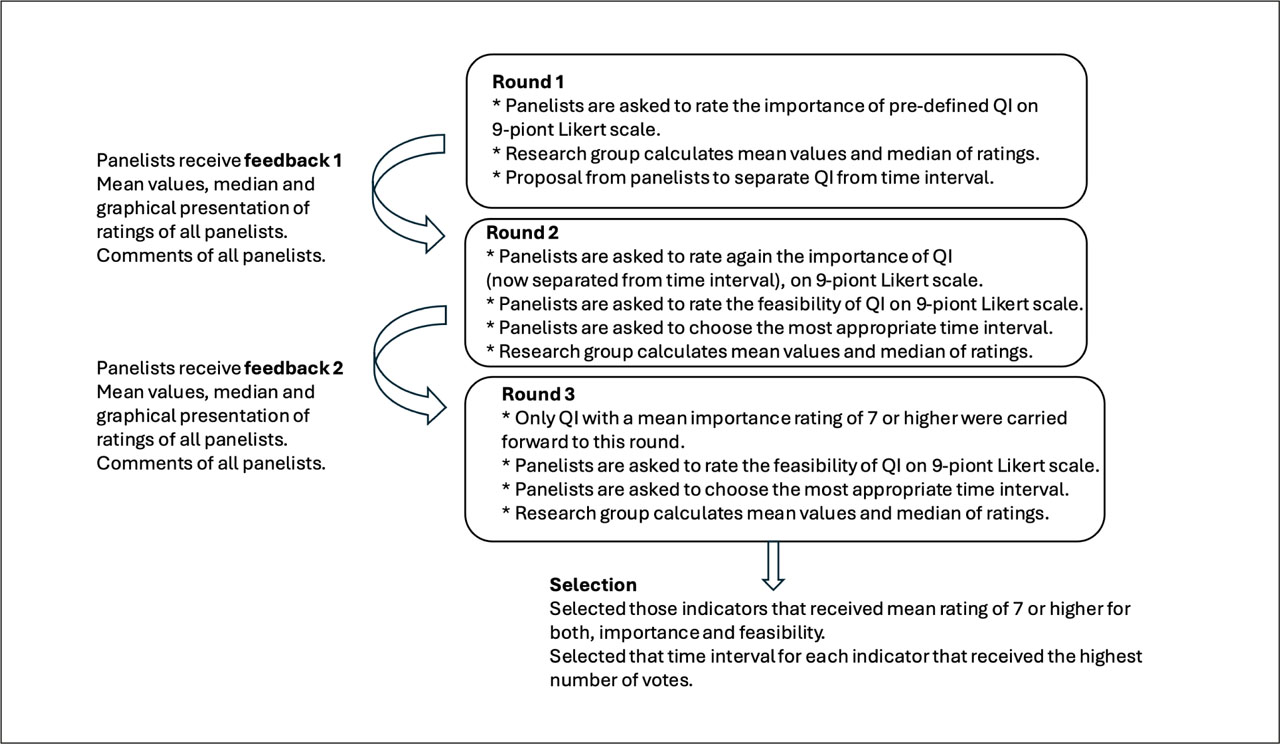
Figure 1.
Summary of the study process.
Table 1.
Characteristics of panel members.
| No. | Gender | Specialty | Experience | Area of expertise | Region in Slovenia |
|---|---|---|---|---|---|
| 1 | F | GP/FM | E | Experience in CTWC | Posavska |
| 2 | F | GP/FM | L | Working in CTWC | Koroška |
| 3 | F | GP/FM | M | Working in CTWC | Osrednjeslovenska |
| 4 | F | GP/FM | E | Working in CTWC | Osrednjeslovenska |
| 5 | M | GP/FM | E | Working in CTWC | Primorska |
| 6 | F | GP/FM | M | Experience in CTWC | Osrednjeslovenska |
| 7 | F | paediatrician | L | Working in CDU | Osrednjeslovenska |
| 8 | F | GP/FM | M | Quality assurance | Osrednjeslovenska |
| 9 | F | GP/FM | L | Quality assurance | Osrednjeslovenska |
| 10 | F | GP/FM | L | Quality assurance | Osrednjeslovenska |
| 11 | F | GP, emergency medicine specialist | M | Quality assurance | Osrednjeslovenska |
| 12 | M | GP/FM | M | Quality assurance | Osrednjeslovenska |
| 13 | F | GP/FM | L | Quality assurance | Osrednjeslovenska |
| 14 | M | GP/FM | M | Quality assurance | Gorenjska |
| 15 | M | GP/FM | L | Quality assurance | Zasavska |
In the first round, proposed indicators were combined: a QI and a time interval for implementation in practice (e.g. measuring blood pressure every 24 months). Panel members noted that these should be rated separately, and the indicators were therefore redefined for round two. Eight new indicators were suggested in the first round.
At the end of the third round, 33 QIs were validated.
Of the 44 indicators proposed by the researcher, 28 were validated (64%). Seven were classified as not important (16%), and 9 as important but not feasible (20%).
Of the 8 indicators suggested by panel members, 5 were validated (62.5%). None were classified as not important; 3 were considered important but not feasible (37.5%).
3.1. Lifestyle factors
Four of the 5 indicators were validated (80%), covering smoking, alcohol consumption, BMI, and discussions on constipation.
3.2. Lifestyle advice
Three of the 5 indicators (60%) were validated, covering physical activity, smoking, and alcohol consumption. Two indicators, relating to dental visits and healthy eating, were rated as not feasible.
3.3. Clinical outcomes
A total of 11 indicators were validated, including 1 added in the first round. These addressed screening, blood pressure, blood glucose and TSH measurement, specialist referrals, and epilepsy medication. Three indicators, relating to hearing loss and osteoporosis screening, were classified as important but not feasible.
3.4. Ongoing care
Three indicators were validated, including 2 added in the first round, relating to pharmacotherapy, social inclusion, and chronic disease follow-up. Six indicators (2 of which were suggested by panel members) were deemed as not feasible, including over-the-counter medication, incontinence, depression, abuse, rehabilitation, and caregiver burnout.
3.5. Administration
All 3 proposed indicators were validated, covering contact, social history, and the person responsible for consent.
3.6. Preventive medicine
Nine of the 10 indicators were validated, covering inclusion in screening programmes, registered nurse programmes, and vaccinations. The only indicator rated as not feasible was HPV vaccination for sexually active people.
3.7. Time intervals
Of the 33 validated indicators, 9 have no time interval, as they represent documentation requirements (e.g., caregiver contact, social integration, vaccination status). The remaining indicators were divided as follows: 11 should be reviewed annually and 13 biennially.
The complete list of validated QIs with time intervals is provided in Table 2.
Table 2.
List of validated quality indicators with appropriate time intervals.
| A note in the documentation | |
| 1. | Record whether the person is involved in any form of social integration (specify type). |
| 2. | Record parameters for chronic diseases as monitored. |
| 3. | Record contact details of a relative or caregiver. |
| 4. | Record of the person responsible for decision-making if the person with ID is (or will be) unable to give consent. |
| 5. | Record inclusion in a registered nurse programme (»referenčna ambulanta«). |
| 6. | Record tetanus vaccination in the last 10 years (or refusal). |
| 7. | Record pneumococcal vaccination in accordance with national recommendations (or refusal). |
| 8. | Record vaccination against Haemophilus influenzae and hepatitis B (or refusal). |
| 9. | Record vaccination against tick-borne meningoencephalitis in accordance with national recommendations (or refusal). |
| Every 12 months | |
| LIFESTYLE FACTORS | |
| 1. | Record regular monitoring of digestion, including discussion of constipation. |
| LIFESTYLE ADVICE | |
| 1. | Record a discussion on physical activity. |
| 2. | For smokers, record a discussion on smoking cessation. |
| 3. | For non-smokers, record a discussion on the harmful effects of smoking. |
| 4. | Record a discussion on the harmful effects of alcohol consumption. |
| CLINICAL OUTCOMES | |
| 1. | For people aged over 16 years with no chronic medical conditions: record blood pressure measurement. |
| 2. | For people with a chronic medical condition: record blood pressure measurement. |
| 3. | Record blood glucose measurement. |
| 4. | For people with epilepsy: record a discussion on medication uses and measures required during and after a seizure. |
| 5. | For people taking psychotropic drugs: record referral to a neurologist to assess the justification of therapy. |
| ONGOING CARE | |
| 1. | Record regular review of drug therapy, including indications, dosage, frequency, and adherence. |
| PREVENTIVE MEDICINE | |
| 1. | Record vaccination against seasonal influenza (or refusal). |
| Every 24 months | |
| LIFESTYLE FACTORS | |
| 1. | Record smoking status for people aged over 16 years. |
| 2. | Record alcohol consumption status for people aged over 16 years with no chronic condition. |
| 3. | Record body mass, BMI, or waist circumference for people aged over 16 years. |
| CLINICAL OUTCOMES | |
| 1. | Record a preventive check-up for all people aged over 16 years. |
| 2. | Record TSH level. |
| 3. | For people with Down syndrome or risk constellations: record TSH level. |
| 4. | For people aged over 40 years: record referral to an ophthalmologist (to assess vision and rule out glaucoma). |
| 5. | For people with Down syndrome aged over 30 years: record a referral to an ophthalmologist (to assess vision and rule out glaucoma). |
| 6. | Record referral to a neurologist for any person with ID who has epilepsy. |
| ADMINISTRATION | |
| 1. | Record updated social history: place of residence, caregiver, income? |
| PREVENTIVE MEDICINE | |
| 1. | Record participation (or non-participation) in the Dora1 screening programme and follow-up actions where there is no response. |
| 2. | Record participation (or non-participation) in the Zora2 screening programme and follow-up actions where there is no response. |
| 3. | Record participation (or non-participation) in the Svit3 screening programme and follow-up actions where there is no response. |
4. DISCUSSION
4.1. Main findings
The study presents the first set of family medicine QIs for people with ID in Slovenia, developed and validated through expert consensus. These indicators cover multiple domains: lifestyle factors, lifestyle advice, clinical outcomes, ongoing care, preventive medicine, and administration. The findings are consistent with recommendations reported in the literature.
4.2. Comparison with literature
Compared with QIs for primary care in the general population without chronic disease in Slovenia (23), the indicators validated for people with ID in Slovenia are more demanding, requiring earlier initiation and more frequent preventive measures (see Table 3). The only QI in this group that was not validated was osteoporosis screening. Two indicators on osteoporosis screening were proposed, but neither was validated. However, screening using the FRAX index is part of the standard registered nurse programme.
A search of the PubMed database identified only 2 sets of recommendations for primary care for people with ID: from Canada (7) and New South Wales (16). These served as the basis for proposed QIs in this study. Comparison of these with the QIs validated for Slovenia shows common domains across all three: comprehensive health assessment, informed consent, medication review, mental health, physical activity, immunisations, epilepsy, vision screening, and thyroid disease.
This study confirmed the importance of assessing constipation and social inclusion, which are not included in the other two sets of recommendations. Conversely, some of the QIs validated for Slovenia appear in only one of the two external recommendations (e.g. screening programmes, smoking, alcohol, contact, and social history).
However, this study did not validate indicators related to genetics, nutritional risk, H. pylori screening, or dementia. Although panel members considered these important, they rated several features from the other two recommendations as not feasible (e.g. oral health, hearing, osteoporosis, HPV immunisation). A detailed comparison of all three sources is provided in Table 4.
Table 3.
Comparison of quality indicators (QIs) for primary care in the general population without chronic disease in Slovenia and QIs for people with intellectual disability (ID) in Slovenia.
| Quality indicator | General population in Slovenia | People with ID in Slovenia |
|---|---|---|
| Smoking | Check every 5 years for people aged over 30 years. | Check every 2 years for people aged over 16 years. |
| For smokers, record a discussion on smoking cessation annually. | ||
| For non-smokers, record a discussion on the harmful effects of smoking annually. | ||
| Alcohol consumption | Check every 5 years for people aged over 30 years. | Check every 2 years for people aged over 16 years. |
| For people with ID, record a discussion on the harmful effects of alcohol consumption annually. | ||
| Tetanus vaccination | Regular revaccination against tetanus. | Record tetanus vaccination within the last 10 years (or refusal). |
| Cardiovascular risk assessment | Every 5 years for people aged over 30 years. | Every 24 months, perform a preventive check-up for people with ID aged over 16 years. |
| FRAX index | Every 5 years. | / |
| Chronic diseases | Maintain a list of chronic diagnoses. | Monitor parameters for chronic diseases appropriately. |
Table 4.
Comparison of QIs in international recommendations and QIs validated for people with ID in Slovenia.
| QI | Canada | New South Wales | Slovenia |
|---|---|---|---|
| Oral health | Dentist every 6 months | Dentist annually | Rated important but not feasible |
| Vision | Refer once before 40 years (30 years for DS), then every 2 years | Every 5 years after 45 years (30 years for DS) | Every 2 years after 40 years (30 years for DS) |
| Hearing | Every 5 years after 45 years (3 years for DS) | Every 5 years after 45 years (3 years for DS) | Rated important but not feasible |
| Nutrition risk | Annual counselling | Annually | Rated not important |
| Constipation | / | “Treat proactively” | Record discussion annually |
| Epilepsy | Regular reassessment; education | Record frequency, therapy, and side effects annually; neurologist referral annually | Record medication and seizure behaviour annually; neurologist referral every 24 months |
| Thyroid | Screen every 1–3 years (more often for DS) | Every 3–5 years (annually for DS) | TSH every 24 months |
| GERD/H. pylori | Screen GERD; test for H. pylori if symptomatic | Emphasised, without specific recommendations | Testing for H. pylori rated not important |
| Osteoporosis | Screen high-risk from age 19 years | Annual Vit D and Ca | Screening rated important but not feasible; Vit D/Ca not important |
| Immunisations | Hib and pneumococcus | NHMRC guidelines; hep A/B; annual influenza; every 5 years for pneumococcus for people with chronic diseases | Record vaccinations/refusal; H. influenzae and hepatitis B; tetanus every 10 years; pneumococcus and TBE per national recommendations; influenza annually |
| Screening programmes | Annually review of screening participation | Record inclusion in Dora, Zora, Svit every 2 years | |
| Medication review | Every 3 months | Every 3–6 months | Review annually. |
| Physical activity | Promote healthy living | 30 min/day most days | Discussion annually; BMI/waist every 24 months |
| Genetics | Refer if cause unknown | Consider in adults without a diagnosis | / |
| Women’s health | As for the general population; annual review of menstrual history / menopause symptoms | ||
| STDs/abuse | Screen sexual practices; education | / | HPV immunisation rated important but not feasible |
| Smoking/alcohol | / | Annual review and advice | Status every 2 years; annual discussion on harmful effects |
| Mental health, difficult behaviours | Assess levels of adaptive functioning | Assess for underlying physical or external factors in behavioural change | Annual neurologist referral for psychotropic drugs; depression screening rated important but not feasible |
| Justify psychotropic drug use annually | |||
| When behavioural problems or a psychiatric diagnosis, assess possible physical, environmental, and emotional factors | |||
| Dementia | Baseline assessment at 40 years | Emphasised, without specific recommendations | Screening after 40 years rated not important |
| Comprehensive assessment | Screen CVD earlier | Annually | Inclusion in a registered nurse programme; preventive check every 2 years; annual BP and glucose |
| Contact | Record guardian and social history annually | Record caregiver contact details; social history every 2 years | |
| Abuse/neglect | Screen annually for abuse/neglect and report | Rated important but not feasible | |
| Informed consent | Encourage advance planning; assign legal substitute decision-makers | Identify responsible person annually | Record responsible person |
| Social inclusion | Record inclusion |
4.3. Outcomes
Validated QIs span a wide range, from organisational aspects to specific clinical measures. Some indicators are specific to this population (e.g. caregiver contact, identification of the person responsible for decision-making), while others apply to the general population but are not considered quality measures in that context (e.g. inclusion in a registered nurse programme, discussion of constipation).
Validated QIs should be reviewed regularly, either annually or biennially. This is feasible, given that annual examinations for people with chronic diseases are already standard in Slovenian family medicine (23). Although each QI was rated individually as feasible, it is uncertain whether all can be addressed within routine appointments, particularly given time constraints. Registered nurses, who form an integral part of family medicine teams in Slovenia (24, 25), could take responsibility for many of these indicators.
Four indicators related to smoking and alcohol use revealed inconsistencies. Panel members discussed the appropriate frequency, noting variation by age and habits. They agreed to discuss harmful effects annually but to record status only biennially. As this approach lacks consistency, both are recommended annually.
4.4. Strengths and limitations
4.4.1. Strengths
Panel members were recruited from three distinct areas of care for people with ID, providing a broad range of experience. All were part of the Slovenian healthcare system, ensuring familiarity with what is feasible in practice. Panel members also represented several geographical regions, which is relevant given documented interregional differences in morbidity and mortality (26).
4.4.2. Limitations
The Delphi method has inherent limitations, including the lack of a standardised definition of consensus (20). Panel members were selected for their expertise rather than as a representative sample. As Slovenia lacks comprehensive training in this area, participants were not traditional “experts” but clinicians most engaged in, and experienced in, the care of people with ID in clinical practice.
We modified the Delphi technique in two ways: first, by predefining proposed QIs; second, by allowing all indicators to proceed to the second round after separating QIs from time intervals based on panel member feedback. Skipping the open-ended first round may have limited the emergence of novel indicators and introduced bias towards existing recommendations, although panel members were still invited to suggest additional indicators. We provided a brief rationale for each proposed indicator in the first Delphi round to ensure a shared understanding among panel members. Some participants were quality-of-care experts with limited experience in working with people with ID; the rationales were therefore intended to support more informed judgments. While this context helped to broaden perspectives, it may also have introduced a framing effect and reduced the diversity of initial opinions, as well as the range of additional indicators suggested by panel members.
4.5. Feasibility
Of the proposed QIs, 23.1% were considered important but not feasible. Some limitations stem from the Slovenian healthcare system (e.g. dental visits), while others relate to a lack of insurance coverage (e.g. osteoporosis screening). Additional barriers are likely to relate to stigma (27) or limited understanding of people with ID. Panel members noted that, while HPV vaccination and screening for depression, incontinence, caregiver burnout, and abuse were important, they were not feasible. The study did not investigate further why these elements were perceived as not feasible. However, the literature identifies time constraints, communication challenges, and limited experience in addressing these specific issues in people with ID as the most frequent limiting factors (28,29,30).
This study aimed to validate QIs for assessing QoC for people with ID. However, QoC evaluation involves more than adherence to QIs; other dimensions include accessibility, patient-centeredness, and perceived quality from the user’s perspective (31). In this study, the outcome is a list of measures to be performed. The Canadian and Australian guidelines (7, 16) provide recommendations and guidance with explanatory content that supports understanding of this vulnerable population. The QIs can serve as a tool for assessing QoC but are unlikely to shift clinicians’ perspectives or significantly impact overall care. Therefore, a ready-to-use clinical checklist should be developed based on the QIs defined by this study and piloted in a clinical setting.
5. CONCLUSION
Fifteen panel members shared their expert opinions in a modified Delphi process to validate QIs for the care of people with ID in family medicine in Slovenia. A total of 33 QIs were validated across six domains: lifestyle factors, lifestyle advice, clinical outcomes, ongoing care, preventive medicine, and administration. Consensus was reached on their importance, feasibility, and the appropriate time intervals for each indicator. These QIs can be integrated directly into existing system structures, particularly through the activities of registered nurse programmes in Slovenian family medicine. The study therefore provides a set of indicators that can inform the development of a clinical checklist and serve as a practical tool for evaluating both organisational and clinical aspects of QoC. Future research should assess how implementation within these structures influences health outcomes and should include pilot testing in selected practices to evaluate usability and workload implications.
ACKNOWLEDGMENTS
We thank all panel members who contributed to the study, as well as those who participated through snowball sampling.
Notes
[9] ETHICAL APPROVAL
Ethical approval was obtained from the National Medical Ethics Committee of the Republic of Slovenia (NMEC), No. 0120-204/2022/3.