

Table 1.
Overview of instruments used in the study.
| Instrument | Developer/Year | Language | Target Age | Scales / Dimensions | Cronbach’s α | Validation |
|---|---|---|---|---|---|---|
| School Violence Questionnaire (SVQ 2003) [20] | Child Protection Centre of Zagreb (2003) | Croatian | 12–15 | 11 aggressive behaviours grouped into 5 violence types | 0.84 | Validated in Croatian |
| Trauma Symptom Checklist for Children (TSCC-A) [21] | Briere (1996); Croatian edition by Buljan Flander & Profaca | Croatian | 8–16 | 44 items / 6 subscales: anxiety, depression, anger, PTSD, overt and fantasy dissociation | 0.82–0.89 | Validated and standardised in Croatian |
| Psychosomatic Symptoms Scale (PSS) [23] | Vulić-Prtorić (2019) | Croatian | 10–18 | 35 items in 7 somatic domains (frequency and interference) | 0.89–0.91 | Validated for the Croatian population |
Table 2.
Sociodemographic characteristics of students by role in bullying.
| N (%) | Neutral | Victim | Bully | Bully/Victim | p* |
|---|---|---|---|---|---|
| Gender | |||||
| Male | 887 (48.0)a | 134 (43.2)a | 50 (69.4)a | 56 (54.9)a,b | <0.001 |
| Female | 960 (52.0)a | 176 (56.8)a | 22 (30.6)a | 46 (45.1)a,b | |
| Family structure | |||||
| Both parents | 1648 (89.2)a | 266 (85.8)a,b | 60 (83.3)a,b | 82 (80.4)b | 0.011 |
| Other | 199 (10.8)a | 44 (14.2)a,b | 12 (16.7)a,b | 20 (19.6)b | |
| Siblings | |||||
| 0 | 172 (9.3) | 28 (9) | 10 (13.9) | 11 (10.8) | 0.308 |
| 1 | 744 (40.3) | 111 (35.8) | 26 (36.1) | 32 (31.4) | |
| 2 | 563 (30.5) | 110 (35.5) | 18 (25) | 39 (38.2) | |
| 3 or more | 368 (19.9) | 61 (19.7) | 18 (25) | 20 (19.6) | |
| Area of residence | |||||
| Urban | 1177 (63.7) | 201 (64.8) | 46 (63.9) | 78 (76.5) | 0.076 |
| Rural | 670 (36.3) | 109 (35.2) | 26 (36.1) | 24 (23.5) | |
| Grade level | |||||
| 7th | 621 (33.6)a | 112 (36.1)a | 13 (18.1)b | 20 (19.6)b | 0.001 |
| 8th | 628 (34.0)a | 96 (31)a | 24 (33.3)a | 36 (35.3)a | |
| 9th | 598 (32.4)a | 102 (32.9)a,b | 35 (48.6)b | 46 (45.1)b | |
| Academic performance | |||||
| 1 (Fail) | 61 (3.3)a | 7 (2.3)a | 3 (4.2)a | 5 (4.9)a | 0.005 |
| 2 (Poor) | 58 (3.1)a | 10 (3.2)a | 1 (1.4)a | 8 (7.8)a | |
| 3 (Satisfactory) | 398 (21.5)a | 87 (28.1)a | 23 (31.9)a | 25 (24.5)a | |
| 4 (Very good) | 638 (34.5)a | 96 (31)a | 32 (44.4)a | 30 (29.4)a | |
| 5 (Excellent) | 692 (37.5)a | 110 (35.5)a | 13 (18.1)b | 34 (33.3)a,b | |
Table 3.
Frequency and impact of psychosomatic symptoms among students by role in bullying.
| Neutral | Victim | Bully | Bully/Victim | p* | |
|---|---|---|---|---|---|
| Frequency | |||||
| Pseudoneurological | 1.11a [0.3] | 1.44b [1] | 1.22b,c [0.5] | 1.33c [0.9] | <0.001 |
| Cardiovascular | 1.33a [1] | 2b [1.3] | 1.67a,b [1] | 2b [1.3] | <0.001 |
| Musculoskeletal | 1a [0.5] | 1.5c [1.5] | 1a,b [0.5] | 1.5b,c [1.5] | <0.001 |
| Respiratory | 1.33a [0.3] | 1.67b [1] | 1.33a [0.3] | 1.67b [0.3] | <0.001 |
| Gastrointestinal | 1.33a [0.6] | 1.67c [0.7] | 1.39a,b [0.6] | 1.56b,c [0.8] | <0.001 |
| Dermatological | 1.33a [1] | 1.67b [1] | 1.33a,b [1] | 1.5b [1] | <0.001 |
| Pain/Fatigue | 1.67a [0.7] | 2.17b [1] | 1.83a [0.7] | 2.17b [0.8] | <0.001 |
| Interference | |||||
| Pseudoneurological | 1.11a [0.3] | 1.33c [0.7] | 1.22b [0.6] | 1.22b,c [0.8] | <0.001 |
| Cardiovascular | 1.33a [0.7] | 1.67c [0.7] | 1.33a,b [0.7] | 1.67b,c [1] | <0.001 |
| Musculoskeletal | 1a [0.5] | 1.5b [1] | 1a,b [0.5] | 1b [1] | <0.001 |
| Respiratory | 1.33a [0.7] | 1.67c [1] | 1.33a,b [0.7] | 1.67b,c [1] | <0.001 |
| Gastrointestinal | 1.22a [0.4] | 1.44c [0.7] | 1.22a,b [0.8] | 1.39b,c [0.7] | <0.001 |
| Dermatological | 1a [0.7] | 1.33c [1] | 1.17a,b [0.7] | 1.33b,c [1] | <0.001 |
| Pain/Fatigue | 1.5a [0.7] | 1.83b [0.8] | 1.67b [0.7] | 1.83b [0.7] | <0.001 |
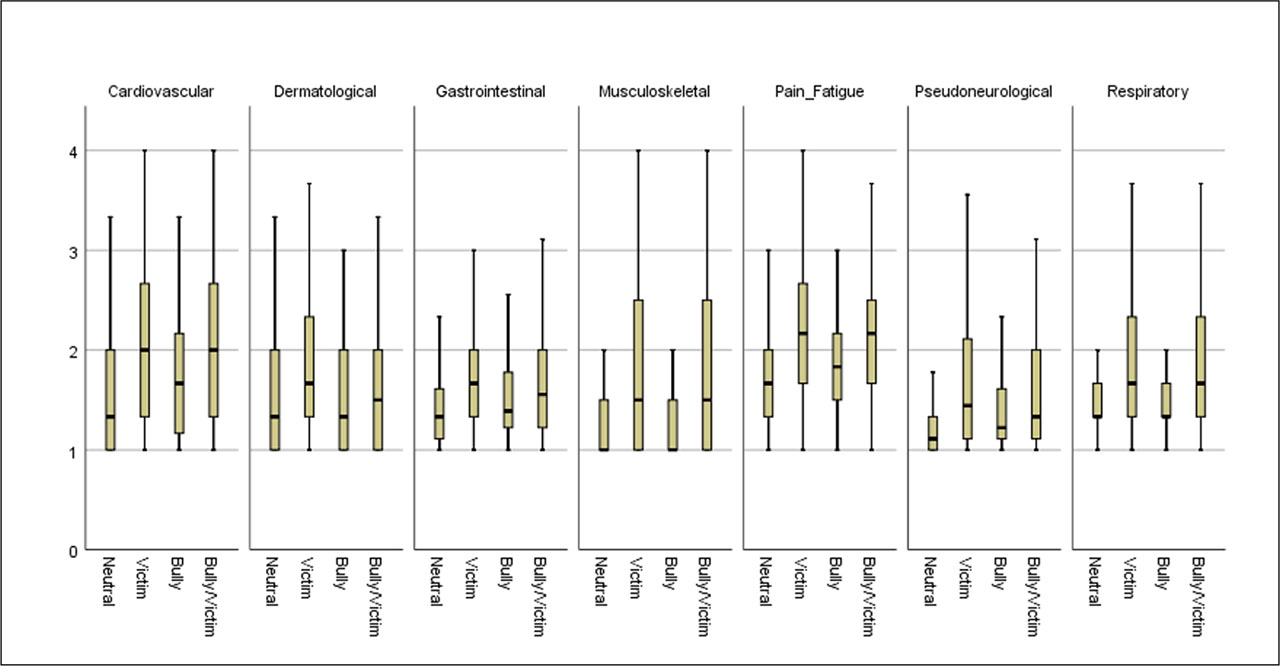
Figure 1.
Frequency of psychosomatic symptoms by bullying role.
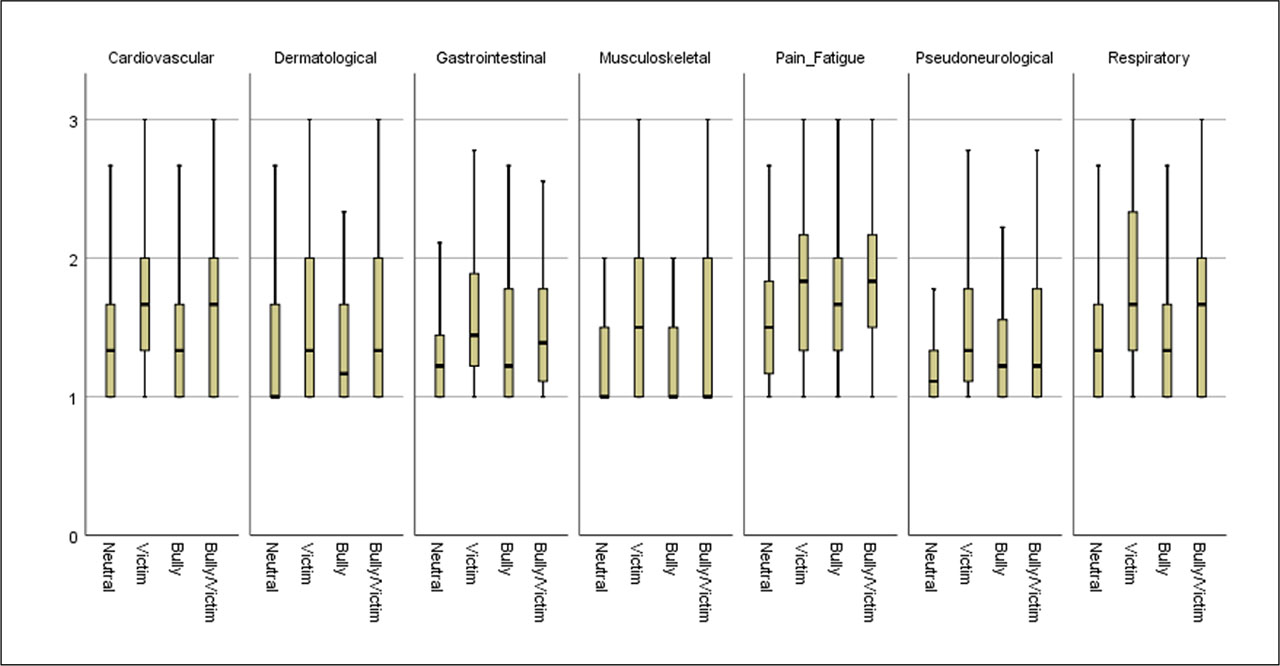
Figure 2.
Interference of psychosomatic symptoms with daily functioning due to bullying role.
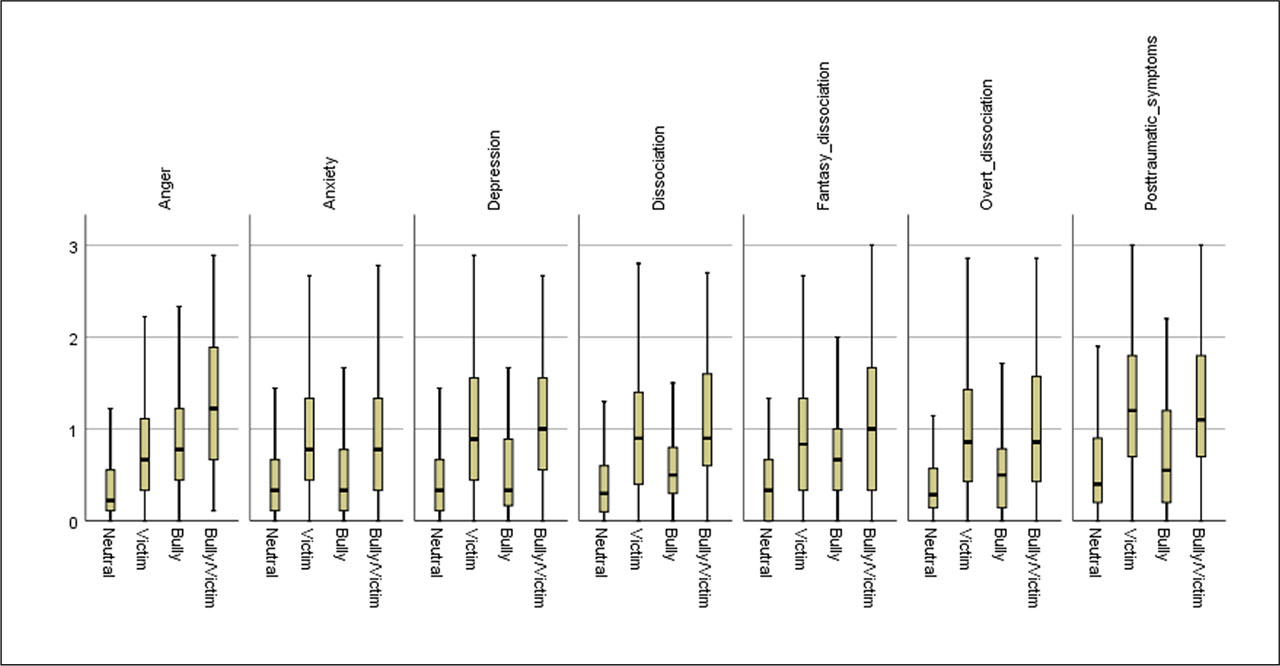
Figure 3.
Distribution of traumatic symptoms according to bullying involvement.