

1. INTRODUCTION
Peer violence, or bullying, is recognised as a significant public health concern due to its potentially severe and lasting psychological and physical effects on children (1, 2). While bullying affects youth globally, its impact is shaped by sociocultural factors. In Bosnia and Herzegovina (BiH), a post-conflict society with enduring psychosocial stressors and limited institutional resources, children may face unique vulnerabilities related to exposure to violence (3, 4). Despite this, there is a lack of nationally representative data on school bullying in BiH, particularly regarding its association with children’s mental and somatic health (1, 5). Adolescents’ mental health is significantly influenced by the support they receive from their social networks. Studies show that social-based support, including from teachers and peers, plays a crucial role in reducing perceived stress and the risk of depression (6). However, stigmatising attitudes toward mental health remain prevalent among youth in the region, including future healthcare professionals, which may hinder help-seeking and reinforce silence around psychological distress (7).
Children may be involved in bullying in multiple roles: as bullies, victims, or both bullies and victims (termed bully/victims in this paper) (8). In addition to these roles, recent research highlights the importance of peer bystanders in shaping the dynamics of school violence. Bystanders may act as reinforcers, defenders, or remain passive, and their responses can either sustain or interrupt bullying episodes (9, 10, 11). Studies show that bystanders represent the largest group in the classroom, and that their behaviour is influenced by factors such as moral disengagement, social status goals, and perceived peer support (11). While this study focuses on students directly involved in bullying, future research should consider the broader peer ecology, including bystander roles and classroom norms, to better understand the social mechanisms that perpetuate or prevent peer violence (9, 10, 12). Previous studies have shown that children in the dual role of bully/victim are at the greatest risk of adverse outcomes, including emotional dysregulation, behavioural problems, and psychosomatic complaints (13). Traumatic symptoms, such as anxiety, depression, and posttraumatic stress disorder (PTSD), are also prevalent among youth exposed to violence, and may have lasting psychological consequences (14, 15). Psychosomatic symptoms, such as headaches, fatigue, and stomach pain without a clear medical cause, are particularly relevant indicators of distress in school-aged children (16). In addition to regional findings, international research offers valuable insights into the social dynamics of bullying. Studies from Finland and the United States have emphasised the role of peer networks and group processes in sustaining bullying behaviours. Prior research has shown that peer reinforcement contributes to the persistence of aggression (17), while other studies have examined the social positioning of bullies within classroom hierarchies (18, 19). These perspectives underscore the importance of considering group-level influences and social context when interpreting bullying-related outcomes.
This study aims to assess the prevalence of bullying among students in the seventh to ninth grades of primary schools in the Federation of Bosnia and Herzegovina (FBiH), to explore gender differences in the experience of and engagement in bullying, and to examine the association between exposure to bullying and the presence of traumatic and psychosomatic symptoms. By providing data from a large sample of adolescents in a unique sociocultural context, this study may help improve understanding of bullying-related health risks and offer insight for developing context-sensitive school-based prevention programmes.
2. METHODS
2.1. Study design and participants
This cross-sectional study was conducted between February and March 2023 in 18 primary schools from seven of the ten cantons in the FBiH. The number of schools was determined based on available approvals and the aim of including schools from diverse geographical areas, within the limits of administrative feasibility. A stratified cluster sampling design was applied: cantons served as strata, while within each stratum the cantonal ministries of education provided lists of eligible schools. Schools were then randomly selected, and in each selected school, all available classes from grades seven to nine (ages 13 to 15) were included in the study, ensuring full participation across the targeted age range. All students present in the selected classes on the day of data collection were invited to participate.
Although the sampling plan initially targeted all ten cantons of the FBiH, three cantons did not participate because approval from the relevant ministries could not be obtained. Therefore, the final sample included seven cantons.
Cochran’s formula was used to calculate the minimum required sample size (n=1,537), assuming a 20% prevalence rate of bullying, a 95% confidence level, and a margin of error of ±2%. A total of 2,822 students completed the questionnaire. After excluding 491 incomplete or invalid responses, the final sample consisted of 2,331 students (1,127 boys, 48.3%; 1,204 girls, 51.7%).
Most students were in the eighth (33.6%) or ninth grades (33.5%), while 32.9% were in the seventh grade. The majority of students lived with both parents (88.2%), had at least one sibling (90.5%), and came from an urban area (64.4%). Regarding academic performance, 70.5% of students reported having very good or excellent grades, while only 6.6% had failing or poor grades.
2.2. Instruments
Validated and standardised instruments were used to assess school violence, trauma symptoms, and psychosomatic complaints, with authorisation from the respective authors or institutions (20,21,22,23).
All instruments were administered in Croatian, which is mutually intelligible with Bosnian and Serbian and widely understood in the FBIH. A detailed overview of the instruments is provided in Table 1.
Table 1.
Overview of instruments used in the study.
| Instrument | Developer/Year | Language | Target Age | Scales / Dimensions | Cronbach’s α | Validation |
|---|---|---|---|---|---|---|
| School Violence Questionnaire (SVQ 2003) [20] | Child Protection Centre of Zagreb (2003) | Croatian | 12–15 | 11 aggressive behaviours grouped into 5 violence types | 0.84 | Validated in Croatian |
| Trauma Symptom Checklist for Children (TSCC-A) [21] | Briere (1996); Croatian edition by Buljan Flander & Profaca | Croatian | 8–16 | 44 items / 6 subscales: anxiety, depression, anger, PTSD, overt and fantasy dissociation | 0.82–0.89 | Validated and standardised in Croatian |
| Psychosomatic Symptoms Scale (PSS) [23] | Vulić-Prtorić (2019) | Croatian | 10–18 | 35 items in 7 somatic domains (frequency and interference) | 0.89–0.91 | Validated for the Croatian population |
Demographic and educational variables were collected using the introductory section of the School Violence Questionnaire (SVQ 2003), which includes items on school name, grade level, gender, age, place of residence, number of siblings, family structure, and academic performance in the previous school year.
Categorisation into bullying roles was based on responses to the School Violence Questionnaire (SVQ 2003) (20). Students who reported experiencing at least one form of peer violence or admitted to perpetrating it were classified as victims or bullies, respectively. Those who reported both experiences were categorised as bully/victims. Students who indicated no involvement in any form of violence were classified as neutral (20).
Academic performance was assessed by asking participants to indicate their final achievement in the previous school year using a five-point categorical scale (1 = Fail to 5 = Excellent).
The Cronbach’s alpha coefficients for the instruments used in this study were satisfactory. For the School Violence Questionnaire, internal consistency was 0.81 for experiencing violence and 0.78 for committing violence. The Trauma Symptom Checklist for Children showed coefficients ranging from 0.77 to 0.87 across its subscales. For the Psychosomatic Symptom Scale, reliability values across its seven domains ranged from 0.70 to 0.85.
2.3. Data collection procedure
Data were collected with the cooperation of school principals, teachers, and counsellors. Parents received written information about the study and provided informed consent. Students filled in anonymous paper questionnaires during class time, placing them in sealed boxes after completion to ensure confidentiality.
2.4. Ethical approval
The study was approved by the Ethics Committee of the University of Mostar Faculty of Medicine (number: 01-I-2110/22, date: December 5, 2022), as well as the federal and cantonal ministries of education and science. Participation was voluntary and anonymous. The study followed national ethical guidelines for research involving children (3).
2.5. Statistical analysis
Data analysis was performed using IBM SPSS Statistics, Version 25.0 (Armonk, NY: IBM Corp.). The normality of continuous variables was tested using the Shapiro-Wilk test. Categorical variables were presented as counts and percentages, with the Chi-square (χ2) test with a comparison of proportions with the Bonferroni correction used to assess statistical significance. Numerical variables were presented as medians and interquartile ranges, with the Mann-Whitney and Kruskal-Wallis tests with Dunn’s post-hoc test and the Bonferroni correction for multiple tests used for significance testing. The significance level was set at α=0.05. P-values that could not be expressed to three decimal places were reported as p<0.001.
3. RESULTS
3.1. Prevalence and roles in bullying
Out of the total sample, 13.3% of students (n=310) identified as victims, 3.1% (n=72) as bullies, and 4.4% (n=102) as both victims and bullies. The remaining 79.2% of students were not involved in bullying and are referred to as the neutral group.
Statistically significant differences were found between groups in relation to gender, family structure, grade level, and academic performance (Table 2). No significant differences were observed for the number of siblings or area of residence.
Table 2.
Sociodemographic characteristics of students by role in bullying.
| N (%) | Neutral | Victim | Bully | Bully/Victim | p* |
|---|---|---|---|---|---|
| Gender | |||||
| Male | 887 (48.0)a | 134 (43.2)a | 50 (69.4)a | 56 (54.9)a,b | <0.001 |
| Female | 960 (52.0)a | 176 (56.8)a | 22 (30.6)a | 46 (45.1)a,b | |
| Family structure | |||||
| Both parents | 1648 (89.2)a | 266 (85.8)a,b | 60 (83.3)a,b | 82 (80.4)b | 0.011 |
| Other | 199 (10.8)a | 44 (14.2)a,b | 12 (16.7)a,b | 20 (19.6)b | |
| Siblings | |||||
| 0 | 172 (9.3) | 28 (9) | 10 (13.9) | 11 (10.8) | 0.308 |
| 1 | 744 (40.3) | 111 (35.8) | 26 (36.1) | 32 (31.4) | |
| 2 | 563 (30.5) | 110 (35.5) | 18 (25) | 39 (38.2) | |
| 3 or more | 368 (19.9) | 61 (19.7) | 18 (25) | 20 (19.6) | |
| Area of residence | |||||
| Urban | 1177 (63.7) | 201 (64.8) | 46 (63.9) | 78 (76.5) | 0.076 |
| Rural | 670 (36.3) | 109 (35.2) | 26 (36.1) | 24 (23.5) | |
| Grade level | |||||
| 7th | 621 (33.6)a | 112 (36.1)a | 13 (18.1)b | 20 (19.6)b | 0.001 |
| 8th | 628 (34.0)a | 96 (31)a | 24 (33.3)a | 36 (35.3)a | |
| 9th | 598 (32.4)a | 102 (32.9)a,b | 35 (48.6)b | 46 (45.1)b | |
| Academic performance | |||||
| 1 (Fail) | 61 (3.3)a | 7 (2.3)a | 3 (4.2)a | 5 (4.9)a | 0.005 |
| 2 (Poor) | 58 (3.1)a | 10 (3.2)a | 1 (1.4)a | 8 (7.8)a | |
| 3 (Satisfactory) | 398 (21.5)a | 87 (28.1)a | 23 (31.9)a | 25 (24.5)a | |
| 4 (Very good) | 638 (34.5)a | 96 (31)a | 32 (44.4)a | 30 (29.4)a | |
| 5 (Excellent) | 692 (37.5)a | 110 (35.5)a | 13 (18.1)b | 34 (33.3)a,b | |
Post-hoc pairwise comparisons showed that the bully group included a significantly higher proportion of male students and a lower proportion of female students compared to the neutral and victim groups. No significant gender differences were observed between the bully and bully/victim groups.
Students living with both parents were significantly more represented in the neutral group, while those from other family structures were more frequently found in the bully/victim group.
Regarding grade level, seventh-grade students were significantly less represented in the bully and bully/victim groups, whereas ninth-grade students were more commonly found in these roles. Eighth-grade students showed a relatively balanced distribution across all groups. In terms of academic performance, students with excellent grades were significantly less represented in the bully group compared to the neutral and victim groups. No significant differences were observed among students with lower levels of academic achievement.
3.2. Psychosomatic symptoms and exposure to bullying
Significant differences were observed among students categorised by their role in bullying (neutral, victim, bully, bully/victim) for both the frequency and impact of psychosomatic symptoms (Table 3).
Table 3.
Frequency and impact of psychosomatic symptoms among students by role in bullying.
| Neutral | Victim | Bully | Bully/Victim | p* | |
|---|---|---|---|---|---|
| Frequency | |||||
| Pseudoneurological | 1.11a [0.3] | 1.44b [1] | 1.22b,c [0.5] | 1.33c [0.9] | <0.001 |
| Cardiovascular | 1.33a [1] | 2b [1.3] | 1.67a,b [1] | 2b [1.3] | <0.001 |
| Musculoskeletal | 1a [0.5] | 1.5c [1.5] | 1a,b [0.5] | 1.5b,c [1.5] | <0.001 |
| Respiratory | 1.33a [0.3] | 1.67b [1] | 1.33a [0.3] | 1.67b [0.3] | <0.001 |
| Gastrointestinal | 1.33a [0.6] | 1.67c [0.7] | 1.39a,b [0.6] | 1.56b,c [0.8] | <0.001 |
| Dermatological | 1.33a [1] | 1.67b [1] | 1.33a,b [1] | 1.5b [1] | <0.001 |
| Pain/Fatigue | 1.67a [0.7] | 2.17b [1] | 1.83a [0.7] | 2.17b [0.8] | <0.001 |
| Interference | |||||
| Pseudoneurological | 1.11a [0.3] | 1.33c [0.7] | 1.22b [0.6] | 1.22b,c [0.8] | <0.001 |
| Cardiovascular | 1.33a [0.7] | 1.67c [0.7] | 1.33a,b [0.7] | 1.67b,c [1] | <0.001 |
| Musculoskeletal | 1a [0.5] | 1.5b [1] | 1a,b [0.5] | 1b [1] | <0.001 |
| Respiratory | 1.33a [0.7] | 1.67c [1] | 1.33a,b [0.7] | 1.67b,c [1] | <0.001 |
| Gastrointestinal | 1.22a [0.4] | 1.44c [0.7] | 1.22a,b [0.8] | 1.39b,c [0.7] | <0.001 |
| Dermatological | 1a [0.7] | 1.33c [1] | 1.17a,b [0.7] | 1.33b,c [1] | <0.001 |
| Pain/Fatigue | 1.5a [0.7] | 1.83b [0.8] | 1.67b [0.7] | 1.83b [0.7] | <0.001 |
Post-hoc pairwise comparisons showed that, for pseudoneurological symptoms, victims and bullies both reported significantly higher frequencies than neutral students. No significant differences were found between victims and bullies. Bully/victims also scored significantly higher than neutral students, but did not differ from bullies in this regard.
In the cardiovascular domain, victims and bully/victims reported significantly higher frequencies than neutral students. Bullies did not differ significantly from any other group.
Musculoskeletal symptoms were significantly more frequent among victims and bully/victims compared to neutral students. Bullies did not differ significantly from neutral students, but scored significantly lower than victims.
For respiratory symptoms, victims and bully/victims scored higher than both bullies and neutral students, while bullies did not differ from neutrals.
Gastrointestinal symptoms were significantly more frequent among victims and bully/victims compared to neutral students. Bullies did not differ significantly from neutral students or bully/victims, but scored significantly lower than victims.
Dermatological symptoms were significantly more frequent among victims and bully/victims compared to neutral students. Bullies did not differ significantly from any other group.
Pain and fatigue symptoms were significantly more frequent among victims, bullies, and bully/victims compared to neutral students. No significant differences were found among the three involved groups.
In terms of the interference of symptoms with daily functioning, victims and bully/victims consistently reported greater interference than neutral students across all symptom domains, while bullies showed intermediate levels. Victims and bully/victims differed significantly from neutrals in pseudoneurological symptoms and pain and fatigue, but not in other domains. The most pronounced impacts were observed in pain and fatigue, pseudoneurological, and gastrointestinal symptoms.
In addition to the statistical results presented in Table 3, Figures 1 and 2 provide visual representations of the distribution of psychosomatic symptoms across bullying roles. These box plots illustrate both the frequency and interference of symptoms, highlighting group differences and variability within each domain.
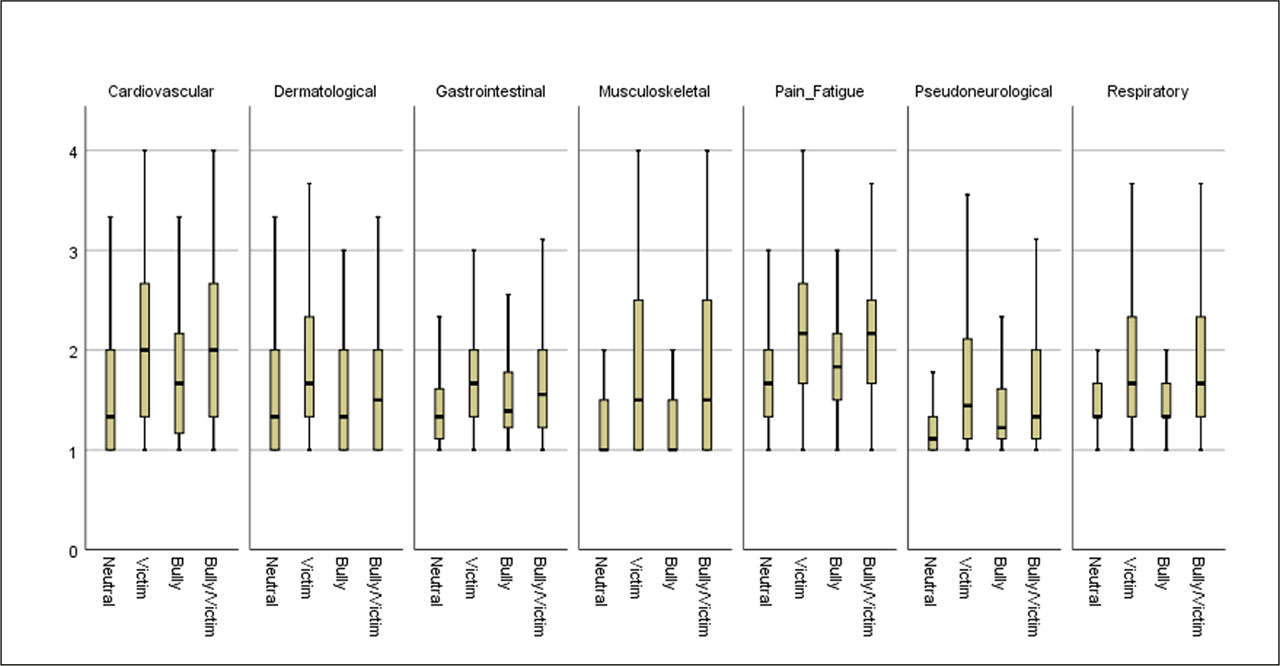
Figure 1.
Frequency of psychosomatic symptoms by bullying role.
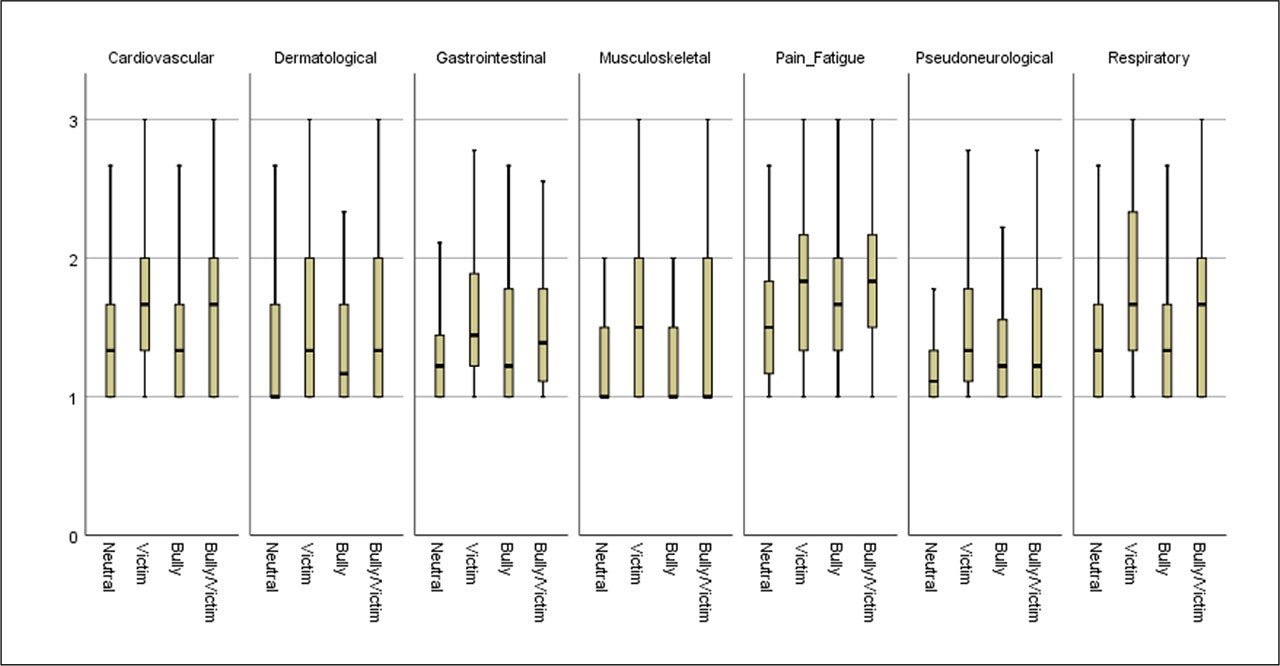
Figure 2.
Interference of psychosomatic symptoms with daily functioning due to bullying role.
3.3. Trauma-related symptoms by bullying role
Figure 3 presents the distribution of trauma-related symptoms across bullying role groups. Students who identified as bully/victims show consistently higher levels of all measured symptoms, including anxiety, depression, anger, posttraumatic symptoms, dissociation, overt dissociation, and fantasy dissociation, compared to neutral students. Their box plots display the highest median scores and broader ranges, suggesting greater severity and variability in symptom expression. Neutral students consistently show the lowest symptom levels across all domains (Figure 3).
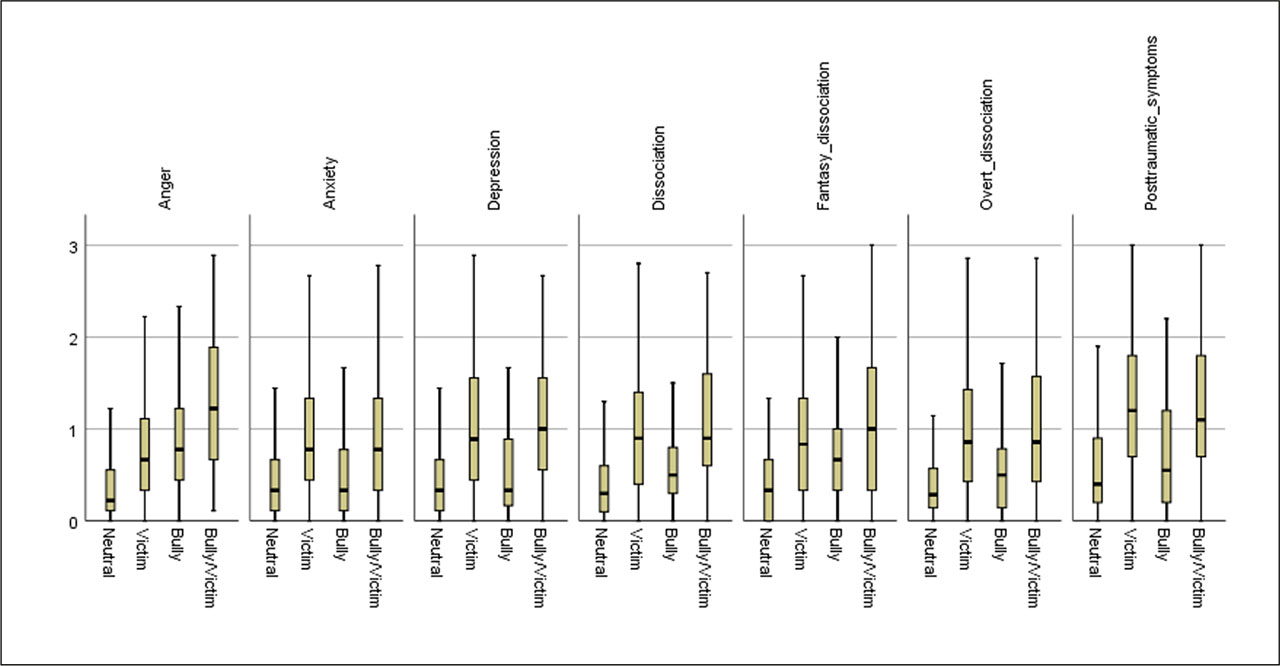
Figure 3.
Distribution of traumatic symptoms according to bullying involvement.
Both bully/victims and victims demonstrate elevated trauma-related symptoms, with bully/victims tending to have higher median values and wider distributions, particularly for anger, posttraumatic symptoms, and dissociative indicators (Figure 3). Anxiety and depression are elevated in both groups, with slightly higher scores among victims. Bullies generally report lower symptom levels than victims and bully/victims, but higher than neutral students in domains such as anger and posttraumatic symptoms (Figure 3).
Overall, the group of bully/victims appears most affected, followed by victims, while bullies show intermediate scores. Neutral students consistently report the lowest levels of traumatic symptoms (Figure 3).
4. DISCUSSION
This study provides one of the most comprehensive insights into bullying and mental health among adolescents in the FBiH to date. With a large and geographically diverse sample, it confirms that bullying remains a serious public health issue, with over one in five students involved either as a victim, bully, or both.
Consistent with European data (1), the prevalence observed in our sample (21%) is comparable to findings from Croatia (24) and Serbia (25). However, it is slightly lower than some earlier Balkan reports (4), which may reflect cultural, contextual, or methodological differences in reporting. Gender-related differences were expected: girls more frequently reported victimisation, while boys were more often bullies or bully/victims, consistent with previous regional and international studies (1, 2, 20).
An important contribution of this study is the analysis of grade-level differences. Victims were more often from lower grades (seventh), while bullies and bully/victims were more common in higher grades (eighth and ninth). This developmental trend is consistent with research showing that bullying roles shift with age, reflecting both cognitive-moral development and peer group dynamics (9, 10). Our findings add to this evidence by highlighting that the middle-school period represents a sensitive stage when students transition from a higher victimisation risk in early adolescence to more active roles in bullying as they grow older.
Psychosomatic complaints were significantly more prevalent among victims and bully/victims, with particularly high levels of fatigue, gastrointestinal, and pseudoneurological symptoms. These findings are in line with international meta-analyses showing that peer victimisation is robustly associated with somatic symptoms (14, 27). The additional measure of interference with daily functioning strengthens this observation, indicating that bullying not only correlates with symptom frequency, but also with its impact on everyday life.
Trauma-related symptoms were most pronounced in bully/victims, who reported the highest levels of anger, dissociation, and overall psychological distress. This confirms earlier evidence that bully/victims represent the most vulnerable subgroup, facing risks of both internalising and externalising difficulties (15, 16, 26).
Our results are consistent with prior findings in BiH, which reported elevated psychological distress among bully/victims (4). This study extends earlier work by offering a more nuanced symptom analysis and situating the findings within the specific socio-cultural context of post-conflict BiH.
Notably, even students with high academic performance were found among victims and bully/victims, indicating that academic success is not necessarily a protective factor against being involved in bullying. Bullies, in contrast, showed lower awcademic performance and lower overall symptom levels, with anger being a prominent exception, possibly reflecting emotional dysregulation or aggressive coping strategies (26, 28).
These results show that peer violence is not a simple phenomenon but reflects the interconnected influence of demographic, developmental, and psychological factors. Recognising the specific roles – victims, bullies, and the dual role of bully/victims – is essential for understanding risk patterns and guiding prevention efforts. Importantly, the broader social context, including prevailing attitudes toward mental health, may shape how students interpret and respond to psychological distress. Recent findings from South-East Europe show that stigmatising beliefs remain widespread even among medical students, underscoring the need for early, school-based interventions that promote mental health literacy and reduce stigma (7).
4.1. Study limitations
This study has several limitations. First, since it is based on cross-sectional data, it is not possible to draw firm conclusions about causal relationships between victimisation, violent behaviour, and the examined factors. Although the study covered various aspects of victimisation, it did not include information on exposure to other potentially traumatic events, such as witnessing violence or the loss of a loved one, which may limit the comprehensiveness of understanding children’s experiences. Additionally, polytraumatisation and its connection to traumatic symptoms were not specifically explored.
Second, all data were collected through self-report questionnaires, which, although common, carries the risk of subjectivity and socially desirable responses. Future studies could benefit from the inclusion of multiple informants, such as peers, parents, or teachers, to enhance data reliability.
Third, this study focused exclusively on students in grades seven to nine, leaving out students of younger and older ages, which may limit the ability to generalise the findings to the wider school-age population. Additionally, the sample did not include students who may have witnessed bullying without direct involvement (bystanders), although this group is known to experience emotional and psychosomatic consequences. Their exclusion may thus underestimate the broader impact of peer violence.
Fourth, the study did not include control variables such as socioeconomic status (SES), parental education, parental employment, school-level characteristics, or broader contextual factors. Without these, it is not possible to fully account for potential confounding effects, which is especially important in cross-sectional research. Given the established link between SES, exposure to violence, and health outcomes, this represents a relevant limitation that should be addressed in future research.
Finally, the sample did not cover all cantons in the FBiH. Although the study included schools from seven cantons and thus ensured broad geographic coverage, it cannot be considered fully representative of the entire federation. The findings should therefore be interpreted with caution when generalising to the whole population.
4.2. Practical implications
These findings should be interpreted in the context of BiH as a post-conflict society marked by war-related trauma, economic challenges, and constraints within institutional support systems. Such factors likely contribute to the persistence of school violence and increased emotional distress among children. Considering the limited regional research examining bullying within the socio-political context of the region, this study offers valuable insights.
The large sample and detailed assessment of psychosomatic and traumatic symptoms strengthen the robustness of the results. While previous regional studies have largely focused on the prevalence rates of general well-being indicators, this study contributes a more detailed analysis of psychological functioning. These insights underscore the need for school programmes that not only address violence, but also incorporate systematic screening and early identification of psychosomatic and trauma-related symptoms.
The relevance of peer networks in sustaining bullying behaviour has been well-documented in international research. Prior studies have demonstrated that bullies often occupy central positions within peer groups, where social status and peer reinforcement contribute to the persistence of aggression (9, 18, 19). In light of these findings, school-based prevention programmes should incorporate strategies that address group-level dynamics, including peer-led interventions, social network mapping, and staff training to identify and respond to harmful peer structures.
Training school staff and integrating psychosocial screening within school and primary healthcare settings are essential steps toward timely identification of and support for vulnerable children. This is particularly important in environments where stigma toward mental illness may hinder recognition and responses to psychological distress. In addition, the observed differences across grade levels suggest that prevention efforts should be developmentally tailored, with early interventions targeting younger students at higher risk of victimisation and peer-focused strategies for older students who more often assume aggressive or dual roles.
5. CONCLUSIONS
This study provides valuable insights into the prevalence of peer violence and its association with psychosomatic and traumatic symptoms across a broad geographic area of the FBiH, although the results cannot be considered fully representative of the entire Federation.
Given BiH’s post-conflict context, persistent psychosocial stressors may exacerbate the impact of bullying. The results underscore the necessity of trauma-informed, school-based prevention strategies that integrate early screening and multidisciplinary support. Addressing these challenges through tailored interventions is critical to fostering safer educational environments and improving student well-being.
These findings support the need for context-specific interventions, including training for school personnel in recognising psychosomatic and trauma-related symptoms, and integrating simple screening tools into school health programmes and primary care. Strengthening intersectoral collaboration among education, healthcare, and child protection services is essential to ensure timely and adequate support for vulnerable students.
ACKNOWLEDGEMENTS
We would like to acknowledge and thank all subjects participating in the survey.
Notes
[9] Conflicts of interest CONFLICTS OF INTEREST
The authors declare that no conflicts of interest exist.
[11] ETHICAL APPROVAL
This study was approved by the Ethics Committee of the University of Mostar, Faculty of Medicine (number: 01-I-2110/22, date: December 5, 2022). Additional permissions were obtained from the federal and cantonal ministries of education.
[12] INFORMED CONSENT
Written informed consent was obtained from the parents or legal guardians of all student participants prior to data collection.
[13] AVAILABILITY OF DATA AND MATERIALS
Data sharing is not applicable to this article due to ethical and privacy restrictions, but data are available from the corresponding author on reasonable request.
[14] LLM STATEMENT
During the preparation of this article, the author(s) used the GPT-4 language model to:
review and amend grammatical and spelling mistakes,
ensure linguistic consistency and coherence,
test and fine-tune the article’s wording,
format the references.
After using this model, the author(s) reviewed and edited the content as needed and take(s) full responsibility for the content of the publication.