
TABLE 1.
Mania/hypomania
| Title, author, year | Study design | Participants (n) | Age years mean (SD) | Term/s used | Clear definition | Definition | Reference | Assessment instrument | Reference | Inter-rater/Test-re-test reliability |
|---|---|---|---|---|---|---|---|---|---|---|
| A randomised controlled trial of cognitive behavior therapy in adolescents with major depression treated by selective serotonin reuptake inhibitors. The ADAPT trial. Goodyer et al, 2008 | RCT | 208 | 14 (1.5) | Hypomania | No | N.A | No | No | No | N.A |
| SSRI-induced disinhibition syndrome | ||||||||||
| Age Effects on Antidepressant-Induced Manic Conversion. Martin et al, 2004 | Retrospective clinical study | 87 920 | a Range: 5–29 | Manic conversation | Yes | Patients treated with SSRI who received a new diagnosis of bipolar disorder or developed mania after two months of treatment. | No | No | No | N.A |
| Antidepressant-induced manic switching | ||||||||||
| An open study of the effects of sertraline on adolescent major depression. McConville et al, 1996 | Open trial | 13 | 15.1 (1.6) | SSRI-induced mania | No | N.A | No | No | No | N.A |
| Case report: Mixed mania—Apparent induction in an adolescent by a selective serotonin reuptake inhibitor antidepressant (SSRI). James, 1996 | Case reports | 1 | 15 | Mixed mania | No | N.A | No | No | No | N.A |
| Citalopram and mania. Pravin et al, 2004 | Case reports | 4 | 12.5 (3.8) | Developed mania | Yes | SSRI-induced manic symptoms according to DSM-IV. | DSM-IV | No | No | No |
| Developed hypomania | ||||||||||
| Drug-induced switch | ||||||||||
| SSRI-induced switch | ||||||||||
| Escitalopram-associated mania in a child. Kul et al, 2008 | Case reports | 1 | 11 | Developed mania | No | N.A | No | No | No | N.A |
| SSRI-induced mania | ||||||||||
| Fluoxetine-related mania in an adolescent girl diagnosed with selective mutism: A case report. Akaltun & Ayaydin, 2020 | Case reports | 1 | 16 | Mania symptoms | No | N.A | No | No | No | N.A |
| Developing hypomania/mania | ||||||||||
| SSRI-induced mania | ||||||||||
| Mania associated with fluoxetine treatment in adolescents. Venkataraman et al, 1992 | Case reports | 5 | 14.6 (0.5) | SSRI-induced hypomania/mania | No | N.A | No | No | No | N.A |
| Mania induced by sertraline in a prepubertal child Ghaziuddin, 1994 | Case reports | 1 | 7 | SSRI-induced mania | Yes | All features of a DSM-III-R manic episode. | DSM-III-R | No | No | No |
| Manic Symptoms as a Symptom of Antidepressant Discontinuation Syndrome in a Child Özcan et al, 2013 | Case reports | 1 | 12 | Antidepressant withdrawal/discontinuation hypomania/mania | Yes | 1. A manic state that starts after stopping or reducing the dose of an antidepressant. | Narayan and Haddad (2012) | No | No | N.A |
| 2. No pharmacological confounders are present that could account for the manic state. | ||||||||||
| 3. Continuous antidepressant treatment for at least 4 weeks before the manic state began. | ||||||||||
| 4. Symptoms began within 1 week of antidepressant stoppage or dose reduction. | ||||||||||
| More on SSRI-induced mania Kat, 1996 | Case reports | 2 | 15 (1.0) | SSRI-induced mania | No | N.A | No | No | No | N.A |
| Paroxetine induced mania Oldroyd, 1997 | Case reports | 1 | 16 | SSRI-induced mania | No | N.A | No | No | No | N.A |
| Paroxetine induced mania in pre-adolescence Sharkey & O’Donovan, 2004 | Case reports | 2 | 11.5 (0.5) | SSRI-induced mania | No | N.A | No | No | No | N.A |
| Paroxetine pharmacokinetics in depressed children and adolescents Findling et al, 1999 | Open trial | 30 | 11.2 (2.9) | Developed Hypomania | No | N.A | No | No | No | N.A |
| SSRI-induced mania Heimann & March, 1996 | Case reports | 1 | 15 | “Psychic akathisia”, drug-induced switching to mania, SSRI-induced mania or switching | No | N.A | No | No | No | N.A |
| SSRI-induced mania in obsessive-compulsive disorder Diler & Avci, 1999 | Case reports | 3 | 9.3 (0.5) | SSRI-induced mania | No | N.A | No | No | No | N.A |
| SSRI-induced mania: Comment Grubbs, 1997 | Case reports | 1 | 14 | SSRI-induced mania | No | N.A | No | No | No | N.A |
| The Effectiveness and Tolerability of Citalopram in a Turkish Sample of Children with Obsessive Compulsive Disorder Toros et al, 2002 | Open trial | 23 | 10.6 (2.5) | Hypomania, SSRI-induced hypomania | No | N.A | No | No | No | N.A |
Included articles (n= 18) describing mania/hypomania as adverse reactions to SSRI treatment. Information recorded from the articles: the term for mania/hypomania used, if a clear definition of the term was provided, and if so, if a reference for the definition was provided, if they used an assessment instrument to identify/diagnose the mania/hypomania, was a reference for the instrument provided, and finally if inter-rater reliability was provided.
TABLE 2.
Activation
| Article name and author | Study design | Participants (n) | Age (n = years) | Term used | Clear definition | Definition | Reference | Assessment instrument | Reference | Inter-rater/Test-re-test reliability |
|---|---|---|---|---|---|---|---|---|---|---|
| A pilot study of actigraphy as an objective measure of SSRI activation symptoms: results from a randomized placebo controlled psychopharmacological treatment study Bussing et al, 2015 | RCT | 44 | 11.8 (3.3) | Activation syndrome | Yes | Five symptom clusters, irritability, akathisia, disinhibition, mania, and self-harm. | (43) | TEASAP | (21) | No |
| Activation Adverse Events Induced by the Selective Serotonin Reuptake Inhibitor Fluvoxamine in Children and Adolescents Reinblatt et al, 2009 | RCT | 45 | 10.0 (2.4) b | Activation cluster adverse events | Yes | 1. Activation: Activated, disruptive, activation, animated; | No | Adverse Event questionnaire | No | Yes |
| 2. Disinhibition: Disinhibited, doing things they wouldn’t normally do, disinhibition, aggression or outburst; | ||||||||||
| 3. Hyperactivity: Hyper, hyperactivity, increased energy | ||||||||||
| Development and Psychometric Evaluation of the Treatment Emergent Activation and Suicidality Assessment Profile J. M. Reid et al, 2010 | Open trial | 30 | 12.1 (2.9) | Activation syndrome | Yes | Symptoms of behavioral activation by antidepressants can vary greatly, manifesting as any combination of the following: irritability, agitation, somatic symptoms of anxiety, panic attacks, restlessness, hostility, aggressiveness, insomnia, disinhibition, emotional lability, impulsivity, social withdrawal, restlessness, hypomania/mania, paranoia or other psychotic symptoms, or other unusual changes in behavior or mood. | Based upon review of the literature, and discussion among manuscript authors, as well as the FDA hearings in 2004. | TEASAP | N.A | Yes |
| Constructs initially selected as most congruent with activation syndrome “irritability;” “disinhibition/impulsivity;” and “akathisia.” | ||||||||||
| Low-Dose Fluvoxamine Treatment of Children and Adolescents with Pervasive Developmental Disorders: A Prospective, Open-Label Study Martin et al, 2003 | Open trial | 18 | 11.3 (3.6) | Behavioral activation | No | N.A | No | No | No | N.A |
| Paroxetine Open-Label Treatment of Pediatric Out patients With Obsessive-Compulsive Disorder Rosenberg et al, 1999 | Open trial | 20 | 11.1 (2.4) | Behavioral activation | No | N.A | No | No | No | N.A |
| Psychometric properties of the Treatment-Emergent Activation and Suicidality Assessment Profile (TEASAP) in youth with OCD Bussing et al, 2013 | RCT | 56 | 11.7 (3.3) | Activation | Yes | Five symptom clusters, irritability, akathisia, disinhibition, mania, and self-harm. | (43) | TEASAP | (43) | Yes |
| Behavioral activation | CGI-SA | (74) | ||||||||
| Selective Serotonin Reuptake Inhibitor-Induced Behavioral Activation in the PANDAS Subtype Murphy et al, 2006 | Case reports | 1 | 9 | Behavioral activation | No | N.A | No | No | No | N.A |
| Side-effects of SSRIs disrupt multimodal treatment for pediatric OCD in a randomized-controlled trial A. M. Reid et al, 2015 | RCT | 56 | 11.70 (3.30) | Activation syndrome | Yes | “irritability, akathisia, disinhibition, mania, and self-harm.” | (21) | TEASAP | (21) | No |
| SSRIs associated with behavioral activation and suicidal ideation Vorstman et al, 2001 | Case reports | 1 | 10 | Behavioral activation, | Yes | The occurrence of symptoms of restlessness, disinhibition, and irritability as a possible side effect of SSRI treatment has been differently named as (hypo)mania, psychic akathisia, and behavioral activation. | (75) | No | No | N.A |
| (Hypo)mania, psychic akathisia | ||||||||||
| Suicidal events in the Treatment for Adolescents With Depression Study (TADS). Vitiello et al, 2009 | RCT | 439 | 14.6 (1.5) | Behavioral activation | Yes | Anxiety, irritability, agitation, and insomnia | (76) | Adolescent Depression Scale | No | No |
| The SOFIA Study: Negative Multi-center Study of Low Dose Fluoxetine on Repetitive Behaviors in Children and Adolescents with Autistic Disorder Herscu et al, 2020 | RCT | 158 | b9.1 (3.3) | Activation syndrome | Yes | Activation symptoms were identified a priori and were grouped into four symptom categories: Mood alteration, changes in sleep, changes in reactivity, and changes in energy. If they showed two or more symptoms. | No | No | No | N.A |
| Tolerability of selective serotonin reuptake inhibitors in thirty-nine children under age seven: a retrospective chart review Zuckerman et al, 2007 | Retrospective clinical study | 39 | 5.9 (0.8) | Behavioral activation | No | N.A | No | No | No | N.A |
Included articles (n=12) describing activation as an adverse reaction to SSRI treatment. Information recorded from the articles: the term for activation used, if a clear definition for the term was provided, and if so, if a reference for the definition was provided, if they used an assessment instrument to identify/diagnose the mania/hypomania, was a reference for the instrument provided, and finally if inter-rater reliability was provided.
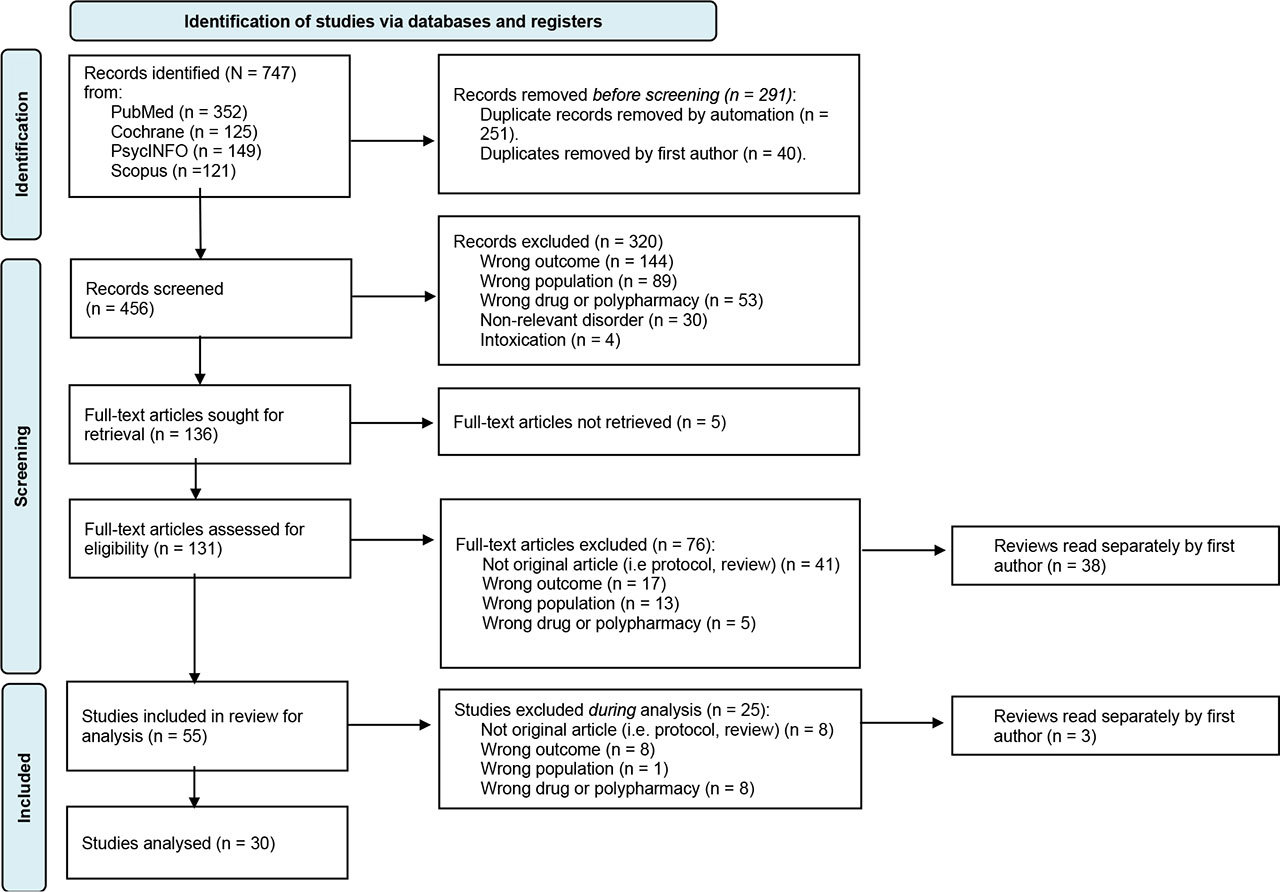
FIGURE 1.
Flow diagram of the selection process
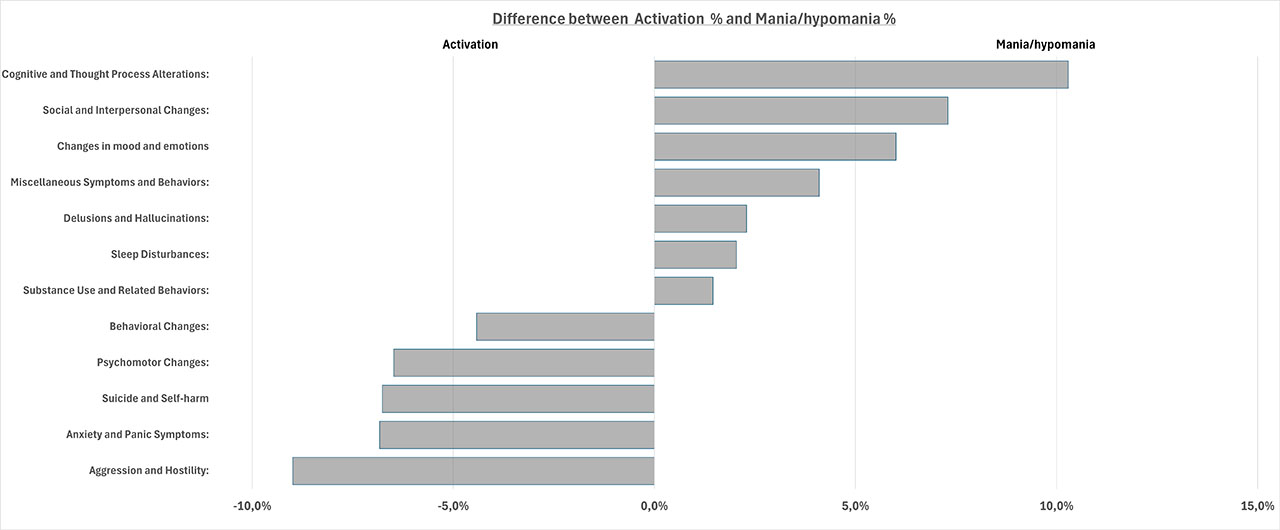
FIGURE 2.
Differences between symptoms reported for activation and for mania/hypomania.