
1. Literature Review
Many researchers analysed the bearing capacity based on the static method in which the bearing capacity coefficients were calculated based on static loads on the footings and the weight of the soil in both active and passive conditions. The classical bearing capacity theories started from Rankine (1857), Prandtl (1921), Terzaghi (1943), Meyerhof (1957), Saran et al. (1989) and many others who extensively studied the bearing capacity of shallow footings for static loading case. Terzaghi's bearing capacity theory (1943) was the first general theory for the bearing capacity of soils. Okabe (1924) and Mononobe and Matsuo (1929) were the pioneers in the inclusion of ‘seismicity’ in the design of structures. IS: 1893–1984(Part-3) has also adopted the Mononobe and Okabe method for the determination of seismic active and passive earth pressure behind the retaining wall. Sarma and lossifelis (1990), Richards et al. (1993), Budhu and Al-Karni (1993) and Kumar and Kumar (2003) considered the seismic forces both on the structures and on the supporting soil mass, which were not considered by Meyerhof (1957). Researchers like Dormieux and Pecker (1995), Paolucci and Pecker (1997), Soubra (1997), Kumar and Rao (2002), Kumar (2003) and Choudhury and Subba Rao (2005) studied the seismic bearing capacity of shallow footings for horizontal ground. Sawada et al. (1994), Sarma (1999) and Askari and Farzaneh (2003) gave the solution for seismic bearing capacity of shallow foundations near the sloping ground. Again, some work for surface footing on the sloping ground was carried out by Zhu (2000), Kumar and Kumar (2003) and Kumar and Rao (2003) using limit equilibrium analysis, method of characteristics, etc. Choudhury and Rao (2006), Castelli and Lentini (2012), Farzaneh and Askari (2013) and Chakraborty and Kumar (2014) determined the seismic bearing capacity of a shallow foundation embedded in sloping ground by using the theorem of limit equilibrium method and limit analysis in conjunction with finite elements and non-linear optimisation technique, respectively. In their analysis, it was found that on increasing slope inclination, the bearing capacity decreased. But the researchers did not analyse the bearing capacity on layered soil. Yamamoto (2010) investigated seismic bearing capacity coefficients of spread and embedded foundations near slope in the analytical method. The pseudo-static approach was used, and the seismic forces consisted of a horizontal load applied to the foundation and inertia of a soil mass. Chakraborty and Kumar (2013) evaluated the bearing capacity factor on the sloping ground by applying lower bound (LB) finite element limit analysis in conjunction with non-linear optimisation. Baazouzi et al. (2016) studied the numerical analysis of the bearing capacity for a strip footing near a cohesionless slope and subjected to a centred load using the finite difference code. Button (1953) was the first to analyse the bearing capacity of strip footing on two layers of clay under static loading conditions. In this analysis, it was postulated that failure surface at the ultimate load is cylindrical, where the centre of the cylindrical curve lies at the edge of the footing. Meyerhof and Hanna (1978) considered the case of footing reposing in various layers overlaying a strong soil deposit. Michalowski and Shi (1995) applied the kinematic approach of limit analysis to account for the limit pressure under footings to ascertain the bearing capacity of footings reposing on two-layered soil. Purushothamaraj et al. (1974) analysed the bearing capacity of shallow substratum utilising the upper bound (UB) limit analysis theorem. From all these literature surveys, it is seen that the bearing capacity of shallow foundation embedded in slope on layered soil is still limited. In the present analysis, the seismic bearing capacity of strip footing embedded in slope on two-layered soil has been analysed by using the limit equilibrium method with the pseudo-static approach.
2. Methodology
A strip footing having a width B0 is assumed to be on the top of a two-layered c−φ soil as shown in Fig. 1. The footing (Fig. 2) having base AM is embedded in a sloping ground DY with an inclination i to the horizontal ground surface. The footing is resting on two-layered c-φ soil. Homogeneous, isotropic c-φ soil with surcharge load along with the sloping ground is assumed in the analysis. Soil is assumed to be a rigid, perfectly plastic medium satisfying the Mohr–Coulomb failure criterion. Let the footing be at a depth of (Df) below the ground surface (Fig. 2). Load (P1) acts along the centre line of the footing. For shallow foundation (Df≤B0), the overburden pressure is idealised here as a triangular load distribution that acts over the length of RY at an angle of inclination (i). From the concept of Debnath and Ghosh (2018), the two main regions, active wedge and passive wedge, are thereby assumed to be acoulomb failure mechanism as shown in Fig. 2. The active region gives an active lateral thrust PA pushing against the passive resistance Pp. The wall frictional angle between the active and passive zones is denoted as δ. The active and passive zones are inclined at an angle αA1, αA2, αp1 αp2, respectively. The detailed free body diagram of the active zone and passive zone is shown in Figs 3–6. From the equilibrium of the two wedges, the active pressure and passive resistance will be equal. Then, by equating the active pressure and passive resistance, the authors found out the maximum load acting on the foundation. After optimisation of the load pL by particle swarm optimisation (PSO) technique, the authors found out the minimum resistance. Parameters involved in the present study are as follows: c1= cohesion of soil in the top layer, c2= cohesion of soil in the bottom layer, φ1 = angle of friction of soil in the top layer, φ2= angle of friction of soil in the bottom layer, γ1= unit weight of soil in the top layer, γ2= unit weight of soil in the bottom layer, αA1 = angle of slip surface at the top layer in the active zone, αA2 = angle of slip surface at the bottom layer in the active zone, αp1 = angle of slip surface at the top layer in the passive zone, αp2 = angle of slip surface at the bottom layer in the passive zone, δi= friction angle along the surface between active and passive zones at the ith layer.
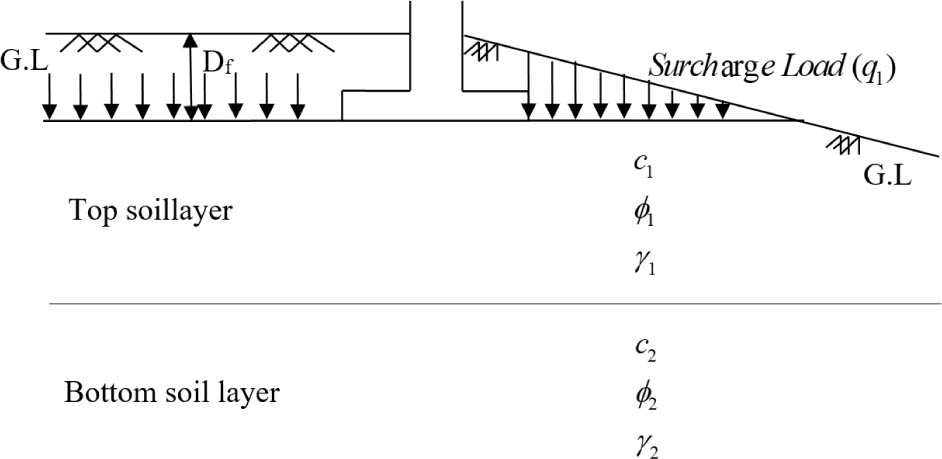
Figure 1
Geometry of footing on two-layered soil profile.
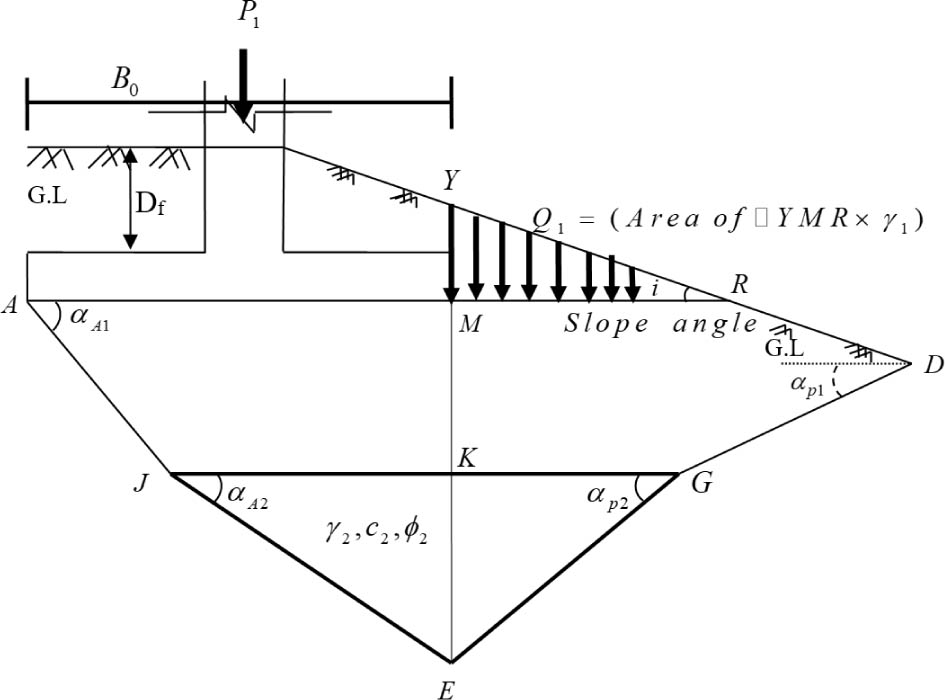
Figure 2
Failure mechanism and wedges assumed in present analysis.
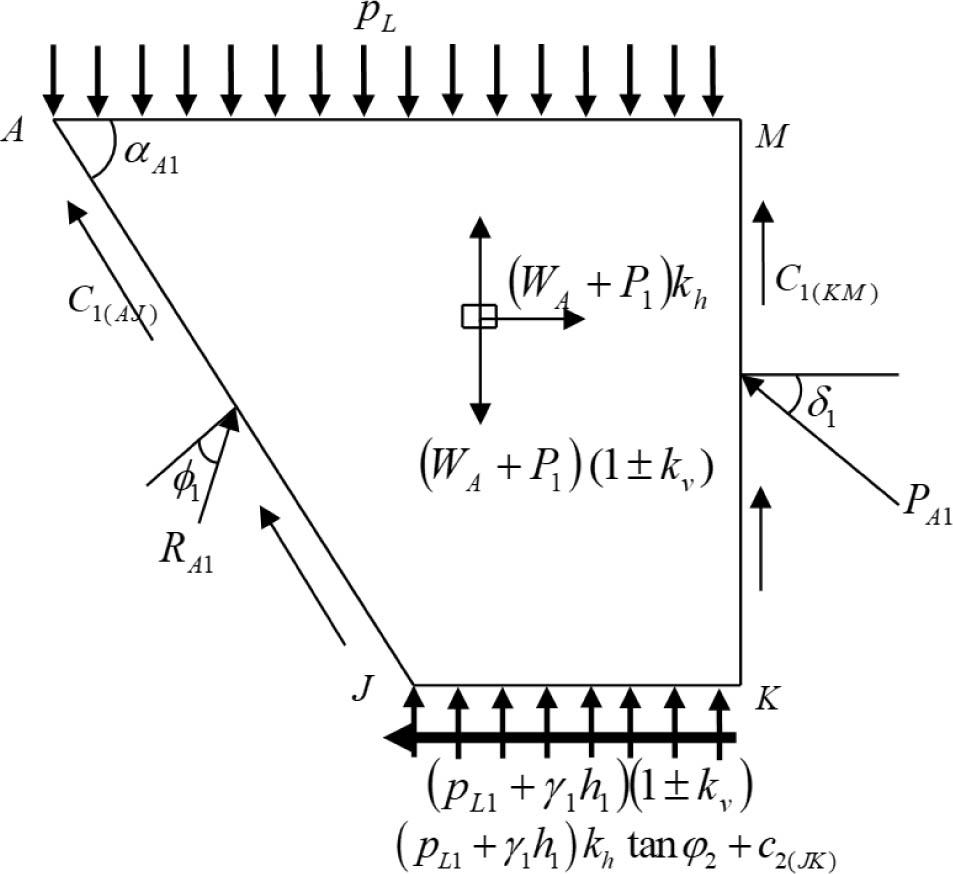
Figure 3
Active wedge in Top layer.
2.1. Active pressure at the top layer
As shown in Fig. 3, wedge AMKJ is a known active wedge that is posited at the top layer, giving pressure to the passive wedge. The weight of the wedge
with the length of JK being equal toTotal load acting on the foundation is given by
Total cohesive force (C1) on the slip lines AJ and MK is calculated as
The intensity of load at layer thickness h1 is expressed as (depicted in Fig. 7)
Conceding to limit equilibrium conditions, the authors can write
After solving Equations 5 and 6 and modifying both, the active pressure can be obtained as given below:
2.2. Active pressure at the bottom layer
From Fig. 4, active pressure distributing from the top layer to the wedge JKE.
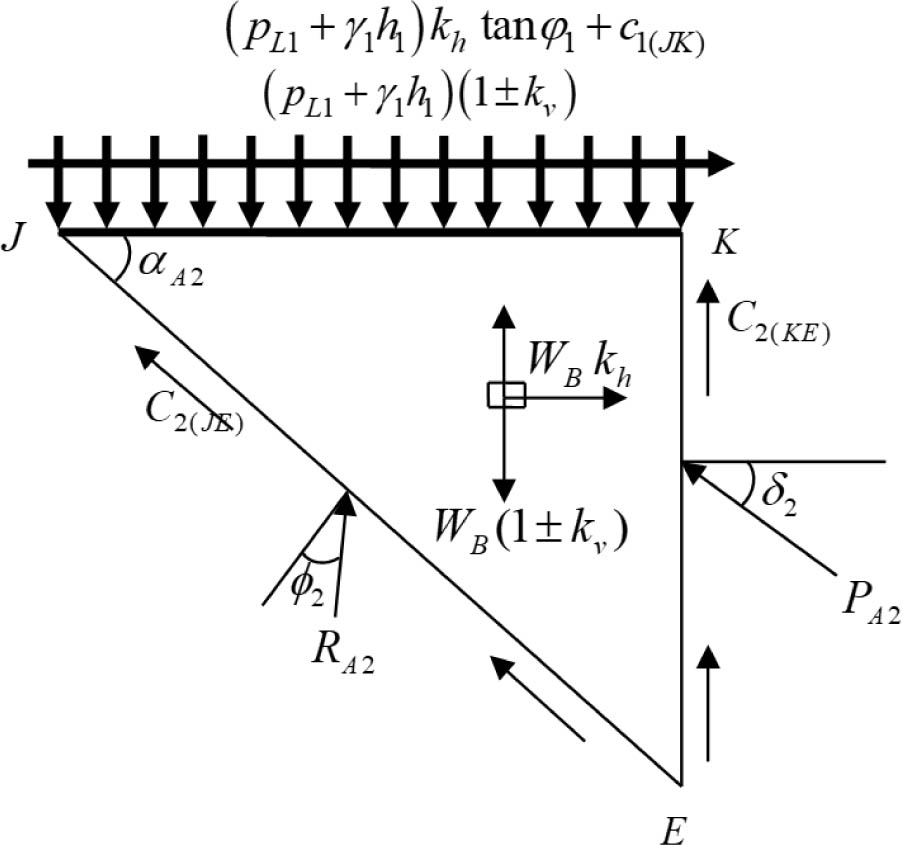
Figure 4
Active wedge in Bottom layer.
The weight of the wedge:
Base shear at the interface between the two layers is given as:
Total cohesive force at the slip lines JE and KE is expressed as:
Conceding to limit equilibrium conditions,
Solving Equations 11 and 12 and simplifying them, we obtain
The details of equations of PA2 are given in Appendix I.
Hence, total active pressure from both the layers is given by
2.3. Passive resistance at the top layer
Due to active pressure generated in the top layer, the passive zone gives resistance to the active pressure. The weight of the passive wedge, as depicted in Fig. 5, is given as
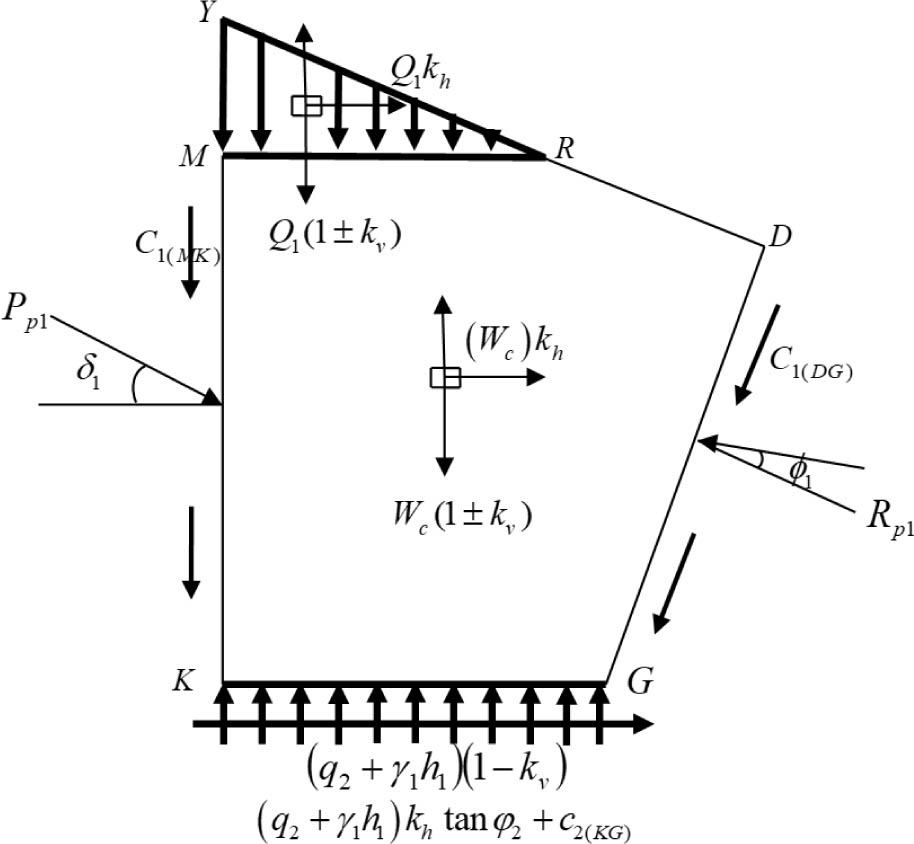
Figure 5
Passive wedge in Top layer.
Extra loadingacting on the foundation is expressed as surcharge load
Total surcharge load in the top layer of the passive zone is given as
Total cohesive force in the slip lines KG and GD of the passive wedge is given as
Using limit equilibrium equations
Solving Equations 19 and 20 and modifying both equations, passive resistance can be expressed as:
2.4. Passive resistance at the bottom layer
Total weight of the passive wedge KGE, as shownin Fig. 6, is calculated as
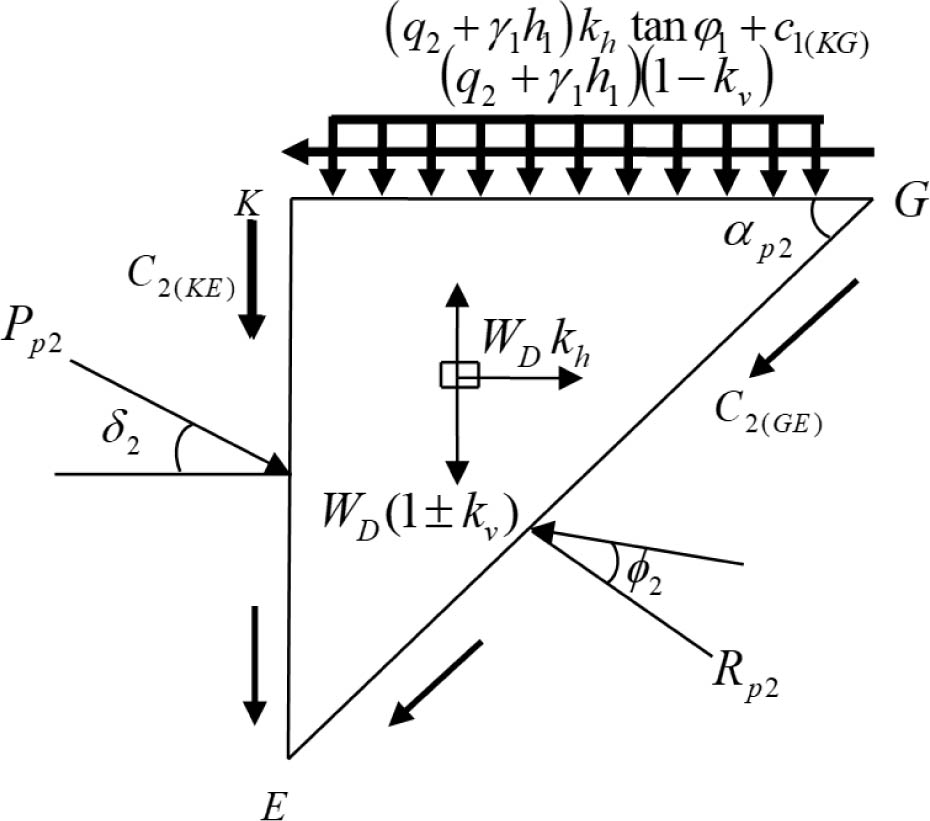
Figure 6
Passive wedge in Bottom layer.
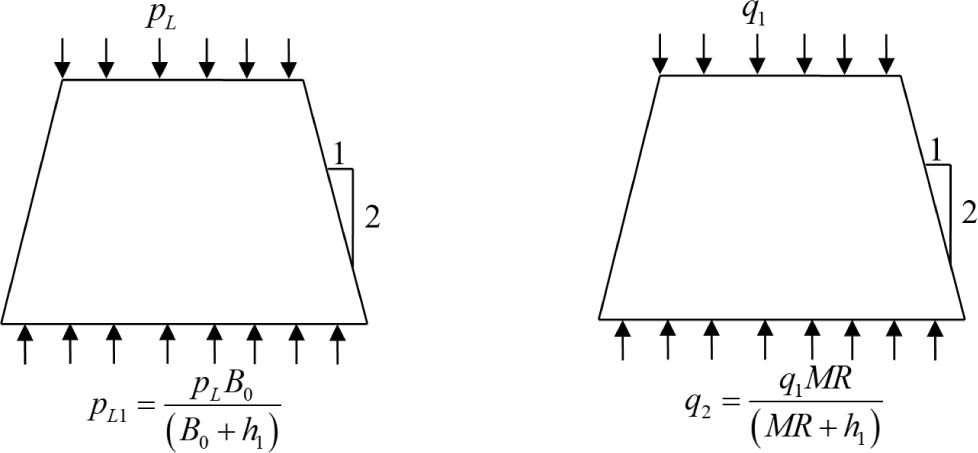
Figure 7
Load spread mechanism.
According to 2 : 1 load distribution method, intensity of surcharge load at depth h1 can be written as
Base shear between two passive wedges can be coded as
Cohesive forces in slip lines KE, KG and GE are given as
Case 1: Considering the effective area of active zones
Case 2: Considering the effective area of passive zones
The bearing capacity factor (Nγ′) is a function of several parameters including cohesion, surcharge and unit weight. It can be expressed as:
The details of the equations a1, b1, e1 and d1 are given in Appendix II.
Where c̅ is averaged cohesion in each layer in the slip line is shown by
a1, b1, e1 and d1 are dimensionless equations.In seismic condition, (Nγ″) can be expressed as (NγE) and in static condition, (Nγ″) can be expressed as (NγS), whereas (Nγ″) is the unity factor for the simultaneous resistance of unit weight, surcharge and cohesion.
3. Results and Discussion
The bearing capacity factor (Nγ″) has been computed by PSO algorithm, with the optimum (Nγ″) optimized w.r.t. variables αA1, αA2, αp1 and αp2. The minimum value is taken as an optimised value. The design charts of the obtained bearing capacity coefficients (Nγ″) for different values of slope angle (i) are shown in Figs 8 and 9 (φ = 30°, 40°, ). It has been observed that (Nγ″) decreases when the slope angle (i) increases. The results obtained from MATLAB are summarised in design Tables 1 and 2. Using these design tables, the bearing capacity coefficients of the strip footing near slope are easily obtained with sufficient accuracy from the engineering point of view. Undrained bearing capacity is expressed as Ncs in the design tables.
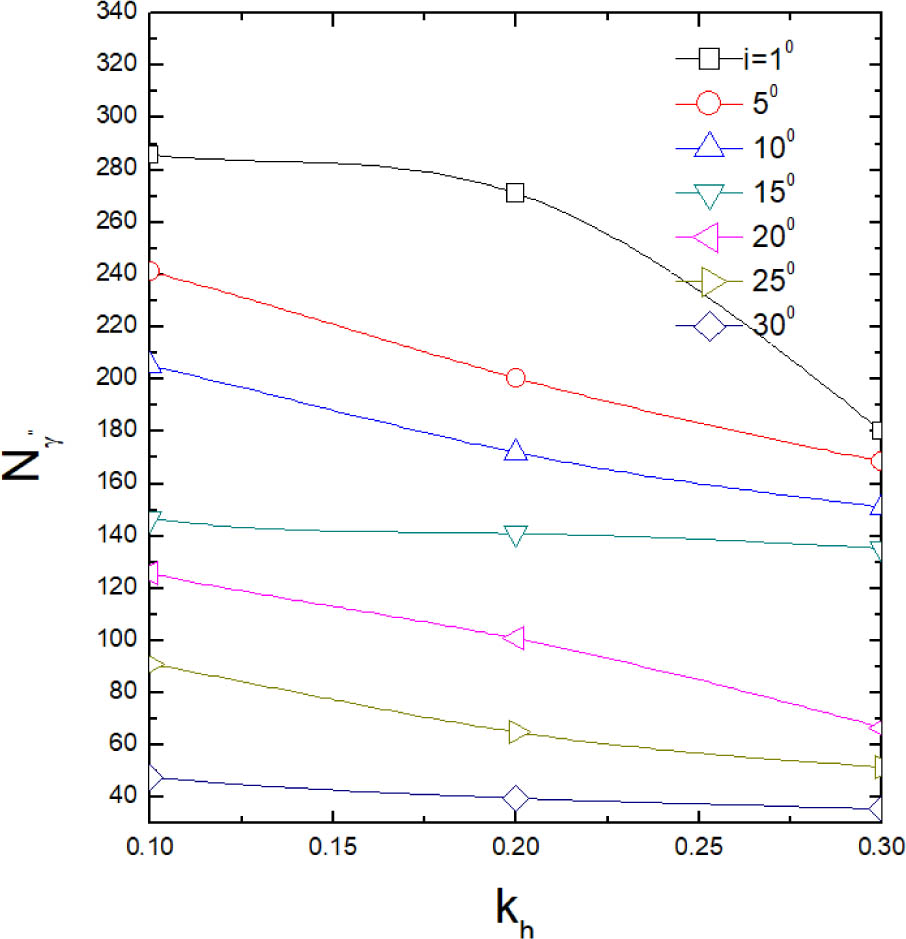
Figure 8
Design chart of Bearing capacity coefficient at φ2 = 30°, δ2 = φ2/2, i = 150, δ1/δ2 = 0.8, kv = kh/2, γ1/γ2 = 0.8, Df/B0 = 0.5, h1/B0 = 0.25, 2c2/B0γ2 = 0.2, c1/c2 = 0.8.
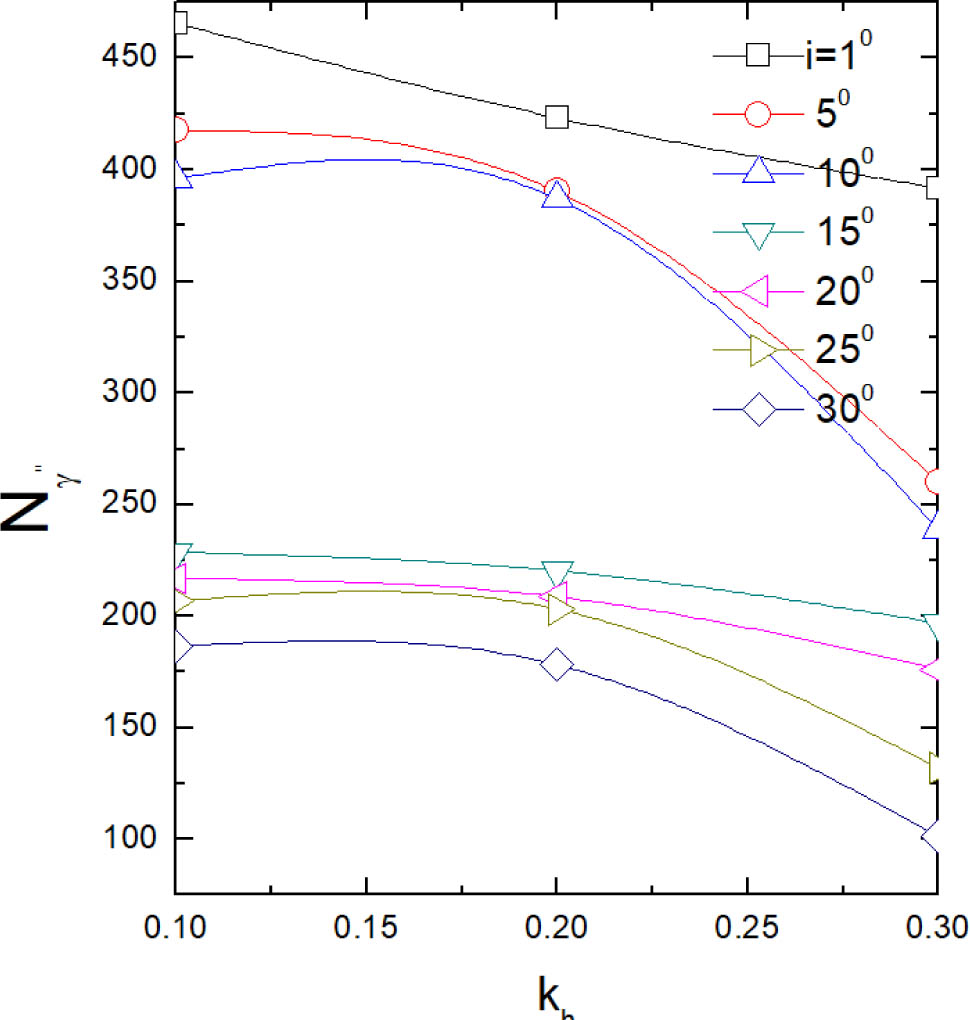
Figure 9
Design chart of Bearing capacity coefficient at φ2 = 40°, δ2 = φ2/2, i = 150, δ1/δ2 = 0.8, kv = kh/2, γ1/γ2 = 0.8, Df/B0 = 1, h1/B0 = 0.25, 2c2/B0γ2 = 0.2, c1/c2 = 0.8
Table 1
Undrained seismic bearing capacity Ncs for strip footing placed adjacent to two layered slope with i=15°.
| kh | Df/B0 | c1/c2 | c1/γB0 | kh | Df/B0 | c1/c2 | c1/γB0 | ||||||
|---|---|---|---|---|---|---|---|---|---|---|---|---|---|
| 1 | 2 | 4 | 6 | 1 | 2 | 4 | 6 | ||||||
| 0 | 0.25 | 0.25 | 5.52 | 5.54 | 5.56 | 5.56 | 0 | 0.50 | 0.25 | 4.54 | 4.60 | 4.62 | 4.64 |
| 0.5 | 5.52 | 5.54 | 5.56 | 5.56 | 0.5 | 4.52 | 4.60 | 4.61 | 4.63 | ||||
| 0.75 | 5.42 | 5.37 | 5.43 | 5.46 | 0.75 | 4.52 | 4.60 | 4.60 | 4.62 | ||||
| 1 | 4.74 | 4.40 | 4.41 | 4.42 | 1 | 4.36 | 4.42 | 4.44 | 4.47 | ||||
| 1.5 | 3.05 | 3.17 | 3.22 | 3.22 | 1.5 | 3.32 | 3.45 | 3.52 | 3.54 | ||||
| 2 | 2.4 | 2.52 | 2.58 | 2.6 | 2 | 1.55 | 2.82 | 2.90 | 2.92 | ||||
| 3 | - | 1.80 | 1.85 | 1.88 | 3 | – | 2.12 | 2.22 | 2.24 | ||||
| 4 | - | 0.6 | 1.51 | 1.53 | 4 | – | 0.91 | 1.84 | 1.90 | ||||
| 5 | - | – | 1.29 | 1.31 | 5 | – | – | 1.61 | 1.64 | ||||
| 0.75 | 0.25 | 4.50 | 4.46 | 4.25 | 4.49 | 1 | 0.25 | 4.40 | 4.49 | 4.52 | 4.53 | ||
| 0.5 | 4.5 | 4.48 | 4.53 | 4.59 | 0.5 | 4.39 | 4.49 | 4.52 | 4.53 | ||||
| 0.75 | 4.4 | 4.4 | 4.54 | 4.58 | 0.75 | 4.38 | 4.49 | 4.52 | 4.53 | ||||
| 1 | 4.35 | 4.2 | 4.45 | 4.49 | 1 | 4.38 | 4.44 | 4.47 | 4.48 | ||||
| 1.5 | 4.05 | 3.84 | 3.93 | 3.96 | 1.5 | 3.88 | 4.2 | 4.3 | 4.33 | ||||
| 2 | 3.45 | 3.24 | 3.36 | 3.4 | 2 | 1.87 | 3.62 | 3.76 | 3.82 | ||||
| 3 | - | 2.44 | 2.62 | 2.68 | 3 | – | 2.7 | 3.07 | 3.13 | ||||
| 4 | - | 1.12 | 2.20 | 2.28 | 4 | – | 1.38 | 2.64 | 2.71 | ||||
| 5 | - | – | 1.92 | 2.0 | 5 | – | – | 2.27 | 2.42 | ||||
| 1.25 | 0.25 | 4.42 | 4.46 | 4.50 | 4.52 | 1.5 | 0.25 | 4.44 | 4.50 | 4.52 | 4.53 | ||
| 0.5 | 4.41 | 4.43 | 4.48 | 4.51 | 0.5 | 4.41 | 4.49 | 4.52 | 4.53 | ||||
| 0.75 | 4.40 | 4.42 | 4.47 | 4.50 | 0.75 | 4.41 | 4.49 | 4.52 | 4.54 | ||||
| 1 | 4.39 | 4.41 | 4.45 | 4.48 | 1 | 4.38 | 4.44 | 4.47 | 4.48 | ||||
| 1.5 | 4.01 | 3.59 | 3.74 | 3.85 | 1.5 | 4.17 | 4.49 | 4.52 | 4.44 | ||||
| 2 | 3.67 | 3.2 | 3.42 | 3.45 | 2 | 2.34 | 4.18 | 4.31 | 4.37 | ||||
| 3 | - | 2.64 | 2.92 | 2.97 | 3 | – | 3.1 | 3.54 | 3.74 | ||||
| 4 | - | 1.67 | 2.59 | 2.67 | 4 | – | 1.92 | 3.3 | 3.43 | ||||
| 5 | - | – | 2.36 | 2.48 | 5 | – | – | 2.87 | 3.12 | ||||
| 0.1 | 0.25 | 0.25 | 4.84 | 4.79 | 4.8 | 4.81 | 0.1 | 0.5 | 0.25 | 4.12 | 4.2 | 4.23 | 4.24 |
| 0.5 | 4.82 | 4.78 | 4.8 | 4.81 | 0.5 | 4.13 | 4.2 | 4.24 | 4.24 | ||||
| 0.75 | 4.64 | 4.79 | 4.8 | 4.81 | 0.75 | 4.13 | 4.2 | 4.24 | 4.24 | ||||
| 1 | 4.12 | 4.15 | 4.2 | 4.21 | 1 | 4.06 | 4.15 | 4.19 | 4.21 | ||||
| 1.5 | - | 3.03 | 3.09 | 3.11 | 1.5 | – | 3.37 | 3.46 | 3.5 | ||||
| 2 | - | 2.42 | 2.49 | 2.51 | 2 | – | 2.76 | 2.87 | 2.91 | ||||
| 3 | - | – | 1.82 | 1.87 | 3 | – | – | 2.21 | 2.25 | ||||
| 4 | - | – | 1.47 | 1.51 | 4 | – | – | 1.85 | 1.89 | ||||
| 5 | - | – | – | 1.28 | 5 | – | – | – | 1.65 | ||||
| 0.75 | 0.25 | 4.11 | 4.14 | 4.18 | 4.2 | 1 | 0.25 | 4.06 | 4.15 | 4.18 | 4.19 | ||
| 0.5 | 4.08 | 4.13 | 4.18 | 4.19 | 0.5 | 4.05 | 4.14 | 4.19 | 4.19 | ||||
| 0.75 | 4.06 | 4.14 | 4.18 | 4.19 | 0.75 | 4.04 | 4.13 | 4.18 | 4.19 | ||||
| 1 | 4.04 | 4.15 | 4.2 | 4.21 | 1 | 4.02 | 4.11 | 4.14 | 4.17 | ||||
| 1.5 | - | 3.74 | 3.85 | 3.89 | 1.5 | – | 4.07 | 4.18 | 4.2 | ||||
| 2 | - | 3.13 | 3.31 | 3.36 | 2 | – | 3.48 | 3.71 | 3.79 | ||||
| 3 | - | – | 2.61 | 2.68 | 3 | – | – | 3.01 | 3.1 | ||||
| 4 | - | – | 2.14 | 2.28 | 4 | – | – | 2.34 | 2.67 | ||||
| 5 | - | – | – | 2.02 | 5 | – | – | – | 2.38 | ||||
| 1.25 | 0.25 | 4.08 | 4.14 | 4.18 | 4.19 | 1.5 | 0.25 | 4.05 | 4.14 | 4.18 | 4.19 | ||
| 0.5 | 4.06 | 4.14 | 4.18 | 4.2 | 0.5 | 4.04 | 4.14 | 4.18 | 4.19 | ||||
| 0.75 | 4.05 | 4.13 | 4.18 | 4.19 | 0.75 | 4.05 | 4.14 | 4.18 | 4.19 | ||||
| 1 | 4.04 | 4.15 | 4.2 | 4.21 | 1 | 4.06 | 4.14 | 4.19 | 4.2 | ||||
| 1.5 | - | 4.14 | 4.19 | 4.2 | 1.5 | – | 4.14 | 4.19 | 4.2 | ||||
| 2 | - | 3.84 | 4.07 | 4.16 | 2 | – | 3.95 | 4.18 | 4.2 | ||||
| 3 | - | – | 3.37 | 3.48 | 3 | – | – | 3.67 | 3.82 | ||||
| 4 | - | – | 2.54 | 3.05 | 4 | – | – | 2.72 | 3.38 | ||||
| 5 | - | – | – | 2.68 | 5 | – | – | – | 2.98 | ||||
Table 2
Undrained seismic bearing capacity Ncs for strip footing placed adjacent to two layered slope with i=30°.
| kh | Df/B0 | c1/c2 | c1/γB0 | kh | Df/B0 | c1/c2 | c1/γB0 | ||||||
|---|---|---|---|---|---|---|---|---|---|---|---|---|---|
| 1 | 2 | 4 | 6 | 1 | 2 | 4 | 6 | ||||||
| 0 | 0.25 | 0.25 | 5.12 | 5.16 | 5.18 | 5.19 | 0 | 0.5 | 0.25 | 4.06 | 4.14 | 4.21 | 4.23 |
| 0.5 | 5.12 | 5.16 | 5.18 | 5.19 | 0.5 | 4.05 | 4.13 | 4.19 | 4.22 | ||||
| 0.75 | 4.82 | 4.91 | 4.96 | 4.97 | 0.75 | 4.03 | 4.11 | 4.17 | 4.20 | ||||
| 1 | 3.8 | 3.96 | 4.03 | 4.05 | 1 | 3.8 | 3.96 | 4.06 | 4.08 | ||||
| 1.5 | 2.23 | 2.81 | 2.9 | 2.93 | 1.5 | 2.32 | 3.01 | 3.10 | 3.12 | ||||
| 2 | – | 2.18 | 2.3 | 2.33 | 2 | – | 2.45 | 2.61 | 2.65 | ||||
| 3 | – | 1.25 | 1.68 | 1.72 | 3 | – | 1.44 | 2 | 2.06 | ||||
| 4 | – | – | 1.33 | 1.38 | 4 | – | – | 1.65 | 1.72 | ||||
| 5 | – | – | 1 | 1.17 | 5 | – | – | 1.24 | 1.5 | ||||
| 0.75 | 0.25 | 3.82 | 3.97 | 4.06 | 4.09 | 1 | 0.25 | 3.80 | 3.92 | 4.04 | 4.06 | ||
| 0.5 | 3.83 | 3.97 | 4.06 | 4.09 | 0.5 | 3.80 | 3.92 | 4.04 | 4.06 | ||||
| 0.75 | 3.82 | 3.97 | 4.07 | 4.09 | 0.75 | 3.80 | 3.91 | 4.04 | 4.06 | ||||
| 1 | 3.8 | 3.96 | 4.06 | 4.09 | 1 | 3.82 | 3.96 | 4.03 | 4.05 | ||||
| 1.5 | 2.51 | 3.25 | 3.37 | 3.41 | 1.5 | 2.64 | 3.44 | 3.59 | 3.64 | ||||
| 2 | – | 2.73 | 2.9 | 2.95 | 2 | – | 2.96 | 3.17 | 3.23 | ||||
| 3 | – | 1.67 | 2.31 | 2.38 | 3 | – | 1.86 | 2.56 | 2.67 | ||||
| 4 | – | – | 1.92 | 2.05 | 4 | – | – | 2.17 | 2.34 | ||||
| 5 | – | – | 1.5 | 1.8 | 5 | – | – | 1.74 | 2.07 | ||||
| 1.25 | 0.25 | 3.83 | 3.96 | 4.03 | 4.06 | 1.5 | 0.25 | 3.8 | 3.96 | 4.03 | 4.05 | ||
| 0.5 | 3.83 | 3.96 | 4.03 | 4.05 | 0.5 | 3.79 | 3.96 | 4.02 | 4.04 | ||||
| 0.75 | 3.83 | 3.96 | 4.03 | 4.05 | 0.75 | 3.8 | 3.96 | 4.03 | 4.05 | ||||
| 1 | 3.83 | 3.96 | 4.03 | 4.05 | 1 | 3.8 | 3.96 | 4.03 | 4.05 | ||||
| 1.5 | 2.74 | 3.65 | 3.84 | 3.9 | 1.5 | 2.8 | 3.84 | 4.01 | 4.04 | ||||
| 2 | – | 3.2 | 3.45 | 3.53 | 2 | – | 3.41 | 3.71 | 3.8 | ||||
| 3 | – | 2.1 | 2.9 | 3.02 | 3 | – | 2.33 | 3.18 | 3.32 | ||||
| 4 | – | – | 2.43 | 2.64 | 4 | – | – | 2.69 | 2.94 | ||||
| 5 | – | – | 2.02 | 2.35 | 5 | – | – | 2.28 | 2.64 | ||||
| 0.1 | 0.25 | 0.25 | 4.25 | 4.31 | 4.34 | 4.34 | 0.1 | 0.5 | 0.25 | 3.57 | 3.68 | 3.74 | 3.76 |
| 0.5 | 4.25 | 4.31 | 4.34 | 4.35 | 0.5 | 3.57 | 3.69 | 3.74 | 3.76 | ||||
| 0.75 | 4.25 | 4.31 | 4.33 | 4.33 | 0.75 | 3.57 | 3.69 | 3.74 | 3.76 | ||||
| 1 | 3.44 | 3.6 | 3.67 | 3.7 | 1 | 3.44 | 3.61 | 3.68 | 3.71 | ||||
| 1.5 | – | 2.6 | 2.7 | 2.73 | 1.5 | – | 2.82 | 2.94 | 2.97 | ||||
| 2 | – | 2.03 | 2.15 | 2.19 | 2 | – | 2.29 | 2.46 | 2.5 | ||||
| 3 | – | – | 1.57 | 1.61 | 3 | – | – | 1.89 | 1.95 | ||||
| 4 | – | – | 1.23 | 1.3 | 4 | – | – | 1.48 | 1.64 | ||||
| 5 | – | – | – | 1.1 | 5 | – | – | – | 1.4 | ||||
| 0.75 | 0.25 | 3.45 | 3.61 | 3.68 | 3.7 | 1 | 0.25 | 3.44 | 3.61 | 3.68 | 3.7 | ||
| 0.5 | 3.45 | 3.61 | 3.68 | 3.7 | 0.5 | 3.44 | 3.61 | 3.68 | 3.7 | ||||
| 0.75 | 3.45 | 3.61 | 3.68 | 3.7 | 0.75 | 3.45 | 3.61 | 3.68 | 3.71 | ||||
| 1 | 3.45 | 3.61 | 3.68 | 3.7 | 1 | 3.45 | 3.61 | 3.68 | 3.7 | ||||
| 1.5 | – | 3.04 | 3.18 | 3.22 | 1.5 | – | 3.23 | 3.44 | 3.5 | ||||
| 2 | – | 2.55 | 2.75 | 2.81 | 2 | – | 2.78 | 3.04 | 3.12 | ||||
| 3 | – | – | 2.2 | 2.28 | 3 | – | – | 2.5 | 2.62 | ||||
| 4 | – | – | 1.74 | 1.96 | 4 | – | – | 2.03 | 2.27 | ||||
| 5 | – | – | – | 1.74 | 5 | – | – | – | 1.97 | ||||
| 1.25 | 0.25 | 3.45 | 3.61 | 3.68 | 3.67 | 1.5 | 0.25 | 3.44 | 3.61 | 3.68 | 3.7 | ||
| 0.5 | 3.44 | 3.61 | 3.68 | 3.67 | 0.5 | 3.44 | 3.61 | 3.68 | 3.7 | ||||
| 0.75 | 3.44 | 3.61 | 3.68 | 3.67 | 0.75 | 3.44 | 3.61 | 3.68 | 3.7 | ||||
| 1 | 3.45 | 3.61 | 3.68 | 3.7 | 1 | 3.45 | 3.62 | 3.68 | 3.7 | ||||
| 1.5 | – | 3.47 | 3.68 | 3.71 | 1.5 | – | 3.61 | 3.68 | 3.7 | ||||
| 2 | – | 2.95 | 3.3 | 3.38 | 2 | – | 3.13 | 3.59 | 3.68 | ||||
| 3 | – | – | 2.76 | 2.91 | 3 | – | – | 3.06 | 3.24 | ||||
| 4 | – | – | 2.18 | 2.54 | 4 | – | – | 2.33 | 2.86 | ||||
| 5 | – | – | – | 2.22 | 5 | – | – | – | 2.53 | ||||
3.1. Computation of Ncs
Merifield et al. (1999) investigated the bearing capacity of a strip footing resting on a two-layer clay deposit with a horizontal ground surface and proposed a modified bearing capacity factor Nc*, which can be expressed as:
where qu= ultimate bearing capacity and c1 = undrained shear strength of the top layer.Similarly, a dimensionless undrained bearing capacity factor Ncs is defined in the present study, which is a function of the parameters cu/γB0, Df/B0, c1/c2, i, kh and it can be described by the following equation:
Ranges of various parameters are given as follows:
is the ratio of wall friction angles between the top and bottom layers.Since the heuristic algorithms give us low ramification and high execution and these methods are relatively new, they can be applied in the geotechnical problem. Out of these methods, a brief discussion on PSO is given here as it is used in the analysis.
3.2. Particle swarm optimisation
Kennedy and Eberhart (1995) developed PSO as a simulation of birds swarm. A swarm is a group of individuals with defined rules for individual behaviours and communication. The ability of each individual to deal with the previous experiences of the swarm is called swarm intelligence. This capability guides the swarm towards its optimum goal. PSO is a population-based search technique where a population of particles start their journey in a space concerning the current best position (Hossain and EI-Shafie 2014; Hajihassani et al. 2017). Reynolds (1987) described three simple rules for the behaviours of individuals inside a swarm, which were used as one of the basic concepts of PSO by Kennedy and Eberhart (1995). Although these simple rules model the behaviour of individuals, their combination produces a complicated behaviour for the swarm.
Individuals avoid collision with others
Individuals go towards the goal of the swarm
Individuals go to the centre of the swarm
The process of decision-making related to individuals is another basic concept of PSO. Each individual of the swarm makes decision based on the following two factors:
Own experiences of the individual that is its bestresults so far
The experiences of other individuals in the swarm that is the best results in the whole swarm
Figure 10 illustrates the standard flowchart of PSO. At the starting step of the original PSO, a certain number of individuals, called particles, are distributed in the search space by using a random pattern (Kennedy and Eberhart 1995; Cheng et al. 2007; Aote et al. 2013). Each particle is representative of a feasible solution. Figure 11 shows the schematic structure of a particle in PSO involving three divided parts as its current position, best position and velocity. The current position, best position and velocity of particles record the current coordinates, best coordinates and velocity vectors of a particle in D-dimensional space, respectively, where D starts from 1 (Kalatehjari 2013). Consequently, for a particle in D-dimensional space, a 3D-dimensional particle is desirable. PSO aims to meet the termination criteria which are defined as the criteria for terminating the iterative search process. To select an appropriate termination criterion, it should be noted that the termination condition does not cause a premature converge and it should protect against oversampling of the fitness (Engelbrecht 2007). The following termination criteria are frequently used in PSO:
Termination when the maximum number ofiterations is exceeded
Termination when a satisfactory solution isfound based on the condition of each problem
Termination when no improvement is achievedover a certain number of iterations
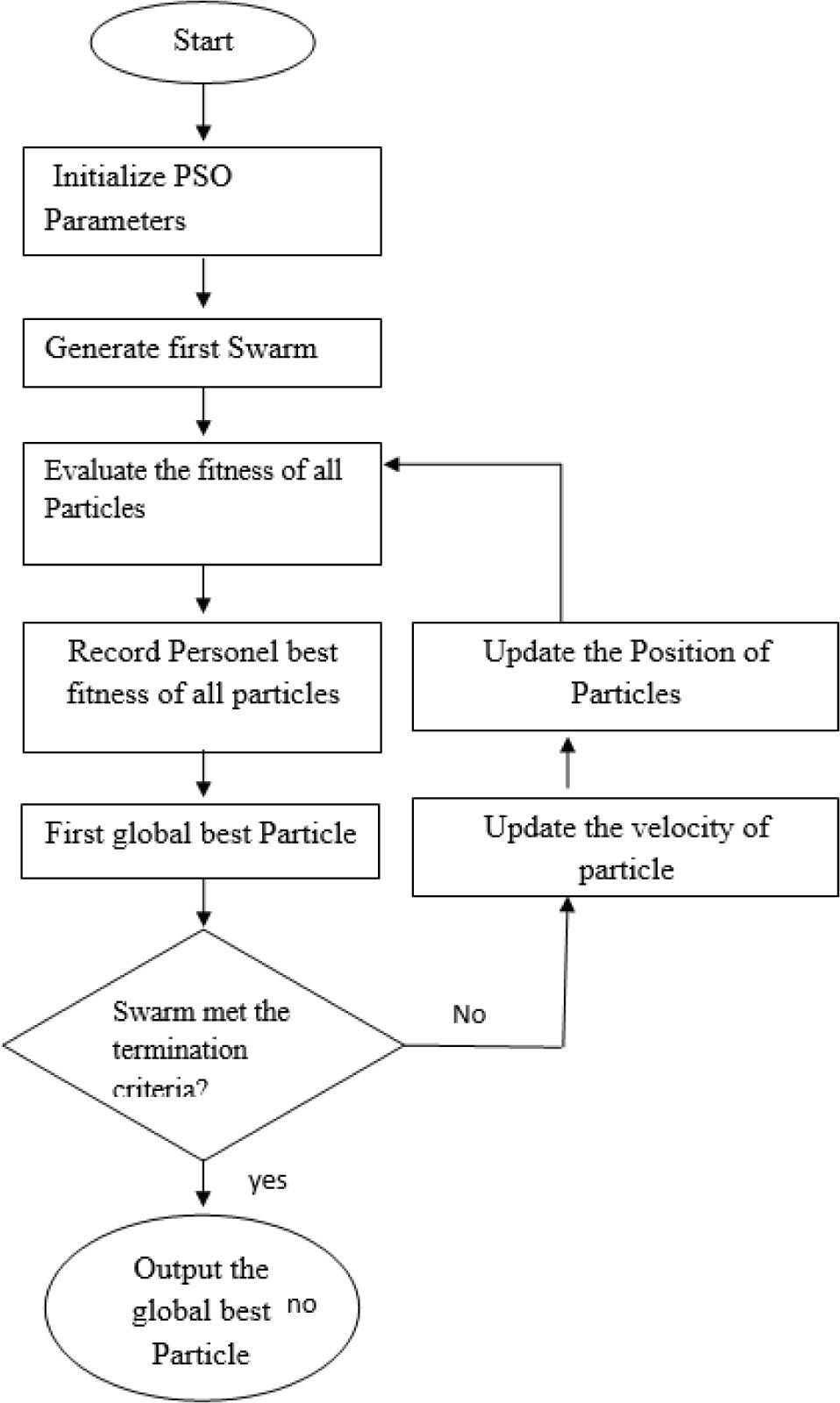
Figure 10
Flowchart of PSO algorithm.
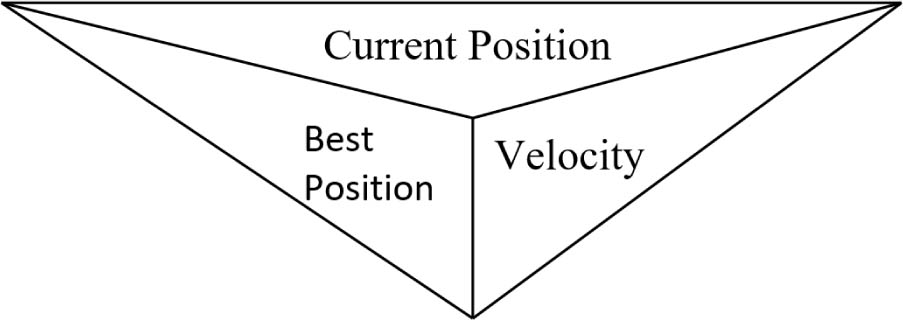
Figure 11
Schematic structure of a particle in PSO (Kalatehjari 2013).
These criteria are applied to ensure that PSO can converge on a feasible solution. Although PSO has some limitation which is explained by Gbenga et al. (2016) and Aote et al. (2013), PSO tries to make the objective function as a minimum or maximum dependingon the problem to be solved. To lead the swarm towards this aim, the fitness value of each particle is determined by evaluating its current position by the objective function. After evaluation offitness of all particles, Equation 39 (velocity equation) is used to calculate the velocity of particles based on their best position and the position of the best particle in the swarm. Using Equation 40, particle positions can be updated according to their current positions and velocities. This iterative process continues until reaching the termination criteria. Equations 39 and 40 are as follows (Kennedy and Eberhart 1995):
where v is the velocity of an nth particle in the past iteration and v(n−1) is the velocity of the nth particle in the current iteration. The vectors of random numbers of an nth particle are presented by u(0, ϑ1) and u(0, ϑ2), bpn(i) is the best position of the nth particle so far, bgn(i) is the position of the best particle of the swarm so far, and Xn(i−1) and Xn(i) are the positions of the nth particle in the current and next iterations, respectively. Input parameters are taken for optimisation as follows:3.3. Parametric study
3.3.1. Weak soil layer over strong soil layer
Aparametric study was done for the variation of pseudo-static seismic bearing capacity coefficients with different soil parameters as shown in Figs 12–18.
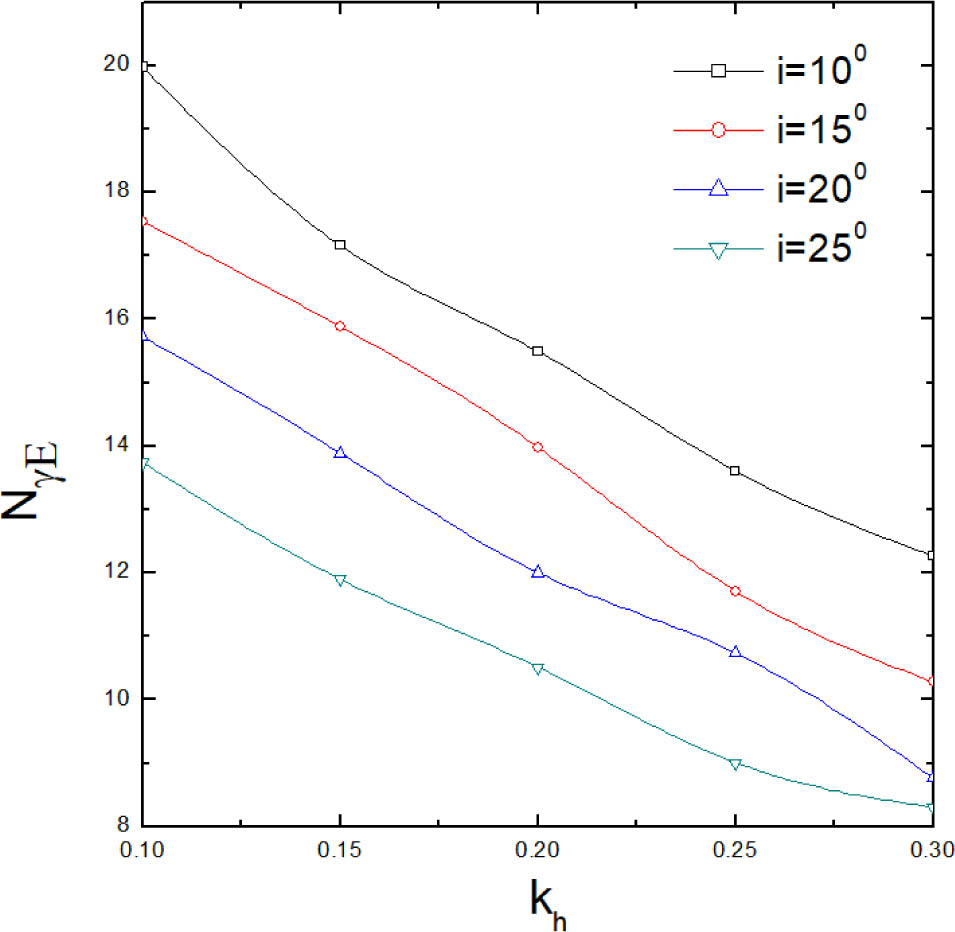
Figure 12
Variation of NγE with kh for φ2 = 30°, δ2 = φ2/2, φ1/φ2 = 0.8, δ1/δ2 = 0.8, kv = kh/2, γ1/γ2 = 0.8, Df/B0 = 0.5, h1/B0 = 0.25, 2c2/B0γ2 = 0.2, c1/c2 = 0.8.
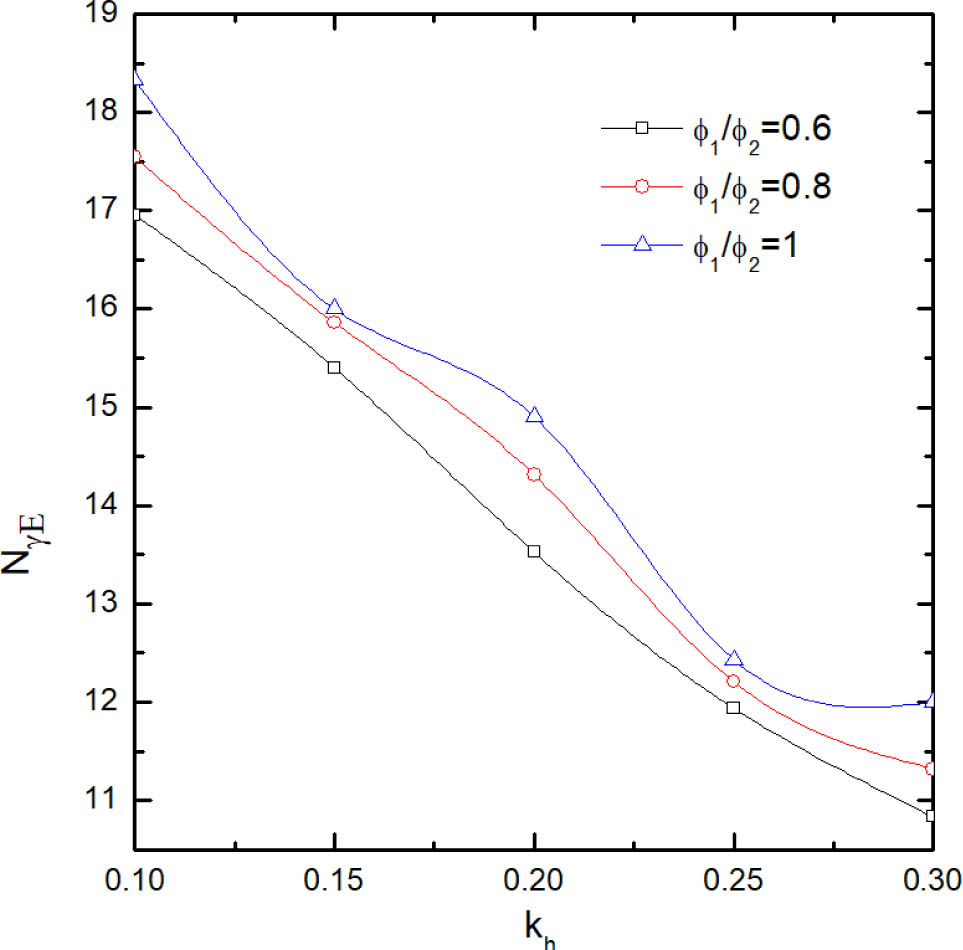
Figure 13
Variation of NγE with kh for φ2 = 30°, δ2 = φ2/2, i = 150, δ1/δ2 = 0.8, kv = kh/2, γ1/γ2 = 0.8, Df/B0 = 0.5, h1/B0 = 0.25, 2c2/B0γ2 = 0.2, c1c2 = 0.8.
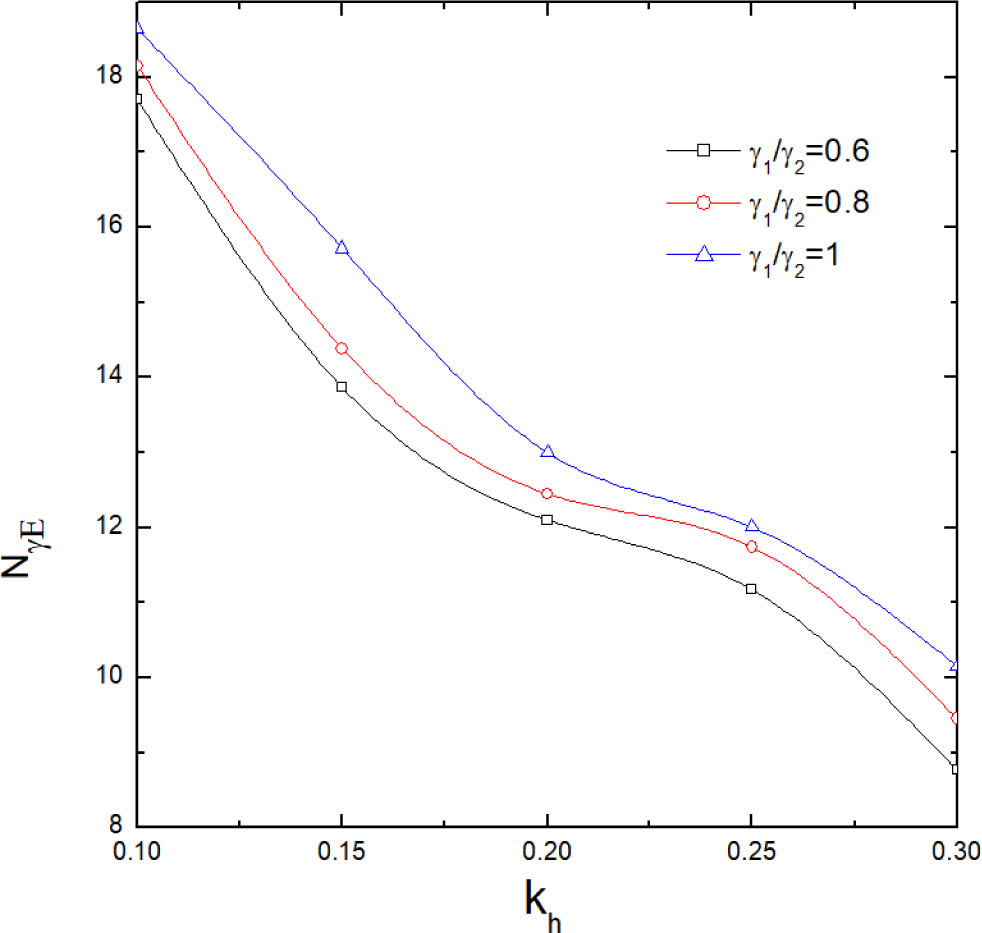
Figure 14
Variation of NγE with kh for φ2 = 300, δ2 = φ2/2, i = 150, δ1/δ2 = 0.8, kV = kh/2, φ1/φ2 = 0.8, Df/B0 = 0.5, h1/B0 = 0.25, 2c2/B0γ2 = 0.2, c1/c2 = 0.8.
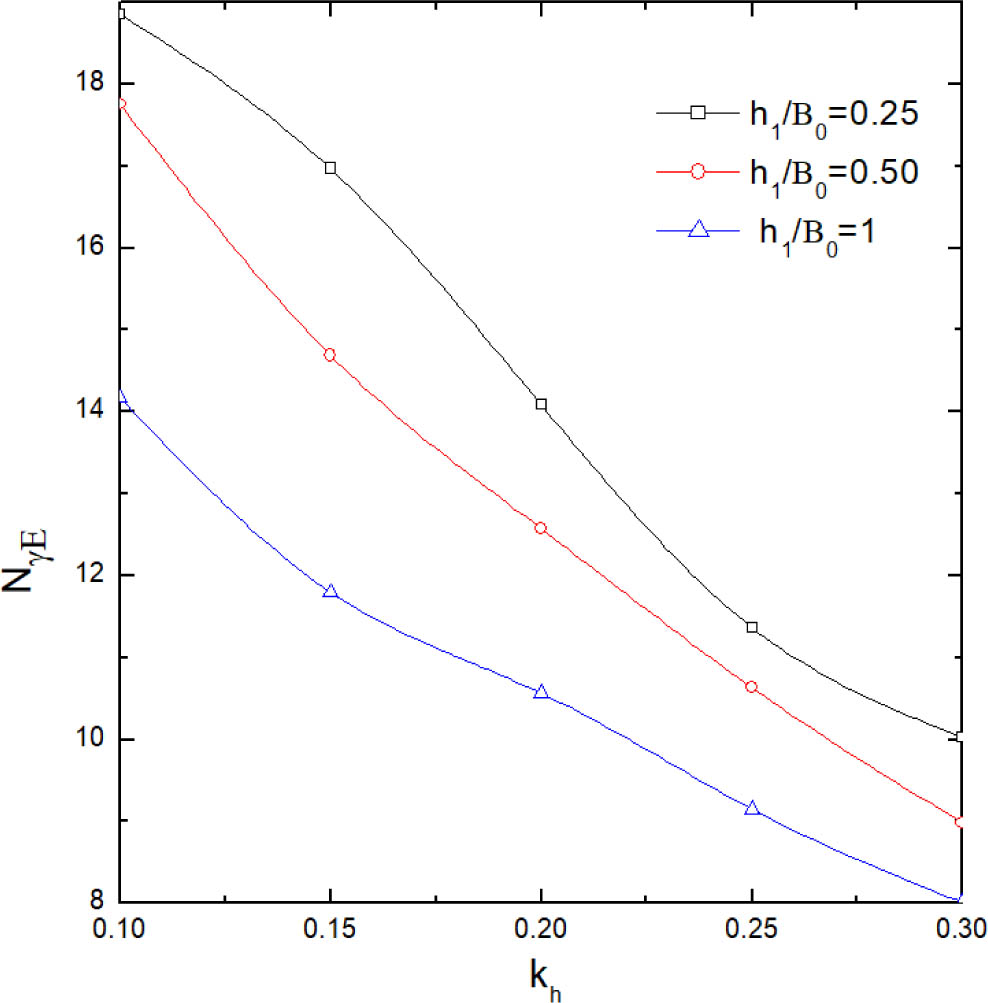
Figure 15
Variation of NγE with kh for φ2 = 30°, δ2 = φ2/2, i = 15, δ1/δ2 = 0.8, kv = kh/2, φ1/φ2 = 0.8, Df/B0 = 0.5, γ1/γ2 = 0.80, 2c2/B0γ2 = 0.2, c1/c2 = 0.8.
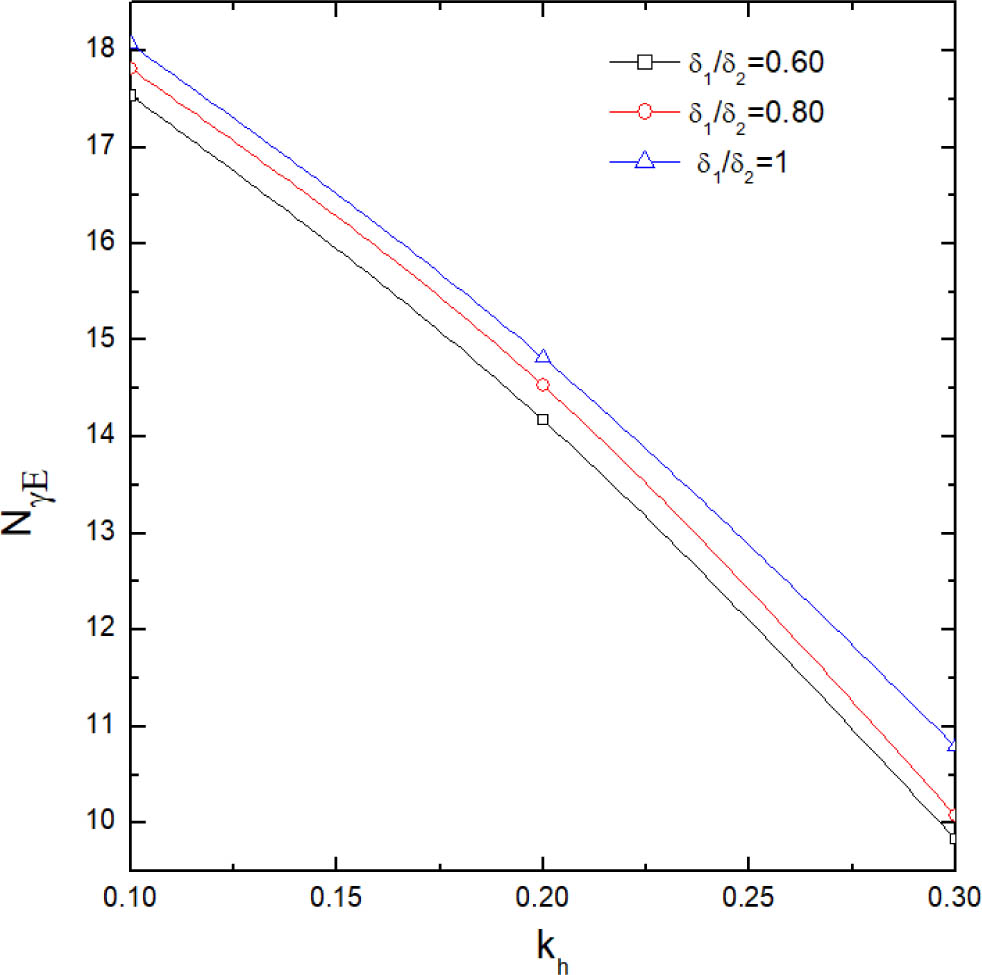
Figure 16
Variation of NγE with kh for φ2 = 30°, δ2 = φ2/2 i = 150, c2/c2 = 0.8, kV = kh/2, φ1/φ2 = 0.8, Df/B0 = 0.5, h1/B0 = 0.25, γ1/γ2 = 0.8.
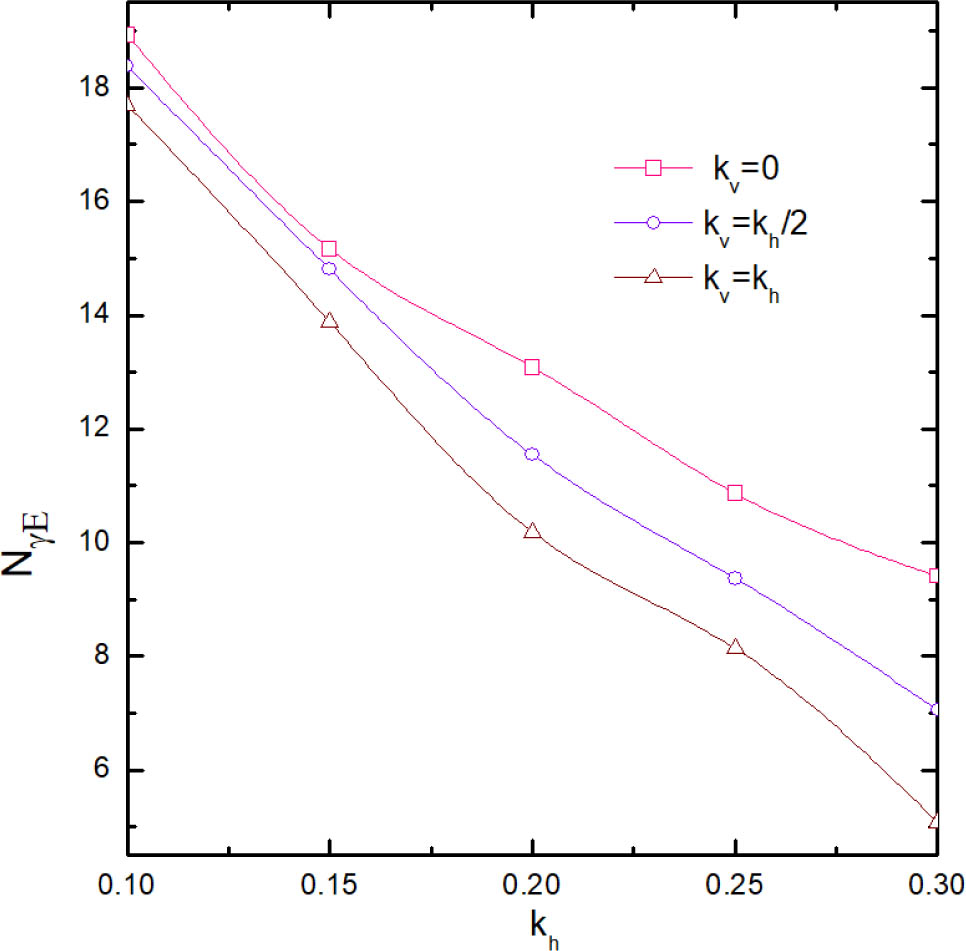
Figure 17
Variation of NγE with kh for φ2 = 30, δ2 = φ2/2, Df/B0 = 0.5 i = 20°, h1/B0 = 0.25, γ1/γ2 = 0.8, δ1/δ2 = 0.8, φ1/φ2 = 0.8, 2c2/B0γ2 = 0, c1/c2 = 0.
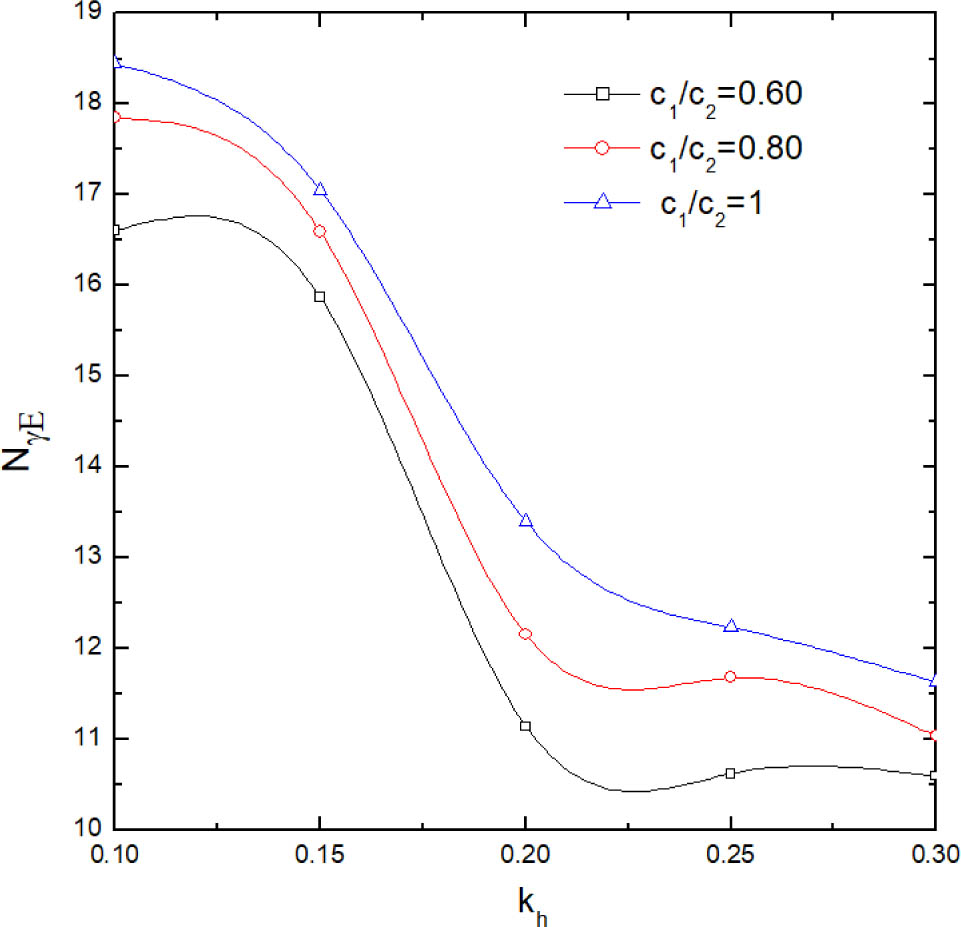
Figure 18
Variation of NγE with kh for φ2 = 30°, δ2 = φ2/2 i = 150, δ1/δ2 = 0.8, kV = kh/2, φ1/φ2 = 0.8, Df/B0 = 0.5, h1/B0 = 0.25, γ1/γ2 = 0.8.
3.3.2. Variations of seismic bearing capacity coefficient for different values of slope angle (i) using PSO algorithm
Figure 12 shows the variation of seismic bearing capacity coefficient (NγE) at φ2 = 300, , , , , , , , and with kh. From the plot, it is seen that NγE decreases with the increase of angle of inclination (i). As the slope angle is increased, the area of the slope is decreased; therefore, the failure zone is decreased, resulting in much smaller bearing capacity.
3.3.3. Variations of seismic bearing capacity coefficient for different values of using PSO algorithm
Figure 13 depicts the variations of seismic bearing capacity coefficient (NγE) at φ2 = 300, , i = 150, , , , , , and with kh. From the plot, it is seen that coefficient NγE increases with an increase in the value of . An increase in ratio increases the strength of the soil (or internal resistance of the soil) against the shearing resistance, which results in increasing the bearing capacity. Here, φ1 value is increased while keeping the φ2 value constant.
3.3.4. Variations of seismic bearing capacity coefficient for different values of using PSO algorithm
Figure 14 shows the variations of seismic bearing capacity coefficient (NγE) at φ2 = 300, , i = 150, , , , , , and with kh. From the plot, it is seen that coefficient NγE increases with an increase in the value of . Here, the ratio is increased while keeping γ2 as a constant.
3.3.5. Variations of seismic bearing capacity coefficient for different values of using PSO algorithm
Figure 15 shows the variations of seismic bearing capacity coefficient (NγE) at φ2 = 300, , i = 150, , , , , , and with kh. From the plot, it is seen that NγE decreases with an increase in the value of . h1 is the depth of the top layer and it is considered in the analysis that it is weaker than the bottom layer. So, a weaker layer will provide less resistance, and hence increase in the thickness of this layer decreases the value of bearing capacity coefficients.
3.3.6. Variations of seismic bearing capacity coefficient for different values of using PSO algorithm
Figure 16 shows the variation of seismic bearing capacity coefficient (NγE) at φ2 = 300, , i = 150, , , , , , and with kh. From the plot, it is seen that NγE increases with an increase in the value of .
3.3.7. Variations of seismic bearing capacity coefficient for different values of kv using PSO algorithm
Figure 17 shows the variation of NγE at φ2 = 300, , i = 150, , , , , , and with kh. From the plot, it is seen that NγE decreases with an increase in kv. It is obvious because increase in the value of kv increases the disturbance of base soil and this decreases the value of NγE.
3.3.8. Variations of seismic bearing capacity coefficient for different values of using PSO algorithm
Figure 18 shows the variation of NγE at φ2 = 300, , i = 150, , , , , , and with kh. From the plot, it is seen that the coefficient NγE increases with an increase in the value of . By increasing the ratio, intermolecular attraction among the soil particles increases, which results in an increase in the bearing capacity.
3.3.9. Strong soil layer over weak soil layer
3.3.10. Variations of seismic bearing capacity coefficient for different values of using PSO algorithm
Figure 19 depicts the variations of seismic bearing capacity coefficient (NγE) at φ2 = 200, , , , , , , and with kh. From the figure, it is seen that the coefficient NγE increases with an increase in the value of . As the upper layer is considered a strong layer for this parameter, increasing the internal soil friction bearing capacity will be increased. Here, the φ1 value is increased, keeping the φ2 value constant.
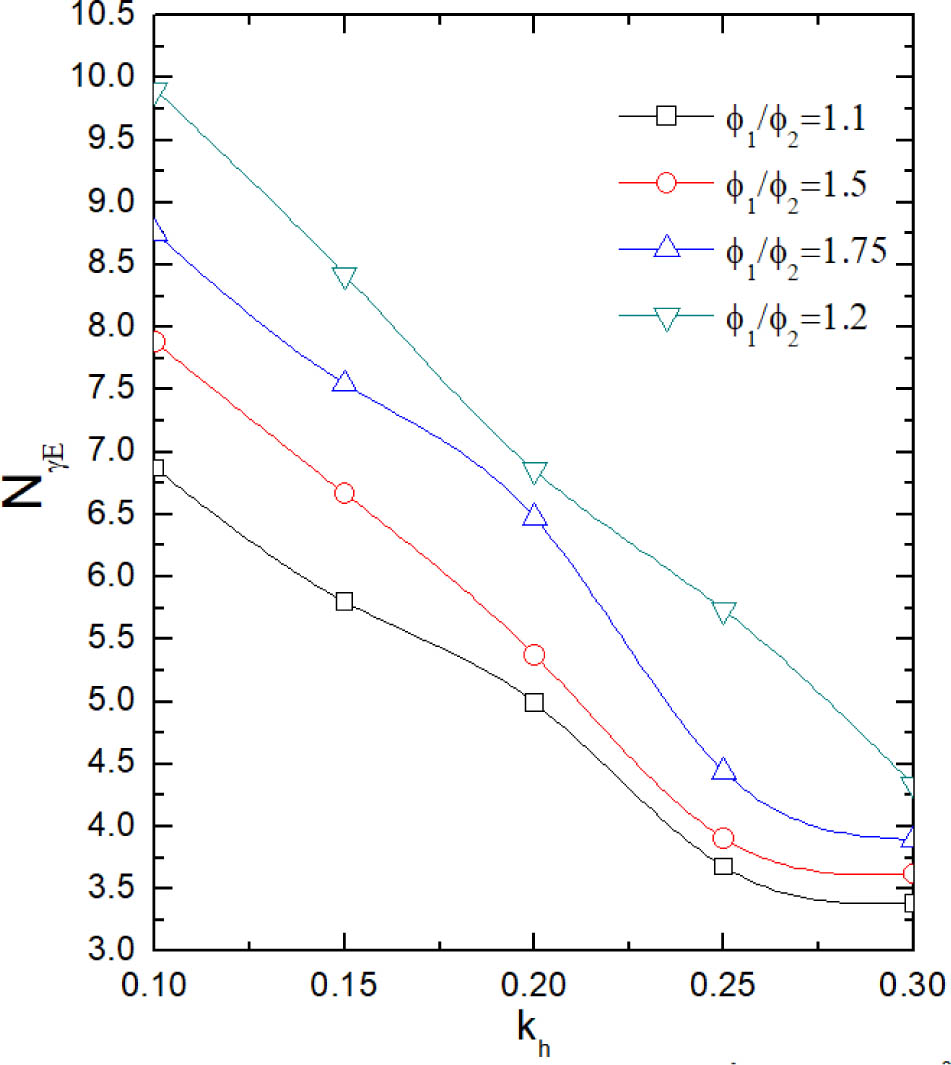
Figure 19
Variation of NγE with kh for φ2 = 20°, δ2 = φ2/2, i = 20° δ1/δ2 = 1.1, kv = kh/2, γ1/γ2 = 1.1, Df/B0 = 0.50, 2c2/B0γ2, = 0, c1/c2 = 0.
3.3.11. Variations of seismic bearing capacity coefficient for different values of using PSO algorithm
Figure 20 shows the variations of seismic bearing capacity coefficient (NγE) at φ2 = 300, , , , , , , and with kh. From the figure, it is seen that the coefficient NγE increases with an increase in the value of . The ratio is increased keeping γ2 as a constant. Here, γ1 is the unit weight of the strong soil layer and γ2 is the unit weight of the weak soil layer.
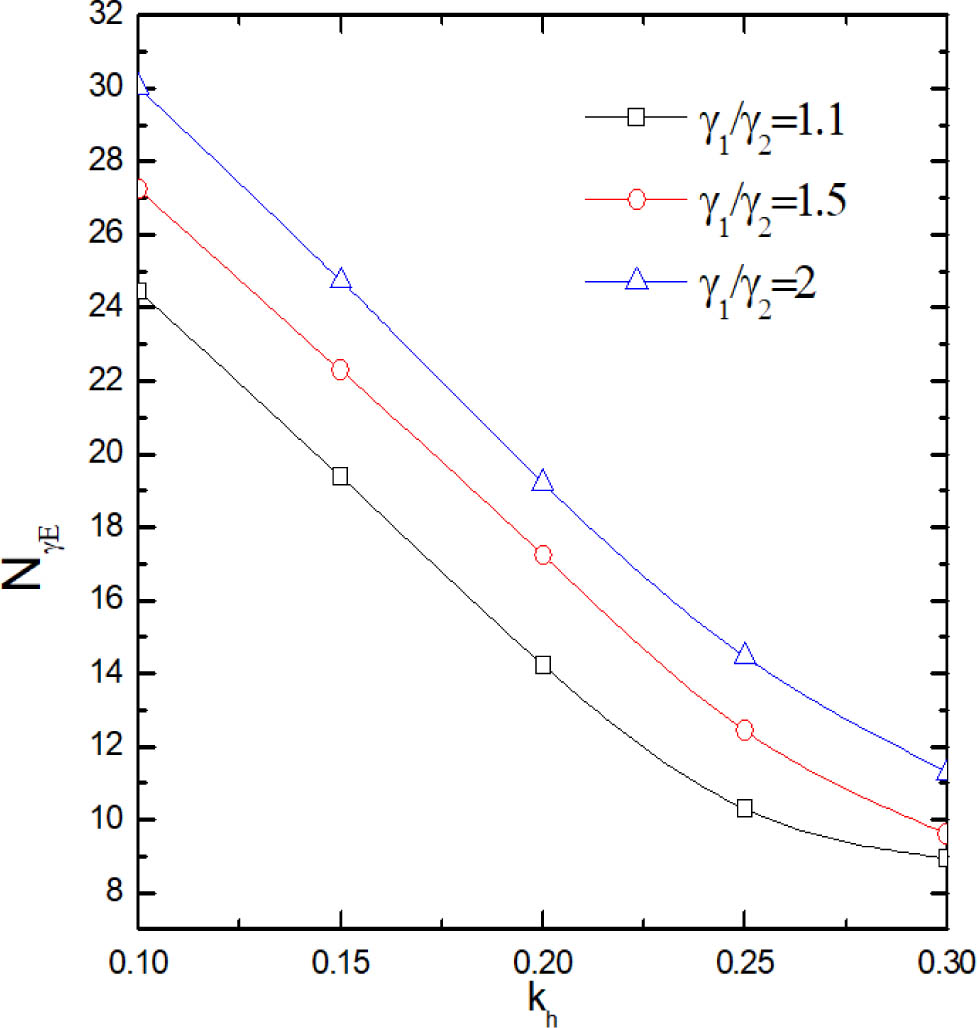
Figure 20
Variation of NγE with kh for φ2 = 30°, i = 20°, δ2 = φ2/2, h1/B0 = 0.25, δ1/δ2 = 1.1, kv = kh/2, φ1/φ2 = 1.1, D/B0 = 0.50, 2c2/B0γ2 = 0, c1/c2 = 0.
3.3.12. Variations of seismic bearing capacity coefficient for different values of using PSO algorithm
Figure 21 shows the variations of (NγE) at φ2 = 300, , , , , , , , with kh. From the plot, it is seen that the coefficient NγE increases with an increase in the values of . Here, c2 is the cohesive force on the weak soil layer and c1 is the cohesive force on the strong soil layer. Hence, the ratio is increased while keeping c2 constant. So, the value NγE will increase.
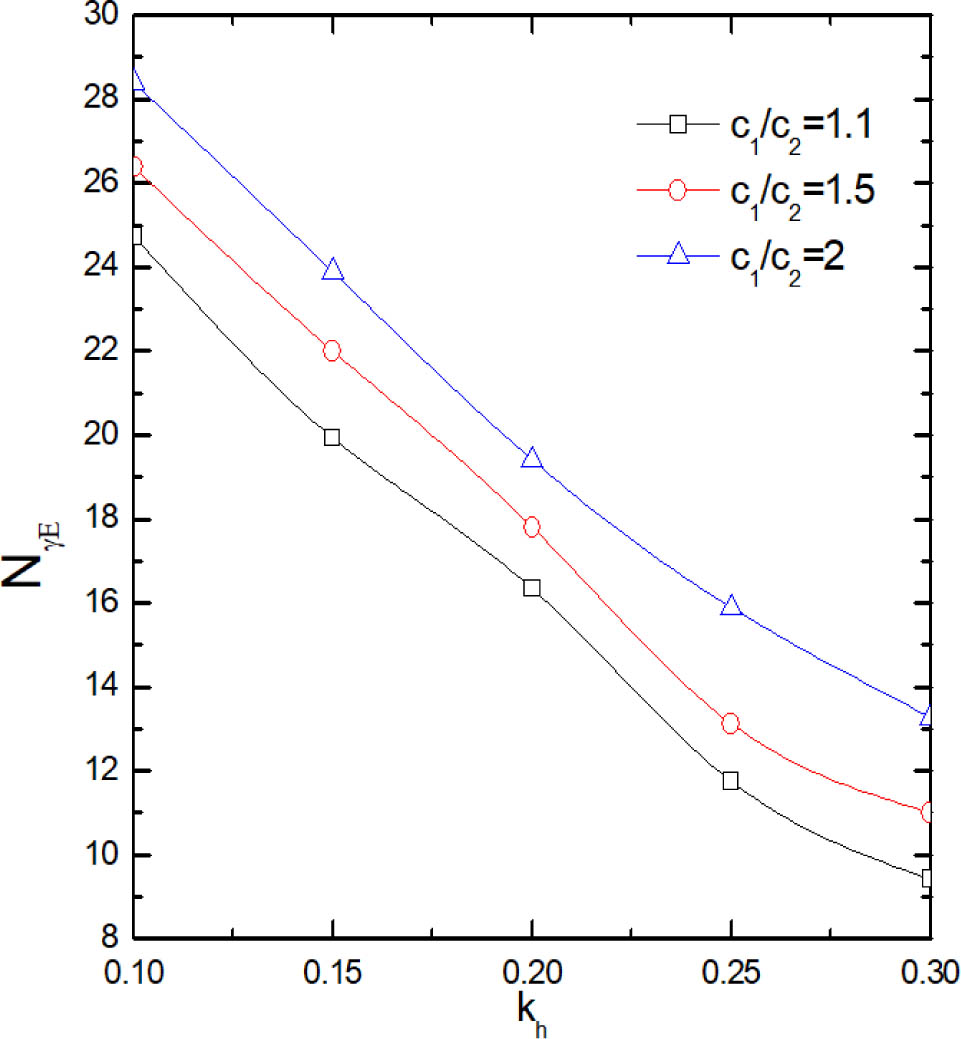
Figure 21
Variation of NγE with kh for φ2 = 30°, i = 20°, δ2 = φ2/2, h1/B0 = 0.25, δ1/δ2 = 1.1, kv = kh/2, φ1/φ2 = 1.1, D/B0 = 0.50, γ1/γ2 = 1.1.
4. Comparisons
The bearing capacity coefficient (Nγ″) has been computed by using a computer programing software ‘MATLAB’ code. PSO algorithm is applied, which can calculate the ultimate bearing capacity, qult, for various combinations of soil properties in each layer. Table 3 shows a comparison of the ultimate bearing capacity for Df/B0 = 0.25 between Askari and Farzaneh (2003), Sawada et al. (1994), Yamamoto (2010) and the present analysis, demonstrating the potentiality of the present analysis. It is found that the solutions from Sawada et al. (1994) have high values with the increase of γ, compared with those from Askari and Farzaneh (2003), Yamamoto (2010) and the present analysis. This fact depends on the assumed failure mechanism. For the case of γ = 9.8, 19.8, the solutions from the present analysis tend to have lower values than those from Askari and Farzaneh (2003). The proposed solutions of the footing at two-layered slope with different cu/γB0, Df/B0 and c1/c2 are compared with the results of Wu et al. (2020), as shown in Table 4. These results are compared for bearing capacity coefficient (Ncs). The undrained seismic bearing capacity coefficients can be written as: Ncs=qult/c1=f (cu/γB0, Df/B0, c1/c2, i, kh). qult is the ultimate bearing capacity of the strip footing. The cases of footings lying on two-layered level ground with the seismic action are compared with the results of Jahani et al. (2019), and the comparison is presented in Table 5. It is observed from Table 5 that the results of the present study agree well with those of previous studies. Consequently, Tables 6–8 display comparisons of the variation in Ncs with Xiao et al. (2019) for different slope angles i=150, 300 and 450. The undrained static bearing capacity factors for cohesion (Ncs) obtained in the present study for a footing of uniform slope were compared with the UB and LB solutions of Xiao et al. (2019), semi-empirical results reported by Vesic (1975), the upper bound (UB) solutions obtained from Kusakabe et al. (1981), the limit-equilibrium methods of Narita and Yamaguchi (1990) and the finite element results provided by Georgiadis (2010). Comparison of these results is shown in Fig. 22 for the case of slope angle (i)=300. In Fig. 22, it is observed that the values of Ncs obtained from the UB solutions of Kusakabe et al. (1981) and Georgiadis (2010) lie between the UB and LB solutions of Xiao et al. (2019). The semi-empirical solutions of Vesic (1975) give the lowest values, whereas the values reported by Narita and Yamaguchi (1990) are found to be the highest dimensionless bearing capacity coefficients. From this figure, it is also observed that the values obtained in the present study are closer to the UB solutions obtained by Xiao et al. (2019) and Narita and Yamaguchi (1990). The present values lie between these two researches’ values. To verify the reliability of the present model, the LB and UB results were compared with the present limit equilibrium method. The present model of Df/B0 = 0, i = 300 andc1/c2 = 1 with different seismic coefficients kh were compared with the previous LB and UB results (Wu et al. 2020), FEM results (Cinicioglu and Erkli 2018) and FELA results (Keshavarz et al. 2019). It can be seen in Fig. 23 that the present seismic bearing capacity coefficients (NcE) closely match with the Upper bound (UB) limit analysis values. Based on the comparisons mentioned above, the proposed model can be proved with relatively minor error.
Table 3
Comparison of variation of seismic bearing capacity (quE) KN/m2 with γ (KN/m3) for the case of φ = 30°, c = 9.8KN/m2, i = 20°, B0 = 10m.
| Sawada et al. (1994) | Askari and Farzaneh (2003) | Yamamoto (2010) | Present Analysis | |||||
|---|---|---|---|---|---|---|---|---|
| kh | γ=9.8 | γ=19.8 | γ=9.8 | γ=19.8 | γ=9.8 | γ=19.8 | γ=9.8 | γ=19.8 |
| 0.1 | 1798 | 3321 | 1066 | 1856 | 1013 | 1795 | 1614.14 | 3139.92 |
| 0.2 | 1770 | 3269 | 829 | 1307 | 755 | 1283 | 654 | 1167 |
Table 4
Comparison of the variation in Ncs with different cu/γB0, Df/B0, c1/c2 for i=30°.
| cu/γB0 | Ncs (Present study) | Ncs (Wu et al. 2020) | ||||||
|---|---|---|---|---|---|---|---|---|
| Df/B0=0.5, c1/c2=0.5 | Df/B0=1.5, c1/c2=0.5 | Df/B0=1.5, c1/c2=1.5 | Df/B0=0.5, c1/c2=1.5 | Df/B0=0.5, c1/c2=0.5 | Df/B0=1.5, c1/c2=0.5 | Df/B0=1.5, c1/c2=1.5 | Df/B0=0.5, c1/c2=1.5 | |
| 1 | 4.06 | 3.78 | 2.78 | 2.34 | 4.05 | 3.79 | 2.8 | 2.34 |
| 2 | 4.15 | 3.92 | 3.05 | 2.95 | 4.16 | 3.96 | 3.01 | 3.01 |
| 4 | 4.20 | 4.02 | 3.11 | 3.04 | 4.19 | 4.02 | 3.12 | 3.12 |
| 6 | 4.22 | 4.04 | 3.22 | 3.10 | 4.2 | 4.04 | 3.15 | 3.15 |
| 8 | 4.24 | 4.06 | 3.23 | 3.14 | 4.21 | 4.05 | 3.17 | 3.17 |
| 10 | 4.25 | 4.08 | 3.24 | 3.16 | 4.22 | 4.6 | 3.17 | 3.17 |
Table 5
Comparison of the variation in Ncs with different kh and c1/c2 for i=0° and Df/B0.
| kh | Ncs (Present study) | Ncs (Jahani et al. 2019) | ||||
|---|---|---|---|---|---|---|
| c1/c2=0.25 | c1/c2=0.50 | c1/c2=0.75 | c1/c2=0.25 | c1/c2=0.50 | c1/c2=0.75 | |
| 0 | 5.62 | 3.94 | 3.06 | 5.67 | 4 | 3.1 |
| 0.1 | 5.20 | 3.48 | 2.75 | 5.25 | 3.58 | 2.73 |
| 0.2 | 4.04 | 3.04 | 2.37 | 4.44 | 3.12 | 2.4 |
| 0.3 | 3.38 | 2.65 | 2.12 | 3.47 | 2.7 | 2.15 |
Table 6
Comparison of the variation in Ncs for i=15°.
| h1/B0 | Df/B0 | c1/c2 | Xiao et al. (2019) | Present study | ||||||
|---|---|---|---|---|---|---|---|---|---|---|
| c1/γB0 | c1/γB0 | |||||||||
| 1 | 2 | 4 | 6 | 1 | 2 | 4 | 6 | |||
| 0.5 | 0.25 | 0.25 | 5.71 | 5.73 | 5.74 | 5.74 | 5.68 | 5.70 | 5.71 | 5.72 |
| 0.5 | 5.71 | 5.73 | 5.74 | 5.74 | 5.68 | 5.70 | 5.71 | 5.72 | ||
| 0.75 | 5.53 | 5.57 | 5.58 | 5.59 | 5.49 | 5.55 | 5.56 | 5.57 | ||
| 1 | 4.51 | 4.58 | 4.61 | 4.63 | 4.49 | 4.53 | 4.58 | 4.60 | ||
| 0.50 | 0.25 | 4.70 | 4.75 | 4.77 | 4.77 | 4.68 | 4.71 | 4.74 | 4.74 | |
| 0.5 | 4.70 | 4.75 | 4.77 | 4.77 | 4.68 | 4.72 | 4.75 | 4.75 | ||
| 0.75 | 4.70 | 4.74 | 4.77 | 4.77 | 4.68 | 4.71 | 4.75 | 4.75 | ||
| 1 | 4.51 | 4.57 | 4.61 | 4.62 | 4.45 | 4.51 | 4.59 | 4.59 | ||
| 1 | 0.25 | 0.25 | 5.71 | 5.73 | 5.73 | 5.75 | 5.68 | 5.70 | 5.71 | 5.72 |
| 0.5 | 5.71 | 5.73 | 5.73 | 5.74 | 5.68 | 5.70 | 5.70 | 5.71 | ||
| 0.75 | 5.52 | 5.57 | 5.58 | 5.59 | 5.50 | 5.55 | 5.56 | 5.57 | ||
| 1 | 4.51 | 4.58 | 4.61 | 4.63 | 4.48 | 4.55 | 4.59 | 4.61 | ||
| 0.50 | 0.25 | 4.70 | 4.75 | 4.77 | 4.78 | 4.68 | 4.72 | 4.74 | 4.75 | |
| 0.5 | 4.71 | 4.75 | 4.77 | 4.78 | 4.67 | 4.74 | 4.75 | 4.76 | ||
| 0.75 | 4.70 | 4.75 | 4.77 | 4.78 | 4.66 | 4.74 | 4.74 | 4.75 | ||
| 1 | 4.51 | 4.58 | 4.62 | 4.62 | 4.49 | 4.55 | 4.60 | 4.61 | ||
| 2 | 0.25 | 0.25 | 5.71 | 5.73 | 5.74 | 5.73 | 5.69 | 5.72 | 5.72 | 5.73 |
| 0.5 | 5.71 | 5.73 | 5.74 | 5.74 | 5.69 | 5.71 | 5.72 | 5.73 | ||
| 0.75 | 5.52 | 5.57 | 5.58 | 5.59 | 5.50 | 5.55 | 5.56 | 5.57 | ||
| 1 | 4.51 | 4.58 | 4.62 | 4.63 | 5.49 | 5.53 | 5.54 | 5.55 | ||
| 0.50 | 0.25 | 4.70 | 4.74 | 4.77 | 4.79 | 4.69 | 4.72 | 4.75 | 4.77 | |
| 0.5 | 4.70 | 4.76 | 4.77 | 4.77 | 4.68 | 4.70 | 4.73 | 4.75 | ||
| 0.75 | 4.70 | 4.74 | 4.76 | 4.78 | 4.67 | 4.68 | 4.70 | 4.72 | ||
| 1 | 4.51 | 4.58 | 4.61 | 4.62 | 4.47 | 4.54 | 4.59 | 4.60 | ||
| 3 | 0.25 | 0.25 | 5.70 | 5.73 | 5.74 | 5.74 | 5.69 | 5.71 | 5.72 | 5.72 |
| 0.5 | 5.70 | 5.73 | 5.74 | 5.74 | 5.69 | 5.71 | 5.72 | 5.72 | ||
| 0.75 | 5.52 | 5.56 | 5.58 | 5.58 | 5.50 | 5.55 | 5.56 | 5.57 | ||
| 1 | 4.51 | 4.58 | 4.61 | 4.62 | 4.48 | 4.55 | 4.58 | 4.60 | ||
| 0.50 | 0.25 | 4.71 | 4.75 | 4.77 | 4.78 | 4.69 | 4.72 | 4.74 | 4.77 | |
| 0.5 | 4.70 | 4.75 | 4.77 | 4.78 | 4.68 | 4.72 | 4.74 | 4.77 | ||
| 0.75 | 4.70 | 4.75 | 4.77 | 4.77 | 4.67 | 4.71 | 4.73 | 4.73 | ||
| 1 | 4.51 | 4.58 | 4.61 | 4.63 | 4.49 | 4.55 | 4.59 | 4.60 | ||
Table 7
Comparison of the variation in Ncs for i=30°.
| h1/B0 | Df/B0 | c1/c2 | Xiao et al. (2019) | Present study | ||||||
|---|---|---|---|---|---|---|---|---|---|---|
| c1/γB0 | c1/γB0 | |||||||||
| 1 | 2 | 4 | 6 | 1 | 2 | 4 | 6 | |||
| 0.5 | 0.25 | 0.25 | 5.15 | 5.20 | 5.23 | 5.23 | 5.11 | 5.16 | 5.21 | 5.21 |
| 0.5 | 5.15 | 5.20 | 5.22 | 5.23 | 5.11 | 5.16 | 5.21 | 5.20 | ||
| 0.75 | 4.86 | 4.95 | 5.00 | 5.01 | 4.81 | 4.88 | 4.91 | 4.96 | ||
| 1 | 3.88 | 4.01 | 4.07 | 4.09 | 3.82 | 4.01 | 4.03 | 4.05 | ||
| 0.50 | 0.25 | 4.09 | 4.18 | 4.23 | 4.24 | 4.05 | 4.16 | 4.20 | 4.21 | |
| 0.5 | 4.09 | 4.18 | 4.23 | 4.24 | 4.02 | 4.14 | 4.18 | 4.20 | ||
| 0.75 | 4.09 | 4.18 | 4.23 | 4.24 | 4.01 | 4.12 | 4.16 | 4.18 | ||
| 1 | 3.88 | 4.00 | 4.07 | 4.09 | 3.84 | 3.95 | 4.02 | 4.05 | ||
| 1 | 0.25 | 0.25 | 5.15 | 5.20 | 5.22 | 5.23 | 5.10 | 5.15 | 5.20 | 5.21 |
| 0.5 | 5.15 | 5.20 | 5.22 | 5.23 | 5.09 | 5.13 | 5.19 | 5.20 | ||
| 0.75 | 4.85 | 4.95 | 5.00 | 5.01 | 4.80 | 4.85 | 4.90 | 4.93 | ||
| 1 | 3.83 | 3.99 | 4.06 | 4.08 | 3.80 | 3.92 | 3.99 | 4.01 | ||
| 0.50 | 0.25 | 4.10 | 4.19 | 4.24 | 4.25 | 4.07 | 4.11 | 4.20 | 4.22 | |
| 0.5 | 4.10 | 4.19 | 4.23 | 4.25 | 4.05 | 4.10 | 4.19 | 4.20 | ||
| 0.75 | 4.10 | 4.19 | 4.23 | 4.25 | 4.04 | 4.10 | 4.18 | 4.19 | ||
| 1 | 3.83 | 3.99 | 4.06 | 4.08 | 3.80 | 3.95 | 4.04 | 4.06 | ||
| 2 | 0.25 | 0.25 | 5.15 | 5.20 | 5.22 | 5.23 | 5.11 | 5.17 | 5.20 | 5.21 |
| 0.5 | 5.15 | 5.20 | 5.22 | 5.23 | 5.10 | 5.17 | 5.20 | 5.21 | ||
| 0.75 | 4.85 | 4.95 | 5.00 | 5.01 | 4.82 | 4.90 | 4.96 | 4.99 | ||
| 1 | 3.83 | 3.99 | 4.06 | 4.08 | 3.81 | 3.95 | 4.01 | 4.04 | ||
| 0.50 | 0.25 | 4.09 | 4.19 | 4.23 | 4.25 | 4.07 | 4.15 | 4.20 | 4.22 | |
| 0.5 | 4.09 | 4.19 | 4.23 | 4.25 | 4.05 | 4.14 | 4.20 | 4.21 | ||
| 0.75 | 4.09 | 4.19 | 4.23 | 4.25 | 4.05 | 4.14 | 4.20 | 4.21 | ||
| 1 | 3.82 | 3.98 | 4.05 | 4.07 | 3.80 | 3.94 | 4.01 | 4.04 | ||
| 3 | 0.25 | 0.25 | 5.16 | 5.20 | 5.22 | 5.23 | 5.11 | 5.18 | 5.20 | 5.21 |
| 0.5 | 5.16 | 5.20 | 5.22 | 5.23 | 5.11 | 5.17 | 5.20 | 5.21 | ||
| 0.75 | 4.85 | 4.95 | 5.00 | 5.01 | 4.81 | 4.92 | 4.99 | 5.00 | ||
| 1 | 3.83 | 3.99 | 4.06 | 4.08 | 3.80 | 3.96 | 4.03 | 4.06 | ||
| 0.50 | 0.25 | 4.10 | 4.19 | 4.23 | 4.25 | 4.07 | 4.15 | 4.20 | 4.23 | |
| 0.5 | 4.09 | 4.19 | 4.23 | 4.24 | 4.06 | 4.14 | 4.20 | 4.22 | ||
| 0.75 | 4.10 | 4.19 | 4.23 | 4.24 | 4.05 | 4.12 | 4.18 | 4.20 | ||
| 1 | 3.83 | 3.99 | 4.06 | 4.08 | 3.80 | 3.93 | 4.03 | 4.06 | ||
Table 8
Comparison of the variation in Ncs for i=45°.
| h1/B0 | Df/B0 | c1/c2 | Xiao et al. (2019) | Present study | ||||||
|---|---|---|---|---|---|---|---|---|---|---|
| c1/γB0 | c1/γB0 | |||||||||
| 1 | 2 | 4 | 6 | 1 | 2 | 4 | 6 | |||
| 0.5 | 0.25 | 0.25 | 4.57 | 4.63 | 4.66 | 4.67 | 4.54 | 4.60 | 4.62 | 4.64 |
| 0.5 | 4.57 | 4.64 | 4.66 | 4.68 | 4.53 | 4.60 | 4.61 | 4.63 | ||
| 0.75 | 4.23 | 4.34 | 4.40 | 4.41 | 4.21 | 4.31 | 4.37 | 4.40 | ||
| 1 | 3.44 | 3.57 | 3.63 | 3.65 | 3.41 | 3.53 | 3.55 | 3.59 | ||
| 0.50 | 0.25 | 3.49 | 3.62 | 3.67 | 3.70 | 3.45 | 3.58 | 3.62 | 3.67 | |
| 0.5 | 3.49 | 3.61 | 3.67 | 3.70 | 3.44 | 3.59 | 3.60 | 3.67 | ||
| 0.75 | 3.49 | 3.61 | 3.68 | 3.70 | 3.43 | 3.56 | 3.59 | 3.66 | ||
| 1 | 3.44 | 3.57 | 3.63 | 3.65 | 3.42 | 3.53 | 3.56 | 3.64 | ||
| 1 | 0.25 | 0.25 | 4.57 | 4.63 | 4.66 | 4.67 | 4.55 | 4.60 | 4.63 | 4.65 |
| 0.5 | 4.57 | 4.63 | 4.66 | 4.68 | 4.54 | 4.58 | 4.62 | 4.64 | ||
| 0.75 | 4.13 | 4.28 | 4.35 | 4.37 | 4.11 | 4.25 | 4.33 | 4.35 | ||
| 1 | 3.16 | 3.41 | 3.51 | 3.54 | 3.11 | 3.38 | 3.50 | 3.52 | ||
| 0.50 | 0.25 | 3.49 | 3.61 | 3.68 | 3.69 | 3.45 | 3.59 | 3.64 | 3.67 | |
| 0.5 | 3.49 | 3.61 | 3.68 | 3.69 | 3.44 | 3.58 | 3.63 | 3.67 | ||
| 0.75 | 3.49 | 3.61 | 3.68 | 3.69 | 3.43 | 3.57 | 3.63 | 3.67 | ||
| 1 | 3.16 | 3.41 | 3.51 | 3.54 | 3.12 | 3.38 | 3.50 | 3.52 | ||
| 2 | 0.25 | 0.25 | 4.58 | 4.64 | 4.66 | 4.68 | 4.54 | 4.60 | 4.62 | 4.66 |
| 0.5 | 4.58 | 4.63 | 4.67 | 4.68 | 4.53 | 4.60 | 4.61 | 4.64 | ||
| 0.75 | 4.11 | 4.28 | 4.35 | 4.38 | 4.10 | 4.25 | 4.32 | 4.32 | ||
| 1 | 3.15 | 3.41 | 3.50 | 3.54 | 3.11 | 3.40 | 3.48 | 3.50 | ||
| 0.50 | 0.25 | 3.49 | 3.61 | 3.67 | 3.69 | 3.44 | 3.58 | 3.62 | 3.64 | |
| 0.5 | 3.49 | 3.61 | 3.68 | 3.69 | 3.42 | 3.56 | 3.61 | 3.63 | ||
| 0.75 | 3.49 | 3.61 | 3.67 | 3.69 | 3.41 | 3.54 | 3.58 | 3.61 | ||
| 1 | 3.15 | 3.41 | 3.51 | 3.54 | 3.10 | 3.36 | 3.52 | 3.52 | ||
| 3 | 0.25 | 0.25 | 4.58 | 4.64 | 4.67 | 4.67 | 4.55 | 4.62 | 4.64 | 4.65 |
| 0.5 | 4.58 | 4.63 | 4.67 | 4.68 | 4.54 | 4.60 | 4.62 | 4.64 | ||
| 0.75 | 4.11 | 4.28 | 4.35 | 4.37 | 4.08 | 4.24 | 4.31 | 4.35 | ||
| 1 | 3.15 | 3.40 | 3.51 | 3.54 | 3.12 | 3.36 | 3.41 | 3.48 | ||
| 0.50 | 0.25 | 3.49 | 3.61 | 3.67 | 3.69 | 3.44 | 3.60 | 3.62 | 3.65 | |
| 0.5 | 3.48 | 3.61 | 3.67 | 3.69 | 3.43 | 3.60 | 3.61 | 3.63 | ||
| 0.75 | 3.49 | 3.61 | 3.67 | 3.67 | 3.42 | 3.58 | 3.60 | 3.63 | ||
| 1 | 3.15 | 3.40 | 3.51 | 3.54 | 3.13 | 3.38 | 3.49 | 3.51 | ||
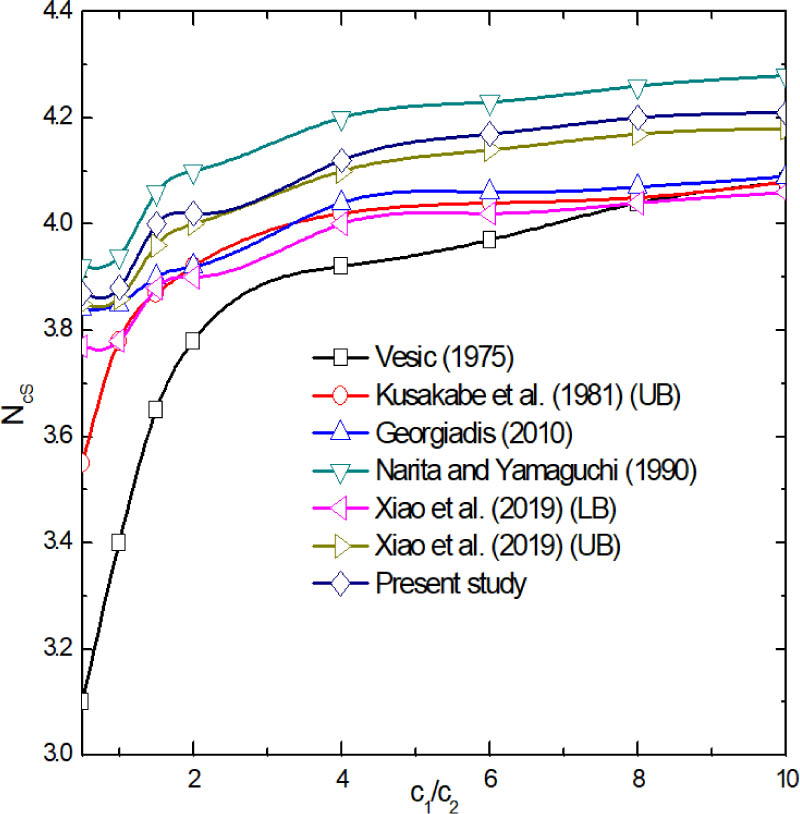
Figure 22
Comparison of variation in static bearing capacity coefficients (NCS) with c1/c2 for i = 300.
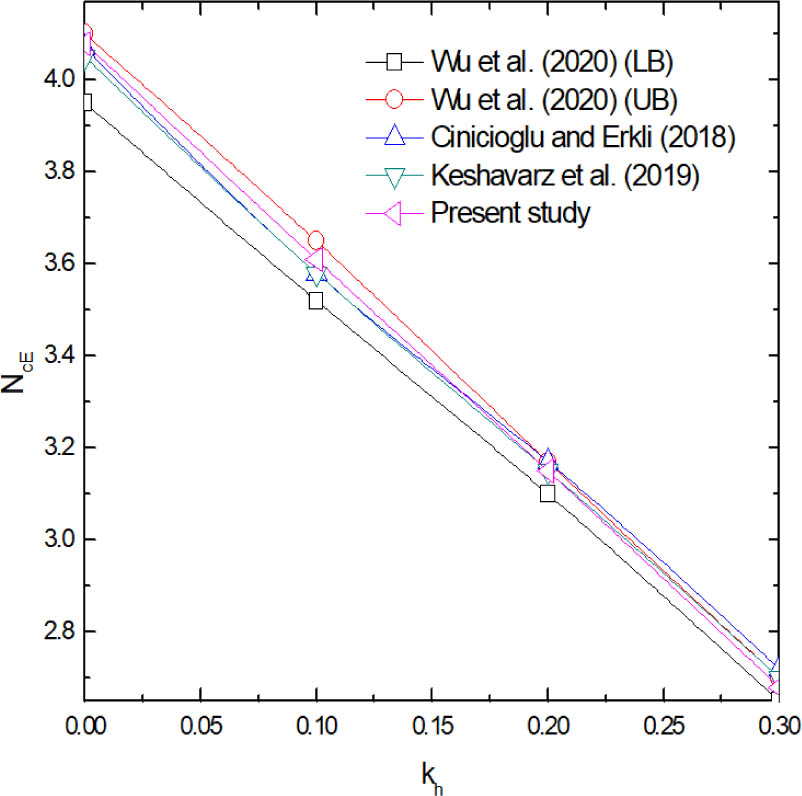
Figure 23
Comparison of seismic bearing capacity coefficients (NcE) with kh for Df/B0 = 0, i = 30°, c1/c2 = 1.
5. Conclusions
This paper has investigated the seismic bearing capacity of shallow foundations near slope using pseudo-static limit equilibrium analysis. Linear failure mechanism has been proposed to obtain pseudo-static bearing capacity coefficients of embedded strip footing near slope using limit equilibrium analysis. The PSO technique has been applied to obtain minimum bearing capacity coefficients.
Based on the present investigation, the following conclusions can be drawn:
NγE values from the present analysis agreed well with other analyses reported by Askari and Farzaneh (2003), Sawada et al. (1994) and Yamamoto (2010). The present analysis shows a tendency to decrease NγE values by increasing the horizontal seismic coefficient (kh) and vertical seismic coefficient (kv).
The seismic bearing capacity coefficient Ncs was found relatively minor error value with previous researchers.
The minimum pseudo-static bearing capacity coefficients are presented in the form of design table for practical use in geotechnical engineering. It has been observed that the magnitude of bearing capacity coefficients decreases with an increase in slope inclination.
The seismic bearing capacity decreases with greater undrained shear strength ratio (c1/c2) and the effect becomes more significant when the thickness of the top layer decreases.
The value of Ncs increases with increasing c1/γB0, whereas thiseffect recedes with an increase of c1/γB0. Also, greater value of c1/γB would decrease the effect of bottom layer.
Notes
[1] Data availability statement:
The authors confirm that some data and code generated during this study are proprietary or confidential and may only be provided with restrictions (e. g., PSO code).