
Table 1
- Major Indian HF registries: population, GDMT use and outcomes.
| Registry (ref) | Population and setting | GDMT use | ARNI use | Mortality and readmission | Main limitation |
|---|---|---|---|---|---|
| NHFR [3,10,11] | 10,851 patients with acute decompensated HF; 53 tertiary hospitals, 21 states; period [add] | 47.5% of eligible HFrEF patients; definition [add] | 4.8% | 90-day mortality 14.2%, readmission 8.4%; 1-year mortality 22.1%, readmission 17.2% | Tertiary hospitals only; hospitalised patients |
| ICMR-NCDIR [2] | 6018 hospitalised patients; more than 60% rural; period [add] | Reported by drug class and age group [add summary figure] | 5.9%–7.5% | 90-day mortality 12.6% (young), 13.4% (middle-aged), 19.0% (elderly) | Hospitalised patients; class-wise rather than combined GDMT reporting [verify] |
| ICCNHFR [4] | Acute decompensated HF, multiple hospitals; N and period [add] | 24.99% on all guideline-based therapies at discharge; 23.72% continued the combination at 30 days | [add] | 30-day outcomes [add] | Short follow-up |
| CSI-KHFR [5] | Acute HF, Kerala; N and period [add] | About 28% of HFrEF patients | Low; less than β-blockers and MRAs [add%] | In-hospital mortality 7%; 90-day mortality 11.6% | Single state; acute HF |
| Trivandrum HF Registry [6,12] | Acute HF, Kerala; N and period [add] | 25% of HFrEF patients discharged on GDMT | [add] | 1-year mortality 30.8%, readmission 30.2%; 5-year mortality 59%; median survival about 3.1 years | Older cohort, pre-dating routine four-pillar therapy [verify] |
| Eastern India tertiary-centre registry [7] | HFrEF patients, single tertiary centre, 2019–2024; N [add] | Four-pillar GDMT 48.6% (first half 2022) rising to 76.3% (second half 2024) | Sacubitril/valsartan target dose reached in 20% | [add] | Single centre; specialist care |
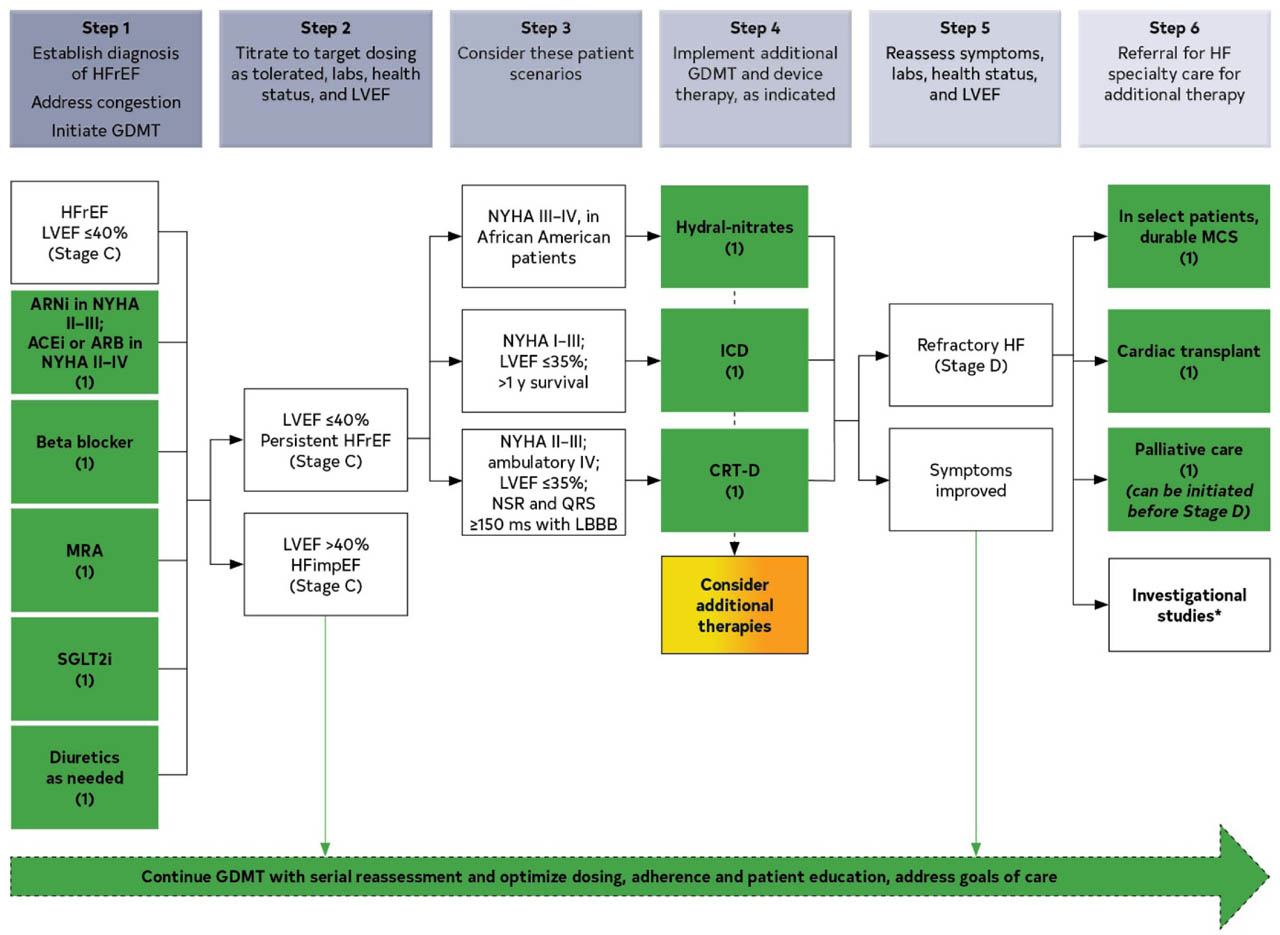
Figure 1
- Guideline-directed pharmacological treatment of patients with HFrEF. ARNI, angiotensin receptor-neprilysin inhibitor; GDMT, guideline-directed medical therapy; HF, heart failure; HFrEF, heart failure with reduced ejection fraction.
Table 2
- Stepwise pathway for GDMT implementation.
| Level | Interventions | Metric to track |
|---|---|---|
| Patient | Cost assessment; education; fixed-dose combinations; written plan; early reporting of adverse effects | Adherence; affordability; persistence at 30 days, 90 days, 12 months |
| Clinician | Patient-profile-based algorithm; low-dose four-class initiation; documented reason when below target | Classes started (0–4); proportion at target or maximum tolerated dose |
| Healthcare system | Automatic early post-discharge follow-up; multidisciplinary or pharmacist-supported titration; telehealth where specialists are scarce | Time to initiation; time to optimisation |
| Policy | Generic and public-sector supply; essential medicines inclusion; insurance coverage; integration with chronic disease programs | Availability and price of four-pillar drugs; out-of-pocket spending |
Table 3
- Barriers to GDMT implementation, proposed interventions and the strength of supporting evidence.
| Level | Barrier | Intervention | Supporting evidence | Gap/quality |
|---|---|---|---|---|
| Patient | Cost; limited health literacy; polypharmacy; follow-up burden | Cost review at each visit; education on disease-modifying therapy; fixed-dose combinations; written medication plan | [8,27,29,36] | Observational or narrative; no Indian intervention trial identified |
| Clinician | Fear of hypotension, hyperkalaemia and renal dysfunction; unfamiliarity; preference for diuretics | Patient-profile-based algorithms; low-dose initiation of all four classes | [8,22,26] | Consensus-based; no outcome data from India |
| Clinician/hospital | Slow sequential titration | Early four-pillar initiation; rapid up-titration with early follow-up | [23,24,25] | Strong design, limited Indian applicability; more adverse events with intensive titration |
| Healthcare system | Fragmented post-discharge care; few HF specialists | Structured multidisciplinary HF clinic | [31,32] | Small or uncontrolled; Indian trial details to add |
| Healthcare system | Specialist access | Pharmacist-led clinics; telehealth co-management; remote titration | [33,34,35,37] | Mostly non-Indian, non-randomised or pilot |
| Healthcare system | Variable quality of care across sites | Quality-improvement programs; registries with inertia metrics | [30] | Cluster trial did not improve its primary outcome |
| Policy | Medicine affordability and availability; insurance coverage | Generic and public-sector procurement; essential medicines lists; insurance coverage; chronic disease programs | [27,29] | No evaluation of a policy intervention for HF medicines in India identified |