
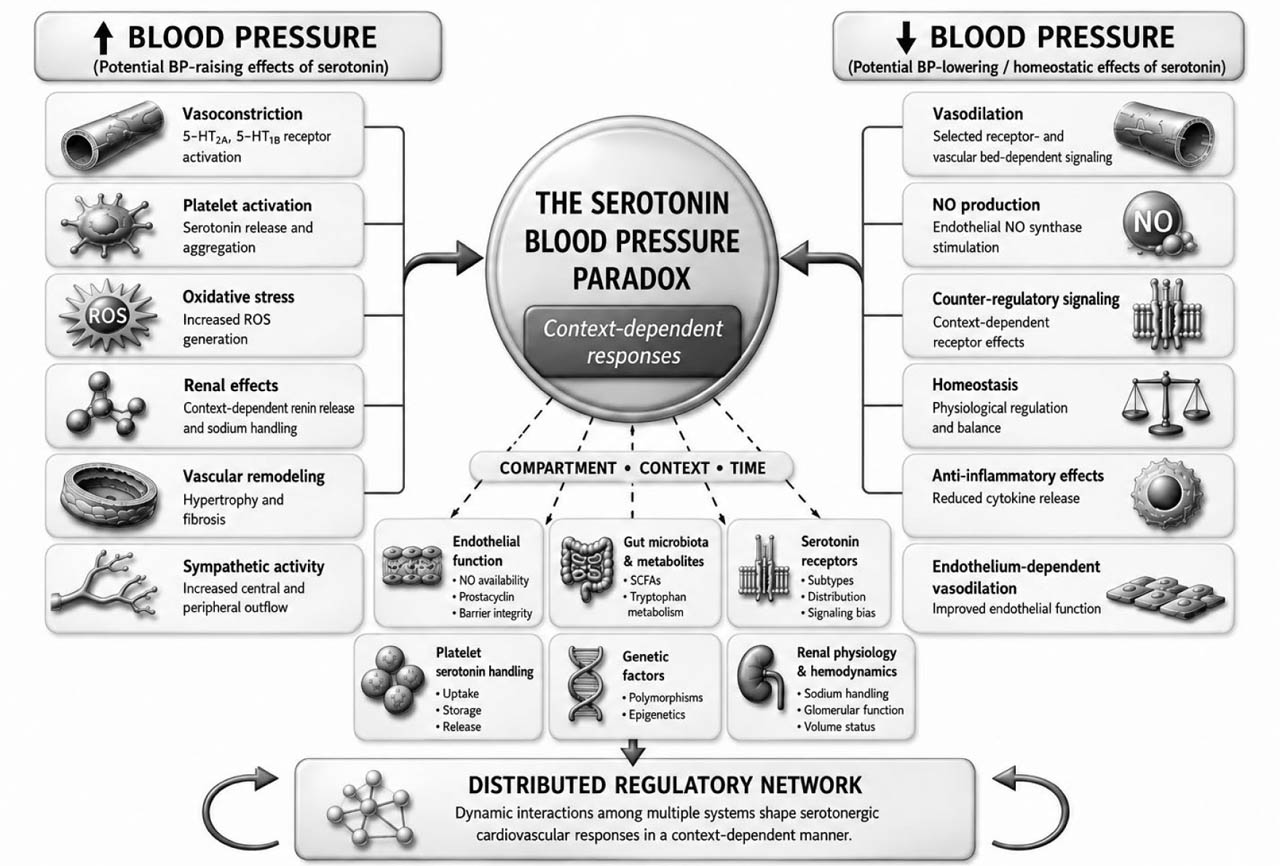
Figure 1-
Integrative framework for the serotonin BP paradox. Serotonergic responses emerge within a distributed network and vary by biological compartment, context and time. The framework is conceptual and does not imply a fixed causal hierarchy. BP, blood pressure; NO, nitric oxide.
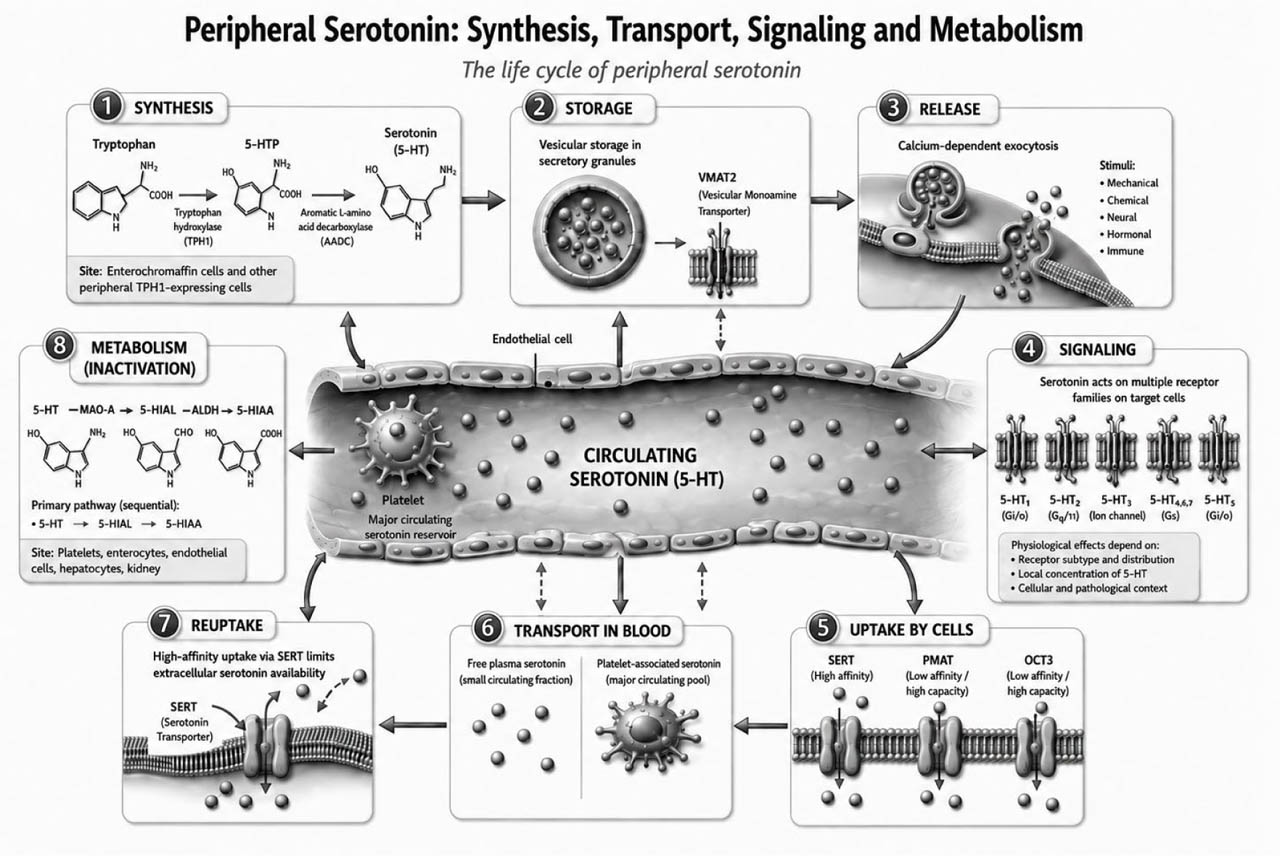
Figure 2-
Peripheral serotonin synthesis, transport, storage, release and metabolism. Intestinal synthesis, platelet uptake and storage, receptor signalling, cellular transport and metabolism create distinct serotonergic compartments whose biological and analytical significance should not be considered interchangeable. 5-HIAA, 5-hydroxyindoleacetic acid; 5-HT, 5-hydroxytryptamine; AADC, aromatic l-amino acid decarboxylase; PMAT, plasma membrane monoamine transporter; SERT, serotonin transporter.
Table 1-
Serotonin receptor subtypes and cardiovascular relevance.
| Receptor | Major signalling | Principal cardiovascular localisation/function | Cardiovascular effects relevant to this review | Evidence relevant to systemic hypertension |
|---|---|---|---|---|
| 5-HT1A | Gi/o | Central autonomic nuclei; limited peripheral vascular role | Central sympathoinhibition and hypotensive responses in experimental models | Predominantly preclinical. RVLM 5-HT1A activation produces hypotension in rats [12] contributes experimentally to urapidil action [16]. Human relevance is not independently established. |
| 5-HT1B | Gi/o | Vascular smooth muscle | Vasoconstriction in selected vascular beds | Human vascular evidence. Contributes with 5-HT2A to serotonin-induced contraction in human internal thoracic artery [18]. Direct causal evidence in chronic systemic hypertension is lacking. |
| 5-HT1D | Gi/o | Vascular/neuronal tissues; prejunctional signalling | Modulation of neurotransmitter release and vascular responses | Limited evidence for systemic hypertension. Cardiovascular role is context- and vascular-bed-dependent [3,6]. |
| 5-HT2A | Gq/11 | Vascular smooth muscle; platelets; central cardiovascular circuits | Vascular contraction; amplification of platelet activation; region-specific central autonomic effects | Relatively strong functional evidence, but not a validated hypertension mechanism. Human vascular contraction [18], platelet amplification [19] central effects may be depressor depending on neural site [13]. Antagonist studies do not establish selective 5-HT2A blockade as an effective antihypertensive strategy [22,23,24]. |
| 5-HT2B | Gq/11 | Vascular and cardiac tissues | Proliferative/remodelling signalling; particularly relevant to pulmonary vascular biology | Evidence stronger in pulmonary than systemic vascular disease. No established causal role in human systemic hypertension [3,6]. |
| 5-HT3 | Ligand-gated cation channel | Autonomic and sensory pathways; NTS | Rapid neuronal signalling and modulation of cardiovascular reflexes | Predominantly preclinical. NTS 5-HT3 activation can inhibit baroreflex regulation and alter arterial-pressure responses [14]. |
| 5-HT4 | Gs | Heart; gastrointestinal and some vascular tissues | Positive chronotropic/inotropic signalling; tissue-specific effects | Human cardiac pharmacology exists, but no established role in systemic hypertension [6,10]. |
| 5-HT5A | Gi/o | Predominantly CNS | Poorly characterised cardiovascular actions | No established role in systemic hypertension [10]. |
| 5-HT6 | Gs | Predominantly CNS | Limited established peripheral cardiovascular function | No established role in systemic hypertension [10]. |
| 5-HT7 | Gs | Vascular smooth muscle and other tissues | Vasorelaxant/counter-regulatory responses in selected vascular beds | Predominantly preclinical. Can restrain 5-HT2A-mediated contraction in isolated rat vena cava [21] direct human systemic-hypertension evidence is lacking. |
[i] 5-HT, 5-hydroxytryptamine; CNS, central nervous system; Gi/o, inhibitory G-protein family; Gq/11, Gq/11 protein family; Gs, stimulatory G protein; NTS, nucleus tractus solitaries; RVLM, rostral ventrolateral medulla.
[ii] Note: Serotonin receptor effects are highly dependent on anatomical site, vascular bed, receptor co-expression, endothelial state and experimental conditions. The table summarises cardiovascular relevance rather than assigning individual receptors fixed ‘pressor’ or ‘depressor’ functions. Evidence from pulmonary vascular disease is not considered direct evidence for systemic arterial hypertension. 5-HT3 is an ionotropic receptor; the remaining receptor families are G-protein-coupled receptors [3,10].
Table 2-
Human evidence for serotonergic involvement in systemic arterial hypertension.
| Domain | Representative human evidence | Main findings | Nature of evidence | Interpretation and major limitations |
|---|---|---|---|---|
| Circulating and platelet serotonin | Kamal et al. [33] Biondi et al. [34] Nityanand et al. [35] | Altered platelet serotonin uptake/content and plasma or release-related measures reported in essential hypertension, but direction and magnitude differ among studies | Small human observational/physiological studies | Suggests altered serotonergic homeostasis but findings are heterogeneous; biological matrices and analytical methods differ; causality cannot be inferred |
| Platelet serotonin uptake/SERT | Fetkovska et al. [36] Jafri et al. [37] Brenner et al. [38] | Reduced platelet uptake and altered SERT-related measures reported; effects may depend on age/sex and can be influenced by circulating factors or BP control | Human mechanistic/observational | Relatively consistent signal of altered platelet handling, but reversibility argues against assuming a fixed primary SERT defect |
| Renal serotonergic physiology | Tomoda et al. [39] Hirose et al. [40] | Altered renal hemodynamic response to enhanced endogenous serotonin; associations between urinary serotonin-related measures, BP, and microalbuminuria | Small physiological study + observational clinical study | Directly relevant to human systemic hypertension, but sample sizes and observational design limit causal conclusions |
| SLC6A4 genetic variation | Williams et al. [9] | 5-HTTLPR associations with BP/hypertension differed across populations, including differences in direction of effect | Large human population studies | Supports genetic modification rather than a universal risk allele; substantial population/ancestry dependence |
| HTR2A genetic variation | Choi et al. [41] Liolitsa et al. [42] | Associations reported for HTR2A variants, with cohort- and sex-dependent patterns | Human cohort/case-control evidence | Associations are heterogeneous and do not establish a clinically predictive serotonergic genotype |
| 5-HT2 antagonism | Cameron et al. [22] Donnelly et al. [23] Hosie et al. [24] | Ketanserin lowers BP, but more selective ritanserin does not reproduce the same effect; ketanserin also has alpha1-adrenoceptor antagonist activity | Human pharmacological studies | Demonstrates pharmacological modulation but does not validate selective 5-HT2 blockade as an antihypertensive mechanism |
| SERT modulation/antidepressant exposure | Calvi et al. [43] Zhong et al. [44] Zhang et al. [45] Pillinger et al. [46] | SSRIs generally show little consistent BP reduction; cardiovascular effects vary among antidepressants and populations | Reviews/meta-analyses of clinical studies | SERT modulation does not generate a reproducible antihypertensive phenotype; drug-specific non-serotonergic effects complicate interpretation |
| Prospective serotonin-based prediction or treatment selection | No robust validated evidence identified among the studies included in this review | No established serotonin measure, SERT phenotype, receptor genotype, or serotonergic biomarker has been prospectively validated for hypertension prediction or treatment selection | Evidence gap | Serotonin-guided diagnosis or therapy remains investigational |
[i] 5-HTTLPR, serotonin transporter-linked polymorphic region; BP, blood pressure; SERT, serotonin transporter; SSRIs, selective serotonin reuptake inhibitor.
[ii] Note: This table summarises directly relevant human evidence for systemic arterial hypertension and is intended as a descriptive evidence map rather than a formal grading system. Animal and in vitro studies are excluded. Findings from pulmonary hypertension are not treated as direct evidence for systemic hypertension. Because this is a narrative review rather than a systematic review, the final row should be interpreted as an evidence gap identified within the literature included in the present synthesis, not as proof that no such study exists.
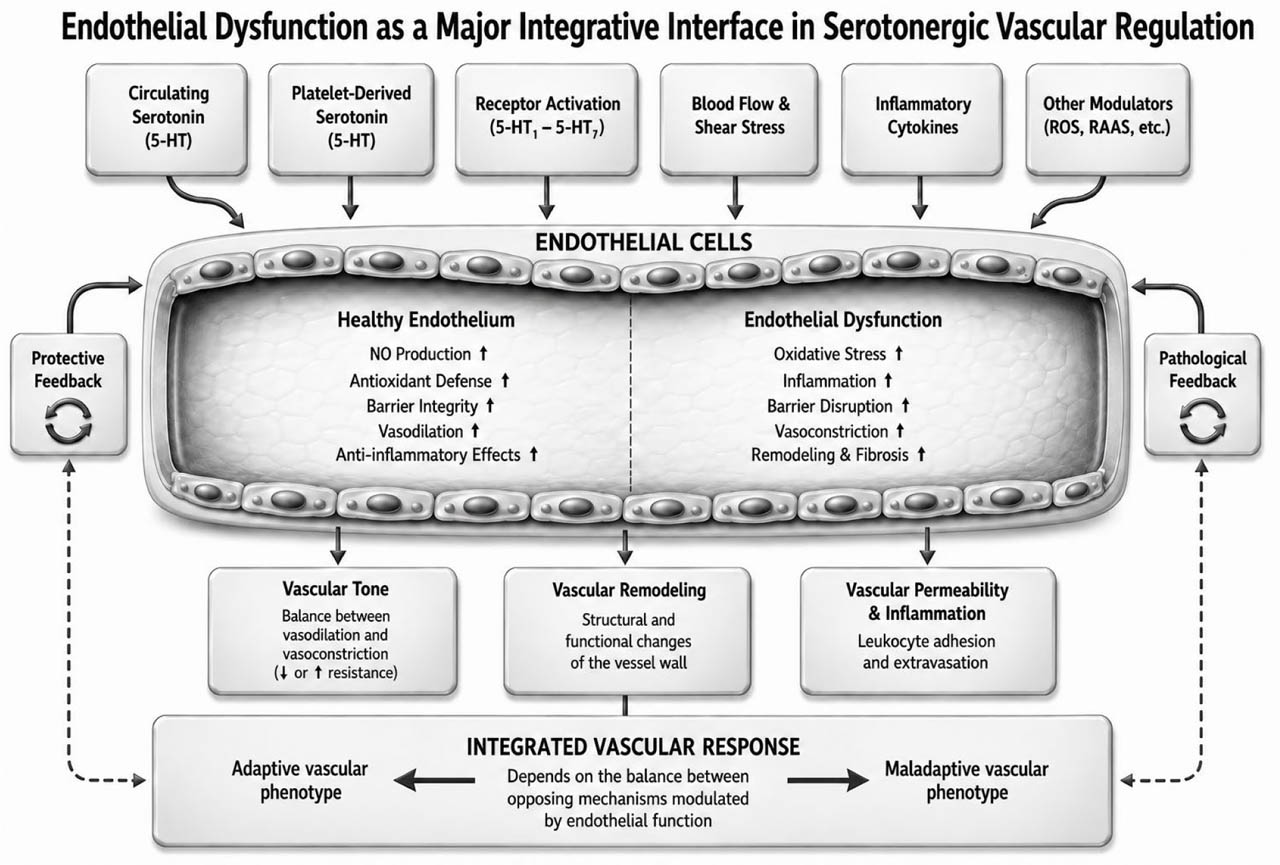
Figure 3-
Endothelial–vascular interface in serotonergic cardiovascular regulation. Endothelial state modifies responses to serotonergic, platelet-derived, inflammatory, hemodynamic and metabolic signals. The endothelium represents one major interface within a distributed network rather than a central integrator. 5-HT, 5-hydroxytryptamine; NO, nitric oxide; RAAS, renin-angiotensin-aldosterone system; ROS, reactive oxygen species.
Table 3-
Mechanistic basis of context-dependent serotonergic BP responses.
| Regulatory domain | Potential BP-raising/maladaptive mechanisms | Potential BP-lowering/homeostatic mechanisms | Major context determinants | Evidence context | Representative references |
|---|---|---|---|---|---|
| Vascular receptor signalling | 5-HT2A/5-HT1B-mediated vascular smooth-muscle contraction | Vasodilator/counter-regulatory responses in selected vascular beds; 5-HT7-mediated restraint of contraction experimentally | Receptor repertoire; vascular bed; serotonin concentration; endothelial state | Human vascular + preclinical | [18,20,21] |
| Endothelial–vascular interface | Loss of endothelium-dependent buffering may expose or amplify vasoconstrictor responses | Intact endothelial signalling can support NO-dependent vasodilation and modify platelet-derived vasoactive responses | Endothelial integrity; oxidative/inflammatory state; vascular disease | Human physiological/ex vivo + conceptual | [20,55,56,57] |
| Platelet/SERT regulation | Platelet activation releases stored serotonin locally and can amplify vasoconstrictor/pro-aggregatory signalling | Resting SERT-dependent uptake limits extracellular serotonin availability; normal platelet handling contributes to peripheral homeostasis | Platelet activation; SERT density/activity; concomitant agonists; vascular injury | Human mechanistic/observational | [11,19,29,33,34,35,36,37,38] |
| Central autonomic regulation | Region-specific serotonergic signaling may facilitate sympathetic or baroreflex responses | 5-HT1A-mediated sympathoinhibition and other region-specific depressor mechanisms | Brain region; receptor subtype; autonomic state | Predominantly preclinical | [12,13,14,15,16,17] |
| Renal serotonergic physiology | Increased renal vascular resistance or context-dependent alterations in renal handling may favour BP elevation | Serotonergic effects can also modify renal perfusion, filtration, urine flow and sodium excretion in the opposite direction | Local serotonin formation; renal function; physiological state; receptor context | Preclinical + limited human physiological evidence | [39,40,52,53,54] |
| Gut microbiota-serotonin axis | Microbial changes may alter intestinal serotonin production and interact with pathways relevant to BP regulation | Normal microbial metabolism may contribute to physiological regulation of enterochromaffin-cell serotonin production | Microbial composition; diet; metabolites; host factors | Mechanistically strong preclinical evidence; human hypertension link largely associative | [7,25,26,27,28] |
| Intracellular serotonylation | Modification of intracellular proteins may influence contraction, cytoskeletal signalling, proliferation, or remodelling | Effects are protein- and time-dependent; serotonylation cannot be classified uniformly as maladaptive | Target protein; transglutaminase activity; cellular compartment; duration of exposure | Molecular/in vitro and preclinical; human evidence mainly pulmonary vascular | [47,48,49,50,51] |
| Genetic background | Certain variants may modify transporter or receptor function in ways associated with higher BP in specific populations | The same or related variants may show neutral or different effects in other populations | Ancestry; sex; environment; gene–gene and gene–environment interactions | Human association evidence | [9,41,42] |
[ii] Note: The mechanisms shown are not mutually exclusive and should not be interpreted as a causal sequence or as having equal evidentiary weight. ‘BP-raising’ and ‘BP-lowering/homeostatic’ describe potential context-dependent effects rather than predictable net effects in an individual patient. Inflammation, oxidative stress, metabolic status, medication exposure and disease stage are treated as cross-cutting contextual modifiers rather than independent serotonergic pathways.