
Table 1
Risk stratification in pulmonary arterial hypertension (modified from [1, 20]).
| Initial risk assessment (3 risk-strata) | |||||
|---|---|---|---|---|---|
| Determinants of prognosis | Low risk (<5%) | Intermediate risk (5–20%) | High risk (>20%) | ||
| Clinical parameters | Signs of right heart failure | Absent | Absent | Present | |
| Symptom progression | No | Slow | Rapid | ||
| Syncope | No | Occasional | Repeated | ||
| WHO-FC | I, II | III | IV | ||
| Exercise tests | 6MWD | >440 m | 165–440 m | <165 m | |
| CPET | peak V′O2 | >15 mL×kg−1×min−1 | 11-15 mL×kg−1×min−1 | <11 mL×kg−1×min−1 | |
| V′E/CO2 | <36 | 36–44 | >44 | ||
| Biomarkers | BNP | <50 ng/L | 50–800 ng/L | >800 ng/L | |
| NT-proBNP | <300 ng/L | 300–1100 ng/L | >1100 ng/L | ||
| Imaging | TEE | RA area | <18 cm2 | 18–26 cm2 | >26 cm2 |
| TAPSE/sPAP | >32 mm/mmHg | 19–32 mm/mmHg | <19 mm/mmHg | ||
| PE | No | Minimal | Moderate or large | ||
| cMRI | RVEF | >54% | 37–54% | <37% | |
| SVi | >40 mL/m2 | 26–40 mL/m2 | <26 mL/m2 | ||
| RVESVi | <42 mL/m2 | 42–54 mL/m2 | >54 mL/m2 | ||
| Hemodynamics | RAP | < 8 mmHg | 8–14 mmHg | >14 mmHg | |
| CI | >2.5 L×min−1×m−2 | 2.0-2.4 L×min−1×m−2 | <2.0 L×min−1×m−2 | ||
| SVi | >38 mL/m2 | 31–38 mL/m2 | <31 mL/m2 | ||
| SvO2 | >65% | 60–65% | <60% | ||
| Risk assessment at follow-up (4 risk-strata) | |||||
| Determinants of prognosis | Low | Intermediate-low | Intermediate-high | High | |
| WHO-FC | I, II | III | IV | ||
| 6MWD | >440 m | 320–440 | 164–319 | <165 m | |
| BNP | <50 ng/L | 50–199 ng/L | 200–800 ng/L | >800 ng/L | |
| NT–proBNP | <300 ng/‘l | 300–649 ng/L | 650–1100 ng/L | >1100 ng/L | |
1 Abbreviations: WHO-FC, World Health Organization functional class; 6MWD, 6-minute walk distance; CPET, cardiopulmonary exercise testing; V′O2, oxygen uptake; V′E, minute ventilation; V′CO2, carbon dioxide production; BNP, brain natriuretic peptide; NT-proBNP, N-terminal pro-BNP; TEE, transthoracic echocardiography; RA, right atrium; TAPSE, tricuspid annular plane systolic excursion; sPAP, systolic pulmonary artery pressure; PE, pericardial effusion; cMRI, cardiac magnetic resonance imaging; RVEF, right ventricular ejection fraction; SVI, stroke volume index; RVESVI, right ventricular end-systolic volume index; RAP, right atrial pressure; CI, cardiac index; SvO2, mixed venous oxygen saturation.
Table 2
The main drugs administred for pulmonary arterial hypertension treatment in Romania.
| Class of drugs | Availabledrugs | Doses |
|---|---|---|
| Calcium channel blockers | Diltiazem | 60–360 mg b.i.d. |
| Amlodipine | 5–30 mg o.d. | |
| Felodipine | 5–30 mg o.d. | |
| Nifedipine | 10–60 mg t.i.d. | |
| Endothelin receptor antagonists | Bosentan | 62.5–125 mg b.i.d. |
| Macitentan | 10 mg o.d. | |
| Phosphodiesterase 5 inhibitors | Sildenafil | 20 mg t.i.d. |
| Soluble guanylate cyclase stimulator | Riociguat | 1–2.5 mg t.i.d. |
| Prostacyclin receptor agonist | Selexipag | 200–1600 μg b.i.d. |
| Prostacyclin analogues | Treprostinil s.c. | 1.25 ng/kg/min–maximum tolerated dose |
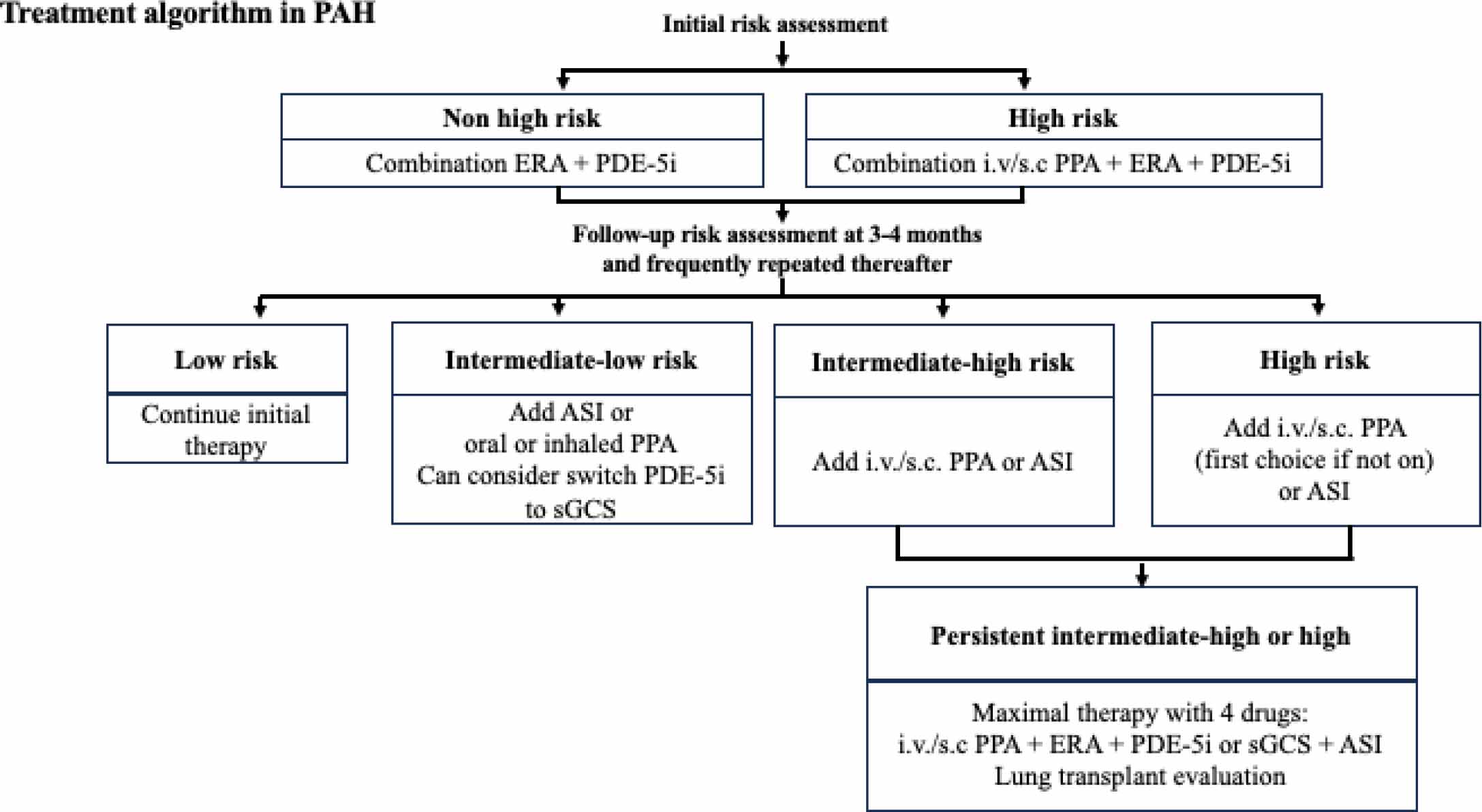
Figure 1
Treatment algorithm in pulmonary arterial hypertension (modified from [20]).
ASI, activin signaling inhibitors; ERA, endothelin-1 receptor antagonists; PAH, pulmonary arterial hypertension; PDE5i, phosphodiesterase-5 inhibitors; i.v., intravenous; s.c., subcutaneous; PPA, prostacyclin pathway agents; sGCS: soluble guanylyl cyclase stimulators.