
Introduction
Pulmonary arterial hypertension (PAH) is a complex, chronic-progressive, and disabling condition with a severe prognosis. PAH can be described as a vasculopathy characterized by the remodeling of the pulmonary vascular bed. Proliferative and inflammatory phenomena at the vascular wall level, including the formation of inflammatory infiltrates and plexiform lesions, cause the narrowing of the vascular lumen, resulting in increased resistance in the pulmonary vessels. This can lead to right heart failure, and, ultimately, to the patient’s death.
According to current guidelines,[1] PAH is defined from a hemodynamic perspective (parameters evaluated during the right heart catheterization) as follows: mean pulmonary artery pressure (mPAP) >20 mmHg; pulmonary artery wedge pressure (PAWP) ≤15 mmHg; and pulmonary vascular resistance (PVR) >2 WU.
The prevalence of PAH varies greatly depending on different patient registries. However, limitations associated with registry estimates may underestimate the true prevalence, which can be as high as 160 cases per million inhabitants. Currently, Romania has no national registry of PAH patients; therefore, we must rely on epidemiological data reported in the literature. According to the data included in the ESC/ERS Pulmonary Hypertension Guidelines published in 2022, and data from patient registries in developed countries, the incidence of PAH is approximately 6 cases per million adults, while the prevalence varies between 48–55 cases per million adults.[1]
The natural progression of the disease, in the absence of treatment, shows that the median life expectancy of patients with PAH after diagnosis was 2.8 years,[2] a figure comparable to that of some of the most severe forms of cancer. Thirty-two percent of untreated patients with PAH die within the first year from diagnosis, and only 34% of patients are still alive five years after diagnosis.
The prognosis of treated patients has improved, but long-term survival remains far from acceptable. PAH progresses continuously, with lung or heart-lung transplantation being the only option in very advanced stages of the disease.[3] Mortality-risk groupes (attributed at diagnosis and subsequently during monitoring) were developed to predict survival. An analysis of data extracted from the Swedish registry of PAH patients (SPHAR) showed a five-year survival rate of 92% for patients in the low-risk group, while patients in the intermediate-risk group presented a survival rate of 56%. The same analysis showed that the survival rate for patients in the high-risk group dramatically dropped to just 6%.[4]
PAH is characterized by rather nonspecific symptoms, which significantly contribute to confusion with other conditions, and, consequently, to delays in accurate diagnosis and the initiation of treatment. The primary symptoms of pulmonary hypertension are related to right ventricular dysfunction—a direct consequence of progressive pulmonary vasculopathy—and are typically associated with exertion in the early stages of the disease. The central symptom is dyspnoea, which occurs during exertion and worsens with increased activity. As the disease progresses, additional symptoms may emerge. The symptoms correlate with the stage and severity of the condition and may include fatigue, palpitations, hemoptysis, abdominal distension, exertional nausea, weight gain due to fluid retention, syncope, and chest pain during exertion, and dysphonia. In advanced stages of the disease, patients may experience dyspnoea even at rest. The clinical presentation of PAH can be modified by other conditions associated with PAH and by various comorbidities.
Diagnosing PAH requires a comprehensive approach that includes medical history, physical examination, ECG, laboratory tests, lung function tests, imaging examinations (chest X-ray, echocardiography, thoracic CT scan, ventilation/perfusion lung scintigraphy, and cardiac magnetic resonance imaging), exercise testing and right heart catheterization with vasoreactivity testing in specific etiologies. Definitive diagnostic of PAH is made exclusively through right heart catheterization, which allows for the measurement of hemodynamic parameters.
Risk assessment in pulmonary arterial hypertension
According to the current guidelines for the diagnosis and treatment of PAH (ESC/ERS Guidelines) and the recommendations of the last World Symposium on Pulmonary Hypertension (WSPH), the therapeutic approach is based on the assessment of a 1-year mortality risk, both at the time of diagnostic and during follow-up visits at intervals of 3-4 months. The treatment goal is to achieve and maintain a low-risk status, which is proved to predict a better long-term prognosis.[1]
For risk stratification at diagnostic, the current guidelines recommend using a three-strata model, considering as many factors as possible, emphasizing disease type, WHO functional class (WHO-FC), six-minute walk distance (6MWD), BNP/NT-proBNP levels and hemodynamics. Additionally, imaging examinations (such as echocardiography and cardiac magnetic resonance) play an essential role in highlighting disease-induced changes in the heart and vasculature.[1]
For risk stratification during follow-up visits, the use a simplified four-strata model is recommended as a basic tool, using cut parameters such as functional class, 6-minutes walking distance, BNP/NT-proBNP levels.[1] However, additional variables—especially right heart imaging and hemodynamic values—should also be considered as needed.
Changes in the risk-status are recognized as predictors of long-term survival. Patients with PAH that are at high-risk face an increased risk of death. Risk stratification forms the basis of therapeutic decision-making and serves as a prognostic factor for disease progression and survival.
Therapeutic approach in pulmonary arterial hypertension
PAH has a multifactorial pathogenesis, with many of the pathophysiological pathways currently targeted by therapies, while other potential pathways are under investigation for future treatments. Historically, available therapies have targeted three major pathophysiological pathways: the prostacyclin pathway, the endothelin pathway, and the nitric oxide pathway. Each therapy primarily acts by modulating the tone of the pulmonary musculature, leading to vasodilation, which reduces right ventricular afterload and improves cardiopulmonary hemodynamics.[5]
Extensive research on PAH in recent years has resulted in a better, although still incomplete, understanding of the disease’s pathogenesis and the emergence of new therapeutic options that target mechanisms beyond traditional vasodilation. For instance, transforming growth factor β (TGF-β) plays a significant role in the initiation and progression of PAH. TGF-β is not only an important modulator of vascular remodeling and pulmonary inflammation, but also influences cardiac hypertrophy and fibrosis.[6–10] Consequently, inhibiting activin signaling (which belongs to the TGF-β superfamily of ligands), particularly activin A, is believed to restore the balance between proliferative and anti-proliferative signaling, thereby potentially controlling vascular proliferation. This would be associated with thinning of the vascular wall, positive remodeling of the arterial wall and right heart, and improved hemodynamics.
Survival in PAH depends on the right ventricle’s ability to adapt to the continuous increase in afterload caused by progressive narrowing of the distal pulmonary vasculature.[11,12] Therefore, the current therapeutic strategy for PAH focuses on preventing the onset of right ventricular failure.
Therapeutic management in PAH can be divided into general measures and targeted treatments specifically designed for this condition. In this section, we will focus exclusively on PAH specific drug treatments.
Therapeutic goals in PAH
Despite the currently available therapies and the therapeutic strategies recommended by the current guidelines, patients’ conditions continue to deteriorate due to disease progression, and the prognosis remains poor. Current guidelines support a therapeutic approach based on the mortality risk assessment, with the goal of treatment being to achieve and maintain a low-risk status, which is directly correlated with better survival. For risk stratification at diagnosis, it is recommended to use the three-strata model, considering as many factors as possible (Table 1). For risk stratification during follow-up visits, it is recommended to use a simplified four-strata model as a basic tool (Table 1), but additional variables—especially right heart imaging and hemodynamic values—should also be considered as necessary.
Table 1
Risk stratification in pulmonary arterial hypertension (modified from [1, 20]).
| Initial risk assessment (3 risk-strata) | |||||
|---|---|---|---|---|---|
| Determinants of prognosis | Low risk (<5%) | Intermediate risk (5–20%) | High risk (>20%) | ||
| Clinical parameters | Signs of right heart failure | Absent | Absent | Present | |
| Symptom progression | No | Slow | Rapid | ||
| Syncope | No | Occasional | Repeated | ||
| WHO-FC | I, II | III | IV | ||
| Exercise tests | 6MWD | >440 m | 165–440 m | <165 m | |
| CPET | peak V′O2 | >15 mL×kg−1×min−1 | 11-15 mL×kg−1×min−1 | <11 mL×kg−1×min−1 | |
| V′E/CO2 | <36 | 36–44 | >44 | ||
| Biomarkers | BNP | <50 ng/L | 50–800 ng/L | >800 ng/L | |
| NT-proBNP | <300 ng/L | 300–1100 ng/L | >1100 ng/L | ||
| Imaging | TEE | RA area | <18 cm2 | 18–26 cm2 | >26 cm2 |
| TAPSE/sPAP | >32 mm/mmHg | 19–32 mm/mmHg | <19 mm/mmHg | ||
| PE | No | Minimal | Moderate or large | ||
| cMRI | RVEF | >54% | 37–54% | <37% | |
| SVi | >40 mL/m2 | 26–40 mL/m2 | <26 mL/m2 | ||
| RVESVi | <42 mL/m2 | 42–54 mL/m2 | >54 mL/m2 | ||
| Hemodynamics | RAP | < 8 mmHg | 8–14 mmHg | >14 mmHg | |
| CI | >2.5 L×min−1×m−2 | 2.0-2.4 L×min−1×m−2 | <2.0 L×min−1×m−2 | ||
| SVi | >38 mL/m2 | 31–38 mL/m2 | <31 mL/m2 | ||
| SvO2 | >65% | 60–65% | <60% | ||
| Risk assessment at follow-up (4 risk-strata) | |||||
| Determinants of prognosis | Low | Intermediate-low | Intermediate-high | High | |
| WHO-FC | I, II | III | IV | ||
| 6MWD | >440 m | 320–440 | 164–319 | <165 m | |
| BNP | <50 ng/L | 50–199 ng/L | 200–800 ng/L | >800 ng/L | |
| NT–proBNP | <300 ng/‘l | 300–649 ng/L | 650–1100 ng/L | >1100 ng/L | |
1 Abbreviations: WHO-FC, World Health Organization functional class; 6MWD, 6-minute walk distance; CPET, cardiopulmonary exercise testing; V′O2, oxygen uptake; V′E, minute ventilation; V′CO2, carbon dioxide production; BNP, brain natriuretic peptide; NT-proBNP, N-terminal pro-BNP; TEE, transthoracic echocardiography; RA, right atrium; TAPSE, tricuspid annular plane systolic excursion; sPAP, systolic pulmonary artery pressure; PE, pericardial effusion; cMRI, cardiac magnetic resonance imaging; RVEF, right ventricular ejection fraction; SVI, stroke volume index; RVESVI, right ventricular end-systolic volume index; RAP, right atrial pressure; CI, cardiac index; SvO2, mixed venous oxygen saturation.
The therapeutic goal in pulmonary hypertension is to prolong patients’ lives, improve their quality of life, and reintegrate and maintain PAH patients into socio-professional activities as much as possible by ensuring specific treatment.
Therapeutic algorithm in PAH. The treatment of PAH patients includes general measures and PAH specific therapies
General measures refer to recommendations regarding physical activity and rehabilitation, vaccination, surgical procedures, travel and altitude exposure, and pregnancy. Also, general measures include treatment with diuretics in case of right heart failure symptoms, and anticoagulation when there is documented thrombosis in the pulmonary arteries and oxygen supplementation in patients with an arterial blood oxygen pressure less than 60 mmHg.[1]
Specific treatment in PAH includes several classes of drugs, mentioned in the following sections.
Calcium channel blockers (CCB)
PAH patients who respond favourably to the acute vasoreactivity test (performed during cardiac catheterization) may exhibit a positive response to treatment with calcium channel blockers (CCB).[13,14] A positive response is defined by a decrease in mPAP to ≤ 40 mmHg, with a reduction of more than 10 mmHg from baseline, and either an increase or no change in cardiac output. Less than 10% of patients with idiopathic PAH, hereditary PAH, or drug/toxin-induced PAH are responders, and an acute vasodilator response does not predict a favourable long-term response to CCBs in other forms of PAH.[13–15]
Among the CCBs, the most used in PAH are nifedipine, diltiazem, and amlodipine.[13,14] Effective daily doses in PAH are relatively high and must be achieved gradually. Patients who meet the criteria for a positive vasodilator response and are treated with CCBs must be closely monitored, with a complete reassessment—including right heart catheterization—after 3–6 months of therapy. Additional vasoreactivity testing should be performed at reassessment to detect a persistent vasodilator response, which may support possible increases in the CCB dose.
The criteria for a persistent vasodilator response at reassessment are as follows: WHO-FC I/II, BNP <50 ng/L or NT-proBNP <300 ng/L, and normal or near-normal hemodynamic values at rest (mPAP ≤30 mmHg and PVR ≤4 Wood units). In the absence of a satisfactory response, additional PAH specific therapy should be initiated. In some cases, a combination of CCBs with specific PAH medications may be necessary due to clinical deterioration. Non-vasoreactive patients should not be treated with CCBs because of the potential for severe side effects (e.g., severe hypotension, syncope, and right ventricular failure), unless CCBs are prescribed at standard doses for other indications.[16]
PAH specific therapy
Nowadays, several classes of drugs are available for clinical use (Table 2).
Table 2
The main drugs administred for pulmonary arterial hypertension treatment in Romania.
| Class of drugs | Availabledrugs | Doses |
|---|---|---|
| Calcium channel blockers | Diltiazem | 60–360 mg b.i.d. |
| Amlodipine | 5–30 mg o.d. | |
| Felodipine | 5–30 mg o.d. | |
| Nifedipine | 10–60 mg t.i.d. | |
| Endothelin receptor antagonists | Bosentan | 62.5–125 mg b.i.d. |
| Macitentan | 10 mg o.d. | |
| Phosphodiesterase 5 inhibitors | Sildenafil | 20 mg t.i.d. |
| Soluble guanylate cyclase stimulator | Riociguat | 1–2.5 mg t.i.d. |
| Prostacyclin receptor agonist | Selexipag | 200–1600 μg b.i.d. |
| Prostacyclin analogues | Treprostinil s.c. | 1.25 ng/kg/min–maximum tolerated dose |
Endothelin receptor antagonists (ERA). These drugs bind to endothelin receptors A and/or B on pulmonary artery smooth-muscle cells, promoting vasodilation. The available agents in Romania are: bosentan (initial dose of 125 mg/day, target dose of 250 mg/day) with the most common side effect being increases in liver transaminases and macitentan (initial and maintenance dose of 10 mg/day) with rare side effects such as anemia.[1]
Phosphodiesterase 5 inhibitors (PDE5i). These drugs promote vasodilation on the nitric oxide pathway slowing the cyclic guanosine monophosphate (cGMP) degradation. Sildenafil, the only drug from this class available for PAH treatment in Romania, has an approved dose of 60 mg a day; side effects include headache, flushing, and epistaxis.[1]
Soluble guanylate cyclase stimulators (sGCS) these agents promote vasodilation by increasing cGMP levels independently of the endogenous nitric oxide. Riociguat, with a target dose of 2.5 mg three times daily, is approved for PAH treatment and also for chronic thromboembolic pulmonary hypertension (inoperable and postoperative residual forms).[1]
Prostacyclin analogues and prostacyclin receptor agonists (prostacyclin pathway agents, PPAs). These drugs induce vasodilation, inhibit platelet aggregation, and have both cytoprotective and anti-proliferative effects. From this group of PAH-specific drugs, only two are available in Romania: subcutaneous treprostinil, a prostacyclin analogue with a continuous administration via a pump and with infusion-site pain as the most frequent adverse event and selexipag, an oral prostacyclin receptor agonist available in different concentrations. The most common adverse effects of these agents, often limiting the dose increases, are headache, diarrhoea, jaw pain, flushing.[1]
Activin signaling inhibitors (ASI), which bind to activin and members of the transforming growth factor β superfamily, restoring the balance between growth-promoting activin pathways and growth-inhibiting BMP pathways, target the vascular remodeling in PAH.[17–18] Sotatercept, a homodimeric recombinant fusion protein consisting of the extracellular domain of the human activin receptor type IIA (ActRIIA) linked to the human IgG1 Fc domain, acts as a ligand trap for multiple activin-class ligands by binding and sequestering them. [18] Sotatercept, with a starting dose of 0.3 mg/kg and a maintenance dose of 0.7 mg/kg every three weeks, added to background mono-, dual-, or triple-combination therapy, demonstrated significant clinical efficacy. This includes improvement in the six-minute walk distance, significant reductions in key hemodynamic parameters, including PVR, mPAP and N terminal-pro-B-type natriuretic peptide levels, and enhancements in WHO functional class.[19] The long-term impact of sotatercept on survival remains to be fully established. Adverse events include telangiectasia, increased hemoglobin levels, and bleeding events (mainly epistaxis and gingival bleeding).[19] The data regarding the efficacy of sotatercept for PAH treatment recently emerged and this drug was included in the revised PAH treatment algorithm from the last World Symposium on Pulmonary Hypertension.[20]
Treatment algorithm in PAH
After confirming the PAH diagnostic through cardiac catheterization and conducting the vasoreactivity test, choosing the specific initial therapy is made according to the guidelines’ recommendations and based on the patient’s risk-status at diagnostic (Figure 1), by using the three-strata risk model.[1,20]
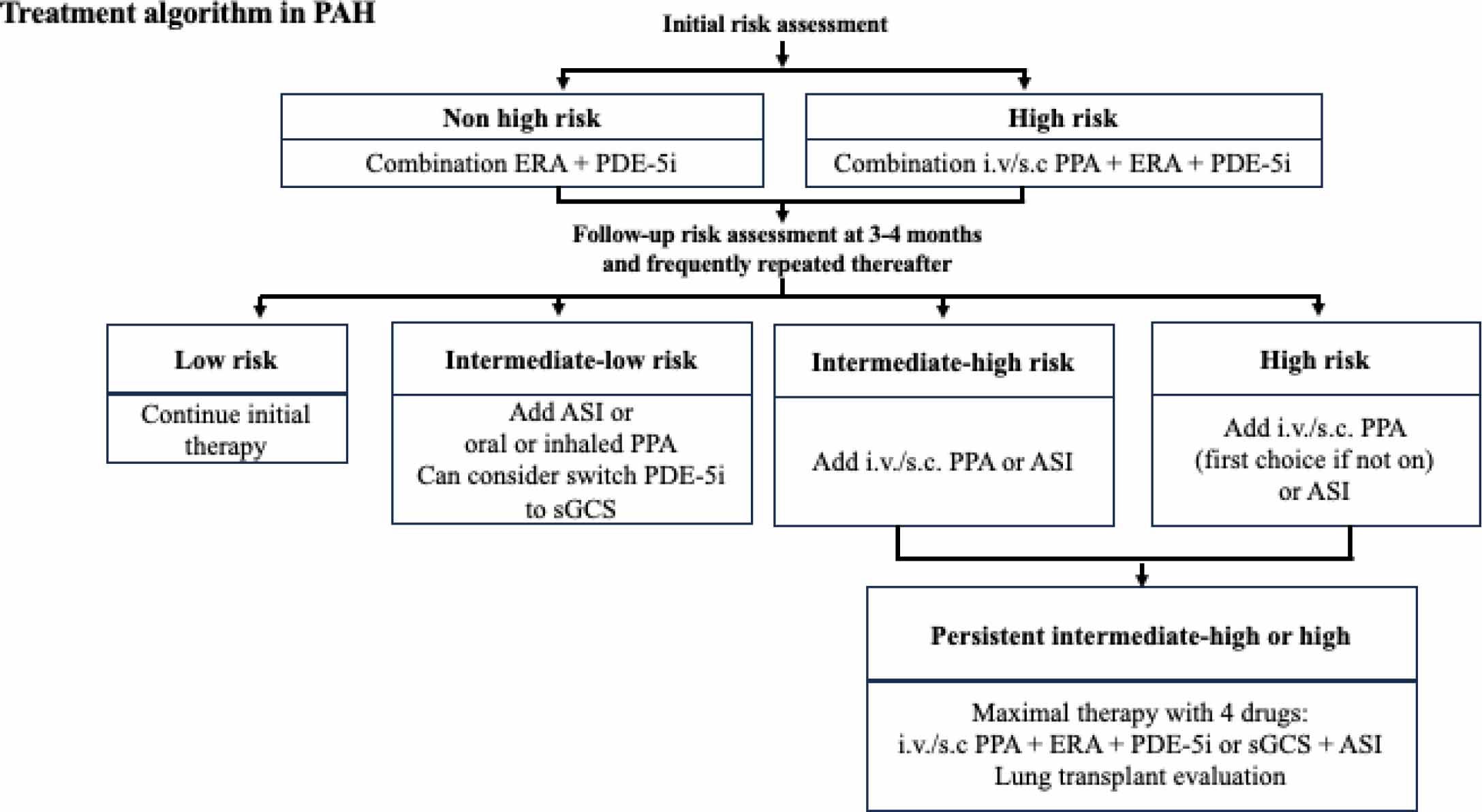
Figure 1
Treatment algorithm in pulmonary arterial hypertension (modified from [20]).
ASI, activin signaling inhibitors; ERA, endothelin-1 receptor antagonists; PAH, pulmonary arterial hypertension; PDE5i, phosphodiesterase-5 inhibitors; i.v., intravenous; s.c., subcutaneous; PPA, prostacyclin pathway agents; sGCS: soluble guanylyl cyclase stimulators.
Thus:
– For patients at low-risk or intermediate-risk at diagnostic, treatment will be initiated with dual combination therapy: ERA + PDE5i.
– For patients at high-risk at diagnostic, treatment will be initiated with triple combination therapy: ERA + PDE5i + i.v/s.c PPA.[1,20]
Patients will be reassessed periodically, every 3-4 months, as well as whenever their clinical condition requires it. At follow-up, for risk reassessment, the four-strata risk model will be used, the therapeutic approach aligning with the patient’s classification into one of these four groups.[1,20]
Thus:
– If at follow-up the patient is at low-risk, the therapeutic approach will consist of continuing the previously administered therapy.
– If at follow-up the patient is at intermediate-low risk, the therapeutic approach will consist of triple combination therapy:
- Add ASI to ERA + PDE5i or
- Add oral/inhaled PPA to ERA + PDE5i
- Consideration may be given to switch PDE5i to sGCS
– If at follow-up the patient is at intermediate-high or high-risk, the therapeutic approach will be:
- Add i.v/s.c. PPA (if not already prescribed), or
- Add ASI
– If despite therapy escalation, the patient remains at intermediate-high or high-risk, the therapeutic approach will consist of four-drug combination therapy:
i.v/s.c. PPA + ASI + ERA + PDE5i/sGCS, and lung transplant evaluation.[20]
Therefore, maximal medical therapy has been upgraded from the conventional combination of three agents—ERA, PDE5i, and IV/SC PPA—to a four-drug regimen that includes sotatercept. The inclusion of sotatercept in this regimen reflects its emerging role in addressing more advanced disease states and improving patient outcomes in those who remain inadequately controlled on existing therapies.[21] The remarkable efficacy and safety profile of sotatercept makes it a significant therapeutic agent, especially for patients who do not adequately respond to maximal vasodilatory therapy. For the moment, sotatercept is not available in the national program for PAH treatment in Romania.
Before targeted PAH treatments became available, the the median survival of patients with idiopathic PAH was 2.8 years after diagnosis. Over the ensuing 30 years, the various treatments that were developed improved hemodynamics, exercise tolerance, and worsening-free survival. Life expectancy of patients with PAH increased, with the median survival after diagnosis now exceeding 5 years.[22]
Conclusion
Optimal PAH treatment comprises the use of combination therapy for most patients, including those who are newly diagnosed. Different therapeutic combinations are tailored according to the patient’s risk status at time of diagnostic, and more specifically during periodic reassessments. Exceptions apply to patients with a positive vasodilator response (confirmed according to the testing algorithm), who should initially be treated with calcium channel blockers. Maximum therapy in PAH is currently represented by four-drug combination therapy. Patients should be reassessed periodically (every 3-4 months, as well as whenever their clinical condition warrants), and early escalation of therapy is recommended. Adding additional therapy to the treatment regimen for patients at intermediate-low, intermediate-high, or high-risk may provide benefits by promoting the patient’s improvement, thereby contributing to a better long-term prognosis.
Notes
[3] Conflicts of interest Conflicts of Interest
The authors declare no conflict of interest.
[4] Ethics approval and consent to participate
This study does not require institutional review board approval.