
1. Introduction
Sustainable development efforts and educational initiatives
After the first UN decade (2005–2015), the United Nations defined 17 Sustainable Development Goals (SDGs) and 169 targets for a global framework for all nations (Leal Filho et al., 2018). Social justice, economic responsibility, and environmental health are essential for global sustainability (Leal Filho et al., 2018). The core competencies of Education for Sustainable Development are to recognize, assess, and act. Recognition requires knowledge, whereas assessment requires values that influence actions and behavior. Recent international research conceptualizes ESD competencies broadly, encompassing not only knowledge but also skills, values, attitudes, and the capacity to engage critically with sustainability challenges (Hammer & Lewis, 2023). Sustainability literacy research likewise emphasizes the importance of assessing students’ knowledge and understanding of sustainability-related issues (Kuehl et al., 2023). In the present study, this general ESD competence framework is operationalized through three complementary constructs: environmental knowledge, environmental values, and individual interest. Knowledge represents the cognitive component relevant to recognizing sustainability-related issues, while environmental values reflect an evaluative component. Individual interest is included as a motivational construct relevant to sustained engagement with sustainability-related topics. These constructs are not treated as a single established ESD model but as complementary theoretical perspectives underlying the empirical design of the present study.
The relationships between these constructs are supported by previous research. According to Grob (1995) and Kollmuss and Agyeman (2002), environmental awareness is associated with knowledge and ecological attitudes (including values) that can influence each other (Roczen et al., 2014). According to Frick et al. (2004), knowledge includes system-related (SYS) and action-related (ACT) knowledge that leads to pro-environmental behavior. System- and action-related knowledge therefore constitute the two knowledge dimensions assessed in the present study. Empirical research often shows a positive knowledge impact, but less so for values and pro-environmental behavior (Bonney et al., 2009). Environmental values constitute the evaluative component of the present framework. In this study, they are sustained engagement. conceptualized on the basis of the 2-MEV framework, which distinguishes between preservation (PRE) and utilization (UTL), complemented by appreciation of nature (APR) (Bogner, 1998, 2018). The framework is particularly suitable for the present study because it was developed for adolescent target groups. In addition to environmental competencies (knowledge, values, and reported behavior), interest can also drive learning processes and is classified either as generalized (encompassing a variety of topics) or concrete (limited to a subject domain) (Krapp & Prenzel, 2011). Some authors have highlighted that attitudes and interest are independent constructs (attitudes representing general, non-personal evaluation viewpoints, whereas interest reflects the subjective value attached to knowledge about the object of interest). It is, for example, possible to have a negative attitude towards an issue (e.g., meat consumption as a vegetarian) and yet have a strong and enduring interest in understanding that topic (Krapp & Prenzel, 2011). Dopelt et al. (2019) found that students (N=361) have a knowledge gap regarding the environmental impact of the food they consume, and they are not good at assessing environmentally friendly behaviors. Causes could include a lack of interest, with interest being an important variable that enables sustainable learning in conjunction with knowledge development (Renninger & Hidi, 2019). Krapp et al. (1992) distinguish between situational and individual interest. Situational interest is context-dependent and may develop into enduring individual interest through
In our cross-sectional study, we focused on adolescents’ individual interest, as we assumed they had already engaged with environmental issues. Furthermore, current studies mainly focus on adults rather than adolescent students (Nkaizirwa et al., 2021). However, adolescents’ interest is based on knowledge, values, emotions, or activities, for example those carried out during leisure time.
An overall objective of Education for Sustainable Development (ESD) is the acquisition of different competencies, e.g., concepts for sustainable development of private life, active participation, and global responsibility. To summarize, all citizens should be able to reflect on their own actions when making decisions to assess potential threats to themselves, fellow citizens, and the planet (e.g., assessment of environmental hazards such as carbon footprint for long transport routes, impact of purchasing non-local, non-seasonal products). These core competencies relating to sustainability goals should be developed at school and integrated into teaching topics. There are different opportunities in formal and informal contexts to integrate Education for Sustainable Development into the classroom. While the SDGs provide an internationally recognized framework for ESD, scholars have also argued that they should be critically examined with regard to their underlying assumptions and normative perspectives (e.g., Stein et al., 2022). Accordingly, they should also be addressed as a subject of critical reflection in educational contexts.
Educational context: PASCH schools in Brazil
In Germany, 17 SDGs are increasingly being integrated into school curricula, not only in science subjects but also, more recently, in foreign language education. Against this background, the PASCH initiative (“Schools: Partners for the Future”) promotes German language education at partner schools worldwide, including 23 schools in Brazil. PASCH was initiated by the German Foreign Office and is based on cooperation with intermediary organizations such as the Central Agency for Schools Abroad, the German Academic Exchange Service (DAAD), and the Pedagogical Exchange Service (PAD) of the Standing Conference of the Ministers of Education and Cultural Affairs of the Länder, Federal Republic of Germany (Schulpartnerschaft der Zukunft, 2023). The initiative connects more than 2,000 schools worldwide in areas where German has a special status. Its work primarily includes teaching projects, further training for teachers (for example, on the 2030 Agenda), and transnational student projects on the topics of migration, racism, and environmental protection. Depending on the school type, PASCH schools combine German educational approaches with their respective national curricula to varying degrees. Within the PASCH initiative, coordinated by the Goethe-Institut, ESD topics are incorporated into DaF (German as Foreign Language) lessons through teaching materials, international projects, and teacher training (Goethe-Institut, n.d.-b). Consequently, PASCH schools provide an appropriate educational context in which language learning is combined with sustainability education. This educational setting forms the basis of the present study, which investigates Brazilian students’ knowledge, values, and interests related to ESD and the 17 SDGs in the context of foreign language learning. Notably, by learning a language and subject matter in parallel, a deeper understanding of the subject matter can be achieved (Hallet, 2005). To understand the relevance of these initiatives, it is important to consider the broader Brazilian educational context. In the last 20 years, Brazil has been considered one of the most and quota programs, can only counteract extreme social inequality to a limited extent promising emerging economies in the world (Cerioli, 2022). However, the country is strongly characterized by social inequality, and the illiteracy rate among Afro-Brazilians, for example, is almost three times higher than that of the national population, which can be explained by impeded access to education (Santos & Silva, 2018). Even aid programs, such as scholarship (Glewwe & Kassouf, 2012). The consequences are reflected above all in the education system, which is divided into a public sector and a fee-based private sector. It is true that all students generally attend a so-called Ensino Fundamental (1st–9th grade) and an Ensino Médio (10th–12th grade). However, the quality of teaching is highly dependent on the respective institution, and as a result, it is mostly only students from the private sector who have access to quality education (Wedler & Müller de Acevedo, 2023). In the tertiary education sector, on the other hand, there are free, public universities that offer an excellent education; however, due to the demanding selection process, usually only students from the private sector have access to these institutions. As a result, a person’s background, ethnicity, and status often determine their career path. For this reason, social programs such as scholarships and quotas, as well as foreign partner initiatives such as PASCH, are essential to enable socially disadvantaged students to advance in education (Wedler & Müller de Acevedo, 2023). In an education system that for decades was primarily aimed at reducing the illiteracy rate, foreign languages and environmental education have had a rather subordinate role, further exacerbated under Bolsonaro’s government (Cerioli, 2022). Following the change of head of state and the introduction of a new Ensino Médio, more thought is being given to sustainability goals in the educational context. An important role is also played by the textbooks used in German lessons (Münch-Manková, 2023), in which ESD is increasingly addressed, enabling further discussions on e-mobility and sustainable clothing, for example. These topics are also reinforced by materials from PASCH-net, the platform for networking PASCH schools abroad, through which competitions are announced on the topic of ‘City of the Future’ or ‘What are you doing about water scarcity’, among others. Teaching units on the topics ‘Less plastic - eight tips for everyday life’ or ‘Sustainability mobile’ can also be found at all levels. At this point, the unit ‘Be active together - for our earth’ should also be mentioned, which specifically addresses the 17 SDGs (Schulpartnerschaft der Zukunft, 2023). As a result, PASCH schools have access to an extensive range of teaching projects that promote ESD and therefore play a pioneering role compared with many other schools in Brazil.
Content and language integrated learning in German (CLILiG)
CLIL is a dual approach that enables the learning of subject content from different subject areas through a foreign language (Haataja, 2013). Within the PASCH initiative, ESD is intentionally integrated into German-as-a-Foreign-Language (DaF) lessons in line with the Goethe-Institut’s educational framework, which promotes the integration of sustainability education into foreign language teaching (Goethe-Institut, n.d.-a). In the present study, this instructional approach represents a form of content-integrated language learning (soft CLIL). In contrast to conventional DaF instruction, students not only learn German but also acquire subject knowledge through the foreign language. Integrating subject-specific content into foreign language instruction enables learners to engage with complex sustainability issues while simultaneously developing the linguistic resources needed to participate in sustainability-related discussions (Bechtel, 2021). This is the case when PASCH school partnerships create projects in which 17 SDGs are discussed in German and Portuguese (e.g., What effects can poverty have on our health?). CLIL can strengthen learners’ ability to process inputs, which promotes cognitive development (Bialystok, 1999; Kuska et al., 2010). Since students learn sustainability-related concepts through German, understanding how they conceptualize and associate ESD terminology becomes an important aspect of this instructional approach. Hörsch et al. (2023) showed that knowledge of sustainability concepts is one of the predictors of sustainability literacy. This provides the rationale for examining students’ connotations of ESD-related terms in the present study.
In CLIL lessons, learning subject-specific concepts (terms) is central. In the pre-conceptual phase, terms are not yet linked to a specific meaning. This meaning must be acquired linguistically and subject-specifically step by step. The concepts (terms) are associated differently (connotation) and they have a logical core (definition) and a scope (denotation) (Heitzmann, 2013; Münch-Manková, 2020). Connotation refers to the emotional or cultural associations that a word carries beyond its literal definition. For example, the term nuclear energy can connote heating, radioactivity, and danger; definitionally, it is the energy contained in atomic nuclei. A connotation is therefore the content-evaluative, emotional meaning of words and can thus be positive or negative. In our study, we examined the connotations of ESD terms, especially the term ‘sustainable’. Against this background, the present study investigates how environmental competencies (knowledge, values, and individual interest) relate to Brazilian adolescents’ conceptual understanding of sustainability in the context of ESD integrated into German-as-a-Foreign-Language (DaF) instruction. To address this research question, we pursued the following objectives:
Research question and objectives
Based on the results of the discussed studies, we focused on four objectives:
Testing the knowledge (system- and action-related) items and the distribution of person parameters along the latent dimension via the Rasch model.
Testing values using the 2-MEV and APR scale via factor analysis (FA).
Examining the associations among the three latent variables—knowledge, environmental values, and individual interest—using confirmatory factor analysis (CFA).
Determining content-related evaluative and emotional meaning, to monitor adolescent students’ connotations of the term ‘sustainable’.
2. Methods
Research design
The present study was designed as an exploratory cross-sectional study. Rather than evaluating a specific instructional intervention, it aimed to provide a baseline of Brazilian PASCH students’ environmental competencies and conceptual understanding of sustainability. The findings are intended to inform the further development of ESD-oriented DaF teaching, including future learning activities developed jointly with teacher education students. At the participating schools, ESD instruction primarily addressed SDG 1 (No Poverty) and SDG 2 (Zero Hunger), reflecting locally relevant issues. These activities formed part of the regular PASCH German-as-a-Foreign-Language (DaF) curriculum and were implemented by the participating teachers rather than standardized by the research team.
Sample and ethics statement
Our study recruited 187 Brazilian adolescent students (♀ = 86; ♂ = 93; 8 = NA) from different secondary PASCH schools (N7./8. = 27, N9./10. = 80, and N11./12. = 78; 2 = NA) who completed an online questionnaire (using LimeSurvey) for assessment in 2022. A total of 39 participants attended a public school and 140 attended a private school; school type was not reported for eight participants. The questionnaire was anonymous, so the students could not be identified in any way. Permission to conduct the study was obtained from the Goethe-Institut in São Paulo, the participating school administration, and the responsible teacher.
Structure of the questionnaires
The survey contained the following:
A self-developed item set of system- and action-related knowledge (17 items per category; one correct answer per item), based on the distinction between system- and action-related knowledge described by Frick et al. (2004), to analyze person parameters relating to the 17 Sustainable Development Goals (SDGs).
A total of 20 items from the psychometric constructs of 2-MEV and APR (Bogner, 2018), using a five-point Likert scale (‘1 = strongly disagree’, ‘2 = disagree’, ‘3 = partially agree’, ‘4 = agree’, and ‘5 = totally agree’). These constructs were selected because they were developed for adolescent target groups and differentiate between preservation (PRE), utilization (UTL), and appreciation of nature (APR).
A self-developed set of 17 individual interest items, based on the conceptualization of individual interest by Krapp et al. (1992) and Krapp and Prenzel (2011), using a five-point Likert scale (‘1 = strongly disagree’, ‘2 = disagree’, ‘3 = partially agree’, ‘4 = agree’, and ‘5 = totally agree’), focusing on the 17 SDGs (related to the knowledge items). We did not use a validated scale to measure individual interest in adolescents. Instead, each interest item was adapted according to the corresponding knowledge item based on the 17 SDGs. Unlike alternative instruments such as the New Environmental Paradigm (NEP; Dunlap & Van Liere, 1978) and the Environmental Motives Scale (EMS; Schultz, 2001), the selected 2-MEV and APR scales were developed for adolescents and were therefore better suited to our target group.
A total of 5 open questions on the terms ‘clean energy’, ‘nuclear energy’, ‘sustainable’, ‘energy transition’, and ‘waste disposal park’. For each term, content-related, evaluative, and emotional connotations were collected and evaluated separately to ensure a detailed understanding of each dimension. In the context of this study, we focused on the term ‘sustainable’ because sustainability constitutes the central guiding concept of the study and we aim to relate students’ conceptual understanding of sustainability to their environmental competencies.
Each SDG term (e.g., SDG_1_poverty) was expressed in one system-related knowledge item, one action-related knowledge item, and one overall individual interest item (Fig. 1). We also analyzed differences by sex.
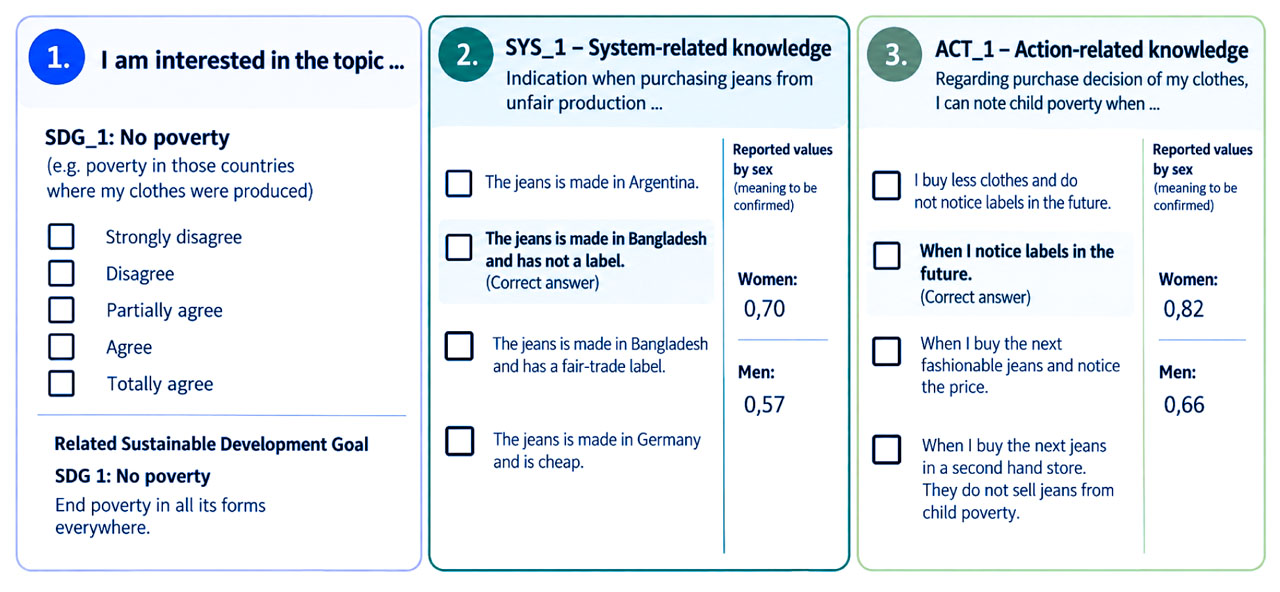
Figure 1:
Item examples of system- and action-related knowledge and interest.
Statistical analysis, validity, and reliability
The psychometric measuring instruments were analyzed using factor analysis, where factor loadings below 0.4 were left out. We conducted statistical tests using R (R Foundation for Statistical Computing, Version 4.0.2 for Windows, www.r-project.org). We examined the 34 knowledge items of each student using a Rasch model with R and the eRm package (Mair & Hatzinger, 2007) to indicate the location of knowledge item parameters and distribution of person parameters on the latent dimension. We examined the values (2-MEV and APR) of each student using factor analysis with R and used the psych package (Revelle, 2012) and GPArotation package (Bernaards & Jennrich, 2015) and then conducted principal components analysis (PCA) and oblimin rotation. Sampling adequacy was assessed using the Kaiser–Meyer–Olkin (KMO) test (>0.6, moderate adequacy; >0.7, intermediate adequacy; >0.8, good adequacy; and >0.9, strong adequacy) (Kaiser & Rice, 1974). We examined the knowledge items, values (2-MEV and APR), and individual interest items of each student using confirmatory factor analysis (CFA) with R and used the R packages lavaan (Rosseel, 2012) and semPlot (Epskamp, 2015) to examine factor structures. Model fit was assessed using the chi-square test and the following fit criteria: RMSEA < 0.08, SRMR < 0.08, and CFI ≥ 0.90 (Browne & Cudeck, 1993; Hooper et al., 2008). The CFA was based on Rasch person estimates (logits) for knowledge and subscale mean scores for values and individual interest. The three latent constructs were measured using their respective observed indicators (e.g., APR, PRE, and UTL for environmental values), and correlations between the latent constructs were estimated.
The connotations of ‘sustainable’ were determined using an open question, with responses subdivided into (a) content-related evaluative and (b) emotional connotations, and analyzed using inductive category formation according to Mayring’s (2015) qualitative content analysis. The content-related evaluative connotations were categorized into (a) ecological, (b) economic, and (c) social associations. Seven ecological subcategories were identified: no environmental damage, no risk, environmental protection, harmony with the environment, handling raw materials, measures, and nativeness. The seven economic subcategories were energy supply, durability, production, progress, recycling, efficiency, and affordability. The seven social subcategories were responsibility, preserving resources, satisfaction of needs, quality of life, opportunity, balance, and harmony. The emotional connotations could be divided into (d) positive, (e) negative, and (f) neutral. There were 12 positive subcategories (e.g., happiness, hope, optimism, peace), 6 negative subcategories (e.g., effort, apathy, comfort, urgency), and only 1 neutral subcategory (responsibility) (Tables 1 and 2).
Table 1:
Coding guidelines for the main connotation categories.
| Categories of connotations: content-related evaluative | Definition | Examples |
|---|---|---|
| Ecological associations (a) | All statements with reference to the environment, nature, or climate. | “Something that is good for nature” |
| Economic associations (b) | All statements with reference to the economy, business, or consumption. | “Cost reduction”, “supporting local businesses” |
| Social associations (c) | All statements related to the socio-cultural or emotional life of people (more abstract concepts like justice, equality, solidarity, etc.). | “Good quality of life” |
| Positive emotions (d) | All terms related to positive feelings. | “Peace”, “joy” |
| Negative emotions (e) | All terms related to negative feelings. | “Anxiety about the future” |
| Neutral emotions (f) | All terms related to neutral or ambivalent feelings. | “Responsibility” |
Table 2:
Examples of the categorization of adolescent students’ connotations of “sustainable”.
| ID / Statement | Category 1: Ecological | Category 2: Economic | Category 3: Social |
|---|---|---|---|
| ID_394: „Something that is harmful to the environment and is renewable or reusable“ | ✔ Yes | ✔ Yes | ✖ No |
| ID_404: „veganism“ | ✔ Yes | ✔ Yes | ✔ Yes |
| ID_453: „Consideration for our fellow human beings“ | ✖ No | ✖ No | ✔ Yes |
3. Results
System- and Action-related Knowledge regarding Sustainable Development Goals
We applied a simple ‘Rasch model’ to test the quality of 34 system- and action-related knowledge items. All items were dichotomized and showed an almost-acceptable range of the weighted fit mean square (wMNSQ) (0.7 ≤ wMNSQ ≤ 1.4) (Bond & Fox, 2001). The distribution of person estimate scores (logits, ratio’s natural logarithm of the ratio between correct and incorrect answers) reflects the complexity of item formation in the histogram (Fig. 2) ranging from ‘fairly easy’ (-2) on the left to ‘more difficult’ (+3) on the right side of the latent dimension for knowledge.
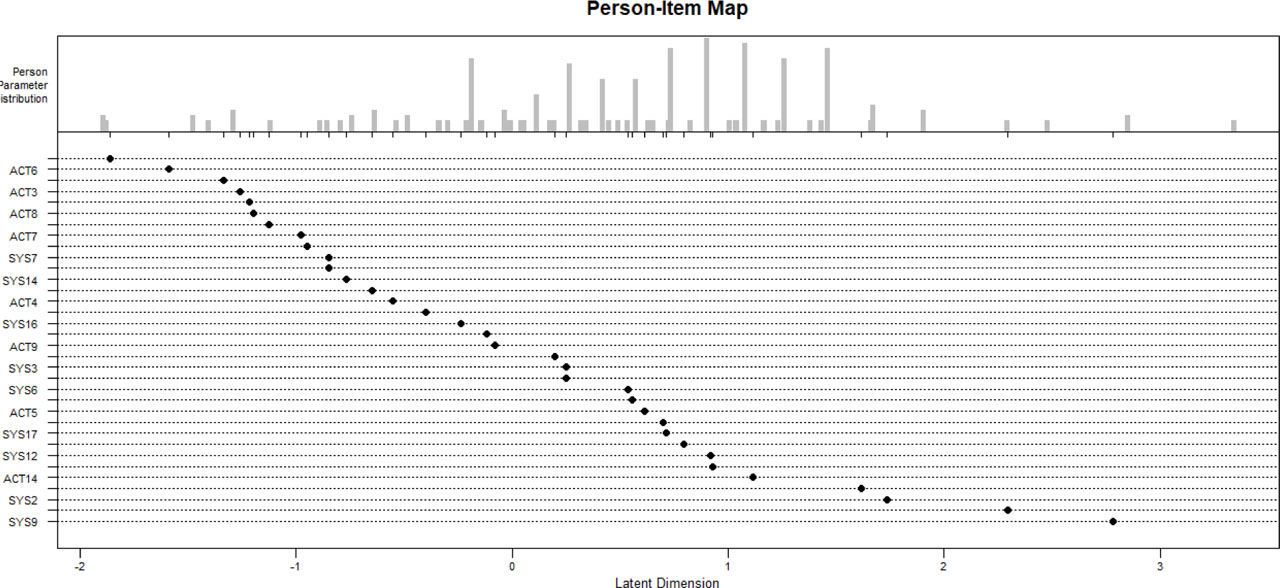
Figure 2:
Person-Item Map of system- (SYS) and action-related knowledge (ACT). Black dots represent the knowledge items. Grey bars represent the estimated person distribution.
Depending on grade level, adolescent students in upper secondary grades received higher scores in knowledge, expressed in person parameters, than those in lower grades (Fig. 3).
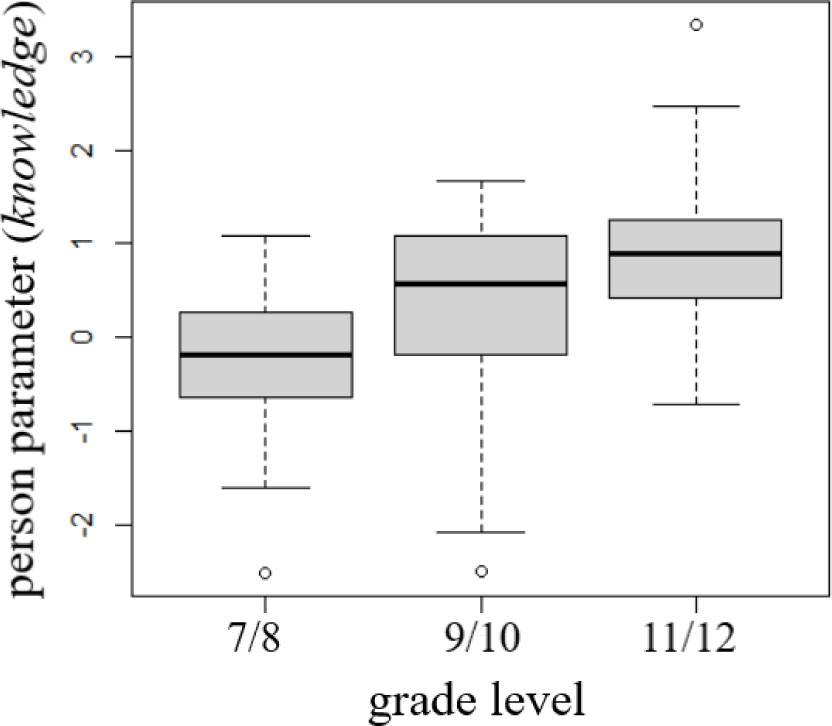
Figure 3:
Students’ person parameters by grade level
Values
The principal component analysis of 20 items yielded three components corresponding to preservation (PRE), appreciation (APR) and utilization (UTL) (Bogner, 2018). The Kaiser-Meyer-Olkin (KMO) value was .70, indicating moderate sampling adequacy (Kaiser & Rice, 1974). Cronbach’s alpha was 0.72 for PRE (6 items), 0.47 for APR (7 items), and 0.45 for UTL (7 items). While PRE showed acceptable internal consistency, APR and UTL showed low internal consistency. Results involving these two subscales should therefore be interpreted with caution. Across the latent variable of knowledge, high achievers (higher logit scores) attained higher scores than low achievers (lower logit scores) regarding values to protect the environment. We observed that females tended to want to protect the environment (higher values score) whereas males tended to exploit the environment (lower values score).
Interest in SDGs in relationship with knowledge and values
We calculated students’ mean scores for individual interest, which exceeded 3.5 across all grades. Comparisons showed that females are more interested in social SDGs (e.g., SDG_1_poverty) whereas males are more interested in economic SDGs (e.g., SDG_9_industry, innovation, and infrastructure). The interest in SDGs was generally high, with scores above average. Only a few items showed lower scores in our target groups’ individual interest, such as ‘Life on land (SDG 15) - Threats to diversity’. However, their knowledge of diversity was higher than their interest. In this case, the grade level was an important factor. The average in lower grades, e.g., 7/8 (M = 0.35), in system knowledge tended to be lower, while 11/12 graders yielded a better score (M = 0.59). The same applies regarding action-related knowledge (grade 7/8: M = 0.48; grade 11/12: M = 0.68).
Modeling knowledge, values and individual interest
For our model, we used Rasch person estimates for knowledge and subscale mean scores for environmental values (PRE, APR, and UTL) and individual interest regarding the SDGs (United Nations, n.d.), grouped into social, ecological, and economic categories. Confirmatory factor analysis (CFA) showed positive correlations between knowledge and values (ξ = .65, p = .006), values and individual interest (ξ = .85, p < .001), and knowledge and individual interest (ξ = .39, p = .001) (Fig. 4). We evaluated model fit using several indices: χ2(17) = 43.520, p < .001, RMSEA = 0.095, SRMR = 0.07, and CFI = 0.935. The fit indices provided mixed evidence of model fit: SRMR and CFI met the predefined criteria, whereas RMSEA exceeded the threshold of .08.
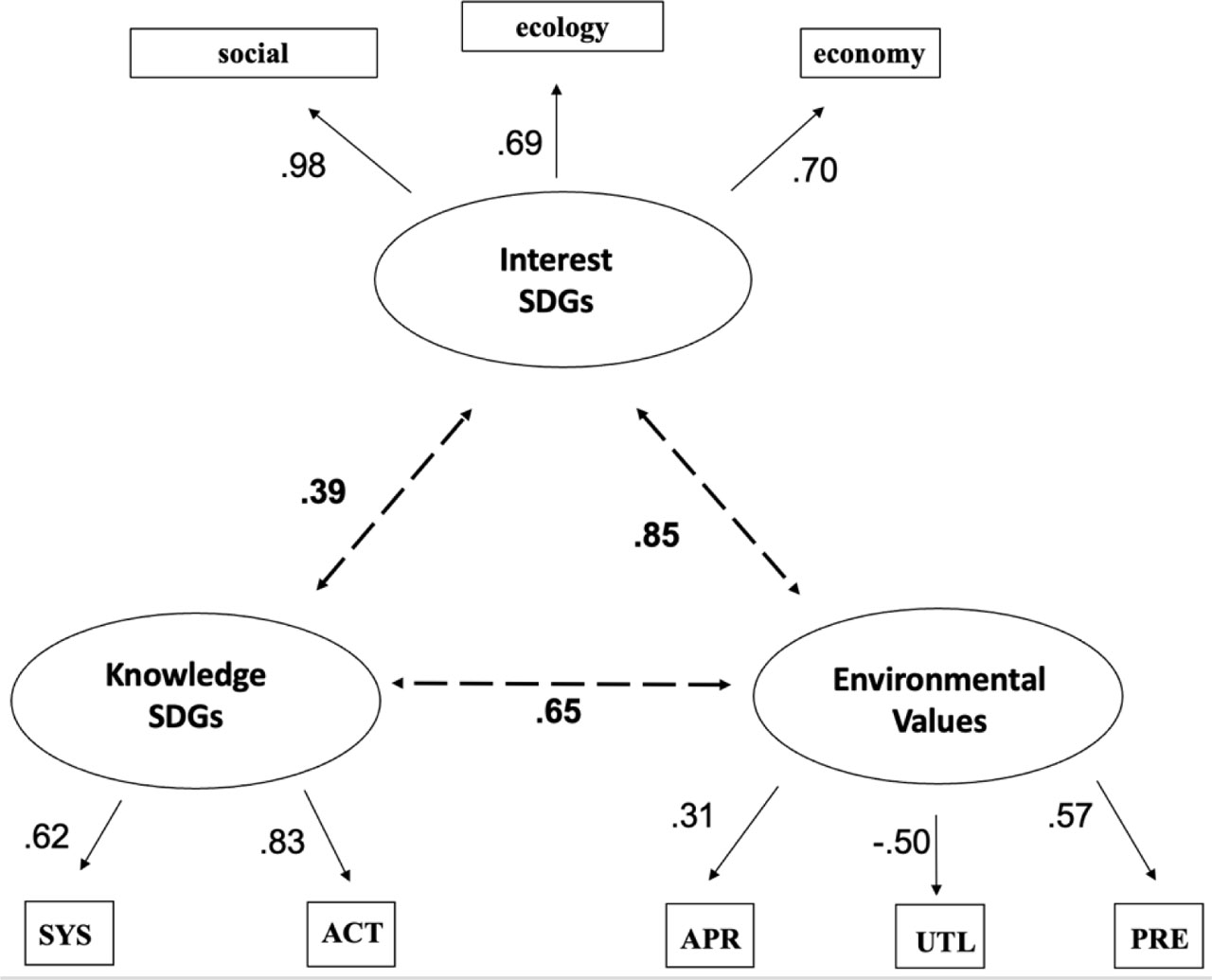
Figure 4:
Path analysis of knowledge, values and interest. Solid arrows represent standardized factor loadings; dashed double-headed arrows represent correlations between the latent variables.
As illustrated in Figure 4, the model shows positive relationships between all three constructs. The standardized coefficients (ξ) indicate the strength of these relationships: environmental knowledge is positively related to environmental values (ξ = .65), and environmental values show a particularly strong positive relationship with individual interest (ξ = .85). The relationship between environmental knowledge and individual interest is positive but weaker (ξ = .39). Thus, adolescents with higher environmental knowledge tend to report stronger environmental values and greater individual interest, while the closest relationship in the model is observed between environmental values and individual interest.
Content-related evaluative and emotional meaning (connotations) of ‘sustainable’
First, the content-related evaluative associations were analyzed. Adolescent students (N=153) predominantly connect ‘sustainable’ with ecological (N=85) and economic (N=69) associations and less so with social associations (N=24). Multiple coding was possible, as individual responses could be assigned to more than one category. Among ecological associations, the category ‘nativeness’ (N=24) is the most common, representing originality, health, cleanliness, and generally something good for people and nature. Among economic subcategories, ‘recyclability’ (N=22) dominates, for example, in terms of repairing rather than buying new goods. The term ‘preserving resources’ is most represented among social associations (N=7). This refers to conserving natural resources to ensure their availability for future generations. In terms of emotional connotations, ‘sustainable’ is predominantly associated with positive emotions (N=109) such as hope, relief, or peace; negative emotions, like apathy or fear of the future, were less frequently mentioned (N=8). ‘Responsibility’ (N=6) has been included as a neutral connotation, as it can include positive effects in terms of action and negative ones in terms of fear of being overwhelmed. The remaining 30 responses did not contain an identifiable emotional association.
4. Discussion
School systems in Germany and abroad are generally faced with the transformative task of anchoring sustainable development in subject-specific learning within the classroom. The earlier students are introduced to the topics and problems of sustainable development, the more natural their later critical and committed approach to the major political, ecological, economic and social challenges of our time will be. In German schools, the ESD theme is integrated via various decrees, primarily involving STEM subjects. For example, the curriculum of Lower Saxony illustrates this development by embedding ESD across all school types and subjects through the 2021 ESD decree (Niedersächsisches Kultusministerium, 2021). Further consideration is being given to integrating ESD into foreign language studies, in a meaningful and non-superficial way. This is also in line with the whole institution approach, which focuses on the entire institution of the school (or university) when implementing the ESD theme. At German schools abroad, this is often achieved through school partnerships, usually multinational ones, which organize ESD-related exchanges and projects. This study investigated the knowledge, values, and interests of students in Brazilian PASCH schools implementing ESD.
Modelling knowledge, values and individual interest
The findings suggest that integrating ESD objectives into foreign language lessons may support the development of action-related knowledge. In our model, however, the correlation between individual interest and knowledge was lower. This is consistent with the fact that higher knowledge does not automatically lead to higher interest (Krapp & Prenzel, 2011). In contrast to studies in European countries with adolescent students (see Introduction chapter), the two orthogonal factors of values (conservation and use) are different for Brazilian adolescents in this study. This indicates that interest alone does not guarantee higher knowledge levels. It appears that students in higher grades have a greater awareness of nature (evidenced by lower ‘use’ values) compared to those in lower grades. Adolescents in European countries are more likely to protect the environment in lower grades (low values for use) and only use nature in adolescence (higher values for use) (Maurer et al., 2020; Raab et al., 2018). In general, our model shows a strong correlation between values and individual interest. Several studies have shown that female adolescent students showed greater interest than males; in our result, females showed greater interest in social SDGs, whereas males showed greater interest in economic SDGs. While the topics of the ecological SDGs achieved higher values in lower grades, these decreased in the higher grades (e.g., SDG 15 ‘Life on land’). To protect biodiversity, topics relating to SDG 15 should be covered more, e.g., in (foreign language) lessons for this target group. As mentioned in the introduction, knowledge appears to be the key to action. Dopelt et al. (2019) found that the students they surveyed had knowledge gaps regarding the environmental impact of food consumption and difficulties in assessing environmentally friendly behaviors. In our study, we focused on knowledge and interest regarding the 17 SDGs. The findings provide a basis for the further development of ESD-oriented DaF teaching, including future learning activities developed together with teacher education students. Several limitations should be considered when interpreting these findings. Due to the cross-sectional design, the relationships identified between knowledge, environmental values, and individual interest cannot be interpreted as causal or as developmental changes over time. Furthermore, the study was conducted with students from selected Brazilian PASCH schools; therefore, the findings cannot be generalized to Brazilian adolescents as a whole. Future longitudinal studies could examine how these relationships develop over time.
Connotations of ‘sustainability’ of Brazilian adolescent students at PASCH schools
Regarding the connotations of ‘sustainable,’ students associate the term with positive aspects. This finding complements the quantitative results of the present study by providing insight into how students subjectively conceptualize sustainability. The predominance of ecological and positive associations suggests that sustainability is linked not only to environmental issues but also to personally meaningful ideas and emotions. They primarily associate negative connotations with fear of the future. This also corresponds to the current discourse about ‘generation Z scared of the future’. Anxiety and distress about the ecological crisis seem to be a rapidly growing phenomena (Pihkala, 2020). Primarily, ecological associations arise in connection with words such as climate, nature conservation, health, and nativeness. Social aspects tend to have fewer associations compared to ecological ones. However, when asked directly, Brazilian students prefer, for example, the construction of roads leading to schools, even if it is at the expense of nature (item of the 2-MEV+APR). In contrast, European students prefer not to build more roads (Maurer & Bogner, 2022; Raab et al., 2018). This reflects the different development paradigms of the countries, highlighting the necessity to consider social and cultural aspects. The connotation analysis indicates that students predominantly conceptualize sustainability as an ecological rather than a multidimensional concept. Although sustainability comprises ecological, economic, and social dimensions, spontaneous associations focused mainly on environmental protection (e.g., ecologicamente correto/ecologically correct, proteção dos recursos naturais para o futuro/protection of natural resources for future generations), renewable energy (e.g., energia limpa/clean energy, energia renovável/renewable energy), and positive future-oriented values such as hope and responsibility (e.g., Esperança/hope, equilíbrio/balance). Social aspects, such as justice or equality (e.g., justiça/justice, igualdade/equality), were mentioned considerably less often. This suggests that future ESD-oriented DaF teaching could place greater emphasis on making the social dimension of sustainability more explicit. If social issues like equity (even in the sense of having good access to school) are not resolved, it will be difficult to focus on ecological goals, even if ‘sustainable’ is considered something positive.
5. Conclusion
The results of this study provide an overview of environmental competencies and individual interest in ESD topics from Brazilian adolescent students at PASCH schools. Unlike most previous studies conducted in STEM education, the present study focused on ESD in the context of German-as-a-Foreign-Language (DaF) teaching, where language learning and sustainability-related content are integrated through a soft CLIL approach. Knowledge levels were higher in the upper secondary grades than in the lower grades. Our model identified a strong relationship between knowledge and values, a strong relationship between values and individual interest, and a weaker relationship between knowledge and individual interest. The mean score overall for this target group regarding the system (SYS)- and action-related knowledge (ACT) is very positive. The estimated person parameters indicated a satisfactory level of knowledge. Individual interest regarding the SDGs differs by age and sex (female students are more interested in social topics, whereas male students are more interested in economic topics). Promoting environmental awareness in early childhood is critical to influencing the values of students as they grow up. Notably, the content-related evaluative and emotional connotations Brazilian adolescent students associate with the term ‘sustainable’ may differ from those of students in other countries due to differences in everyday experiences (e.g., road and rail infrastructure, poverty in favelas). These factors may help explain the differences in social and economic interests observed in this study. A follow-up study with adolescent students from a wealthy country (e.g., Switzerland or Germany) could offer differences and similarities, especially when students from different PASCH schools (e.g., in Brazil and Germany) work on the same projects (e.g., Müllauer, 2019). In principle, teaching materials need to be adapted to the target group, for example in the area of sustainability, which is perceived differently by young Brazilians than by young Europeans. Accordingly, the SDGs provide an important framework for ESD but should also be discussed critically in educational settings. Future DaF teaching should therefore not only promote knowledge of the SDGs but also encourage learners to reflect critically on their underlying assumptions and possible limitations.
6. Conflict of Interest
The authors declare no conflict of interest.
7. Acknowledgments
The authors are grateful to all participating students for their time and engagement in this study. We sincerely thank Juliane Müller de Acevedo for facilitating contact with the participating PASCH schools and for her valuable input on the PASCH-related sections of the manuscript.
8. Funding
The authors’ positions were funded through the Qualitätsoffensive Lehrerbildung (grant number 01JA1913), a joint initiative of the German Federal Government and the Länder aimed at improving the quality of teacher education. The program was funded by the German Federal Ministry of Education and Research. The authors are responsible for the content of this publication.