
1. Introduction
The concept of Education for Sustainable Development (ESD) is considered to have a central role in effectively addressing current and future societal challenges such as climate change, global disparities, and poverty (UNESCO, 2021a). ESD follows an action-oriented and innovative educational approach that aims to empower learners worldwide to develop knowledge, awareness, and skills to actively participate in the sustainable transformation of society (UNESCO, 2021b). Since 2020, the UNESCO program “Education for Sustainable Development: Towards achieving the SDGs (ESD 2030)” has been emphasizing the importance of education as the key to achieving the 17 sustainability goals of the 2030 Agenda (UNESCO, n. d.). Teachers in educational institutions thus play a particularly important role, as they are regarded as primary change agents who both impart knowledge and actively contribute to the transition toward a sustainable society (Mittrach & Meyer, 2023). They are expected to teach students specific ESD-related competencies, such as systems thinking, strategic action, collaboration, critical thinking, and self-reflection (UNESCO, 2017). Fulfilling this responsibility requires not only embedding ESD in the school curriculum but also consistently integrating it into teacher training across all subjects. In this context, Open Educational Resources (OER) have been identified by UNESCO (2022) as a valuable tool for promoting the principles of ESD, while also supporting the provision of high-quality, inclusive, and equitable education. OER are teaching and learning materials that are freely accessible and modifiable. They align with key principles of ESD, such as access to education, participation, and equal opportunities (UNESCO, 2019). They could play an important role in the second phase of teacher training in Germany, since the openness and flexibility of OER would benefit both teacher trainers and trainee teachers (Farrow, 2017; Farrow et al., 2024; Wyss, 2024) (Note: Teacher training in Germany is divided into three phases: the first phase (university education), the second phase (practical phase with training elements at teacher training centers), and the third phase (continuing education for teachers)).
Teacher trainers (known in Germany as “Fachseminarleiter” or “Seminarleiter”) can purposefully use OER to convey subject-specific and didactic ESD knowledge, structure learning processes, and integrate ESD topics into teacher training. By employing open materials, they can adapt high-quality resources for seminar sessions, share them, and collaboratively develop them further with trainee teachers. This approach allows for greater individualisation of learning, as the materials can be flexibly adapted to suit the specific needs and interests of the trainees. In this way, OER can encourage a culture of cooperative learning in teacher training programs and help to establish ESD as an interdisciplinary principle.
Teacher trainers play a key role in this process as multipliers, as they directly influence how ESD is implemented and experienced in seminars. Despite their fundamental role, the implementation of ESD in the second phase of teacher training in Germany has not been analysed in depth. There is also a lack of systematic analysis of the extent to which OER are integrated into teacher training institutes for practical training after university. Therefore, the present study aims to:
analyse how ESD is used in different teacher training institutes in Germany,
survey how teacher trainers assess the relevance of ESD in the training program of trainee teachers, and
examine the extent to which teacher trainers assess the potential of OER in the context of ESD.
For this purpose, a quantitative survey was conducted as part of the OERLe project (Participatory Design of OER and OEP in the Second Phase of Teacher Education – Using Education for Sustainable Development as an Example, https://bne-oer.de/oerle/), which is funded by the German Ministry of Education, involving 75 teacher trainers from various locations in the federal states of North Rhine-Westphalia, Brandenburg, and Saxony-Anhalt. In order to structure the data more effectively, we developed a model that provides a basis for discussing the implementation of ESD. As there is limited theoretical and empirical research on ESD in the second qualification phase, the model was primarily developed based on elements of the Whole-Institution-Approach (Hargis et al., 2021; Holst, 2023; Holst et al., 2024; Holst et al., 2025; Kratzert & Salmen, 2024; UNESCO, 2017). Relevant guidelines from the ministries of education were also considered to define the structure and levels of implementation (lpb, n. d.; MSB NRW, 2019).
In the following, we first outline the potential ways in which ESD can be integrated into the different phases of teacher education in Germany. Considering all phases enables us to contextualize the second phase within the broader continuum of ESD implementation. We will then present the model that we have developed. Finally, we will present the survey that we have prepared and discuss the selected results.
2. ESD in teacher education in Germany
This chapter provides an overview of the integration of ESD across the three phases of teacher training in Germany, outlining both the structure of each phase and the current state of empirical research on ESD implementation. Following this overview, the subsequent section will focus on the second phase and introduce a model outlining how ESD could be embedded within it.
2.1. ESD across the phases of teacher education
Due to federal structures, the federal states of Germany develop their own curricula and training regulations, which means that approaches such as ESD vary in the extent to which they are considered in teacher training (KMK, 2017; 2024).
However, teacher training in all federal states generally follows the same three-phase model (Rieckmann & Holz, 2017): university education (first phase), trainee teacher program (second phase) and in-service training and professional development (third phase). Each of these phases offers specific starting points for integrating ESD to promote the continuous professionalization of prospective and practising teachers.
In the first phase of teacher education at universities, an increasing trend toward the inclusion of ESD can be observed, supported by approaches such as interdisciplinary courses, service-learning formats and cross-disciplinary projects (Budke & Vasiljuk, 2024; Lindau & Bremer, 2025). However, ESD is often not adequately integrated into curricula, and subject-specific didactic concepts for teaching ESD competencies need further development. A recent analysis of the module handbooks and examination regulations of the 20 German universities with the highest number of teaching graduates reveals significant variations in the integration of ESD between institutions and subject areas (Brock & Holst, 2022). These findings highlight the importance of subject didactics. Although universities increasingly include ESD in formal documents, it often remains treated as an external add-on, leaving the fundamental structures of teacher education largely unchanged (Holst et al., 2024). In addition, numerous studies have investigated various aspects of ESD integration in this initial phase, including teacher students’ perceptions of sustainability and ESD (Hinze et al., 2024), the professional development of university lecturers (Ruckelshauß & Siegmund, 2024), and the ongoing need for professionalization regarding ESD knowledge among students (Baumann et al., 2023; Bröll & Haustein, 2023).
In the second phase of teacher training, which is the focus of this article, ESD is primarily integrated through practical school-based training at seminar centers (MSB NRW, 2019). The extent and form of implementation vary widely, depending on the respective course locations and teacher trainers (MSB NRW, 2019). Subject-related courses (e.g. Geography, German, Biology, etc.) offer the opportunity to address ESD in the context of the respective subject didactics and to transfer it to everyday teaching in a practical manner. In educational courses (in German: Haupt- und Kernseminar), ESD-related topics are often addressed as part of school development processes or in relation to fundamental pedagogical issues. In principle, ESD should be regarded as a cross-cutting topic in both subject-specific and educational seminars (MSB NRW, 2019). However, there are currently no binding guidelines specifying how ESD should be integrated into seminars. Some teacher training seminars have begun to implement ESD following a Whole-Institution-Approach (Holst, 2023; Kratzert & Salmen, 2024), in which sustainability is embedded holistically across all aspects of the institution. This includes teaching practices, organizational structures, infrastructure, training culture, mission statements, and cooperation with the wider community. While other teacher training seminars have included ESD in their training regulations, its practical implementation often depends on the initiative of individual trainers (KMK, 2017). Unlike the first qualification phase, there has only been limited empirical research on the second phase to date. Although the results of a nationwide survey on the integration of ESD in the various phases of teacher training are available, these are based on self-reported data from the federal states and only provide a rough, state-centered overview of the formal integration of ESD (KMK, 2017).
In the third phase, state institutes, NGOs, and foundations are increasingly offering training programs on ESD for the professional development of teachers already in active employment (GES, n. d.; NUA, n. d.; Akteursplattform BNE, n. d.). However, there are hardly any empirical studies on this phase of teacher training either.
The integration of ESD into teacher training is currently characterised by a fragmented structure. Although the Standing Conference of the Ministers of Education and Cultural Affairs (KMK) recommends embedding ESD across all phases of teacher training (KMK, 2024), survey data from the federal states show substantial variation in how ESD is integrated into both the initial and the preparatory phases of teacher education (KMK, 2017). The offering of professional development related to ESD varies greatly in the third phase, influenced by state-specific conditions and the organizational structures of the respective institutions (KMK, 2017). Moreover, the three qualification phases - university education, preparatory service, and in-service training - operate largely independently of one another, making it difficult to systematically and coherently develop ESD-related competencies. Cross-phase collaboration, which would be particularly beneficial in light of the ongoing digitalization of education, has not yet been fully realized (Eckstein, 2022).
As shown, there is little concrete information on how ESD is implemented in everyday courses or integrated into second-phase curricula. Similarly, empirical insights into the professional practices of teacher trainers are limited. However, teacher trainers play a key role in the implementation of ESD in the second phase of teacher training. They have considerable freedom in terms of content when organising their courses and decide how it is embedded, and which pedagogical approaches are used. Consequently, surveying teacher trainers is essential for gaining insight into the implementation of ESD, its degree of curricular integration, and the conditions that enable or hinder its implementation.
The aim of this study is therefore to examine how ESD is actually implemented in various teacher training centers in Germany – particularly in North Rhine-Westphalia, Brandenburg, and Saxony-Anhalt. For this purpose, a model was developed that theoretically illustrates various ways of integrating ESD into the second phase of teacher training and is presented in the following chapter.
2.2. Ways to implement ESD in the second phase of teacher training
International evidence highlights persistent barriers to integrating Education for Sustainable Development (ESD) into teacher education, although the existing research has focused predominantly on initial teacher education at universities. Across five European countries, ESD implementation remains fragmented, optional, and institutionally inconsistent. Key barriers include curriculum overload, rigid ECTS structures, disciplinary competition, and insufficient educator expertise, despite strong policy support from UNESCO and the European Union (Supple et al., 2025). In Germany, challenges include the fragmentation of teacher education across different phases, limited ESD expertise among teacher educators, inconsistent understandings of ESD, and weak political coordination, resulting in ESD often being treated as an additional rather than an integral component of teacher education (Christoforatou, 2021). Similarly, in South Africa, inconsistent curriculum integration, the absence of a coherent national framework, and inadequate in-service teacher training hinder the implementation of ESD (Olawumi & Mavuso, 2024). In India, insufficient preparation of teacher educators, rigid pedagogical traditions, institutional constraints, and limited educational resources remain major obstacles despite supportive national policies (Kazirul, 2025). Likewise, teacher educators in Pakistan identify insufficient institutional support, limited funding, time constraints, scarce instructional resources, and low awareness of ESD as key barriers to preparing pre-service teachers for sustainability education (Khadim et al., 2023). A systematic review by Pegalajar-Palomino et al. (2021) further demonstrates that, despite increasing efforts to integrate sustainability into teacher education curricula, substantial deficits remain in developing the professional competencies required to implement ESD effectively in teaching practice. A broader review of 158 peer-reviewed studies further characterizes Teacher Education for Sustainable Development (TESD) as a rapidly growing research field that extends beyond curriculum integration by addressing learning environments, learner characteristics, learning outcomes, institutional transformation, and future visions for teacher education (Fischer et al., 2022).
Given that the implementation of ESD in teacher education involves multiple actors, institutions, and governance levels, these findings point to the need for a framework that captures this complexity. As this study focuses on the second phase of teacher education in Germany (the preparatory service following university-based teacher education), we propose using a multi-level implementation model to analyse how ESD is embedded.
We developed a model to conceptualize how ESD can be implemented, illustrating the different possible ways of integration in this phase of training (see Figure 1). During this process, we identified several implementation levels based on the Whole-Institution-Approach (Hargis et al., 2021; Holst, 2023; Holst et al., 2024; Holst et al., 2025; Kratzert & Salmen, 2024; UNESCO, 2017). We used different elements of this approach to define and structure these levels. We also considered guidelines from ministries of education to inform the model’s structure further (lpb, n. d.; MSB NRW, 2019).
While the Whole-Institution-Approach serves as the overarching conceptual foundation of our model, we acknowledge that a range of conceptual approaches to ESD implementation in teacher education has been proposed. Many of these frameworks, including CSCT, KOM-BiNE (Rauch & Steiner, 2013), the UNECE teacher competence framework, the RSP (A Rounder Sense of Purpose) framework (Scherak & Rieckmann, 2020), the EduSTA framework (Němejc et al., 2024), and more recently the CoDesignS framework (Ahmad & Ibahrine, 2025), primarily focus on defining the sustainability competencies that teachers or teacher educators should acquire and on supporting their professional development. These competence-oriented perspectives are explicitly incorporated into our model at the course level, where ESD competencies are developed through teaching and learning activities, and at the curricular level, where they are systematically embedded in curricula. However, competence development alone does not capture the institutional conditions required for the sustainable implementation of ESD. We therefore adopted and further developed the Whole-Institution-Approach because it additionally addresses structural and organizational dimensions, including institutional mission statements, examination regulations, curriculum structures, the qualification and professional development of teacher educators, interdisciplinary collaboration, institutional communication, and cooperation with external partners. These dimensions are reflected in the higher implementation levels of our model (integrative, network and cooperation, and institutional level), providing a comprehensive framework for analysing the implementation of ESD in the second phase of teacher education in Germany.
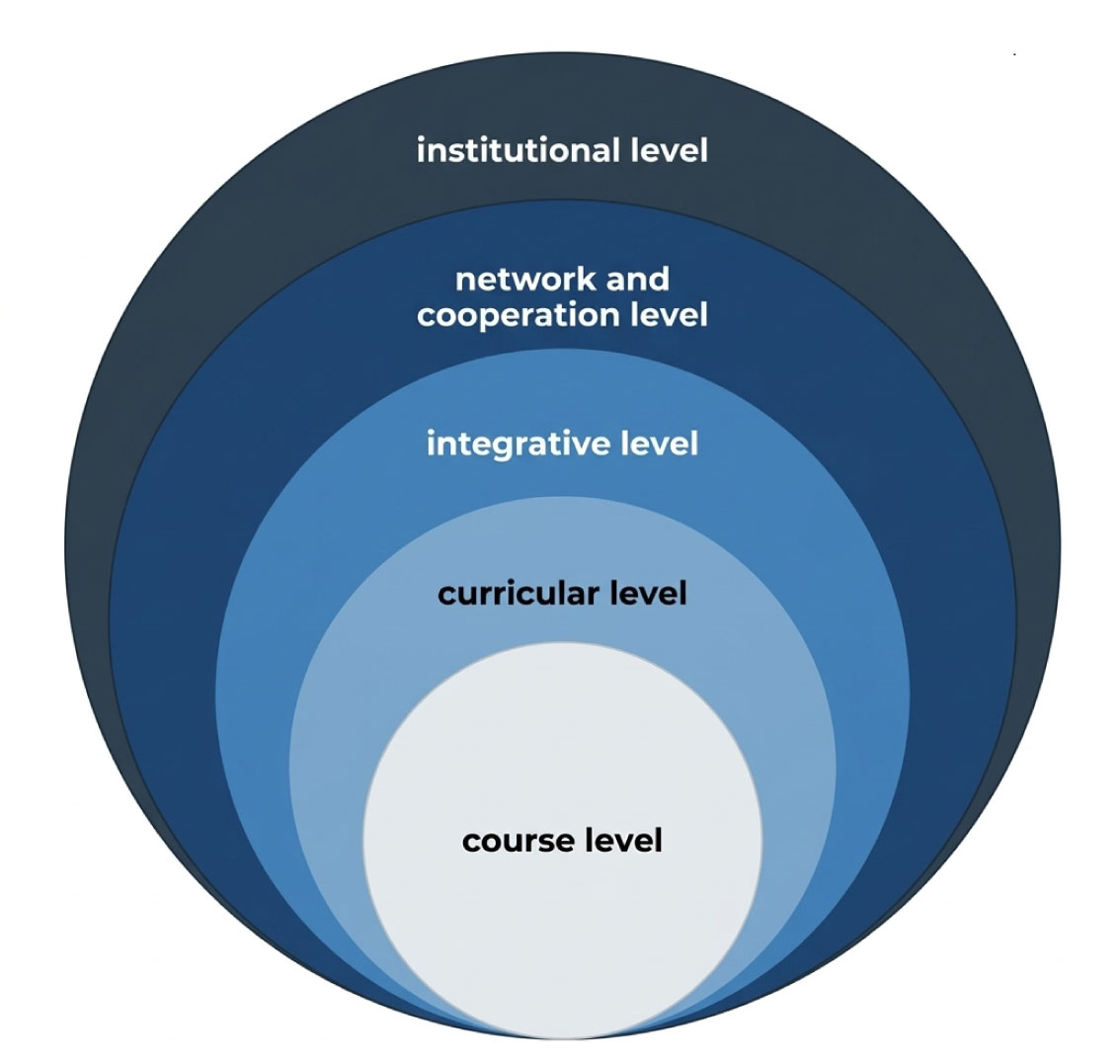
Figure 1:
Implementation of ESD at various levels in the second phase of teacher training (own design)
The model has five levels, with each lower level included in the one above it. The first two levels primarily address the development and systematic embedding of ESD competencies. The higher levels extend beyond competence development by addressing the organizational and structural conditions required for the sustainable implementation of ESD. These levels are briefly explained below with examples.
At the course level, teacher trainers implement ESD in their courses for trainee teachers according to their own interests, commitment, and expertise. At this level, trainee teachers acquire ESD-related knowledge, skills, values, and competencies through teaching and learning activities. Foundational principles may include approaches that define competencies for pre-service teachers (e.g., Budke & Vasiljuk, 2024, p. 318; Scherak & Rieckmann, 2020), but these must be adapted to the second phase of teacher education. In contrast to university education in Germany, which aims to impart both subject-specific and pedagogical ESD competencies, the focus in the second phase of teacher education is on the practical teaching and application of appropriate didactic approaches for teaching ESD. Quality-assured OER teaching materials can be very helpful in the teaching process.
At the curricular level, ESD is an integral part of the training program and examination regulations and is embedded across all subjects (e.g., Geography, German, Biology).
Consequently, all training programs include mandatory ESD-related modules, learning objectives, and assessment formats that systematically foster the development of ESD competencies, and all teacher trainers consider ESD in their seminar planning. Due to the decentralized structure of teacher education in Germany, the curricula must be adapted separately at each training location.
At the integrative level of the model, ESD is regarded as a connecting topic in pedagogical, subject-specific didactic and practical school components in the context of teacher training in the second phase. This takes place at a teacher training institution where student teachers take at least two subject-specific courses that they have already studied at university, as well as a course in educational science.
At the network and cooperation level, training institutions for the second phase of teacher education enter into partnerships with universities (first-phase training institutions) and schools where student teachers are gaining practical experience. Together, they coordinate the training content with regard to ESD. Additionally, NGOs, local authorities and companies may be part of the ESD network. Open educational practices (OEP) and collaboratively developed teaching materials (OER) can reinforce this network and strengthen cooperation. This level helps to ensure that ideas from the practice (e.g., from schools, universities, or NGOs) are integrated into the courses and vice versa. For instance, there is potential for collaboration with universities on research in the field of ESD, or the establishment of regional ESD networks, wherein teacher trainers, schools, teachers, and external partners collaborate on the development and monitoring of projects.
Finally, ESD is comprehensively embedded in the teacher training institution at the institutional level, i.e. in accordance with the Whole-Institution-Approach as a guiding principle, attitude, and part of the training standards (Hargis et al., 2021; Holst, 2023; Holst et al., 2024; Holst et al., 2025; Kratzert & Salmen, 2024). All employees, including those in administration, management, seminar leadership, trainee teaching, and custodial roles, have a shared understanding of ESD as an integral component of their professional identity.
These include, amongst other things, guiding principles, measures to improve the qualifications of trainers, institutionalised exchange of experience and quality assurance within the institution, as well as the exchange of information and cooperation with universities and schools.
The model presented here is intended to provide a framework for organizing the collected data and for analyzing the degree to which ESD is implemented in the second qualification phase of teacher education in Germany.
3. Methodology
At the start of the “OERLe – Participatory Design of OER and OEP in the Second Phase of Teacher Training – Using the Example of Education for Sustainable Development” project (https://bne-oer.de/oerle/), a needs analysis was conducted with trainers in the second phase of teacher training. Selected items from this survey that contribute to achieving the objectives of this work are presented below.
3.1. Sampling
Teacher trainers from North Rhine-Westphalia, Brandenburg and Saxony-Anhalt participated in the survey who provide students with practical training, who have already completed a Master’s degree in teacher training.
The invitation to participate was passed on to the participants via the management level of the training centers. Consequently, we had no direct influence on the number of teacher trainers who participated from the respective teacher training centers. The teacher training centers in Bonn, Dortmund and Halle were particularly well represented. Other participants worked at the teacher training centers Bernau, Magdeburg, Solingen and Potsdam.
The participants trained teachers in 18 different subjects for teaching in primary, secondary, comprehensive, high, and vocational schools (see table 1). A total of 75 teacher trainers were surveyed. The teacher trainers’ ages ranged from 32 to 63, with an average of 49.
Table 1:
Characteristics of the respondents N=75 (Some of the terms relating to functions or types of school in Germany are in German to make the information easier to understand)
| Characteristics of the teacher trainers surveyed | N | % |
|---|---|---|
| Gender | ||
| Male | 22 | 29,3 |
| Female | 33 | 44 |
| No answer | 20 | 26,7 |
| Federal state in Germany | ||
| North Rhine-Westphalia | 37 | 49,3 |
| Saxony-Anhalt | 18 | 24 |
| Brandenburg | 2 | 2,7 |
| No answer | 18 | 24 |
| Role at the Teacher Training Center (the second phase of teacher training following a university degree in Germany) | ||
| Kernseminarleiter*in/ Hauptseminarleiter*in (Core seminar leader) | 15 | 20 |
| Fachleiter*in/ Fachseminarleiter*in/ Fachausbilder*in (Subject trainer) | 35 | 46,7 |
| Head of the Teacher Training Center | 1 | 1,3 |
| Other | 4 | 5,3 |
| No answer | 20 | 26,7 |
| Type of school for which training is provided | ||
| Primary school | 15 | 20 |
| Haupt-, Real-, Gesamtschule (secondary schools) | 14 | 18,7 |
| Gymnasium (high school) | 22 | 29,3 |
| Vocational school | 1 | 1,3 |
| No answer | 23 | 30,7 |
| Subjects | ||
| German | 7 | 9,3 |
| Educational Sciences/Pedagogy | 13 | 17,3 |
| Biology | 5 | 6,7 |
| English | 4 | 5,3 |
| Other (music, geography, politics, sports, general studies) | 11 | 14,8 |
| No answer | 21 | 28 |
The study of this group of respondents is particularly relevant, as they act as multipliers who are in contact with many future teachers and, through their practical training, have a key influence on the implementation of both ESD and OER.
3.2. Survey
Data were collected between August and November 2024 using an online questionnaire. The seminar leaders rated 41 items using a four-point Likert scale. Twenty of these items are relevant to the objectives of this study. These items can be divided into three topics: ‘Integration of ESD into the second phase of teacher training’, ‘Dealing with open educational resources (OER) in the second phase of teacher training’, and ‘Potential and obstacles in the use of OER in the second phase of teacher training’. The individual items are shown in Table 2.
Table 2:
Items used in the survey, which were rated by respondents on a four-point Likert scale (strongly agree; agree; disagree; strongly disagree; don’t know).
| Topic | Item |
|---|---|
| Integration of ESD into the second phase of teacher training | The integration of education for sustainable development (ESD) into teacher training is highly relevant to me. |
| Implementing ESD is the responsibility of individual trainers/coaches. | |
| ESD is implemented by trainee teachers in a compulsory project. | |
| At my teacher training center, there are ESD advisors who support me in implementing ESD. | |
| ESD is implemented in every seminar through the curricula of our teacher training center. | |
| ESD is structurally integrated throughout my entire teacher training college (Whole-Institution-Approach). | |
| As part of my work training trainee teachers I regularly collaborate with subject didactics experts at universities. | |
| Dealing with open educational resources (OER) in the second phase of teacher training | I consider it useful to use open educational resources in teacher training |
| I already use open educational resources in teacher training. | |
| I use open educational resources to prepare for my work in teacher training | |
| I know how to profitably implement open educational resources in teacher training | |
| I know where to find good open educational resources for trainee teacher training. | |
| Potential and obstacles in the use of OER in the second phase of teacher training | Time savings in seminar preparation |
| Expansion of the seminar content | |
| Up-to-date materials | |
| Free access to materials | |
| Lack of suitable learning units | |
| Legal uncertainty | |
| Technical barriers | |
| Difficult integration into seminar topics |
3.3. Evaluation
The results of the survey were evaluated with descriptive statistics. Each item was presented individually in graph form. Additionally, the extent to which the items correlated with each other was examined. For this purpose, all 41 items were categorised under the main headings of ESD experience, ESD interest, OER experience and OER interest, and summary indices were formed. These were then correlated with the sociodemographic data using Pearson’s product-moment correlation. This made it possible to evaluate the relationship between the test subjects’ ESD experience, ESD interest, OER experience and OER interest, and the federal states, locations of the teacher training centers, school subjects, gender and age.
To ensure methodological rigor, several quality criteria were considered during the development and implementation of the quantitative survey. Objectivity was enhanced through a standardized online survey administered under identical conditions for all participants, thereby minimizing interviewer and environmental influences. The questionnaire was pretested and reviewed by colleagues to improve item clarity and to ensure the use of appropriate terminology for subjects and institutional roles, which may vary across German federal states. Content validity was established by deriving the survey items from the literature (see Chapter 2 and the Introduction) and further supported by two qualitative interviews with teacher educators conducted during the instrument development phase. Responses were collected using a four-point Likert scale with an additional “I don’t know” option to reduce forced or biased responses. Reliability was strengthened by the anonymous online format, which minimized social desirability bias and enabled participants to respond independently of their social environment.
4. Results
The results are presented in three steps below. Firstly, we describe how ESD is currently integrated into the second phase of teacher training. Secondly, we describe how OER are currently used. Finally, we outline the potential and obstacles that teacher trainers perceive in the use of OER.
4.1. Integration of ESD into the second phase of teacher training in Germany
The results show that the majority of teacher trainers in the second phase of teacher training consider integrating ESD to be highly relevant. 80% of teacher trainers surveyed either agreed or strongly agreed that ESD was highly relevant to training (see Fig. 2). Most teacher trainers state that it is their responsibility to integrate ESD into their courses. However, only 28% of teacher trainers have made ESD a compulsory project in teacher training, which suggests that personal responsibility is not always translated into action. Additionally, 48% of teacher trainers report receiving support from ESD advisors. Another 48% either fully or somewhat agree with the statement that ESD is implemented in every course through the teacher training center’s curricula. 63% of teacher trainers surveyed said that ESD is structurally integrated throughout the teacher training center in the sense of a Whole-Institution-Approach. However, only 30% of teacher trainers collaborate with subject didactic experts from universities (see Fig. 2).
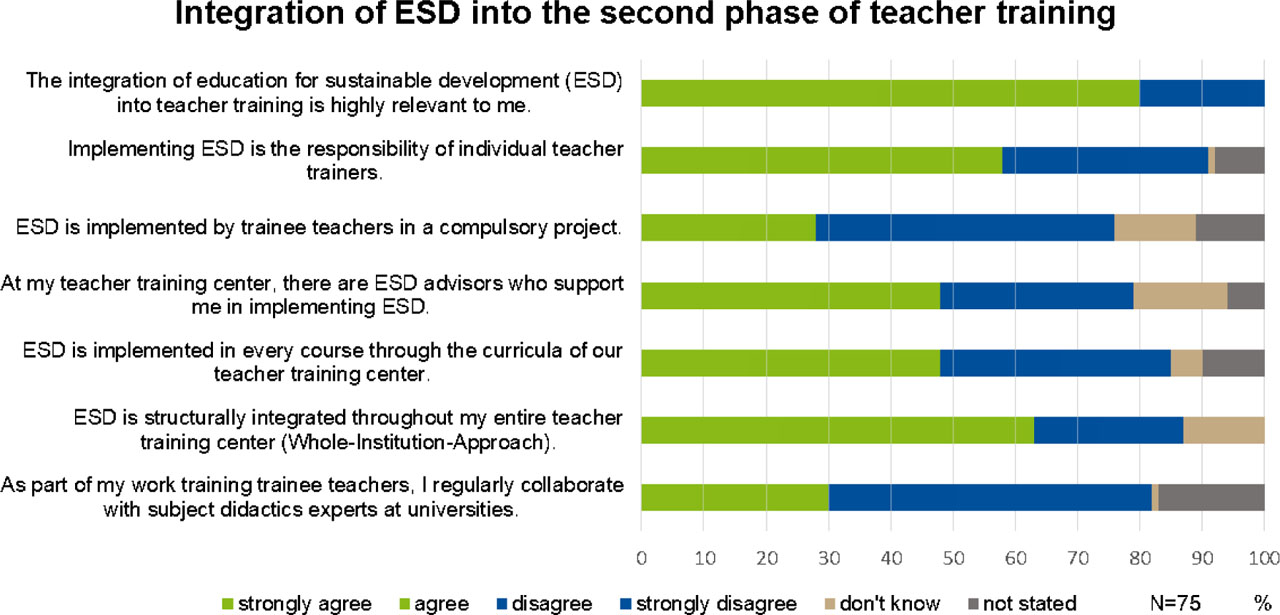
Figure 2:
Integration of ESD into the second phase of teacher training. Own illustration.
4.2. Dealing with open educational resources (OER) in the second phase of teacher training
Figure 3 shows that 66% of teacher trainers either fully or somewhat agree with the statement that it makes sense to use OER in courses. However, only 32% of teacher trainers use OER in their teaching. Furthermore, only 27% of teacher trainers use OER to prepare their own courses. Similarly, only 32% of teacher trainers say they know how to profitably integrate OER into their courses, and only 27% say they know how to find good OER for their teaching.
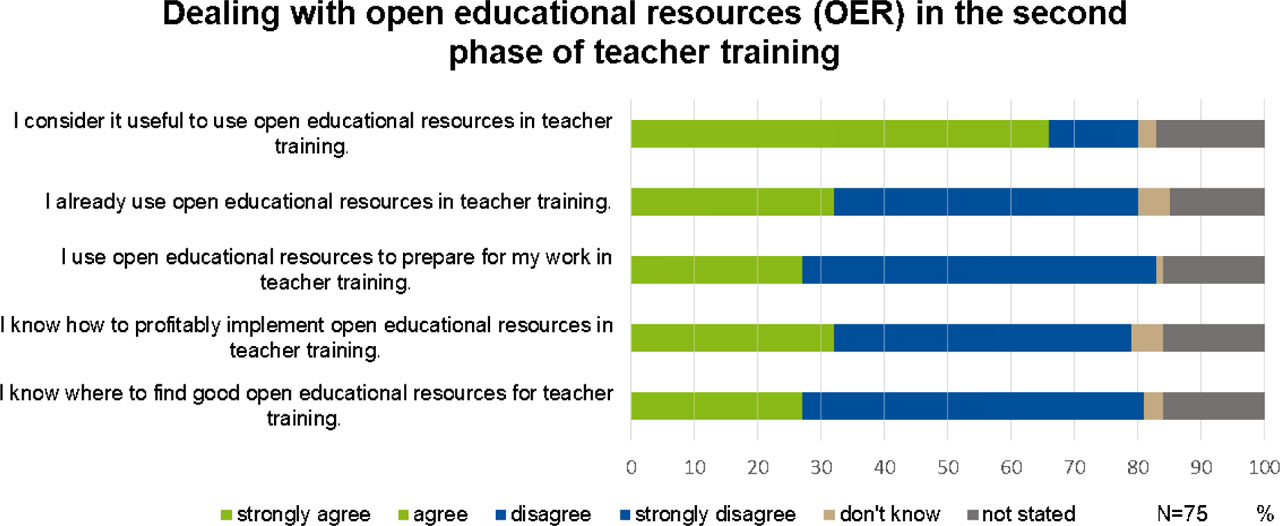
Figure 3:
Use of open educational resources (OER) in the second phase of teacher training. Own illustration.
4.3. Potential and obstacles in the use of OER in the second phase of teacher training
The respondents identified numerous advantages of OER. 62% of teacher trainers consider OER useful for preparing courses, expecting it to save time. 73% see the advantage of being able to expand course content with OER, 72% appreciate the topicality of OER materials and 82% see free accessibility as an advantage. However, teacher trainers also identified some potential obstacles to the use of OER. 50% of trainers stated that there are no suitable OER offerings for their courses. 37% feel uncertain about the legal aspects of using OER and 42% are hindered by technical issues when using OER. Additionally, 38% of teacher trainers find it challenging to integrate OER into their course topics (see Fig. 4).
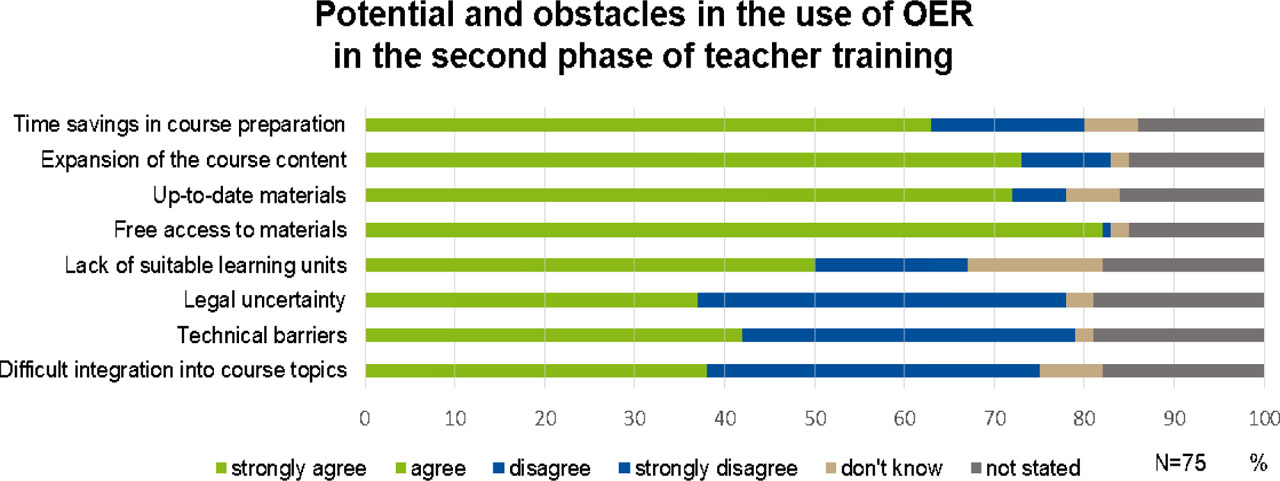
Figure 4:
Potential and obstacles in the use of OER in the second phase of teacher training. Own illustration.
Evaluating the correlations between sum indices of ESD and OER experience and interest, and sociodemographic data such as federal state, teacher training center location, school subjects, gender and age, revealed no significant correlations. There was insufficient correlation between any of the indices and the sociodemographic data to draw conclusions. Therefore, it can be assumed that participants’ interest in and experience of ESD and OER is not related to their federal state of origin, teacher training center location, school subjects, gender or age.
5. Discussion
This study sheds light on the current state of ESD integration in the second phase of teacher training, as well as the role of Open Educational Resources (OER) in ESD teaching. The perspectives of teacher trainers are of particular interest, given their key role in the integration and teaching of ESD. It should be noted that this study did not influence the selection of participants directly. It is possible that seminar leaders with a particular interest in ESD participated in the study. The majority of teacher trainers surveyed are aware of the relevance of ESD and its integration into study courses. They follow the German guidelines of the Standing Conference of the Ministers of Education and Cultural Affairs in doing so, which recommends teaching ESD across all subjects and core seminars (KMK, 2024, p. 15). However, there are significant differences in the implementation of ESD integration. Regarding the model for implementing ESD at various levels in the second phase of teacher training (see Fig. 1), the results show that teacher trainers often state that ESD is either-integrated at an institutional level, in line with a Whole-Institution-Approach, throughout the teacher training center; or that integration is left to the course level itself. However, if ESD were to be integrated into teacher training as a Whole-Institution-Approach, it would also need to incorporate curricular, integrative, networking and cooperative elements. Interestingly, half of the teacher trainers describe the curricular and integrative levels, and only a quarter describe the cooperation and network levels. This could mean that some teacher trainers claim ESD is integrated into their courses in the sense of a Whole-Institution Approach, yet it is not integrated into the curricula. It is not a compulsory project, they do not have ESD advisors, and there are no networks with universities. This raises questions about teacher trainers’ understanding of the Whole-Institution-Approach and their vision for ESD integration in teacher training seminars. To date, no studies have examined how different teacher training centers understand ESD, its significance and integration, and their own role in this process. Further qualitative studies should therefore examine ESD integration at individual teacher training centers.
The fact that half of the teacher trainers state that ESD has yet to be integrated into the curriculum at their teacher training centers, meaning that teaching ESD is not mandatory for them, reinforces the findings of Holst et al. (2024) that ESD is still treated as an ‘add-on’ in some subjects. While the majority of teacher trainers recognise the importance of integrating ESD, this integration has only been partially successful at various levels in their courses. To support this integration, the second phase of teacher training could incorporate interdisciplinary courses, service learning formats and interdisciplinary projects related to ESD more intensively (Budke & Vasiljuk, 2024; Lindau & Bremer, 2025). Additionally, a pilot project at the Wiesbaden teacher training courses demonstrated how ESD can be meaningfully incorporated at all levels (Fischer & Sundermann, 2018). Such examples of good practice can provide guidance for other teacher training centers or be adopted in part.
In addition, OER can contribute to the teaching of ESD in teacher training courses. OER make it possible to easily integrate high-quality ESD content free of charge (Riar et al., 2020, p. 109). For this reason, UNESCO also recommends promoting the use of OER (UNESCO, 2022). The teacher trainers surveyed have already shown considerable interest in using OER. However, they seem to have had little experience of handling, using or creating OER to date. As in higher education, OER seem to have played hardly any role in the second phase of teacher training thus far (Riar et al., 2020, p. 109). Teacher trainers cite various obstacles like legal uncertainties and technical hurdles. In addition, they particularly highlight the lack of high-quality OER. Teacher trainers require OER that are specifically designed for their needs and courses. Finding existing OER that meet these criteria can therefore be difficult. Furthermore, teacher trainers may not be aware of all the available options for finding suitable OER. These issues could be resolved by collaborating with universities.
With the support of university educators, obstacles such as a lack of time among teacher trainers or difficulties in finding suitable OER could be overcome through joint developing and using of OER. At the same time, this could strengthen networking and cooperation for the integration of ESD (see Fig. 1), since most of the teacher trainers surveyed stated that they had not yet collaborated with universities. OER could therefore serve as a bridge between the first and second phases of teacher training in Germany. The project ‘OERLe – Participatory Design of OER and OEP in the Second Phase of Teacher Training – Using the Example of Education for Sustainable Development’, presented in this paper, facilitates this kind of collaboration, enabling university educators and teacher trainers to learn and benefit from each other. The result is high-quality OER adapted to the requirements of individual courses, which can be used to great effect. These OER can also be distributed and reused free of charge. Furthermore, projects such as OERLe establish networks that endure beyond the project’s lifespan.
For ESD to be meaningfully and comprehensively integrated into the second phase of teacher training, the responsibility for this integration cannot lie solely with the teacher trainers. However, teacher trainers themselves decide whether and how ESD is taught in the study courses. As the results show no noticeable differences between federal states or teacher training centers with regard to ESD and OER, differences in ESD integration must lie with individual teacher trainers. Ultimately, they are the key influencers. They can decide relatively independently how much training they provide prospective teachers with in ESD, and these teachers will then teach students year after year. Teacher trainers’ influence on our school system as multipliers should not be underestimated. Therefore, integration cannot be enforced only through a top-down approach. Instead, teacher trainers must be supported through offerings such as quality-assured OER developed in collaboration with universities to enable the integration of ESD. In this context, the study by Kim (2018), among others, provides valuable insights into the principles that should guide the integration of OER into teacher education. These include critical reflection on educational resources, the meaningful incorporation of newly acquired knowledge into lesson planning, and the adaptation, revision, and remixing of OER to meet specific teaching contexts. Future research should also investigate how the collaborative creation, adaptation, and use of OER by pre-service teachers, teacher educators in the practical phase of teacher education, school teachers, and university lecturers can foster Open Educational Practices (OEP). Such collaborative practices have the potential to establish a sustainable culture of sharing, co-creation, and professional exchange, thereby supporting the dissemination of effective approaches for implementing Education for Sustainable Development (ESD) across all phases of teacher education.