
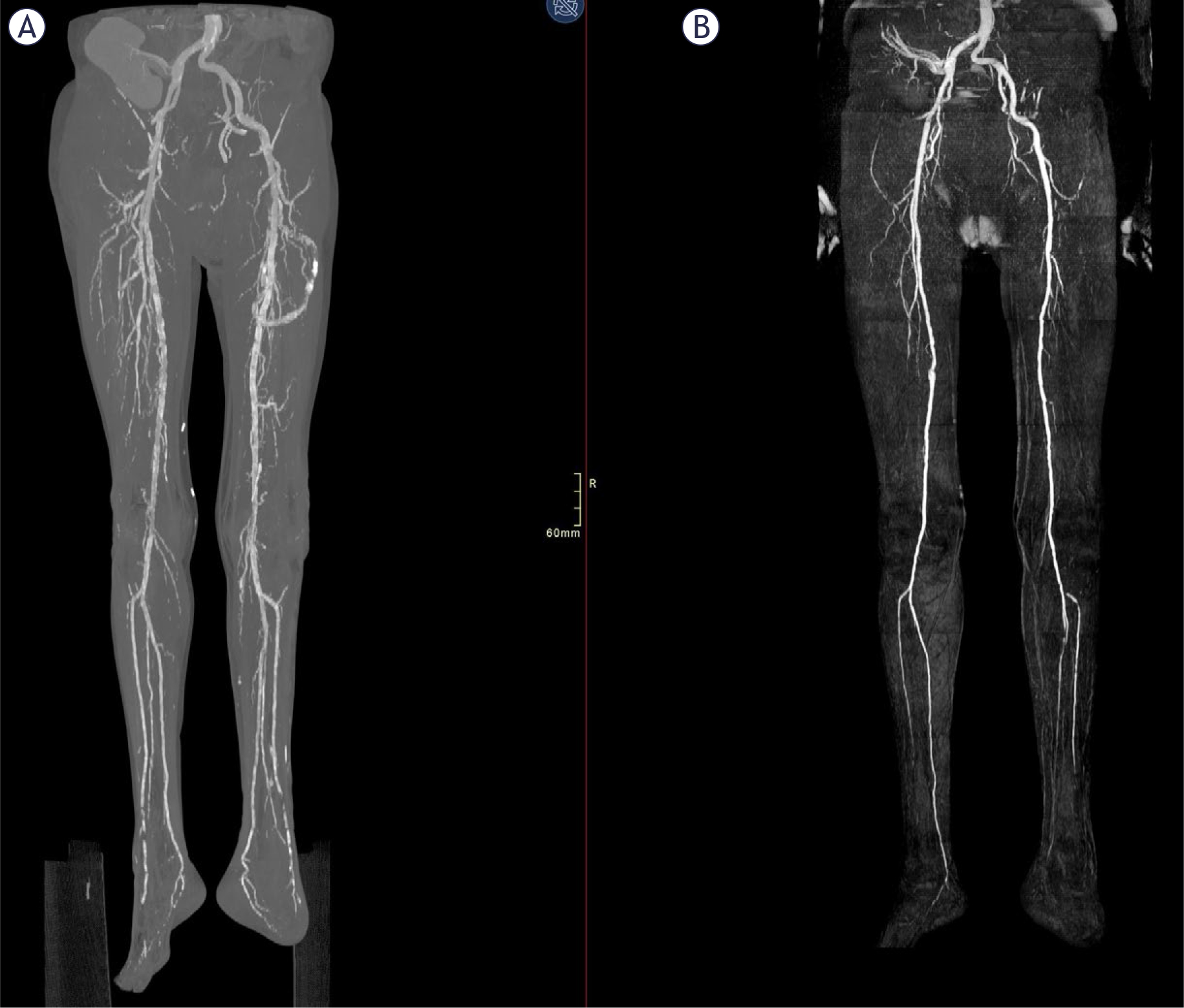
FIGURE 1
(A) Computed tomography angiography (CTA) of the pelvis and lower extremities demonstrating diffuse arterial wall calcifications, most pronounced in the below-the-knee arteries, limiting accurate assessment of vessel patency due to blooming artefacts. The arrow indicates a heavily calcified proximal anterior tibial artery. (B) Non-contrast quiescent-interval single-shot magnetic resonance angiography (QISS MRA) of the same vessels in the same patient, demonstrating preserved arterial patency without interference from arterial wall calcifications, which are not visualized on QISS MRA. The arrow indicates two significant stenoses of the proximal anterior tibial artery.

FIGURE 2.
Carbon dioxide angiography (CO2 angiography) in the same patient as Figure 1, showing patency of the femoral arteries as seen on computed tomography angiography (CTA) and non-contrast quiescent-interval single-shot magnetic resonance angiography (QISS MRA). The arrow indicates two significant stenoses of the anterior tibial artery.
TABLE 1.
Results of agreement quiescent-interval slice-selective magnetic resonance angiography (QISS MRA), computer tomography angiography (CTA) and digital subtraction angiography (DSA)
| Comparison | κ Value | 95% CI | p-value | Agreement level |
|---|---|---|---|---|
| QISS MRA vs. CTA | 0.41 | 0.31–0.52 | < 0.001 | Moderate |
| QISS MRA vs. DSA | 0.49 | 0.37–0.60 | < 0.001 | Moderate |
| CTA vs. DSA | 0.57 | 0.34–0.80 | < 0.001 | MODERATE |
TABLE 2.
Kappa values by arterial segment
| Arterial segment | QISS MRA vs. CTA κ | QISS MRA vs. DSA κ | CTA vs. DSA κ |
|---|---|---|---|
| Pelvic arteries | 0.40 | 0.51 | NA |
| Femoropopliteal arteries | 0.29 | 0.23 | 0.55 |
| Below-the-knee arteries | 0.42 | 0.61 | 0.32 |
TABLE 3.
Segment-based diagnostic performance of QISS MRA and CTA for detection of significant (≥ 50%) stenosis/occlusion using DSA as the reference standard
| Modality / territory | Paired segments (n) | TP | TN | FP | FN | Sensitivity (%) | Specificity (%) | PPV (%) | NPV (%) | Accuracy (%) |
|---|---|---|---|---|---|---|---|---|---|---|
| QISS MRA – all segments | 121 | 37 | 64 | 13 | 7 | 84.1 | 83.1 | 74.0 | 90.1 | 83.5 |
| QISS MRA – below-the-knee | 72 | 25 | 36 | 7 | 4 | 86.2 | 83.7 | 78.1 | 90.0 | 84.7 |
| CTA – all segments | 39 | 3 | 31 | 3 | 2 | 60.0 | 91.2 | 50.0 | 93.9 | 87.2 |
| CTA – below-the-knee | 16 | 0 | 14 | 1 | 1 | 0.0 | 93.3 | 0.0 | 93.3 | 87.5 |