
1. Introduction
Shannon’s foundational work on zero-error capacity established a deep connection between noisy channels and graph theory [1]. Shannon showed that to each classical noisy channel N, one can associate a corresponding graph GN, called a confusability graph, which encodes many important properties of the channel. Notably, GN will have an independent set (cf. a clique) of size k if and only if there is a collection of distinct inputs x1, … xk for N which have a zero (cf. non-zero) probability of being confused as outputs.
A quantum graph is a generalization of a graph which allows to extend the graph notion of confusability to quantum channels [2]. In brief, given a quantum channel Φ there exists a corresponding operator system 𝒮Φ.
A collection of states ρ1, … ρk forms an independent set (cf. clique) for 𝒮Φ if the average overlap Tr(Φ(ρi)Φ(ρj)) is sufficiently small (cf. large). Quantum graphs have been studied from various points of view including channel capacity, non-local games, and non-commutative relations [3–10].
Due to the ubiquity of graphs in classical complexity, one might ask if it is also natural to study quantum graphs in the context of quantum complexity theory. In the classical setting, deciding if a graph has a clique (or an independent set) is NP-complete [11]. The complexity class QMA is recognized as a quantum analogue of NP, as the classical proof strings of NP are replaced by general quantum states for this class. Kitaev emphasized this view by demonstrating QMA-completeness of the local Hamiltonian problem, a quantum analogue of the NP-complete problem k-SAT [12]. Similarly, other NP-complete problems have been shown to quantize to QMA-complete problems, e.g., [13,14]. It is therefore reasonable to expect the clique and independent set problems for quantum graphs to be QMA-complete.
Surprisingly, the complexity of these problems has received relatively little study. An initial treatment was given by Beigi and Shor [15]; however, as we discuss in Section 1.4, their work would require the additional assumption that the input states are product states in order to apply to our setting. An alternative quantum analogue of NP is class QMA(2), which contains QMA and differs from QMA in that the verifier is provided with two poly-sized quantum witness states, with the promise that the two states are unentangled [16,17]. There are relatively few known QMA(2)-complete problems compared to the cornucopia of QMA-complete problems; moreover, known QMA(2)-complete problems like the sparse separable Hamiltonian problem [18], and the product isometry output problem [19], don’t appear to be straightforward generalizations of NP-complete problems.
In this work, we study the decision problems of identifying cliques and independent sets in quantum graphs. We present our problem instances as circuit descriptions of quantum channels Φ, which in turn determines quantum graphs (operator systems) 𝒮Φ. We also consider versions of the clique/independent set problems for graphs, where instead of an explicit description of a graph, the verifier is given a circuit description of a noisy channel which implicitly determines a graph, given as its confusability graph.
Summary of Results
We examine the clique and independent set problems for quantum channels, and we show they are both in QMA(2). Furthermore we prove that the clique problem is QMA(2) -complete and additionally show that, by quantifying over a restricted class of channels, we recover a complete problem for QMA. For deterministic and classical noisy channels, we show that our versions of both the clique and independent set problems are complete for NP and MA, respectively. Our work outlines a hierarchy of decision problems which captures completeness for all four of these important complexity classes and provides evidence for viewing QMA(2) as a natural quantum analogue of NP.
1.1. Background
In this section, we provide a brief overview of quantum graphs. For completeness we highlight that there are several overlapping notions of quantum graphs, which have been discovered in somewhat distinct settings, for example in early works due to Erdős, Katavolos, and Shulman [20] and Weaver [21,22]. More comprehensive introductions to the topics of operator systems and quantum graphs can be found in [23], [24], and [25].
We focus on the motivation of quantum graphs from the point of view of confusability graphs and describe how to include ordinary graphs1 as quantum graphs. We also discuss the technical challenges of giving a quantum graph as an input for a decision problem. Next, we outline our approach of presenting them as the description of a quantum circuit and then sketch the definitions of the 2-clique and 2-independent set problems. The extension of these definitions to larger sets of states is given in Section 3. Lastly, we discuss how presenting problem instances as circuits descriptions of channels, which implicitly determines a confusability graph, motivates new versions of the clique and independent set problems for classical graphs as well.
1.1.1. Quantum Graphs
Confusability Graphs
A classical noisy channel N : X → ϒ may be parametrized by a probability transition matrix N = N(y|x), which gives the probability of receiving output y given input x. Given a channel N, the corresponding confusability graph GN is defined on vertex set X with edges x ~ x′ whenever N(y|x)N(y|x′) ≠ 0, for some y ∈ ϒ, that is, whenever there is non-zero probability that two inputs are mapped to the same output [1]. A set X′ ⊆ X forms an independent set of GN if x ≁ x′ for all distinct x, x′ ∈ X′, which is if and only if the probability of any pair of distinct x, x′ ∈ X′ being sent to the same output is 0. Similarly, X′ forms a clique of GN if x ~ x′ for all distinct x, x′ ∈ X′, which is if and only if any pair of distinct elements x, x′ ∈ X′ have a non-zero probability as being received as the same output.
In the quantum setting, classical noisy channels are superseded by quantum channels, represented by completely positive trace-preserving (CPTP) maps Φ : 𝕄n(ℂ) → 𝕄m(ℂ). To each such quantum channel, one can associate an operator system 𝒮Φ ⊆ 𝕄n, which is constructed as the linear span of all products for some set of Kraus operators {Ai}i of Φ. The operator system 𝒮Φ is independent of the choice of Kraus representation and can be used to generalize the role of confusability graphs to study zero-error capacities of quantum channels. In particular, a collection of orthonormal states |v1〉, … |vk〉 can be distinguished from one another with certainty after passing through the channel if and only if |vi〉〈vj| is orthogonal to 𝒮Φ, in which case we say |v1〉, …, |vk〉 is an (exact) independent set for Φ or 𝒮Φ [2]. More generally, one can extend other notions from classical graph theory such as cliques and graph colorings to the setting of operator systems [9,26–28]. In this context, operator systems are often referred to as quantum graphs or non-commutative graphs. For the purposes of this work we use this same terminology, and a quantum graph refers to an operator system 𝒮 inside a matrix algebra 𝕄n. Below, we discuss how classical graphs can be embedded into the set of quantum graphs, and in Section 1.1.2, we discuss how they can be presented using a quantum circuit.
Classical Graphs as Quantum Graphs
It is possible to embed classical graphs into the set of quantum graphs in the following way. Starting with an undirected graph G, define an operator system 𝒮G by taking the span of |i〉〈j| over vertices i and j in G satisfying i = j or ~G j. Graphs G and H are isomorphic if and only if 𝒮G and 𝒮H are unitarily equivalent [28]. Similarly, given a noisy channel N = N(y|x), there are several ways to construct a corresponding quantum channel 𝒮ΦN which satisfies 𝒮GN = 𝒮GN. Generalizations of cliques, independent sets, and colorings to quantum graphs respect this construction, i.e., there is a correspondence between k-cliques, k-independent sets, and k-colorings for G and those for the quantum graph 𝒮G [24].
The Correspondence between Channels and Graphs
Different noisy channels can give rise to the same confusability graph, i.e., the construction N ↦ GN is not injective. Similarly, in the quantum setting, the construction Φ ↦ 𝒮Φ is not injective. On the other hand, given any graph G one can construct N satisfying G = GN with an appropriate choice of transition probabilities N = N(y|x); likewise given any operator system 𝒮 ⊆ 𝕄n, it is possible to define Φ such that 𝒮Φ = 𝒮 [24]. Consequently, quantifying over all quantum channels is sufficient to quantify over all quantum graphs, and it is hence well-motivated to consider parameters for quantum graphs at the level of channels.
The Complement of a Quantum Graph
Recall that, given a graph G, the complement is a graph on the same vertex set where the adjacency relation is defined as if and only if i ≁G j. However, there is no generally agreed-upon approach to extending the notion of the graph complement to quantum graphs. One straightforward approach would be to take the orthogonal complement of 𝒮 inside 𝕄n with respect to the Hilbert-Schmidt inner product, but this will not be an operator system as it fails to contain the identity element, and hence fails to correspond to any channel. One can remedy this by making a correction such as to account for the identity [9]. Unfortunately, this does not extend the graph complement as . Another approach allows both operator systems as well as their orthogonal complements to be considered as quantum graphs [27].
Relevant for this work is the fact that there is no straightforward and unique notion of a graph complement for quantum graphs, and consequently, the complexity of decision problems based on cliques and independent sets for quantum graphs cannot be reduced to one another by taking a complement. Indeed, as we discuss in Section 1.5, it is even possible that they have different complexity.
Quantum Independent Sets and Quantum Cliques
Motivated by the study of non-local games, quantum generalizations of many graph parameters have been found. The existence of k-cliques, k-independent sets, and k-colorings for a classical graph G can be determined by the existence of a perfect classical strategy for a corresponding non-local game. In some cases, quantum strategies for these games can outperform classical strategies, and perfect quantum strategies give rise to quantum cliques and quantum independent sets for classical graphs [29,30]. By considering non-local games where the questions are quantum states, one can also define quantum cliques and quantum independent sets for quantum graphs [31].
It is known that determining the quantum value—or commuting operator value—of a non-local game is an undecidable problem [32–34]. These results can be captured using the non-local games associated to the graph parameters mentioned above, and thus it is undecidable to determine the existence of quantum cliques/quantum independent sets in either classical or quantum graphs [35]. In this work, we take a different perspective and do not consider quantum cliques or quantum independence sets. Instead, we exclusively study the complexity of determining the existence of cliques and independent sets in graphs and quantum graphs.
1.1.2. The Clique/Independent Set Problems for Quantum Graphs
In Section 4, we define approximate k-cliques and approximate k-independent sets at the level of quantum channels. For convenience, we restate these definitions here. To keep the presentation concise, we only include the case k = 2. In fact, restricting to k = 2 is sufficient for all of our complexity results in this paper, and in Appendix A we describe an explicit reduction of the corresponding decision problems from k > 2 to k = 2.
Definition 1.
Let α ∈ [0,1]. We say a pair of orthogonal states ρ1, ρ2 are an (α, 2)-clique for Φ if Tr[Φ(ρ1)Φ(ρ2)] ≥ α, and an (α,2)-independent set if, Tr[Φ(ρ1)Φ(ρ2)] ≤ 1 – α.
We remark on a few details motivating Definition 1. Firstly, we require the input state to be exactly orthogonal. This agrees well with the classical noisy channel setting, which considers sets of distinct inputs x1 ≠ x2. Second, we express the probability that the outputs of the channel are confused by means of the overlap under the Hilbert-Schmidt inner product Tr[Φ(ρ1)Φ(ρ2)]. This also agrees well with classical notions of confusability since, if the output states are classical, i.e., Φ(ρ1) = ∑x λx|x〉〈x| and Φ(ρ2) = ∑x μx|x〉〈x|, then the overlap ∑x λx μx becomes simply the probability of the channels providing the same input on independent evaluations. Further, using the overlap as a measure of confusability is also natural in the computational setting, as the overlap can be efficiently sampled from the output states by means of the swap test, unlike other measures of closeness such as the trace distance. We note that we do not require the input states to be pure, though we can always assume the states in a clique or independent set are pure by convexity. Neither do we assume the output states are pure, as we quantify over general, not necessarily unitary, channels. Lastly, the definition reduces to the exact case for particular values of the parameters: (1, k)-independent sets of Φ are k-independent sets of 𝒮Φ, and (1, k)-cliques are k-independent sets of .
What may be seen as a flaw of our definition is that it is possible for a mixed state ρ to have small overlap with itself. This observation may seem somewhat contradictory to our measure of confusability, as this means that two inputs that have the same output state may nevertheless be close to independent, or pseudo-independent. However, by seeing mixed states as samples from an ensemble of pure states, what this really means is that, upon taking two independent samples from the ensemble, they are unlikely to be equal. As we discuss in Section 1.3, this property actually plays an important role in our proof approach establishing QMA(2)-completeness of the clique problem.
Presenting Quantum Graphs as Quantum Circuits
Problems based on finding cliques, independent sets, or graph colorings are well-studied in classical complexity; they all give rise to NP-complete problems [11]. In these cases, the input to the problem includes an explicit description of the vertices and edges of a graph. Providing an explicit description of a quantum graph raises some challenges: notably quantum graphs are linear subspaces 𝒮 ⊆ 𝕄n and are thus determined by a basis of operators. As such, given a quantum channel Φ on an n-qubit system, the corresponding quantum graph 𝒮Φ is a subspace with up to 22n dimensions, so specifying it in this way requires a description of an exponentially sized basis. Note that this problem also arises in the classical case, if the graphs in question are seen as arising from a noisy channel on an n-bit input space. For our work, we will instead consider quantum graphs as being determined by an underlying quantum channel Φ, and give a problem instance as a quantum circuit C describing the action of the channel Φ = ΦC.
Clique and Independent Set Problems
The quantum channel 2-clique problem with completeness c and soundness s is the promise problem with yes instances consisting of circuits C such that ΦC has a (c, 2)-clique, and no instances consisting of circuits for which ΦC has no (s, 2)-clique. We always assume c ≥ s, and in the cases we consider that there is some probability gap between them. We define the quantum channel 2-independent set problem in a parallel way. In Definition 7, we express these problems more formally and extend them to larger k. These promise problems are written qClique(k)c,s and qIS(k)c,s. In this approach, a verifier given a problem instance C may perform computations by running the circuit C in order to implement channel ΦC, which determines properties of an underlying quantum graph 𝒮ΦC. The size of a problem instance is then the size of the quantum circuit, which is used to run this computation, rather than the size of an explicit description for the operator system 𝒮ΦC.
We also consider the restricted problems where the circuits C are only taken from a specific family of quantum circuits 𝒞, which we write as qClique(k, 𝒞)c,s and qIS(k, 𝒞)c,s. This allows us to determine hardness results with respect to particular families of channels/quantum circuits such as entanglement-breaking channels and channels that implement partial traces. Importantly, in Section 5, we specify a family of circuits for which these problems are QMA-complete.
Revisiting the Classical Case
In light of the above discussion, we can revisit problems related to cliques and independent sets of classical graphs. More concretely, we consider the input given as a description of a classical circuit which implements a deterministic or probabilistic (noisy) function f on input set X. Note that if X = {0,1}n, then the confusability graph Gf will be an exponentially sized graph. We then define our decision problems as deciding if the corresponding confusability graph Gf has a clique or independent set of size k. In this approach, the size of the problem instance is related to the runtime needed to compute the adjacency relations in Gf, rather than the size of an explicit description of Gf itself. We also note that our approach differs from graph problems for succinctly presented graphs [36], and to the best of our knowledge has not been studied before from this point of view.
In the case that f is deterministic, the confusability graph consists of a disjoint union of complete subgraphs. In this case, deciding if Gf has a clique of size k = 2 is equivalent to the well-studied collision problem for functions. It asks whether, given some function f : X → ϒ, is there a pair of elements in the domain x, y ∈ X with the same image f (x) = f (y)—a collision. The presumed computational difficulty of this problem on certain classes of functions underlies the security of hash functions, which serve as a primary building block of much of modern cryptography.
More formally, we say a deterministic function f has a k-clique, or a k-independent set, if there exists distinct inputs x1, …, xk such that f(x1) = ⋯ = f(xk) or f(x1) ≠ … ≠ f(xk) respectively. The corresponding decision problems, whose instances are classical circuits describing functions, are denoted Clique(k) and IS(k). We study this case in Section 6.1.
In the case that the underlying function f is probabilistic, i.e., f is a noisy classical channel, the corresponding confusability graph Gf can be more interesting. Indeed, by suitably picking the transition probabilities, it can be observed that any graph on a vertex set V can arise as the confusability graph of some noisy channel f with input set V. In Section 6.2, we study the complexity of deciding the existence of approximate k-cliques and approximate k-independent sets for probabilistic functions. We restate the relevant definitions for the case k = 2 here.
Definition 2.
Let α ∈ [0,1]. A probabilistic function f : X → ϒ has an (α, 2)-clique if there exist distinct x, x′ ∈ X such that Pr[f (x) = f (x′)] ≥ α, and an (α, 2)-independent set if there exist distinct x, x′ ∈ X such that Pr[f(xi) = f(xj) ≤ 1 – α.
The probabilistic 2-clique problem and the probabilistic 2-independent set problem are the promise problems that consist of deciding the existence of approximate 2-cliques or 2-independent sets, up to some specified promise gap c – s. In Section 6.2, we extend these definitions to larger k and we write pClique(k)c,s and pIS(k)c,s for the corresponding promise problems.
1.2. Main Results
Our contributions focus on the complexity of the k-clique and k-independent set problems across four different settings: the quantum case, a restricted quantum case where we only consider entanglement-breaking channels, and we conclude by addressing the classical deterministic and probabilistic cases. We show that deciding 2-cliques across these settings is complete for the classes QMA(2), QMA, NP, and MA, respectively. Further, we show that the k- independent set problems in the deterministic, probabilistic, and restricted quantum cases are complete for the same classes.
In the quantum setting, we study the complexity of deciding approximate k-cliques (qClique(k)c,s) and approximate k-independent sets (qIS (k)c,s) for a quantum channel Φ. The inputs for these problems are given as the description of a quantum circuit which implements Φ. In Section 4, we show that for k = 2 both problems are in QMA(2), and establish the completeness of qClique(2)c,s. Our hardness result is obtained when quantifying over a specific subset of quantum circuits, 𝒞Tr ⊕ 𝒞Tr ⊕ 𝒞EB, as defined in Definitions 9,10, and 11. Informally, this corresponds to the set of circuits which implement channels that are probabilistic mixtures of entanglement-breaking channels and partial trace maps. This is stronger than the hardness of the problem quantified over all channels and implies it.
Theorem 1 (Quantum Case).
There exist c, s : ℕ → (0,1) with constant gap such that the clique problem qClique(2, 𝒞Tr ⊕ 𝒞Tr ⊕ 𝒞EB)c,s is QMA(2)-complete.
In Section 4.2, we show that, by slightly extending our proof of hardness of the quantum clique problem for QMA(2), we can show that it is also hard for QMA(k). Hence, we provide an alternate proof that QMA(k) = QMA(2) than the original proof of Harrow and Montanaro [37].
In Section 5, we show that by further restricting the set of channels to a particular subset 𝒞EB′ of the entanglementbreaking channels, we can obtain QMA-completeness for qClique(2, 𝒞EB′)c,s. This suggests any potential distinction between QMA and QMA(2) may be reflected in the difference between the properties of these channels and those considered above.
Theorem 2 (Restricted Quantum Case).
There exist c, s : ℕ → (0,1) with polynomial gap such that qClique(2, 𝒞EB′)c,s is QMA-complete.
In Section 6, we review the complexity of deciding k-cliques and k-independent sets for deterministic functions—the problems Clique(k) and IS(k). These problems can be viewed as a rephrasing of the well-studied collision problem for functions. Our contribution here is to provide new proofs for NP-completeness of these problems and to state them in a way that generalizes to the problems considered in Section 6.2, Section 4, and Section 5.
In Section 6.2, we consider the problems of deciding approximate k-cliques (pClique(k)c,s) and approximate k-independent sets (pIS(k)c,s) for probabilistic functions.
Theorem 4 (Probabilistic case).
There exist c, s : ℕ → (0,1) with constant gap such that pClique(2)c,s and pIS(2)c,s are MA-complete.
Finding natural MA-complete problems is in itself an active area of research, and few examples are known [38,39].
If one begins with a deterministic or classical noisy channel f, and considers its inclusion as a quantum channel Φf, as described in [24], then f will have an (α,k)-clique if and only if Φf does. Hence, the classical decision problems analyzed in Section 6 can naturally be viewed as a restriction of the problems in Theorem 5, which in turn are a restriction of the problems considered and Section 4. Our results can thus be viewed as a natural hierarchy of problems which are complete for all four of the proof classes NP, MA, QMA, and QMA(2), and whose complexity may be tuned by varying the collection of channels.
In Appendix A, we provide a direct reduction from clique and independent set problems in the deterministic, probabilistic, and quantum settings from larger k to k = 2. In Appendix B, we provide a more straightforward proof establishing QMA(2)-hardness for qClique(2)c,s when quantifying over all quantum circuits than the stronger one given in Theorem 1.
1.3. Proof Techniques
Our proof techniques were inspired by techniques in self-testing and protocols for delegating quantum computation, such as in [40,41]. Other recent work of Bassirian, Fefferman, and Marwaha considers different connections between self-testing and QMA(2) [42]. In short, if we know a channel has or does not have cliques over a particular set of states—for example, the separable states—then we can combine it with another channel to guarantee that possible cliques among the remaining states are not important. The proofs use two important constructions, which we will comment on here. We also discuss different techniques we use in the proof of QMA-completeness of a restricted version of the problem.
Non-unitary Circuits and Direct Sums
First, we devise a new technique to take direct sums of quantum circuits (10). In order to be able to parameterize arbitrary non-unitary channels by means of circuit diagrams, we work with an extended circuit model that appends partial trace and state preparation maps to a basic set of unitary gates. In this way, we extend the universality of a gate set to CPTP maps by means of the Stinespring dilation theorem. At the level of channels, there are a variety of ways to compose the maps to get new ones, but it is not always immediate how that translates to composition at the level of circuits—importantly, whether it is computationally efficient. In our constructions, the way we will combine channels is by means of the direct sum: given two channels Φ1 and Φ2 and a probability p, the direct sum is pΦ1 ⊕ (1 – p)Φ2, the convex combination of the channels Φ1 and Φ2 with orthogonal output spaces. Of course, the circuit model is well-adapted for composition and direct products of maps, but not for sums. To get the wanted superposition of circuits, we might add a qubit in state , conditionally act by either Φ1 or Φ2 based on this qubit, and then measure the added qubit. This, however, has a technical obstruction: conditioning a non-unitary channel can put the number of output qubits in superposition or probabilistic mixture, which is untenable. Instead, we use the fact that the circuits decompose into the basic gates to separate the unitary from the non-unitary gates. Then, the unitary gates act conditionally on the additional modulating qubit as wanted, and the non-unitary gates can be aligned to act the same way for both Φ1 and Φ2. In this way, we get a circuit that implements a direct sum of channels of size polynomial (in fact linear) in the size of the circuits describing the original channels. See also Figure 2 for an illustration of this construction. We are optimistic that this direct sum construction might be able to find various other applications in quantum information.
Self-Testing for Cliques
Next, the direct sum construction allows us to port ideas from self-testing over to questions about quantum cliques. The main technical tool we prove to use this technique is Lemma 5. As noted above, the technique takes the direct sum of two channels in order to expand the set of pairs of states on which some property of one of the channels holds. To illustrate how this works, we outline the proof of QMA(2)-hardness of the quantum 2-clique problem (6), which is based on this technique. Given some instance x of a QMA(2) promise problem (ϒ, N), we know that there is some efficiently constructable circuit Φx that accepts with high probability on some separable state if x is a yes instance, and with low probability on every separable state if x is a no instance. In the first step, we construct an entanglementbreaking channel Ψx that runs this verification, measures, and outputs a pure state if it accepts and a highly mixed state if it rejects (8). Note that this channel acts on one more qubit than Φx, which it immediately traces out, in order to have that qubit guarantee orthogonality of any clique. If Φx accepts with high probability, then Ψx outputs a state close to pure, and thus, the overlap of two input states differing only in the orthogonality qubit will be high. As such, if x is a yes instance, Ψx has a clique in the separable states. On the other hand, if Φx accepts with low probability, then the output state will be far from pure, resulting in low overlap—as such, a no instance leads to a channel Ψx with no cliques among the separable states. The trick however is to lift this property to all the states. To do so, we use the channel Φ1 constructed in Lemmas 6 and 7, consisting of a direct sum of partial traces on the subregisters we wish to be unentangled. For this channel, we uncover a property reminiscent of self-testing: if states form a near optimal clique, then they must be separable, since partial traces of entangled states are mixed and hence have low overlap. Finally, in the convex combination of Φ1 and Ψx, we find via Lemma 5 that if we weight Φ1 sufficiently, then the testing for separability overcomes any potential non-separable cliques of Ψx, and thus that for a no instance the channel has no cliques. Since the weighting can be chosen to preserve polynomial or constant gaps, this proves the hardness of the 2-clique problem for QMA(2). We believe that this technique is readily extendable to prove other properties of channels; in fact, in Appendix A, we use Φ1 as well as a channel that guarantees orthogonality among the tensor terms of a separable state to reduce the quantum k-clique problem directly to the 2-clique problem.
Independent Sets
It is interesting to note that, though this proof technique is very useful in determining properties of cliques, it seems not to be well-adapted to the study of independent sets. First, Lemma 5 is used to expand collections of states where there is no clique, whereas this would require us to be able to expand collections of states where there is no independent set. A more serious technical obstruction, however, is that where cliques may arise from essentially one source, independent sets arise from two. The overlap of two states is high if they are approximately equal and pure. However, the overlap of two states is low if they are approximately orthogonal or highly mixed. The first corresponds to an approximate version of the independent sets for an operator system, but the second does not. This case of low overlap, which we refer to as a pseudo-independent set, underpins the proofs of hardness of the clique problem, but seems to be an obstruction for the independent set problem. In particular, if we want to guarantee small overlap, it is not required to output orthogonal states—it suffices to output a highly mixed state. Also, high overlap is critical in guaranteeing separability of states by means of Lemma 7. This raises an interesting question: does there exist a channel where the independent sets are separable states? Resolving this would serve to illuminate the complexity of the clique problem greatly.
Entanglement-Breaking Channels and QMA
Finally, our proof of the QMA-completeness of the clique problem for a subclass of the entanglement-breaking channels uses significantly different techniques. The main difficulty lies in showing that this problem actually lies in QMA. This relies on an interesting result of Brandão [43], which shows that the subclass of QMA(2) where the verifier may measure with a Bell measurement—measure each of the factors in the separable state separately, and then classically compute whether or not to accept—lies in QMA. We find that computing the clique value by running the channel and then doing the swap test is in fact a Bell measurement when the channel is entanglement-breaking. Nevertheless, we must still further restrict, because there is another check needed to verify a clique: checking orthogonality of the states. In our proof that the clique problem is in QMA(2), we also do this via the swap test. However, since this swap test is not prefixed by an entanglement-breaking channel, it cannot be evaluated by a Bell measurement. In fact, Harrow and Montanaro [37] show that the swap test cannot even be run by an LOCC measurement, which is a larger class than the Bell measurements. As such, we need a different method to guarantee orthogonality; we work over channels where the output is independent of one of the qubits, i.e., that qubit is immediately traced out. This is the same method as we have used to guarantee existence of an orthogonal clique in the QMA(2)-hard clique problem. As such, the prover need not even send as a proof a clique where the states are orthogonal—the verifier may nevertheless be certain that there exists one. Finally, we note that, unlike the QMA(2)-completeness result, the QMA-completeness result generalizes immediately to the independent set problem as well.
1.4. Relation to Other Works
Closely related to our work is that given in the unpublished work of Beigi and Shor [15]. In their work, a promise problem referred to as the quantum clique problem is proven to be complete for QMA. This problem is similar to but distinct from qIS(k, 𝒞)c,s = (ϒ, N) as we define it in Definition 6. Firstly, in terms of terminology, what Beigi and Shor refer to as a quantum clique for a channel is more closely related to what is commonly called an independent set in the quantum graph literature. The standardization of this terminology was established after the release of their work, and we chose to model our terminology following more current conventions.
There are also a few more substantial differences that make our results and theirs incomparable in a direct sense. In order to highlight some of these differences, we restate their definition below.
Definition 3.
[Definition 2.9 from [15]] Quantum clique problem (Φ, k, a, b)
Input Integer numbers n and k, non-negative real numbers a, b with an inverse polynomial gap b – a > n–c, and an entanglement-breaking channel Φ that acts on n-qubit states.
Promise Either there exists ρ1 ⊕ ⋯ ⊕ ρk such that ∑i,j Tr(𝒮 Φ(ρi) ⊕ Φ(ρj)) ≤ a or for any state ρ1,2…k we have .
Output Decide which one is the case.
One key difference between Definitions 7 and 3 is that their promise problem makes explicit reference to the SWAP operator S—see Section 2.5 for more details on this and the well-known swap test. Even when quantifying over only entanglement-breaking maps, it is not clear that the two problems are the same, since the swap test can fail if the input state is not given as a product state. That is, the promise made in the work of Beigi and Shor is more significant than we use: no instances are those where the swap test rejects with high probability on all, potentially entangled, states and not just on separable states, as we require.
To give more detail, we consider the case k = 2. No instances of Definition 3 are channels Φ satisfying Tr(S Φ⊕2 (ρ1,2)) ≥ b for all possibly entangled states ρ1,2, whereas no instances of Definition 7 are channels Φ satisfying Tr(Φ(ρi)Φ(pj)) ≥ b for all pairs of orthogonal states ρ1 and ρ2. That is, no instances of Definition 3 will be no instances of Definition 7 but the converse does not clearly hold, even in the case of restricting to entanglementbreaking maps.
Another difference is with regard to how the classical description for a quantum channel Φ is given as input to the problems. Beigi and Shor establish QMA-completeness for Definition 3 when considering entanglement-breaking quantum channels given in terms of an operator sum, or Kraus, representation
whereas in our case we consider inputs given as a description of a quantum circuit C.Despite some differences in our approaches we took much inspiration from the ideas present in [15]. Separate from our work here, another active project is investigating the complexity of quantum graph problems using an approach more closely following that given in [15].
1.5. Open Problems
In this section, we outline a selection of open problems motivated by our work.
Deciding Independent Sets in Quantum Graphs
The existence of graph complementation provides a straightforward way to reduce the problems of deciding cliques and independent sets for graphs. This also extends to the versions of these problems introduced in Section 6.
In the quantum setting, our proof technique establishing QMA(2) -hardness for the clique problem qClique (k)c,s could not readily be extended to the problem qIS (k)c,s. As discussed in Section 1.1.1, there is no canonical way to take the complement of a quantum graph as there is classically. Instead, several differing approaches have been considered in the literature. Even when one considers the different approaches available, it is not clear how to use these maps on the level of operator systems to obtain an efficient reduction between qClique(k)c,s and qIS(k)c,s. Indeed, in an informal sense, it would appear that under any appropriate notion of complementation the complement of a quantum graph can be a significantly more complicated object than the original quantum graph. On the one hand, we know that the quantum independent set problem is contained in QMA(2). On the other hand, it is hard for QMA. However, we feel it is unlikely that there exists a QMA verification circuit for qIS(k)c,s. This is a similar situation to the pure state version of the QMA-complete consistency of local density matrices problem, which has long been conjectured to be complete for QMA(2) [13]. It is possible that neither of these problems is QMA or QMA(2)-complete, and a reduction from one of the two problems to the other would be enlightening.
Deciding Colorings
Famously, Lovász showed a reduction between the k-coloring problem and the 3-coloring problem in ordinary graphs [44]. In this case, the instances are given using an explicit description of the graph. In Section 6, we introduce new variants of the k-clique and k-independent set problems motivated from the study of noisy channels and confusability graphs. It is straightforward to similarly define a new version of the k-coloring problem. We did not investigate the complexity of this problem but suggest it as worthy area of exploration. Since a coloring on exponentially many vertices cannot be described in polynomial time, it is altogether possible that the class where this coloring problem lives is significantly larger than NP.
In the quantum setting, various approaches to define a k-coloring for a quantum graph have been considered [9,27]. Informally, a k-coloring of a quantum graph 𝒮 ⊆ 𝕄k consists of a partition of an orthogonal basis for ℂk into independent sets. As in the classical case, for an n-qubit quantum channel, this would require specifying a basis for a 2n dimensional space. It seems unlikely that the corresponding problem could be decided in QMA(2).
Other Graph Problems
There are a variety of decision problems for graphs which can possibly be extended to the quantum setting via a similar approach to the one we use for the clique and independent set problems. We suggest two more here. Firstly, in our problems, the size k of a clique or independent set is a parameter which defines the problem. One can instead consider the value k to be specified along with the circuit description as an input. In the classical case of graphs described by their adjacency matrices, this takes the complexity of finding a clique or independent set from P to NP-hard [11]. One might imagine a similar jump happens in the cases we have considered, from NP, MA, QMA, or QMA(2) to larger classes.
Secondly, one can consider versions of the well-studied graph isomorphism and non-isomorphism problems. In particular, consider a quantum verifier who receives as input a pair of circuits C1 and C2 which implement classical or quantum channels Φ1 and Φ2. The corresponding promise problems would then be to decide if the quantum graphs 𝒮Φ1 and 𝒮Φ1 are approximately isomorphic or far from isomorphic. The quantum analogues of these problems may also provide new approaches to zero-knowledge proof protocols in the quantum setting, since graph isomorphism/non-isomorphism played an important role in early work on zero-knowledge proof systems [45,46]. The area of zeroknowledge proof systems in the quantum setting has seen a flurry of recent advances [13,40,47–49], and it would be interesting if the study of quantum graph isomorphisms can provide new approaches to zero-knowledge in some of these settings.
Another possible area of exploration is Ramsey theory for quantum graphs. Ramsey theory is a branch of mathematics initiated by F. Ramsey which examines the existence of ordered substructures arising in graphs of a sufficient size [50]. Ramsey theory has some interesting connections with computational complexity, such as studying the computational complexity of computing the Ramsey numbers [51]. Several of the motivating themes of Ramsey theory have been explored for quantum graphs [7,52], and it may be worthwhile to explore connections to complexity inspired by these works that incorporate our approaches for presenting quantum graphs as circuits.
Applications
While the problems studied here present natural problems which are expressive enough to give complete problems for a variety of well-studied classes, we do not present any concrete applications. It would be interesting to explore how the qClique and qIS problems may have applications in other areas of quantum information theory.
Another potential application may be found using the construction given in Section 4.1.2. This presents a new tool that allows one to take direct sums of quantum circuits as opposed to the more standard tensor product. It would be interesting to see if this has applications in areas such as quantum algorithms or quantum linear algebra.
1.6. Acknowledgments
We thank David Cui, Joshua Nevin, Seyed Sajjad Nezhadi, Laura Mančinska, Se-Jin Kim, and Adrian She for lengthy discussions during the early stages of this project. We also thank Adrian She and David Cui for detailed discussions and for sharing extensive notes on [15].
1.7. Outline
In Section 2, we outline the important notation we use and give some brief background information on complexity theory and aspects of quantum information we require. In Section 3, we recall the standard definitions of cliques and independent sets for graphs, and connect them to our definitions of these properties for quantum channels. Next, in Section 4, we define and study the clique and independent set problems for quantum channels. We show in Section 4.1 that the quantum 2-clique problem is QMA(2)-complete, and in Section 4.2 that this completeness implies a new proof that QMA(k) = QMA(2). In Section 4.3, we discuss the quantum independent set problem for quantum channels. Finally, in Section 5, we present a restriction of the quantum clique and independent set problems that is QMA-complete. In Section 6, we consider the classical deterministic (Section 6.1) and probabilistic (Section 6.2) versions of the clique and independent set problems. We show their completeness for the complexity classes NP and MA, respectively. We also collect some additional results in appendices: first, in Appendix A, we give reductions from k-clique and independent set problems to the corresponding problem with k = 2; also, in Appendix B, we give a simpler but weaker proof of the QMA(2)-completeness of the quantum 2-clique problem.
2. Preliminaries
2.1. Notation
We use italic capitals H, K, L to represent Hilbert spaces, which we always assume to be finite-dimensional. Given a finite set S, write ℂS for the {|S|-dimensional Hilbert space with canonical (computational) basis {|s〉 | s ∈ S}. As a special case, we denote the space of one qubit Q = ℂ{0,1}. Fix some Hilbert space H. Write H⊥ for the superspace H + ℂ|⊥〉 where |||⊥〉|| = 1 and 〈⊥|ψ〉 = 0 for all |ψ〉 ∈ H. For any subspace K ⊆ H, write μK for the maximally mixed state on K. Write ℬ(H) for the space of linear operators on H, write 𝒫(H) for the space of positive operators, and 𝒟(H) to be the set of density operators (trace 1 positive operators). We use quantum state interchangeably with density operator, specifying to pure quantum states when necessary; we use quantum channel interchangeably with completely positive trace-preserving (CPTP) map.
We denote the set of all bitstrings . Given some x ∈ {0,1}*, write |x| ∈ ℕ for its length. For a function f : ℕ → [0,1], write f : ℕ → (0, 1)exp to mean that there exist N, k > 0 such that 2–nk < f (n) < 1 – 2–nk for all n ≥ N. Write the set of polynomially bounded functions poly = {f : ℕ → ℝ | ∃k, N ≥ 0. f(n) ≤ nk ∀ n ≥ N}. For a natural number n ∈ ℕ, write [n] := {1,2, …, n}.
2.2. Complexity Theory
A language is a subset L ⊆ {0,1}*. An element x ∈ L is called a yes instance, and an element x ∉ L is called a no instance. A promise problem is a pair (ϒ, N) of disjoint subsets ϒ, N ⊆ {0,1}*. Here, x ∈ ϒ is called a yes instance and x ∈ N is called a no instance, while x ∉ ϒ ∪ N is indeterminate. Promise problems generalize languages in the sense that every language L corresponds to the promise problem (L, Lc). A complexity class is a collection of languages or promise problems.
A function f : {0,1}* → {0,1}* is computable in time T(n) if there exists a Turing machine M that, on input x, outputs M(x) = f(x) in T(|x|) steps. We say f is polynomial-time computable if there exists a polynomial p : ℕ → ℕ such that f is computable in time p (n).
A language L1 is polynomial-time Karp-reducible to another language L2 if there exists a polynomial-time computable function f such that x ∈ L1 iff f(x) ∈ L2. For promise problems, a similar definition holds, the only difference being that the function must map no instances to no instances as well. Given a complexity class C, L is C-hard (under polynomial-time Karp reductions) if every element of C is polynomial-time Karp reducible to L. L is C-complete if additionally L ∈ C.
2.3. Quantum and Classical Circuits
In its usual usage, the circuit model of quantum computation is used to describe unitary channels. To describe unitaries, we fix a (finite) universal gate set S ∈ 𝒰n0(ℂ)—in this work, we do not need to specify the choice of gate set, but one can, for example, always assume that it is the Clifford+ T gate set {CNOT, H, T}. We can approximate any unitary to arbitrary precision by a composition of finitely many tensors of the basic gates.
In order to describe all quantum channels, we need to add two non-unitary operations, that change the number of qubits, to the basic gate set:
The partial trace on one qubit Tr : ℬ(ℂ2) → ℂ;
State preparation of one qubit in the computational basis ℂ → ℬ(ℂ2), λ ↦ λ|0〉〈0|.
Due to the Stinespring dilation theorem, the augmented gate set S ∪ {Tr, |0〉〈0|} can approximate any quantum channel to arbitrary precision. Stinespring dilation also guarantees that the circuit can be expressed in a canonical form where qubit preparation happens first, followed by unitary gates, followed by partial traces. In fact, given a circuit description, it can be taken to this canonical form efficiently simply by sliding the state preparations backwards and the partial traces forwards. As such, we will assume that the circuits are always in this form.
Note that POVM measurements can in particular be realized in this model. For example, measurement of a qubit in the computational basis can be realized by the following circuit:
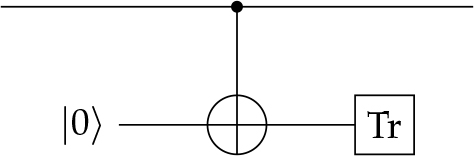
Other measurements can be realized similarly—diagonalizing for PVMs or using Naimark’s theorem for general POVMs—although the circuit representations may consist of many gates.
For the computational problems we consider, the instances take the form of circuit diagrams describing some quantum channel. It is perhaps simplest from the theory standpoint to present the diagrams as pictures, but it is wholly equivalent to represent the circuits as an encoding of the diagram as a bitstring, which is more natural from a computational standpoint. For a circuit diagram C, write ΦC for its implementation as a quantum channel. We take the length of the circuit |C| = in(C) + out(C) + gates(C), the sum of the number of input qubits, the number of output qubits, and the number of gates. Note that it is possible to choose an encoding as a bitstring whose length is polynomial in the circuit length described above, and vice versa.
We can also treat classical circuits in a similar way. Here, circuits describe not channels but functions f : {0,1}m → {0,1}n. But, as in the quantum case, we can choose a finite universal gate set, for example, {NAND}. Given a classical circuit diagram C, write fC for the function it represents and |C| = in(C) + out(C) + gates(C) for the circuit size.
2.4. Distances between States
There are a variety of natural distance measures between quantum states; we use three: the Euclidean norm, the trace norm, and the Frobenius (or Hilbert-Schmidt) norm. The Euclidean distance is only defined on pure states and is simply the natural norm induced by the inner product on the Hilbert space . The trace norm is defined for all A ∈ ℬ(H) as ; and the Frobenius norm is defined similarly as . The following simple lemma relates the metrics that these norms induce on the pure states. We use this extensively and without mention.
2.5. The Swap Test
The swap test, first introduced in [53], provides a computationally efficient way to project on the symmetric subspace of a tensor product Hilbert space— the +1 eigenspace of the swap operator that exchanges the two tensor terms. The swap test proceeds on a state ρ ∈ 𝒟 (H ⊗ H) as follows:
Prepare an auxiliary qubit in the state |+〉.
Act with the swap operator on ρ conditionally on the auxiliary qubit.
Measure the auxiliary qubit in the Hadamard basis. Accept if the measurement result is 0 and reject if not. The swap test is illustrated as a quantum circuit in Figure 1.
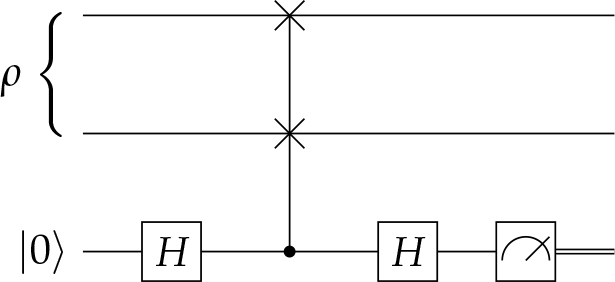
Figure 1.
Quantum circuit representation of the swap test.
Let ΠH : H ⊗ H → H ⊗ H be the projector onto the symmetric subspace. Then, the swap test implements the channel . It’s also useful to note that, if ρ is a separable state ρ = ρ1 ⊗ ρ2, then the probability of the swap test accepting is .
3. Graph Parameters for Quantum Channels
In this section, we recall the definitions of quantum graphs and their graph parameters. Since every quantum graph can be generated by a quantum channel, we discuss how the clique and independent set graph parameters can be pulled back to the level of quantum channels. This serves to motivate the approximate version of these parameters that we introduce in Definition 6.
Definition 4.
A quantum graph is an operator system S ⊆ ℬ(H) for H a finite-dimensional Hilbert space, that is a vector subspace closed under the adjoint and containing 𝕀.
As noted in the introduction, any quantum channel generates a quantum graph, sometimes referred to as its quantum confusability graph. For Φ : ℬ(H) → ℬ(K) with Kraus decomposition , the corresponding quantum graph is
Proposition 1 ([24, Proposition 7.18]).
Let S ⊆ ℬ(H) be a quantum graph. Then, there exists a finite-dimensional Hilbert space K and a quantum channel Φ : ℬ(H) → ℬ(K) such that S = SΦ.
However, as for classical confusability graphs, the quantum channel corresponding to a quantum graph is not unique. Next, we recall the definitions of the independent set and clique graph parameters for a quantum graph.
Definition 5 ([2,26]).
Let S ⊆ ℬ(H) be an operator system. A collection of orthogonal states |v1〉, …, |vk〉 ∈ H form a
k-independent set of S if |vi〉〈vj| is orthogonal to S for all i ≠ j;
k-clique of S if |vi〉〈vj| ∈ S for all i ≠ j.
These parameters are known to naturally extend the classical definitions.
Theorem 5 ([24]).
A graph G, with corresponding quantum graph SG, has a k-independent set (resp k-clique) if and only if SG does.
As for the classical case, these graph parameters can also be described in terms of a channel generating S. This will allow us to work with quantum graph parameters for quantum channels.
In the case of independent sets, Duan, Severini, and Winter establish that the independent sets for 𝒮 correspond to states which are perfectly distinguishable after passing through the channel.
Lemma 2 ([2]).
Let Φ : ℬ(H) → ℬ(K) be a quantum channel and S = SΦ ⊆ ℬ(H) be its quantum confusability graph. Then, pure states |v1〉, …, vk〉 ∈ H are a k-independent set of S if and only if the overlap
for all i ≠ j.The connection between cliques for quantum graphs and channels is not as direct, since in general the quantum graph corresponding to a channel does not retain enough information about the original channel. Nevertheless, given a quantum graph S, one can associate to it a channel Φ whose behavior determines cliques in the quantum graph S.
Lemma 3.
Let S ⊆ ℬ(H) be an operator system. Then, there exists a Hilbert space K,achannel Φ : ℬ(H) → ℬ(K), and a constant c > 0 (depending on the operating system) such that orthogonal states |u〉, |v〉 ∈ H satisfy |u〉〈v| ∈ S if and only if
Proof.
First, we construct the requisite channel, following the construction of Paulsen [24]. Write d = dim H and n = dim S. Let X1, …, Xn–1 ∈ ℬ(H) be hermitian operators such that is an orthonormal basis of S. Then, set . H is hermitian, so there exists r > 0 such that r 𝕀 + H ≥ 0. Let C ∈ 𝕄n (ℬ(H)) be such that and let , be the dn × d block columns of C. Define Φ : ℬ(H) → 𝕄n(ℬ(H)) as . Note that Φ is a quantum channel as . Also, S = SΦ since
giving . Also, take .Let |u〉, |v〉 ∈ H be orthogonal pure states. Then, the overlap
the length of the orthogonal projection onto S with respect to the Hilbert-Schmidt inner product. Then, if |u〉〈v| ∈ S, and if |u〉〈v| ∉ S, , giving that Tr[Φ(|u〉〈u|)Φ(|v〉〈v|)] ≥ c if and only if |v〉〈v ∈ S.We use Lemma 3 to motivate the notion of a clique (cf. independent set) for a quantum channel Φ, as being a collection of orthogonal states with sufficiently high average (cf. low) overlap after passing through the channel.
4. The Complexity of the Clique Problem
4.1. The Quantum Clique Problem Is QMA(2)-Complete
In this section, we introduce and study the complexity of the promise problem of deciding the existence of an approximate independent set/clique for a quantum channel, given as a circuit.
Definition 7.
Let 𝒞 be some collection of quantum circuits, c, s : ℕ → [0,1], and k ∈ ℕ. The quantum channel k-clique problem on 𝒞 with completeness c and soundness s is the promise problem qClique(k, 𝒞)c,s = (ϒ, N) with
The quantum channel k-independent set problem on 𝒞 with completeness c and soundness s is the promise problem qIS(k, 𝒞)c,s = (ϒ, N) with
Write qClique(k)c,s and qIS(k)c,s for the promise problems with respect to all circuits.
The main results of this section are to show that all of the above problems are in QMA(2) for c, s : ℕ → (0,1)exp with polynomial gap, and to show that the quantum 2-clique problem for some class of channels is in fact QMA(2)- hard. First, we recall the formal definition of QMA(2).
Definition 8.
Let c, s : ℕ → [0,1]. A promise problem ϒ, N ⊆ {0,1}* is in QMA(2)c, s if there exist polynomials p, q : ℕ → ℕ and a Turing machine V with one input tape and one output tape such that
For all x ∈ {0,1}*, V halts on input x in q (|x|) steps and outputs the description of a quantum circuit from 2p(|x|) qubits to one qubit.
For all x ∈ ϒ, there exist states ρ, σ ∈ 𝒟 (Q⊗p(|x|)) such that 〈1|ΦV(x) (ρ ⊗ σ)|1〉 ≥ c(|x|).
For all x ∈ N and ρ, σ ∈ 𝒟(Q⊗p(|x|)), 〈1|ΦV(x)(ρ ⊗ σ)|1〉 ≤ s(|x|).
We know that whenever c, s : ℕ → (0,1)exp and have polynomial gap, then , as for MA and QMA. Due to [37], we also know that QMA(P) = QMA(2) for P : ℕ → ℕ any polynomial number of provers.
Lemma 4.
Let 𝒞 be any set of quantum circuits and let c, s : ℕ → [0,1]. Then, the problem qClique (2, 𝒞)c,s ∈ QMA(2)c′,s′, where and
Thus, if c, s : ℕ → (0,1)exp have polynomial gap, then , giving that qClique(2, 𝒞)c,s ∈ QMA(2).
Proof.
Suppose the verifier receives a quantum circuit C. Let Φ = ΦC. The verifier expects to receive a proof ρ ⊗ σ ∈ 𝒟(Q⊗2in(C)), and then effects the following procedure.
The verifier samples a random bit b, which is 0 with probability p (to be specified later).
If b = 0, the verifier runs the swap test on ρ ⊗ σ. If it fails, she accepts and outputs 1, and if it passes, she rejects and outputs 0.
If b = 1, the verifier acts with Φ to get Φ(ρ) ⊗ Φ(σ). Then, she runs the swap test on this state, and outputs 1 if it passes and 0 if it fails.
Now, suppose C ∈ ϒ. Then, there exists a (c(|C|),2)-clique ρ, σ ∈ 𝒟(Qin(C)), so the prover provides ρ ⊗ σ to the verifier. If b = 0, the probability of accepting is , as ρ and σ are orthogonal; if b = 1, since ρ and σ form a clique, the probability of accepting is . All together, the acceptance probability is at least . On the other hand, suppose that C ∈ N. Then, for all orthogonal ρ, σ ∈ 𝒟(Qin(C)), Tr[Φ(ρ)Φ(σ)] ≤ s(|C|). Without loss of generality, we may assume that the verifier receives a pure state proof ρ ⊗ σ = |ψ〉〈ψ| ⊗ |ϕ〉〈ϕ|. Then, if b = 0, the probability of accepting is . There exists a state |ϕ′〉 orthogonal to |ψ〉 such that |ϕ〉 = α|ψ〉 + β|ϕ′〉 with |α|2 = |〈ψ|ϕ〉|2. Now, note that
So, if b = 1, the probability of accepting is
Thus, the total probability of accepting is at most
by maximizing over |〈ϕ|ψ| ∈ ℝ. Now taking , we get andNext, we want to show that the quantum clique problem is in fact QMA(2)-hard as well. In fact, we show the stronger property that a subclass of all channels achieves this hardness. First, we introduce this subclass.
Definition 9.
A quantum channel Φ : ℬ(H) → ℬ(K) is entanglement-breaking if there exists a POVM {Mi}i ⊆ 𝒫 (H) and a set of states {σi}i ⊆ 𝒫(K) such that Φ(ρ) = ∑i Tr[ Miρ]σi.
Write 𝒞EB for the set of quantum circuits representing entanglement-breaking channels. Write 𝒞Tr for the collection of circuits that are partial traces on some of the qubits.
The name entanglement-breaking for these maps arises since, if Φ is entanglement-breaking, then the output state of 𝕀 ⊗ Φ is always separable. These are the only maps with the property. For more on entanglement-breaking channels, see for example [54,55].
The circuits we are interested in combine the above two restricted classes of channels by means of a direct sum. At the level of channels, we mean to use channels of the form pΦTr ⊕ (1 — p)ΦEB To do so, we need a way to form the direct sum of two quantum circuits.
Definition 10.
Let C1 and C2 be circuits with in(C1) = in(C2) and p ∈ [0,1]. Let Pi be the number of qubits prepared by Ci, and let Ti = in(Ci) + Pi – out(Ci) be the number of qubits traced out by Ci. We define the direct sum circuit C1 ⊕p C2 as the circuit constructed as follows:
(i) The circuit prepares a qubit R in the state .
(ii) The circuit prepares max {P1, P2} + |out(C1) – out(C2)| qubits in state |0〉.
(iii) The circuit acts with all the unitary gates of C1 conditioned on R. Then, it swaps, conditionally on R as well, the qubits of C1 that would be traced out to the last positions.
(iv) The circuit flips R with X and acts in the same way as above for C2 conditioned on R, before flipping back with X.
(v) The circuit traces out the last max{T1, T2} qubits.
(vi) The circuit measures R in the computational basis.
Note that the state cannot be generated exactly by finitely many gates from the gate set for all but countably many values of p. However, for any p, polynomially many gates (in the circuit sizes) can be used to construct an exponentially good approximation to the state, which we use to keep the circuits of reasonable length. See also Figure 2 for an example of the implementation of the above definition.
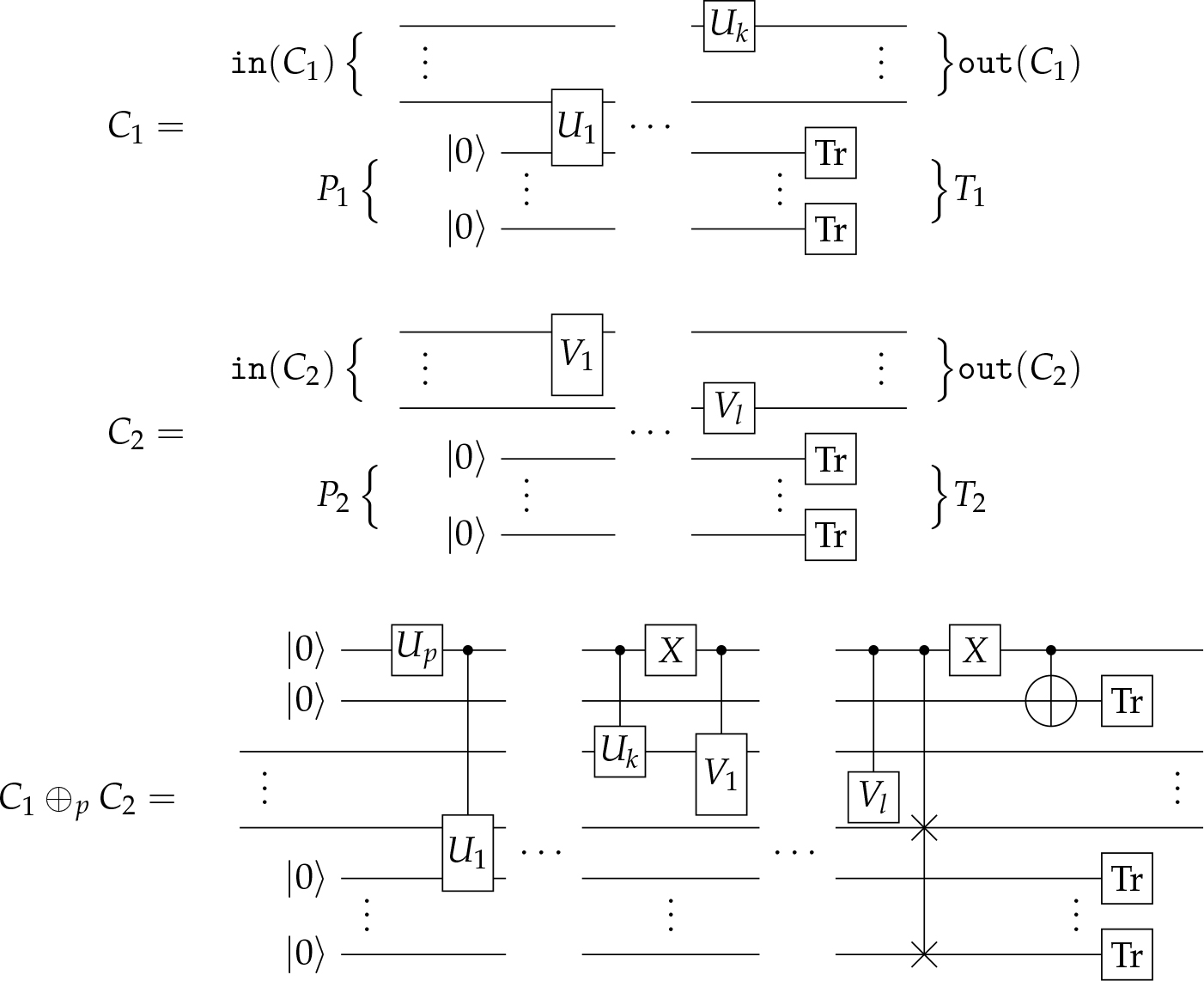
Figure 2.
Representation of the construction of the circuit C1 ⊕p C2 from the circuits C1 and C2 in canonical form, with out(C2) < out(C1). Up is a unitary that implements the map to good approximation.
Using the natural identification, for m > n, of Q⊗m ⊕ Q⊗n with the subspace , we see that . Note also that, by the above definition |C1 ⊕p C2| = O (|C1| + |C2|).
Theorem 6.
There exist c, s : ℕ → (0,1)exp with constant gap such that the clique problem qClique (2)c,s (2, 𝒞Tr ⊕ 𝒞Tr ⊕ 𝒞EB) is QMA(2)-hard.
To prove this theorem, we develop a technique to take a channel whose cliques have certain properties with respect to a set of states, and combine it with another channel in order to enlarge the set of states on which those properties hold. This is inspired by self-testing techniques, such as Lemma 5.5 of [40].
Lemma 5.
Let H, K, and K′ be Hilbert spaces, and A, B ⊆ 𝒟(H)2 be sets of pairs of states. Suppose there exist channels Φ : ℬ(H) → ℬ(K) and Ψ : ℬ(H) → ℬ(K′) with the properties that
For (ρ, σ) ∈ A, Tr[Φ(ρ)Φ(σ)] ≤ p0, and if Tr[Φ(ρ)Φ(σ)] ≥ p0 – ε then there exist (ρ0, σ0) ∈ B such that ||ρ – ρ0||Tr + ||σ – σ0||Tr ≤ Cεα for some constants C, α > 0 independent of (ρ, σ).
For all (ρ, σ) ∈ B, Tr[Ψ(ρ)Ψ(σ)] ≤ q0.
Then, for all η > 0, there exists p ∈ (0,1) such that the channel Φp : ℬ(H) → ℬ (K ⊕ K′) defined Φp = pΦ ⊕ (1 – p)Ψ satisfies the property that, for all (ρ, σ) ∈ A,
From the proof below, it may be verified that if η = 1/poly, C = poly, and α < 1 is constant, we get a probability p, 1 – p = 1/poly. Further, the construction preserves polynomial gaps. In fact, if we have the promise that Tr[Ψ(ρ)Ψ(σ)] ≤ s for all (ρ, σ) ∈ B or Tr[Ψ(ρ)Ψ(σ)] ≥ c for some (ρ, σ) ∈ A ⋂ B with c – s = 1/poly, then we have that either Tr[Φp(ρ)Φp(σ)] ≤ s′ for all (ρ, σ) ∈ A or Tr[Φp(ρ)Φp(σ)] ≥ c′ for some (ρ, σ) ∈ A ⋂ B, where c′ = p2p0 + (1 – p)2c and s′ = p2p0 + (1 – p)2s + η. So the gap becomes c′ – s′ = (1 – p)2 (c – s) – η. Since , we may choose η = 1/poly small enough to preserve the polynomial gap.
Proof.
Let (ρ, σ) ∈ A. Then, there exists some ε > 0 such that Tr[Φ(ρ)Φ(σ)] = p0 – ε. By hypothesis, there exist (ρ0, σ0) ∈ B such that ||ρ – ρ0||Tr + ||σ – σ0||Tr ≤ Cεα. Also, we have by hypothesis that Tr[Ψ(ρ0)Ψ(σ0)] ≤ q0. Therefore,
Using this bound,
To finish the proof, it remains to show that p maybe chosen so that (1 – p)2 Cεα – p2ε ≤ η for all ε > 0. Without loss of generality, we may assume α < 1. Then, by extremizing the expression with respect to ε, we see that it is maximized at , giving . Thus, rearranging the wanted expression gives
Since , we may tak , or
to get the result.Lemma 6.
Let H and K be Hilbert spaces and pure state . Suppose that there exist εi > 0 such that Tr(ρiσi) ≥ 1 – εi for all i, where ρi and σi are the marginals on the i-th copy of H. Write . Then, there exist separable states such that , , and .
Proof.
Fix some i = 1, …, k. Then, Tr(ρiσi) = 1 – εi implies that . In particular, since . Now, let be a spectral decomposition of ρi, with λi,1 ≥ λi,2 ≥ ‥‥ First, the above implies that and the fact that ρi is a state means that ∑j λi,j = 1. As such,
Thus, , or equivalently . Now, we can expand |ψ〉 in the basis of H⊗k as , where the |ψj1 … jk〉 ∈ K are subnormalized states such that . For all i, we have that
Therefore, by a union bound,
Let and . Then,
By symmetry, we also get separable such that .
For the last part of the proof, note that
Next, and similarly for σ, so
Together, this gives , as wanted
Lemma 7.
Let H and K be Hilbert spaces and k ∈ ℕ, and define the channel as
where ρi is the marginal of ρ on the i-th copy of H and 𝔼 is the normalized sum (expectation). Let be orthogonal pure states. Then, and if , then there exist states |ψ1〉, …, |ψk〉 ∈ H and orthogonal states |α〉, |β〉 ∈ K such that where and .Proof.
First, . Now, suppose that . Let εi ∈ [0,1] such that Tr(ρiσi) = 1 – εi; we know that kε ≥ 𝔼i εi. Then, due to Lemma 6, there exist separable states such that , and . Since all these are pure states, this implies that , , and . Let ; then
Now, the inner product
There exists a state |β〉 ∈ H′ orthogonal to |α〉 such that |ϕ′〉 = a|α〉 +b|β〉 for some . Due to this
Let and . Then we get the wanted result
Lemma 8.
Let H be a Hilbert space. For any channel Φ : ℬ(H) → ℬ(Q) define Ψ : ℬ(H ⊗ Q) → ℬ (Q⊥) as
Then, for any ρ ∈ 𝒟(H) and σ, σ′ ∈ 𝒟(Q), if , then ; and if , then
Proof.
We can directly compute this. First, . Therefore,
The inequalities follow from this expression.
Proof of Theorem 6.
Let , and let x ∈ ϒ ∪ N. Then, there exists a polynomial-time computable channel Φx : ℬ(Q⊗2p(|x|)) → ℬ(Q) such that, if x ∈ ϒ, there exist ρ,σ ∈ 𝒟(Q⊗p(|x|)) such that and if x ∈ N, for all ρ, σ ∈ 𝒟(Q⊗p(|x|)), . Construct the channel from Φx as in Lemma 8. Also, write H = Q⊗p(|x|) and K = Q, and let Φ1 : ℬ(H ⊗ H ⊗ K) → ℬ(H ⊗ ℂ[2]) as in Lemma 7. For p ∈ (0,1), consider the channel Φp = pΦ1 ⊕ (1 – p)Ψx. Using the construction of Definition 10 and the fact that Φx admits a circuit polynomial in the size of the instance x, we see that this channel admits a circuit representation polynomial in |x|.
First, suppose that x ∈ ϒ. Then, we claim that there exist ρ, σ ∈ 𝒟(Q⊗(2p(|x|)+1)) such that . Since x ∈ ϒ, there exists a separable state on which Φx accepts with high probability; we may, without loss of generality, assume that this state is pure so of the form |ψ〉 ⊗ |ϕ〉. Let ρ = |ϕ〉〈ϕ| ⊗ |ϕ〉〈ϕ| ⊗ |0〉〈0| and σ = |ψ〉〈ψ| ⊗ |ϕ〉〈ϕ| ⊗ |1〉〈1|. Then, , and similarly for σ, giving that
Now, suppose that x ∈ N. We use Lemma 5 to show that for all η > 0, there exists ρ ∈ (0,1) such that . We need that Φ1 and Ψx satisfy the conditions of lemma. Let
First, due to Lemma 7, for all (ρ, σ) ∈ A, , and if , then there exists such that . Also, due to Lemma 8, we know that for all . As such, Lemma 5 gives that for all η > 0, there exists p ∈ (0,1) such that for all (ρ,σ) ∈ A. As this bound holds for all pure states, it holds for all states. This gives that is QMA(2)c,s-hard. Finally, as remarked near Lemma 5, η may be chosen so that p2/2 + 19(1 – p)2/32 and p2/2 + (1 – p)2/2 + η have constant gap 3(1 – p)2/32 – η, as the coefficient from Lemma 7 is constant in the case k = 2.
4.2. Reducing QMA(k) to QMA(2) Using Quantum Cliques
In this section, we give an alternate proof of QMA(k) = QMA(2) (for k polynomial) to the original proof of Harrow andMontanaro [37]. To do this, we show that qClique(2)c,s with some polynomial gap is hard for QMA(k), independently of the result of [37]. The proof is similar to the case k = 2 that we showed in Theorem 6. This implies the wanted equality via Lemma 4, which showed that qClique(2)c,s ∈ QMA(2) for all c, s with polynomial gap.
Theorem 7.
For all c, s : ℕ → (0,1)exp with polynomial gap and k : ℕ → ℕ polynomial, there exist c′, s′ : ℕ → (0,1)exp with polynomial gap such that qClique(2)c′,s′ is QMA( k)c, s-hard.
Proof.
The proof proceeds analogously to 6. Let L = (ϒ, N) ∈ QMA(k)c,s. By increasing the number of proofs, it is possible to amplify the probability gap. In particular, there exists a polynomial k′ : ℕ → ℕ such that . Let x ∈ ϒ ∪ N be an instance of L. Now, let Φx : ℬ(Q⊗k′p(|x|)) → ℬ(Q) be the channel of the verifier for L, from which we can follow the construction of Lemma 8 to get Ψx : ℬ(Q⊗k′p(|x|)) → ℬ(Q⊥). Also, let H = Q⊗p(|x|), K = Q, and Φ1 : ℬ(H⊗k′ ℂ[k′ ⊗ K) → ℬ(H ⊗ ℂ[k′]) be the channel from Lemma 7 with k = k′. Let Φp = pΦ1 ⊕ (1 – p)Ψx; we consider the cliques of this channel. Note that, using the construction of Definition 10, it is direct to see that this channel admits a circuit representation polynomial in the size of the instance x.
First, suppose x ∈ ϒ. Then, there exist some separable state such that . As such, we have that with ρ = ρ0 ⊗ |0〉〈0| and , giving that (ρ,σ) forms a . On the other hand, if x ∈ N, then, we know that for all separable . As such, we know by Lemma 5 that for all η > 0, there exists ρ such that Φp has no , as in Theorem 6. This gives a probability gap , which can be chosen to be inverse polynomial, as the coefficient from Lemma 7, 10k′, is polynomial.
4.3. What about Quantum Independent Sets?
The quantum independent set problem, defined in Definitions 6 and 7, seems very similar to the quantum clique problem. However, its exact complexity remains vexing. Nevertheless, we are able to show that, as for the clique problem, the independent set problem is contained in QMA(2).
Lemma 9.
Let c,s : ℕ → [0, 1] and k : ℕ → ℕ. Then qIS(k)c,s ∈ QMA(k)c′,s′ for and .
This implies immediately that for k polynomial and c, s : ℕ → (0,1)exp with polynomial gap qIS(k)c,s ∈ QMA(2), since the gap remains polynomial. The proof proceeds in the same way as the proof of Lemma 4.
Proof.
Suppose the verifier receives an instance C ∈ ϒ ∪ N and a QMA(k) proof ρ1 ⊗ ⋯ ⊗ ρk. Let Φ = ΦC. Then, the verifier effects the following procedure.
The verifier samples a uniformly random pair of distinct i, j ∈ [k] and a random bit b, which is 0 with probability p.
If b = 0, the verifier runs the swap test on ρi ⊗ ρj and outputs 1 if and only if it fails.
If b = 1, the verifier computes Φ(ρi) ⊗ Φ(ρj), and again runs the swap test, outputting 1 if it fails.
Suppose C ∈ ϒ, then there exists a (c(|C|), k)-independent ρ1, …, pk set of Φ. So, the prover can send ρ1 ⊗ ⋯ ⊗ ρk. If b = 0, the probability of accepting is ; if b = 1, the probability of accepting is . Thus, the probability of accepting is .
Now, suppose C ∈ N. We may suppose that each ρi = |ψ〉〈ψi| is pure. If b = 0, then the probability of accepting is ; if b = 1, the probability of accepting is . Let Ψ be the matrix whose columns are |ψi〉, and let Ψ = UΣV† be its singular value decomposition. The matrix with orthonormal columns Ψ′ nearest to Ψ in Frobenius norm is Ψ′ = UV†—this is the solution to the orthogonal Procrustes problem [56], see also Lemma A5 for more. The norm distance between these matrices is
Let be the columns of Ψ′. Then, as these vectors are orthonormal, the fact that there is no independent set implies . As such, we can upper bound the probability of accepting if b = 1 by
using Jensen’s inequality. Thus, putting the two cases together, the probability of accepting is by maximizing over ||Ψ – Ψ′||2 ∈ ℝ. Taking gives the wanted values of c′ and s′.5. Specifying to QMA
Many NP-complete computational problems quantize naturally to QMA-complete. We have seen, however, that the clique problem quantizes rather to a QMA(2)-complete problem. This situation begs the question of whether there is some subclass of circuits on which the clique problem is sufficiently weakened to be QMA-complete. In this section we show that these circuits are those representing (a large subclass of) the entanglement-breaking channels, consisting of a measurement followed by state preparation. This contrasts well with the result of the previous section, wherein we showed that the clique problem for direct sums of the entanglement-breaking channels with partial traces end up being QMA(2)-complete. First, we recall the definition of the class QMA.
Definition 12.
Let c, s : ℕ → (0,1). A promise problem ϒ, N ⊄ {0,1}* is in QMAcs if there exist polynomials p, q : ℕ → ℕ and a Turing machine V with one input tape and one output tape such that
For all x ∈ {0,1}*, V halts on input x in q(|x|) steps and outputs the description of a quantum circuit from p(|x|) qubits to one qubit.
For all x ∈ ϒ, there exists a state ρ ∈ 𝒟(Q⊗p(|x|)) such that 〈1|ΦV(x) (ρ)|1〉 ≥ c(|x|).
For all x ∈ N and ρ ∈ 𝒟(Q⊗p(|x|)), 〉1|ΦV(x)(ρ)|1〉 ≤ s(|x|).
As long as c, s : ℕ → (0,1)exp with polynomial gap, we have that , so as previously we take this to be the class QMA.
Definition 13.
Write 𝒞EB′ ⊆ 𝒞EB for those circuits whose output is independent of at least one of the input qubits, i.e., there exists a qubit R such that ΦC(ρ) = ΦC(TrR (ρ) ⊗ σR) for some σ ∈ 𝒟(Q).
We aim to first show that qClique(2, 𝒞EB′) ∈ QMA. Note that we are only showing inclusion of a subclass of the entanglement-breaking channels in QMA. Why not all of them? For general channels, our proof of inclusion of the clique problem in QMA(2) has the verifier run the swap test to verify orthogonality of the clique. However, in QMA, the verifier does not have this power—in fact, Harrow and Montanaro show that there is no LOCC swap test [37]. As such, we need some other way that the verifier can guarantee that the provided clique is orthogonal. Leaving the result independent of one of the qubits allows the orthogonality to be provided by that qubit. In fact, the prover need not even provide orthogonal states to the verifier for a yes instance: the verifier checks on those qubits that are measured, and for the remaining one, she may be certain that there are extensions of the given states to that qubit that are both orthogonal and a clique.
We use a result of Brandão [43] to prove the inclusion. First, we need to define a useful subclass of QMA(2). A two-answer POVM {M, 𝕀 – M} is a Bell measurement if there exist some m, n ∈ ℕ, pij ∈ [0,1], and POVMs such that
Let QMABell (2) ⊆ QMA(2) be the subset of problems where the verifier may make a Bell measurement in order to decide whether to accept or reject.
Theorem 8 (Special case of Theorem 6.5.2 in [43]).
QMABell (2) = QMA.
Now, we use this to show the inclusion.
Proposition 2.
Let c, s : ℕ → [0,1]. Then, .
Using the result of Brandão, we get as a corollary that qClique(2, 𝒞EB′|)c,s ∈ QMA when c, s : ℕ → (0,1)exp with polynomial gap.
Proof.
Note that if Φ is a channel whose output is independent of one of its qubits Qi, then if there exists a pair of states ρ, σ such that Tr[Φ(ρ)Φ(σ)] ≥ α, then there exists a pair of orthogonal states ρ′ = TrQi (ρ) ⊗ |0〉〈0|, σ′ = TrQi (σ) ⊗ |1〉〈1| such that Tr[Φ(ρ′)Φ(σ′)] = Tr[Φ(ρ)Φ(σ)] ≥ α. As such, the verifier need not verify that the two states in the clique are orthogonal. Thus, given some circuit C and a purported proof ρ ⊗ σ, the verifier simply computes Φ(ρ) ⊗ Φ(σ), performs the swap test, and outputs 1 if and only if the swap test accepts. If C is a yes instance, then the prover can provide a proof p ⊗ σ such that Tr[Φ(ρ)Φ(σ)] ≥ c(|C|), in which case the prover accepts with probability . Otherwise, if C is a no instance, then for all states ρ, σ, Tr[Φ( ρ)Φ(σ)] ≤ s (|C|), by the remark at the beginning of the proof. As such, the swap test accepts with probability .
It remains to show that the measurement that the verifier makes is a Bell measurement. The measurement operator for outcome 1 is M = (Φ† ⊗ Φ†)(Πsym) where Πsym is the projector onto the symmetric subspace. Writing Φ(ρ) = ∑i Tr[Miρ]σi, as it is entanglement-breaking, we have that Φ† (A) = ∑i Tr[Aσi]Mi, so
which is manifestly a Bell measurement operator.Theorem 9.
There exist c, s : ℕ → (0,1)exp with polynomial gap such that qClique (2, 𝒞EB′)c, s is QMA-hard.
Proof.
We show this by reducing the local Hamiltonian problem to the clique problem. Let be an instance of the k-local Hamiltonian problem with completeness α and soundness β. By construction [12], we may assume that the Hamiltonian is normalized in the sense that 0 ≤ Hi ≤ 𝕀. By gap amplification, we may further assume that β > 4α with polynomial gap. Let c = 1 – 2α/t and s = 1 – β/(2t). This gives c and s with polynomial gap.
We construct the channel Φ : ℬ(Q⊗n+1) → ℬ(Q⊥) as
Since this channel consists of randomly sampling i ∈ {1, …, t} uniformly at random, measuring according to the POVM {Hi, 𝕀 – Hi〉, and then preparing a state of fixed size, it can be described by a circuit CH of size polynomial in the size of the description of H.
Now, suppose H is a yes instance. Then, there exists a state 〈ψ|H|ψ〉 ≤ α. So, taking ρ = |ψ〉〈ψ| ⊗ |0〉〈01|, σ = |ψ〉〈ψ| ⊗ |1〉〈1|, we get that
On the other hand, if H is a no instance, then for all states ρ ∈ ℬ(Q⊗n), Tr[Hρ] ≥ β. Then, for any state ρ ∈ ℬ(Q⊗n+1), we have that Tr[(H ⊗ 𝕀)ρ] ≥ β, giving
Thus, for any pair of orthogonal states ρ, σ, the triangle inequality gives that ≤ s.
We finish this section by noting what happens to the quantum 2-independent set problem on this reduced set of circuits. It turns out it is also a QMA-complete problem in an almost identical way to the clique problem, so we only provide a sketch of this here. It is an easy exercise to verify that Proposition 2 may be slightly modified to show that , and hence the quantum 2-independent set problem for this subset of entanglement-breaking channels is in QMA. On the other hand, by a construction similar to Theorem 9 and to a construction in Theorem 3.1 of [15], we also get that the problem is QMA-hard. As such, this leads to the following theorem.
6. Classical Collision and Clique Problems
In this section, we formally introduce the classical versions of the clique and collision problems and study their computational complexity.
6.1. The Deterministic Case
The collision problem for functions is of fundamental interest to complexity theory and cryptography. It asks whether, given some function f : X → ϒ, is there a pair of elements in the domain x, y ∈ X with the same image f(x) = f(y)—a collision.
Collisions also have a natural interpretation in the language of channel capacity. The function f can be seen as a deterministic (i.e., not noisy) channel from the input set X to the output set ϒ. As in the case for a noisy channel, this induces a confusability graph on the set X: x and y are connected by an edge if and only if f(x) = f(y). That is, the confusability graph indicates the collisions of the function. The graphs that this procedure induces are, in themselves, not particularly interesting—they are simply disjoint unions of complete graphs on the subsets of the input set that collide—but they allow to interpret collisions in a graph-theoretic way, as cliques. With this in mind, we define the following graph-theoretic notions for functions.
Definition 14.
Let X, ϒ be sets and k ∈ ℕ.
A function f : X → ϒ has a k-clique (or k-collision) if there exist distinct x1, …, xk ∈ X such that f(x1) = … = f(xk).
A function f : X → ϒ has a k-independent set if there exist distinct x1, …, xk ∈ X suchthat f(xi) ≠ f(xj) for all i ≠ j.
To study the complexity of finding cliques and independent sets, we fix a presentation for the functions we consider. The most basic way to present a function is as a table of values. Though this is the most general, it is highly inefficient: a function that may be easy to compute is described with the same complexity as a function that is more difficult, and the length of the function description is exponential in the size of the input set. Two natural and equivalent options from the point of view of computational complexity are to present a function as a Turing machine or as a circuit diagram. We will use the circuit description, as this will generalize more naturally to quantum channels, represented as quantum circuits. With this choice of convention, we can formally present the clique and independent set problems in the deterministic case.
Definition 15.
Let k ∈ ℕ. The language for the k-clique problem is
The language for the k-independent set problem is
It is well known that the collision problem for general functions is NP-complete; we will give simple constructions that provide this completeness in the context of our graph-theoretic language. First, we recall the definition of NP.
Definition 16.
A language L ⊆ {0,1}* is in NP if there exist polynomials p, q : ℕ → ℕ and a Turing machine V with two input tapes and one output tape such that
For all x, y ∈ {0,1}*, V halts on input (x, y) in q(|x|) steps.
For all x ∈ L, there exists y ∈ {0,1}p(|x|) such that V(x, y) = 1.
For all x ∉ L and for all y ∈ {0,1}*, V(x, y) = 0.
To finish this section, we give proofs of the NP-completeness of both the 2-clique and the 2-independent set problems. Note that the proofs of inclusion of the 2-clique and 2-independent set problems in NP generalize directly to the case of k-cliques and k-independent sets (for k polynomial in the instance size), showing that these a priori harder problems are also NP-complete. In Appendix A, we also provide direct reductions to the 2-clique and independent set problems.
Proof.
First, it is direct to see that the problem Clique(2) ∈ NP. In fact, given a circuit C, the verifier expects to receive a proof of the form (x, y) for x, y ∈ {0,1}in(C), computes fC(x) and fC(y), and accepts if and only if they are equal. If C is a yes instance, then the prover can simply provide a collision, causing the verifier to accept; otherwise, there is no clique for the prover to provide, so the verifier never accepts.
Next, we need to see that Clique(2) is NP-hard. Let L ∈ NP, let V : {0,1}* × {0,1}* → {0,1} be its verifier Turing machine, q be the halting time, and p be the proof length. Then, for each x ∈ {0,1}*, let be the function fx(y,b) = (y,b ∧ V(x,y)). Since V(x,y) halts in q(|x|) steps, fx is computable in time polynomial in |x|, and hence has a circuit description Cx that is polynomial size in |x|. This provides an instance of the collision problem. Now, if x ∈ L, there exists y such that V(x, y) = 1, so fx(y, 0) = (y, 1) = fx(y, 1), so Cx ∈ Clique(2); on the other hand, if x ∉ L, then for all y, V(x,y) = 0, giving fx(y,b) = (y,b) is injective, so Cx ∉ Clique(2). As such, we have the wanted Karp reduction.
Proof.
First, we need that IS(2) ∈ NP. As for the clique problem, the proof for a circuit C can be taken to be the description of the independent set (x, y). In that case, the verifier simply needs to compute fC(x) and fC(y) and check that they are different, something that it can do efficiently in the length of the circuit.
Conversely, let L ∈ NP be some language and let V be a verifier for L. Now for x ∈ {0,1}*, consider the function fx : {0,1}p(|x|) → {0,1}2 defined as , where y1 is the first bit of y. If x ∉ L, then V(x, y) = 0 for all y ∈ {0,1}p(|x|), so fx(y) = (0,0) giving that there is no independent set. On the other hand, if there is y such that . Then, for any z ∈ {0,1}p(|x|) such that z1 ≠ y1, fx(y) = fx(z). So, fx has a 2-independent set if and only if x ∈ L. Finally, it is direct to see that, since the circuit of y → V(x, y) is efficiently describable in |x|, the circuit of fx is also.
6.2. The Probabilistic Case
The results of the previous section generalize easily to probabilistic functions. This is the setting where cliques and independent sets of functions were originally considered, since probabilistic functions model noisy channels [1]. First, we formally introduce probabilistic functions.
Definition 17.
A probabilistic function f : X → ϒ is a function that to each x ∈ X associates a random variable f(x) on ϒ.
Intuitively, cliques of a noisy channel describe inputs that are likely to become confused, and independent sets describe inputs that are unlikely to. We can think of this in the context of zero-error capacity, wherein cliques are those inputs that are always confused, and independent sets are those that are never confused. However, from a complexity-theoretic point of view, this is too restrictive, since we are looking to extract a property of a probabilistic object that should hold exactly. To remedy this, we define cliques/independent sets with respect to an additional parameter that describes the probability of confusion.
Definition 18.
Let X, ϒ be sets, k ∈ ℕ, and α ∈ [0,1].
A probabilistic function f : X → ϒ has an (α, k)-clique if there exist distinct x1, …, xk ∈ X such that for all i ≠ j,
where the probability is with respect to independent evaluations of the function, that is .A probabilistic function f : X → ϒ has an (a, k)-independent set if there exist distinct x1, …, xk ∈ X such that for all i ≠ j,
Similarly to the deterministic case, we describe functions by circuits. Here, however, to allow probabilistic functions, we will consider probabilistic circuits, where there are some bits of random input.
Definition 19.
A probabilistic circuit Cm with n inputs is a circuit C on n + m inputs such that on each evaluation of the circuit, the final m wires are given uniformly random bits as input.
A probabilistic Turing machine Mp with k input tapes is a Turing machine M with k + 1 input tapes along with a function p: ℕ → ℕ. On input x, Mp (x) = M (x, r) where r ∈ {0,1}p(|x|) is sampled uniformly at random.
Next, we can introduce the complexity problem for probabilistic cliques and independent sets. Rather than a language, we present it as a promise problem, which provides a probability gap between the yes and no instances.
Definition 20.
Let k ∈ ℕ and let c, s : ℕ → (0,1). The probabilistic k-clique problem with completeness c and soundness s is the promise problem pClique (k)c,s = (Y, N) with
The probabilistic k-independent set problem with completeness c and soundness s is the promise problem pIS(k)c,s = (ϒ, N) with
Analogously to the deterministic case, the probabilistic clique and independent set problems are complete for the probabilistic analogue of NP, which is MA. First, we provide a definition of this class.
Definition 21.
Let c,s : ℕ → (0, 1). A promise problem ϒ, N ⊆ {0,1}* is in MAc,s if there exist polynomials p, q, l : ℕ → ℕ and a probabilistic Turing machine Vl with two input tapes and one output tape such that
For all x, y ∈ {0,1}*, Vl halts on input (x, y) in q(|x|) steps.
For all x ∈ ϒ, there exists y ∈ {0,1}p(|x|) such that Pr[Vl(x,y) = 1] ≥ c(|x|).
For all x ∈ N, there exists y ∈ {0,1}* Pr[Vl(x,y) = 1] ≤ c(|x|).
Note that, as long as there exists N → ℕ, a polynomial P : ℕ → ℕ no larger than exponential such that and for all n ≥ N, so we write this class simply MA.
Next, we show completeness of the 2-clique and independent set problems. As in the deterministic case, we refer to Appendix A for the reduction from k-cliques and independent sets to this case.
Proposition 5.
There exist c, s : ℕ → (0,1) with constant gap such that pClique(2)c,s is MA-complete.
Proof.
First, we see that pClique(2)c,s ∈ MAc,s forall c, s. An instance is simply a probabilistic circuit Cm,and the verifier expects a proof that is a (c, 2) -clique (x, y). Then, the verifier computes samples of fCm (x) and fCm (y), and accepts if and only if they are equal. Then, if , so Pr[Vl(Cm, (x,y)) =1] ≥ c (|Cm|). Conversely, if Cm ∈ N, Pr[fCm (x) = fCm(y)] ≤ s (|Cm|),so Pr[Vl (Cm, (x, y)) = 1] ≤ s (|Cm|), completing the proof of inclusion.
Let . Then, there exists a probabilistic polynomial time Turing machine Vl such that for all x ∈ ϒ, there exists y such that ; and if x ∈ N, then for all . For each x, let . be a probabilistic circuit describing the probabilistic function . If x ∈ Y, then (y, 0), (y, 1) forms a (2/3,2)-clique, as
Conversely, if x ∈ N, then suppose there exists a (s, 2)-clique (y, b), (y′, b′) for s ≥ 1/3. First, since the probability of acceptance is greater than 0, we must have y = y′. Also, since (y, b) = (y, b′), we can take without loss of generality b = 0 and b′ = 1. Therefore,
which is a contradiction. This provides that (2) is MA-hard.Proof.
It is, as before, direct to see that pISc,s (2) ∈ MAc,s for all c,s with polynomial gap. Given a circuit Cm as instance and a proof (x, y), the verifier simply computes samples of fCm (x) and fCm (y) and accepts iff they are not equal. If (x, y) is a (c, 2)-independent set of fCm, then ; and conversely, if fCm has no (s, 2)-independent set, Pr[Vl (Cm, (x, y)) = 1] ≤ s.
Now, let with verification circuit Vl, and define the probabilistic circuit with function . If x ∈ ϒ, then there exists y such that , giving that Taking any z such that z1 ≠ y1, the possible values of are (0, 0) and (z1, ¬z1), so . As such, . On the other hand, if x ∈ N, for all y, , so . Thus, for all y, y′, . Thus, is MA-hard.
Notes
[1] Contributed by Author Contributions
E.C. and A.M. contributed to all work in this manuscript. All authors have read and agreed to the published version of the manuscript.
[2] Conflicts of interest Conflicts of Interest Statement
The authors declare no conflicts of interest.
[3] Data Availability Statement
There is no supporting data required or used for these results.
Appendices
Appendix A. Reductions from k-cliques to 2-cliques
In this appendix, we provide reductions for deterministic, probabilistic, and quantum k-clique and independent set problems to the corresponding 2-clique/independent set problem. Matching the completeness results, we are able to show the reduction for both the clique and independent set problems, but for the quantum case, we show only the reduction in the case of cliques. For conciseness, we work at the level of channels—it is direct that the results below imply complexity-theoretic results at the level of circuits.
Lemma A1.
Let f : X → ϒ be a function. Define g : Xk × ℤ2 → Xk × ℤ2 as
Then, g has a 2-clique if and only if f has a k-clique.
It is direct to note that the mapping from the circuit of f to the circuit of g is efficient, that is polynomial in k and the size of the description of f.
Proof.
Suppose f has a k-clique. Then, there exist distinct x1, …, xk ∈ X such that f(x1) = … = f(xk). By definition of g, g(x1, …, xk, 0) = (x1, …, xk, 1) = g(x1, …, xk, 1), so g has a 2-clique. Conversely, suppose f does not have a k-clique, i.e., the pre-image of every element in ϒ has cardinality at most k – 1. Then, g is identity—in particular injective—so it does not have a 2-clique.
Lemma A2.
Let f : X → ϒ be a function. Define g : Xk → ℤ2 as
Then, g has a 2-independent set if and only if f has a 2-independent set.
As for the previous lemma, it is direct that the construction of g is efficient.
Proof.
Suppose f has a k-independent set. Then, there exist x1, …, xk ∈ X distinct such that f(x1), …, f(xk) are all distinct. As such g(x1, …, xk) = 1. But since g(x1, …, x1) = 0, we have a 2-independent set ((x1, …, xk), (x1, …, x1)). Conversely, suppose that f does not have a k-independent set. Then, for all x1, …, xk ∈ X there exist i, j such that f(xi) = f(xj). As such, we always have g(x1, …, xk) = 0, giving that there is no 2- independent set.
Next, we extend this to the probabilistic case.
Lemma A3.
Let f : X → ϒ be a probabilistic function, and let S = {(i, j)|1 ≤ i ≤ j ≤ k}. Define g : to be the probabilistic function where g (x1, …, xk, b) is the random variable (x1, …, xk, b ⋁ δf(xi), f(xj), b ⋁ d, (i, j)) for d = 1 if and only if x1, …, xk are all distinct and (i, j) sampled uniformly at random from S. Then, g has an (2α/k(k –1),2)-clique if and only if f has a (α, k)-clique, with α > 0.
As in the deterministic case, this gives a reduction from the k-clique problem pClique(k)c,s to the 2-clique problem pClique(2)2c/k(k–1), 2s/k(k–1), which preserves the polynomial completeness-soundness gap if and only if k is polynomial in the circuit size. This however is a reasonable restriction on k, as a proof for a clique of size larger than polynomial cannot even be read in polynomial time.
Proof.
Suppose f has an (α, k)-clique. Then, there exist distinct elements x1, …, xk ∈ X such that Then,
Conversely, suppose that g has a (2α/k(k –1), 2)-clique. Then, there exist and b, b′ ∈ ℤ2 such that . If for some i, then this probability is 0, which is a contradiction. On the other hand, if b = b′, then the two elements of the clique are not distinct. As such, the clique must be (x1, …, xk, 0), (x1, …, xk, 1). Further, if xi = xj for any i ≠ j, then d = 0, so g(x1, …, xk, 0) ɠ g(x1, …, xk, 1), giving that the x1, …, xk are all distinct. By the calculation from the previous direction, this gives that
so x1, …, xk is an (α, k)-clique of f.Lemma A4.
Let k ≥ 3. Let f : X → ϒ be a probabilistic function, and let S = {(i, j)|1 ≤ i < j ≤ k}. Define g : Xk → ℤ2 × S to be the probabilistic function where g(x1, …, xk) is the random variable (di, j, (i, j)) for d = 1 if and only if x1, …, xk are all distinct and f(xj) = f(xj) with (i, j) sampled uniformly at random from S. Then, g has an (1 – 2(1 – α)/k(k – 1), 2)-independent set if and only if f has a (α, k)-independent set, with α > 0.
proof.
Suppose f has an (α, k)-independent set. Then, there exist distinct x1, …, xk ∈ X such that . Then, I claim (x1, …, xk) and (x1, …, x1) form a (2α/k(k – 1), 2)-independent set of g. In fact,
Conversely, suppose that g has a (1 – 2(1 – α)/k(k – 1), 2)-independent set. Then, there exist (x1, …, xk) and such that . First, this probability is . If x1, …, xk are all distinct, we have
and otherwise Pr[g(x1, …, xk) = 0] = 1. The same holds in the same way forNext, consider the function p(x, y) = xy + (1 – x)(1 – y) on x, y ∈ [0,1]. We have that, if or . Further, if , then either or . The above implies that , so we may without loss of generality assume . This implies that , giving that (x1, …, xk) is an (α, k)-independent set of f.
Finally, we provide the reduction between the quantum clique problems. To do so, we make use of the techniques introduced in Section 4. First, we need to add an additional channel to our toolkit, that will allow us to guarantee orthogonality of a purported clique.
Lemma A5.
Let H, K be Hilbert spaces and let be the projector onto the symmetric subspace. Define the set S = {(i, j)|1 ≤ i < j ≤ k} and the quantum channel as
where ρi,j is the marginal on the i-th and j-th subregisters. Then, for any pure separable states of the form , and if , there exist orthogonal states such that where and .Let Ψ = [|ψ1〉 ⋯ |ψk〉] be a dim H × k matrix. For any matrix , the Frobenius norm
So, our goal becomes to find an isometry Ψ′ that minimizes this norm, since this is the class of matrices whose columns are orthonormal—this question is called the orthogonal Procrustes problem. Let Ψ = 𝒰ΣV† be the singular-value decomposition, where Σ ∈ 𝕄k × k(ℂ) is a diagonal matrix with elements σi ≥ 0 and 𝒰 ∈ 𝕄dim H×k, V ∈ 𝕄k × k(ℂ) are isometries: the solution of the problem is Ψ′ = 𝒰V†. In fact, the unitary that minimizes ∥Ψ – Ψ′∥2 is the one that maximizes , which by unitarity is maximized when the diagonal elements of 𝒰†Ψ′V are all 1, giving 𝒰†Ψ V = 𝕀. With this candidate, it suffices to compute the norm. Note that (Ψ†Ψ)ij = 〈ψi|ψj〉, so
On the other hand, . This provides that
Therefore, we have orthonormal vectors such that . Taking as in the statement, we have immediately
Lemma A6.
Let Φ : ℬ(H) → ℬ(K) be a quantum channel and let p1, p2, p3 > 0 such that p1 + p2 + p3 = 1. Let S = {(i, j)|1 ≤ i < j ≤ k} as in the previous lemma. Let ΠH and ΠK be the projectors onto the symmetric subspaces of H ⊗ H and K ⊗ K, respectively. Let be the channel from Lemma 7 and be the channel from Lemma A5. Define the channel as
Define Φ′ = p1Φ1 ⊕ p2Φ2 ⊕ p3Φ3. Suppose Φ has an (α, k)-clique. Then, Φ′ has an (α′, 2)-clique, with .Proof.
Let ρ1, …, ρk be an (α, k)-clique of Φ. We may, without loss of generality, suppose that ρi – |ψ1〉〈ψi| are all pure, as convex combinations cannot increase the overlap. Now, I claim that σ0 = ρ1 ⊗ ⋯ ⊗ ρk ⊗ |0〉〈0| and σ1 = ρ1 ⊗ ⋯ ⊗ ρk ⊗|1〉〈1| forms a (α′, 2)-clique of Φ′. First, σ0 and σ1 are orthogonal. Next, due to 7, and due Lemma A5, . Finally,
Putting this together,
Since the function we have that , by the clique property. Thus, we have , as wanted.
Theorem A1.
Let Φ and Φ′ be as in Lemma A6. Then, if Φ has no(β, k) -clique, then, for all η, there are p1, p2, p3 such that Φ′ has no (β′ + η, 2)-clique, with .
Together with the previous lemma, this gives a reduction from qClique(k)c,s to qClique(2)c′, s′, where as long as with polynomial gap, c′ and s′ have polynomial gap.
Proof.
The proof proceeds by two successive applications of Lemma 5. For the first application, let , and B = {(ρ, σ) ∈ A||ψ1〉, … ψk〉 orthonormal}. Then, as Φ has no (β, k)-clique, for all (ρ, σ) ∈ B, , due to the fact that for x ∈ [0, 1]. Then, byusing Lemma A5 there exists p ∈ (0,1) such that pΦ2 ⊕ (1 -p)Φ3 has no -clique. Now for the second application, we take B to be A from above and A – {(|ψ〉〈ψ|, |ϕ〉〈ϕ|)}. Then, using Lemma 7, there exists q ∈ (0, 1) such that qΦ1 ⊕(1–q)pΦ2 ⊕(1–q)(1– p)Φ3 has no -clique. Take η = (1–q)2η1 + η2 ≤ η1 + η2, which can be made arbitrarily small, and p1 = q, p2 = (1 – q)p, p3 = (1 – q)(1 – p), which completes the proof.
Appendix B. Alternate proof of QMA(2)-hardness
In this appendix, we give an alternate proof that the quantum clique problem is QMA(2)-hard. The proof is conceptually simpler than the proof in Section 4, but provides no additional constraints on the structure of the channels.
Theorem A2.
There exist c, s : ℕ → (0,1)exp with polynomial gap such that qClique(2)c, s is QMA(2) -complete.
Proof.
Let L ∈ QMA(2). Based on the construction of [37], we can make some assumptions about the structure of the verification circuit. First, we may assume that the witness state is pure, and that it consists of two copies of the same state |ψ〉 ⊗ |ψ〉 ∈ (ℂ2)⊗2m. Second, we can assume that, for any classical input x, the verification circuit takes the form of some unitary Vx acting on the space of the witness state and some polynomial-sized workspace W = (ℂ2)⊗k, and that the verification algorithm accepts or rejects by making a measurement of the first qubit of the output of the unitary. That is, if x ∈ L, then there exists |ψ〉 ∈ (ℂ2)⊗m such that ∥(〈1|⊗ 𝕀)Vx|ψ〉|ψ〉|0k||2 ≥ c; and if x ∉ L, then for all |ψ〉, |ϕ〉 ∈ (ℂ2)⊗m, ∥(〈1|⊗ 𝕀)Vx|ψ〉|ϕ〉|0k||2 ≥ s.
Now, we want to construct a channel Φx that has a 2-clique if and only if x ∈ L. Write H = (ℂ2)⊗m, W = (C2)⊗k, ϒ = ℂ2, and G = (ℂ2)⊗2m+k–1, so that Vx : H ⊗ H ⊗ W → ϒ ⊗ G. Run the channel Φx : ℬ(G ⊗ ℂ2) → ℬ(H) on input ρ as follows:
Trace out the last qubit of ρ to get ρG.
Act with on |1)〉〈1|⊗ρg.
Measure W in the computational basis. If the measurement result is 0k, do nothing to the remaining state; otherwise replace it with a maximally mixed state.
Trace out the first copy of H.
This construction is illustrated in Figure A1
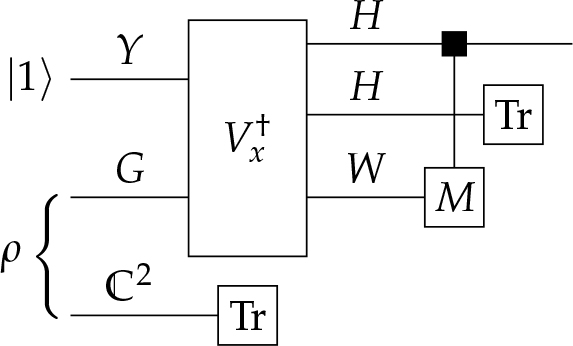
Figure A1.
Construction of the channel from a QMA(2)-language verification circuit.
First, consider the case that x ∈ L. Then, there exists |g〉 ∈ G such that . We claim the wanted clique is ρ = |g〉〈g|⊗|0〉〈0|, σ = |g〉〈g|⊗|1〉〈1|. For either of those two states, the state after step 2 is , where |α|2 ≥ c. Were 1 = 1, the output would be |ψ〉, in which case Tr(ϕ(ρ0)σ(σ0)) = 1. In reality, . Thus,
Now, consider the case that x ∉ L. In this case, for all |ψ〉,|ϕ〉 ∈ H, and |g〉 ∈ G, . Since every mixed state is a convex combination of pure states, if we show that for all pure states |ψ〉, |ϕ) ∈ G ⊗ ℂ2, Tr(Φ(|ψ〉〈ψ|)Φ(|ϕ〉〈ϕ|)) is upper bounded by some constant, the same bound must hold for all states. Further, we may, by the same argument, work only with states that remain pure after the partial trace is taken in step 1—these are the separable states |ψ〉 = |ψG) ⊗ |ψ0〉, |ψ〉 = |ϕG〉 ⊗ |ϕ0〉. With this assumption, after step 2, |ψ〉 becomes for some states |ψHH〉 ∈ H ⊗ H and |⊥〉 ∈ H ⊗ H ⊗ W, where |α|2 + |β|2 = 1. Letting μHH be the maximally mixed state on H ⊗ H, the state after step 3 is the |α|2|ψHH〉〈ψHH| + |β|2μHH. Expanding via the Schmidt decomposition, the final state after step 4 is
Note also that for all i. In the same way, for some ||α2qi ≤ s. Finally, we get that, by the Cauchy-Schwarz inequality,