Have a personal or library account? Click to login
Matrix Encoding Method in Variational Quantum Singular Value Decomposition Cover

Matrix Encoding Method in Variational Quantum Singular Value Decomposition

Open Access
|Aug 2025

Figures & Tables

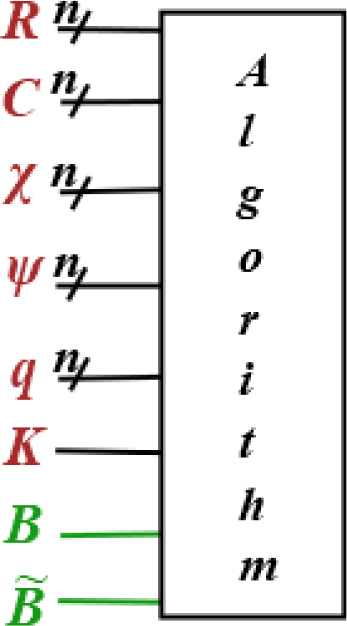
Figure 1.

Structure of subsystems required for performing the quantum part of variational SVD. It includes five n-qubit subsystems for encoding the matrix M(subsystems R, C), orthonormal eigenvectors 〈ψj| and |ψj〉 (subsystems χ, ψ) and weights qi (subsystem q). In addition, the one-qubit subsystem K serves as a controlling qubit in controlled operators of the algorithm and two one-qubit ancillae B and B˜{\tilde B} serve for the controlled measurement.

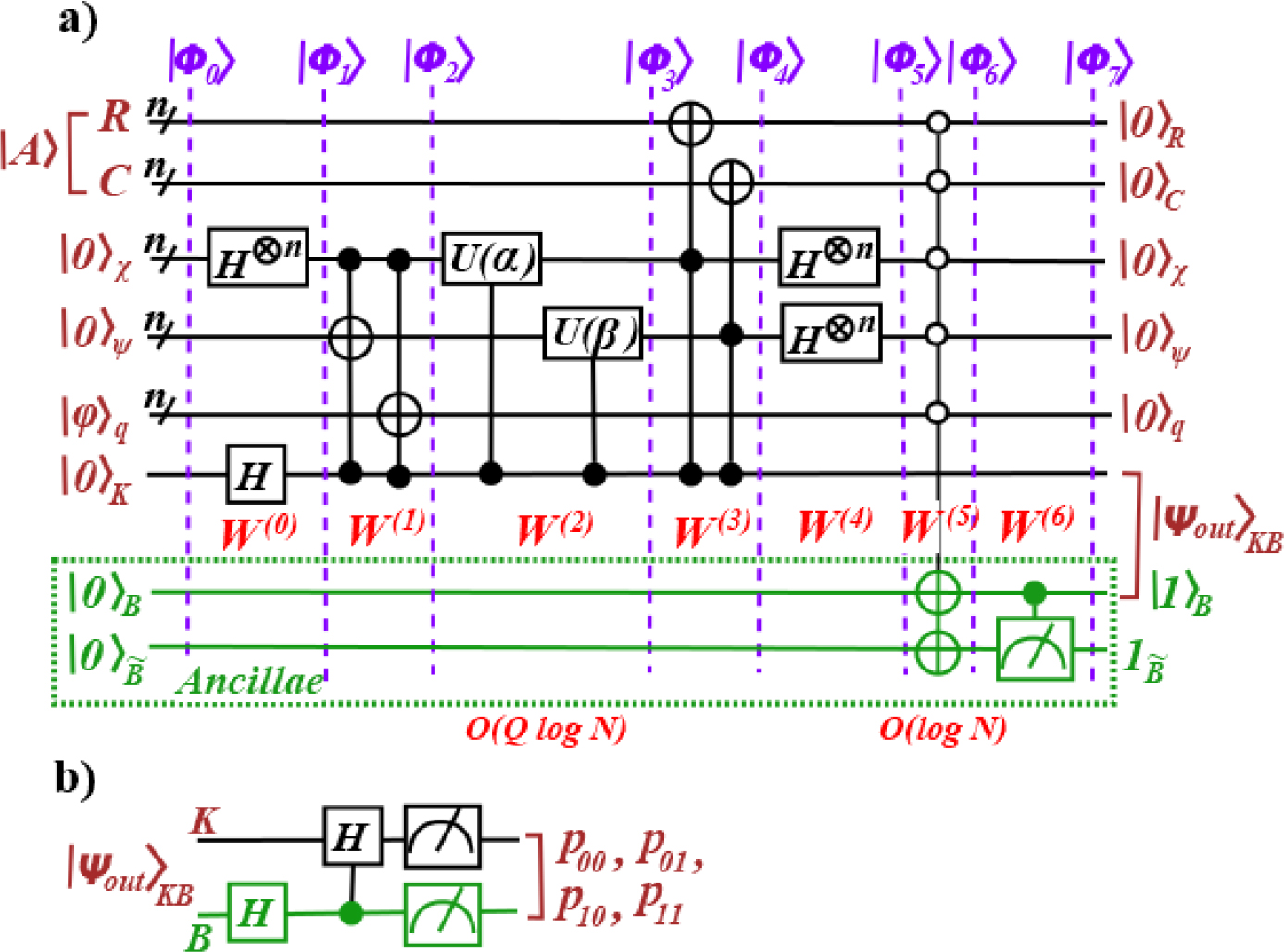
Figure 2.

The circuit for the quantum part of the variational SVD algorithm. The depth of this circuit can be estimated as O(Qlog(N)/ε). (a) The circuit for creating the state |ψout〉K given in (27); the operatorsW(j), j = 0, …,6 are presented without subscripts for brevity. (b) The operators applied to the state |ψout〉KB to probabilistically obtain the normalization G and the objective function L(α, β).
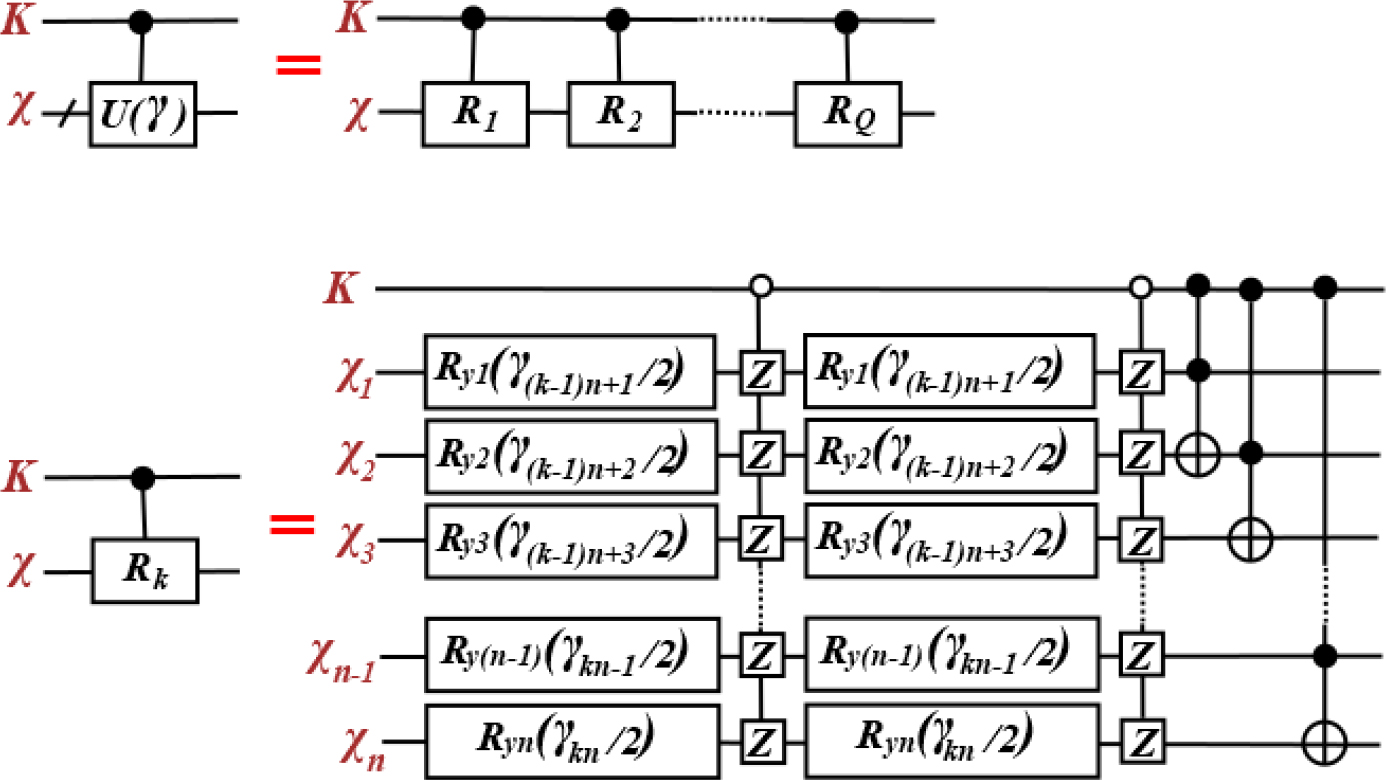

Figure 3.

The circuit for the operatorsWψK(2)(α)W_{\chi K}^{(2)}(\alpha ) (and WψK(2)(β)W_{\psi K}^{(2)}(\beta )). Here the set of parameters γ is either α (for WψK(2)(α)W_{\chi K}^{(2)}(\alpha )) or β (for WψK(2)(β)W_{\psi K}^{(2)}(\beta )), Z ≡ σ(z).

Figure 4.

The hybrid algorithm for calculating SVD. The matrices Û, D and V^{\hat V} are defined in terms of U(α*) and U(β*) according to (4), ΔL = |L[k+1] – L[k]|. For simplicity, we indicate only the function L and first derivatives ∂γL to be transferred from the output of the quantum algorithm to the input of the classical algorithm. However, the higher order derivatives might be required as well.
DOI: https://doi.org/10.2478/qic-2025-0020 | Journal eISSN: 3106-0544 | Journal ISSN: 1533-7146
Language: English
Page range: 356 - 368
Submitted on: Apr 14, 2025
Accepted on: Jul 1, 2025
Published on: Aug 22, 2025
Published by: Cerebration Science Publishing Co., Limited
In partnership with: Paradigm Publishing Services
Publication frequency: 1 issue per year

© 2025 Alexander I. Zenchuk, Wentao Qi, Junde Wu, published by Cerebration Science Publishing Co., Limited
This work is licensed under the Creative Commons Attribution-NonCommercial-NoDerivatives 4.0 License.