
Introduction
Chronic obstructive pulmonary disease (COPD) is a chest disease identified by abnormality in airway and/or alveolar function that cause persistent and progressive lower respiratory tract obstruction (1). Chronic obstructive pulmonary disease (COPD) is linked with severe morbidity and mortality worldwide. COPD is defined by airflow obstruction, and consists of two conditions: chronic bronchitis and emphysema both of them are related to the same causative factors and may coexist. Pulmonary function, which is measured by spirometry, is the characteristic feature of COPD (2).
Sarcopenia is defined as skeletal muscle dysfunction and the loss of skeletal muscle mass. Sarcopenic people aged over 65 years complains of disability, poor quality of life, and increased risk of premature death, leading to significant individual and socioeconomic burden (3) Obesity is defined as an accumulation of adiposity. Obese patients with COPD are exposed to have a poor physical health status, decreased exercise tolerance, and poor quality of life with increased comorbidities and mortality rate (4). In the late 20th century, Franssen et al. identified a group of elderly individuals who exhibited both obesity and sarcopenia, a condition they termed sarcopenic obesity (SO) (5).
SO is considered as a clinical condition identified by increased adiposity and decreased skeletal muscle mass and/or function (6).
Nowadays, it is estimated that ~11% of elderly people worldwide have SO, which sharply increases after the age of 70. SO is a dramatic factor for disability and survival, increasing the risk of obesity comorbidity (7).
Patients with both SO and COPD presents a more inflammatory response involving crosstalk between systemic inflammation and lipodystrophy that attributes to the incidence and development of SO (8) Obesity serves as a major risk factor for a wide range of non-communicable diseases, such as insulin resistance. Metabolic syndrome, high blood pressure, systemic inflammation, and cardiovascular disorders are also prevalent in patients with COPD (9). Moreover, obesity in individuals with COPD is linked with many other health comorbidities, such as exacerbated symptoms of dyspnoea, increased consumption of medications, and increased hospitalisation (10).
It is very important to have high level of knowledge on the clinical features of elderly obese with COPD Since both COPD and obesity places a high burden on the healthcare system (11). There are significant changes in muscle power, size, mass, oxidative capacity, and endurance in severe COPD cases. In severe COPD, muscles contract slowly but easily tired, resulting in rapid lactic acidosis and reduction in exercise capacity. There are several factors affecting functional and structural changes in muscles as well as systemic inflammation such as immobilisation, muscle disuse, hypoxemia, hypercapnia, acidosis, undernutrition, and systemic steroid use. Loss of muscle strength, power and endurance leads to fatigue, poor quality of life, and reduced exercise capacity (12).
Consequently, the decreased muscle mass, function, and strength (in another word, ‘sarcopenia’) occurs as a result of the systemic chemical or inflammatory effects of obesity and COPD. To the best of our knowledge, no studies to date have been conducted on the effects weight reduction program on SO with patients with COPD.
This study was conducted to investigate the effect of using weight reduction programme on SO in COPD patients.
Subjects and procedures
Study design: A single blinded randomised controlled trial study was conducted on sarcopenic obese diagnosed with COPD (Stage II-Global Initiative for Chronic Obstructive Lung Disease (GOLD) criteria) (1) at October 6 University hospitals from August 2024 to July 2025.
Subjects: Fifty male patients, aged 50–65 years were sent for eligibility assessment for intervention in this study and were excluded from this study if they have current active respiratory disorders other than COPD, for example, lung cancer, tuberculosis, or other significantly abnormal chest radiography not associated with COPD (documented within the past year). Chronic diseases such as diabetes mellitus, chronic kidney diseases, rheumatoid arthritis, neuromuscular diseases and musculoskeletal disorders that interfered with performance of the programme.
Methods (procedures)
All patients were given full explanation about the assessment and treatment procedures and informed consent form was signed from each patient before participating in the study.
Evaluative procedures
1. History taking
A detailed medical history was taken from all patients in recording data sheet in both groups which included personal, past, present, demographical data and COPD history, onset of disease, X-rays, physical level activity and medication.
2. Body composition and sarcopenia assessment
The body composition of each patient was determined with the bioelectrical impedance analysis (Bioelectric Impedance Analysis (BIA); InBody 770, Korea) method. Muscle mass was automatically calculated by the BIA device. Then, the skeletal muscle mass index (SMMI) (kg/m2) was calculated by dividing the skeletal muscle mass (SMM) by the square of the patient’s height according to Janssen formula (14).
3. Hand grip strength assessment
It was a reliable and valid hand grip dynamometer used to monitor the development of grip strength by recording the maximum reading (kg) from three attempts using the dominant hand, with a digital screen presents measurements to the nearest 0.1 kg that enables operator interpretation limited (15).
4. Stopwatch, coloured tape to mark starting line and end line of corridor
They were used for the application of 6 MWDT. It was a useful test to measure the response of cardiorespiratory systems while exercising. It was an assessment to measure the distance a person is capable of walking on a flat, hard surface in 6 min. Each subject was asked to walk as possible as he can through 6 min, and then the distance was calculated. Verbal encouragement is a tool that is used to promote participation by the patient (16).
Treatment procedures
For group A: They were given a low-caloric diet and asked to perform a supervised moderate intensity aerobic training on electronic treadmill, three sessions per week for 40 min for 10 weeks. Each patient’s training intensity was calculated as the training heart rate based on the subject’s age and predicted maximum heart rate and resting heart rate.
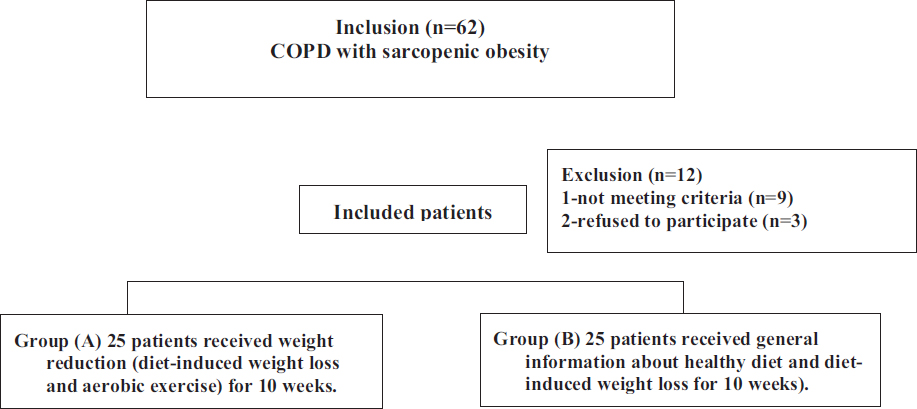
All patients were randomly assigned into two equal groups:
Group A: (n = 25) received weight reduction (healthy lifestyle control, diet-induced weight loss (1300–1500 Kcal/day) and aerobic exercise 40 min, 3 sessions/week for 10 weeks (13).
Group B: (n = 25) was given general information about healthy food choices and low-calorie diet (1300–1500 Kcal/day) for the same period.
1. Low caloric diet
By providing 1300–1500 Kcal/day. A diet with low saturated fat and no trans fats and high fiber diets (such as fruits, vegetables, whole grains, and non-refined complex carbohydrates) were emphasised.
2. Supervised moderate intensity aerobic training on electronic treadmill
Each exercise session consisted of three phases; the warmup, active, and cool-down phases. During the warm-up phase, the subjects performed simple stretching exercise for all large muscle groups or walk with low intensity (30%–40% of the maximal heart rate) for 5 min, after that patients were instructed to achieve their pre-calculated training heart rate (65%–75% of their maximal heart rate) in bouts with a total time of 40 min, then the patient ending the session by cooldown phase which continued 5 min during which the workload gradually decreased (30%–40% of their maximal heart rate) until Heart Rate (HR) had nearly returned to their resting levels. For group B: They were given general oral and written information about healthy food choices and low-caloric diet (1300–1500 Kcal/day) at baseline and at subsequent weekly visits for food exchange list, but no specific individualised exercise programmes were offered to them and the programme was applied for 10 weeks as group 1.
Statistical analysis
Unpaired t-test was conducted for comparison of subject characteristics between groups. Normal distribution of data was checked using the Shapiro–Wilk test. Levine’s test for homogeneity of variances was conducted to test the homogeneity between groups. Mixed Multivariant Analysis of Variance (MANOVA) was conducted to investigate the effect of treatment on weight, BMI, SMM, SMMI, handgrip strength (HGS) and 6MWT. Post hoc tests using the Bonferroni correction were carried out for subsequent multiple comparisons. The level of significance for all statistical tests was set at P < 0.05. All statistical analysis was conducted through the statistical package for social sciences (SPSS) version 25 for windows (IBM SPSS, Chicago, IL, USA).
Results
Subject characteristics
Table 1 showed the subject characteristics of the group A and B. There was no significant difference between groups in age, weight, height, and BMI (P > 0.05).
Table 1.
Comparison of subject characteristics between the group A and B
| Group A | Group B | ||||
|---|---|---|---|---|---|
| Mean ± SD | Mean ± SD | MD | t-value | P-value | |
| Age (years) | 55.28 ± 4.67 | 55.76 ± 4.50 | −0.48 | −0.37 | 0.71 |
| Weight (kg) | 94.18 ± 4.65 | 94.56 ± 4.30 | −0.38 | −0.31 | 0.76 |
| Height (cm) | 170.00 ± 2.99 | 169.88 ± 3.13 | 0.12 | 0.14 | 0.89 |
| BMI (kg/m2) | 31.53 ± 0.98 | 31.72 ± 1.03 | −0.19 | −0.66 | 0.51 |
Effect of treatment on weight, BMI, SMM, SMMI, HGS and 6MWT
Mixed MANOVA revealed a significant interaction effect of treatment and time (F = 25.69, P = 0.001, Partial Eta Squared = 0.78). There was a significant main effect time (F = 3571.01, P = 0.001, Partial Eta Squared = 0.99). There was a significant main effect of treatment (F = 2.64, P = 0.02, Partial Eta Squared = 0.27).
Within group comparison
There was a significant decrease in weight and BMI posttreatment in both groups compared with that pre-treatment (P < 0.001). The percentage of change in weight and BMI in group A was 10.07% and 7.04%, respectively; while in group B was 6.97% and 3.91%m respectively. (Table 2). There was a significant increase in SMM, SMMI, HGS, and 6MWT post-treatment in group A compared with pretreatment, with percentage changes of 7.56%, 7.56%, 47.07%, and 14.71%, respectively (P < 0.001). In group B, there was no significant change in SMM (0.14%) or SMMI (0.10%) (P > 0.05), whereas HGS and 6MWT showed significant increases of 27.96% and 6.79%, respectively (P < 0.001).
Table 2.
Mean weight and BMI pre- and post-treatment of group A and B
| Pre treatment | Post treatment | ||||
|---|---|---|---|---|---|
| Mean ± SD | Mean ± SD | MD | % of change | P-value | |
| Weight (kg) | |||||
| Group A | 94.18 ± 4.65 | 84.70 ± 3.07 | 9.48 | 10.07 | 0.001 |
| Group B | 94.56 ± 4.30 | 87.97 ± 4.11 | 6.59 | 6.97 | 0.001 |
| MD | −0.38 | −3.27 | |||
| P = 0.76 | P = 0.003 | ||||
| BMI (kg/m2) | |||||
| Group A | 31.53 ± 0.98 | 29.31 ± 0.97 | 2.22 | 7.04 | 0.001 |
| Group B | 31.72 ± 1.03 | 30.48 ± 1.23 | 1.24 | 3.91 | 0.001 |
| MD | −0.19 | −1.17 | |||
| P = 0.51 | P = 0.001 | ||||
Between group comparison
There was no significant difference between groups pretreatment (P > 0.05). Comparison between groups posttreatment revealed a significant decrease in weight and BMI of group A compared with that of group B (P < 0.01). (Table 2). There was a significant increase in SMM, SMMI, hand grip strength, and 6MWT of group A compared with that of group B post-treatment (P < 0.01). (Table 3).
Table 3.
Mean SMM, SMMI, HGS and 6MWT pre- and post-treatment of group A and B
| Pre-treatment | Post-treatment | ||||
|---|---|---|---|---|---|
| Mean ± SD | Mean ± SD | MD | % of change | P-value | |
| SMM (kg) | |||||
| Group A | 28.31 ± 1.65 | 30.45 ± 2.05 | −2.14 | 7.56 | 0.001 |
| Group B | 28.69 ± 1.92 | 28.65 ± 1.92 | 0.04 | 0.14 | 0.81 |
| MD | −0.38 | 1.8 | |||
| P = 0.46 | P = 0.002 | ||||
| SMMI | |||||
| Group A | 9.79 ± 0.49 | 10.53 ± 0.61 | −0.74 | 7.56 | 0.001 |
| Group B | 9.94 ± 0.59 | 9.93 ± 0.59 | 0.01 | 0.10 | 0.81 |
| MD | −0.15 | 0.6 | |||
| P = 0.35 | P = 0.001 | ||||
| Hand grip strength (kg) | |||||
| Group A | 23.20 ± 2.81 | 34.12 ± 2.74 | −10.92 | 47.07 | 0.001 |
| Group B | 24.32 ± 2.50 | 31.12 ± 1.86 | −6.8 | 27.96 | 0.001 |
| MD | −1.12 | 3 | |||
| P = 0.14 | P = 0.001 | ||||
| 6MWT (m) | |||||
| Group A | 286.64 ± 12.24 | 328.80 ± 15.78 | −42.16 | 14.71 | 0.001 |
| Group B | 288.28 ± 11.34 | 307.84 ± 11.99 | −19.56 | 6.79 | 0.001 |
| MD | −1.64 | 20.96 | |||
| P = 0.63 | P = 0.001 | ||||
Discussion
COPD is a systemic disorder and usually present with many comorbidities. One of the most common disorders is a skeletal muscle dysfunction. According to the GOLD 2023 Report, dysfunction of skeletal muscle is characterised by loss of muscle mass and dysfunction of the remaining cells. (1). Many of COPD patients were noticed to have some abnormalities in their body composition, including obesity (17). Obesity is often characterised by excess body fat accumulation in the adipose tissue to the extent that health may be impaired (3) COPD patients with obesity are considered to have a poorer health status and demonstrate increased comorbidities, morbidity, mortality, impaired exercise tolerance, and decreased quality of life (4)
Physical exercise in patients with COPD has gradually attracted the attention of scholars in recent years. The GOLD guidelines suggest that regular physical exercise for all patients with COPD, which significantly improves breathing, general status, and exercise tolerance (18)
Regarding weight and BMI in our study, it was found that there was a significant decrease in weight and BMI in both groups post-treatment compared with that of pre-treatment (P = 0.001). Weight reduction programme is indicated for sarcopenic obese individuals, irrespective of the presence of COPD (19). General recommendations for weight loss apply to individuals with COPD. A loss of 5%–10% of baseline weight within 6 months is a highly recommended essential goal and individuals should be offered a comprehensive lifestyle modification consisting of both healthy low-calorie diet and physical activity (18).
In one study done by Villareal et al. (20), they evaluated the combined effects of resistance and physical exercise, in combination with a low-calorie diet, in 160 sarcopenic obese in older adults. After 6 months, the body weight had decreased by 9% (P < 0.001) in all of the exercise groups, and did not change significantly in the control group (no weight-management or exercise programme). Also, Trouwborst et al. have suggested that a moderate weight loss dietary regimen, along with physical exercise have a substantial beneficial effect on SO parameters (21).
Regarding to SMM and SMMI in our study, it was found that there was a significant increase in muscle mass and muscle mass index post-treatment in group A (P < 0.001) with no change in muscle mass or muscle mass index post-treatment group B.
Pulmonary rehabilitation is highly recommended by the American Thoracic Society for all adults with stable COPD to improve physical performance, muscle power, and quality of life (22). Pulmonary rehabilitation programmes are very useful in sarcopenic obese with patients with COPD and typically combine aerobic/endurance training (such as walking, cycling, and treadmill), strengthening of respiratory muscle and healthy diets (23). Physiologically, physical training induces muscle fibre remodelling for more oxidative fibres, increases capillary density, and upregulates anabolic signalling pathways, thereby enhancing muscle protein synthesis, oxidative capacity, and muscle mass (24). These adaptations lead to significant improvements in 6MWT, as well as significant increase in peak work capacity, quadriceps strength, and physical performance (25). Moreover, pulmonary rehabilitation programme can lead to reversal of sarcopenia in a group of patients. For example, Jones et al. (25) have demonstrated that 28% of sarcopenic COPD patients have no longer met the diagnostic criteria after the intervention of the programme.
Several studies in sarcopenic patients with COPD have reported that these individuals are associated with reduced exercise capacity, impaired functional performance, and lower quality of life, and that interventions such as aerobic exercise and healthy diets can improve these results even when changes in muscle mass are modest (26).
In a study done by Benz et al. reported that skeletal muscle wasting could occur in the early COPD stages (27) and different exercise modalities could significantly improve lower limb muscle mass in COPD (15). Previous studies have found that resistance exercise can effectively improve lower limb lean muscle mass, increase the cross section area of quadriceps muscle in COPD (28).
Also the systematic review by Eglseer et al. focused on the importance of combined effects of dietary and physical exercise interventions in elderly individuals with SO. They concluded that physical training led to significant reduction in body fat and increased muscle mass and improved muscle power (29).
Also, our result had come in constant with s study by Janani and Sedhunivas who concluded that aged people who regularly participated in moderately aerobic exercise had better oxygen consumption, muscle mass, and function in their lower limbs (30).
Regarding to HGS in our study, it was found that there was a significant increase in hand grip strength in both groups post-treatment (P < 0.001) with more improvement change in group A compared to group B.
HGS has been used as an important indicator of low muscle power to diagnose sarcopenia, because low HGS is an index overall muscular strength, nutritional status, muscle mass, and walking performance (31).
A previous meta-analysis of 24 randomised control trials reported that many exercise forms, including aquatic exercise, walking, flexibility, home-trainer exercise, strength training, calisthenics, Chi, balance training and multi-dimensional training, and improved HGS in older adults. Physical exercise improves HGS by improving cardiopulmonary function, muscle strength and bone health, moreover the combined effect of weight loss and aerobic exercise is often more effective than either intervention alone (32).
Also, Lee concluded that continuous regular physical activity including aerobic and strength exercise, can help to significantly improve HGS, leading to a decreased risk of SO (33).
Seong et al. also reported that there was a strong relationship between physical exercise and hand grip strength, which is a significant measure reflective of the overall physical health (34).
Our results revealed that there was a significant increase in 6MWT in group A and group B post-treatment compared with that of pre-treatment (P = 0.001). When comparing two groups with each other, there was a significant increase in 6 MWT of group A post-treatment compared with that of group B (P = 0.001).
Our results have come in the agreements with Saarsan et al. who have reported that both aerobic and resistance training increase the 6MWD of obese women irrespective of weight loss (35).
Reports from large COPD cohort investigations, such as COPD gene, suggested that obese patients with COPD may experience high mortality and negative outcomes, such as physical activity limitation, dysponea, and quality-of-life measures (36).
Indeed, SO was related to reduced physical activity and increased systemic inflammation in COPD, compared with patients with normal body composition after matching for personal data, anthropometric data, smoking, and disease severity (37).
Another study done by Papadopoulou et al. concluded that physical and respiratory exercises, and low caloric diets, could be used in clinical practice to improve functional status and achieve weight loss (38).
In this study, a weight reduction programme combining low-calorie diets with exercise can effectively decrease body weight and BMI in sarcopenic obese patients with COPD, while also enhancing SMM, SMMI, HGS, and performance on the six-min walk distance test.
Strength and limitations of the study
One of the strength point of this study that it was the first study that investigate the effect of weight reduction programme on SO on COPD patients, while one of the limitations of our study is the application on mild obese patients. The severity of obesity strongly affects overall performance and modifies the type of intervention. Another limitation of our study is the small size of the participants; despite statistical adjustments, it contributes to a small sampling bias.
Notes
[4] Contributed by Authors’ contribution
Alaa Magdy Mostafa contributed to the study conception and design, patient recruitment, data collection, implementation of the intervention, and drafting of the manuscript.
Karim Ahmed contributed to the study design, supervision of the research process, interpretation of the results, and critical revision of the manuscript for important intellectual content.
Mahmoud Mohamed El Batanouny contributed to the medical evaluation of patients, confirmation of COPD diagnosis, clinical supervision, and review of the manuscript.
Lamis Ahmed Osama Ghaly contributed to data analysis, statistical interpretation, methodological guidance, and manuscript revision.
All authors have read and approved the final manuscript and agree to be accountable for all aspects of the work.
[5] Ethics approval
Ethics Committee approval has been granted. The name of the committee and the number of the decision:
↳ Please write the name of the committee and the number of the decision: O6U.PT.RCE/024/003005
[6] Ethical considerations
A study was conducted in accordance with the declaration of Helsinki (Code of Ethics of the World Medical Association). The study protocol was approved by the Ethical Committee of the Faculty of Physical Therapy, October 6 University (No.PT.REC/024/003005).
[7] Conflicts of interest Conflicts of interest
There is no conflict of interest.
[8] Informed consent statement
No informed consent was necessary.