

Figure 1.
3D and cross-sectional views of a radial flux proposed design generator.

Figure 2.
Per-phase equivalent circuit of a high-speed radial flux generator.
Table 1.
Key geometric design parameters of the proposed aerospace generator.
| Parameter | Value | Unit |
|---|---|---|
| Number of stator slots | 9 | |
| Number of poles | 6 | |
| Stator outer diameter | 120 | mm |
| Shaft diameter | 30 | mm |
| Airgap length | 2 | mm |
| Magnet thickness | 7 | mm |
| Banding thickness | 1 | mm |
Table 2.
Material properties of the proposed and conventional aerospace generator designs (Tian et al., 2025; Wang and Wang, 2011).
| Parameters | Proposed design material | Conventional design material | Unit | |
|---|---|---|---|---|
| Stator core | Rotor core | |||
| Lamination thickness | 0.018 | 0.05 mm | 0.15 | mm |
| Relative permeability (µr) | 80,000–100,000 | 200–500 | 18,000 | |
| Poisson’s ratio | 0.3 | 0.32 | 0.3 | |
| Thermal conductivity | 23 | 6 | 14.5 | W/m/K |
| Specific heat capacity (Cp) | 480 | 500 | 460 | J/kg/K |
| Young’s coefficient | 140,000 | 160,000 | 207,000 | Mpa |
| Curie temperature | 570 | 560 | 980 | °C |
| Yield stress | 800 | 200 | 393 | Mpa |
| Density | 7,300 | 7,500 | 8,110 | kg/m3 |
| Electrical resistivity | 1.2E−6 | 20E−6 | 4.06E−7 | Ω/m |

Figure 3.
Simulation workflow for performance evaluation of proposed and conventional aerospace generators.
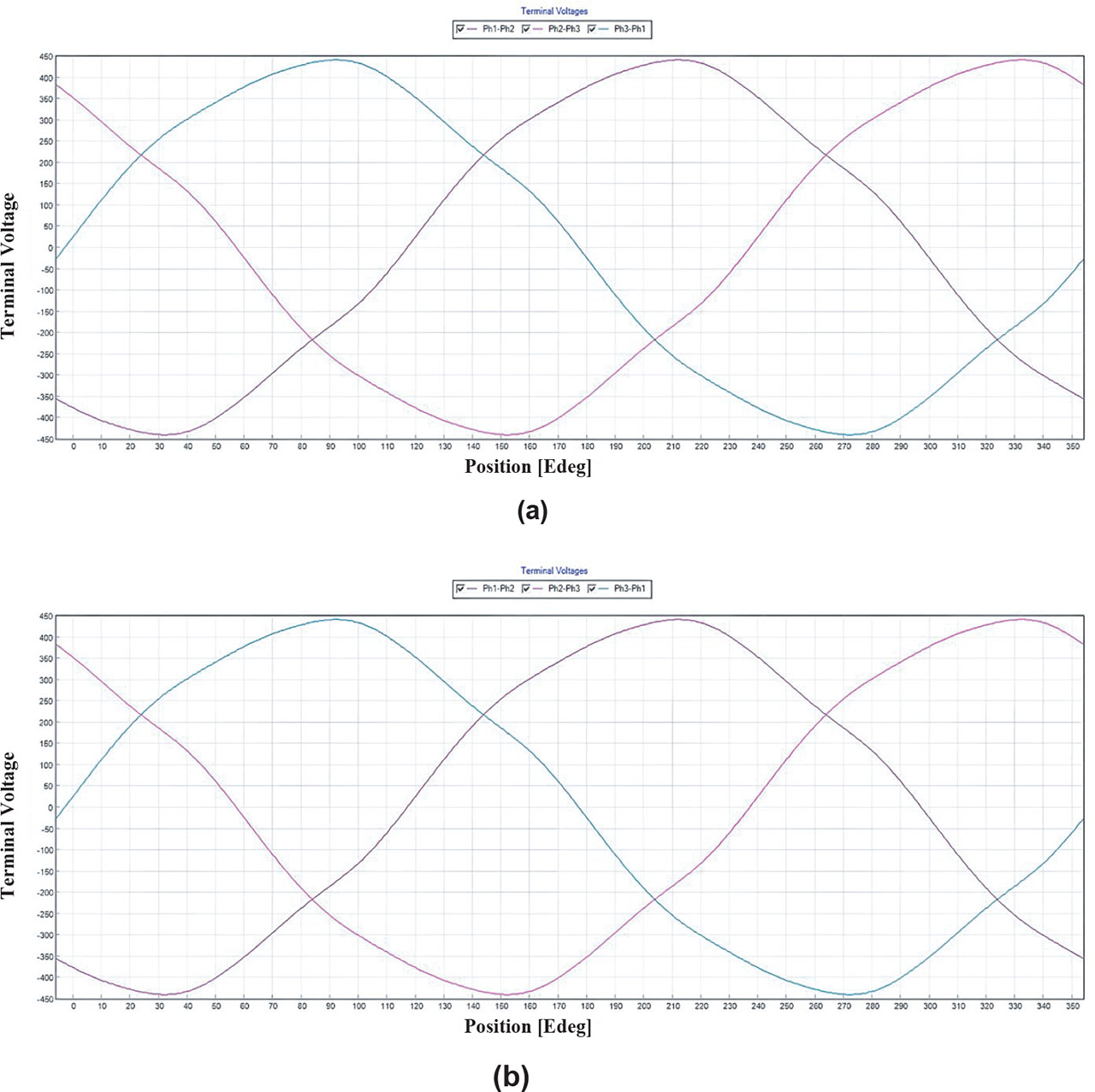
Figure 4.
Phase-to-phase terminal voltages: (a) proposed Finemet–SMC-based generator and (b) Hiperco 50-based conventional generator. SMC, soft magnetic composites.

Figure 5.
Torque–speed characteristics of: (a) proposed Finemet–SMC-based generator and (b) Hiperco 50-based conventional generator. SMC, soft magnetic composites.
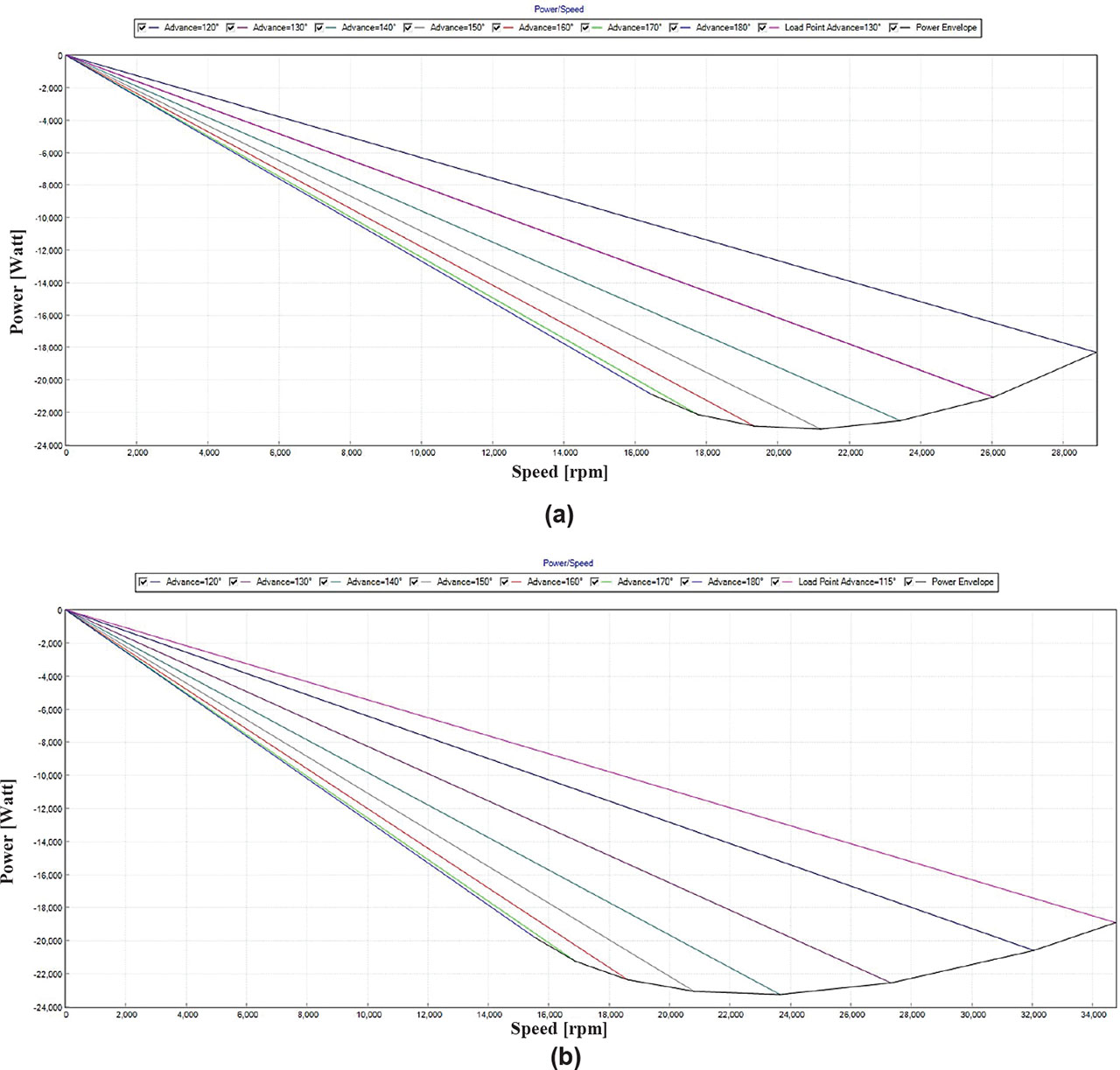
Figure 6.
Power–speed envelopes of (a) the proposed Finemet–SMC-based generator and (b) the conventional Hiperco 50 generator. SMC, soft magnetic composites.

Figure 7.
Comparison of magnetic flux density distribution: (a) proposed Finemet–SMC-based generator and (b) Hiperco 50-based conventional generator. SMC, soft magnetic composites.
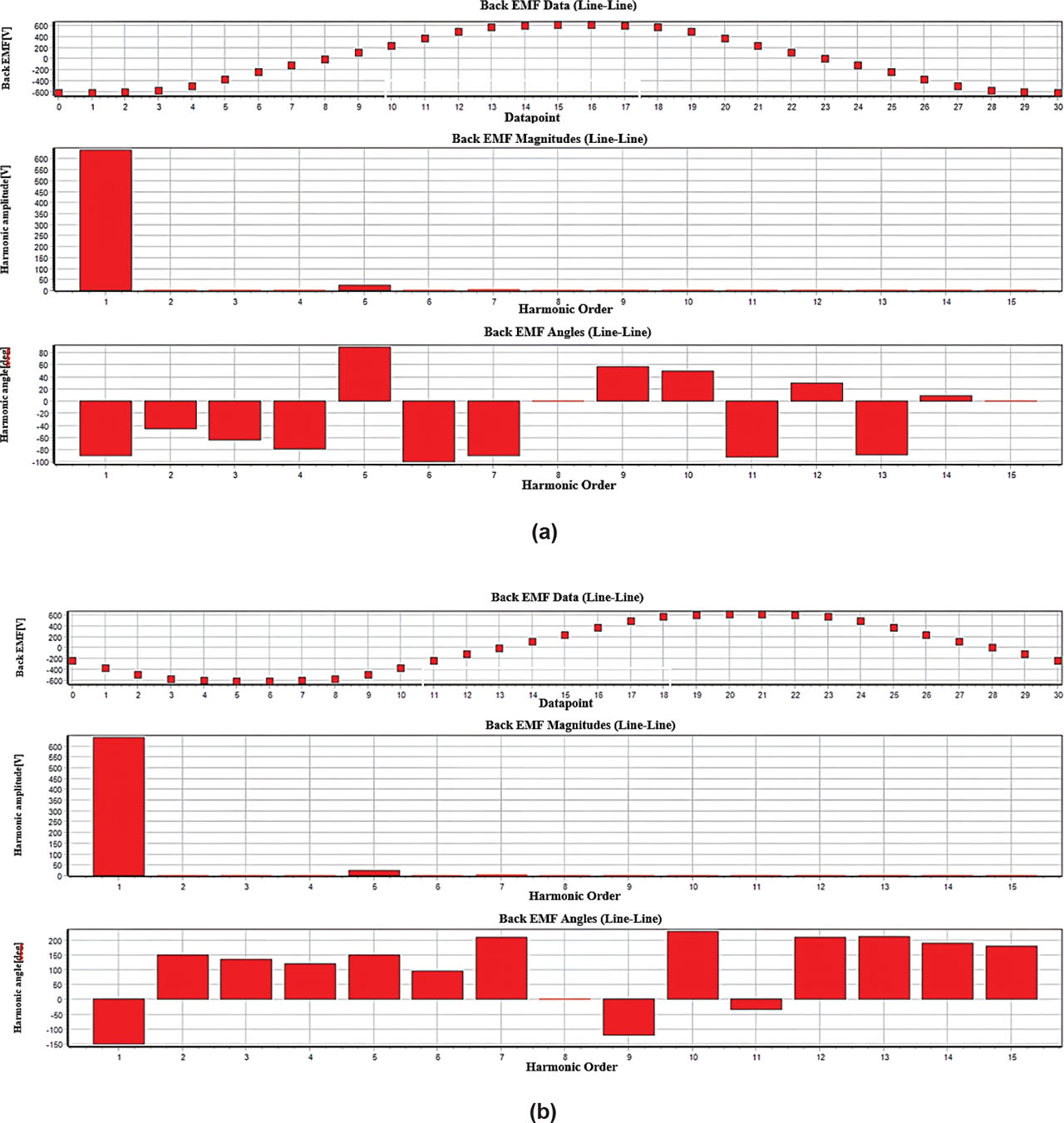
Figure 8.
Back EMF and harmonic signature analysis: (a) proposed Finemet–SMC-based generator and (b) Hiperco 50-based conventional generator. SMC, soft magnetic composites.

Figure 9.
Torque waveform and FFT analysis: (a) proposed Finemet–SMC-based generator and (b) Hiperco 50-based conventional generator. FFT, fast Fourier transform; SMC, soft magnetic composites.
Table 3.
Comparative thermal parameters and cooling techniques of conventional and proposed aerospace generators
| Thermal parameter | Conventional aerospace generators | Proposed aerospace generators | Unit |
|---|---|---|---|
| Winding loss | 450.7 | 232.5 | (W) |
| Iron loss – stator core | 226.6 | 0.6027 | (W) |
| Iron loss – rotor core | 0.3087 | 0.02588 | (W) |
| Magnet loss | 29.53 | 33.82 | (W) |
| Additional loss | 29.83 | 29.42 | (W) |
| Total loss | 737 | 296.4 | (W) |
| Total thermal loss | 637.4 | 165.4 | (W) |
| Max winding temperature | 142 | 89 | (°C) |
| Max stator temperature | 168.4 | 92.5 | (°C) |
| Max rotor temperature | 157.9 | 88.1 | (°C) |
| Thermal limit margin | 15 | 42 | % |
| Thermal conductivity of core | 14.5 | 23 | |
| Cooling mechanism | Passive convection | Directed forced air |
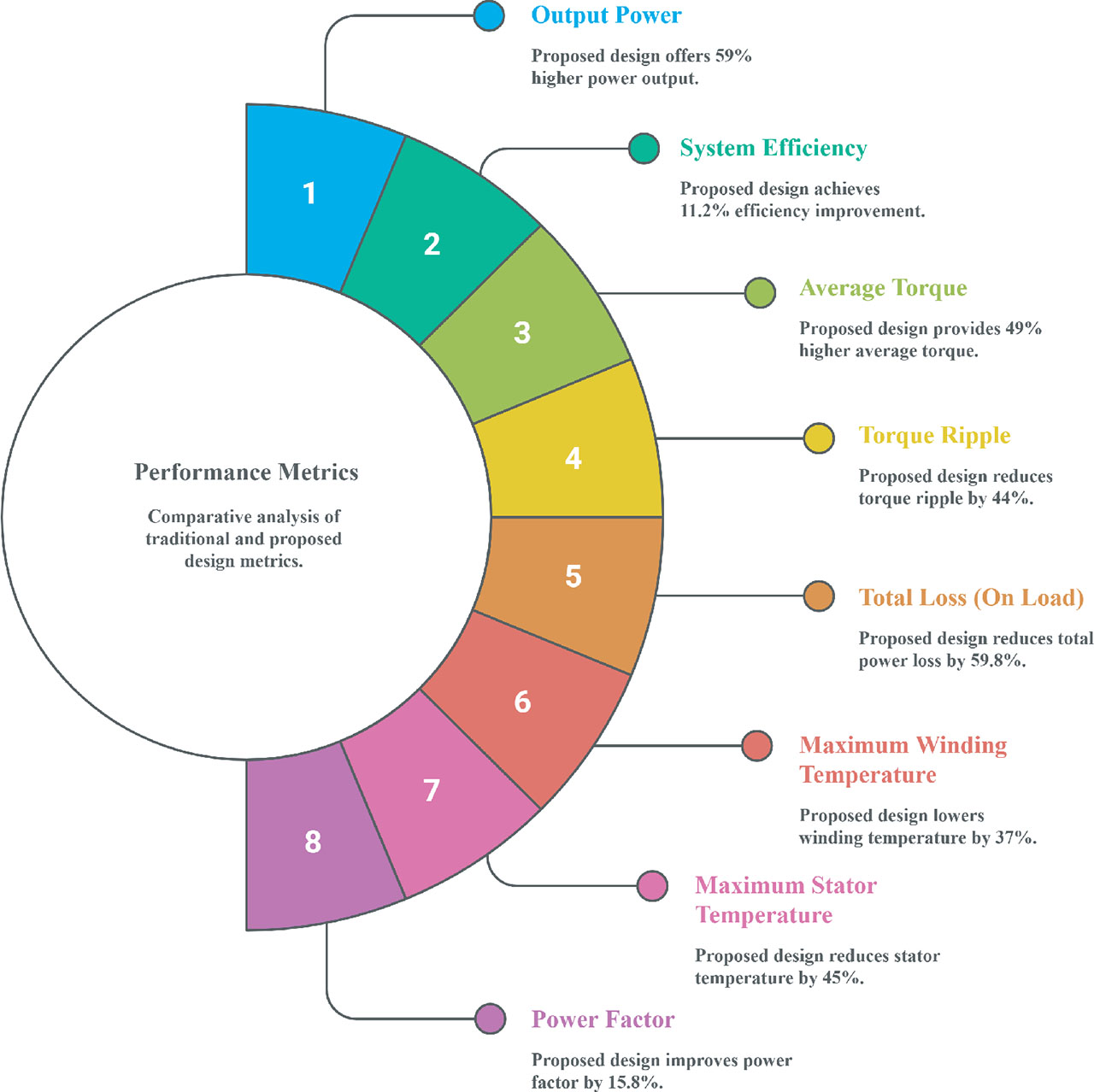
Figure 10.
Key performance improvements in the proposed Finemet–SMC design. SMC, soft magnetic composites.
Table 4.
Comparative cost and material analysis of conventional vs. proposed aerospace generator designs (Innovation. Carpenter Technology, n.d.; Metal powders | Höganäs, n.d.; VAC - Advanced Magnetic Solutions | VAC, n.d.).
| Component | Material (Trad./Prop.) | Weight (kg) (Conv./Prop.) | Cost of conventional aerospace generator (USD) | Cost of proposed design aerospace generator (USD) |
|---|---|---|---|---|
| Stator lamination (Back) | Hiperco 50/Finemet FT3M | 2.469/2.222 | 1,728.30 | 666.60 |
| Stator lamination (tooth) | Hiperco 50/Finemet FT3M | 2.293/2.064 | 1,605.10 | 619.20 |
| Rotor lamination (total) | Hiperco 50/SMC HB1 | 0.6339/0.5862 | 443.73 | 70.34 |
| Armature winding (active) | Copper/Litz wire | 2.163/1.114 | 35.77 | 33.42 |
| Armature end winding (total) | Copper/Litz wire | 2.121/0.546 | 35.10 | 16.38 |
| Magnet | Recoma 28 | 0.6147 | 737.64 | 737.64 |
| Rotor banding | Inconel 718 | 0.1397 | 11.18 | 11.18 |
| Shaft (total) | Steel (general) | 2.425 | 4.85 | 4.85 |
| Total estimated cost | $4,601.67 | $2,159.61 | ||
| Cost reduction | 53.1% |