
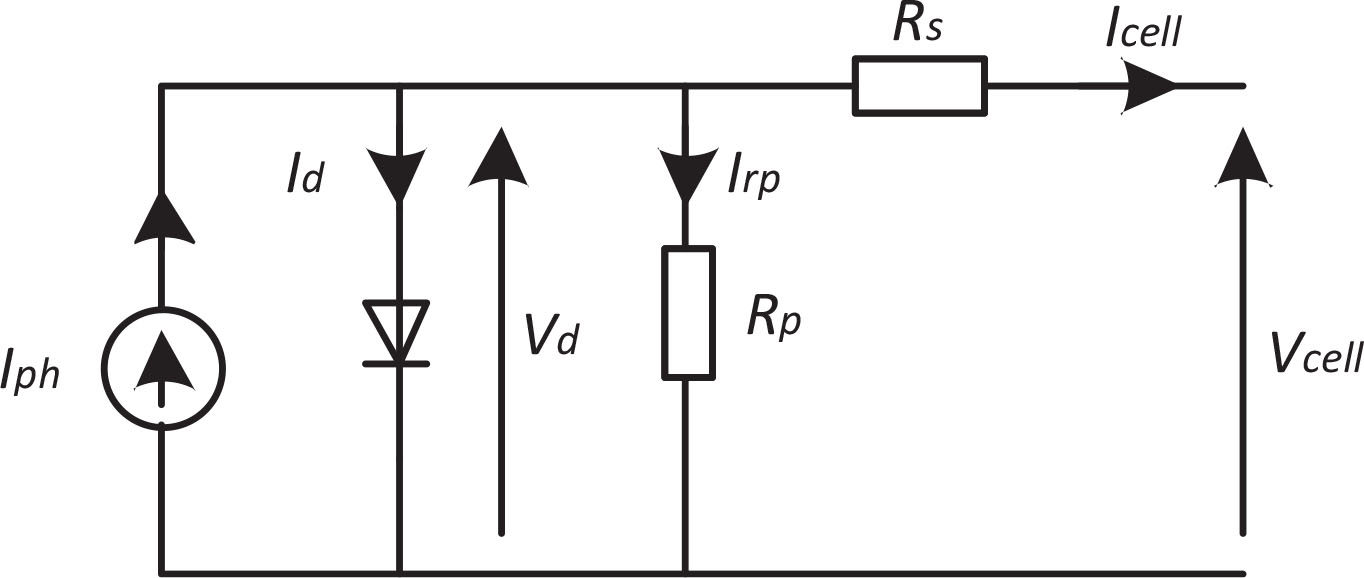
Fig. 1.
Equivalent PV cell scheme. PV, photovoltaic.
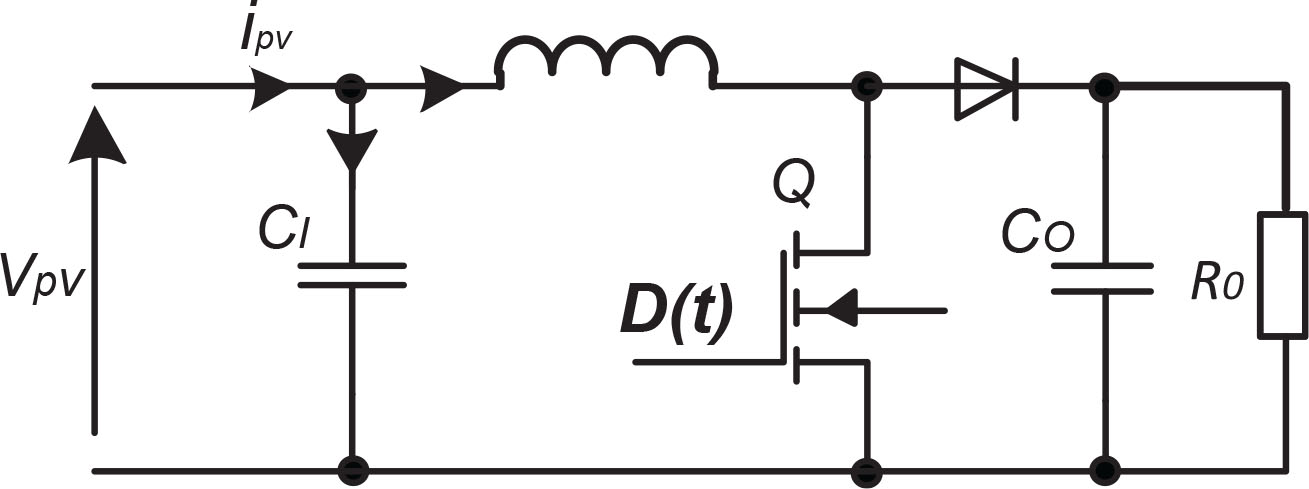
Fig. 2.
Boost converter circuit.
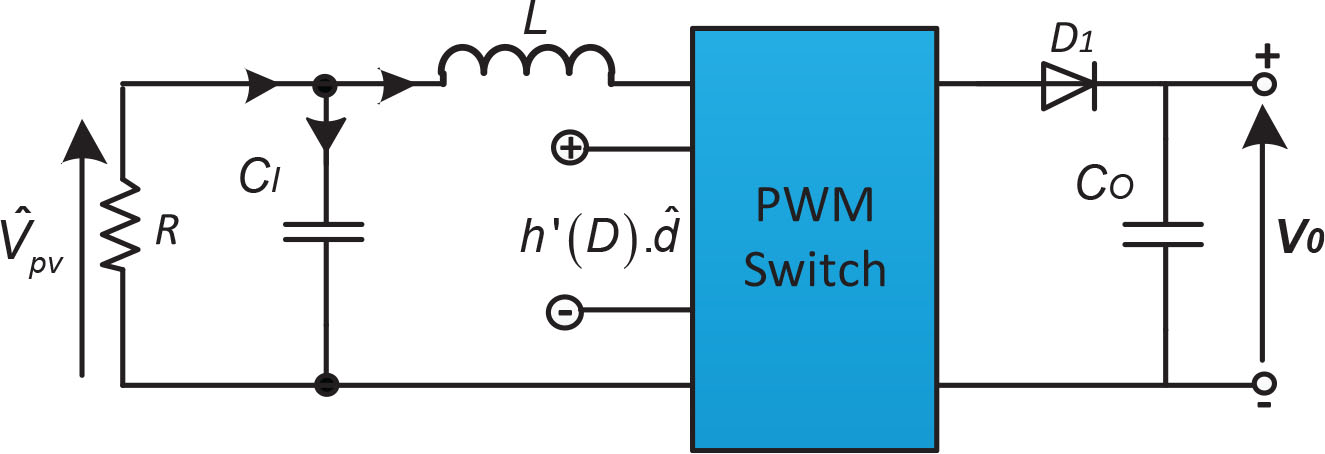
Fig. 3.
PV output converter circuit: Small-signal model. PV, photovoltaic.
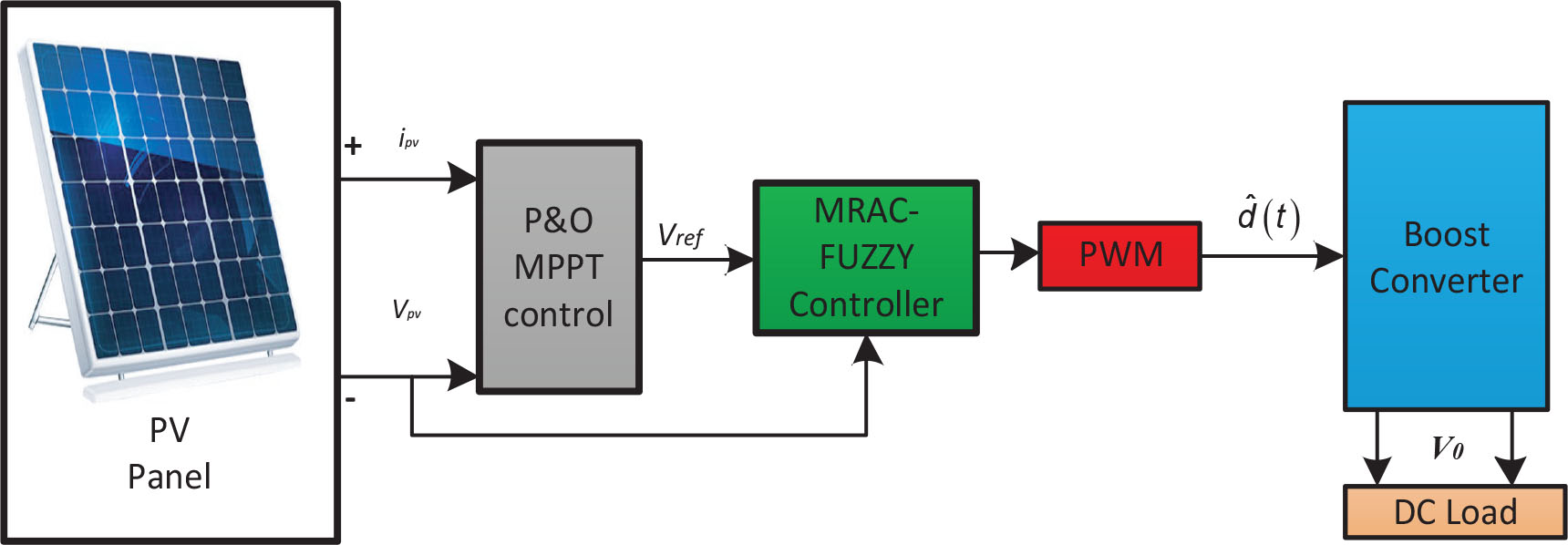
Fig. 4.
PV system featuring the proposed MPPT control algorithm. MPPT, maximum power point tracking; P&O, perturb and observe; PV, photovoltaic; PWM, Pulse Width Modulation..
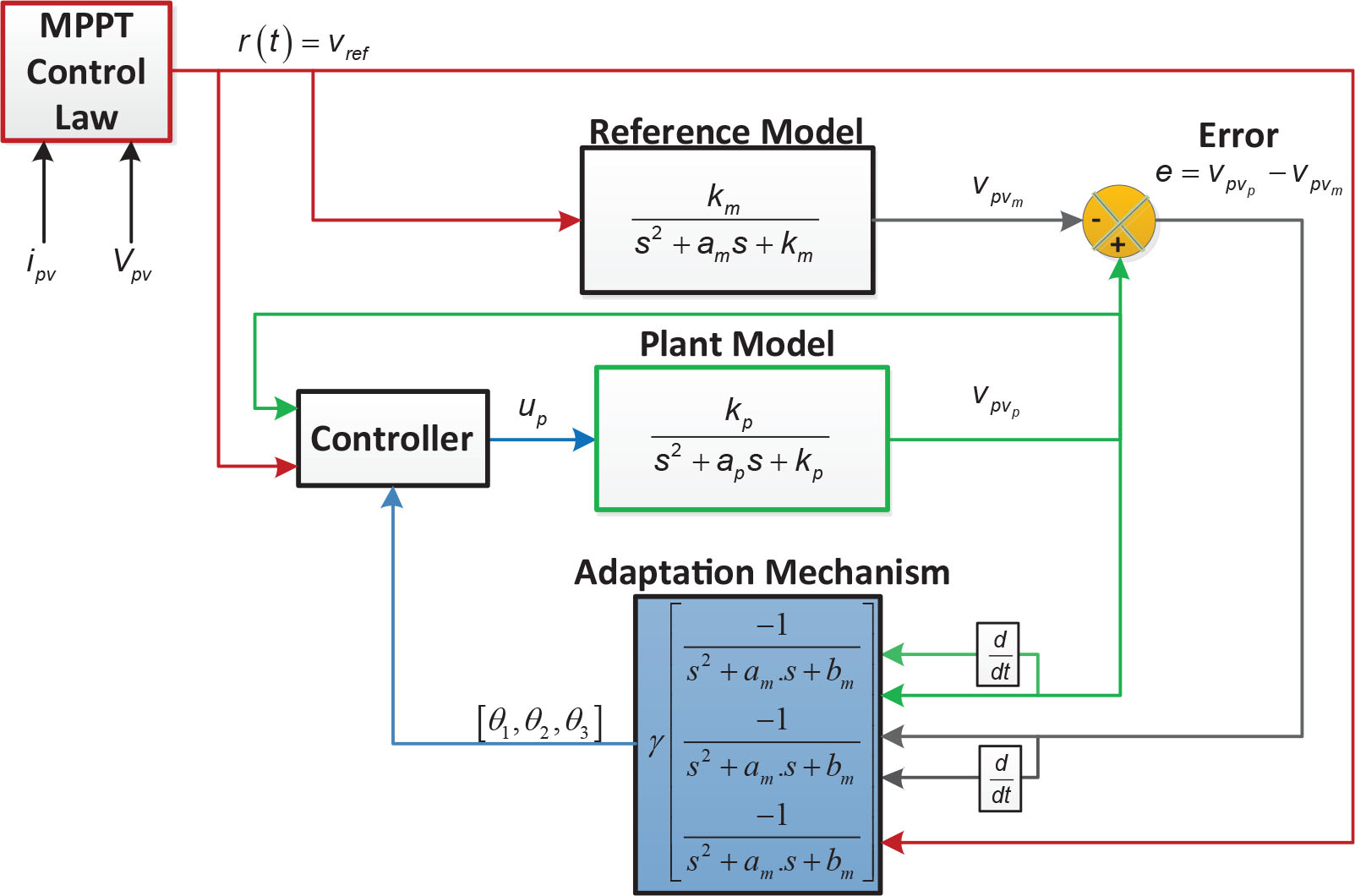
Fig. 5.
Block scheme of the suggested MRAC controller. MPPT, maximum power point tracking.
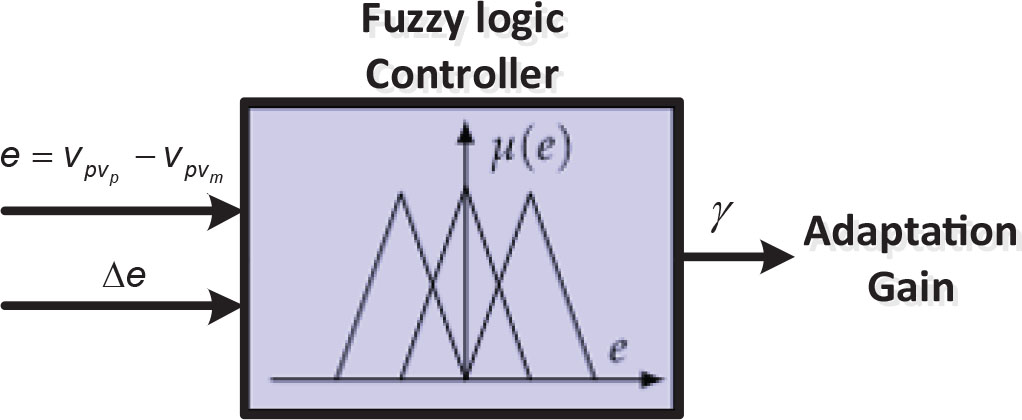
Fig. 6.
Structure of the FL γ adaptation. FL, fuzzy logic.
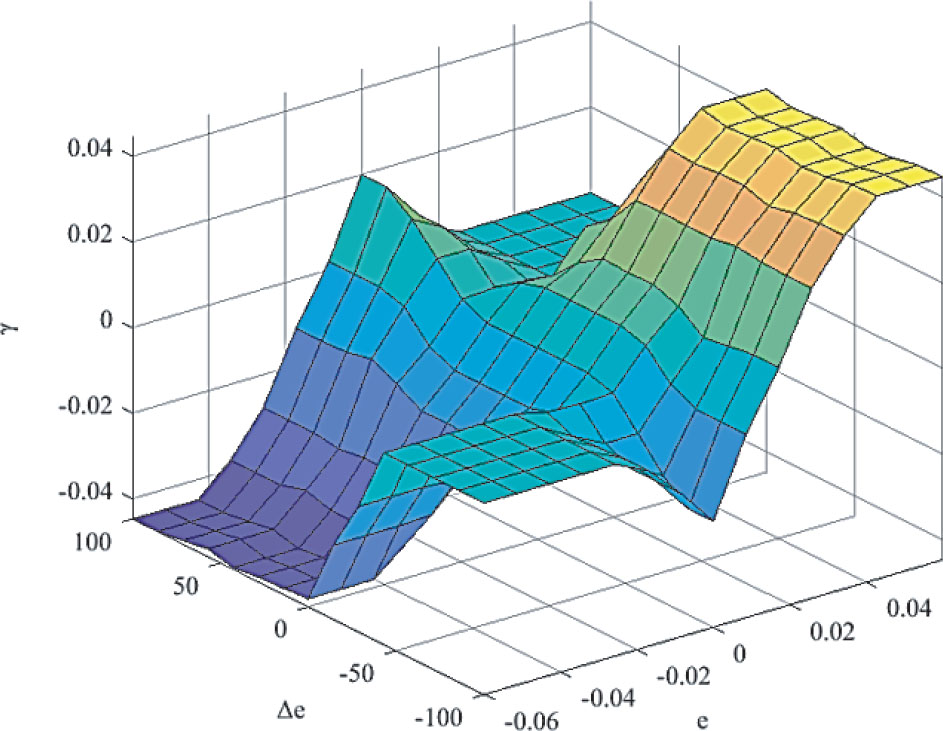
Fig. 7.
Control surface of the fuzzy controller.
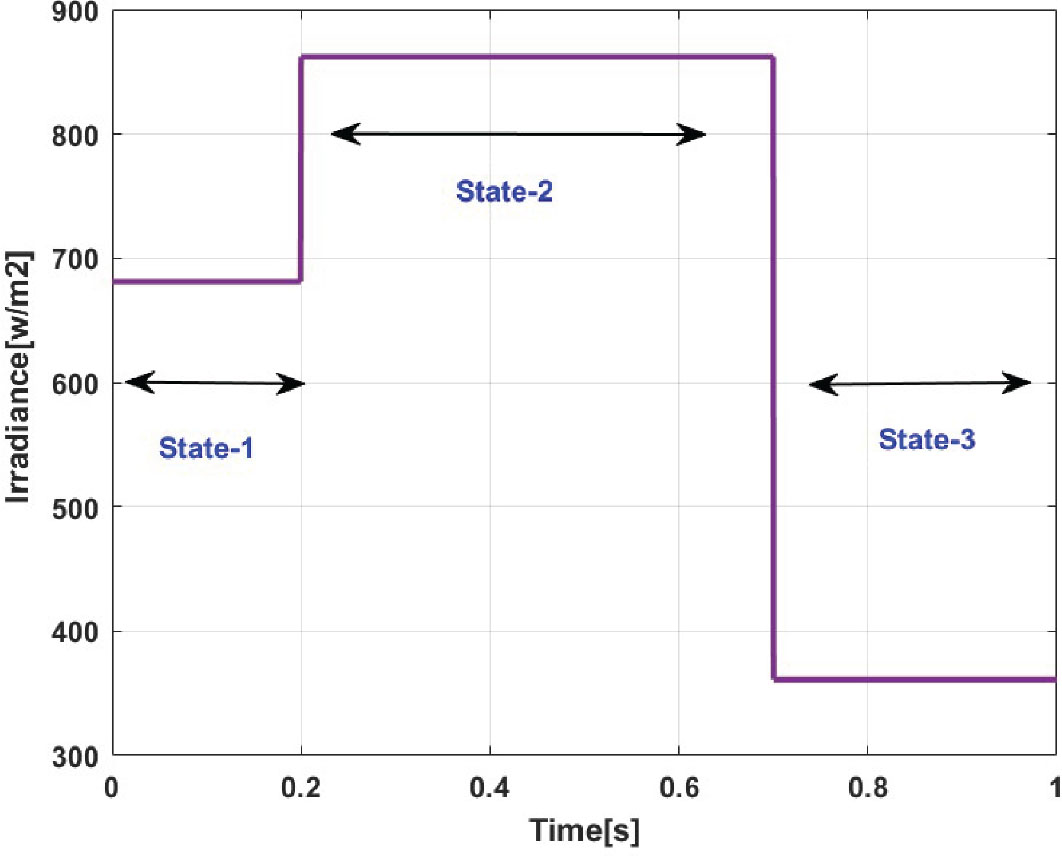
Fig. 8.
Irradiation pattern profile.
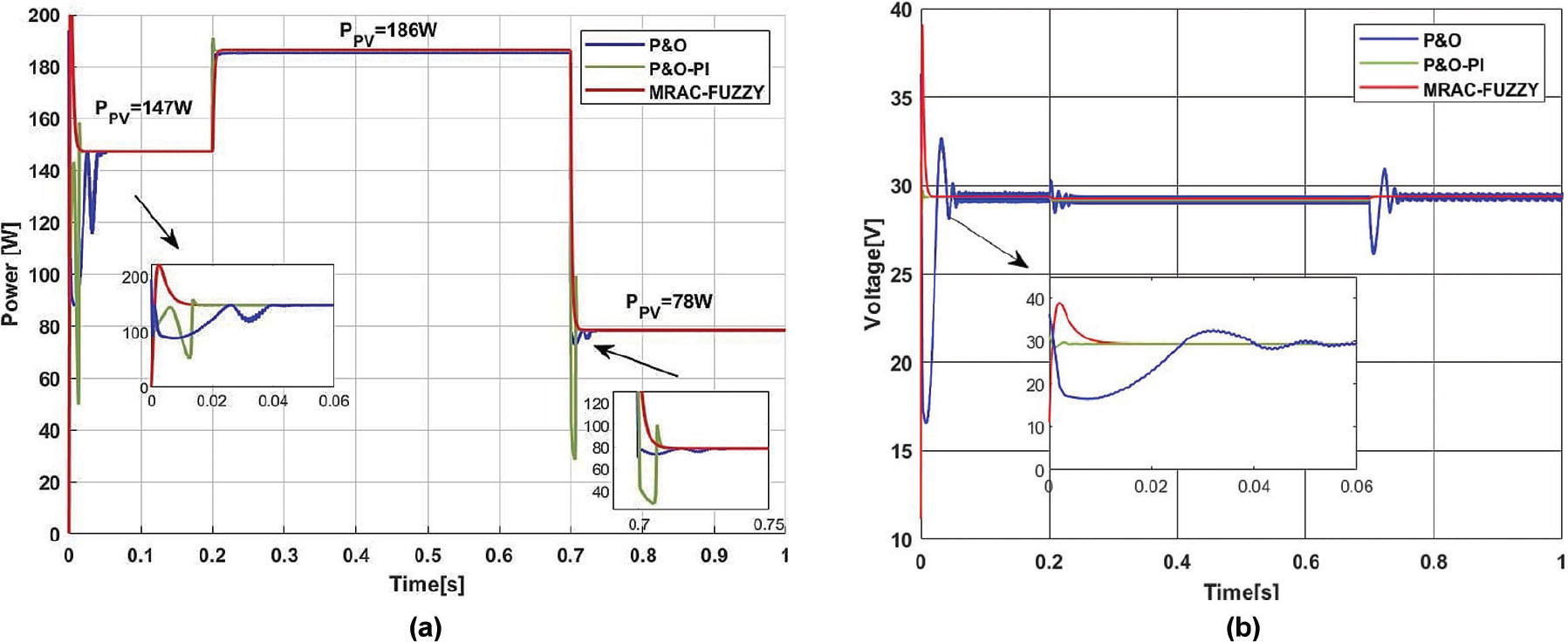
Fig. 9.
Simulation results for three MPPT controllers for different radiation and a fixed temperature. MPPT, maximum power point tracking; P&O, perturb and observe. (a) Power, (b) Voltage.
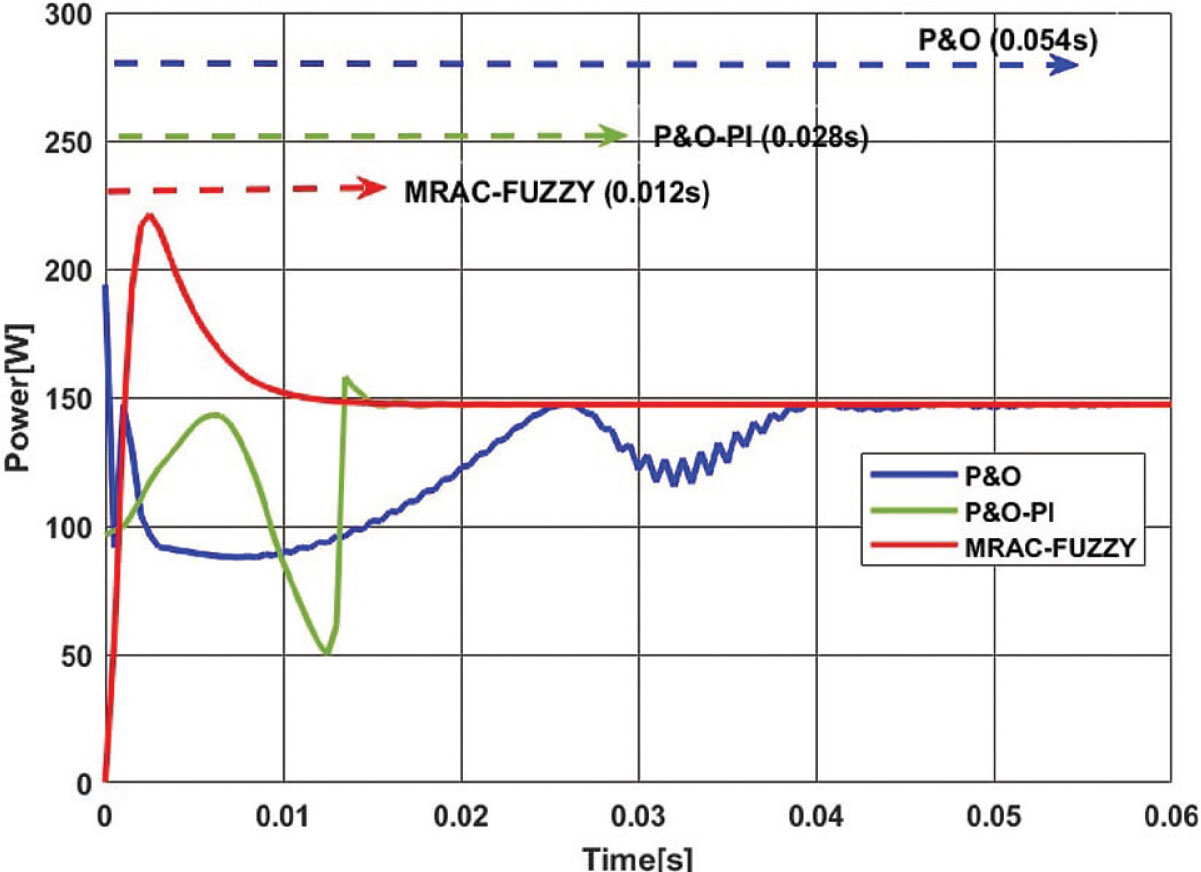
Fig. 10.
MPPT speed with varying irradiance and constant temperature. MPPT, maximum power point tracking; P&O, perturb and observe.
Table 2.
Simulation parameters.
| PV model parameters | Value | DC–DC boost parameters | Value |
|---|---|---|---|
| Maximum power (PMPP) | 213.15 W | CI | 100 µF |
| Maximum current (IMPP) | 7.35 | VIN | 56.6–60.3 V |
| Maximum voltage (VMPP) | 29 V | L | 2 mH |
| Short-circuit current (Isc) | 7.84 A | R0 | 20 Ω |
| Open-circuit voltage (Voc) | 36.3 V | CO | 100 µF |
| Number of parallel modules | 2 | V0 | 112.5–129.1 V |
| PV cell Rpe | 313.4 Ω | ||
| Number of series module | 2 | ||
| PV cell Rse | 0.39 Ω | ||
| Cells per module | 60 | ||
| Ri | 25 Ω |
Table 3.
MRAC-FUZZY control parameters.
| MRAC_FUZZY parameters | Value |
|---|---|
| ap = 1/(RxCI) | 400 (rad/s) |
| am | 8.17 × 10³ (rad/s) |
| bp = bm 1/L × CI | 1.67 × 10⁷ (rad/s)2 |
| kp = V0 /L × CI | 6.45 × 10⁸ V (rad/s)2 |
| Simulation step time (Ts) | 1 µs |
| Switching frequency (fs) | 20 kHz |
| Km | 5.75 × 10⁸ V (rad/s)2 |
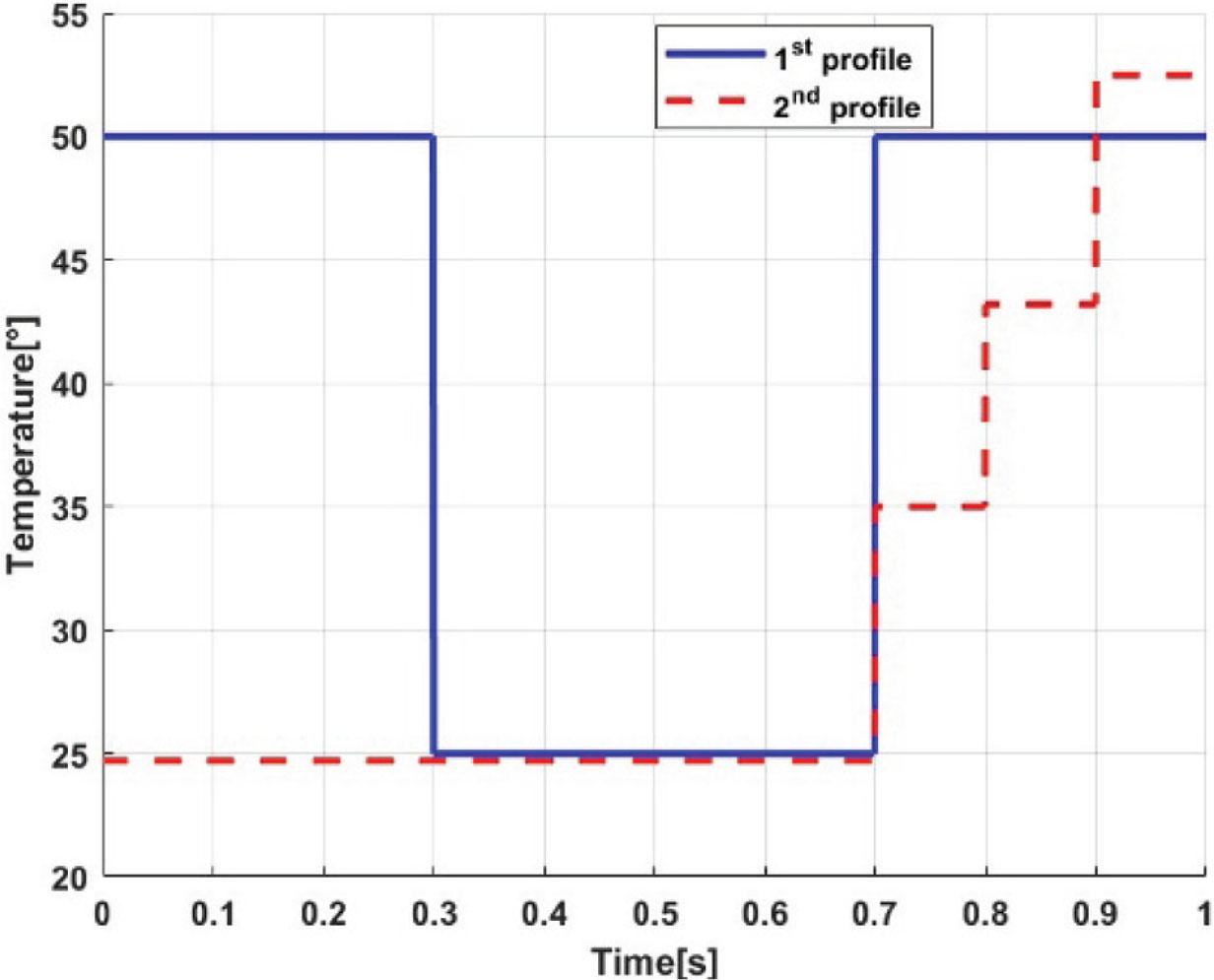
Fig. 11.
Temperature profile (Pattern 1- and Pattern 2 --).
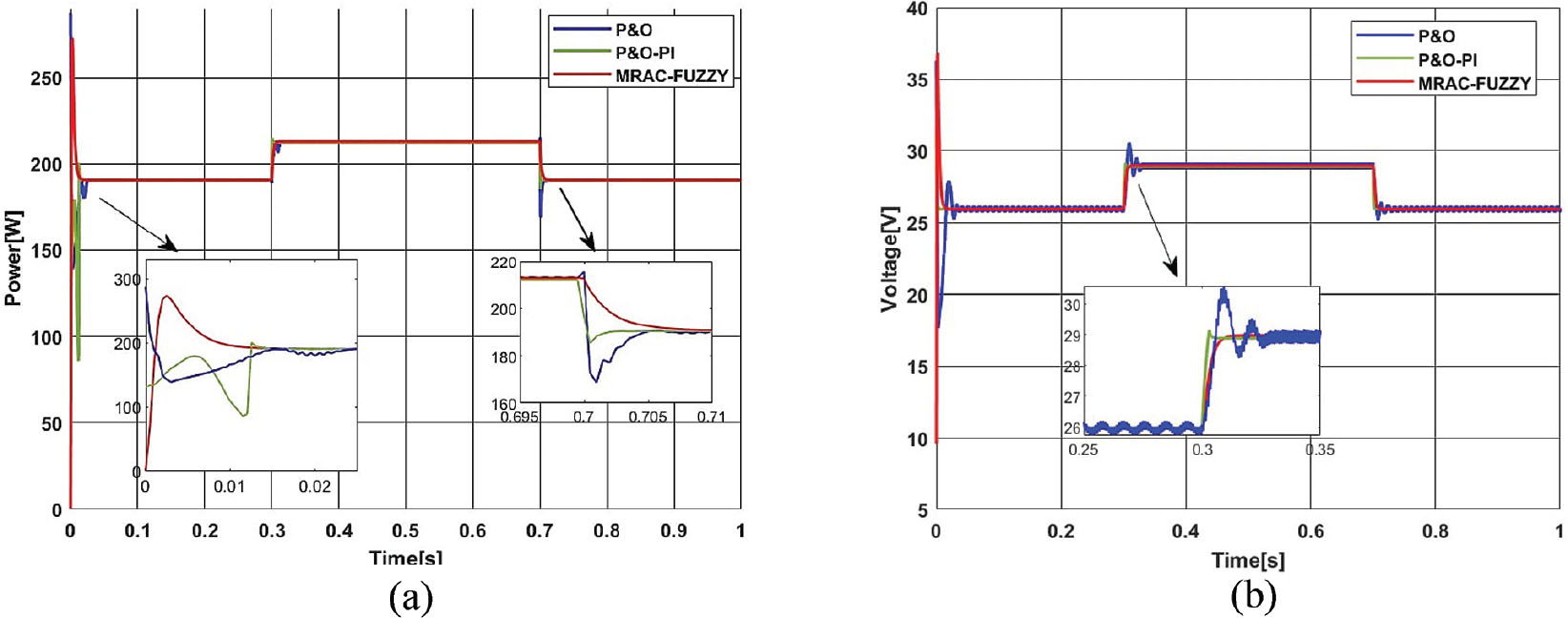
Fig. 12.
Performance of three MPPT controllers with variable temperature and constant irradiation (Pattern 1). MPPT, maximum power point tracking; P&O, perturb and observe. (a) Power, (b) Voltage.
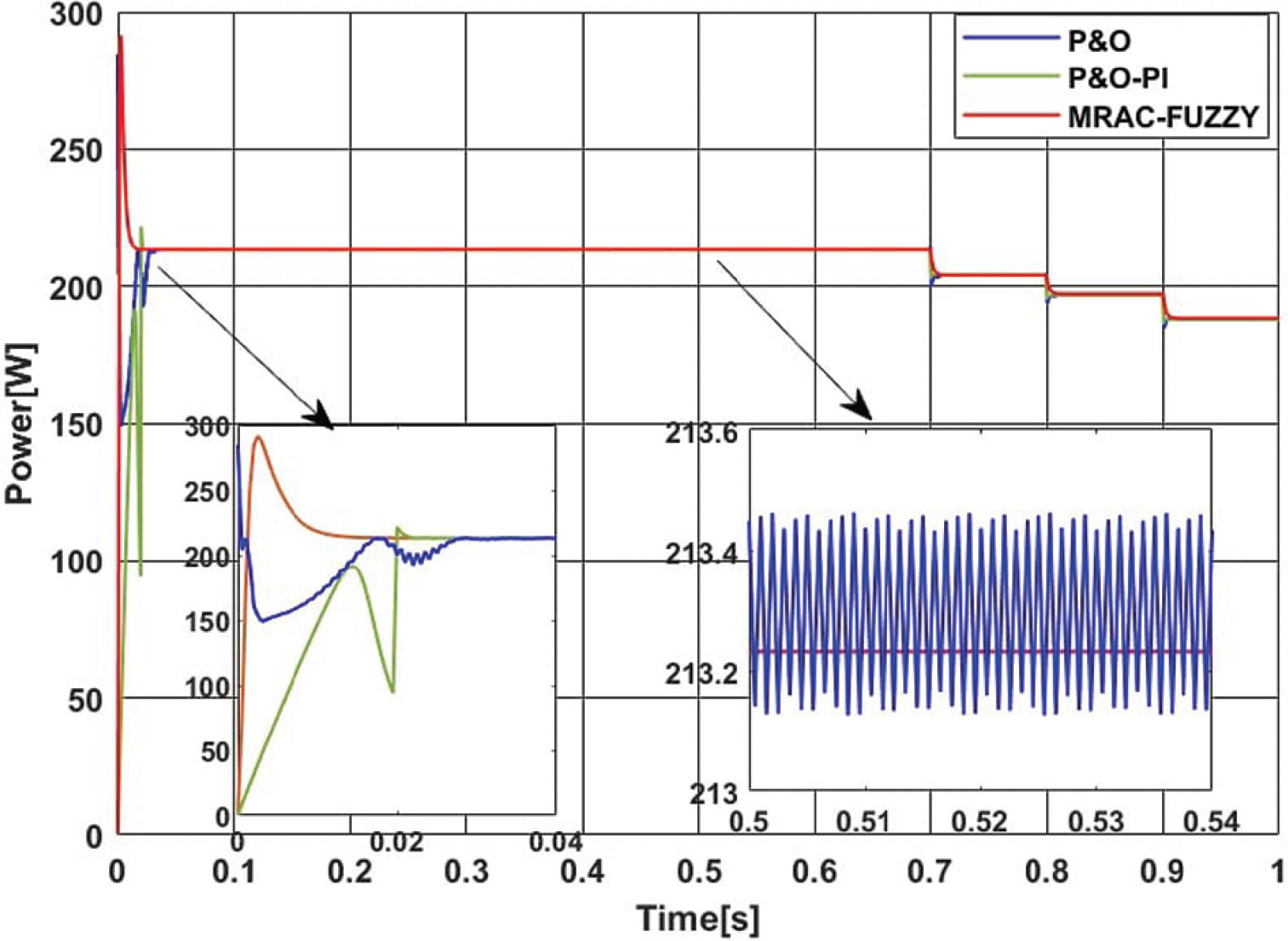
Fig. 13.
Three MPPT controllers performing at different temperatures and constant irradiation (Pattern 2). MPPT, maximum power point tracking; P&O, perturb and observe.
Table 4.
Performance comparison of the three algorithms
| MPPT techniques | State-1 | State-2 | State-3 |
|---|---|---|---|
| Response time (s) | |||
| P&O | 0.054 | 0.051 | 0.03 |
| P&O-PI | 0.028 | 0.034 | 0.022 |
| MRAC_FUZZY | 0.012 | 0.013 | 0.01 |
| Ripples (W) | |||
| P&O | 0.957 | 0.2 | 0.21 |
| P&O-PI | 0.55 | 0.12 | 0.1 |
| MRAC_FUZZY | 0.0002 | 0.0001 | 0.0001 |
| Energy losses (%) | |||
| P&O | 3.2 | 2.1 | 4.3 |
| P&O-PI | 1.4 | 1.43 | 3.21 |
| MRAC_FUZZY | 0.0002 | 0.0001 | 0.0004 |
| Efficiency (%) | |||
| P&O | 95.2 | 96 | 94.34 |
| P&O-PI | 96.21 | 96.02 | 95.27 |
| MRAC_FUZZY | 99.96 | 99.98 | 99.94 |
| Average steady state power(W) | |||
| P&O | 147.16 | 184.92 | 78.244 |
| P&O-PI | 147.17 | 185.997 | 78.297 |
| MRAC_FUZZY | 147.22 | 186.266 | 78.36 |
Table 5.
Performance comparison of three MPPT algorithms
| MPPT techniques | P&O | P&O-PI | MRAC-FUZZY |
|---|---|---|---|
| Response time (s) | 0.054 | 0.028 | 0.012 |
| Ripple (W) | 0.33 | 0.12 | 0.0001 |
| Energy loss (%) | 3.13 | 1.45 | 0.0005 |
| Efficiency (%) | 95.2 | 96.21 | 99.94 |
Table 6.
An analysis comparing the suggested approach to other methods
| Performance parameters | Adaptive MPPT controller (Saibal et al. (2022)) | ANFIS-TRSMC (Mbarki et al. (2022)) | (PSO) (Ersalina et al. (2023)) | (GWO)-PID (Jesus et al. (2023)) | Proposed MPPT |
|---|---|---|---|---|---|
| Tracking time | 0.0036 | 0.04 | 0.012 | 0.018 | 0.011 |
| Oscillations at MPP | Low | Medium | Medium | No | No |
| Complexity | Medium | Medium | Medium | Medium | Low |
| Efficiency (%) | 97.69 | 98.9 | 96.96 | 98.50 | 99.98 |