
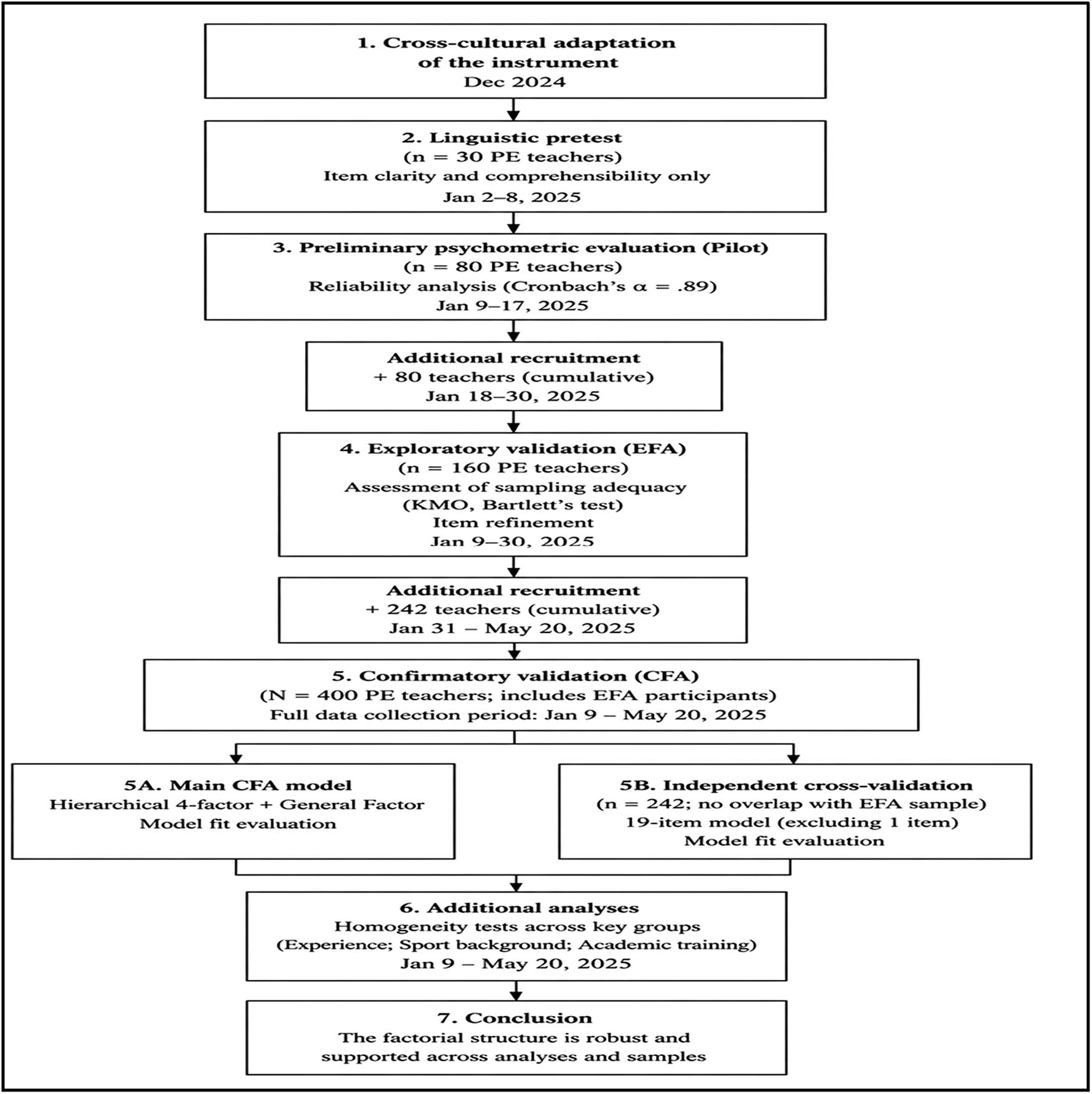
Figure 1
Timeline flow diagram of the instrument adaptation and psychometric validation process.
Source: Authors’ contribution.
Table 1
Kaiser–Meyer–Olkin (KMO) measure and Bartlett’s test of sphericity.
| Kaiser–Meyer–Olkin measure of sampling adequacy | 0.927 | |
| Bartlett’s test of sphericity | Approximate Chi-square | 1807.581 |
| Degrees of freedom (df) | 231 | |
| Significance (p-value) | 0.000 | |
Source: Authors’ contribution.
Table 2
Sociodemographic and professional characteristics of the participants (n = 400).
| Variable | Category | n | % |
|---|---|---|---|
| Academic background | Bachelor’s degree (Baccalaureate + 4) in PE/STAPS | 53 | 16.2 |
| Bachelor’s degree (Baccalaureate + 3) in PE/STAPS + CRMEF qualification | 120 | 30.2 | |
| Bachelor’s degree (Baccalaureate + 3) in fundamental/professional/science & technology + CRMEF qualification | 91 | 21.1 | |
| Regional Pedagogical Center (CPR) | 102 | 24.2 | |
| Aggregation in PE | 16 | 4.0 | |
| Pedagogical inspection in PE | 18 | 4.3 | |
| Teaching experience | 1–5 Years | 171 | 43.0 |
| 5–10 Years | 56 | 14.3 | |
| 10–15 Years | 50 | 11.2 | |
| 15–20 Years | 21 | 5.2 | |
| More than 20 Years | 102 | 26.3 | |
| High-level sport practice | Yes | 256 | 64.0 |
| No | 144 | 36.0 |
Source: Authors’ contribution.
Table 3
Results of the first EFA.
| Component | 1 | 2 | 3 |
|---|---|---|---|
| C1 [Design, create, and evaluate learning situations adapted to students’ needs in physical and sports activities, taking into account their cultural and social context] | 0.557 | ||
| C2 [Plan, manage, and evaluate learning processes focused on the development of students’ motor skills, integrating their individual characteristics] | 0.590 | ||
| C3 [Design, implement, and analyze pedagogical interventions in PE according to the objectives of the Moroccan school curriculum, ensuring coherence between OTI and OTC] | 0.662 | ||
| C4 [Develop and implement programs promoting the effective inclusion of students with special educational needs, in line with national educational guidelines] | 0.606 | ||
| C5 [Analyze and adjust PE teaching practices to meet students’ needs, considering specific contexts (class size, available infrastructure, etc.)] | 0.597 | ||
| C6 [Effectively address the diversity of practices and skill levels in PE by adapting proposed activities] | 0.650 | ||
| C7 [Design and adjust motor situations to foster active participation and motor skill development in diverse educational environments] | 0.766 | ||
| C8 [Use appropriate assessment tools to measure students’ progress and competencies in PE] | 0.677 | ||
| C9 [Understand students’ psychomotor development stages and integrate them into PE pedagogical approaches] | 0.629 | ||
| C10 [Identify physical capacities and factors influencing their development, and apply suitable techniques to enhance them] | 0.602 | ||
| C11 [Understand bodily maturation processes and their impact on students’ motor learning] | 0.619 | ||
| C12 [Know the biological and physiological foundations of the human body to organize safe and adapted physical activities] | 0.601 | ||
| C13 [Value sports manifestations from Moroccan cultural traditions (popular games, traditional activities, etc.) in the PE context] | |||
| C14 [Integrate fundamental principles of outdoor physical activities in contexts specific to Morocco (climate, topography, etc.)] | 0.532 | ||
| C15 [Use play as a pedagogical tool to foster student engagement and learning of PE skills] | |||
| C16 [Develop and utilize body language and non-verbal communication as means of training and cultural valorization] | 0.607 | ||
| C17 [Introduce students to diverse sports disciplines, adapting content and pedagogical tasks to their needs and educational level] | 0.635 | ||
| C18 [Promote complementary physical and sports activities (e.g., hiking, inter-school competitions) in line with educational objectives and the Moroccan context] | 0.831 | ||
| C19 [Identify and prevent health risks related to inappropriate or excessive physical practices, considering local issues (e.g., overweight, recurrent injuries)] | 0.757 | ||
| C20 [Raise students’ awareness of the importance of physical activity for health and well-being, using scientific data adapted to the Moroccan context] | 0.784 | ||
| C21 [Integrate hygiene (body care, injury prevention) and nutrition concepts in PE classes to encourage healthy habits] | 0.817 | ||
| C22 [Implement pedagogical strategies to encourage students to engage in regular physical activity outside school] | 0.696 |
Source: Authors’ contribution.
Table 4
Results of the second EFA.
| Component | 1 | 2 | 3 |
|---|---|---|---|
| C1 | 0.570 | ||
| C2 | 0.598 | ||
| C3 | 0.658 | ||
| C4 | 0.607 | ||
| C5 | 0.601 | ||
| C6 | 0.650 | ||
| C7 | 0.773 | ||
| C8 | 0.675 | ||
| C9 | 0.645 | ||
| C10 | 0.620 | ||
| C11 | 0.636 | ||
| C12 | 0.612 | ||
| C14 | 0.508 | ||
| C16 | 0.616 | ||
| C17 | 0.637 | ||
| C18 | 0.836 | ||
| C19 | 0.747 | ||
| C20 | 0.785 | ||
| C21 | 0.813 | ||
| C22 | 0.718 |
Source: Authors’ contribution.
Table 5
CFA results.
| Factor/competency group | Competencies | Standardized regression weights | Squared multiple CORRELATION (R 2) |
|---|---|---|---|
| F1 | Design, create, and evaluate learning situations adapted to students’ needs in physical and sports activities, considering their cultural and social context | 0.608 | 0.370 |
| Plan, manage, and assess learning processes focused on developing students’ motor skills, integrating their individual characteristics | 0.653 | 0.427 | |
| Design, implement, and analyze PE interventions according to the Moroccan school program objectives, ensuring coherence between OTI and OTC | 0.579 | 0.335 | |
| Develop and implement programs promoting the effective inclusion of students with special educational needs, in line with national educational guidelines | 0.678 | 0.459 | |
| Analyze and adjust PE practices to meet students’ needs according to specific contexts (class size, available infrastructure, etc.) | 0.712 | 0.507 | |
| Effectively respond to diversity in PE practices and student skill levels by adapting proposed activities | 0.671 | 0.451 | |
| Design and adjust motor situations to promote active participation and motor skill development in diverse educational environments | 0.728 | 0.530 | |
| Use appropriate assessment tools to measure students’ progress and competencies in PE | 0.697 | 0.486 | |
| F2 | Understand the stages of students’ psychomotor development and integrate them into PE teaching approaches | 0.696 | 0.484 |
| Identify physical capacities and factors affecting their development, and apply suitable techniques to improve them | 0.767 | 0.588 | |
| Understand body maturation processes and their impact on students’ motor learning | 0.773 | 0.598 | |
| Know the biological and physiological foundations of the human body to organize safe and appropriate physical activities | 0.767 | 0.588 | |
| F3 | Integrate fundamental principles of outdoor physical activities in context-specific settings in Morocco (climate, topography, etc.) | 0.614 | 0.378 |
| Use play as a pedagogical tool to enhance student engagement and learning of PE competencies | 0.665 | 0.442 | |
| Develop and use body language and non-verbal communication as teaching tools and for cultural valorization | 0.673 | 0.452 | |
| Introduce students to various sports disciplines, adapting content and tasks to their needs and educational level | 0.714 | 0.510 | |
| F4 | Identify and prevent health risks related to inappropriate or excessive physical activity, considering local issues (e.g., overweight, recurrent injuries) | 0.710 | 0.505 |
| Raise students’ awareness of the importance of physical activity for their health and well-being, using scientifically adapted data for the Moroccan context | 0.787 | 0.620 | |
| Integrate hygiene concepts (body care, injury prevention) and nutrition into PE lessons to encourage healthy habits | 0.786 | 0.618 | |
| Implement pedagogical strategies to encourage regular physical activity outside the school context | 0.689 | 0.474 |
Source: Authors’ contribution.
Table 6
Global incremental fit indices of the CFA model (NFI, RFI, IFI, TLI, and CFI).
| Model | NFI Delta1 | RFI rho1 | IFI Delta2 | TLI rho2 | CFI |
|---|---|---|---|---|---|
| Model | 0.907 | 0.885 | 0.958 | 0.947 | 0.957 |
| Saturated model | 1.000 | 1.000 | 1.000 | ||
| Independence model | 0.000 | 0.000 | 0.000 | 0.000 | 0.000 |
Source: Authors’ contribution.
Table 7
Parsimony-adjusted fit indices of the CFA model (PRATIO, PNFI, PCFI).
| Model | PRATIO | PNFI | PCFI |
|---|---|---|---|
| Model | 0.810 | 0.735 | 0.776 |
| Saturated model | 0.000 | 0.000 | 0.000 |
| Independence model | 1.000 | 0.000 | 0.000 |
Source: Authors’ contribution.
Table 8
RMSEA and associated confidence interval of the CFA model.
| RMSEA | 90% CI lower | 90% CI upper | PCLOSE |
|---|---|---|---|
| 0.043 | 0.036 | 0.051 | 0.935 |
Source: Authors’ contribution.
Table 9
Information criteria of the CFA model (AIC and BCC).
| Model | AIC | BCC |
|---|---|---|
| Proposed model | 497.700 | 506.264 |
| Saturated model | 550.000 | 583.644 |
| Independence model | 3870.916 | 3873.607 |
Source: Authors’ contribution.