
1. Introduction
The professionalization of teachers has emerged as a central pillar of global Vocational Education and Training (VET) reforms, emphasizing the transition from theoretical knowledge to measurable, high-level professional competencies (Darling-Hammond, 2020; OECD, 2019, 2020; Guerriero, 2017). In Physical Education (PE), this shift requires the integrated mobilization of pedagogical, didactical, and scientific knowledge to address the complex demands of contemporary learning environments (Casey & MacPhail, 2018).
Within this framework, competency is commonly defined as the effective mobilization of knowledge, skills, and attitudes in order to manage complex professional situations (Le Boterf, 2018; Tardif, 2017). In PE specifically, this construct takes on a multidimensional character, encompassing pedagogical content knowledge (PCK), classroom management, safety procedures, and the promotion of students’ social and motivational development (Berthold et al., 2025; Lee & Wright, 2024). These competencies are developed through a dynamic and longitudinal process shaped by the interaction between formal training and professional practice (Zhou et al., 2023). Moreover, the specific nature of PE, characterized by its pedagogical, didactical, and ergonomic dimensions, requires teachers to integrate technical–scientific expertise with reflective and adaptive skills in complex and evolving teaching situations (Fraile & Aparicio, 2015a, b).
In this context, the assessment of competencies has become a strategic priority for aligning teacher education programs with professional standards (Kirk, 2009). Recent research has proposed a wide range of approaches to identify and measure these competencies, including qualitative exploratory studies (Peng & Jiang, 2023), theoretical indexing models (Xiang & Xiang, 2022), and quantitative approaches based on validated questionnaires (Anggara, 2020; Asún et al., 2020). More recent contributions have also emphasized multidimensional tools capable of capturing teacher–student interactions and classroom processes (Berthold et al., 2025; Saiz-González et al., 2025).
Despite these advances, several limitations persist. A number of studies have highlighted the lack of cross-cultural measurement invariance and the limited transferability of existing instruments across different educational contexts (Cañadas et al., 2019; Tul et al., 2015, 2019). In addition, systematic reviews underline the scarcity of empirically validated tools adapted to non-Western contexts and the overreliance on descriptive self-report measures (Altaweel & AlJa’afreh, 2017; Hawamdeh, 2021).
Addressing these limitations requires rigorous processes of instrument development and validation. In quantitative research, this involves multi-stage procedures to ensure reliability and structural validity (Hair et al., 2019). In the field of PE, several recent studies have demonstrated the importance of combining psychometric validation with cultural adaptation. For instance, Baena-Morales et al. (2023, 2024) developed and validated adapted instruments for assessing competencies in the PE contextually, while Abbassi et al. (2021) emphasized the importance of linguistic and cultural adaptation in the validation of the Flow Scale in Arabic. Similarly, Meier (2020) highlighted the relevance of structured tools for assessing PCK among preservice PE teachers. These contributions converge in stressing that cross-cultural adaptation is a critical methodological challenge requiring translation procedures, expert validation, and empirical testing to ensure conceptual and metric equivalence (Beaton et al., 2000; van de Vijver & Leung, 2021).
In Morocco, this issue is framed by the Strategic Vision 2015–2030, which calls for the professionalization of teaching staff, the establishment of competency-based standards, and the development of subject-specific frameworks. Although initial university training and professional qualification within Regional Centres for Education and Training Professions (CRMEF) have evolved to align with these orientations (Agouzoul et al., 2025), there remains a lack of scientifically validated and contextually adapted instruments for assessing PE teacher competencies. This gap limits the ability of training institutions to evaluate outcomes and ensure alignment with national professional requirements.
Therefore, the present study aims to adapt and validate a measurement instrument designed to assess the competencies required for teaching PE in the Moroccan context. Specifically, the objectives are threefold to (1) culturally and contextually adapt the instrument, (2) examine its psychometric properties, and (3) test its factorial structure using Exploratory and Confirmatory Factor Analyses (EFA and CFA). By providing a reliable and valid tool, this study contributes to the professionalization of PE teachers and supports evidence-based improvements in teacher education and educational policy, while aligning with international efforts to develop comparable and culturally sensitive assessment instruments.
2. Methods
This study adopted a quantitative cross-sectional design to culturally adapt and psychometrically validate a competency-based assessment instrument for Moroccan PE teachers. The validation process followed a sequential multi-phase psychometric design based on internationally recognized recommendations for cross-cultural adaptation and instrument validation (Beaton et al., 2000; Sousa & Rojjanasrirat, 2011; Hair et al., 2019). The overall validation procedure consisted of three consecutive stages: (1) cross-cultural adaptation and content validation of the original instrument; (2) preliminary psychometric evaluation through internal consistency analysis and EFA; and (3) CFA using an enlarged independent validation sample to cross-validate the factorial structure and evaluate construct validity. This sequential approach was adopted to progressively examine the linguistic, conceptual, and psychometric properties of the adapted instrument before confirming its measurement structure.
2.1. Phase 1: Instrument Adaptation and Content Validation
The original instrument developed by Palacios Picos et al. (2019) is a validated SCOPUS-indexed questionnaire designed to assess perceived teaching competencies in PE. Developed within the Spanish higher education context, it is grounded in Classical Test Theory and demonstrated satisfactory psychometric properties in a validation sample of 1,713 participants from 20 universities. The questionnaire comprises four competency dimensions measured through 22 items and has subsequently been employed in several international studies evaluating PE teachers’ professional competencies (Aparicio-Herguedas et al., 2023; Talledo et al., 2024; Correa-Bautista et al., 2025). Its multidimensional structure and theoretical consistency with competency-based teacher education justified its selection for cultural adaptation to the Moroccan educational context.
The adaptation process began with a forward–backward translation procedure to ensure semantic, conceptual, and metric equivalence between the original and the Moroccan French versions. The original English questionnaire was first translated into French by a professional bilingual translator specialized in educational terminology and Arabic-French-English translation. Subsequently, an independent bilingual translator specialized in Arabic–English–French translation, blinded to the original instrument, performed a backward translation into English. The original and back-translated versions were systematically compared by the research team to identify semantic inconsistencies and ensure conceptual equivalence, leading to a preliminary French version of the questionnaire.
The preliminary version was then submitted to a panel of five experts in Sport Sciences and PE, all actively involved in Moroccan PE teacher education and possessing more than twenty years of academic and professional experience. The selection of experts was based on predefined criteria, including doctoral qualifications, recognized research activity in PE, and extensive experience in curriculum design and teacher training. Each expert independently evaluated the questionnaire regarding clarity, conceptual relevance, cultural appropriateness, and professional applicability. Following an iterative consensus procedure, several linguistic and contextual modifications were introduced, particularly through the refinement of item wording and the incorporation of terminology reflecting Moroccan educational practices. The revised version was subsequently resubmitted to the expert panel, which unanimously confirmed its content validity and cultural adequacy.
Before initiating the psychometric validation, a separate linguistic pretest was conducted with 30 in-service PE teachers. This preliminary phase was exclusively intended to evaluate item clarity, comprehensibility, readability, and cultural acceptability rather than to assess the psychometric properties of the instrument. Participants were invited to identify ambiguous expressions or difficult formulations, and minor linguistic revisions were introduced without modifying the conceptual content of the original items.
The final adapted questionnaire consisted of 22 items assessed using a four-point Likert scale ranging from 1 (Not Important) to 4 (Very Important), measuring the perceived importance of professional teaching competencies among Moroccan PE teachers.
2.2. Phase 2: Preliminary Psychometric Evaluation and Exploratory Validation
Following the cross-cultural adaptation process, the psychometric validation was conducted through a sequential design comprising three successive stages: (i) a preliminary psychometric evaluation using a pilot sample, (ii) an exploratory validation based on an enlarged sample, and (iii) a confirmatory validation using an independent extension of the exploratory sample. This progressive strategy was adopted to improve the stability of the parameter estimates and to minimize sampling fluctuations commonly observed during the early stages of instrument validation (Hair et al., 2019; DeVellis & Thorpe, 2021).
The psychometric validation followed a cumulative sequential sampling strategy. After completion of the linguistic pretest (n = 30), the adapted questionnaire was first administered to a pilot psychometric sample of 80 in-service PE teachers to assess its preliminary reliability and factorability. The initial pilot sample was subsequently retained and complemented by an additional 80 teachers, resulting in an exploratory validation sample of 160 participants used to conduct the EFA. Finally, the exploratory sample was further expanded by recruiting an additional 240 participants, yielding a final validation sample of 400 teachers for the CFA. Furthermore, no participants were excluded between the successive psychometric phases. Instead, each subsequent sample incorporated all participants from the previous stage together with newly recruited teachers, thereby increasing sample size while preserving the continuity of the validation process. Figure 1 illustrates the dated flow diagram of the study, summarizing the successive stages of cross-cultural adaptation, participant recruitment, and psychometric validation.
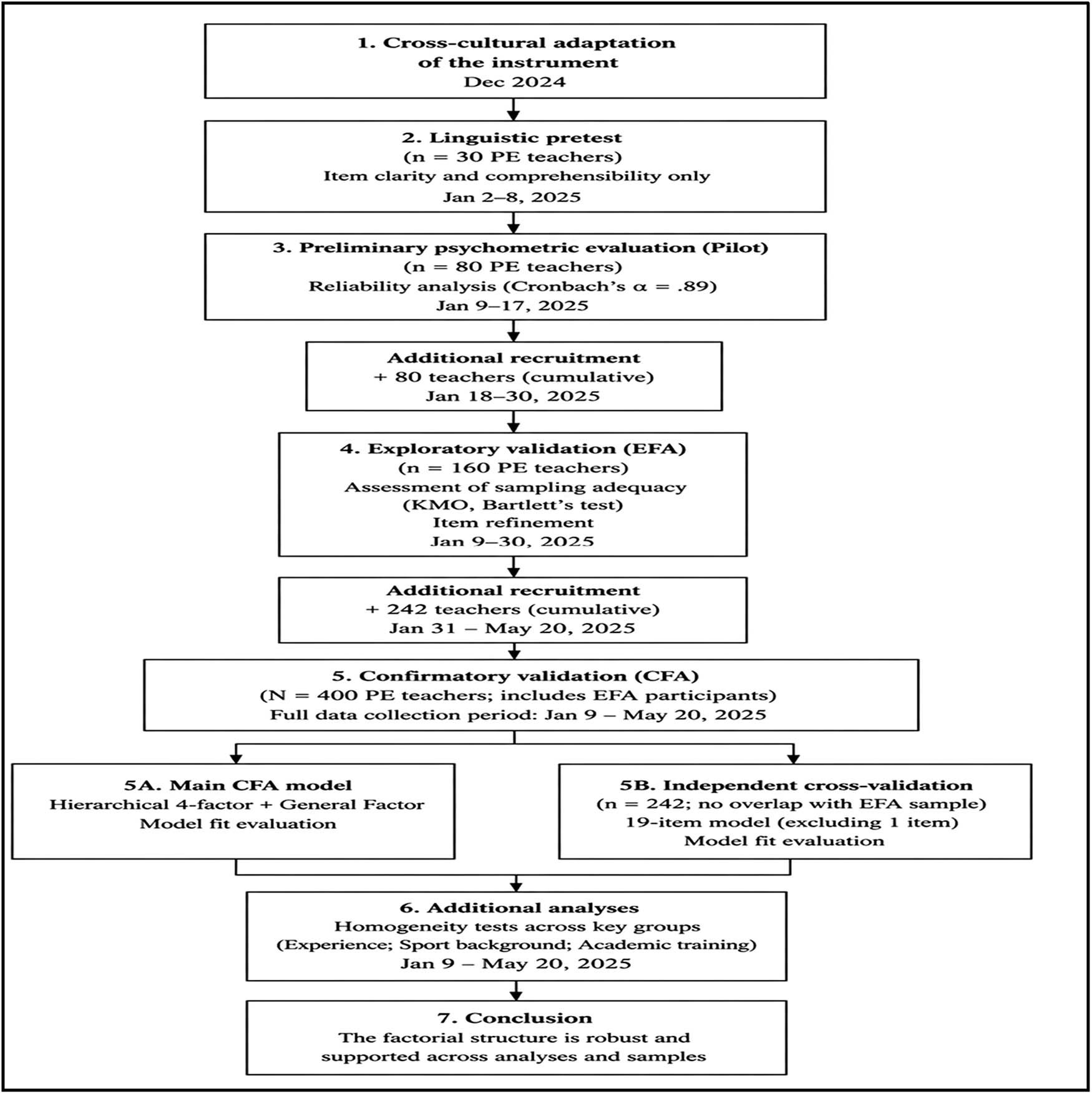
Figure 1
Timeline flow diagram of the instrument adaptation and psychometric validation process.
Source: Authors’ contribution.
2.2.1. Preliminary Psychometric Evaluation (n = 80)
After completion of the linguistic pretest, the final 22-item questionnaire was administered to a pilot sample of 80 in-service Moroccan PE teachers to assess its preliminary psychometric properties (Fayers & Machin, 2000). Unlike the preceding linguistic pretest, which focused exclusively on clarity and comprehensibility, this stage evaluated the instrument’s internal consistency and suitability for factor analysis. Internal consistency was first assessed using Cronbach’s alpha, which reached 0.89, exceeding the recommended threshold of 0.70 (Nunnally & Bernstein, 1994). The factorability of the correlation matrix was then examined using the Kaiser–Meyer–Olkin (KMO) measure of sampling adequacy and Bartlett’s test of sphericity. The KMO coefficient was 0.927, indicating excellent sampling adequacy (Kaiser, 1974), while Bartlett’s test was highly significant (χ 2 = 1807.581, df = 231, p < 0.001), confirming that the observed variables shared sufficient common variance to justify factor analysis. Collectively, these results supported the reliability and factorability of the questionnaire, allowing progression to the exploratory validation stage (Table 1).
2.2.2. Exploratory Validation (n = 160)
To improve the robustness of the exploratory analyses, the pilot psychometric sample was retained and complemented by an additional 80 in-service PE teachers, resulting in a total exploratory sample of 160 participants. This cumulative approach was preferred over independent resampling because the objective was not to compare independent populations but to progressively increase the statistical precision and stability of the psychometric estimates while maximizing the information obtained from valid observations. All responses were collected electronically using Google Forms, exported into Microsoft Excel, and subsequently analyzed using SPSS Statistics Version 30.
An EFA was then conducted to investigate the empirical dimensionality of the adapted questionnaire. Principal Component Analysis (PCA) with Varimax orthogonal rotation was selected as the primary extraction procedure for the exploratory phase of this validation study. Although common-factor extraction methods such as Principal Axis Factoring or Maximum Likelihood are generally recommended when the objective is to estimate latent constructs, PCA remains a widely accepted and methodologically defensible technique during the early, exploratory stages of instrument adaptation, particularly when the aim is to examine the empirical organization of a newly adapted item pool, reduce data complexity, and identify the most parsimonious factorial structure prior to confirmatory testing (Hair et al., 2019). This approach was considered appropriate in the present context, given that the empirical organization of competency indicators within Moroccan PE had not been previously investigated, and the exploratory objective was to assess whether the theoretically derived dimensions remained empirically distinguishable following cultural adaptation, rather than to directly estimate underlying latent variables. The EFA was performed in two successive iterations. During the first analysis, all 22 items were retained. Item loadings, communalities, and cross-loadings were examined according to commonly accepted psychometric criteria. A second EFA was subsequently performed using the refined questionnaire to obtain a more stable and interpretable factorial solution.
To address potential concerns regarding sample overlap between the exploratory and confirmatory phases, given that the 160 EFA participants were retained within the final n = 400 confirmatory sample, homogeneity tests were conducted comparing the EFA sample (n = 160) with the subset of participants recruited exclusively for the confirmatory phase (n = 240, no overlap with the EFA sample). Chi-square tests indicated no significant difference between the two groups regarding years of teaching experience (χ 2 = 3.43, df = 4, p = 0.489) or high-level sport background (χ 2 = 1.68, df = 1, p = 0.195), supporting the comparability of the two subsamples on these dimensions. A significant difference emerged regarding academic training background (χ 2 = 38.38, df = 5, p < 0.001), which is addressed as a limitation in the Discussion section.
2.3. Phase 3: Confirmatory Factor Analysis
Because the primary objective of this exploratory phase was to identify the empirical structure emerging from the Moroccan sample, these findings were subsequently examined through CFA using a substantially larger validation sample. The resulting dataset was then analyzed using SPSS AMOS to perform the CFA. This stage provided a more rigorous and comprehensive assessment of the measurement model by testing and confirming the factorial structure identified during the exploratory phase, while also evaluating its consistency with the underlying theoretical framework through structural equation modeling.
3. Participants
The final validation sample comprised 400 in-service PE teachers from different regions of Morocco, representing diverse academic backgrounds and professional profiles (Table 2). Participants were recruited through six educational and professional training pathways, with teaching experience ranging from 1 to more than 20 years. Additionally, 64% reported previous experience in high-level sports practice, whereas 36% had no such experience. This diversity enhances the representativeness of the sample and supports the robustness and generalizability of the psychometric validation. This diverse and well-distributed sample provides a robust basis for psychometric validation of the instrument and ensures the generalizability of findings to the broader population of Moroccan PE teachers (Hair et al., 2019; Kline, 2016).
Table 2
Sociodemographic and professional characteristics of the participants (n = 400).
| Variable | Category | n | % |
|---|---|---|---|
| Academic background | Bachelor’s degree (Baccalaureate + 4) in PE/STAPS | 53 | 16.2 |
| Bachelor’s degree (Baccalaureate + 3) in PE/STAPS + CRMEF qualification | 120 | 30.2 | |
| Bachelor’s degree (Baccalaureate + 3) in fundamental/professional/science & technology + CRMEF qualification | 91 | 21.1 | |
| Regional Pedagogical Center (CPR) | 102 | 24.2 | |
| Aggregation in PE | 16 | 4.0 | |
| Pedagogical inspection in PE | 18 | 4.3 | |
| Teaching experience | 1–5 Years | 171 | 43.0 |
| 5–10 Years | 56 | 14.3 | |
| 10–15 Years | 50 | 11.2 | |
| 15–20 Years | 21 | 5.2 | |
| More than 20 Years | 102 | 26.3 | |
| High-level sport practice | Yes | 256 | 64.0 |
| No | 144 | 36.0 |
Source: Authors’ contribution.
4. Results
Prior to conducting the EFA, preliminary data screening procedures were performed to ensure data quality and suitability for factor analysis. The dataset was examined for missing values, and no significant missing data were identified. The sample size (n = 160) was considered adequate based on recommended guidelines suggesting a minimum ratio of 5 to 10 participants per item, given that the instrument included 22 items (Tabachnick & Fidell, 2019). Additionally, the data were screened for potential anomalies and coding errors, ensuring the reliability of subsequent analyses. To refine the factor structure, two rounds of EFA were conducted: the first to explore the underlying structure of the instrument (Table 3), and the second to remove poorly performing items and optimize the factor solution (Table 4).
Table 3
Results of the first EFA.
| Component | 1 | 2 | 3 |
|---|---|---|---|
| C1 [Design, create, and evaluate learning situations adapted to students’ needs in physical and sports activities, taking into account their cultural and social context] | 0.557 | ||
| C2 [Plan, manage, and evaluate learning processes focused on the development of students’ motor skills, integrating their individual characteristics] | 0.590 | ||
| C3 [Design, implement, and analyze pedagogical interventions in PE according to the objectives of the Moroccan school curriculum, ensuring coherence between OTI and OTC] | 0.662 | ||
| C4 [Develop and implement programs promoting the effective inclusion of students with special educational needs, in line with national educational guidelines] | 0.606 | ||
| C5 [Analyze and adjust PE teaching practices to meet students’ needs, considering specific contexts (class size, available infrastructure, etc.)] | 0.597 | ||
| C6 [Effectively address the diversity of practices and skill levels in PE by adapting proposed activities] | 0.650 | ||
| C7 [Design and adjust motor situations to foster active participation and motor skill development in diverse educational environments] | 0.766 | ||
| C8 [Use appropriate assessment tools to measure students’ progress and competencies in PE] | 0.677 | ||
| C9 [Understand students’ psychomotor development stages and integrate them into PE pedagogical approaches] | 0.629 | ||
| C10 [Identify physical capacities and factors influencing their development, and apply suitable techniques to enhance them] | 0.602 | ||
| C11 [Understand bodily maturation processes and their impact on students’ motor learning] | 0.619 | ||
| C12 [Know the biological and physiological foundations of the human body to organize safe and adapted physical activities] | 0.601 | ||
| C13 [Value sports manifestations from Moroccan cultural traditions (popular games, traditional activities, etc.) in the PE context] | |||
| C14 [Integrate fundamental principles of outdoor physical activities in contexts specific to Morocco (climate, topography, etc.)] | 0.532 | ||
| C15 [Use play as a pedagogical tool to foster student engagement and learning of PE skills] | |||
| C16 [Develop and utilize body language and non-verbal communication as means of training and cultural valorization] | 0.607 | ||
| C17 [Introduce students to diverse sports disciplines, adapting content and pedagogical tasks to their needs and educational level] | 0.635 | ||
| C18 [Promote complementary physical and sports activities (e.g., hiking, inter-school competitions) in line with educational objectives and the Moroccan context] | 0.831 | ||
| C19 [Identify and prevent health risks related to inappropriate or excessive physical practices, considering local issues (e.g., overweight, recurrent injuries)] | 0.757 | ||
| C20 [Raise students’ awareness of the importance of physical activity for health and well-being, using scientific data adapted to the Moroccan context] | 0.784 | ||
| C21 [Integrate hygiene (body care, injury prevention) and nutrition concepts in PE classes to encourage healthy habits] | 0.817 | ||
| C22 [Implement pedagogical strategies to encourage students to engage in regular physical activity outside school] | 0.696 |
Source: Authors’ contribution.
Table 4
Results of the second EFA.
| Component | 1 | 2 | 3 |
|---|---|---|---|
| C1 | 0.570 | ||
| C2 | 0.598 | ||
| C3 | 0.658 | ||
| C4 | 0.607 | ||
| C5 | 0.601 | ||
| C6 | 0.650 | ||
| C7 | 0.773 | ||
| C8 | 0.675 | ||
| C9 | 0.645 | ||
| C10 | 0.620 | ||
| C11 | 0.636 | ||
| C12 | 0.612 | ||
| C14 | 0.508 | ||
| C16 | 0.616 | ||
| C17 | 0.637 | ||
| C18 | 0.836 | ||
| C19 | 0.747 | ||
| C20 | 0.785 | ||
| C21 | 0.813 | ||
| C22 | 0.718 |
Source: Authors’ contribution.
4.1. STEP 1: Exploratory Factor Analysis – Initial Structure
Following the first EFA using PCA with Varimax rotation, a three-component solution was extracted according to the Kaiser criterion (eigenvalues > 1). These three components explained 55.79% of the total variance, representing an acceptable level of explained variance for social science research (Hair et al., 2019). The first component accounted for 44.17% of the total variance and combined competencies related to the design, planning, management, and evaluation of teaching-learning processes together with competencies associated with biological and psychomotor knowledge. The second component explained 6.82% of the variance and comprised competencies related to health education and the promotion of healthy lifestyles. The third component explained 4.79% of the variance and included competencies associated with pedagogical diversification and culturally contextualized physical activities.
Inspection of the rotated component matrix revealed that two items C13 [Value sports manifestations from Moroccan cultural traditions (popular games, traditional activities, etc.) in the PE context.] and C15 [Use play as a pedagogical tool to foster student engagement and learning of PE skills.] did not exhibit any salient factor loading on any of the three extracted components. Unlike the remaining items, which were clearly associated with one of the retained components, these two indicators failed to demonstrate a meaningful statistical relationship with the emerging factorial structure. According to commonly accepted psychometric recommendations, items that do not load on any extracted component provide insufficient evidence of construct representation during the exploratory stage and may compromise the interpretability of the factorial solution (Hair et al., 2019). Consequently, these two items were provisionally excluded from the exploratory model, and a second EFA was conducted using the remaining items to obtain a more stable and interpretable factorial solution. It should be emphasized that this exclusion was considered exploratory rather than definitive. Because the subsequent Confirmatory Factor Analysis was performed using a substantially larger validation sample (n = 400) within a Structural Equation Modeling framework, the psychometric behavior of all indicators, including the excluded items, was re-examined before establishing the final measurement model.
4.2. STEP 2: Refined EFA
Furthermore, particular attention was paid to potential cross-loadings in order to ensure the discriminant validity of the extracted factors. Following the recommendations of Field (2009) and Hair et al. (2019), items were examined for substantial loadings (≥0.50) on a single factor and minimal loadings on other factors. The results indicated that all retained items loaded strongly on their respective components without significant cross-loadings, thereby confirming a clear factorial structure and good discriminant validity between the three dimensions. This finding supports the conceptual coherence of the extracted factors and reinforces the robustness of the measurement model. This absence of problematic cross-loadings further indicates that each item contributes uniquely to a single latent construct, enhancing the interpretability and factorial purity of the scale. The EFA conducted on the assessment of competencies required for PE teaching in Morocco revealed a three-factor structure, which differs from our initial theoretical model composed of four factors. Specifically, two factors, relating to the design, management, and evaluation of teaching-learning processes in PE and the mastery of biological and psychomotor knowledge, merged into a single factor. This integration contrasts with prior studies in which mastery of biological knowledge consistently emerged as an independent factor (Palacios Picos et al., 2019; Aparicio-Herguedas et al., 2023). The second factor emphasizes health education, quality of life, and bodily hygiene, while the third factor pertains to the pedagogical and cultural diversification of physical and sports activities.
Given this divergence from the hypothesized theoretical model, and in order to confirm the exploratory structure and assess the fit of the model to empirical data, we proceeded with a confirmatory factor analysis (CFA). CFA provides a rigorous statistical method to test whether the factor structure identified by EFA is supported by the data, and allows for refinement of the model when necessary. This approach is embedded within a hypothetico-deductive framework, enabling validation or adjustment of the factor structure initially determined by the EFA (Brown, 2015; Kline, 2016).
4.3. STEP 3: Confirmatory Factor Analysis CFA
CFA is a statistical technique that models the relationships between observed indicators and their underlying latent constructs. It is a specific application of structural equation modeling (SEM), representing relationships among latent variables through covariances rather than causal paths (Gallagher & Brown, 2013). CFA is widely used in quantitative research to test theoretically grounded measurement models. Unlike EFA, which identifies latent structures, CFA is hypothesis-driven and seeks to validate a predefined factorial structure. In this study, CFA assessed the construct validity of the competency-based model for PE teachers in Morocco.
The hypothesized model included a general factor (GF) “Specific Competencies of PE Teachers” underlying four first-order dimensions: F1 (Teaching–learning process), F2 (Physical and psychomotor development), F3 (Learning contents and activities), and F4 (Health, hygiene, and lifestyle). The EFA suggested an alternative three-factor structure, indicating partial reconfiguration of the theoretical model. CFA was then conducted to validate both the theoretical and empirical structures. The sample size was increased to n = 400 to enhance robustness, and the analyses were performed using AMOS within a covariance-based SEM framework. CFA tested the relevance of the general factor, the four dimensions, and the item-factor relationships. Model fit was assessed using CFI, TLI, RMSEA, and PNFI (Tables 6,7,8).
Table 5
CFA results.
| Factor/competency group | Competencies | Standardized regression weights | Squared multiple CORRELATION (R 2) |
|---|---|---|---|
| F1 | Design, create, and evaluate learning situations adapted to students’ needs in physical and sports activities, considering their cultural and social context | 0.608 | 0.370 |
| Plan, manage, and assess learning processes focused on developing students’ motor skills, integrating their individual characteristics | 0.653 | 0.427 | |
| Design, implement, and analyze PE interventions according to the Moroccan school program objectives, ensuring coherence between OTI and OTC | 0.579 | 0.335 | |
| Develop and implement programs promoting the effective inclusion of students with special educational needs, in line with national educational guidelines | 0.678 | 0.459 | |
| Analyze and adjust PE practices to meet students’ needs according to specific contexts (class size, available infrastructure, etc.) | 0.712 | 0.507 | |
| Effectively respond to diversity in PE practices and student skill levels by adapting proposed activities | 0.671 | 0.451 | |
| Design and adjust motor situations to promote active participation and motor skill development in diverse educational environments | 0.728 | 0.530 | |
| Use appropriate assessment tools to measure students’ progress and competencies in PE | 0.697 | 0.486 | |
| F2 | Understand the stages of students’ psychomotor development and integrate them into PE teaching approaches | 0.696 | 0.484 |
| Identify physical capacities and factors affecting their development, and apply suitable techniques to improve them | 0.767 | 0.588 | |
| Understand body maturation processes and their impact on students’ motor learning | 0.773 | 0.598 | |
| Know the biological and physiological foundations of the human body to organize safe and appropriate physical activities | 0.767 | 0.588 | |
| F3 | Integrate fundamental principles of outdoor physical activities in context-specific settings in Morocco (climate, topography, etc.) | 0.614 | 0.378 |
| Use play as a pedagogical tool to enhance student engagement and learning of PE competencies | 0.665 | 0.442 | |
| Develop and use body language and non-verbal communication as teaching tools and for cultural valorization | 0.673 | 0.452 | |
| Introduce students to various sports disciplines, adapting content and tasks to their needs and educational level | 0.714 | 0.510 | |
| F4 | Identify and prevent health risks related to inappropriate or excessive physical activity, considering local issues (e.g., overweight, recurrent injuries) | 0.710 | 0.505 |
| Raise students’ awareness of the importance of physical activity for their health and well-being, using scientifically adapted data for the Moroccan context | 0.787 | 0.620 | |
| Integrate hygiene concepts (body care, injury prevention) and nutrition into PE lessons to encourage healthy habits | 0.786 | 0.618 | |
| Implement pedagogical strategies to encourage regular physical activity outside the school context | 0.689 | 0.474 |
Source: Authors’ contribution.
To improve the clarity and interpretability of the confirmatory results, Table 5 presents the standardized factor loadings (λ) and the corresponding squared multiple correlations (R 2) for each observed item. The standardized loadings indicate the strength of the relationships between the observed indicators and their respective latent constructs, with higher values reflecting stronger associations and supporting the theoretical assignment of items to factors. The squared multiple correlations represent the proportion of variance in each item explained by its corresponding latent factor. The CFA results confirmed a hierarchical four-factor structure comprising: (F1) design, management, and evaluation of teaching–learning processes; (F2) biological and psychomotor foundations in PE; (F3) pedagogical and cultural diversification of physical activities; and (F4) health education and promotion of healthy lifestyles. These first-order dimensions were subsequently modeled under a higher-order general factor representing the overall competencies required for teaching PE in the Moroccan context.
Interestingly, the item C13, which did not exhibit a salient loading during the exploratory phase, was retained in the final CFA model, showing an acceptable standardized factor loading within the pedagogical diversification construct. In contrast, the item C15 remained excluded, as it did not demonstrate any psychometric value throughout the validation process.
Tables 6 and 7 present the global incremental and parsimony-adjusted fit indices, respectively, which indicate that the hypothesized model fits the empirical data well and demonstrates acceptable parsimony. These indices confirm the adequacy of the CFA model in representing the latent structure of PE teachers’ competencies in the Moroccan context. This procedure allows confirmation or refinement of the EFA-derived factorial structure in the Moroccan context, following best practices in instrument validation in kinesiology research (Pacewicz et al., 2024; Drouet et al., 2021).
Table 6
Global incremental fit indices of the CFA model (NFI, RFI, IFI, TLI, and CFI).
| Model | NFI Delta1 | RFI rho1 | IFI Delta2 | TLI rho2 | CFI |
|---|---|---|---|---|---|
| Model | 0.907 | 0.885 | 0.958 | 0.947 | 0.957 |
| Saturated model | 1.000 | 1.000 | 1.000 | ||
| Independence model | 0.000 | 0.000 | 0.000 | 0.000 | 0.000 |
Source: Authors’ contribution.
Table 7
Parsimony-adjusted fit indices of the CFA model (PRATIO, PNFI, PCFI).
| Model | PRATIO | PNFI | PCFI |
|---|---|---|---|
| Model | 0.810 | 0.735 | 0.776 |
| Saturated model | 0.000 | 0.000 | 0.000 |
| Independence model | 1.000 | 0.000 | 0.000 |
Source: Authors’ contribution.
In addition to the incremental and parsimony-adjusted fit indices, the absolute fit indices further supported the adequacy of the hypothesized four-factor hierarchical model. The RMSEA value was 0.043 (90% CI = 0.036–0.051), remaining well below the recommended threshold of 0.06, while the PCLOSE value of 0.935 indicated that the hypothesis of close model fit could not be rejected. Together, these indices provide strong evidence that the proposed model adequately reproduces the observed covariance matrix despite its hierarchical structure (Tables 8 and 9).
Table 8
RMSEA and associated confidence interval of the CFA model.
| RMSEA | 90% CI lower | 90% CI upper | PCLOSE |
|---|---|---|---|
| 0.043 | 0.036 | 0.051 | 0.935 |
Source: Authors’ contribution.
Table 9
Information criteria of the CFA model (AIC and BCC).
| Model | AIC | BCC |
|---|---|---|
| Proposed model | 497.700 | 506.264 |
| Saturated model | 550.000 | 583.644 |
| Independence model | 3870.916 | 3873.607 |
Source: Authors’ contribution.
Model comparison based on information criteria also supported the proposed hierarchical model. The substantially lower AIC (497.70) and BCC (506.26) values compared with the independence model (AIC = 3870.92; BCC = 3873.61) indicate a markedly superior representation of the observed data. These information criteria further confirm that the proposed model achieves an appropriate balance between model fit and complexity. The reliability and convergent validity of the measurement model were assessed using SmartPLS 4 through Cronbach’s alpha, rho_A, composite reliability (CR), and average variance extracted (AVE), as presented in Table 10.
Table 10
Reliability and convergent validity of the measurement model.
| Constructs | Cronbach’s Alpha | rho_A | Composite reliability | Average variance extracted (AVE) |
|---|---|---|---|---|
| F1 | 0.865 | 0.961 | 0.889 | 0.501 |
| F2 | 0.800 | 0.828 | 0.865 | 0.570 |
| F3 | 0.740 | 0.749 | 0.828 | 0.493 |
| F4 | 0.830 | 0.840 | 0.886 | 0.661 |
Source: Authors’ contribution.
For the discriminant validity, it was also assessed by Smart PLS using the Fornell–Larcker criterion, as presented in Table 11. The square root of the AVE for each construct exceeds the corresponding inter-construct correlations, indicating an overall satisfactory level of discriminant validity.
5. Discussion
This study aimed to adapt and validate an instrument assessing the competencies required for PE teachers in Morocco. The EFA conducted on a sample of n = 160 identified three latent factors, with subsequent Varimax rotations used to refine the scale and remove items with low statistical indices, resulting in a 20-item, 3-factor version. A CFA on a larger sample (n = 400) confirmed the factorial structure and showed a more organized model with four latent factors: (F1) Teaching–learning process design, management, and evaluation; (F2) Biology and psychomotor foundations in PE; (F3) Pedagogical and cultural diversification of physical activities; and (F4) Health education and hygiene, all organized under a general factor of competencies required for teaching PE.
The CFA results indicated high standardized regression weights and factor loadings, demonstrating strong relationships between items and their respective latent constructs (Hair et al., 2019; Pacewicz et al., 2024). The squared multiple correlations showed that a substantial proportion of variance in observed items is explained by their latent dimensions, reflecting satisfactory measurement precision. Fit indices such as CFI, TLI, RMSEA, and PNFI were within recommended thresholds, confirming that the theoretical model is well aligned with empirical data and that the hierarchical structure of competencies is valid in the Moroccan context. These findings support the approach advocated in similar international studies emphasizing rigorous instrument validation in kinesiology and PE research (Baena-Morales et al., 2023; Drouet et al., 2021).
Factor 1: Teaching–learning process design, management, and evaluation emerged as the primary dimension of PE teacher competencies. This factor reflects the ability of teachers to plan, organize, and evaluate learning experiences, taking into account students’ needs, including those with special educational requirements, in line with Morocco’s inclusive education policies. The planning component involves setting clear, measurable, and progressive learning objectives, while management focuses on organizing the physical and social classroom environment to maximize engagement and learning. Evaluation enables teachers to monitor students’ progress, adjust instruction, and ensure that learning outcomes are met. This integrated process is consistent with the SHAPE America (2014) and converges with those reported in prior studies (Kovač et al., 2008; Tul et al., 2019; Altaweel & AlJa’afreh, 2017; Asún et al., 2020; Cañadas et al., 2019; Talledo et al., 2024).
Factor 2: Biology and psychomotor foundations in PE captures competencies related to understanding students’ physiological, psychomotor, and motor development. Mastery of these domains allows teachers to design safe and developmentally appropriate learning situations, preventing overexertion and injury while optimizing skill acquisition. This dimension is supported by prior studies and international standards, including ICHPER-SD (1997) and NASPE (2010), highlighting the centrality of biological and psychomotor knowledge in professional PE practice (Tul et al., 2015; Cañadas et al., 2019; Aparicio-Herguedas et al., 2023). The convergence of factor 1 and factor 2 observed during the exploratory phase likely reflects the close integration of these domains in Moroccan PE practice, where disciplinary knowledge is routinely mobilized to support instructional planning, teaching, and student assessment. However, this empirical overlap is not consistent with the conceptual framework established by international competency standards for PE teachers or with the broader international literature, which consistently distinguishes teaching–learning process design, management, and evaluation competencies from disciplinary knowledge as two complementary but conceptually distinct domains. Consequently, although these competencies converged empirically during the exploratory analysis, the confirmatory findings and the theoretical evidence support preserving their distinction within the final measurement model.
Factor 3: Pedagogical and cultural diversification of physical activities reflects the need for teachers to adapt instruction to Morocco’s sociocultural diversity, including urban–rural differences and varying local cultures. Competencies include using play as a pedagogical tool, incorporating non-verbal communication, and integrating diverse physical activities to enhance cultural relevance. Although the average variance extracted (AVE) for Factor 3 was 0.493, slightly below the recommended threshold of 0.50, the construct demonstrated satisfactory internal consistency, with composite reliability (CR = 0.828) and Cronbach’s alpha (α = 0.740) exceeding the recommended criteria. According to Fornell and Larcker (1981), an AVE below 0.50 remains acceptable when the composite reliability exceeds 0.60, indicating that the construct captures an adequate proportion of the variance of its indicators despite a moderate level of measurement error. Therefore, the convergent validity of this factor remains acceptable, although slightly weaker than that of the remaining dimensions, highlighting the need for further refinement of its indicators in future studies.
This factor exhibited a distinctive psychometric pattern throughout the validation process. Although the item C13 was initially removed during the EFA because it failed to load on any extracted factor, it was reinstated in the final CFA model. This result reflects the greater stability of parameter estimates obtained from the larger validation sample (n = 400) and the use of structural equation modeling (SEM), which provided a more robust estimation of the measurement model. Conversely, the item C15 remained excluded because it failed to demonstrate satisfactory psychometric properties in both analyses. This outcome reflects the universal pedagogical nature of play, which consistently aligns with the pedagogical diversification construct, whereas the implementation of traditional Moroccan sports practices is more dependent on contextual factors, such as regional traditions, curriculum implementation, school resources, and teachers’ professional experiences, resulting in greater variability across respondents. Accordingly, the exclusion of this culturally specific item does not reflect limited educational relevance but rather insufficient empirical stability to satisfy the psychometric requirements of the measurement model. The final instrument therefore achieves an appropriate balance between cultural adaptation and psychometric rigor by retaining only those indicators that demonstrated both theoretical relevance and empirical robustness.
Factor 4: Health education and hygiene demonstrated strong statistical support, emphasizing the role of PE teachers in promoting student health and well-being. Competencies in this factor include identifying and preventing health risks, educating students on the benefits of physical activity, and integrating hygiene and nutrition knowledge into PE lessons. Moroccan pedagogical guidelines for PE (2007–2009) also underscore these competencies as essential for fostering lifelong healthy habits, supporting students’ physical, conceptual, and social development (Cañadas et al., 2019; Aparicio-Herguedas et al., 2023). Reliability and validity analyses further reinforced the robustness of the instrument. Cronbach’s alpha, composite reliability, and rho_A exceeded recommended thresholds, while average variance extracted (AVE) values confirmed convergent validity. Discriminant validity, assessed via the Fornell–Larcker criterion, indicated that each factor is distinct, supporting the multidimensional structure of PE teacher competencies (Hair et al., 2019). These results are consistent with prior research on validated instruments in PE, including Baena-Morales et al. (2023) and Abbassi et al. (2021), confirming the feasibility of combining context-specific adaptation with rigorous psychometric validation.
Although the EFA and CFA samples were found to be comparable in terms of teaching experience and sport background, a significant difference emerged in academic training profiles between the initial exploratory sample and the participants recruited exclusively for the confirmatory phase. This difference likely reflects an evolution in recruitment channels over the extended data collection period rather than a substantive sampling bias, but it should be considered when interpreting the generalizability of the confirmatory results. Future replications with stratified sampling by academic training background would help address this limitation.
Overall, this study provides a validated framework for assessing PE teacher competencies in Morocco, offering a comprehensive and culturally relevant reference model. It can guide teacher training, curriculum design, and policy development, ensuring alignment between theoretical standards, practical skills, and local educational requirements. Moreover, by integrating international best practices with Moroccan contextualization, this instrument supports cross-cultural research and contributes to the professionalization of PE teachers worldwide (OECD, 2020; Guerriero, 2017).
6. Conclusion
This study aimed to adapt and validate a measurement instrument designed to assess the competencies required for teaching PE in the Moroccan educational context. The EFA, conducted on an initial sample, suggested a three-factor structure following item purification. However, the CFA supported a hierarchical structure composed of a general competency factor and four first-order dimensions. These four factors: (F1) teaching–learning process design, management, and evaluation; (F2) biological and psychomotor foundations; (F3) pedagogical and cultural diversification of physical activities; and (F4) health education and hygiene emerged from the CFA results and thus represent an empirically derived structure specific to the Moroccan context. Although the labeling and conceptual interpretation of these dimensions are grounded in the present study, their organization remains consistent with the hierarchical logic of the initial theoretical model, thereby ensuring both contextual relevance and theoretical coherence.
The CFA results demonstrated satisfactory model fit indices and strong psychometric properties, including reliability, as well as convergent and discriminant validity. These findings indicate that, although the exploratory phase suggested an alternative structure, the theoretical model provides a more coherent and conceptually robust representation of PE teacher competencies in the Moroccan context. Nevertheless, the marginal deviation reported in factor 3 suggests that the indicators could be further refined in future studies to strengthen their convergent validity.
While the primary objective of this research was to adapt and validate a questionnaire, the results also allow the identification of a structured and empirically supported competency framework. This framework can be considered a reference for PE teacher competencies in Morocco, reflecting the perceptions of practicing teachers and highlighting the essential competencies required for effective professional practice.
Furthermore, the validated structure shows similarities with international models, particularly the Spanish model, suggesting the existence of shared foundations in PE teacher professionalization. Despite contextual specificities, core competencies such as planning, classroom management, assessment, promotion of health, and the mobilization of scientific knowledge appear to be invariant across contexts.
Beyond its methodological contribution, this study responds to the ongoing evolution of the teaching profession, which increasingly emphasizes competency-based approaches in teacher education. The proposed framework can support both initial training and in-service professional development by providing a clear and structured reference for competency acquisition and assessment.
Future research could extend this work by testing the instrument in different cultural contexts, conducting longitudinal validation studies, and incorporating complementary approaches such as observational or performance-based assessments. These perspectives would further strengthen the robustness and applicability of the proposed competency framework.
Acknowledgments
All contributors who do not meet the criteria for authorship should be listed in the Acknowledgments section.
Funding information
This research is funded by the CNRST (National Centre for Scientific and Technical Research, Morocco).
Author contributions
Mousmi Nour: acquisition of data, analysis and interpretation of data, manuscript preparation, obtaining funding; Tsouli Moustaiked Jamal: conception and design of the study.
Conflict of interest statement
No competing interests are declared.
Ethics approval and informed consent
The sample of the study is informed about the aims of this research.