
Table 1
Inclusion and exclusion criteria.
| Include | Exclude | |
|---|---|---|
| Publication type |
|
|
| Language |
|
|
| Country |
|
|
| Study focus | Eligible studies were those reporting on the impact of any form of cultural safety initiative associated with arts or sports programmes, with the primary focus of the article being cultural safety. Broadly, there were two possible categories of inclusion:
|
|
| Outcomes |
|
|
| Date range |
|
|
Source: Authors’ contribution.
Table 2
Overview of systematic reviews (n = 6).
| Citation | Review focus | N (studies) | Key findings/conclusion |
|---|---|---|---|
| de Lannoy et al. (2023) | Adult-oriented outdoor play in Canada | 224 |
|
| Gagliardi et al. (2022) | Culturally safe community-based PA promotion strategies for immigrant women | 13 |
|
| Mansell et al. (2024) | Experiences of sport and recreation amongst Indigenous peoples in Australia, New Zealand, the United States, and Canada | 27 |
|
| Miller and Walke (2024) | The role of community events in increasing the uptake of Indigenous-specific health examinations | 18 |
|
| Pour et al. (2023) | Effectiveness of culturally safe mental health interventions (including sport/physical activity) in improving the well-being of First Nations youth | 4 |
|
| Williams et al. (2024) | Youth perceptions of what is important to their mental health and well-being and how approaches address their needs in Canadian youth-led mental health and well-being initiatives (including arts and music programmes) | 294 |
|
Source: Authors’ contribution.
Table 3
Overview of narrative reviews (n = 2).
| Citation | Review focus | Key findings/conclusion |
|---|---|---|
| Austin and Vadiveloo (2023) | To explore cultural safety in the arts using “practical features of a consent-based practice originating in the field of Intimacy Direction, and Brave Space methodologies developed through social justice facilitation,” (p. 49–50) using the example of a “Let’s Take Over” youth arts programme in Darebin, Australia. The programme was designed to be inclusive of various cultural, social, and socio-economic backgrounds. |
|
| Frazer and Giles (2023) | “To examine if and how sport and Inuit traditional games are identified as meaningful tools in these Inuit suicide prevention strategies.” (Frazer and Giles 2023, p. 1) |
|
Source: Authors’ contribution.
Table 4
Overview of primary studies – sports (n = 9), arts (n = 13), and multifaceted (n = 3).
| Citation, Country | Participant group, N | Intervention description | Key findings/conclusion |
|---|---|---|---|
| Sports focus (n = 9) | |||
| Bennie et al. (2021) Australia | Aboriginal women (n = 20) | Coaching Unlimited is a collaborative coach education and health promotion programme tailored for Aboriginal Australian peoples. Key aim was to build a supportive network of coaches from different regions. |
|
| Brooks-Cleator and Giles (2016) Canada | Elders in Motion (EIM) programme leaders across the Northwest Territories (NWT) (n = 7) | EIM had three main objectives – improve access to PA opportunities for elders living in the NWT; develop a training manual for programme leaders and accompanying video for EIM; and deliver training of EIM to various health and recreational leaders, and students. |
|
| English et al. (2023) Australia | Health promotion stakeholders (n = 11) | Interviews with key stakeholders were conducted to explore “…best practice approaches for developing and implementing holistic (i.e. physical, social, emotional spiritual & cultural) health promotion programmes for young Aboriginal and Torres Strait Islander girls.” (p. 1142) |
|
| Gidgup et al. (2024) Australia | Aboriginal and non-Aboriginal workers who assisted with programme delivery, and family and local members of the communities (n = 17) | The Ironbark PA programme for older Aboriginal and Torres Strait Islander people, a falls prevention programme originally developed in New South Wales (NSW). |
|
| Gidgup et al. (2022) Australia | Aboriginal elders (n = 23) | Ironbark falls prevention exercise programme, including PA (exercises with a strong balance and functional component) and yarning, along with morning tea. Original material was adapted to suit the preferences of Aboriginal elders residing on Noongar Country and referenced a holistic, decolonising approach to implementation. |
|
| Rich and Giles (2015) Canada | Canadian Red Cross (CRC) Swim Programme instructors (n = 36) | The CRC’s Water Safety Instructor Development Programme involved participant reflection on their own cultures; discussions about the various forms of inclusion and exclusion that can occur in swimming and water safety programmes; and how instructors and organisations can prevent such exclusionary practices. |
|
| Rich and Breunig (2022) Canada | Various participants of various leisure programmes (n = not stated) | Various programmes, e.g. The Pizza Game involved teaching safe entries and exits by calling out toppings that would go on a pizza; Pow Wows, an annual week-long competition between four teams that each represented an Indigenous tribe; Community Cup, a soccer tournament; and National Outdoor Leadership School. |
|
| Stronach et al. (2019) Australia | Indigenous women (n = 22) | Various programmes mentioned include The Onkaparinga Women’s Rugby Club; The Indigenous Softball Programme; Women’s Sport Leadership Programme; The Deadly Sistas Girlz Programme to empower Aboriginal girls aged 8–17 years; Gwabba Yorga, Gabba Warra (GYGW) for Indigenous teenage girls, which focuses on increasing awareness about the effects of binge drinking; Moorditj Mums, a pilot programme aimed at young mums to encourage better parenting and pathways to education and employment; Surfing Victoria’s Indigenous Surfing Programme; and Fitzroy Stars Football and Netball Club. |
|
| Whitau and Ockerby (2019) Australia | Girls and young women from Year 3 to 12 (n = not stated) | The Yarning with the Stars project employed both Western and Indigenous research methods to qualitatively evaluate the Shooting Stars programme, which uses netball and other incentives to engage Aboriginal and Torres Strait Islander girls in their education, while promoting their health and well-being. |
|
| Arts focus (n = 13) | |||
| Balla et al. (2022) Australia | Indigenous women (n = 14) | Ten Wayapa Wuurrk (connect to the earth) workshops focusing on connecting to earth and nature for well-being and four bush-dyeing workshops |
|
| Blanchet (2024) Canada | Indigenous women students (n = 8) | Theatricalisation of life stories of Indigenous women students aiming to strengthen the narrative sovereignty of Indigenous women and provide recommendations for culturally safe artistic educational initiatives for Indigenous youth and adults. |
|
| Fanian et al. (2015) Canada | Indigenous youth (n = 9) | Five-day pilot creative arts and music workshop for youth with the aim of empowering youth to explore critical issues facing their community and their lives and find solutions together through the arts. |
|
| Hadley et al. (2022) Australia | Local d/Deaf, disabled, and neurodiverse artists (n = not stated) | The Last Avant-Garde project at six sites around Australia invited artists identifying as d/Deaf, disabled, neurodiverse, having lived experience of a medical or mental health condition, or otherwise being part of the disability arts community to participate in inclusive arts workshops. |
|
| Latimer et al. (2018) Canada | Indigenous youth (n = 42) | Talking Circle focus group, followed by an art workshop. Talking Circles were used to gather narratives from youth about their experiences, expressions, and management of pain. |
|
| Lenette et al. (2022) Australia | Residents of diverse ethnic backgrounds (n = 52) | Involved completing a story from an opening hypothetical scenario related to the COVID-19 pandemic with the aim of capturing how participants made sense of new circumstances and coped with daily life using digital story completion. |
|
| Lines et al. (2021) Canada | Indigenous youth, elders, families, teachers, adult learners, and parents (n = approx. 45) | Forum Theatre facilitator training sessions over 2 years. The training process involved four stages: building community; sharing stories; creating a forum; and inviting community. |
|
| Marchetti and Nicholson (2020) Australia | Incarcerated Indigenous men in prison (n = 30) | The “Dreaming Inside” programme used creative writing (poetry, stories) to help participants reconnect with their culture and rebuild self-confidence and self-esteem. Elders and Aboriginal tutors supported participants. |
|
| Marchetti et al. (2022) Australia | Incarcerated Indigenous women (n = up to 12; 3 were interviewed) | An Indigenous-led, arts-based pilot project in Brisbane Women’s Correctional Centre that used deep active listening, inspired by Dadirri, to help Aboriginal and Torres Strait Islander women on remand reconnect with culture. |
|
| Rieger et al. (2021) Canada | Indigenous women who experienced breast cancer (n = not specified) | A 2-day digital story-telling workshop, and three Talking Circles throughout the digital storytelling workshop to discuss First Nations women’s experiences of breast cancer, perceptions of what knowledge needs to be developed to improve services, and feedback on the digital storytelling workshop. |
|
| Robbins et al. (2017) Canada | Indigenous youth (n = not specified) | A grassroots film creation and production programme in a major urban centre in Saskatchewan that aimed to “enable youth to become creative through the arts in an environment supported by an intergenerational network of Nêhiyaw (Plains Cree) kinship relationships called wâhkôtowin.” (p. 161) |
|
| Whyte (2020) Canada | Incarcerated Indigenous men (n = 32) | Involved two mural making projects that aimed to “address the over-representation [of Indigenous people] within correctional systems and the potential impacts of colonisation on crime, including addiction, trauma and other mental health conditions.” (p. 55) |
|
| Wilson et al. (2018) Australia | Indigenous people (n = not stated) | Involved the creation of “an Indigenous Community Engagement Coordinator initiative, through which presenters, audiences and communities could develop their knowledge, understanding and respect for Indigenous culture and peoples, and for Indigenous communities to connect with their local performing arts centres.” (p. 76) |
|
| Multifaceted (n = 3) | |||
| Doyle et al. (2016) Australia | Indigenous people (n = 850+) | Investigated the aims and purpose of 12 health promotion programmes (encompassing 88 activities) run by Aboriginal Community Controlled Organisations. |
|
| Flouris et al. (2016) Australia | Aboriginal community members or service providers (either non-Aboriginal or Aboriginal) (n = 60) | Youth programmes in three remote Indigenous communities in Central Australia. |
|
| Ollier et al. (2020) Canada | Indigenous people (n = not stated) | Project Jewel, an “on-the-land” wellness programme run by the Inuvialuit Regional Corporation comprising 3-day to 10-day on-the-land wellness programmes (“camps”) six times per year. |
|
Source: Authors’ contribution.
Table 5
Most frequently cited definitions of cultural safety within included studies.
| Citation | No. of times cited in included studies | Cultural safety definition |
|---|---|---|
| Williams (1999) | 4 | “…an environment which is safe for people; where there is no assault, challenge or denial of their identity, of who they are and what they need. It is about shared respect, shared meaning, shared knowledge and experience, of learning together with dignity, and truly listening…” (Williams, 1999, p. 213) |
| Brascoupé and Waters (2009) | 2 | “…the reversal of cultural danger or peril, where individuals and communities may be at risk or in crisis…entails not just the agreement and understanding that cultural differences matter in social and health policy delivery, but also the need to make a real difference in methods of delivery and the ultimate effectiveness of the policies…Cultural safety is not just a process of improving program delivery; it is also part of the outcome.” (Brascoupé & Waters, 2009, p. 11) |
| Note: The authors highlight the need for program leaders/healthcare professionals to reflect on their own culture and position of power. | ||
| Browne et al. (2009) | 2 | “Cultural safety aims to counter tendencies in health care that create cultural risk (or unsafety) – those situations that arise when people from one ethnocultural group believe they are demeaned, diminished or disempowered by the actions and the delivery systems of people from another culture … compatible with critical theoretical perspectives that foster a focus on power imbalances and inequitable social relationships in health care; the interrelated problems of culturalism and racialisation; and a commitment to social justice as central to the social mandate of nursing.” (Browne et al., 2009, p. 169) |
| Curtis et al. (2019) | 2 | “Cultural safety requires healthcare professionals and their associated healthcare organisations to examine themselves and the potential impact of their own culture on clinical interactions and healthcare service delivery … to acknowledge and address their own biases, attitudes, assumptions, stereotypes, prejudices, structures and characteristics that may affect the quality of care provided. In doing so, cultural safety encompasses a critical consciousness where healthcare professionals and healthcare organisations engage in ongoing self-reflection and self-awareness and hold themselves accountable for providing culturally safe care, as defined by the patient and their communities, and as measured through progress towards achieving health equity. Cultural safety requires healthcare professionals and their associated healthcare organisations to influence healthcare to reduce bias and achieve equity within the workforce and working environment…” (Curtis et al., 2019, p. 13) |
Source: Authors’ contribution.
| # | Query | Results |
|---|---|---|
| 1 | (“cultural safety” or “culturally safe” or “culturally unsafe” or “multicultural safety” or “multiculturally safe” or “multiculturally unsafe”).ti,ab. | 1,227 |
| 2 | ((“cultural responsiveness” or “cultural awareness” or “cultural practice*“ or “cultural protocol*“ or “cultural classroom” or “culturally appropriate” or “culturally aware” or “culturally inappropriate” or “culturally responsive” or “culturally sensitive” or “culturally insensitive” or “cultural inclusion” or “culturally included” or “cultural exclusion” or “culturally excluded” or “cultural identit*” or “anti*racism” or “racism” or “discrimination” or “racialisation” or “minorit*” or “ethnic*” or “equity” or “equal opportunit*” or “shared respect” or “shared meaning” or “shared knowledge” or “shared experience” or “intergenerational”) adj9 (safe or safety or unsafe or security)).ti,ab. | 2,524 |
| 3 | 1 or 2 | 3,617 |
| 4 | (“art” or “arts” or “artistic” or “creativ*” or “sport” or “sports” or “recreation*” or “physical activit*” or “physical education” or “traditional adj3 games” or “aboriginal adj3 games” or “play” or “outdoor*” or “exercise*”).ti,ab. | 1,399,933 |
| 5 | 3 and 4 | 270 |
| 6 | (intervention* or impact* or implement* or initiative* or engagement* or partnership* or evaluation* or trial* or pilot* or program* or strateg* or activit* or incentiv* or campaign* or promote* or promotion).ti,ab. | 9,505,203 |
| 7 | 5 and 6 | 209 |
| 8 | (Australia* or “New South Wales” or Victoria or Tasmania or Queensland or “Northern Territory” or “South Australia” or “Western Australia” or “Australian Capital Territory” or aborigin* or “First Nation*” or “First People*” or “traditional owner*” or “indigenous” or “Torres Strait Islander*” or “New Zealand” or “aotearoa” or “maori” or “canada” or “canadian” or “metis” or “cree” or “inuit”).ti,ab. | 388,566 |
| 9 | 7 and 8 | 77 |
| 10 | limit 9 to yr = “2015 – 2024” | 68 |
| # | Query | Results |
|---|---|---|
| 1 | (“cultural safety” or “culturally safe” or “culturally unsafe” or “multicultural safety” or “multiculturally safe” or “multiculturally unsafe”).ti,ab. | 435 |
| 2 | ((“cultural responsiveness” or “cultural awareness” or “cultural practice*” or “cultural protocol*” or “cultural classroom” or “culturally appropriate” or “culturally aware” or “culturally inappropriate” or “culturally responsive” or “culturally sensitive” or “culturally insensitive” or “cultural inclusion” or “culturally included” or “cultural exclusion” or “culturally excluded” or “cultural identit*” or “anti*racism” or “racism” or “discrimination” or “racialisation” or “minorit*” or “ethnic*” or “equity” or “equal opportunit*” or “shared respect” or “shared meaning” or “shared knowledge” or “shared experience” or “intergenerational”) adj9 (safe or safety or unsafe or security)).ti,ab. | 1,072 |
| 3 | 1 or 2 | 1,457 |
| 4 | (“art” or “arts” or “artistic” or “creativ*” or “sport” or “sports” or “recreation*” or “physical activit*“ or “physical education” or “traditional adj3 games” or “aboriginal adj3 games” or “play” or “outdoor*“ or “exercise*”).ti,ab. | 308,286 |
| 5 | 3 and 4 | 149 |
| 6 | (intervention* or impact* or implement* or initiative* or engagement* or partnership* or evaluation* or trial* or pilot* or program* or strateg* or activit* or incentiv* or campaign* or promote* or promotion).ti,ab. | 2,100,442 |
| 7 | 5 and 6 | 118 |
| 8 | (Australia* or “New South Wales” or Victoria or Tasmania or Queensland or “Northern Territory” or “South Australia” or “Western Australia” or “Australian Capital Territory” or aborigin* or “First Nation*” or “First People*” or “traditional owner*” or “indigenous” or “Torres Strait Islander*“ or “New Zealand” or “aotearoa” or “maori” or “canada” or “canadian” or “metis” or “cree” or “inuit”).ti,ab. | 156,308 |
| 9 | 7 and 8 | 45 |
| 10 | limit 9 to yr = “2015 – 2024” | 39 |
| # | Query | Results |
|---|---|---|
| 1 | (“cultural safety” or “culturally safe” or “culturally unsafe” or “multicultural safety” or “multiculturally safe” or “multiculturally unsafe”).ti,ab. | 1,713 |
| 2 | ((“cultural responsiveness” or “cultural awareness” or “cultural practice*”“ or “cultural protocol*” or “cultural classroom” or “culturally appropriate” or “culturally aware” or “culturally inappropriate” or “culturally responsive” or “culturally sensitive” or “culturally insensitive” or “cultural inclusion” or “culturally included” or “cultural exclusion” or “culturally excluded” or “cultural identit*” or “anti*racism” or “racism” or “discrimination” or “racialisation” or “minorit*” or “ethnic*” or “equity” or “equal opportunit*” or “shared respect” or “shared meaning” or “shared knowledge” or “shared experience” or “intergenerational”) adj9 (safe or safety or unsafe or security)).ti,ab. | 4,016 |
| 3 | 1 or 2 | 5,547 |
| 4 | (“art” or “arts” or “artistic” or “creativ*” or “sport” or “sports” or “recreation*” or “physical activit*” or “physical education” or “traditional adj3 games” or “aboriginal adj3 games” or “play” or “outdoor*” or “exercise*”).ti,ab. | 2,203,421 |
| 5 | 3 and 4 | 406 |
| 6 | (intervention* or impact* or implement* or initiative* or engagement* or partnership* or evaluation* or trial* or pilot* or program* or strateg* or activit* or incentiv* or campaign* or promote* or promotion).ti,ab. | 15,064,004 |
| 7 | 5 and 6 | 316 |
| 8 | (Australia* or “New South Wales” or Victoria or Tasmania or Queensland or “Northern Territory” or “South Australia” or “Western Australia” or “Australian Capital Territory” or aborigin* or “First Nation*” or “First People*” or “traditional owner*” or “indigenous” or “Torres Strait Islander*” or “New Zealand” or “aotearoa” or “maori” or “canada” or “canadian” or “metis” or “cree” or “inuit”).ti,ab. | 613,083 |
| 9 | 7 and 8 | 115 |
| 10 | limit 9 to yr = “2015 – 2024” | 102 |
| 11 | limit 10 to english language | 101 |
| # | Query | Results |
|---|---|---|
| 1 | (“cultural safety” or “culturally safe” or “culturally unsafe” or “multicultural safety” or “multiculturally safe” or “multiculturally unsafe”).ti,ab. | 1,225 |
| 2 | ((“cultural responsiveness” or “cultural awareness” or “cultural practice*” or “cultural protocol*” or “cultural classroom” or “culturally appropriate” or “culturally aware” or “culturally inappropriate” or “culturally responsive” or “culturally sensitive” or “culturally insensitive” or “cultural inclusion” or “culturally included” or “cultural exclusion” or “culturally excluded” or “cultural identit*” or “anti*racism” or “racism” or “discrimination” or “racialisation” or “minorit*” or “ethnic*” or “equity” or “equal opportunit*” or “shared respect” or “shared meaning” or “shared knowledge” or “shared experience” or “intergenerational”) adj9 (safe or safety or unsafe or security)).ti,ab. | 1,977 |
| 3 | 1 or 2 | 3,054 |
| 4 | (“art” or “arts” or “artistic” or “creativ*” or “sport” or “sports” or “recreation*” or “physical activit*” or “physical education” or “traditional adj3 games” or “aboriginal adj3 games” or “play” or “outdoor*” or “exercise*“).ti,ab. | 598,240 |
| 5 | 3 and 4 | 249 |
| 6 | (intervention* or impact* or implement* or initiative* or engagement* or partnership* or evaluation* or trial* or pilot* or program* or strateg* or activit* or incentiv* or campaign* or promote* or promotion).ti,ab. | 3,513,733 |
| 7 | 5 and 6 | 194 |
| 8 | (Australia* or “New South Wales” or Victoria or Tasmania or Queensland or “Northern Territory” or “South Australia” or “Western Australia” or “Australian Capital Territory” or aborigin* or “First Nation*” or “First People*” or “traditional owner*” or “indigenous” or “Torres Strait Islander*” or “New Zealand” or “aotearoa” or “maori” or “canada” or “canadian” or “metis” or “cree” or “inuit”).ti,ab. | 222,019 |
| 9 | 7 and 8 | 73 |
| 10 | limit 9 to yr = “2015 – 2024” | 66 |
| 11 | limit 10 to english language | 64 |
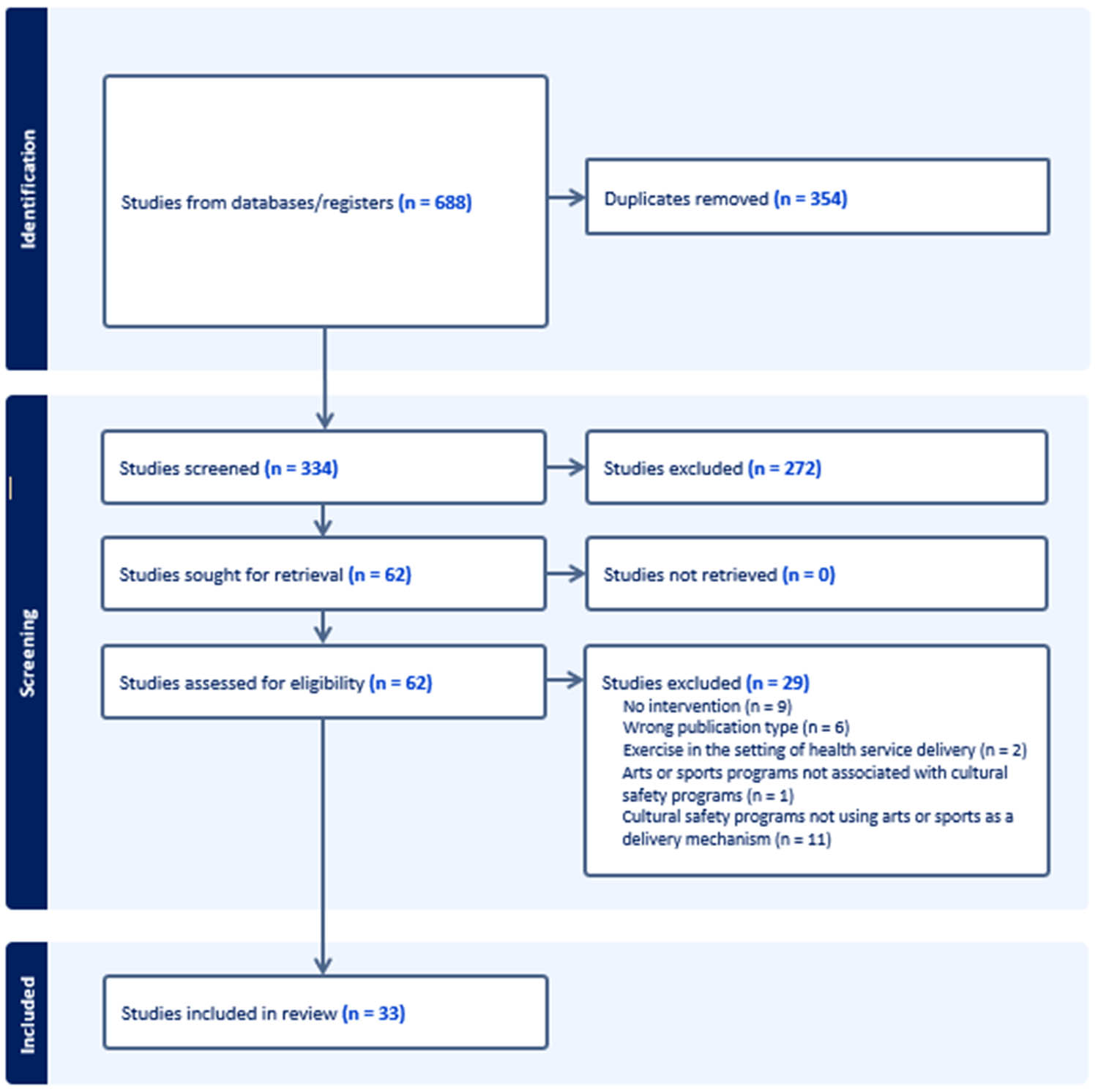
Figure A1
PRISMA flowchart for the study selection process.
Source: Authors’ contribution
| Citation | Cultural safety definition |
|---|---|
| Other related terms/concepts where relevant (italics) | |
| Austin and Vadiveloo (2023) | “Cultural safety is understood as an empowering and transformative process for interrogating the architecture of systems that have been structured by white supremacist, cis-hetero, patriarchal and ableist paradigms” (p. 48) |
| “Cultural safety is therefore, in part, a strategy to dismantle existing structures and support the provision of environments that are spiritually, socially and emotionally, as well as physically, safe for people, ‘where there is no assault or challenge or denial of their identity, of who they are or what they need’ ( Williams 1999 )” (p. 49) | |
| Balla et al. (2022) | “[A]n environment that is safe for people: where there is no assault, challenge or denial of their identity, of who they are and what they need. It is about shared respect, shared meaning, shared knowledge and experience of learning, living and working together with dignity and truly listening ( Williams, 1999 )” (p. 353) |
| Brooks-Cleator and Giles (2016) | “Cultural relevancy and cultural appropriateness are a part of cultural safety; however, cultural safety goes beyond cultural relevancy and other concepts in that it 1) transfers the power to define the quality of the program to the participant and 2) focuses on how the program leader needs to reflect on his/her own culture and position of power (Brascoupé & Waters 2009).” (p. 454) |
| “In culturally relevant and culturally appropriate approaches, the onus is on the provider to meet the participants’ cultural needs. In their discussion on how to provide culturally appropriate – and we suggest culturally relevant as well – programs and materials, Kreuter et al. (2003) emphasized that Bhealth [promoters/providers/educators] must be able to identify and describe cultures and/or subcultures within a given population, understand how each relates to health behavior, and apply this knowledge in planning and development activities” (p. 134).”(p. 454) | |
| Frazer and Giles (2023) | “Cultural safety is a term that challenges other approaches – cultural sensitivity, cultural relevancy, and cultural competency – to understanding culture in Indigenous communities by “focusing less on sensitivity and awareness and more on safety and the risk of failing to provide a safe environment” (Giles & Darroch 2014).” (p. 4) |
| Gagliardi et al. (2022) | “Cultural safety has been defined as effective care of a person from another culture as determined by that person, where culture includes but is not limited to: age or generation, gender, sexual orientation, occupation, socioeconomic status, ethnic origin, migrant experience, religious/spiritual beliefs or disability ( Curtis et al., 2019 ; Mackean et al., 2020 ).” (p. 2) |
| Gidgup et al. (2024) | “Culturally appropriate programs are about building strong relationships at places that Elders feel comfortable to attend, with like minded fellow countrymen and women who are seeking the same social and emotional connections” (p. 448) |
| Lenette et al. (2022) | “Cultural safety means that ‘there is no assault on a person’s identity’ ( Williams, 1999 ).” (p. 3) In a research context, “cultural safety aligns with research seeking to redress power imbalances and achieve social justice outcomes ( Browne et al., 2009 ).” (p. 3) |
| Lines et al. (2021) | “Strength-based approaches are premised on applicable ideas that have worked well or are currently working for a community (Tsey et al., 2007). Utilizing a strength-based approach supports community decision-making power in research (Smith 2012), empowerment of participants and partners, and social change (Anderson et al., 2011).” (p. 505) |
| Marchetti and Nicholson 2020 | “When it comes to Aboriginal and Torres Strait Islander prisoners, however, programmes also need to be culturally safe, meaning the development and delivery of programmes by relevant Aboriginal and Torres Strait Islander organisations and local communities with a focus on connection to culture and collective experiences (Australian Law Reform Commission 2017; Cunneen & Tauri 2016).” (p. 424) |
| Marchetti et al. (2022) | Based around the concept that culturally safe prison interventions should “employ ‘culturally sensitive practices’, ‘an awareness of cultural protocols’ and be ‘delivered or supported by Indigenous facilitators’” [Perdacher et al., 2019].” (p. 156) |
| “A culturally safe framework—defined by Mackean et al. [ 2020 ] as consisting of reflexivity, dialogue, a reduction of power differentials, decolonising practices and ‘regardful care’” (p. 159) | |
| Miller and Walke (2024) | “Cultural safety can be defined as requiring health professionals and their associated healthcare organisations to engage in ongoing self-reflection to reduce bias and achieve equity, as defined by the patients and their communities ( Curtis et al. 2019 )” (p. 7) |
| Ollier et al., (2020) | “Cultural safety means that when cultural differences exist between a healthcare service provider and the client, the client determines if the services are respectful and inclusive of their culture (Gerlach, 2007).” (p. 312) |
| “Cultural safety is defined by Williams ( 1999 ) as a spiritually, socially, and emotionally safe environment in which there is no assault, challenge, or denial of someone’s identity and needs.” (p. 313) | |
| “Gerlach (2007:2) explained: “in cultural safety terms ‘culture’ is defined in its broadest sense and ‘safety’ is defined in relation to the responsibility of health professionals to protect their clients from anything which may risk or endanger their health and well-being.” (p. 313) | |
| “Cultural safety “moves beyond the concept of cultural sensitivity to analyzing power imbalances, institutional discrimination, colonization and colonial relationships as they apply to healthcare” [Baba 2013]” (p. 313) | |
| “Bin-Sallik (2003:27) argued that cultural safety is a crucial concept that must be emphasized when addressing issues like designated Indigenous spaces and culturally appropriate curricula and behaviours because “it does not imply special treatment like the terms ‘positive discrimination,’ ‘equal opportunity,’ and ‘culturally appropriate.’” When applied to evaluation research, cultural safety promotes the consideration of the historical, economic, and social contexts that affect an individual’s experience.” (p. 313) | |
| Pour et al. (2023) | “To be culturally safe and responsive is to demonstrate an understanding of how the history of trauma experienced by First Nations people has led to social, emotional and financial disadvantage. (Tujague & Ryan 2021)” (p. 412) |
| Rich and Giles (2015) | “A culturally safe approach does not simply involve being knowledgeable about other cultures; instead, it is “a journey of self awareness” (Brascoupé & Waters, 2009) where providers must acknowledge and reflect upon the “power inherent in their professional position” and the onus is on recipients to determine whether the approach is effective.” (p. 309) |
| Rich and Breunig (2022) | “A culturally safe approach is concerned with understanding the experiences of different people, particularly as a result of dominant practices within a specific (e.g., leisure, health, etc.) context (Smye & Browne, 2002).” (p. 369) |
| “Cultural sensitivity involves the ability of an individual to identify and understand sociocultural differences and ethical issues, in order to contextualize experiences of others (Ryba & Schinke, 2009; Schinke et al., 2012).” (p. 373) | |
| “Cultural competence, on the other hand, incorporates the skills and knowledge to build relationships and work with peoples of diverse cultural backgrounds (Blair & Coyle, 2005; Stone, 2003), particularly in the context of service provision.” (p. 373) | |
| “Cultural humility expands upon this further, emphasizing that no individual can fully understand another’s worldview and therefore people must adopt a respectful, other-oriented engagement in relation to another person’s cultural background and experiences (Hook & Davis, 2019).” (p. 373) | |
| Rieger et al. (2021) | “A cultural safety lens acknowledges that the current health care inequities among Indigenous peoples are rooted in a colonial history and shaped by power imbalances ( Browne et al., 2009 ; Horrill et al., 2018). This perspective calls settlers to enact cultural humility to foster transformed environments where people feel safe receiving care and sharing their stories ( Browne et al., 2009 ; First Nations Health Authority 2020; Horrill et al., 2018).” (p. 2164) |
| “Cultural humility is “a process of self-reflection to understand personal and systemic biases and to develop and maintain respectful processes and relationships based on mutual trust” and “involves humbly acknowledging oneself as a learner when it comes to understanding another’s experience” (First Nations Health Authority 2020).” (p. 2164) | |
| Robbins et al. (2017) | “Cultural safety was originally a concept developed in New Zealand within the context of the nursing profession and it continues to be applied within Maori healthcare (Wepa, 2005). It asserts that to provide quality care for people from different ethnicities, nurses must provide care within a context of cultural values and norms of the patient.” (p. 162) |
| Wilson et al. (2018) | “There is a need to ensure that venues are culturally safe places which are informed and respectful of their local Indigenous peoples, history and culture, knowledgeable of and implementing cultural protocol, and that they create an environment of trust and welcome.” (p. 75) |