
1. Introduction
1.1. What is Cultural Safety?
Cultural safety originated in nursing and midwifery practice in New Zealand in the 1980s. In response to the poor health status of the country’s Māori people, Irihapeti Merenia Ramsden, ONZM conducted pioneering research in the area, which defined cultural safety as,
“The effective nursing of a person/family from another culture by a nurse who has undertaken a process of reflection on [their] own cultural identity and recognises the impact of the nurses’ culture on [their] own nursing practice” (Papps & Ramsden, 1996, p. 491).
This concept has attracted considerable attention worldwide and has grown to encompass a broader array of social groups, including those defined by age, gender, sexual orientation, socioeconomic status, ethnicity, religion, and differing abilities (De & Richardson, 2008).
In this evolution, considerable attention has been focused on the needs of Indigenous people. This reflects increased community advocacy and awareness regarding the complex and harmful impacts of colonisation, which is driving efforts to address the resulting intergenerational disadvantage. A report by the Lowitja Institute reflects this expansion in the concept and application of cultural safety concerning Aboriginal and Torres Strait Islander peoples (Mohamed et al., 2024).
Although the term “cultural safety” is used in this review, it is important to acknowledge that this is one of many interrelated terms such as “cultural competence,” “cultural responsiveness,” and “cultural awareness.” Additionally, cultural safety is seen as conceptually aligned with social inclusion and health equity as its scope has moved beyond interpersonal elements of healthcare provision to encompass the creation of culturally safe environments and consideration of structural elements of service delivery (Thompson, 2022).
2. Cultural Safety in Sports and Arts Activities
The growth in cultural safety to multiple social groups parallels the growth in areas beyond health care, such as workplaces (Victorian Equal Opportunity and Human Rights Commission, 2024), human services (Mohamed et al., 2024), and policy settings (Mackean et al., 2020). Therefore, leaders and service deliverers in these sectors increasingly focus on creating culturally safe environments to optimise health and well-being, participation, and inclusiveness. This includes community-based sports and arts activities (Austin & Vadiveloo, 2023; Mansell et al., 2024).
Cultural safety in sports/recreation, and arts settings is important for several reasons. First, community sports and arts activities, particularly in group settings, contribute to physical and psychological well-being and foster a sense of belonging (Austin & Vadiveloo, 2023; Mansell et al., 2024; Miller & Walke, 2024; Storr et al., 2024). Second, these benefits have not been equitably distributed; for example, immigrant women have low rates of physical activity (PA) (Gagliardi et al., 2022), and participation in sports is much lower in Aboriginal and Torres Strait Islander children (44%) compared to non-Indigenous children (72%) in Australia (Mansell et al., 2024).
Finally, these activities themselves, if carefully designed, can mitigate negative impacts on health and other domains that have arisen from lower rates of participation for some demographics. For example, PA can help to address higher rates of chronic disease in Aboriginal and Torres Strait Islanders (Mansell et al., 2024; Miller & Walke, 2024); and participation in group art activities offers critical opportunities to acknowledge, process, and express the effects of intergenerational trauma arising from colonisation (Latimer et al., 2018; Robbins et al., 2017).
3. Local Communities as Hubs for Culturally Safe Activities
Local communities are frequent settings for group sports/recreation and arts activities as people build social connections through shared recreational spaces, schools, and other environments close to where they live. Because neighbourhoods and built environments foster these activities, they are critical determinants of health.
With Australia experiencing rising rates of chronic disease (Australian Institute of Health and Welfare, 2021), associated economic and health burdens (Australian Institute of Health and Welfare, 2024), and health inequalities between population groups (Australian Institute of Health and Welfare, 2020), optimising the potential of place-based physical and art activities is a high priority.
This is reflected by the 10-year (2023–2033) strategy of the Victorian Health Promotion Foundation (VicHealth), which identifies neighbourhood and built systems as one of three foundational pillars for health, alongside commercial/economic and food systems (Victorian Health Promotion Foundation, 2023). VicHealth, a statutory authority established by the Victorian (Australia) Parliament in 1987, is a leader in health promotion – the process of enabling people to increase control over and improve their health. While its primary focus remains promoting good health and preventing chronic disease, its current strategy aims to reshape the systems that create barriers to Victorians’ health and wellbeing. By focusing on neighbourhood and built systems as a foundational pillar, VicHealth uses its expertise and research to transform the environments where Victorians “live, connect, play, travel, create, and work”.
4. Aim of the Review
This review serves as an evidence-based foundation for VicHealth’s strategic focus, specifically identifying how culturally safe sports and arts programmes can eliminate systemic discrimination and address the rising burden of chronic disease. The aim of this review is therefore to address the question: What is known about the impact of cultural safety initiatives in sports and arts programmes in Australia, New Zealand, and Canada? Given the breadth of the concept of cultural safety, a secondary aim of the review was to identify and describe how eligible research studies defined cultural safety.
5. Methods
A rapid review method was employed to address the aims of this review. Over the last decade, rapid reviews have enabled government and other actors to access review-level knowledge more quickly than “traditional” systematic reviews (Khangura et al., 2012). For this study, we employed the Cochrane Collaboration definition of “rapid reviews”:
“…a type of evidence synthesis that brings together and summarises information from different research studies to produce evidence for people such as the public, healthcare providers, researchers, policy makers, and funders in a systematic, resource efficient manner. This is done by speeding up the ways we plan, do, and/or share the results of conventional structured (systematic) reviews, by simplifying or omitting a variety of methods that should be clearly defined by the authors.” (Garritty et al., 2024, p. 3)
This builds upon earlier definitions (Hamel et al., 2021; Speckemeier et al., 2022), with more recent methodological studies highlighting the need for thoughtful co-design of review parameters with knowledge users (Garritty et al., 2024), limiting data extraction to the most important fields relevant to the question (Garritty et al., 2024), and flexible approaches for searching that involve at least two databases and incorporate input from a specialist librarian (Klerings et al., 2023).
6. Key Definitions
As described above, cultural safety has evolved into numerous concepts and settings. For these reasons, cultural safety is a term that does not currently have a broadly agreed definition. For this review, given that describing definitions of cultural safety was an aim, all papers that self-identified as being focused on cultural safety were within scope. These encompassed papers using the specific phrase “cultural safety” or key synonyms including, but not limited to “cultural inclusion,” “anti-racism,” “equity,” and “inclusion.”
Similarly, the review employed broad and pragmatic definitions of “sports/recreation” and “arts.” For the purpose of this review, we define “sports” as organised PA involving physical exertion and skill as the primary focus, with elements of competition where rules and patterns of behaviour governing the activity exist formally through organisations (Department of Creative Industries, Tourism and Sport, 2017; Khasnabis et al., 2010) and “recreation” as activities that people choose to do for relaxation, health, and well-being, making their leisure time more interesting and enjoyable (Department of Creative Industries, Tourism and Sport, 2017; Khasnabis et al., 2010). Operationally, articles about sports/recreation activities (e.g. netball, walking) or arts (e.g. visual, performance, music) were included.
7. Search Strategy
We conducted a comprehensive literature search to identify peer-reviewed articles that described programmes to foster cultural safety via sports and arts in Australia, New Zealand, and Canada. These countries were selected to optimise transferability to the Victorian context, given that all have a history of colonisation and are high-income Commonwealth countries with comparable health system characteristics. While the USA shares features of colonial history, it was excluded because its health system and governance structures are too dissimilar to that of Victoria, Australia.
Search strategy development was informed by documentation provided by VicHealth and naïve searching by the review team members to identify “gold set” documents (documents that will very likely be included in the review that can validate the final search terms). The draft search terms and “gold set” documents were then discussed with VicHealth, and the search strategy was confirmed.
Nine electronic databases were searched – Scopus, ProQuest, Informit, Web of Science, Google Scholar, Medline, Global Health, Embase, and Emcare – using a combination of free-text and controlled vocabulary terms combined with truncation, proximity operators, and Boolean operators to combine the terms. All search strategies are presented in Appendix 1.
8. Study Selection and Data Extraction
Search results were imported and de-duplicated in Covidence, a web-based collaboration software platform used to manage the production of systematic reviews and other types of evidence synthesis (Veritas Health Innovation, 2023). Study titles and abstracts were independently screened against pre-defined eligibility criteria (Table 1) by two review team members. Any disagreements between the two screeners were resolved through discussion or by a third screener taking the final vote.
Table 1
Inclusion and exclusion criteria.
| Include | Exclude | |
|---|---|---|
| Publication type |
|
|
| Language |
|
|
| Country |
|
|
| Study focus | Eligible studies were those reporting on the impact of any form of cultural safety initiative associated with arts or sports programmes, with the primary focus of the article being cultural safety. Broadly, there were two possible categories of inclusion:
|
|
| Outcomes |
|
|
| Date range |
|
|
Source: Authors’ contribution.
Following this, full texts of studies selected for inclusion during the title and abstract screening were screened in duplicate against the eligibility criteria. Reasons for excluding any records at the full-text stage were recorded. Disagreements between screeners were resolved via consensus or by a third screener.
Upon completion of the screening process, the following data elements were extracted from the included studies by two reviewers with a review of 50% of the content for quality assurance by a third reviewer:
Study aims
Number of included studies (reviews)
Definition of cultural safety
Activity focus (sports/arts) and brief description
Participant group and location (primary studies)
Activity purpose (primary studies)
Key findings and conclusions.
9. Findings
9.1. Study Selection
Following the removal of duplicates, 334 citations were identified. After dual independent screening of all 334 titles and abstracts, 62 full text articles were reviewed in duplicate, of which 33 studies were found to meet all inclusion criteria (See Appendix 2 for PRISMA diagram).
9.2. Study Characteristics
The 33 included studies comprised six systematic reviews (de Lannoy et al., 2023; Gagliardi et al., 2022; Mansell et al., 2024; Miller & Walke, 2024; Pour et al., 2023; Williams et al., 2024), two narrative reviews (Austin & Vadiveloo, 2023; Frazer & Giles, 2023), and 25 primary studies.
Among the primary studies, nine focused on sports (Bennie et al., 2021; Brooks-Cleator & Giles, 2016; English et al., 2023; Gidgup et al., 2022; 2024; Rich & Breunig, 2022; Rich & Giles, 2015; Stronach et al., 2019; Whitau & Ockerby, 2019), 13 focused on the arts (Balla et al., 2022; Blanchet, 2024; Fanian et al., 2015; (Hadley et al., 2022); Latimer et al., 2018; (Lenette et al., 2022); Lines et al., 2021; Marchetti & Nicholson, 2020; Marchetti et al., 2022; Rieger et al., 2021; Robbins et al., 2017; (Whyte, 2020); Wilson et al., 2018), and three had a multifaceted focus (Doyle et al., 2016; (Flouris et al., 2016); Ollier et al., 2020). Fourteen of the primary studies were conducted in Australia and 11 were conducted in Canada.
The primary studies predominantly utilised qualitative methodologies, collecting data through yarning circles, semi-structured interviews, focus groups, and participatory workshops (Balla et al., 2022; Blanchet, 2024; Brooks-Cleator & Giles, 2016; English et al., 2023; Flouris et al., 2016; Gidgup et al., 2024; Hadley et al., 2022; Latimer et al., 2018; Lenette et al., 2022; Lines et al., 2021; Marchetti & Nicholson, 2020; Marchetti et al., 2022; Ollier et al., 2020; Rich & Breunig, 2022; Rich & Giles, 2015; Rieger et al., 2021; Robbins et al., 2017; Stronach et al., 2019; Whitau & Ockerby, 2019; Whyte, 2020; Wilson et al., 2018). Only four studies employed mixed-methods approaches (Bennie et al., 2021; Doyle et al., 2016; Fanian et al., 2015; Gidgup et al., 2022), and no purely quantitative studies were identified.
The participant groups across the primary studies reflect the origins of cultural safety in Indigenous healthcare, with 19 studies focused on Indigenous people. Several of these studies also specify the age and gender of participants, with six studies focused on Indigenous women (Balla et al., 2022; Bennie et al., 2021; Blanchet, 2024; Marchetti et al., 2022; Rieger et al., 2021; Stronach et al., 2019), four studies focused on Indigenous youth (Fanian et al., 2015; Latimer et al., 2018; Lines et al., 2021; Robbins et al., 2017), two studies focused on Indigenous men (Marchetti & Nicholson, 2020; Whyte, 2020), and one study focused on Indigenous girls/youth (Whitau & Ockerby, 2019). Six studies were focused on Indigenous people of multiple ages and genders (Brooks-Cleator & Giles, 2016; Doyle et al., 2016; Flouris et al., 2016; Gidgup et al., 2022; Ollier et al., 2020; Wilson et al., 2018). One primary study focused on people with disabilities (Hadley et al., 2022), another primary study focused on people from ethnic backgrounds (Lenette et al., 2022), and four primary studies focused on mixed groups (English et al., 2023; Gidgup et al., 2024; Rich & Breunig, 2022; Rich & Giles, 2015).
Further details about the study characteristics, as well as short summaries of some key findings, are presented in Tables 2–4.
Table 2
Overview of systematic reviews (n = 6).
| Citation | Review focus | N (studies) | Key findings/conclusion |
|---|---|---|---|
| de Lannoy et al. (2023) | Adult-oriented outdoor play in Canada | 224 |
|
| Gagliardi et al. (2022) | Culturally safe community-based PA promotion strategies for immigrant women | 13 |
|
| Mansell et al. (2024) | Experiences of sport and recreation amongst Indigenous peoples in Australia, New Zealand, the United States, and Canada | 27 |
|
| Miller and Walke (2024) | The role of community events in increasing the uptake of Indigenous-specific health examinations | 18 |
|
| Pour et al. (2023) | Effectiveness of culturally safe mental health interventions (including sport/physical activity) in improving the well-being of First Nations youth | 4 |
|
| Williams et al. (2024) | Youth perceptions of what is important to their mental health and well-being and how approaches address their needs in Canadian youth-led mental health and well-being initiatives (including arts and music programmes) | 294 |
|
Source: Authors’ contribution.
Table 3
Overview of narrative reviews (n = 2).
| Citation | Review focus | Key findings/conclusion |
|---|---|---|
| Austin and Vadiveloo (2023) | To explore cultural safety in the arts using “practical features of a consent-based practice originating in the field of Intimacy Direction, and Brave Space methodologies developed through social justice facilitation,” (p. 49–50) using the example of a “Let’s Take Over” youth arts programme in Darebin, Australia. The programme was designed to be inclusive of various cultural, social, and socio-economic backgrounds. |
|
| Frazer and Giles (2023) | “To examine if and how sport and Inuit traditional games are identified as meaningful tools in these Inuit suicide prevention strategies.” (Frazer and Giles 2023, p. 1) |
|
Source: Authors’ contribution.
Table 4
Overview of primary studies – sports (n = 9), arts (n = 13), and multifaceted (n = 3).
| Citation, Country | Participant group, N | Intervention description | Key findings/conclusion |
|---|---|---|---|
| Sports focus (n = 9) | |||
| Bennie et al. (2021) Australia | Aboriginal women (n = 20) | Coaching Unlimited is a collaborative coach education and health promotion programme tailored for Aboriginal Australian peoples. Key aim was to build a supportive network of coaches from different regions. |
|
| Brooks-Cleator and Giles (2016) Canada | Elders in Motion (EIM) programme leaders across the Northwest Territories (NWT) (n = 7) | EIM had three main objectives – improve access to PA opportunities for elders living in the NWT; develop a training manual for programme leaders and accompanying video for EIM; and deliver training of EIM to various health and recreational leaders, and students. |
|
| English et al. (2023) Australia | Health promotion stakeholders (n = 11) | Interviews with key stakeholders were conducted to explore “…best practice approaches for developing and implementing holistic (i.e. physical, social, emotional spiritual & cultural) health promotion programmes for young Aboriginal and Torres Strait Islander girls.” (p. 1142) |
|
| Gidgup et al. (2024) Australia | Aboriginal and non-Aboriginal workers who assisted with programme delivery, and family and local members of the communities (n = 17) | The Ironbark PA programme for older Aboriginal and Torres Strait Islander people, a falls prevention programme originally developed in New South Wales (NSW). |
|
| Gidgup et al. (2022) Australia | Aboriginal elders (n = 23) | Ironbark falls prevention exercise programme, including PA (exercises with a strong balance and functional component) and yarning, along with morning tea. Original material was adapted to suit the preferences of Aboriginal elders residing on Noongar Country and referenced a holistic, decolonising approach to implementation. |
|
| Rich and Giles (2015) Canada | Canadian Red Cross (CRC) Swim Programme instructors (n = 36) | The CRC’s Water Safety Instructor Development Programme involved participant reflection on their own cultures; discussions about the various forms of inclusion and exclusion that can occur in swimming and water safety programmes; and how instructors and organisations can prevent such exclusionary practices. |
|
| Rich and Breunig (2022) Canada | Various participants of various leisure programmes (n = not stated) | Various programmes, e.g. The Pizza Game involved teaching safe entries and exits by calling out toppings that would go on a pizza; Pow Wows, an annual week-long competition between four teams that each represented an Indigenous tribe; Community Cup, a soccer tournament; and National Outdoor Leadership School. |
|
| Stronach et al. (2019) Australia | Indigenous women (n = 22) | Various programmes mentioned include The Onkaparinga Women’s Rugby Club; The Indigenous Softball Programme; Women’s Sport Leadership Programme; The Deadly Sistas Girlz Programme to empower Aboriginal girls aged 8–17 years; Gwabba Yorga, Gabba Warra (GYGW) for Indigenous teenage girls, which focuses on increasing awareness about the effects of binge drinking; Moorditj Mums, a pilot programme aimed at young mums to encourage better parenting and pathways to education and employment; Surfing Victoria’s Indigenous Surfing Programme; and Fitzroy Stars Football and Netball Club. |
|
| Whitau and Ockerby (2019) Australia | Girls and young women from Year 3 to 12 (n = not stated) | The Yarning with the Stars project employed both Western and Indigenous research methods to qualitatively evaluate the Shooting Stars programme, which uses netball and other incentives to engage Aboriginal and Torres Strait Islander girls in their education, while promoting their health and well-being. |
|
| Arts focus (n = 13) | |||
| Balla et al. (2022) Australia | Indigenous women (n = 14) | Ten Wayapa Wuurrk (connect to the earth) workshops focusing on connecting to earth and nature for well-being and four bush-dyeing workshops |
|
| Blanchet (2024) Canada | Indigenous women students (n = 8) | Theatricalisation of life stories of Indigenous women students aiming to strengthen the narrative sovereignty of Indigenous women and provide recommendations for culturally safe artistic educational initiatives for Indigenous youth and adults. |
|
| Fanian et al. (2015) Canada | Indigenous youth (n = 9) | Five-day pilot creative arts and music workshop for youth with the aim of empowering youth to explore critical issues facing their community and their lives and find solutions together through the arts. |
|
| Hadley et al. (2022) Australia | Local d/Deaf, disabled, and neurodiverse artists (n = not stated) | The Last Avant-Garde project at six sites around Australia invited artists identifying as d/Deaf, disabled, neurodiverse, having lived experience of a medical or mental health condition, or otherwise being part of the disability arts community to participate in inclusive arts workshops. |
|
| Latimer et al. (2018) Canada | Indigenous youth (n = 42) | Talking Circle focus group, followed by an art workshop. Talking Circles were used to gather narratives from youth about their experiences, expressions, and management of pain. |
|
| Lenette et al. (2022) Australia | Residents of diverse ethnic backgrounds (n = 52) | Involved completing a story from an opening hypothetical scenario related to the COVID-19 pandemic with the aim of capturing how participants made sense of new circumstances and coped with daily life using digital story completion. |
|
| Lines et al. (2021) Canada | Indigenous youth, elders, families, teachers, adult learners, and parents (n = approx. 45) | Forum Theatre facilitator training sessions over 2 years. The training process involved four stages: building community; sharing stories; creating a forum; and inviting community. |
|
| Marchetti and Nicholson (2020) Australia | Incarcerated Indigenous men in prison (n = 30) | The “Dreaming Inside” programme used creative writing (poetry, stories) to help participants reconnect with their culture and rebuild self-confidence and self-esteem. Elders and Aboriginal tutors supported participants. |
|
| Marchetti et al. (2022) Australia | Incarcerated Indigenous women (n = up to 12; 3 were interviewed) | An Indigenous-led, arts-based pilot project in Brisbane Women’s Correctional Centre that used deep active listening, inspired by Dadirri, to help Aboriginal and Torres Strait Islander women on remand reconnect with culture. |
|
| Rieger et al. (2021) Canada | Indigenous women who experienced breast cancer (n = not specified) | A 2-day digital story-telling workshop, and three Talking Circles throughout the digital storytelling workshop to discuss First Nations women’s experiences of breast cancer, perceptions of what knowledge needs to be developed to improve services, and feedback on the digital storytelling workshop. |
|
| Robbins et al. (2017) Canada | Indigenous youth (n = not specified) | A grassroots film creation and production programme in a major urban centre in Saskatchewan that aimed to “enable youth to become creative through the arts in an environment supported by an intergenerational network of Nêhiyaw (Plains Cree) kinship relationships called wâhkôtowin.” (p. 161) |
|
| Whyte (2020) Canada | Incarcerated Indigenous men (n = 32) | Involved two mural making projects that aimed to “address the over-representation [of Indigenous people] within correctional systems and the potential impacts of colonisation on crime, including addiction, trauma and other mental health conditions.” (p. 55) |
|
| Wilson et al. (2018) Australia | Indigenous people (n = not stated) | Involved the creation of “an Indigenous Community Engagement Coordinator initiative, through which presenters, audiences and communities could develop their knowledge, understanding and respect for Indigenous culture and peoples, and for Indigenous communities to connect with their local performing arts centres.” (p. 76) |
|
| Multifaceted (n = 3) | |||
| Doyle et al. (2016) Australia | Indigenous people (n = 850+) | Investigated the aims and purpose of 12 health promotion programmes (encompassing 88 activities) run by Aboriginal Community Controlled Organisations. |
|
| Flouris et al. (2016) Australia | Aboriginal community members or service providers (either non-Aboriginal or Aboriginal) (n = 60) | Youth programmes in three remote Indigenous communities in Central Australia. |
|
| Ollier et al. (2020) Canada | Indigenous people (n = not stated) | Project Jewel, an “on-the-land” wellness programme run by the Inuvialuit Regional Corporation comprising 3-day to 10-day on-the-land wellness programmes (“camps”) six times per year. |
|
Source: Authors’ contribution.
9.3. Definitions of Cultural Safety
The results from the definition-focused portion of the review are presented first to give context to the other findings. Table 5 provides an overview of the most cited cultural safety definitions and concepts. The full list of the definitions used, and the definitions of related terms, is provided in Appendix 3.
Table 5
Most frequently cited definitions of cultural safety within included studies.
| Citation | No. of times cited in included studies | Cultural safety definition |
|---|---|---|
| Williams (1999) | 4 | “…an environment which is safe for people; where there is no assault, challenge or denial of their identity, of who they are and what they need. It is about shared respect, shared meaning, shared knowledge and experience, of learning together with dignity, and truly listening…” (Williams, 1999, p. 213) |
| Brascoupé and Waters (2009) | 2 | “…the reversal of cultural danger or peril, where individuals and communities may be at risk or in crisis…entails not just the agreement and understanding that cultural differences matter in social and health policy delivery, but also the need to make a real difference in methods of delivery and the ultimate effectiveness of the policies…Cultural safety is not just a process of improving program delivery; it is also part of the outcome.” (Brascoupé & Waters, 2009, p. 11) |
| Note: The authors highlight the need for program leaders/healthcare professionals to reflect on their own culture and position of power. | ||
| Browne et al. (2009) | 2 | “Cultural safety aims to counter tendencies in health care that create cultural risk (or unsafety) – those situations that arise when people from one ethnocultural group believe they are demeaned, diminished or disempowered by the actions and the delivery systems of people from another culture … compatible with critical theoretical perspectives that foster a focus on power imbalances and inequitable social relationships in health care; the interrelated problems of culturalism and racialisation; and a commitment to social justice as central to the social mandate of nursing.” (Browne et al., 2009, p. 169) |
| Curtis et al. (2019) | 2 | “Cultural safety requires healthcare professionals and their associated healthcare organisations to examine themselves and the potential impact of their own culture on clinical interactions and healthcare service delivery … to acknowledge and address their own biases, attitudes, assumptions, stereotypes, prejudices, structures and characteristics that may affect the quality of care provided. In doing so, cultural safety encompasses a critical consciousness where healthcare professionals and healthcare organisations engage in ongoing self-reflection and self-awareness and hold themselves accountable for providing culturally safe care, as defined by the patient and their communities, and as measured through progress towards achieving health equity. Cultural safety requires healthcare professionals and their associated healthcare organisations to influence healthcare to reduce bias and achieve equity within the workforce and working environment…” (Curtis et al., 2019, p. 13) |
Source: Authors’ contribution.
Of the 33 included studies, 16 provided an explicit definition of cultural safety (Austin & Vadiveloo, 2023; Balla et al., 2022; Brooks-Cleator & Giles, 2016; Frazer & Giles, 2023; Gagliardi et al., 2022; Lenette et al., 2022; Marchetti & Nicholson, 2020; Marchetti et al., 2022; Miller & Walke, 2024; Ollier et al., 2020; Pour et al., 2023; Rich & Breunig, 2022; Rich & Giles, 2015; Rieger et al., 2021; Robbins et al., 2017; Wilson et al., 2018). Additionally, four studies provided definitions of related terms, such as cultural sensitivity, cultural competence, cultural humility, culturally appropriate programmes, and strengths-based approaches (Gidgup et al., 2024; Lines et al., 2021; Rich & Breunig, 2022; Rieger et al., 2021).
9.4. Common Elements Used When Defining Cultural Safety
Among the definitions of cultural safety used, the most frequently occurring themes were:
Ensuring that there is no assault, denial, or challenge to individuals’ identity (including, but not limited to, age or generation, gender, sexual orientation, occupation, socioeconomic status, ethnic origin, migrant experience, religious/spiritual beliefs or disability) (Austin & Vadiveloo, 2023; Balla et al., 2022; Brooks-Cleator & Giles, 2016; Gagliardi et al., 2022; Lenette et al., 2022; Ollier et al., 2020).
Shared knowledge and experiences of learning, reflexivity, dialogue, and intentional listening (Balla et al., 2022; Marchetti & Nicholson, 2020; Marchetti et al., 2022; Miller & Walke, 2024; Robbins et al., 2017)
Recognising and addressing inequities rooted in colonial histories and institutional discrimination (Austin & Vadiveloo, 2023; Marchetti et al., 2022; Ollier et al., 2020; Pour et al., 2023; Rich & Breunig, 2022; Rieger et al., 2021).
Acknowledging and reducing power imbalances (Brooks-Cleator & Giles, 2016; Lenette et al., 2022; Marchetti et al., 2022; Ollier et al., 2020; Rich & Breunig, 2022; Rieger et al., 2021).
Creating a safe environment that is spiritually, socially, and emotionally supportive for people to share their stories and receive care (Austin & Vadiveloo, 2023; Balla et al., 2022; Frazer & Giles, 2023; Ollier et al., 2020; Rieger et al., 2021; Wilson et al., 2018)
Ensuring that the recipient, and their communities, determine what works and what is respectful and inclusive of their culture (Brooks-Cleator & Giles, 2016; Gagliardi et al., 2022; Miller & Walke, 2024; Ollier et al., 2020; Rich & Breunig, 2022)
Ensuring that healthcare providers and facilitators have knowledge and understanding about other cultures and cultural protocols (Frazer & Giles, 2023; Marchetti & Nicholson, 2020; Marchetti et al., 2022; Pour et al., 2023; Rich & Breunig, 2022; Robbins et al., 2017; Wilson et al., 2018)
Other mentioned elements included achieving social justice outcomes (Lenette et al., 2022) and health professionals’ responsibility to protect clients from risks or harm (Ollier et al., 2020).
9.5. Key Features of Culturally Safe Practices
Drawing upon the key principles outlined above, culturally safe programmes share several important features. Successful initiatives were designed with strong community involvement, making them relevant and inclusive (Bennie et al., 2021; Gagliardi et al., 2022). Common features included using participants’ preferred languages, hosting activities in community-based settings, and involving facilitators who reflected participants’ cultural and social norms (Gagliardi et al., 2022). These programmes also worked to remove barriers to participation (Bennie et al., 2021; Gagliardi et al., 2022). Flexibility and respect for local cultures were essential, for example the Ironbark programme successfully established a supportive programme framework for both the Elders who participated and their communities (Gidgup et al., 2022).
Leadership of Indigenous people and the role of Elders were particularly significant in creating culturally safe spaces (Whyte, 2020). Elders provided cultural guidance, shared traditional knowledge, and strengthened programme relationships (Brooks-Cleator & Giles, 2016; Whyte, 2020). Programmes that addressed intergenerational trauma, grief, and systemic inequities were especially effective (Marchetti & Nicholson, 2020; Pour et al., 2023).
9.6. Challenges and Areas for Improvement
While most programmes captured in the review showed promise, some also faced challenges. Insufficient funding and staffing made maintaining programme quality and adapting to participants’ needs difficult (English et al., 2023). Standardised Western frameworks often failed to meet the cultural needs of Indigenous communities, highlighting the need for culturally relevant content and greater involvement of local leaders (Brooks-Cleator & Giles, 2016; Frazer & Giles, 2023). Efforts to promote inclusivity were sometimes hindered by resistance within organisations, particularly in areas like sports/recreation (Rich & Giles, 2015). To overcome these barriers, programmes demonstrated the importance of working closely with Indigenous communities throughout programme lifecycles (Miller & Walke, 2024). Co-design approaches prioritising community leadership and respecting cultural protocols were shown to improve outcomes and foster cultural safety (English et al., 2023; Lines et al., 2021).
9.7. Impact of Cultural Safety Programmes: Sports Programmes
Culturally safe sports programmes created environments that promoted self-determination, empowerment, and cultural connections. Participation in sports improved physical and mental health, self-esteem, and confidence among Indigenous women, enabling them to assume leadership roles within their communities (Stronach et al., 2019). For youth, sports programmes reinforced cultural ties and supported holistic well-being by addressing spiritual, emotional, mental, and physical health while strengthening connections to ancestry and the wider community (Frazer & Giles, 2023; Pour et al., 2023).
Programmes for older adults, such as Ironbark, a PA initiative targeting Aboriginal and Torres Strait Islander people aged 45 and over to improve their health and well-being, have been positively received for their cultural relevance, emphasis on relationship-building, and PA promotion (Gidgup et al., 2022, 2024). Community events integrating cultural celebrations have further supported health promotion and increased participation in these programmes (Miller & Walke, 2024). Moreover, addressing racism at all levels of competition, and fostering leadership of Indigenous people within community clubs, were found to be essential for supporting Indigenous athletes and strengthening community spirit (Mansell et al., 2024).
9.8. Impact of Cultural Safety Programmes: Arts Programmes
Culturally safe arts programmes have reported benefits for participants, particularly within Indigenous communities. By creating supportive spaces for self-reflection, emotional expression, and personal growth, these initiatives address the holistic needs of individuals while promoting cultural reconnection and belonging (Blanchet, 2024; Marchetti & Nicholson, 2020; Robbins et al., 2017; Whyte, 2020). For instance, the Dreaming Inside programme, an arts-based programme for incarcerated Aboriginal and Torres Strait Islander men in NSW, utilised creative writing to facilitate cultural reconnection and enhance well-being. Participants reported improved self-worth, confidence, a sense of belonging, and emotional well-being through the opportunity to express and process emotions in a culturally safe space (Marchetti & Nicholson, 2020).
Similarly, the Forum Theatre programme was an arts programme that used games and image work to create a short play reflecting an oppressive situation. It employed an Indigenous strengths-based approach to reframe complex topics (e.g. suicide prevention) into actionable wellness interventions, through collaboration with community partners and ongoing leadership and guidance from Indigenous community members (Lines et al., 2021). For young people, arts programmes offered opportunities to develop skills in areas like music production, visual arts, and spoken word (Fanian et al., 2015). These activities fostered strong relationships with peers, facilitators, and their communities, which, in turn, contributed to a sense of extended family and cultural belonging (Fanian et al., 2015; Robbins et al., 2017).
Overall, employing strengths-based approaches fostered resilience, self-determination, and identity exploration through artistic expression. Creating culturally safe spaces further enabled participants to navigate the interconnected physical, emotional, and spiritual dimensions of well-being (Austin & Vadiveloo, 2023; Hadley et al., 2022; Latimer et al., 2018; Williams et al., 2024). These findings underline the importance of trust and collaboration for success.
Two arts-focused initiatives surfaced unexpected insights. In the Talking Circle sessions, physical pain emerged as the predominant theme, aligning with the types of physical discomforts that youth commonly report in national surveys. However, when participants had the opportunity to express their pain through painting with an Indigenous artist in a culturally safe environment, emotional pain became more evident. Emotional pain often overlapped with aspects of physical, spiritual, and mental pain (Latimer et al., 2018). For some of the incarcerated men in the study by Whyte (2020), the correctional system was their first exposure to cultural access, which the author reflected “speaks to the greater dialogue regarding the impact of colonisation on community health as a whole” (Whyte, 2020, p. 59).
10. Discussion
10.1. Statement of Key Findings
This rapid scoping review aimed to synthesise knowledge about the impact of cultural safety initiatives in sports and arts programmes in Australia, New Zealand, and Canada and to identify and describe how studies defined cultural safety. A comprehensive literature search identified 33 relevant articles comprising 8 reviews and 25 primary studies. Most primary studies (n = 19) focused on Indigenous people.
Of the 16 studies providing an explicit definition of cultural safety, key themes from the definitions encompassed recognising and respecting individual identities, including age, gender, culture, and life experiences (Balla et al., 2022; Marchetti & Nicholson, 2020); the importance of shared knowledge, open discussions, and mutual understanding (Balla et al., 2022; Lines et al., 2021); acknowledging colonial histories and systemic discrimination as barriers to equity, including through Indigenous-led programmes (Mansell et al., 2024; Rieger et al., 2021); reducing power imbalances and allowing communities to shape programmes (Gidgup et al., 2022; Miller & Walke, 2024); and understanding cultural practices, including adherence to cultural protocols and involving Indigenous facilitators (Marchetti & Nicholson, 2020; Whyte, 2020).
Positive impacts of arts-based initiatives centred on addressing holistic needs and promoting cultural reconnection and belonging. Similarly, sports-based programmes promoted self-determination, empowerment, and cultural connections. Furthermore, sports participation improved physical and mental health, self-esteem, and confidence, particularly among Indigenous women. Key challenges for initiatives and programmes included insufficient funding and staffing, inappropriate use of standardised Western frameworks, and organisational resistance.
10.2. Comparison of Findings with Related Research
The definitions of cultural safety drawn from the included studies show that considering the critical nuances of the definitions may have important implications. For example, Austin and Vadiveloo (2023) describe the duality of cultural safety as both an ethical framework and an intended outcome, emphasising the need to be mindful of its overarching intent and conscious that in making spaces safer, it is important to be cognisant of imposing the organiser’s values and beliefs on the activity, which can result in participants losing agency and power. Such situations can reinforce, rather than diminish, power structures inherent in colonisation (Frazer & Giles, 2023). This underlines the importance of thoughtful self-reflection and reflexivity in reference to one’s positionality in guiding cultural safety planning and practice, as highlighted in Ramsden’s seminal definition (Papps & Ramsden, 1996). Relatedly, a recommendation of multiple studies in this review was the need to ensure that sports and arts activities are co-designed with, and, where able, delivered by representatives of the groups they seek to include. This appears critical in addressing hidden biases of those outside of these groups.
Two studies offered powerful manifestations of this concept. First, Latimer et al. (2018) used artistic expression to explore how Indigenous children and youth express pain, and concluded that “Indigenous cultures often conceptualise health issues very differently from Western medicine…Youth reported high rates of physical pain and missed school due to pain, but primarily shared emotional and mental pain experiences in their artwork” (Latimer et al., 2018, p. 11). Second, the study by Lines et al. (2021), which examined strength-based approaches to wellness aimed at youth, included elders, families, adult learners, and toddlers. This underlined the importance of community connections and relational accountability, suggesting that more limited approaches, for example those where only youth are included, may inadvertently neglect this key ingredient.
Notably, 19 of the 25 primary studies focused on Indigenous people, including 6 on Indigenous women and 5 on Indigenous youth. In contrast, few of the included studies focused on other groups who may also benefit from cultural safety practices, for instance people with disability and from non-majority ethnic backgrounds. Although one review focusing on PA promotion for immigrant women reported positive findings, there were relatively few studies within this review (Gagliardi et al., 2022). Furthermore, no studies were identified addressing the needs of other groups like LGBTQIA+, gender-diverse individuals, and/or those from minority religious groups. Explanations for this could include limitations in the review scope, disruptions to programmes arising from the COVID-19 pandemic, and publication lag. Further exploration of cultural safety initiatives addressing the needs of these groups is warranted.
However, a relatively large volume of research on Indigenous people does not obviate the need for further research focused on this group. The review of Pour et al. (2023) concluded that “mainstream psychological wellbeing methods, Rules, dos and don’ts continue to operate using colonial ideologies when providing services to First Nations youth…It is imperative that the “colonial lens” is removed and culturally safe practices are embedded…” (Pour et al., 2023, p. 406). The study of an arts programme in Victoria, Australia by Austin and Vadiveloo (2023) emphasised the importance of engaging Indigenous people in facilitator and leadership positions: “the basic principle of ensuring that there is a Welcome and then ongoing Acknowledgement of Country is useful but ultimately insufficient in cultivating culturally safe collaborative space for First Nations young people working with a white facilitator on stolen land” (Austin & Vadiveloo, 2023, p. 66).
Future avenues of research could include, but are not limited to, exploring how cultural safety definitions and terminology vary across target populations (e.g. culturally and linguistically diverse (CALD) communities, people with disability and LGBTQIA+); examining how cultural safety is approached theoretically by different academic disciplines; focusing on activities beyond sports and arts; and more targeted primary and review research examining specific groups or disciplinary perspectives.
10.3. Strengths and Limitations of the Review
This is the first known review focusing on cultural safety in sports and arts settings. The review applied robust dual independent study selection methods using explicit and pre-determined criteria; comprehensive searching of nine databases by a specialist librarian; and collaboration with the review commissioners on review approach and interpretation, reflected by co-authorship. Given the breadth of the concept of cultural safety, an in-depth exploration of how cultural safety was defined and operationalised across the included studies was another strength of the review.
Review limitations are primarily related to adjustments in the scope of the review to accommodate a rapid review time frame: limitations to the English language, a small number of countries with shared characteristics, and a 10-year time frame. While some relevant evidence may have been found in earlier years, the review focused on more recent evidence to identify current trends and due to limited resource availability. In addition to different sectoral approaches to “cultural safety” across populations, there are also many ways to view cultural safety from various academic disciplines; this aspect was beyond the scope of the present work.
Furthermore, quality appraisal was not undertaken – noting this is not routine in scoping reviews (Munn et al., 2018). In addition to considerable variation in study design across the included literature, various underlying research paradigms were represented owing to the nature of the topic, and differing study designs led to the inclusion of very large and very small sample sizes. In this context, it can be argued that quality appraisal was unlikely to add value to the interpretation of review findings.
11. Implications for Policy and Practice
11.1. Definitional Themes and Their Application
For organisations in a position to implement insights from this review, the findings can provide a foundation for advancing cultural safety as a core element of health promotion and community well-being strategies. The review highlights critical definitional elements of cultural safety, including the importance of shared knowledge, reflexivity, and dialogue, addressing systemic inequities rooted in colonial histories, and fostering environments free from identity-based assault or denial. These elements can be used to develop and refine organisational definitions of cultural safety. For instance, VicHealth used the findings of this review to refine its current definition to “cultivating an environment where individuals feel respected, valued, and supported in their cultural identity, with systems fostering equity by actively addressing power imbalances and embracing cultural differences to minimise harm and racism within Victoria.”
Policy implications include embedding these themes into organisational frameworks, co-designing programmes with communities to reflect their lived experiences and cultural protocols, and, where possible, employing staff or programme leaders who share participants cultural backgrounds. The findings underscore the importance of integrating shared learning and dialogue mechanisms into partnerships with local government, sports and arts organisations, and community groups. Such approaches reflect organisations’ commitment to fostering equity, trust, and mutual respect among diverse stakeholders. Finally, the review’s emphasis on reducing power imbalances and acknowledging colonial histories reinforces the need for policies and practice that promote self-determination and equity.
11.2. Opportunities for Operationalising Cultural Safety Principles
There are several ways to operationalise cultural safety principles identified in the review for organisations. Practical steps may include:
Resource allocation: Providing targeted funding to support community-led programmes that prioritise cultural inclusion and connectedness. These programmes can improve mental health, social cohesion, and overall well-being by addressing barriers to participation for marginalised groups.
Capacity building: Offering training, resources, and networking support for stakeholders to develop cultural competence; understanding of cultural protocols; and skills for self-reflection. This aligns with the review’s finding that knowledge and reflexivity are key to fostering culturally safe environments.
Community engagement: Enhancing identification and relationships with underrepresented community groups, ensuring that programmes address their needs and priorities. This engagement needs to be more than “one off” projects. Rather, work needs to be ongoing and undertaken with intentional consideration of long-standing forms of oppression and the need for iterative, reflexive approaches.
11.3. Addressing Barriers and Facilitators
The review identifies several barriers to implementing cultural safety, such as resistance within organisations, insufficient funding, and reliance on Western frameworks. Overcoming these barriers involves adopting a strengths-based co-design approach that prioritises community leadership and cultural relevance. Facilitators such as Indigenous leadership, relational accountability, and recognition of intergenerational trauma are essential for creating sustainable and impactful initiatives. We acknowledge that cultural safety is a complex phenomenon with individual and system-level characteristics and drivers. This review focused on the practical manifestations of cultural safety practices. While the wider system and other dynamics are critical for building and scaling cultural safety practices, exploration of this aspect was beyond the scope of the present work. Of note, the context of this review was to inform a long-term strategy based around system transformation (Victorian Health Promotion Foundation, 2023). Therefore, deeper exploration of system implications of this review is an important next step for both policy and research.
12. Conclusion
The identification of 33 relevant studies reflects growing interest in this topic. These studies describe considerable benefits of cultural safety initiatives, but also important reflections that can enable practitioners and researchers to build upon and refine cultural safety research and practice. The findings of this review show that cultural safety can be viewed as an essential practice in addressing health and well-being inequities.
As the evidence base remains largely focused on Indigenous populations, expanding research to include CALD communities, people with disability, LGBTQIA+ individuals, and other marginalised groups is an important next step. Public health and other organisations can use these insights by aligning them with their strategic priorities, which can help foster environments where all individuals feel valued in their cultural identity.
Funding information
Funding for this project was provided by VicHealth.
Author contributions
Diki Tsering: Conception and design of the study, analysis and interpretation of data, and manuscript preparation; Veronica Delafosse: Conception and design of the study, acquisition of data, and manuscript preparation; Paul Kellner: Conception and design of the study, acquisition of data, analysis and interpretation of data, and manuscript preparation; Kevin Kapeke: Conception and design of the study, acquisition of data, analysis and interpretation of data, manuscript preparation, and obtaining funding; Susan Maury: Conception and design of the study, acquisition of data, analysis and interpretation of data, manuscript preparation, and obtaining funding; Xavier Walsh: Conception and design of the study, acquisition of data, analysis and interpretation of data, manuscript preparation, and obtaining funding; Alessandro Demaio: Conception and design of the study, manuscript preparation, and obtaining funding; and Peter Bragge: Conception and design of the study, acquisition of data, analysis and interpretation of data, manuscript preparation, and obtaining funding.
Conflict of interest statement
Kevin Kapeke, Xavier Walsh, Susan Maury, and Alessandro Demaio were employed by VicHealth at the time of writing. Diki Tsering, Peter Bragge, Veronica Delafosse, and Paul Kellner were funded by VicHealth to undertake the review. There are no other interests to declare.
Appendices
Appendices
Appendix 1: Search strategies
Database: Scopus
Date searched: October 4, 2024
Number of citations: 142
(TITLE-ABS-KEY(“cultural safety” OR “culturally safe” OR “culturally unsafe” OR “multicultural safety” OR “multiculturally safe” OR “multiculturally unsafe”)
OR
TITLE-ABS-KEY((“cultural responsiveness” OR “cultural awareness” OR “cultural practice*” OR “cultural protocol*” OR “cultural classroom” OR “culturally appropriate” OR “culturally aware” OR “culturally inappropriate” OR “culturally responsive” OR “culturally sensitive” OR “culturally insensitive” OR “cultural inclusion” OR “culturally included” OR “cultural exclusion” OR “culturally excluded” OR “cultural identit*” OR “anti*racism” OR “racism” OR “discrimination” OR “racialisation” OR “minorit*” OR “ethnic*” OR “equity” OR “equal opportunit*” OR “shared respect” OR “shared meaning” OR “shared knowledge” OR “shared experience” OR “intergenerational”) W/9 (safe OR safety OR unsafe OR security))
AND
TITLE-ABS-KEY(“art” OR “arts” OR “artistic” OR “creativ*” OR “sport” OR “sports” OR “recreation*“ OR “physical activit*” OR “physical education” OR “traditional W/3 games” OR “aboriginal W/3 games” OR “play” OR “outdoor*” OR “exercise*”)
AND
TITLE-ABS-KEY(intervention* OR impact* OR implement* OR initiative* OR engagement* OR partnership* OR evaluation* OR trial* OR pilot* OR program* OR strateg* OR activit* OR incentiv* OR campaign* OR promote* OR promotion)
AND
TITLE-ABS-KEY(Australia* OR “New South Wales” OR Victoria OR Tasmania OR Queensland OR “Northern Territory” OR “South Australia” OR “Western Australia” OR “Australian Capital Territory” OR aborigin* OR “First Nation*” OR “First People*“ OR “traditional owner*” OR “indigenous” OR “Torres Strait Islander*” OR “New Zealand” OR “aotearoa” OR “maori” OR “canada” OR “canadian” OR “metis” OR “cree” OR “inuit”))
AND PUBYEAR > 2014 AND PUBYEAR < 2025 AND ( LIMIT-TO ( DOCTYPE,“ar”) OR LIMIT-TO ( DOCTYPE,“re”)) AND ( LIMIT-TO ( LANGUAGE,“English”))
Database: PROQUEST – Seven databases
Arts & Humanities Database
Australia & New Zealand Database
Canadian Business & Current Affairs Database
Health & Medical Collection
Performing Arts Periodicals Database
Public Health Database
Social Science Database
Date searched: October 7, 2024
Number of citations: 65
noft(“cultural safety” OR “culturally safe” OR “culturally unsafe” OR “multicultural safety” OR “multiculturally safe” OR “multiculturally unsafe”)
AND
noft(art OR arts OR artistic OR creativ* OR sport OR sports OR recreation OR leisure OR “physical activit*” OR “physical education” OR games OR play OR outdoor* OR exercise*) AND
noft(intervention* OR impact* OR implement* OR initiative* OR engagement* OR partnership* OR evaluation* OR trial* OR pilot* OR program* OR activit* OR incentiv* OR campaign* OR promote* OR promotion)
AND
noft(Australia* OR “New South Wales” OR Victoria OR Tasmania OR Queensland OR “Northern Territory” OR “South Australia” OR “Western Australia” OR “Australian Capital Territory” OR aborigin* OR “First Nations” OR “First Peoples” OR “traditional owner” OR “indigenous” OR “Torres Strait Islander” OR “New Zealand” OR “aotearoa” OR “maori” OR “canada” OR “canadian” OR “metis” OR “cree” OR “inuit”)
AND
stype.exact(“Scholarly Journals”) AND la.exact(“English”)
Additional limits – Date: From 2015 to 2024; Source type: Scholarly Journals; Language: English
Filter – article
Database: INFORMIT – Nine databases
Australian Family & Society Abstracts (FAMILY)
Australian Public Affairs Full Text (APAFT)
Business Collection
Families & Society Collection
Health Collection
Humanities & Social Sciences Collection
Indigenous Collection
Indigenous Studies Bibliography (AIATSIS)
Literature & Culture Collection
Date searched: October 7, 2024
Number of citations: 40
“cultural safety” AND [art OR arts OR artistic OR creativ* OR sport OR sports OR recreation OR leisure OR “physical activit*” OR “physical education” OR games OR play OR outdoor* OR exercise*] AND Resource Type: Journal Article AND Publication Date: (01/01/2015 TO 31/12/2024)
Database: Web of Science – Two databases
Arts & Humanities Citation Index
Social Sciences Citation Index
Date searched: October 11, 2024
Number of citations: 69
(TS = (“cultural safety” OR “culturally safe” OR “culturally unsafe” OR “multicultural safety” OR “multiculturally safe” OR “multiculturally unsafe”)) OR (TS = (“cultural awareness” NEAR/9 safe)) OR (TS = (“cultural awareness” NEAR/9 safety)) OR (TS = (“cultural awareness” NEAR/9 unsafe)) OR (TS = (“cultural awareness” NEAR/9 security))
AND
TS = (“art” OR “arts” OR “artistic” OR “creativ*” OR “sport” OR “sports” OR “recreation*” OR “physical activit*” OR “physical education” OR “traditional NEAR/3 games” OR “aboriginal NEAR/3 games” OR “play” OR “outdoor*” OR “exercise*”)
AND
TS = (intervention* OR impact* OR implement* OR initiative* OR engagement* OR partnership* OR evaluation* OR trial* OR pilot* OR program* OR strateg* OR activit* OR incentiv* OR campaign* OR promote* OR promotion)
AND
TS = (Australia* OR “New South Wales” OR Victoria OR Tasmania OR Queensland OR “Northern Territory” OR “South Australia” OR “Western Australia” OR “Australian Capital Territory” OR aborigin* OR “First Nation*” OR “First People*“ OR “traditional owner*“ OR “indigenous” OR “Torres Strait Islander*“ OR “New Zealand” OR “aotearoa” OR “maori” OR “canada” OR “canadian” OR “metis” OR “cree” OR “inuit”)
AND
(DT = = (“ARTICLE” OR “REVIEW”)
AND
PY = = (“2015” OR “2016” OR “2017” OR “2018” OR “2019” OR “2020” OR “2021” OR “2022” OR “2023” OR “2024”))
and Social Sciences Citation Index (SSCI) or Arts & Humanities Citation Index (A&HCI) (Web of Science Index)
Database: Google Scholar
Date searched: October 11, 2024
Number of citations: 100 (first 100 by relevance selected)
“cultural safety”|“culturally safe”|“culturally unsafe” art|sport|leisure|creative|recreation|games|play intervention|impact|initiative|evaluation|program australia|“new zealand”|canada
Sorted by relevance, 2015–2024
Database: Medline
Date searched: October 11, 2024
Number of citations: 68
| # | Query | Results |
|---|---|---|
| 1 | (“cultural safety” or “culturally safe” or “culturally unsafe” or “multicultural safety” or “multiculturally safe” or “multiculturally unsafe”).ti,ab. | 1,227 |
| 2 | ((“cultural responsiveness” or “cultural awareness” or “cultural practice*“ or “cultural protocol*“ or “cultural classroom” or “culturally appropriate” or “culturally aware” or “culturally inappropriate” or “culturally responsive” or “culturally sensitive” or “culturally insensitive” or “cultural inclusion” or “culturally included” or “cultural exclusion” or “culturally excluded” or “cultural identit*” or “anti*racism” or “racism” or “discrimination” or “racialisation” or “minorit*” or “ethnic*” or “equity” or “equal opportunit*” or “shared respect” or “shared meaning” or “shared knowledge” or “shared experience” or “intergenerational”) adj9 (safe or safety or unsafe or security)).ti,ab. | 2,524 |
| 3 | 1 or 2 | 3,617 |
| 4 | (“art” or “arts” or “artistic” or “creativ*” or “sport” or “sports” or “recreation*” or “physical activit*” or “physical education” or “traditional adj3 games” or “aboriginal adj3 games” or “play” or “outdoor*” or “exercise*”).ti,ab. | 1,399,933 |
| 5 | 3 and 4 | 270 |
| 6 | (intervention* or impact* or implement* or initiative* or engagement* or partnership* or evaluation* or trial* or pilot* or program* or strateg* or activit* or incentiv* or campaign* or promote* or promotion).ti,ab. | 9,505,203 |
| 7 | 5 and 6 | 209 |
| 8 | (Australia* or “New South Wales” or Victoria or Tasmania or Queensland or “Northern Territory” or “South Australia” or “Western Australia” or “Australian Capital Territory” or aborigin* or “First Nation*” or “First People*” or “traditional owner*” or “indigenous” or “Torres Strait Islander*” or “New Zealand” or “aotearoa” or “maori” or “canada” or “canadian” or “metis” or “cree” or “inuit”).ti,ab. | 388,566 |
| 9 | 7 and 8 | 77 |
| 10 | limit 9 to yr = “2015 – 2024” | 68 |
Database: Global health
Date searched: October 11, 2024
Number of citations: 39
| # | Query | Results |
|---|---|---|
| 1 | (“cultural safety” or “culturally safe” or “culturally unsafe” or “multicultural safety” or “multiculturally safe” or “multiculturally unsafe”).ti,ab. | 435 |
| 2 | ((“cultural responsiveness” or “cultural awareness” or “cultural practice*” or “cultural protocol*” or “cultural classroom” or “culturally appropriate” or “culturally aware” or “culturally inappropriate” or “culturally responsive” or “culturally sensitive” or “culturally insensitive” or “cultural inclusion” or “culturally included” or “cultural exclusion” or “culturally excluded” or “cultural identit*” or “anti*racism” or “racism” or “discrimination” or “racialisation” or “minorit*” or “ethnic*” or “equity” or “equal opportunit*” or “shared respect” or “shared meaning” or “shared knowledge” or “shared experience” or “intergenerational”) adj9 (safe or safety or unsafe or security)).ti,ab. | 1,072 |
| 3 | 1 or 2 | 1,457 |
| 4 | (“art” or “arts” or “artistic” or “creativ*” or “sport” or “sports” or “recreation*” or “physical activit*“ or “physical education” or “traditional adj3 games” or “aboriginal adj3 games” or “play” or “outdoor*“ or “exercise*”).ti,ab. | 308,286 |
| 5 | 3 and 4 | 149 |
| 6 | (intervention* or impact* or implement* or initiative* or engagement* or partnership* or evaluation* or trial* or pilot* or program* or strateg* or activit* or incentiv* or campaign* or promote* or promotion).ti,ab. | 2,100,442 |
| 7 | 5 and 6 | 118 |
| 8 | (Australia* or “New South Wales” or Victoria or Tasmania or Queensland or “Northern Territory” or “South Australia” or “Western Australia” or “Australian Capital Territory” or aborigin* or “First Nation*” or “First People*” or “traditional owner*” or “indigenous” or “Torres Strait Islander*“ or “New Zealand” or “aotearoa” or “maori” or “canada” or “canadian” or “metis” or “cree” or “inuit”).ti,ab. | 156,308 |
| 9 | 7 and 8 | 45 |
| 10 | limit 9 to yr = “2015 – 2024” | 39 |
Database: Embase
Date searched: October 11, 2024
Number of citations: 101
| # | Query | Results |
|---|---|---|
| 1 | (“cultural safety” or “culturally safe” or “culturally unsafe” or “multicultural safety” or “multiculturally safe” or “multiculturally unsafe”).ti,ab. | 1,713 |
| 2 | ((“cultural responsiveness” or “cultural awareness” or “cultural practice*”“ or “cultural protocol*” or “cultural classroom” or “culturally appropriate” or “culturally aware” or “culturally inappropriate” or “culturally responsive” or “culturally sensitive” or “culturally insensitive” or “cultural inclusion” or “culturally included” or “cultural exclusion” or “culturally excluded” or “cultural identit*” or “anti*racism” or “racism” or “discrimination” or “racialisation” or “minorit*” or “ethnic*” or “equity” or “equal opportunit*” or “shared respect” or “shared meaning” or “shared knowledge” or “shared experience” or “intergenerational”) adj9 (safe or safety or unsafe or security)).ti,ab. | 4,016 |
| 3 | 1 or 2 | 5,547 |
| 4 | (“art” or “arts” or “artistic” or “creativ*” or “sport” or “sports” or “recreation*” or “physical activit*” or “physical education” or “traditional adj3 games” or “aboriginal adj3 games” or “play” or “outdoor*” or “exercise*”).ti,ab. | 2,203,421 |
| 5 | 3 and 4 | 406 |
| 6 | (intervention* or impact* or implement* or initiative* or engagement* or partnership* or evaluation* or trial* or pilot* or program* or strateg* or activit* or incentiv* or campaign* or promote* or promotion).ti,ab. | 15,064,004 |
| 7 | 5 and 6 | 316 |
| 8 | (Australia* or “New South Wales” or Victoria or Tasmania or Queensland or “Northern Territory” or “South Australia” or “Western Australia” or “Australian Capital Territory” or aborigin* or “First Nation*” or “First People*” or “traditional owner*” or “indigenous” or “Torres Strait Islander*” or “New Zealand” or “aotearoa” or “maori” or “canada” or “canadian” or “metis” or “cree” or “inuit”).ti,ab. | 613,083 |
| 9 | 7 and 8 | 115 |
| 10 | limit 9 to yr = “2015 – 2024” | 102 |
| 11 | limit 10 to english language | 101 |
Database: Emcare
Date searched: October 11, 2024
Number of citations: 64
| # | Query | Results |
|---|---|---|
| 1 | (“cultural safety” or “culturally safe” or “culturally unsafe” or “multicultural safety” or “multiculturally safe” or “multiculturally unsafe”).ti,ab. | 1,225 |
| 2 | ((“cultural responsiveness” or “cultural awareness” or “cultural practice*” or “cultural protocol*” or “cultural classroom” or “culturally appropriate” or “culturally aware” or “culturally inappropriate” or “culturally responsive” or “culturally sensitive” or “culturally insensitive” or “cultural inclusion” or “culturally included” or “cultural exclusion” or “culturally excluded” or “cultural identit*” or “anti*racism” or “racism” or “discrimination” or “racialisation” or “minorit*” or “ethnic*” or “equity” or “equal opportunit*” or “shared respect” or “shared meaning” or “shared knowledge” or “shared experience” or “intergenerational”) adj9 (safe or safety or unsafe or security)).ti,ab. | 1,977 |
| 3 | 1 or 2 | 3,054 |
| 4 | (“art” or “arts” or “artistic” or “creativ*” or “sport” or “sports” or “recreation*” or “physical activit*” or “physical education” or “traditional adj3 games” or “aboriginal adj3 games” or “play” or “outdoor*” or “exercise*“).ti,ab. | 598,240 |
| 5 | 3 and 4 | 249 |
| 6 | (intervention* or impact* or implement* or initiative* or engagement* or partnership* or evaluation* or trial* or pilot* or program* or strateg* or activit* or incentiv* or campaign* or promote* or promotion).ti,ab. | 3,513,733 |
| 7 | 5 and 6 | 194 |
| 8 | (Australia* or “New South Wales” or Victoria or Tasmania or Queensland or “Northern Territory” or “South Australia” or “Western Australia” or “Australian Capital Territory” or aborigin* or “First Nation*” or “First People*” or “traditional owner*” or “indigenous” or “Torres Strait Islander*” or “New Zealand” or “aotearoa” or “maori” or “canada” or “canadian” or “metis” or “cree” or “inuit”).ti,ab. | 222,019 |
| 9 | 7 and 8 | 73 |
| 10 | limit 9 to yr = “2015 – 2024” | 66 |
| 11 | limit 10 to english language | 64 |
Appendix 2: Results of study selection (PRISMA)
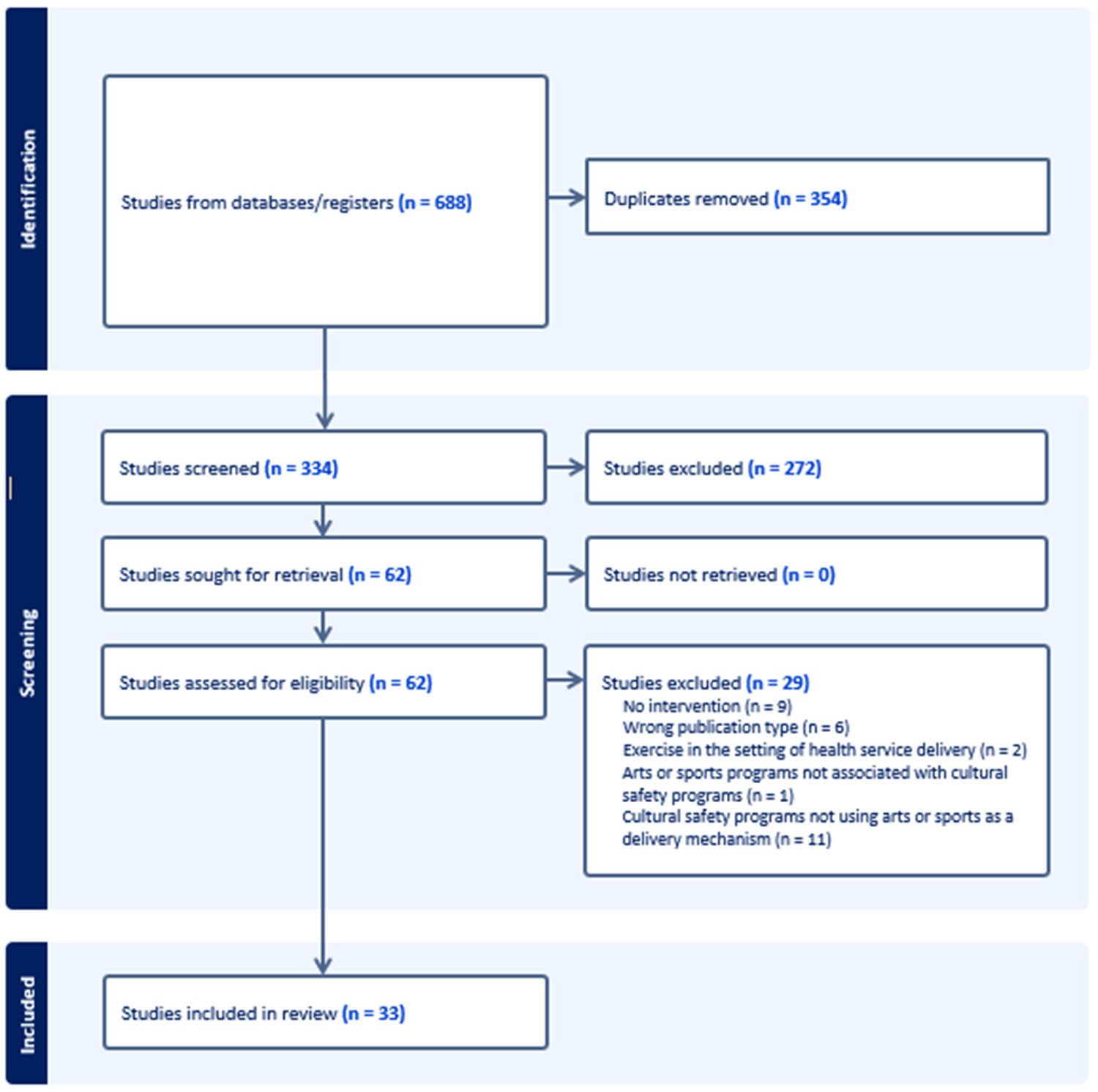
Figure A1
PRISMA flowchart for the study selection process.
Source: Authors’ contribution
Appendix 3: Definitions of cultural safety across included studies
| Citation | Cultural safety definition |
|---|---|
| Other related terms/concepts where relevant (italics) | |
| Austin and Vadiveloo (2023) | “Cultural safety is understood as an empowering and transformative process for interrogating the architecture of systems that have been structured by white supremacist, cis-hetero, patriarchal and ableist paradigms” (p. 48) |
| “Cultural safety is therefore, in part, a strategy to dismantle existing structures and support the provision of environments that are spiritually, socially and emotionally, as well as physically, safe for people, ‘where there is no assault or challenge or denial of their identity, of who they are or what they need’ ( Williams 1999 )” (p. 49) | |
| Balla et al. (2022) | “[A]n environment that is safe for people: where there is no assault, challenge or denial of their identity, of who they are and what they need. It is about shared respect, shared meaning, shared knowledge and experience of learning, living and working together with dignity and truly listening ( Williams, 1999 )” (p. 353) |
| Brooks-Cleator and Giles (2016) | “Cultural relevancy and cultural appropriateness are a part of cultural safety; however, cultural safety goes beyond cultural relevancy and other concepts in that it 1) transfers the power to define the quality of the program to the participant and 2) focuses on how the program leader needs to reflect on his/her own culture and position of power (Brascoupé & Waters 2009).” (p. 454) |
| “In culturally relevant and culturally appropriate approaches, the onus is on the provider to meet the participants’ cultural needs. In their discussion on how to provide culturally appropriate – and we suggest culturally relevant as well – programs and materials, Kreuter et al. (2003) emphasized that Bhealth [promoters/providers/educators] must be able to identify and describe cultures and/or subcultures within a given population, understand how each relates to health behavior, and apply this knowledge in planning and development activities” (p. 134).”(p. 454) | |
| Frazer and Giles (2023) | “Cultural safety is a term that challenges other approaches – cultural sensitivity, cultural relevancy, and cultural competency – to understanding culture in Indigenous communities by “focusing less on sensitivity and awareness and more on safety and the risk of failing to provide a safe environment” (Giles & Darroch 2014).” (p. 4) |
| Gagliardi et al. (2022) | “Cultural safety has been defined as effective care of a person from another culture as determined by that person, where culture includes but is not limited to: age or generation, gender, sexual orientation, occupation, socioeconomic status, ethnic origin, migrant experience, religious/spiritual beliefs or disability ( Curtis et al., 2019 ; Mackean et al., 2020 ).” (p. 2) |
| Gidgup et al. (2024) | “Culturally appropriate programs are about building strong relationships at places that Elders feel comfortable to attend, with like minded fellow countrymen and women who are seeking the same social and emotional connections” (p. 448) |
| Lenette et al. (2022) | “Cultural safety means that ‘there is no assault on a person’s identity’ ( Williams, 1999 ).” (p. 3) In a research context, “cultural safety aligns with research seeking to redress power imbalances and achieve social justice outcomes ( Browne et al., 2009 ).” (p. 3) |
| Lines et al. (2021) | “Strength-based approaches are premised on applicable ideas that have worked well or are currently working for a community (Tsey et al., 2007). Utilizing a strength-based approach supports community decision-making power in research (Smith 2012), empowerment of participants and partners, and social change (Anderson et al., 2011).” (p. 505) |
| Marchetti and Nicholson 2020 | “When it comes to Aboriginal and Torres Strait Islander prisoners, however, programmes also need to be culturally safe, meaning the development and delivery of programmes by relevant Aboriginal and Torres Strait Islander organisations and local communities with a focus on connection to culture and collective experiences (Australian Law Reform Commission 2017; Cunneen & Tauri 2016).” (p. 424) |
| Marchetti et al. (2022) | Based around the concept that culturally safe prison interventions should “employ ‘culturally sensitive practices’, ‘an awareness of cultural protocols’ and be ‘delivered or supported by Indigenous facilitators’” [Perdacher et al., 2019].” (p. 156) |
| “A culturally safe framework—defined by Mackean et al. [ 2020 ] as consisting of reflexivity, dialogue, a reduction of power differentials, decolonising practices and ‘regardful care’” (p. 159) | |
| Miller and Walke (2024) | “Cultural safety can be defined as requiring health professionals and their associated healthcare organisations to engage in ongoing self-reflection to reduce bias and achieve equity, as defined by the patients and their communities ( Curtis et al. 2019 )” (p. 7) |
| Ollier et al., (2020) | “Cultural safety means that when cultural differences exist between a healthcare service provider and the client, the client determines if the services are respectful and inclusive of their culture (Gerlach, 2007).” (p. 312) |
| “Cultural safety is defined by Williams ( 1999 ) as a spiritually, socially, and emotionally safe environment in which there is no assault, challenge, or denial of someone’s identity and needs.” (p. 313) | |
| “Gerlach (2007:2) explained: “in cultural safety terms ‘culture’ is defined in its broadest sense and ‘safety’ is defined in relation to the responsibility of health professionals to protect their clients from anything which may risk or endanger their health and well-being.” (p. 313) | |
| “Cultural safety “moves beyond the concept of cultural sensitivity to analyzing power imbalances, institutional discrimination, colonization and colonial relationships as they apply to healthcare” [Baba 2013]” (p. 313) | |
| “Bin-Sallik (2003:27) argued that cultural safety is a crucial concept that must be emphasized when addressing issues like designated Indigenous spaces and culturally appropriate curricula and behaviours because “it does not imply special treatment like the terms ‘positive discrimination,’ ‘equal opportunity,’ and ‘culturally appropriate.’” When applied to evaluation research, cultural safety promotes the consideration of the historical, economic, and social contexts that affect an individual’s experience.” (p. 313) | |
| Pour et al. (2023) | “To be culturally safe and responsive is to demonstrate an understanding of how the history of trauma experienced by First Nations people has led to social, emotional and financial disadvantage. (Tujague & Ryan 2021)” (p. 412) |
| Rich and Giles (2015) | “A culturally safe approach does not simply involve being knowledgeable about other cultures; instead, it is “a journey of self awareness” (Brascoupé & Waters, 2009) where providers must acknowledge and reflect upon the “power inherent in their professional position” and the onus is on recipients to determine whether the approach is effective.” (p. 309) |
| Rich and Breunig (2022) | “A culturally safe approach is concerned with understanding the experiences of different people, particularly as a result of dominant practices within a specific (e.g., leisure, health, etc.) context (Smye & Browne, 2002).” (p. 369) |
| “Cultural sensitivity involves the ability of an individual to identify and understand sociocultural differences and ethical issues, in order to contextualize experiences of others (Ryba & Schinke, 2009; Schinke et al., 2012).” (p. 373) | |
| “Cultural competence, on the other hand, incorporates the skills and knowledge to build relationships and work with peoples of diverse cultural backgrounds (Blair & Coyle, 2005; Stone, 2003), particularly in the context of service provision.” (p. 373) | |
| “Cultural humility expands upon this further, emphasizing that no individual can fully understand another’s worldview and therefore people must adopt a respectful, other-oriented engagement in relation to another person’s cultural background and experiences (Hook & Davis, 2019).” (p. 373) | |
| Rieger et al. (2021) | “A cultural safety lens acknowledges that the current health care inequities among Indigenous peoples are rooted in a colonial history and shaped by power imbalances ( Browne et al., 2009 ; Horrill et al., 2018). This perspective calls settlers to enact cultural humility to foster transformed environments where people feel safe receiving care and sharing their stories ( Browne et al., 2009 ; First Nations Health Authority 2020; Horrill et al., 2018).” (p. 2164) |
| “Cultural humility is “a process of self-reflection to understand personal and systemic biases and to develop and maintain respectful processes and relationships based on mutual trust” and “involves humbly acknowledging oneself as a learner when it comes to understanding another’s experience” (First Nations Health Authority 2020).” (p. 2164) | |
| Robbins et al. (2017) | “Cultural safety was originally a concept developed in New Zealand within the context of the nursing profession and it continues to be applied within Maori healthcare (Wepa, 2005). It asserts that to provide quality care for people from different ethnicities, nurses must provide care within a context of cultural values and norms of the patient.” (p. 162) |
| Wilson et al. (2018) | “There is a need to ensure that venues are culturally safe places which are informed and respectful of their local Indigenous peoples, history and culture, knowledgeable of and implementing cultural protocol, and that they create an environment of trust and welcome.” (p. 75) |