
1. Introduction
The World Health Organisation (WHO) encourages exercise, highlighting the impact of regular physical activity on physical and psychological health and its contribution to improving quality of life. The WHO aims to reduce physical inactivity by 15 per cent globally by 2030 (World Health Organization, 2024). The positive health effects of physical activity, the encouragement of the WHO, and the prescription of exercise as a remedy for chronic diseases (Pedersen & Saltin, 2006, 2015) contribute to the annual growth in global fitness market demand. According to Deloitte (2026), the number of fitness club members increased by 5.8% compared to the previous year, reaching 75.5 million. Similarly, the number of fitness centres in Europe grew by 2.8%, totalling 67,515 facilities. At the global level, the fitness market was valued at $131.31 billion in 2025 and is projected to reach $244.70 billion by 2032, reflecting a compound annual growth rate (CAGR) of 9.30% (Fortune Business Insights, 2026). Overall, the fitness industry has demonstrated sustained growth over the past decade, even when accounting for the impact of the pandemic, and is expected to maintain this upward trend in the coming years. Nevertheless, despite its continued expansion, the sector remains characterised by high membership turnover, as memberships can be easily cancelled (Çevik & Sevilmiş, 2024).
The literature emphasises that membership termination behaviour in fitness centres is a process that unfolds over time and that terminating membership within the first six months is critical. Most new members fail to maintain regular exercise behaviour (Gjestvang et al., 2021), with membership cancellation and exercise dropout rates ranging from 40 to 65% in the first six months (Gjestvang et al., 2023). Some studies have found that exercise discontinuation behaviour gradually increases by 20.1, 21.1, and 28.3% at 3, 6, and 12 months, respectively (Gjestvang et al., 2020). Similarly, only 30–60% of members maintain their membership by the end of the first year (Clavel San Emeterio et al., 2019). The relevant literature indicates that fitness members who maintain their membership for more than six months demonstrate loyalty and are less likely to terminate their membership (Clavel San Emeterio et al., 2019). A key question that arises in this context is why members choose to terminate their memberships. Previous research has identified a range of factors contributing to membership cancellation (Mihalko et al., 2006; Tross et al., 2024; Watts et al., 2026). For instance, MacIntosh and Law (2015) highlighted membership fees and family-related factors as primary drivers of termination. Similarly, Ratola et al. (2025) found that pricing and member density were among the most influential determinants, while also emphasising the importance of service quality and the role of trainers in promoting member retention. Other studies have pointed to additional factors. Zarotis et al. (2017) identified high membership fees and age-related health issues as key reasons for cancellation. In a subsequent study, Zarotis (2018) further underscored the relevance of motivational factors, including lack of time, low motivation, limited social support, and the overall atmosphere of the fitness centre. Focusing on boutique fitness centres, Addolorato and Gimeno (2025) reported that high member turnover, lack of interest, and the absence of structured training programmes were common reasons for membership termination. Finally, Sairu (2024) demonstrated that the quality and availability of fitness equipment also influence cancellation decisions. These studies contribute to a more comprehensive understanding of membership termination in the fitness industry, consistently highlighting pricing, service quality, and motivational and contextual factors as key determinants of member attrition.
In the contemporary fitness industry, business models, such as low-cost, boutique, and franchise, have become increasingly relevant due to the distinct services and value propositions they offer. These models differ substantially in how they generate revenue, attract and retain customers, and position themselves competitively. Among them, both franchise and boutique fitness centres play a particularly significant role. A boutique fitness centre is typically characterised as a specialised facility that serves a limited number of members, offering personalised training programmes, individualised attention, and a focus on specific fitness disciplines, while placing strong emphasis on service quality and customer experience (Yıldız et al., 2021). In contrast, franchise fitness centres operate as part of a larger chain under a unified brand, following standardised policies regarding service delivery, equipment layout, membership systems, marketing strategies, and operational procedures defined by a central headquarters. These centres generally provide a broad range of fitness services within a single facility (Brown & Fry, 2014). Given these structural and operational differences, the reasons for membership termination in boutique and franchise fitness centres may be driven by distinct dynamics. However, there remains a notable gap in the literature addressing this comparative perspective. Accordingly, this study aims to examine the following research question: What are the common and distinguishing reasons for membership termination in franchise and boutique fitness business models? The study contributes to the literature by examining the impact of business models, while also facilitating strategic decision-making for businesses seeking to increase their market share in the evolving and changing fitness trends.
2. Methods
2.1. Participants
This research was designed as a qualitative study to determine the reasons for membership termination among franchise and boutique fitness centre customers. The data were collected from members of ‘franchise’ and ‘boutique fitness centres’ in Spain. The most important criterion for selecting the members to be interviewed was that they had terminated their membership at a fitness centre for a specific reason and subsequently joined a different fitness centre. In this context, data were collected through purposive sampling. The aim of purposive sampling is to reach participants who can provide in-depth knowledge on the subject (Gentles et al. 2015). Data were collected from an equal number of individuals from each business model. Thus, the aim was to evaluate the reasons for membership termination among members of both business models (franchise n = 21; boutique fitness centres n = 21; total = 42) in a balanced manner. In qualitative research, representativeness is considered in terms of suitability in terms of experience and knowledge rather than statistical criteria (Patton, 2014). It should, of course, be borne in mind that the fitness members selected for the two different business models (franchises and boutique fitness centres) may differ in terms of demographic characteristics (gender, age) within the context of the respective business model. Ethical approval was obtained from the local university (protocol code: 3-03-2026-58). Participant characteristics are presented in Table 1.
Table 1
Participant information.
| Variable | Franchise fitness (n = 21) | Boutique fitness (n = 21) |
|---|---|---|
| Female (n) | 7 | 20 |
| Male (n) | 14 | 1 |
| Average age (±SD) | 34.2 ± 11.8 years | 57.3 ± 11.8 years |
| Practicing exercise (mean ± SD) | 30.9 ± 22.7 months | 64.3 ± 76.6 months |
| Average days per week (±SD) | 3.9 ± 1.4 days | 2.4 ± 1.2 days |
| Average duration per week (±SD) | 87.1 ± 25.6 min | 82.9 ± 25.4 min |
Source: Author’s contribution.
2.2. Procedure
Qualitative research methods were used to collect, analyse and interpret the research data. The data were collected in Spain. The researcher was in Spain in January 2026 for the purposes of academic research and carried out data collection activities during this period. In order to gain an in-depth understanding of the members’ experiences, data was collected using face-to-face interviews (Flick, 2018) and a form containing questions about the decision to terminate membership was completed. The form was structured to learn about the participants’ personal variables, and semi-structured questions were asked to learn about the reasons for membership termination. The interviews lasted approximately 20 min. To achieve the research objective, gender, age, how many years they had been doing fitness training, and how many times a week and how many hours they did fitness training were determined with structured questions. Members were asked a semi-structured question: “Could you explain in sentences your reasons for leaving a fitness centre before?”
One of the biggest misconceptions in the relevant literature is the idea that a larger number of participants can provide more detail. It should be remembered that a sample that reflects the universe is not a valid criterion in qualitative research. In this context, qualitative research focuses on the quality rather than the quantity of the persons interviewed (Mertens, 2014). In assessing the quality of the data, attention was paid to the saturation point. The saturation point is the repetition of codes (Hammarberg et al., 2016; Sim et al., 2018; West, 2001).
Code saturation refers to the situation where no new themes, categories or codes emerge. In other words, when coding data obtained from interviews, observations or document reviews, the researcher encounters repetitive statements beyond a certain point and realises that no new information can be generated; this situation is referred to as “code saturation”. Much of the literature has emphasised code saturation in the termination of data analysis (Guest et al., 2006). Similar studies conducted in the field of sports management support the saturation point in terminating the study group in qualitative research (Sevilmiş et al., 2022; Sevilmiş et al., 2023b).
2.3. Data Analysis
The collected data were analysed using the thematic analysis method (Evans & Lewis, 2018). The participants’ responses were analysed using the licensed MAXQDA programme. The MAXQDA programme is a professional data analysis programme for phenomenological interviews, video and audio analysis in mixed-methods research (Kuckartz & Rädiker, 2019). MAXQDA is often the preferred programme for sports management research (Sevilmiş et al., 2022). MAXQDA is a programme that provides highly detailed data visualisation (two-case model, max map, code relationships, etc.). In this study, the two-case model was specifically chosen as a visual option to distinguish the reasons for membership termination in franchise and boutique fitness centre business models.
2.4. Validity and Reliability
A number of measures have been taken to ensure validity and reliability in the study. In qualitative research, validity relates to the extent to which the research findings reflect the validity of the external world (Silverman, 2020). In this context, care was taken to ensure that the data collection process was conducted in accordance with the research objective, the licensed MAXQDA programme was used, participants voluntarily participated in the research, and the responses obtained were systematically recorded. In addition, diversification was employed to ensure validity. Diversification is a validity method used to enhance credibility during the data collection process and to ensure a more reliable and in-depth understanding of the research topic (Denzin & Lincoln, 2011). In this context, data were collected from two different business models (franchise and boutique fitness centre members). Thus, the necessary sensitivity was shown to ensure that the research findings reflected validity in the outside world.
In qualitative research, reliability is generally assessed through the level of inter-coder agreement (Joffe & Yardley, 2004). Inter-coder agreement is a numerical indicator of the level of consensus among different coders on how the same data should be coded (O’Connor & Joffe, 2020). In this context, the level of agreement between two independent researchers who coded the data using MAXQDA software is evaluated using parameters such as code presence in the document and code frequency and is quantified as Matches/(Matches + Non-Matches) (Miles & Huberman, 1994; Sevilmiş & Yildiz 2021)). In this study, inter-coder agreement was calculated by considering code occurrence in the document. Code occurrence in the document refers to the situation where two independent coders assign the same code to the document. In this case, it is counted as a match. Inter-coder agreement was calculated using the MAXQDA programme, and the code occurrence agreement percentage in the document was determined to be 80%. This agreement percentage is sufficient (Sevilmiş & Yildiz, 2021).
2.5. Coding
Coding can be defined as the process of labelling data to make sense of the content of interviews, observations, images, audio recordings, transcripts or any other documents (Saldana, 2011). In recent years, qualitative data analysis methods have developed rapidly. In particular, technology is increasingly being utilised to facilitate analytical applications (Dalkin et al., 2021). Some software programmes for qualitative research (such as MAXQDA) have incorporated artificial intelligence features for the coding process, a critical stage in data analysis. This feature facilitates the rapid coding, processing and recognition of interview transcripts (Morgan, 2023). Researchers emphasise the need for software features such as artificial intelligence, whilst ensuring that ethical considerations are not compromised (Isangula et al., 2024). MAXQDA, which was also used in this study, features artificial intelligence capabilities, including data summarisation and code suggestion. It suggests possible codes for a selected text. In this study, importance was placed on linking the code suggested by artificial intelligence to the literature, as this is of critical importance for validity in qualitative research. Consequently, if a code suggested by artificial intelligence was used, attention was paid to whether that code existed in the literature. In this context, the studies in Table 2 were examined and used in the coding process.
Table 2
Summary of dropping out in fitness gym.
| Sub-themes | Literature |
|---|---|
| Facility member density | Gjestvang et al. (2020, 2021, 2023) |
| Ratola et al. (2025) | |
| MacIntosh and Law (2015) | |
| Lack of programme suitability | |
| Sairu (2024) | |
| Zarotis (2018) | |
| High membership fee | |
| Insufficient ventilation | |
| Location unsuitability | |
| Sevilmiş et al. (2023a) | |
| Zarotis et al. (2017) | |
| Addolorato and Gimeno (2025) | |
| Instructor indifference | |
| Lack of modern equipment | |
| Lack of cleanliness | |
| Lack of child care | |
| Lack of instructors | |
| Revolving door instructors | |
| Schedule incompatibility | |
| Training monotony | |
| Sloppy-looking staff | |
| Failure to provide promised service | |
| Distracting music |
Source: Author’s contribution.
3. Results
The study determined the reasons participants terminated their memberships based on franchise fitness and boutique fitness centre business models. The reasons for terminating membership in both business models are shown (Figure 1).
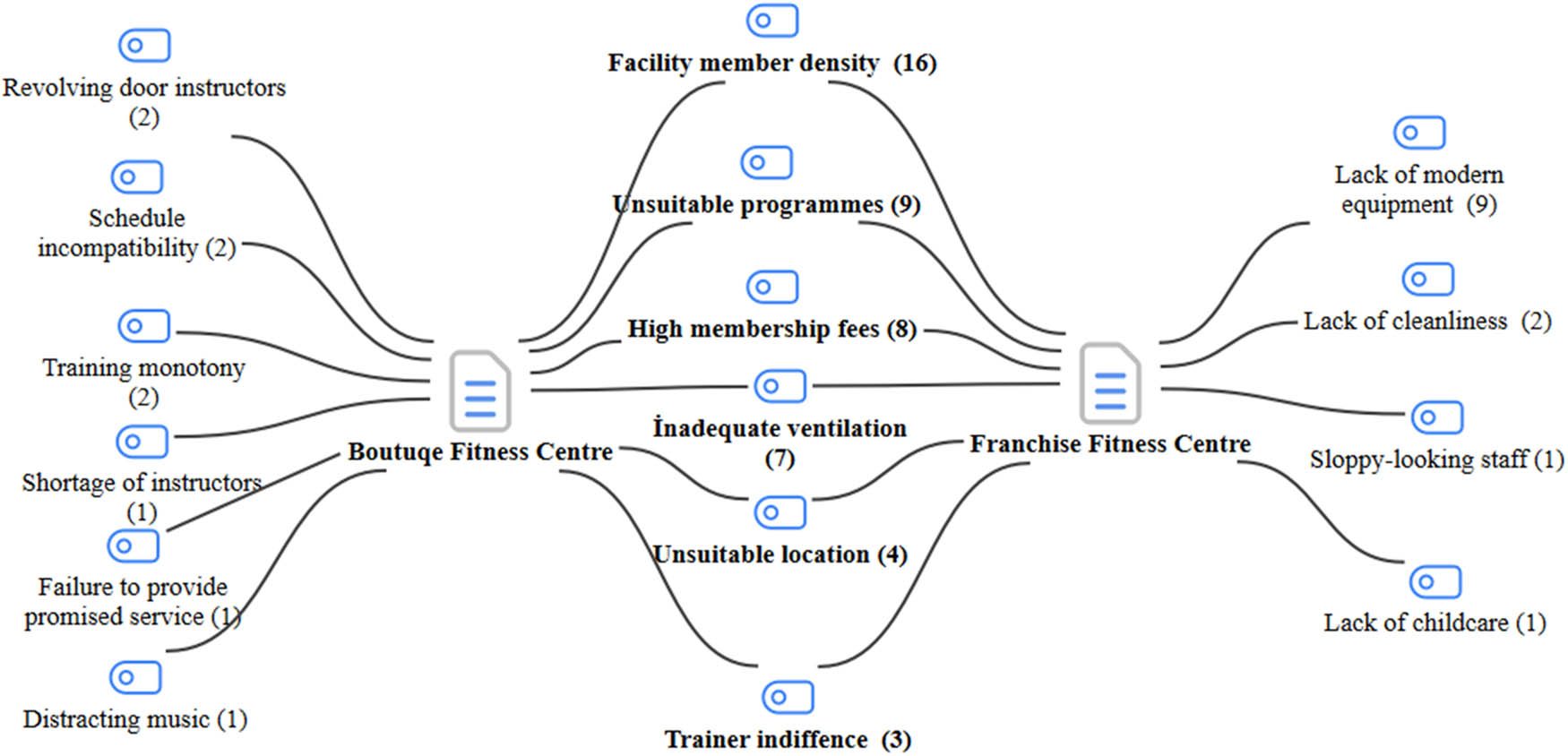
Figure 1
Reasons for membership termination in franchise and boutique fitness centre business models-two case models.
Source: Author’s contribution.
Common reasons for membership termination in both franchise and boutique fitness centres include high member density, unsuitable training programmes, elevated membership fees, inadequate ventilation, inconvenient location, and perceived indifference from trainers. However, some factors appear to be specific to boutique fitness centres, such as high instructor turnover, schedule incompatibility, training monotony, a shortage of instructors, failure to deliver promised services, and distracting music. In contrast, factors that more distinctly characterise membership termination in franchise fitness centres include the lack of modern equipment, poor cleanliness standards, unprofessional staff appearance, and the absence of childcare services.
The following section presents illustrative quotations on the reasons for membership termination in both franchise and boutique fitness business models, along with their corresponding codes, frequencies, and percentages (Table 3).
Table 3
Number and percentage of membership termination codes.
| Common reasons for terminating franchise and boutique fitness centre memberships | ||
| Sub-themes | Number of codes | Percentage |
| Facility member density | 16 | 23.19 |
| Unsuitable programmes | 9 | 13.04 |
| High membership fees | 8 | 11.59 |
| Inadequate ventilation | 7 | 10.14 |
| Unsuitable location | 4 | 5.8 |
| Trainer indifference | 3 | 4.35 |
| Reasons for terminating membership that differentiate franchise fitness centres | ||
| Sub-themes | Number of codes | Percentage |
| Lack of modern equipment | 9 | 13.04 |
| Lack of cleanliness | 2 | 2.9 |
| Lack of childcare | 1 | 1.45 |
| Sloppy-looking staff | 1 | 1.45 |
| Reasons for terminating membership that differentiate boutique fitness centres | ||
| Sub-themes | Number of codes | Percentage |
| Revolving door instructors | 2 | 2.9 |
| Schedule incompatibility | 2 | 2.9 |
| Training monotony | 2 | 2.9 |
| Shortage of instructors | 1 | 1.45 |
| Failure to provide promised service | 1 | 1.45 |
| Distracting music | 1 | 1.45 |
| Total | 69 | 100 |
Source: Author’s contribution.
As seen in Table 4, the interviewees cited sub-themes such as ‘facility member density’, ‘inappropriate and inadequate programmes’, ‘high membership fees’, ‘inadequate ventilation’, ‘inappropriate location’, and ‘trainer indifference’ as reasons for terminating their membership, in order of frequency.
Table 4
Reasons for terminating membership, excerpts.
| Common reasons for terminating franchise and boutique fitness centre memberships | |
| Sub-themes | Codes |
| Facility member density | “…So many people shouldn’t come at certain times”. The excessive crowd made me switch to a different gym (P14) |
| Unsuitable programmes | “The lack of programmes suited to my sporting goals made me switch gyms” (P10) |
| High membership fees | “It started to become too expensive for my monthly budget, so I switched to another fitness centre” (P15) |
| Inadequate ventilation | It was very stuffy; more ventilation was needed. This is why I switched to a different fitness business” (P5) |
| Location unsuitability | “I switched to another one that was more convenient for me in terms of proximity” (P20) |
| Trainer indifference | “The fitness centre, especially the trainers, were very uninterested. They did not engage with us to help us achieve our fitness goals. This is why I left the fitness centre” (P15) |
| Common reasons for terminating franchise fitness centre membership | |
| Sub-themes | Codes |
| Lack of modern equipment | “There is no modern or varied equipment. Faulty equipment is not repaired in a timely manner. This lack of interest led me to terminate my membership” (P5) |
| Lack of cleanliness | “The aspect I criticised the most was the cleanliness, which is why I left” (P18) |
| Lack of childcare | “Although I initially signed up, the lack of services such as childcare led me to cancel my membership” (P9) |
| Sloppy-looking staff | “Careless, uninformed, and unkempt staff were the reason I left the fitness centre” (P6) |
| Common reasons for terminating boutique fitness centre membership | |
| Sub-themes | Codes |
| Revolving door instructors | “The Pilates instructor left and started their own business. The remaining activities at the gym (other activities) were not beneficial for me so I terminated my membership” (P16) |
| Schedule incompatibility | “The reduction in group programmes, and the schedule no longer aligning with mine” (P6) |
| Training monotony | “The reason I left the gym was because I was bored and there were no varied training suggestions” (P18) |
| Shortage of instructors | “I cannot find enough trainers during training sessions. Most of the time, there are none. This was the reason I cancelled my membership at the previous fitness centre” (P21) |
| Failure to provide promised service | “Businesses often fail to deliver many of the services stated in the contract. I therefore terminated my membership at the fitness centre for this reason” (P10) |
| Distracting music | ”. they played very loud and unpleasant music while doing Pilates. This became disturbing for me. I terminated my membership” (P2) |
Source: Author’s contribution.
4. Discussion
This study was conducted to determine the reasons for membership termination in franchise and boutique fitness centre business models. Although franchise (standardisation and reliability) and boutique fitness centres (personalisation/individualisation) offer different service promises, they share common reasons for membership termination. The common reasons for membership termination in franchise and boutique fitness centres were identified as facility member density, unsuitable programmes, high membership fees, inadequate ventilation, unsuitable location, and trainer indifference. Members of franchise and boutique fitness centres most frequently cited “facility member density” as a reason for terminating their membership. A review of the relevant literature reveals that as member density increases, positive perceptions of the fitness business systematically decrease (Zehrer & Raich, 2016). In their study, Ong and Yap (2017) suggest that high customer density can cause discomfort and hinder customer movement. In this context, it is likely that the membership density at the facility triggers the behaviour of terminating membership. Addolorato and Gimeno (2025), in their study conducted on boutique fitness centres, identified membership density as a reason for terminating membership. This study is consistent with our findings. “Unsuitable programmes” have been specified as a significant reason for terminating fitness memberships in both business models. Fitness members expect up-to-date, enjoyable programmes that allow them to achieve their fitness goals. Unsuitable programmes create a mismatch between expectations and reality. Therefore, termination of membership may be possible. In their study, Larson et al. (2018) identified unsuitable programmes as a reason for leaving a fitness centre. This research is consistent with the findings of the present study. “High membership fees” were referred to as the third major reason for fitness membership termination in both business models. This finding is consistent with previous studies indicating that price is a decisive factor in membership decisions (Rust et al., 2000; Sevilmiş et al., 2023a). Every fitness member has a maximum amount they are willing to pay. Failure to provide value for the membership fee paid is likely to result in the member terminating their membership. It has been demonstrated on numerous occasions that the membership fee is a significant factor in the termination of fitness memberships (Ratola et al., 2025; Zarotis et al., 2017). “Inadequate ventilation” was referenced as the fourth most significant reason for terminating fitness memberships in both business models. Inadequate or unsuitable ventilation, particularly during peak usage times, makes the environment uncomfortable and may lead users to cancel their memberships. Inadequate ventilation can make it difficult to provide services and may pose health risks. Previous research has shown that factors such as ventilation are significant contributors to the perception of service quality and negative evaluations of the workplace atmosphere (Brady & Cronin, 2001). “An unsuitable location” has been mentioned as the fifth most significant reason for termination of fitness membership in both business models. Members want the fitness centre or gym to be in a convenient location for them. Non-financial trade-offs, such as transport difficulties, time spent in traffic and parking problems, have a negative impact on members’ perceptions (Patrick et al. 2022). Generally, members are willing to travel a distance of 12–15 min. Previous research has identified an unsuitable location as a significant reason for cancelling a membership (Ratola et al., 2025). This research supports our study. Finally, “trainer indifference” has been documented as a significant reason for the termination of fitness memberships in both business models. Trainer interest, expertise (Yıldız et al., 2021), professional service offering, perceived benefits (Dagger & Sweeney, 2007), and emotional bonds are important for long-term member retention (Venetis & Ghauri, 2004). Members who are not shown interest during training sessions are particularly unable to achieve their sporting goals. This, in turn, negatively affects members’ perceptions of the business.
In fitness centres operating under a franchise business model, lack of modern equipment, lack of cleanliness, sloppy-looking staff, and lack of childcare have been identified as decisive reasons for termination. The literature indicates that facility quality, equipment variety and accessibility, and worn, damaged, or poorly maintained equipment increase dissatisfaction (Macintosh & Doherty, 2007; Ratola et al., 2025). Similarly, lack of cleanliness (Brady & Cronin, 2001), inadequate hygiene conditions, and odour issues reduce the desire to return (Dagger & Sweeney, 2007; Macintosh & Doherty, 2007; Ratola et al., 2025). Moreover, the appearance, attitude, and behaviour of staff, their interest, reliability, politeness, helpfulness, and being positive and energetic are always important to customers (Patrick et al., 2022; Dagger & Sweeney, 2007; Ferrand et al., 2010; Macintosh & Doherty, 2007). These findings support the research results. Contrary to the research results, it has been stated that childcare services are not significantly related to the intention to leave (Macintosh & Doherty, 2007). However, childcare services or children’s play areas may be advantageous for customers who are parents and are unable to exercise for various reasons (such as family and care, work, and school) (Kosma & Buchanan, 2018). Based on the research findings, businesses offering services with the Franchise fitness business model should intervene before problems arise with equipment/facilities to eliminate reasons for membership termination, remove outdated and worn-out machines, and follow current equipment trends (such as digital tracking and smart screens). Regular and continuous checks should be carried out at specific intervals to ensure that equipment, common areas, showers, and changing rooms are kept clean. Staff professionalism and sense of responsibility should be in line with the business’s identity, and special activities and children’s play areas should be designed for families with children.
In boutique fitness centres operating under the boutique fitness business model, factors such as schedule incompatibility, training monotony, shortage of instructors, failure to provide promised service, and disruptive music have been identified as key reasons for termination. Customer participation is a determining factor in the delivery of fitness centre services. Customers may struggle to utilise the service due to time constraints (Tross et al., 2024) or because the programme schedules offered do not align with their lifestyle (Glaveli et al., 2023). Furthermore, repetitive training routines that are not sufficiently original, creative, or engaging can lead to low motivation levels (Venetis & Ghauri, 2004; Ratola et al., 2025). What is more, insufficient staff numbers or trainers who are not suited to the member density (Macintosh & Doherty, 2007) can cause customers to perceive the service quality negatively (Yıldız et al., 2021). Customers join fitness centres based on trust (Macintosh & Doherty, 2007) and expect the promises made to them to be fulfilled (Ferrand et al., 2010). Furthermore, music played through a single speaker, which affects performance and mood during exercise (Karageorghis et al., 2012), may not be preferred by all customers and may be perceived as annoying (Ballmann et al., 2021). These findings support the research results. Based on the research findings, businesses offering services with a boutique fitness business model should keep their current trainers’ expertise up to date, organise training and innovation-oriented programmes, and create checklists to continuously monitor environmental conditions (music, cleanliness). Before making a promise to the customer, it should be assessed whether it can be operationally fulfilled. Flexible and compensable programmes should be created for customers experiencing time incompatibility.
5. Conclusions
In conclusion, this study not only contributes to the existing literature but also provides valuable practical insights for managers of both franchise and boutique fitness centres. By identifying both common and business model–specific reasons for membership termination, managers can implement targeted strategies to mitigate dissatisfaction and improve member retention. The findings highlight that particular attention should be given to shared factors driving membership cancellation, including high member density, unsuitable training programmes, elevated membership fees, inadequate ventilation, inconvenient location, and perceived trainer indifference. These factors are consistent with those identified in previous research, such as Addolorato and Gimeno (2025), Macintosh and Law (2015), Ratola et al. (2025), Sairu (2024), Zarotis (2018), and Zarotis et al. (2017). Moreover, this study distinguishes between the specific drivers of membership termination across the two business models. In boutique fitness centres, factors such as high instructor turnover, schedule incompatibility, training monotony, instructor shortages, failure to deliver promised services, and distracting music are particularly salient. In contrast, in franchise fitness centres, key issues include the lack of modern equipment, poor cleanliness, unprofessional staff appearance, and the absence of childcare services. The findings suggest that fitness centre managers can reduce membership termination rates by addressing both shared service deficiencies and those specific to their business model. By doing so, they can enhance service quality, improve the customer experience, and strengthen member retention.
5.1. Limitations and Future Research
This study has certain limitations. The research identifies the reasons for membership termination in franchise and boutique fitness business models. In this study, the reasons for membership termination were examined within the context of the business model. The reasons for membership termination may vary according to factors such as gender, age, and gym preferences (Yi et al., 2021). Future research could explore demographic differences in membership termination. Furthermore, the data for this study were collected in January 2026 in Spain. Consequently, variables that could influence membership termination, such as seasonality, were not taken into account. Therefore, seasonal variables such as summer and winter could be included in future studies. Age imbalances among members in this study may have influenced the results. Consequently, future studies could be conducted using a balanced sample that accounts for variables such as age.
Membership termination may vary depending on the service structure, customer profile, and expectations of the business model. Therefore, the generalisability of the results is limited. The study explains membership experiences based on customer data, but customers’ attitudes, behaviours, and thoughts may change over time. This may limit the temporal validity of the findings. Future research could broaden the scope by including different fitness business models and increasing sample diversity, thereby strengthening the generalisability of the findings. Furthermore, unlike this study, membership termination among customers who have developed loyalty can be analysed using longitudinal studies. This would enable a clearer identification of the reasons for separation among participants who have developed customer loyalty. Although the findings of this study provide a solid foundation for future research, the lack of research on “franchise” and “boutique” fitness business models has limited the ability to make more robust comparisons. It is therefore clear that further research is needed in the sector to enable a comparison of business models in the fitness industry.
Acknowledgments
We appreciate the anonymous participation of fitness centers in this study.
Author contribution
İlknur Özdemir Çelik: acquisition of data, analysis and interpretation of data, manuscript preparation; Ali Sevilmis: conception and design of the study, analysis and interpretation of data; Jerónimo García-Fernández: conception and design of the study, manuscript preparation; Ainara Bernal-García: acquisition of data, analysis and interpretation of data.
Conflict of interests
Not competing interests.
Funding information
Not funding.
Ethics approval and informed consent
Ethical approval was obtained from the local university (protocol code: 3-03-2026-58).