
1. Introduction
Although awareness of bullying has increased significantly in recent years, bullying remains a major problem in schools. Bullying is defined as repeated and deliberate aggression by a more powerful individual or a group against a less powerful victim (Shetgiri, 2013). It is known that 1 in 10 school-age children in Europe are exposed to and affected by bullying (Inchley et al., 2020). Although there are few studies on the prevalence of bullying in Hungary, the results indicate that 11.6–32.65% of the students are victimized by bullying (Hosozawa et al., 2021; Johansson et al., 2022; Kisfalusi, 2018; Várnai et al., 2022). It is well known that bullying victimization is more frequent in Hungary than other regions in Europe (Hosozawa et al., 2021). Therefore, bullying continuous to be a significant problem in Hungary and many other countries, affecting a large number of children.
Despite this overall picture, when considered on a subject-by-subject basis, it is seen that bullying is not equally observed due to the contextual conditions of each subject and has a greater potential for occurrence in some courses. Bullying incidents in physical education (PE) classrooms were reported at 34.8%, compared to 10.6% in a typical school setting (Killion et al., 2020). This difference occurs due to many reasons such as competition dynamics in the course, large class areas, crowded classes, less teacher supervision, physical appearance, body perception, or skills ability. For this reason, bullying incidents are more common in PE classes than in other classes (Kokkonen et al., 2024; Wei & Graber, 2023). Studies show that bullying occurs more in locker rooms, gyms, playgrounds, and hallways (Olweus et al., 2019; Shetgiri, 2013). Although it is known that being exposed to bullying has serious effects on well-being, risk behaviors, and mental and general health (Husky et al., 2022; Inchley et al., 2020), bullying incidents occurring specifically in PE classrooms also negatively influence students’ performance, enjoyment, physical activity, and class participation (Uğraş et al., 2025; Wei & Graber, 2023; Williamson & Sandford, 2018). Although PE encourages physical activity, if left unaddressed, the dynamics of the class can create an ideal setting for peer bullying (Jiménez-Barbero et al., 2020; Sağin et al., 2022).
In this regard, teachers’ reactions, behaviors, attitudes, and solutions are key factors in the continuation or cessation of bullying. Teachers can use various strategies to cope with bullying situations when they encounter, such as intervening, observing the situation, not intervening, ignoring, and belittling the bullying (Rigby, 2014, 2020). Studies indicate that they often employ punitive actions or control-oriented disciplinary procedures extensively against perpetrators (Bauman et al., 2021; Burger et al., 2015; Duy, 2013; Rigby, 2020). A large number of studies revealed that teachers tend to use “authority-based” strategies as their first intervention strategy and then tend to use “working with the bully” or “involving others” strategies (Burger et al., 2015; Kollerová et al., 2021; Sairanen & Pfeffer, 2011; Strohmeier et al., 2021). Considering these patterns, focusing on teacher education before entering the profession is an essential step for future practices.
To provide a general framework for teacher candidates (TCs), previous studies have shown that TCs tend to talk to the bully or the victim, preferring active and direct strategies such as comforting, affirming, or encouraging the victim (Dawes & Lohrbach, 2025; Mahon et al., 2023; Psalti, 2017). However, they are less likely to prefer collaborative tactics such as peer resolution or classroom discussions (Psalti, 2017). In this context, a study by Mahon et al. (2023) that has a critical importance shows that TCs feel very inadequate when it comes to talking to the bully and mainly prefer talking either to the bully or the victim as an intervention strategy. Nevertheless, the suggested content of these conversations may further harm the victim or create an environment that enables the continuation of bullying. Notably, coping strategies such as “fighting back,” “ignoring,” or “try to be friend” are frequently recommended to the victim (Mahon et al., 2023). Another study has shown that some TC may choose not to intervene at all or adopt less active strategies (Dawes & Lohrbach, 2025). Therefore, TC should not only strengthen their beliefs about bullying but also learn when, where, and which intervention strategies to use before graduating (Pečjak & Pirc, 2015).
1.1. The Present Study
Given these findings, research studies related to antibullying strategies and interventions, especially pertaining to PE settings, remain limited particularly among physical education teacher candidates (PETCs) (Wei & Graber, 2023). PETCs often mirror the teaching styles and approaches they experienced as students, emphasizing the necessity of teacher preparation in reshaping such tendencies (Temiz & Soós, 2025; Wei & Graber, 2024). The availability of a validated instrument tool in PE is important to guide PETCs toward active strategies or identifying ineffective approaches in advance to support the acquisition of these competencies before starting the profession. Handling Bullying Questionnaire (HBQ; Bauman et al., 2008) that is based on the hypothetical bullying scenario that includes coping strategies that teachers can use when dealing with bullying continues to be widely used instrument in the literature and validated in many different cultures (Burger et al., 2015; Kollerová et al., 2021; Rigby, 2014; Sairanen & Pfeffer, 2011; Strohmeier et al., 2021). This questionnaire consists of five subscales that include strategies that can be used: working with the bully, working with the victim, disciplining the bully, ignoring the incident, and enlisting other adults. The present study assumes originality through the application of HBQ scale to TC, more specifically to PETC. Furthermore, with this study, it was applied for the first time in a Hungarian-speaking context. Based on this gap in the literature, given no study validating the Hungarian version of the questionnaire developed by Bauman et al., (2008), this study aimed (1) to translate and adapt the scale to Hungarian, determine its factor structure, and test its validity on a sample of PETCs and (2) to test the questionnaire originally developed for teachers that demonstrates similar validity and consistency of the previous findings.
2. Materials and Methods
2.1. Participants
The study consists of n = 170 PETCs studying in third, fourth and fifth years at a major sport university in Budapest during 2024–2025 academic year. Participants were included in the research using the purposeful sampling to reach PETCs with sufficient pedagogical awareness and a certain level of classroom and practical experience. A total of 51.80% participants (n = 88) were female and 48.20% (n = 82) were male. Their age ranged between 20 and 30 years (mean = 22.32, SD = 1.29). In terms of year of study, 35.30% (n = 60) was in their third year, 25.30% (n = 43) in their fourth year, and 39.40% (n = 67) in their fifth year of the education program. Their grade point average (GPA) from the previous completed term ranged between 3.22 and 5.00 (MGPA = 4.33, SD = .39). Regarding the teaching/coaching experience, 76.50% (n = 130) reported experience, while 23.50% (n = 40) reported no experience.
2.2. Sample Size Calculation
The sample size was determined using the G*Power 3.1.9.7 software. For two-way correlation analysis (parameters: medium effect size: r = 0.30, α = 0.05, 1 − β = 0.80), minimum 84 participants were included, and for one-way ANOVA (parameters: medium effect size f = 0.25, α = 0.05, 1 − β = 0.80, number of groups: 3), 159 participants were included. Accordingly, a sample of 170 people is considered sufficient for the reliability and validity of all analyses.
2.3. Procedures
The studies ethical clearance was obtained by the ethics committee of Hungarian University of Sports Science reference code MTSE-KEB/No09/2025. Participants were contacted collaboration with department members at the university. The researcher introduces the study in person and administered the survey face to face with Google Forms and in a paper format to unsure accessibility. The questionnaire was completed by PETCs approximately in 15 min. No incentives were given; participation was voluntary and anonymous. Each participant provided informed consent. Data were collected over 2-week period. Responses were temporarily stored in an encrypted cloud account created solely for this study and accessible only to the research team. Prior data analysis collected data transferred to password protected computer under the first authors supervision to ensure data security and confidentiality. The original questionnaire was translated into Hungarian following using the well-known translation/back-translation and expert review method (Cha et al., 2007). Initial-back translations and comparisons were independently carried out by separate pair of professors who are bilingual in both languages. A third bilingual academic reviewed the final translated version. The adapted questionnaire was piloted with a small group to ensure linguistic and contextual clarity. Following the pilot study, reliability and validity processes were initiated.
2.4. Measures
2.4.1. HBQ
The questionnaire originally developed by Bauman et al. (2008), which assess teachers’ self-reported strategies for handling bullying through 22 items under 5 subscales after an imaginary bullying scenario: enlisting other adults (“I would discuss the matter with my colleagues at school”, 5 items, α = 0.67), working with bully (“I would help the bully achieve greater self-esteem so that he or she would no longer want to bully anyone”, 5 items, α = 0.72), disciplining the bully (“I would make it clear to the bully that his or her behaviour would not be tolerated”, 3 items, α = 0.52), working with victim (“I would tell the victim to stand up to the bully”, 4 items, α = 0.78), and ignoring the incident (“I would leave it for someone else to sort out.”, 5 items, α = 0.73) as reported in the original study. Each item is rated on a 5-point Likert scale ranging from 1, “I definitely would not,” to 5, “I definitely would.” A mean score for each given strategy subscale was calculated by summing the item scores and dividing by the number of items. For each subscale, higher scores reflect likelihood of usage on particular strategy. In our study in addition to HBQ, participants were asked to provide age, gender, teaching/working experience, year of study, and GPA.
2.4.2. Data Analysis
All analysis were carried out using IBM SPSS 29.00 and IBM SPSS AMOS 26. First, descriptive analysis (percentage, mean, SD), missing values, outliers, and normality checks were performed for data set preparation. Normality assumptions were tested through Skewness and Kurtosis values according to −2 and + 2 acceptable limits stated by several authors (Huck, 2014; Tavakol & Wetzel, 2020). Potential outliers were examined using the box plot analysis. Outliers were sorted according to their distance from the median and removed from the data set step by step, starting from the furthest point. After each removed value, kurtosis and skewness values were recalculated and normality was checked. After removing the responses of nine participants, data met the normality assumption. After all these arrangements, reliability and validity analyses were conducted with 170 participants. The suitability of the data for EFA was tested by Kaiser–Meyer Olkin (KMO) analysis Bartlett’s test of sphericity. exploratory factor analysis (EFA), and confirmatory factor analysis (CFA) were conducted to examine the content validity and the factor structure of the questionnaire. Concurrent validity was examined by exploring the relationships among HBQ subdimensions and demographic variables (gender, year of study, GPA, and teaching experience). Pearson correlation, one-way ANOVA, and independent samples T-tests were used to examine relationships among variables. Pearson correlation coeffects interpreted as follows: “±0.1, small effect; ±0.3, medium effect; ±0.5, large effect” following Field et al. (2012, p. 212) guideline.
3. Results
The first objectives of the research were to determine the factor structure and to test the validity of Hungarian version of HBQ. Exploratory factor analysis was conducted to observe how the items in the scales were loaded onto the factors, and then the compatibility of the factors obtained using confirmatory factor analysis with the data of the study was examined. The sample of this study consists of PETCS, unlike the teachers in the original scale. Therefore, three different EFAs were tested to obtain a structure that overlaps with the theoretical framework of the scale and to determine the factor structure more accurately. Although sample was found to adequate for the analyses, the suitability for the factor analysis were verified with KMO and Bartlett’s test of sphericity. In the first stage of the EFA, the number of factors to retain was determined based on Kaiser criterion, which recommends retaining factors with Eigen values greater than 1.0 (Costello & Osborne, 2005). The principal components analysis is chosen as the extraction method of choice, while varimax for rotation of factors, which requires factors to be orthogonal or completely uncorrelated with each other (Costello & Osborne, 2005).
In the first analysis, in the proposed six-factor structure, communality values were above 0.500. KMO value was found to be 0.756, while the Bartlett test was significant (<0.001), and acceptable level to be evaluated in a factorial structure. It was determined that the data set was suitable for factor analysis (Hoelzle & Meyer, 2012; Lloret et al., 2017). Therefore, factor loadings above 0.300 were taken into consideration. The obtained factor explained 63.65% of the total variance. When the fit indices of the model were examined, it was acceptable at a limited level. Even though the original factor was generally preserved in this structure, some items are loaded on more than one different factor (HB4, HB10, HB9, HB5, HB12, HB21) or reverse loaded (HB7). This result shows there is a possibility that the items belonging to the “Ignoring the Incident” dimension in previous studies may load inversely under another dimension. Therefore, the proposed model was considered to be statistically and conceptually inadequate.
Considering the results of the first EFA and items potentially loaded into multiple factors and negative factor loadings, second EFA was conducted compressing the items into five factors. EFA analysis yielded best model fit in a five-factor model, which consisted previously reported studies (Burger et al., 2015; Shahzadi et al., 2019). In this model, a factor structure with an eigenvalue above 1 was obtained. KMO coefficient was 0.756, and Bartlett’s Test of Sphericity was significant (<0.001), indicating that the data set is adequate for factor analysis. These results largely overlap with the theoretical framework in the original scale, and it was observed that the majority of the factor loadings were distributed over 0.300. As stated by Zeller (2005), communalities of 0.250, 0.275, and 0.300 are considered common minimum acceptable values for an analysis. A factor loading of more than 0.300 indicates a moderate correlation between the item and the factor (Tavakol & Wetzel, 2020). In this study, considering the sample size and the results of the original development study, communalities above 0.300 were included in the principal component analysis. It was observed that some items in the “Ignoring the Incident” dimension loaded negatively. Therefore, when this dimension was compared with other subscales, the question arose as to whether this subdimension represented a separate structure or whether it was the opposite of the other subscales. Therefore, it is suggested that the structural and conceptual structure of this dimension should be reviewed for future studies.
Following the EFA results, confirmatory factor analysis was performed in IBM SPSS AMOS using maximum likelihood estimation. The first-order multifactor confirmatory factor analysis model was chosen to apply in this study. This model is used when observed items in a scale are collected under more than one factor, by gathering the items whose common variances are similar to each other underneath the same factor (Whitaker & Dahling, 2013). Chi-square/df value, as it is the oldest and most widely used to determine the general fit of the model in research studies (Hooper et al., 2008; Steiger, 2007), was taken into consideration to decide whether the model tested can be supported by data. Besides the chi-square/df value CFI and RMSEA goodness of fit, Cronbach’s values were also provided in Table 1.
Table 1
Summary of EFA and CFA findings.
| Extraction | Factor 1 | Factor 2 | Factor 3 | Factor 4 | Factor 5 | ||
|---|---|---|---|---|---|---|---|
| Items | HB14 | 0.624 | 0.775 | ||||
| HB13 | 0.619 | 0.757 | |||||
| HB15 | 0.608 | 0.743 | |||||
| HB20 | 0.472 | 0.661 | |||||
| HB4 | 0.672 | 0.474 | 0.448 | 0.310 | −0.379 | ||
| HB12 | 0.697 | 0.799 | |||||
| HB9 | 0.679 | 0.723 | 0.364 | ||||
| HB19 | 0.507 | 0.613 | |||||
| HB5 | 0.464 | 0.567 | |||||
| HB21 | 0.544 | 0.508 | 0.441 | ||||
| HB1 | 0.657 | 0.802 | |||||
| HB7 | 0.587 | 0.320 | 0.679 | ||||
| HB3 | 0.633 | 0.643 | 0.345 | ||||
| HB17 | 0.624 | 0.745 | |||||
| HB11 | 0.653 | 0.314 | 0.706 | ||||
| HB6 | 0.572 | 0.644 | |||||
| HB22 | 0.455 | 0.638 | |||||
| HB10 | 0.604 | 0.729 | |||||
| HB8 | 0.642 | −0.386 | 0.664 | ||||
| HB18 | 0.648 | −0.478 | 0.585 | ||||
| HB2 | 0.400 | −0.304 | 0.535 | ||||
| HB16 | 0.580 | −0.418 | 0.345 | 0.436 | |||
| EFA | Total | 2.807 | 2.779 | 2.675 | 2.666 | 2.012 | |
| % of variance | 58.820 | 12.761 | 12.633 | 12.160 | 12.118 | 9.147 | |
| KMO | 0.756 | ||||||
| Bartlett’s test | χ 2 = 1306.364, p < 0.001 | ||||||
| CFA | Exact fit χ 2/df | 2.5 < 3 | |||||
| CFI | 0.724 | ||||||
| RMSEA | 0.096 | ||||||
| Reliability | Cronbach’s alpha | 0.750 | 0.727 | 0.697 | 0.732 | 0.692 | |
Source: Author’s contribution.
Examining the CFA results based on Table 1, the communality values were minimum 0.400, which is exceeds the acceptable threshold 0.300. The KMO was 0.756 > 0.700, which is adequate (Kaiser, 1974), and Bartlett’s test of sphericity (p < 0.001) was significant. Factor loadings above 0.300 were reflected in the table, and the total variance explained was 58.82%. Similar to the first EFA, the items were distributed in accordance with the original study. Items HB4, HB9, HB21, HB7, HB3, HB11, HB8, HB18, HB2, and HB16 showed the potential to load under more than one factor with different weights. When the factor loadings of these items for each factor were compared, it was decided to keep the item distribution since the meaning of each item and the highest factor loading value for each item belonged to the factor in the original distribution. HB2, as a reversed item, showed the potential to load on factor 1, HB4 on factor 4, and HB8, HB16, and HB18 on factor 3 with negative loading values. This finding raises questions about whether the items belonging to the “Ignoring the Incident” dimension should be placed as reversed items in another dimension in the scale. It prepares the ground for the necessity of re-evaluating the concept of “Ignoring the Incident” in future research. In summary, five-factor model showed an acceptable level of fit in terms of the chi-square test (χ 2/df < 3, p < 0.001), which is stated by many research studies in common (Schermelleh-Engel et al., 2003) (Figure 1). In addition, Cronbach’s alpha values calculated for the internal consistency of the scale dimensions were found greater than 0.600, which statistically acceptable (Hair et al., 2019).
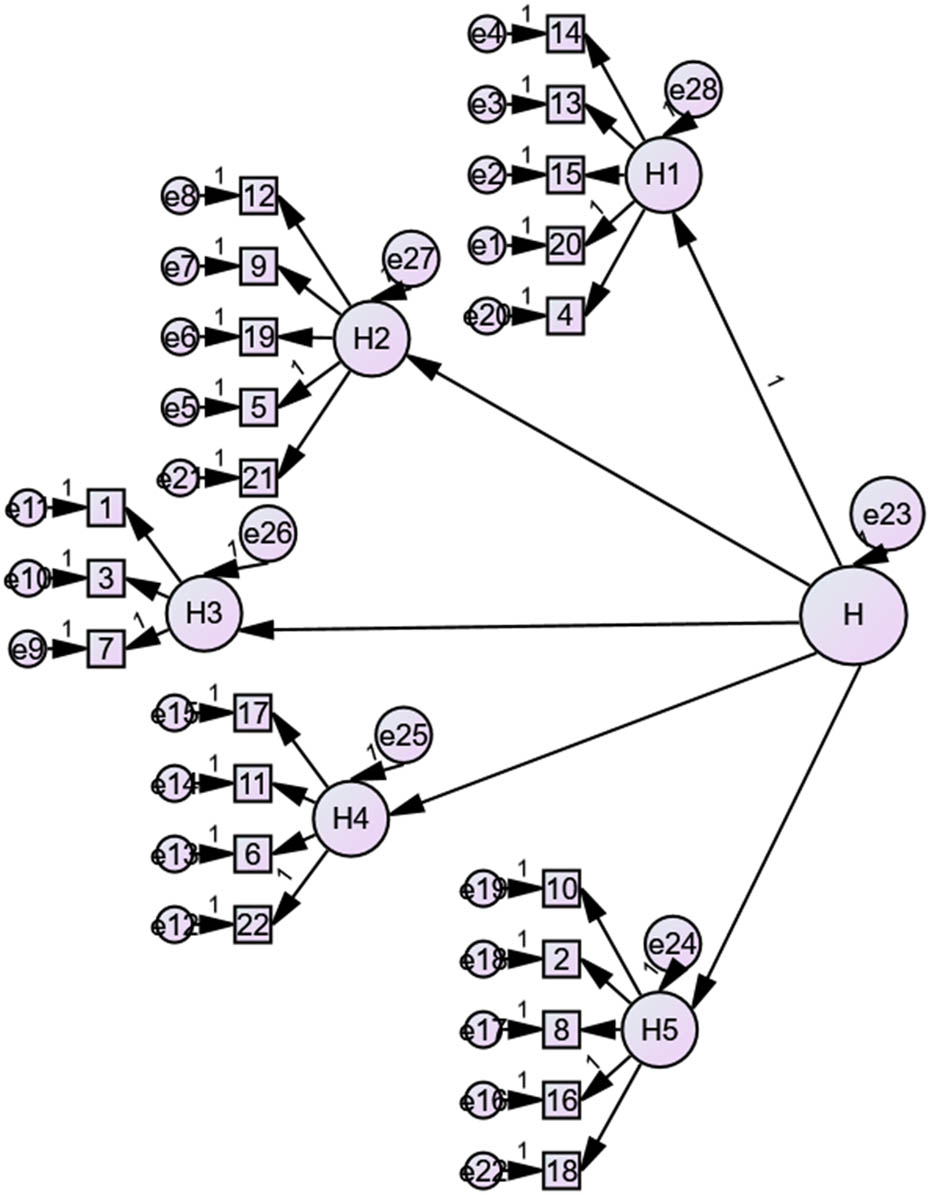
Figure 1
Five-dimensional CFA model.
Source: Author’s contribution.
The scores for each subdimension of the scale were calculated by taking the averages of the relevant items. According to the five-factor structure, the subitems were named as follows: factor 1 named as “Enlisting Other Adults,” factor 2 named as “Working with the Bully,” factor 3 named as “Disciplining the Bully,” factor 4 named as “Working with the Victim,” and factor 5 named as “Ignoring the Incident.” Before moving on to further analysis, the normality distributions of the subdimensions were checked again with skewness kurtosis. All dimensions were between + 1 and –1. This shows that the data are suitable for parametric tests. Then, Pearson correlation was applied to determine the relationships between the questionnaire’s dimensions, one-way ANOVA, and independent samples T-test were applied to determine the differences with demographic variables.
One of the objectives of the study was to assess the concurrent validity of hypothetical scenarios. As a primary analysis, descriptive statistics and Pearson correlation were applied on between study variables and scenarios (see Table 2). According to results, “Working with the Bully” dimension showed positive and significant medium correlation with the “Working with the Victim” (r (170) = 0.432, p < 0.001), a small correlation with “Enlisting Other Adults” (r (170) = 0.241, p < 0.001), and medium correlation with “Disciplining the Bully” (r (170) = 0.352, p < 0.001). Moreover, a significant negative but small correlation was found only in “Ignoring the Incident” (r (170) = −0.181, p < 0.05) dimension. Similarly, the “Working with the Victim” showed a small positive significant correlation with the “Disciplining the Bully” dimension (r = 0.196, p < 0.05), while no significant relationship was found with the other dimensions. In addition, the “Enlisting Other Adults” dimension showed a small positive correlation with the “Disciplining the Bully” dimension (r = 0.163, p < 0.05), while it showed a small negative significant relationship with the “Ignoring the Incident” dimension (r = −0.191, p < 0.05). Finally, the “Ignoring the Incident” dimension showed a medium negative correlation only with the “Disciplining the Bully” subdimension (r = −0.391, p < 0.01). The remaining relationships were not statistically significant.
Table 2
Inferential findings.
| M ± SD | 1 | 2 | 3 | 4 | 5 | 6 | ||
|---|---|---|---|---|---|---|---|---|
| 1. Working with the bully | r | 3.55 ± 0.67 | 1 | |||||
| 2. Working with the victim | r | 2.99 ± 0.81 | 0.432** | 1 | ||||
| 3. Enlisting other adults | r | 3.90 ± .69 | 0.241** | 0.065 | 1 | |||
| 4. Ignoring the incident | r | 1.76 ± 0.55 | −0.181* | 0.117 | −0.191* | 1 | ||
| 5. Disciplining the bully | r | 4.38 ± 0.56 | 0.352** | 0.196* | 0.163* | 0.394** | 1 | |
| 6. Age | r | 22.32 ± 1.29 | 0.223** | 0.221** | −0.229** | 0.065 | 0.087 | 1 |
| 7. GPA | r | 4.33 ± 0.39 | −0.023 | 0.057 | 0.087 | −0.076 | −0.025 | 0.242** |
| 8. Gender | t | 1.48 ± 0.50 | 0.461 | −2.406* | 2.581* | −2.385* | 0.782 | |
| 9. Teaching experience | t | 1.24 ± 0.43 | 0.689 | −0.312 | 0.212 | −0.460 | 0.525 | |
| 10. Year of study | F | 2.04 ± 0.87 | 0.892 | 3.710* | 7.859** | 0.041 | 4.375* |
*p < 0.05, **p < 0.01, M = mean, SD = standard deviation; Gender: female = 1, male = 2; Teaching Experience: 1 = yes, 2 = no; Year of study: 1 = third year, 2 = fourth year, 3 = fifth year.
Source: Author’s contribution.
When the subscales were examined, according to age, a positive but small effect correlation was found in the dimensions “Working with the Bully” (r = 0.223, p < 0.01) and “Working with the Victim” (r = 0.221, p < 0.01), while a negative correlation was found in the dimension “Enlisting Other Adults” (r = −0.229, p < 0.01). When gender differences are examined, it is seen that male candidates scored higher than female candidates in the “Ignoring the Incident” subscale (t = −2.385, p < 0.05) and in the “Working with the Victim” subscale (t = −2.406, p < 0.05). On the other hand, it is seen that female candidates tend to use the “Enlisting Other Adults” strategy more than male candidates (t = 2.581, p < 0.05). According to the year of study, significant results were obtained in three different subscales: “Working with the Victim” (F = 3.710, p < 0.05), “Enlisting other Adults” (F = 7.859, p < 0.01) and “Disciplining the Bully” (F = 4.375, p < 0.05). In addition, no statistically significant relationship or difference was found between the scale subdimensions of teaching experience and academic GPA (p > 0.05).
4. Discussion
The aim of this study was to establish the validity and reliability of the HBQ in Hungarian. Although the fact that the sample of participants was limited to a large sports university in Hungary creates limitations in terms of generalizability, the results provided a valid and reliable measurement tool in determining the strategies of coping with bullying that PETCs will use in the future. Unlike similar studies, original scale has been tested in various cultural contexts, and up to our knowledge, no prior studies have found in adaptation or validation in the Hungarian context especially in PETCs. Furthermore, the questionnaire was developed for teachers, and the aim of this study was to determine the future reactions of PETC. Teacher training or training on bullying in particular will provide solid data on how PETCs will shape their coping strategies. Therefore, the present study aims to fill the gap in the current literature.
For the structural validities of the questionnaire, EFA and CFA analyses were applied, and internal consistency Cronbach alpha coefficients were calculated to conduct validity and reliability analysis. Adapting the original scale with a different sample group necessitated retesting the factor structure. In this context, more than one EFA model was examined. Initially, a six-factor EFA model was examined based on the eigenvalue criterion; however, this structure was deemed unsuitable due to some items loading onto multiple factors and not aligning with the theoretical framework. For this reason, a five-factor model has been implemented. This structure consisting of 22 items and 5 factors has shown theoretical dimensional consistency, supporting its structural validity. It was determined that the most appropriate and balanced model for the theoretical integrity of the model was the five-factor structure in statistical terms. According to these results, the questionnaire explains 58.820% of the total variance. CFA results indicate that model fit indices of the five-factor model are at an acceptable level based on the (Schermelleh-Engel et al., 2003) criteria (χ 2/df = 2.5, RMSE = 0.096, CFI = 0.724). KMO measure of sampling adequacy was 0.759, indicating satisfactory sample size for factor analysis. Barlett’s test of sphericity was statistically significant (p < 0.001), confirming the suitability of the data for structure detection. Internal reliability varies between minimum α = 0.692 and maximum of α = 0.750. This structure largely overlaps with the theoretical model of the original scale. These findings supported the construct validity of the scale for the sample of PETC. In line with several studies on the validity and reliability of the HBQ among teachers, the results of this study demonstrate similar findings by upholding the five-factor structure of the HBQ (Burger et al., 2015; Sairanen & Pfeffer, 2011; Strohmeier et al., 2021). The internal consistency and total variance explained in the present study (α = 0.692–0.750, 58.82%) are comparable to the findings from Estonia (α = 0.55–0.69, 51.5%), America (α = 0.52–0.78, 49.47%), Pakistan (α = 0.50–0.72, 51.7%), and Germany (α = 0.48–0.67) (Burger et al., 2015; Grumm & Hein, 2013; Kollerová et al., 2021; Power–Elliott & Harris, 2012; Rigby, 2014; Sairanen & Pfeffer, 2011; Strohmeier et al., 2021; Yoon et al., 2011). Compared to similar studies conducted with teachers in the literature, this study presented higher internal consistency coefficients and total explained variance values. While the total variance in other cross-cultural studies ranged from 49 to 52%, whereas in this present study, it was slightly higher (58.8%) than that in previous studies. It can be said that factor structure of the HBQ remained stable in the Hungarian PETC sample. In addition to total variance, “Disiplining the Bully” dimension showed a slightly higher alpha value in this study, and its reliability remained relatively low, which is consistent with the previous studies and likely due to the limited number of items included. Overall, the results are in line with the previous research and confirming that the general pattern remain similar across different cultural settings and countries. However, in the study by Kollerová et al. (2021), “Ignoring the Incident” subscale was removed, and a four-factor model consisting of 16 items and including only active strategies was accepted. This model, which is different from the original, explained 50% of the total variance. In addition, some studies have reported a two-factor solution (Grumm & Hein, 2013; Yoon et al., 2011). The reason for the different results is due to different cultural structures. An important note from the study “Ignoring the Incident” dimension has the potential to load negatively on the “Disciplining the Bully” dimension in five- and six-factor EFA. As stated in the studies by Bauman et al. (2021) and Burger et al. (2015), it is confirmed that some psychometric properties are weak, and changes are needed. This situation indicates that these dimensions need to be conceptually reevaluated.
In this study, in addition to the validity and reliability of the questionnaire, some demographic variables were examined to determine the distinctiveness of the scale subscales and to contribute to the construct validity. Pearson correlation analysis was applied to the relationships between the subscales of the questionnaire and showed that “Working with the Bully” was positively and significantly correlated with the “Working with the Victim,” “Enlisting Other Adults,” and “Disciplining the Bully,” and was negatively and significantly correlated with the “Ignoring the Incident.” The subscale “Working with the Victim” was positively correlated with “Disciplining the Bully” but did not show a significant relationship with the other subscales. On the other hand, “Enlisting Other Adults” was positively correlated with “Disciplining the Bully” but negatively correlated with “Ignoring the Incident.” In contrast, “Ignoring the Incident” showed a negative relationship only with “Disciplining the Bully.”
The results of the study indicate that gender and year of study may be effective in the coping strategies that PETC can use. Similarly, the significant differences obtained at the study year showed that these strategies can be changed with the teaching process. The fact that the age variable has a significant relationship with many subscales indicates that PETCs tend to choose more active and individual intervention strategies as they get older. In particular, the fact that PETCS gained more experience due to their professional development may have pushed them to take on more personal responsibility. This shows that the questionnaire reflects pedagogical development and gives results consistent with other demographic variables. The results demonstrate the questionnaire’s sensitivity to intergroup differences confirming its discriminant validity.
5. Limitations and Future Research
This study has some strengths and weaknesses. In contrast to the original questionnaire, this study’s sample consisted of TC specifically PETC. This situation necessitates that the results to be obtained be evaluated only in the context of PETCs. Since data include strategies that can be used to hypothetical bullying scenario, even though it provides as impression of the current state of candidates, it may not be the direct reactions that they would apply in real situation. Therefore, future studies can be designed to follow these changes over a longer period of time. Since it has been determined that age and class factors have an effect on strategies against bullying, it is recommended that future studies conduct longitudinal studies to monitor developmental changes. In addition, different interdisciplinary studies can be conducted to examine the effect of different education curricula on formation of the strategies against bullying.
6. Conclusion
Future teachers will one day be the first support mechanism that bullying victims will turn to. It should not be forgotten that teachers’ reactions are the key factors for preventing or reoccurring of the bullying incidents. Therefore, it is important for TCs to be equipped with appropriate coping skills. The validation results reveal that the HBQ demonstrates adequate validity and reliability within Hungarian-speaking PETCs. Despite being applied to PETC sample, differently from the original, the five-factor structure and reliability results are closely aligned with the previously reported validity studies conducted in other countries. Taken together, the study confirms that HBQ is a psychometrically valid and reliable tool in the Hungarian context. The results give us hope for future teachers as PETCs are unlikely to ignore bullying and tend to use more active strategies such as seeking help from other or working with the bully. However, the fact that PETC predominantly tend to an authority-based strategy such as discipline the bully may stem from their lack of confidence in intervening in the situation. For this reason, it is suggested to make improvement to increase self-efficacy, awareness from the first day of the teaching programme. This study is expected to be an important resource for evaluating, developing, and monitoring PETC intervention strategies against bullying and will also shed light on future research focusing on TC.
Acknowledgments
We would like to thank the Csordás Makszin Ágnes, Boronyai Zoltán and Berki Tamás László for their help during data collection.
Funding information
Open access funding provided by Hungarian University of Sport Sciences. Research supported by the “Sports culture and sports family: prevention and safeguarding of children, youth and professional staff members in sports. Victimisation and its social, organizational, and individual risk factors in Hungary” from National Research Development and Innovation Fund in Hungary with project no: TKP2021-NKTA-55. The funders had no role in study design, data collection and analysis, decision to publish, or preparation of the manuscript.
Author contributions
Ceren Nur Temiz: conception and design of the study, acquisition of data, manuscript preparation. Kübra Ersoy: analysis and interpretation of data, manuscript preparation. Diána Szekeres: manuscript preparation, obtaining funding. Andrea Gál: manuscript preparation, obtaining funding. István Soós: conception and design of the study, analysis and interpretation of data, manuscript preparation.
Conflict of interest statement
The authors of this study declare that there is no conflict of interest.
Ethics approval and informed consent
The studies ethical clearance was obtained by the ethics committee of Hungarian University of Sports Science reference code MTSE-KEB/No09/2025. No incentives were given; participation was voluntary and anonymous. Each participant provided informed consent.