
1. Introduction
Construction projects are complex and are affected by many aspects, which is due to the uniqueness of each construction project, its stationary nature, the variety of participants in the construction process, the relatively slow capital turnover and the high degree of risk (Egwim et al. 2023). Additionally, construction projects are predominantly executed in dynamic environments and must effectively respond to a variety of real-time events (Fahmy et al. 2019). The interrelated components of work tasks, resource plans and stakeholders make construction projects complex and dynamic systems that demand timely and efficient management (Hansen et al. 2023). Thus, scheduling is one of the main elements of any construction project and includes processes such as defining activity lists, sequencing activities, determining task durations and allocating resources. Additionally, schedules should consider real-time disruptions and adapt accordingly.
Professionals in the construction industry still widely use traditional scheduling methods (Behnam et al. 2016), such as the critical-path method (CPM), earned value analysis (EVA) and programme evaluation and review technique (PERT). These planning methods have inherent limitations. For instance, they depend heavily on the expertise of schedulers (Le and Jeong 2020) and lack of adaptation due to the dynamic nature of construction processes (Behnam et al. 2016). Additionally, there are no constraints on resource availability (Abbasi et al. 2020), and these methods require a significant amount of manual effort. Despite these drawbacks, traditional methods might serve as a foundation for developing new planning techniques that are more advanced and adaptive.
Building on these manual approaches, over the past decade, a number of reviews of scheduling automation have been conducted and have discussed the effectiveness of automated methods and tools (Faghihi et al. 2015; Begić et al. 2022; Desgagné-Lebeuf et al. 2022). These reviews found that the main benefits of digitisation and automation include reduced manual work, shortened construction duration, improved productivity and lower costs. However, these reviews did not consider construction planning as a set of processes (i.e., definingactivity lists, sequencing activities, etc.). As a result, there has not been a comprehensive study conducted on the extent to which processes within construction scheduling are automated. This highlights a research gap in the evaluation of the automation level of construction planning processes. Examining construction scheduling as a series of processes offers valuable insights into the complexities of scheduling construction projects. It enables structured observation and the highlighting of inefficiencies within each process and identifies potential directions for future research at a granular level.
To address this gap, the article will conduct a thorough analysis focusing on scheduling methods and evaluating the level of automation by dissecting the scheduling development into component processes. Considering the automation of each process separately will help to determine the overall automation of the scheduling approach and indicate the direction of further research. This study will also consider adaptive scheduling. According to previous studies, adaptive scheduling can improve project management by accommodating real-time changes and uncertainties and should be further investigated to bridge the gap between theoretical scheduling models and the complex reality of practice. (Fahmy et al. 2019; Purushothaman and Kumar 2022).
Thus, this study aims to provide a comprehensive roadmap of the technological steps required to automate the creation and adaptation of construction schedules.
2. Methodology
This study will utilise a systematic literature review, conducted according to the general guideline for undertaking systematic reviews suggested by Kitchenham (2004) in order to answer the following research question.
RQ: What technological developments are required to advance current intelligent scheduling approaches to become automatable in both their creation and support adaptation due to dynamic factors?
The methodology (Figure 1) used to conduct the review involved the following stages:
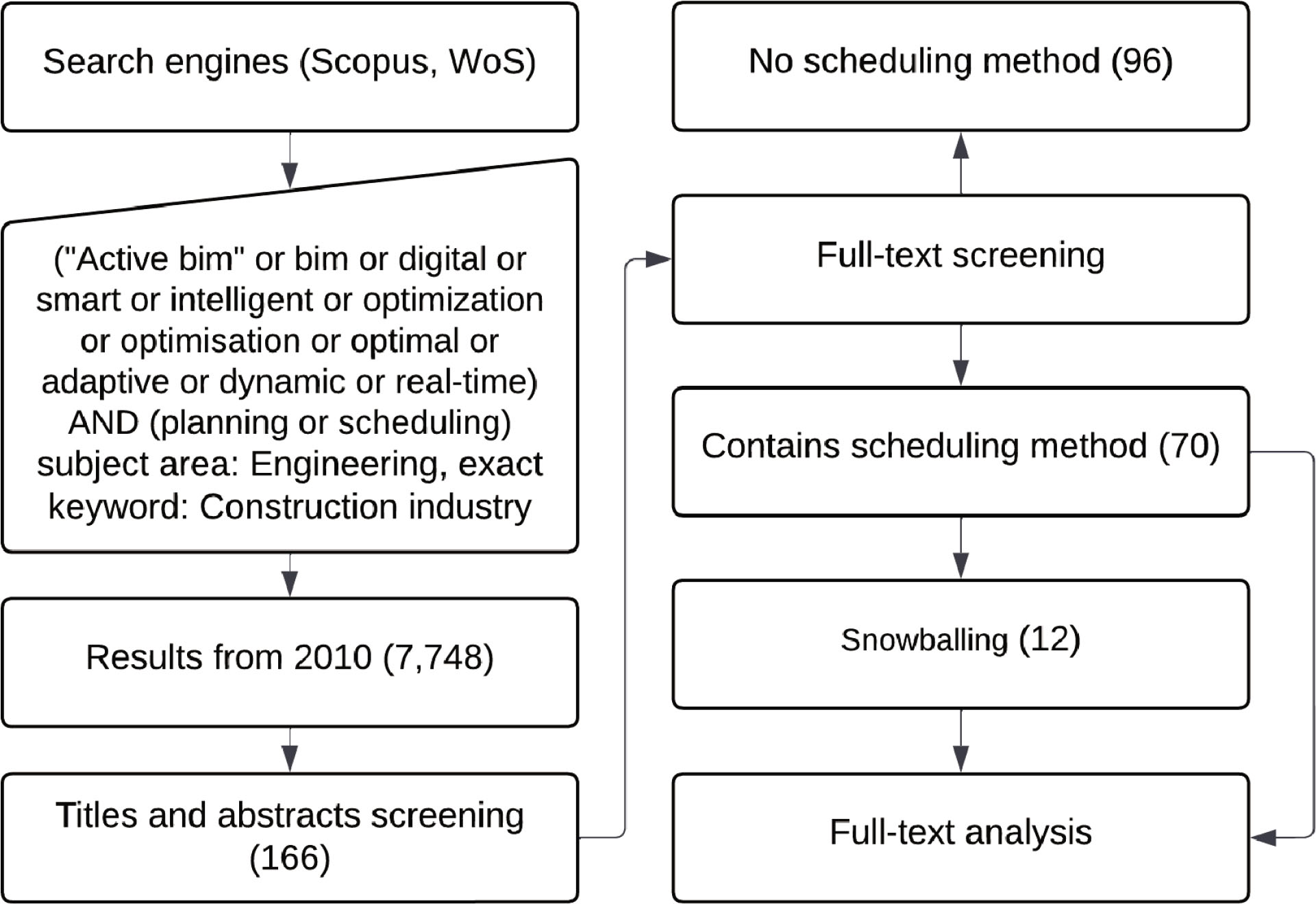
Fig. 1:
Flow chart of the literature review methodology. WoS, Web of Science.
2.1. Stage 1: identifying relevant works using established search engines by keywords related to construction scheduling
For systematic literature reviews, the Web of Science (WoS) and Scopus are the two main bibliographic databases to use (Pranckutė 2021). Scopus is the largest database of curated bibliographic abstracts and citations containing peer-reviewed scientific content (Baas et al. 2020). WoS is recognised academic research and a rich dataset for studies in many disciplines (Zhu and Liu 2020). Using the Scopus and WoS search engines, the following keywords were entered to analyse the general literature in the field of intelligent construction scheduling. To address the proposed research questions from a broad and thorough viewpoint, the following keywords were chosen: (‘Active bim’ or bim or digital or smart or intelligent or optimisation or optimisation or optimal or adaptive or dynamic or realtime) AND (planning or scheduling). The given keywords have been identified as basic terms and synonyms and have been used in keywords in the construction scheduling and building information modelling (BIM) domains. ‘Engineering’ was defined as the subject area, and ‘construction industry’ was chosen as an exact keyword to ensure that the results would be in the construction field. This set of keywords provided 5,629 documents on Scopus and 2,119 documents on WoS databases in the period from 2010 to the present day including journal articles, conference papers, book chapters and reports. The date range of 2010 onwards was set because, while digital technologies in the construction sector are advancing quickly, older works may contain information that is not up to date.
2.2. Stage 2 screening and preserving relevant publications
At this stage, an initial title screening of the collected 7,748 documents was performed to find applicable studies and exclude duplicate works. The abstracts of the remaining 4,911 publications were reviewed and analysed to determine if this study was relevant to the research objectives of this study. Given that this study focuses on the scheduling of work that needs to be carried out on the construction sites. Therefore, studies that primarily focused on high-level strategic planning, such as portfolio management, project feasibility, or profitability, were excluded. Similarly, studies centred on site layout planning, safety, logistics and procurement management were also excluded unless they integrated into site work planning. Additionally, papers written in non-English languages without reliable translations, as well as duplicates of studies that have been updated, such as conference papers published as journal articles, were not considered. This screening left a total of 166 papers.
2.3. Stage 3 full-text screening of the relevant works
At this stage, the whole text of 166 papers was screened. As a result of the screening, the list was divided into two groups. The first group contained 70 works that suggested methods for scheduling construction projects and the second group contained 96 papers that did not present scheduling methods. To obtain a more comprehensive list of papers, reference lists of these 70 papers were also examined according to the Snowballing approach (Choong et al. 2014), and they revealed an additional 12 papers.
2.4. Stage 4 analysis
A full-text analysis of these 82 documents was conducted. Each study is analysed using the assessment framework described in the following Section A Framework for Assessing the Automation and Adaptability of Construction Project Scheduling. Additionally, the following information was collected for each study in this group: (1) scheduling method: this reveals information about a method that was developed and named by the author or an existing, updated method; (2) automated scheduling: this gives information if the generation of any aspect of schedule is automated; (3) BIM: this gives details about the use of BIM technologies; (4) dynamic factors consideration: this gives information on whether the scheduling methods is adaptive to any scheduling delay factors and (5) past experience: this provides insights on the digital integration of past experience. By systematically reviewing the methods proposed by studies, identifying limitations and research gaps and analysing each of the aspects described in the assessment framework, recommendations for future research are provided.
3. A framework for assessing the automation and adaptability of construction project scheduling
This section will provide an overview of the framework used in this study to assess Construction Project Scheduling in terms of automation and adaptability.
Scheduling was defined by Kleck (1982) as the process of determining the length of one or more activities and placing them in the order that makes them form a logically reasonable sequence. From this point of view, it becomes clear that the duration of the tasks and their logical sequence are fundamental. At the same time, understanding the scope of the task is important since it has an immediate impact on scheduling.
Cost, time and quality are the main metrics used to assess construction project performance. An effective schedule that incorporates cost, time, technical data, work breakdown structure (WBS) and activity sequence, risk assessment and resource allocation to activities so that the cost-time relation would be optimised is essential for successful construction projects (Tsegaye 2019). This confirms the importance of task sequences and activity lists and the need to take them into account when assessing the scheduling of construction projects. In any schedule, task duration represents time and helps to determine how long it will take to complete a project, so task duration will be considered an element of project scheduling assessment. The allocation of resources to the project is another aspect to be evaluated, including the distribution of materials and the workforce, which is extremely important for its success (Santos et al. 2022). Adaptive scheduling, which assists in addressing dynamic context and reducing the risk of delays, is another component of project success (Egwim et al. 2023). Considering the dynamic scheduling factors is crucial to solving the delay issue (Fahmy et al. 2019), the ability of approaches to adapt will also be evaluated.
Digitisation is the process of converting analogue data into digital (Begić et al. 2022). Currently, the construction industry is one of the least digitised industries, which makes project management more difficult and unnecessarily time-consuming (Abba et al. 2021). The use of digital technologies is beneficial for construction planning in a number of studies (Abba et al. 2021; Santos et al. 2022; Toan et al. 2023). The digitisation of construction may be found in the form of software, information technology, data models or communication tools.
A key component supporting the digital transition in the construction sector is BIM (Andreea 2022). A BIM is a digital representation of functional and physical characteristics of a project (Abbasi et al. 2020) that may be used to exchange data from multiple sources and reuse it by project participants for increased collaboration (Wickramasekara et al. 2020).
In this paper, we considered automated construction scheduling to mean the use of digital processes to automatically generate schedule details, such as activity list, task duration and sequencing, including automated data acquisition, automated data processing and automated data presentation.
Furthermore, adaptive construction scheduling means considering and adjusting the schedule due to the dynamic and uncertain environment of a construction project (Undozerov 2023).
The attributes of a framework that will be used to assess construction project scheduling approaches are illustrated in Figure 2.
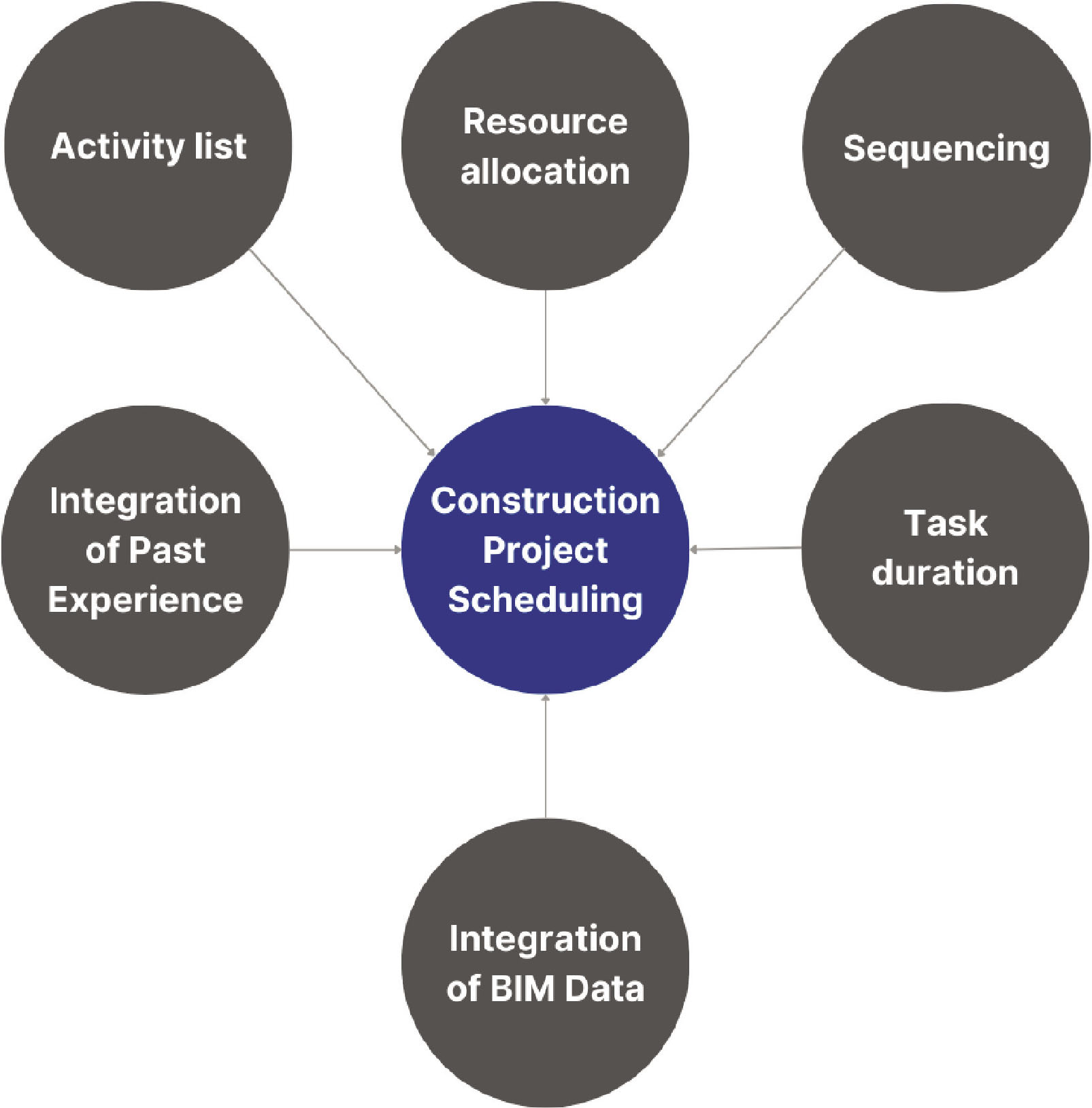
Fig. 2:
Construction project scheduling attributes. BIM, building information modelling.
This study will review literature on construction scheduling from the perspective of the current level of automation and the adaptability of scheduling methods. Automation of Activity list generation, Task duration calculation, Sequencing and Resource allocation will be examined to identify overall automation of scheduling method. The most automated methods require the least amount of manual work in terms of performing individual processes. The research will investigate the Integration of BIM Data into construction scheduling methods as the main digitisation tool. Furthermore, the adaptability of the scheduling method will be defined by analysing whether a scheduling method considers any delays. Additionally, the study will review the adoption of other advanced digital technologies as part of digitisation.
Previous experience and established best practices also play an important role in effective construction planning (Hansen et al. 2023). Prior experience helps to produce more accurate and effective schedules, so as to minimise delays and cost overruns while improving overall project performance (Hong et al. 2023). In this study, the Integration of Past Experience is considered as an organised and digitised system that represents any past experience. This attribute focused on identifying the use of such aspects in the scheduling method.
4. Analysis
Construction project scheduling is a complex process that requires careful consideration of many factors. It is essential to consider numerous aspects that may affect the accuracy and realisability of the schedule whenever preparing a schedule for a construction project. The following subsections provide the analysis of 82 studies selected as per the methodology defined previously. This analysis focused on the digitisation, adaptability and automation of the studied construction scheduling approaches.
Table 1 summarises the frameworks proposed by the 82 reviewed studies. The methods with automated scheduling attributes, the methods that used BIM technologies and the methods that integrated past experience have a tick in their respective columns, and ‘Scheduling method’ column describes the main approach proposed by the author.
Tab. 1:
Scheduling frameworks proposed by researchers.
| Reference | Scheduling method | Automated scheduling | BIM | Delay factors consideration | Past experience |
|---|---|---|---|---|---|
| Mohamed Meabed et al. (2025) | Modified CCS approach | ||||
| Golmaei et al. (2025) | BIM-based WOA for prefabricated construction | ✓ | ✓ | ||
| Jiang et al. (2025) | Deep learning integrated MAS for prefabricated construction | ✓ | ✓ | ✓ | |
| Wang et al. (2024) | BIM-based scheduling | ✓ | ✓ | Workspace | ✓ |
| Kostrzewa-Demczuk and Rogalska (2024) | PTCM II | ||||
| Fazeli et al. (2024) | OA-based 4D BIM | ✓ | ✓ | ||
| Li et al. (2024) | Multi-objective SD-NSGA for prefabricated construction | ✓ | |||
| Feng et al. (2024) | BIM-based multi-objective optimisation GA | ✓ | |||
| Wefki et al. (2024) | BIM-based scheduling integrated with GA optimisation | ✓ | ✓ | ||
| Pregina and Kannan (2024) | F-GERT | ||||
| Hassan et al. (2023) | Multi-objective stochastic optimisation model for repetitive construction | ✓ | |||
| Aminbakhsh and Ahmed (2023) | HGA | ✓ | |||
| Yang et al. (2023) | BIM-based method optimised by GA for prefabricated construction | ✓ | ✓ | ||
| Wu and Ma (2023) | BIM-based method combining ontology constraint rule and GA | ✓ | ✓ | ||
| Hong et al. (2023) | GAS | ✓ | ✓ | ||
| Yu et al. (2023) | Multi-objective static network planning optimisation | ||||
| Soman and Molina-Solana (2022) | LAS integrated RL and LDCC | ✓ | ✓ | ✓ | |
| He et al. (2022) | Collaborative scheduling | Communication | |||
| Lehtovaara et al. (2022) | Collaborative scheduling | Communication | |||
| Scala et al. (2022) | Collaborative scheduling | Communication | |||
| Milat et al. (2021) | Multi-objective optimisation model for resilient scheduling | ||||
| ElMenshawy and Marzouk (2021) | CPM | ✓ | |||
| Banihashemi et al. (2021) | Fuzzy MCDM | ✓ | |||
| Abdelmegid et al. (2021) | LPS integrated DES | ||||
| Santos et al. (2021) | BIM-based scheduling | ✓ | Communication | ||
| Kim et al. (2020) | BIM-based approach for steel frame erection | ✓ | ✓ | ||
| Abbasi et al. (2020) | BIM-based Takt-time and DES | ✓ | ✓ | Supply chain | |
| Mahdavian and Shojaei (2020) | CPM-based CBS | ✓ | ✓ | ||
| Tallgren et al. (2020) | Collaborative scheduling | ✓ | Communication | ||
| Wickramasekara et al. (2020) | BIM-based integrated LPS and CSM | ✓ | Communication | ||
| Li et al. (2020) | BIM-based LBS | ✓ | Safety | ||
| Etges et al. (2020) | LPS | ✓ | |||
| Tao et al. (2020) | Two-stage metaheuristic algorithm | ✓ | Workspace | ||
| Le and Jeong (2020) | AI-based CPM | ✓ | ✓ | ||
| Hammad et al. (2020) | Mixed integer non-linear programming model for optimising the scheduling | ||||
| Francis (2019) | Chronographical Spatiotemporal Scheduling Optimisation Method | ✓ | Workspace | ||
| Wang and Rezazadeh Azar (2019) | BIM-based scheduling for concrete-framed buildings | ✓ | ✓ | ||
| Melzner (2019) | Takt-time | Supply chain | |||
| Joo et al. (2019) | Coordination-based reactive scheduling | Supply chain | |||
| Ma et al. (2019) | CCDSM | Rework | |||
| Tran and Long (2018) | AMODE | ✓ | |||
| Ballesteros-Pérez et al. (2018) | CPM-based weather-aware scheduling | Weather | |||
| Su and Cai (2018) | GPM | ✓ | Workspace | ||
| Getuli and Capone (2018) | BIM-based scheduling | ✓ | ✓ | Workspace | |
| Vahdatikhaki and Mawlana (2017) | DES | ✓ | ✓ | Workspace | |
| Salama et al. (2017) | Simulation-based method for modular construction | ✓ | ✓ | ||
| Chang et al. (2017) | BIM-VRcpSS | ✓ | ✓ | ✓ | |
| de Soto et al. (2017) | BIM-based Tabu-search algorithm | ✓ | |||
| Yuan et al. (2017) | MCM-BIM-CSEWM | ✓ | |||
| Sonmez and Gürel (2016) | Hybrid optimisation method | ✓ | |||
| Abuwarda and Hegazy (2016) | Flexible Constraint Programming framework | ✓ | |||
| Senouci and Mubarak (2016) | Multi-objective optimisation model for scheduling | ✓ | Weather | ||
| Kim et al. (2016) | 3D intelligent model for highway projects | ✓ | ✓ | ||
| Niknam and Karshenas (2016) | BIM-based Semantic Web approach | ✓ | ✓ | Communication | |
| Mohammadi et al. (2016) | BIM-based simulation method | ✓ | ✓ | ||
| Golizadeh et al. (2016) | ANN-based method | ✓ | ✓ | ||
| Fan et al. (2016) | Object-oriented approach | ✓ | |||
| Ashuri and Tavakolan (2015) | Shuffled frog-leaping model for scheduling | ||||
| Moon et al. (2015) | BIM-based fuzzy and GA optimisation method | ✓ | Overlaps | ||
| Tomek and Kalinichuk (2015) | BIM-based Agile method | ✓ | Rework | ||
| Park and Cai (2015) | BIM-based scheduling | ✓ | ✓ | ||
| Liu et al. (2015) | BIM-based scheduling | ✓ | ✓ | ||
| Agrama (2014) | LOB - based multi-objective optimisation model for repetitive construction | ✓ | |||
| Faghihi et al. (2014) | BIM-based GA | ✓ | ✓ | ||
| Gelisen and Griffis (2014) | APBSA | ✓ | ✓ | ||
| Altaf et al. (2014) | BIM-based scheduling | ✓ | ✓ | Safety | |
| Liu et al. (2014a) | BIM-based scheduling for Panelised Construction | ✓ | ✓ | ||
| Liu et al. (2014b) | BIM-based scheduling | ✓ | ✓ | ||
| Taghaddos et al. (2014) | SBAP | ✓ | |||
| Ma et al. (2014) | CCPM | ||||
| Okmen and Oztas (2014) | CPM-based fuzzy method | ||||
| Kim et al. (2013) | BIM-based scheduling | ✓ | ✓ | ||
| Chua et al. (2013) | FReMAS | ✓ | |||
| Anagnostopoulos and Koulinas (2012) | GRASP-based hyperheuristic algorithm | ✓ | |||
| Chen et al. (2012) | ISS | ✓ | |||
| Dong et al. (2012) | LAS | ✓ | Workspace | ||
| Weldu and Knapp (2012) | BIM-based scheduling | ✓ | ✓ | ||
| Konig et al. (2012) | DES | ✓ | ✓ | ||
| Karshenas and Sharma (2010) | VSA | ✓ | |||
| Mikulakova et al. (2010) | CBR | ✓ | ✓ | ✓ | |
| Wu et al. (2010) | DES | ✓ | |||
| Feng et al. (2010) | CPM | ✓ | ✓ |
1 AI, artificial intelligence; AMODE, adaptive multiple objective differential evolution; ANN, artificial neural network; APBSA, automated productivity-based schedule animation; BIM, building information modelling; BIM-VRcpSS, BIM-based visual risk critical path scheduling system; CBS, constraint-based simulation; CCDSM, critical chain design structure matrix; CCPM, critical chain project management; CCS, critical chain scheduling; CPM, critical-path method; CSM, computer simulation and modelling; DES, discrete event simulation; F-GERT, fuzzy-graphical evaluation and review technique; FReMAS, functional requirement model for automatic sequencing; GA, genetic algorithm; GAS, graph-based automated scheduling; GPM, graphical planning method; GRASP, greedy randomised adaptive search procedure; HGA, hybrid genetic algorithm; ISS, intelligent scheduling system; LAS, look-ahead schedule; LBS, Location-based Scheduling; LDCC, linked-data based constraint checking; LOB, Line of Balance; LPS, last planner system; MAS, multi-agent system; MCDM, multi-criteria decision-making; ML, machine learning; OA, optimisation algorithm; PTCM II, probabilistic time couplings method II; RL, reinforcement learning; SBAP, simulation-based auction protocol; SD-NSGA, non-dominated sorting genetic algorithm based on a subspecies differentiation strategy; VSA, visual scheduling application; WOA, whale optimisation algorithm.
4.1. Digitisation
Digitisation has improved collaboration, integration, monitoring, safety and knowledge sharing in construction scheduling practices (Altaf et al. 2014; Santos et al. 2022; Scala et al. 2022). Use of digital technologies has several benefits, such as better record-keeping and time-saving, as well as keeping up-to-date information (Abba et al. 2021) that provides a solid foundation for more adaptive scheduling that is capable of continuously updating, checking and revising the schedule.
Digitisation integrates digital tools and technologies into work processes, while automation allows tasks to be performed without human intervention (Begić et al. 2022). All reviewed the studies used digital technologies in their proposed scheduling methods, which demonstrates the importance of digital technologies in construction scheduling.
Eight studies have demonstrated the potential of integrating past experience to create better project schedules. Mikulakova et al. (2010) and Jiang et al. (2025) used completed project contexts to generate new schedules. Two studies obtained information about activity durations and sequencing from historical project data (Wang and Rezazadeh Azar 2019; Le and Jeong 2020). Hong et al. (2023) investigated the extraction of typical building sequences from historical project schedules. Soman and Molina-Solana (2022) employed artificial intelligence (AI) techniques like reinforcement learning (RL) to learn activities and their corresponding restrictions based on data. Golizadeh et al. (2016) also used an AI technique and predicted activity durations using an artificial neural network (ANN) trained on previous projects. Le and Jeong (2020) integrated AI to automate and address the limitations of traditional CPM. These methods rely on high-quality, well-structured data and have some serious drawbacks, such as using a limited set of information (e.g., activities, sequences, durations, etc.) and being applied for specific types of structures.
The implementation of BIM is recognised as a crucial element of future construction practices, offering benefits in terms of productivity and reliability (Santos et al. 2021; Andreea 2022; Toan et al. 2023; Fazeli et al. 2024). A BIM is a digital model of a project that presents its functional and physical characteristics digitally as a potential solution for solving design and construction challenges (Wickramasekara et al. 2020). The use of BIM in construction planning and management can provide numerous opportunities to leverage 3D models and 4D simulations (Saldanha 2019) and for both the design and construction phases, if it promotes efficiency and time savings throughout the project life cycle. 4D-BIM is created to connect BIM to the project schedule in order to improve the communication of construction planning and sequencing (Getuli and Capone 2018). Coordination between planners and clients throughout the planning process is greatly aided by 4D modelling (Santos et al. 2021). The use of the 4D models may help project management teams find numerous conflicts and inconsistencies that could arise throughout the course of the project; this identification should be done before the start of the construction phase (Mahdavian and Shojaei 2020).
Numerous papers have studied the application of BIM in a collaborative planning approach (Etges et al. 2020; Tallgren et al. 2020; Wickramasekara et al. 2020; Santos et al. 2022). In total, 38 of 82 studies did not use BIM data, while 44 did. However, current BIM-based methods cannot consider factors such as weather, and most of them were studied on a limited set of construction structures.
Application of BIM technologies in construction projects has proven advantageous (Wang and Rezazadeh Azar 2019). Utilising BIM gives an excellent opportunity to digitise construction and automate the scheduling process (Chang et al. 2017). To date, BIM has been used to improve collaboration and communication among stake-holders (Wickramasekara et al. 2020). Automation of the construction scheduling could make it less time-consuming and eliminate the human error factor. In addition, the application of full digitisation in construction projects can effectively reduce schedule overruns by 10%–15% (May et al. 2018). Considering the benefits of using BIM and the limitations of prior research, it is evident that further investigation into BIM for scheduling is necessary.
4.2. Automation
Construction sector digitisation and the use of modern information technology present a significant opportunity to enhance the planning stages of construction (Melzner 2019). To improve productivity, more technology and better planning are needed in the construction industry (Desgagné-Lebeuf et al. 2019). Digitisation does not ensure automation, and tasks can still be performed manually in a digital environment. Fan et al. (2016) offered a method of scheduling that can automatically calculate the durations and generate the schedule according to work sequences, priority of areas and crew allocation. However, this information must be entered manually by the user for the system to work properly. Wu et al. (2010) suggested a totally digitised simulation-based approach for automating the creation of time schedules, but the process depends on time-consuming manual entry of the construction method for each component. Chua et al. (2013) introduced a method for digitised schedule sequencing, but to let the model automatically determine possible sequences and generate schedules, it requires manual conversion of functional requirements into temporal constraints. Examining the scheduling methods showed that 31 papers proposed non-automated scheduling, while automation could be time-saving and enhance the planning stage of construction (Melzner 2019).
From an automation viewpoint, two articles out of seven proposed ways to automatically update historical databases of prior experience (Soman and Molina-Solana 2022; Hong et al. 2023). Automating and improving schedule generation by using structured knowledge and past experience, known as knowledge-based systems (KBS) (Mikulakova et al. 2010). Hong et al. (2023) proposed a graph-based automated scheduling (GAS) method that automatically captures and stores information from previous projects and reuses them. The core data of the method is limited to WBS, sequences, durations and resources. Additionally, the study evaluates mainly the labour costs for the optimisation and excludes other costs, such as materials and machinery, which limits its applicability, and the method is useful only in the early stages of a project when there is a lack of sufficient project information and detailed BIM models are not available. Soman and Molina-Solana (2022) presented a look-ahead schedule (LAS) generation approach where past experience is embedded within the RL framework. The main limitation of the approach is relying on a simulated environment and a lack of real-world validation, which might have more uncertainties that were not captured in the simulation.
Table 2 specifically summarises auto-generated scheduling frameworks and shows their ability to automatically generate schedule details like activity list, task duration, ordering (sequencing) of tasks and resource allocation. A total of 51 papers were found to include auto-generated scheduling frameworks; thus, only this subset is described in the Table. Scheduling attributes that are automatically generated have a tick and a cross where manual input is required. The data column describes the information or raw data required by the method to generate a schedule.
Tab. 2:
Details of auto-generated scheduling frameworks.
| Author | Activity list | Task duration | Ordering (sequencing) | Resource allocation | Data |
|---|---|---|---|---|---|
| Golmaei et al. (2025) | X | X | ✓ | ✓ | BIM model, elements and constructability constraints |
| Jiang et al. (2025) | X | X | ✓ | ✓ | Activity list, duration, BIM or elements attributes and relationship, |
| Wang et al. (2024) | ✓ | ✓ | ✓ | X | BIM model and resource allocation plan |
| Fazeli et al. (2024) | X | ✓ | X | X | BIM model, productivity rates, activity list and sequences |
| Li et al. (2024) | X | X | ✓ | ✓ | Activity list, duration, task constraints and required resources |
| Wefki et al. (2024) | ✓ | ✓ | ✓ | ✓ | CAD drawings or manually filled Excel template or BIM model, resource and activity code libraries and productivity rates |
| Hassan et al. (2023) | X | ✓ | ✓ | X | Activity list, precedence relationships, work quantity and productivity rate |
| Aminbakhsh and Ahmed (2023) | X | X | ✓ | X | Activity list, durations and precedence relationships |
| Yang et al. (2023) | X | X | ✓ | X | BIM model |
| Wu and Ma (2023) | X | ✓ | X | X | BIM model, activity list, constraint rules, and resources |
| Hong et al. (2023) | ✓ | ✓ | ✓ | X | Historical data and needs a construction schedule as input |
| Soman and Molina-Solana (2022) | X | X | ✓ | X | A discrete set of states, agent actions and scalar rewards |
| ElMenshawy and Marzouk (2021) | ✓ | ✓ | ✓ | X | BIM model and productivity rates |
| Banihashemi et al. (2021) | X | ✓ | X | X | Activity list and network and fuzzy values for duration |
| Kim et al. (2020) | X | X | ✓ | X | BIM model |
| Abbasi et al. (2020) | X | X | ✓ | X | 4D BIM model |
| Mahdavian and Shojaei (2020) | X | ✓ | X | X | Activity list and sequences, productivity rates and resources |
| Le and Jeong (2020) | X | ✓ | ✓ | X | Activity list and quantities, historical data |
| Francis (2019) | X | X | ✓ | X | Predefined zones and layers, activity list and durations and required resources |
| Tran and Long (2018) | X | X | ✓ | ✓ | Activity list and relationships, duration and available and required resources |
| Getuli and Capone (2018) | X | X | ✓ | X | BIM model, structural schedule |
| Vahdatikhaki and Mawlana (2017) | X | ✓ | X | X | Activity list and sequences, set of confidence levels and resources |
| Salama et al. (2017) | X | ✓ | X | X | Activity list and sequences, productivity rates, resources and BIM model |
| Chang et al. (2017) | X | ✓ | X | X | BIM model, productivity rates and historical data |
| Sonmez and Gürel (2016) | X | X | ✓ | X | Activity list and relationships, durations and available and required resources |
| Abuwarda and Hegazy (2016) | X | X | ✓ | X | Activity list, alternative network paths, durations, resources and deadlines |
| Senouci and Mubarak (2016) | X | ✓ | X | ✓ | Task list, order, productivity rates, required and available resources and productivity multiplier |
| Kim et al. (2016) | X | ✓ | X | ✓ | BIM model, unit cost, labour cost and productivity rates, |
| Niknam and Karshenas (2016) | X | X | X | ✓ | BIM model, activity list and sequences, durations |
| Mohammadi et al. (2016) | ✓ | ✓ | ✓ | ✓ | BIM model, set of process patterns, sequencing rules, productivity rates and pre-set list of resources |
| Golizadeh et al. (2016) | X | ✓ | X | X | Activity list, resources, historical data and dimensions of an element |
| Fan et al. (2016) | X | ✓ | X | X | Activity list, productivity rates, quantities and sequences |
| Park and Cai (2015) | ✓ | X | ✓ | X | BIM model, WBS directory and sequencing rules |
| Liu et al. (2015) | X | ✓ | ✓ | X | available resources, resource requirements for each activity, productivity rates and process patterns |
| Faghihi et al. (2014) | X | X | ✓ | X | BIM model and stability rules |
| Agrama (2014) | X | X | ✓ | X | Activity list and relationships, durations and available resources |
| Gelisen and Griffis (2014) | X | ✓ | X | X | Activity list and sequences, productivity rates and resources |
| Altaf et al. (2014) | X | ✓ | X | X | emission rate, ventilation rate and productivity rates |
| Liu et al. (2014b) | X | ✓ | ✓ | ✓ | BIM model, productivity rates and cost rates |
| Liu et al. (2014a) | X | ✓ | ✓ | X | project resources, resource requirements for each activity and productivity rates |
| Taghaddos et al. (2014) | X | X | X | ✓ | Project information, scheduling templates and available resources |
| Kim et al. (2013) | X | ✓ | ✓ | ✓ | BIM model, set of predefined activities, sequencing rules and productivity rates |
| Chua et al. (2013) | X | X | ✓ | X | Project information, functional requirements and resource allocation |
| Anagnostopoulos and Koulinas (2012) | X | X | ✓ | ✓ | Activity list and relationships, durations and required and available resources |
| Chen et al. (2012) | X | ✓ | ✓ | ✓ | Productivity rates, available resources, activity network and work quantity take-offs |
| Dong et al. (2012) | X | X | ✓ | ✓ | Priority rule, activity list and quantity, resource quantity and activity duration |
| Weldu and Knapp (2012) | X | X | ✓ | X | Activity list and productivity rates |
| Konig et al. (2012) | X | ✓ | ✓ | ✓ | BIM model and process patterns |
| Mikulakova et al. (2010) | ✓ | ✓ | ✓ | X | Historical data, BIM model and working zones |
| Wu et al. (2010) | X | ✓ | ✓ | X | Activity list, construction methods for each component, available resources, process patterns and productivity rates |
| Feng et al. (2010) | X | ✓ | ✓ | ✓ | BIM model, MD CAD model, schedule period and productivity rates |
Several studies have proposed scheduling methods that are automated using BIM tools. BIM is primarily utilised as a valuable data source (Wang and Rezazadeh Azar 2019; ElMenshawy and Marzouk 2021) and as a schedule visualisation tool (Weldu and Knapp 2012; Niknam and Karshenas 2016). Combining schedule information with BIM created opportunities for the development of 4D models for visualisation (Vahdatikhaki and Mawlana 2017). As a data source, the BIM model provided accurate information about types of building elements, quantities and geometrical data (Abbasi et al. 2020). Additionally, BIM was integrated with optimisation algorithms (OAs) such as genetic algorithm (GA) (Wefki et al. 2024), whale optimisation algorithm (WOA) (Golmaei et al. 2025) and Multi-Objective Optimization (MOO) (Hassan et al. 2023) to enhance decision-making and reduce project duration and costs. The proposed methods, however, have significant drawbacks. Numerous methods are only applicable to buildings with specific types of structure (Weldu and Knapp 2012; Liu et al. 2014a, 2015; Wang and Rezazadeh Azar 2019; Abbasi et al. 2020; ElMenshawy and Marzouk 2021; Wang et al. 2024; Jiang et al. 2025). Some methods need a significant amount of manual input information and adjustments (Konig et al. 2012; Wu and Ma 2023; Fazeli et al. 2024; Golmaei et al. 2025; Jiang et al. 2025).
To analyse the capabilities of proposed auto-generated scheduling methods, this study takes four attributes of scheduling. They are activity list generation (creating a work task list), task duration calculation (time it takes to complete a task), ordering of tasks (placing tasks in chronological order based on dependencies) and resource allocation (assignment of required workforce, material and other resources). As shown in Table 2, there are 26 out of 51 works that proposed methods that auto-generate only one scheduling attribute, 14 methods that auto-generate two attributes and 9 frameworks that auto-generate three attributes. The activity list can be auto-generated in 5 studies, the task duration in 16 studies, the ordering in 15 studies and the resource allocation in 7 studies. Despite all the advantages of automation, only two works out of 51 proposed an auto-generated framework for each of the four construction scheduling components, which shows the need for further development of auto-generated scheduling for construction projects.
While understanding project scope and creating a work activity list are crucial for project scheduling and being the critical input for all other types of auto-generated schedules, according to Table 2, only seven works propose a scheduling method that auto-generates an activity list. Hong et al. (2023) used historical data of 353 projects to train a model to generate activity lists, task durations and labour resource allocation. However, this method needs an initial construction schedule as input and does not consider other resources. ElMenshawy and Marzouk (2021), Konig et al. (2012), Mohammadi et al. (2016), Park and Cai (2015) and Wu and Ma (2023) used a BIM model to extract project related data and created an activity list or order based on a set of specific rules, but rule-based approaches rely on the experience of the rule designer. ElMenshawy and Marzouk (2021) focused on building projects, whereas Mohammadi et al. (2016), Park and Cai (2015) and Konig et al. (2012) focused on concrete structures. Furthermore, it is uncertain whether this set of rules is applicable in all contexts. An analysis of a number of different use cases is needed to determine to which it is possible to automate the generation of construction schedules without the need to develop regulations that are excessively specific to each individual case. Hence, auto-generated scheduling requires improvement when it comes to auto-generating activity lists, the key enabler of all other aspects of generative scheduling. The next step in this direction could be identifying and defining the requirements for a BIM-based framework that can automatically create activity lists for construction project schedules.
Only two works (Mohammadi et al. 2016; Wefki et al. 2024) suggested an auto-generated framework for all four aspects of schedule construction. However, the method proposed by Mohammadi et al. (2016) relies on predefined process patterns that might be less useful for different types of projects. Another limitation is sequencing rules that are based only on structural relationships and functional requirements. Furthermore, no consideration is given to the availability of construction site resources. Wefki et al. (2024) introduced a BIM-based framework for automatically generating and optimising work schedules. This framework also has major limitations. The framework is designed only for concrete cast-in situ structures following the bottom-up construction method. The proposed sequencing logic is based on limited patterns and creates only finish-to-start relationships. Although the framework automates the generation of activities, the initial grouping and sorting of elements involve manual steps.
4.3. Adaptability
Scheduling is the planning of time allocation and relationships between the tasks related to the project to ensure that the construction process proceeds without unnecessary delays and in accordance with the specified amount of time to finish the work items (Abbasi et al. 2020). However, accurately assessing possible risks can be difficult early on in a project, especially if the parties in charge did not have enough time to confirm the schedule (Egwim et al. 2023).
Project scheduling problems have been reviewed many times (Ahuja and Thiruvengadam 2004; Ding et al. 2023; Egwim et al. 2023; Hansen et al. 2023). Ahuja and Thiruvengadam (2004) outlined the state of research on improving project scheduling and monitoring methodologies. Additionally, the study noted the necessity of doing research to improve delay management methods and include them in project scheduling software. Thus, there is a need to not only integrate automated scheduling but move from automated scheduling to adaptive scheduling that is able to self-adjust to manage a variety of delay factors that require rescheduling, i.e., weather and product/labour availability.
A possible approach that might assist in coping with the changing construction environment, leveraging digital technology and automation, is Active BIM. Active BIM is a development that converts classic passive BIM systems into dynamic, interactive platforms (Galić and Klanšek 2023). Instead of supplying simply static information, this strategy intends to allow for the dynamic interchange, communication and assessment of different input parameters among optimisation approaches and BIM models (Begić et al. 2024). Several studies have proposed scheduling methods that combine BIM with OAs (Feng et al. 2010; Kim et al. 2013; Faghihi et al. 2014; Moon et al. 2015). Active BIM functions in construction project scheduling can optimise safety challenges (Altaf et al. 2014), allocate resources effectively (Feng et al. 2010; Abbasi et al. 2020), resolve workspace conflicts (Vahdatikhaki and Mawlana 2017; Getuli and Capone 2018; Wang et al. 2024), improve communication (Niknam and Karshenas 2016) and automate task sequencing (Faghihi et al. 2014; Golmaei et al. 2025). Although advancements have been made in this approach, it has a significant drawback related to compatibility (Flanagan 2018; Galić and Klanšek 2023).
A systematic and realistic risk management approach is needed to handle and control the risk of delays (Egwim et al. 2023). This review examines construction scheduling delay factors as a rationale for implementing adaptive scheduling. In this context, 24 out of 82 works considered at least one delay factor, as shown in Table 1. Communication issues and enhancement of communication among the construction project team were among the most studied, included in seven works. Santos et al. (2021) suggested a BIM environment to improve communication among project stakeholders and introduced a framework to integrate design, scheduling, cost estimation and monitoring teams. Tallgren et al. (2020) also focused on a BIM-based collaborative approach and developed the visual project planner application to enhance communication. He et al. (2022) outlined using the last planner system (LPS) as a basis for collaborative scheduling. LPS is a recognised method for production planning and control that was developed by Ballard (2000). Wickramasekara et al. (2020) proposed a framework that integrated computer simulation and modelling (CSM), BIM and LPS, where the last two helped to increase collaboration. Lehtovaara et al. (2022) recommended decentralisation of planning as a way to advance collaboration. Scala et al. (2022) developed a maturity model for collaborative scheduling to support continuous improvement of collaboration. Niknam and Karshenas (2016) presented a framework for the use of the Semantic Web to enhance collaboration by solving the information integration problem.
According to Table 1, the other most studied dynamic factor was workspace planning to avoid space-time conflicts. This was considered in seven works, and four of them included automation (Dong et al. 2012; Vahdatikhaki and Mawlana 2017; Getuli and Capone 2018; Francis 2019). In addition, five studies out of seven proposed scheduling frameworks using BIM to address the workspace interference problem (Vahdatikhaki and Mawlana 2017; Getuli and Capone 2018; Su and Cai 2018; Tao et al. 2020; Wang et al. 2024). Supply chain issues were considered in three works (Joo et al. 2019; Melzner 2019; Abbasi et al. 2020). Only Abbasi et al. (2020) proposed an auto-generated method that combines BIM and in time technique to plan optimal time, optimal equipment and optimal labour for each activity. Two different studies were conducted to address safety risks (Altaf et al. 2014; Li et al. 2020). Auto-generated scheduling was the subject of one of these studies (Altaf et al. 2014). Vahdatikhaki and Mawlana (2017) created the framework that enables managers and practitioners to statistically assess the probability of various constructability conflicts and graphically analyse the impact of uncertainty on project development. While weather-related concerns were considered in two papers (Senouci and Mubarak 2016; Ballesteros-Pérez et al. 2018) and overlaps were addressed in another (Moon et al. 2015), the examination of rework was the focus of two works (Tomek and Kalinichuk 2015; Ma et al. 2019). Notably, auto-generated methods were not examined in any of those four studies. The lack of research into automated and adaptive systems that take dynamic factors into account tells us there is a need for more research, which might be enhanced using BIM. The future studies might focus on examining the application of BIM-based intelligent scheduling to reduce uncertainty and facilitate improved decision-making for stakeholders by automatically considering construction dynamic factors.
5. Recommendations for future research
This research has examined the developing field of automated and adaptable construction scheduling, demonstrating notable advancements driven by digital technologies. The analysis has highlighted the enormous potential of these advancements to enhance project efficiency, reduce delays and improve resource utilisation. Despite the significant developments in current research, further study is required to solve some problems and close many important gaps to fully fulfil the potential of the field. A systematic review methodology was conducted on the key themes of Digitisation, Automation and Adaptability of schedules to identify areas lacking research attention, recurring limitations and unresolved questions across the studied articles. Thus, this Section provides a set of future research directions for academics that will influence construction scheduling in the future. These recommendations are for future studies:
Eliciting formalised requirements for a BIM-integrated KBS framework to auto-generate scheduling activity lists for construction projects.
Agree on an ontology of terms within construction scheduling to ensure interoperability among digital tools and with existing openBIM data models.
Determining if automatic generation of all aspects of construction schedules can be achieved without the development of excessively specific patterns for individual construction use cases.
Determining if a combination of BIM-based scheduling and AI can further improve both automated and adaptive construction scheduling.
Validating if dynamic automated construction scheduling that considers delay factors has the potential to better address uncertainties in construction scheduling.
In the following subsections, each of the above recommendations will be discussed separately.
5.1. Recommendation 1: Eliciting formalised requirements for a BIM-integrated KBS framework to auto-generate scheduling activity lists for construction projects
The scheduling methods presented in the reviewed studies indicate a trend moving toward automation of scheduling. Automated scheduling frameworks have the potential to streamline construction scheduling (Wefki et al. 2024). Section 4.2 discussed the automation of various schedule components, including task duration estimation, sequencing, resource allocation and activity list generation. It highlighted that despite advancements and integration of AI, machine learning (ML), OAs, activity lists are still typically inputted manually. KBS that uses past experiences or integration of BIM have the potential to automatically generate task lists. While the use of these tools individually has some limitations, discussed in Section 4.2, their combination could be advantageous in generating activity lists and improving all aspects of scheduling. The paper reviewed attempts to integrate KBS and BIM, noting their drawbacks in Sections 4.1 and 4.2. Investigating and formalising methods for integrating the two systems for a specific aim would be beneficial in terms of applicability. This has facilitated the formulation of recommendations for future study.
5.2. Recommendation 2: Agree on an ontology of terms within construction scheduling to ensure interoperability among digital tools and with existing openBIM data models
The analysis of literature highlighted the positive impact of digitisation and the use of different tools. Despite the promising advancements in digital technologies within the construction industry, there are still notable challenges. As described in Section 4.1, the knowledge obtained from past projects is often limited to a basic structured set of information, such as activities, sequences and durations. Given that construction projects occur in a constantly changing environment, project scheduling must also consider environmental circumstances and their impact on construction activities. Active BIM, which facilitates the dynamic exchange of information, has its own limitations, particularly regarding interoperability, as discussed in Section 4.3. To enhance interoperability in Active BIM approaches it is also crucial to adopt openBIM standardised file exchange formats (Yang et al. 2023). In terms of conceptualising knowledge and facilitating its reuse in a machine-readable format, ontologies can serve as valuable tools (Milat et al. 2021). They can act as a semantic bridge between domains and function as knowledge bases for project scheduling (Niknam and Karshenas 2016). To ensure interoperability between digital tools, a standardised terminology that defines key concepts and vocabulary is essential. Agreeing on an ontology of terms within construction scheduling could be a major step towards interoperability among digital tools and with existing openBIM data models. This led to the formulation of actionable recommendations for future research.
5.3. Recommendation 3: Determining if automatic generation of all aspects of construction schedules can be achieved without the development of excessively specific patterns for individual construction use cases
Task list generation is a crucial aspect of construction scheduling, but there are other components that also need to be automated to achieve full automation. Section 4.2 highlighted that out of 82 presented methods, only 2 towards automating four aspects of scheduling assessed by this review. However, the proposed 2 methods have common limitations, such as heavily relying on patterns developed for specific building structures and lacking a defined generalisation of methods. This suggests that there are still opportunities to improve the automation of scheduling components. There is a need for further study on comprehensive automated scheduling frameworks that cover all aspects of construction scheduling, minimising the need for manual input and predefined patterns. A feasible direction for future research has been formulated.
5.4. Recommendation 4: Determining if a combination of BIM-based scheduling and AI can further improve both automated and adaptive construction scheduling
While BIM is a crucial digital technology in the construction industry (Andreea 2022), AI is transforming automation across different sectors (Javaid et al. 2022). However, the analysis revealed a limited number of studies focused on the use of advanced digital technology such as AI. AI could be the next crucial step in construction scheduling and knowledge bases, offering opportunities to modernise and enhance existing methods. The ability of AI to simulate human cognition to identify and store data from successful projects (Mikulakova et al. 2010) can enhance automation, efficiency and adaptability of schedules. Sections 4.1 and 4.2 highlighted the methods that integrated AI and discussed limitations. The application of AI in construction scheduling is still underexplored. Additionally, the integration of BIM with AI has the potential to enhance construction scheduling significantly. This has resulted in the development of practical recommendations.
5.5. Recommendation 5: Validating if dynamic automated construction scheduling that considers delay factors has the potential to better address uncertainties in construction scheduling
The analysis revealed that 24 studies out of the reviewed 82 proposed an adaptive method that considers dynamic factors while scheduling a project. It is essential to consider potential reasons for delays to be prepared for situations that require adjustments to schedules (Fahmy et al. 2019; Undozerov 2023). Notably, only 9 of the 24 studies focused on automated scheduling methods that incorporate delay factors. The low number of studies on automated systems that adapt to dynamic factors indicates a need for more studies. Although BIM has significantly improved collaboration, communication and coordination (Niknam and Karshenas 2016; Tallgren et al. 2020; Wickramasekara et al. 2020) among stakeholders, its current methodologies have limitations in addressing dynamic factors such as weather and are often studied within constrained contexts. The full automation of construction project scheduling is also still underexplored, as only two studies have proposed automation of all four assessed processes (Mohammadi et al. 2016; Wefki et al. 2024). Both have limitations and remain static methods that do not consider dynamic environments. Developing fully automated scheduling systems that can adapt to realtime project conditions and external factors may yield promising results. Validating the construction scheduling frameworks created is essential for ensuring their reliability and practical use in dynamic construction settings.
6. Conclusion
The review has explored the current state of automated and adaptable construction scheduling and provided recommendations for future research for further development of the field. To answer the research question ‘What technological developments are required to advance current intelligent scheduling approaches to become automatable in both their creation and support adaptation due to dynamic factors?’ The study suggested a framework for assessing the automation and adaptability of construction project scheduling. The analysis revealed that several significant technology advancements are essential to achieving complete automation in construction scheduling, which includes both the initial generation of the schedule and real-time adaptability to a changing environment.
The studies reviewed demonstrated the use of various digital tools and software, indicating an overall good level of digitisation. In the context of digitisation, developing open-source and standardised data models and ontologies for construction scheduling can improve interoperability among digital tools. The study has found that most of the papers studied (44 of 82) used a BIM model as a database for extracting the information needed for scheduling. Applying BIM was also found to help enhance the information flow and replace some manual operations (Kim et al. 2013; Wang and Rezazadeh Azar 2019; Mahdavian and Shojaei 2020; ElMenshawy and Marzouk 2021).
The review analysed proposed construction planning processes and evaluated the degree of automation present in each stage, considering all facets of construction scheduling, including task sequencing, resource allocation and task duration. The research provided a holistic understanding of the current state of automation within the construction industry. Despite recognising the advantages of digital technologies significant number of studies still rely on manual scheduling methods. The paper revealed the limited adoption of full automation of scheduling, with only two studies proposing a framework covering all scheduling components (Mohammadi et al. 2016; Wefki et al. 2024).
In terms of adaptive scheduling, Consideration of major dynamic factors (weather, funding, material supply, etc.) has also been explored by a few studies. BIM has been studied in 14 papers considering the factors such as supply chain issues, rework, poor communication, etc. However, there are limitations in existing scheduling methods, including the inability to address risks and adapt to changing project circumstances. This work has found that there is no comprehensive BIM-based scheduling approach that can be used to schedule the whole construction project, utilising OpenBIM approaches, with the ability to factor in causes of delays.
Practically, the study highlights the potential of automated and adaptive scheduling methods to improve efficiency and accuracy in construction project planning significantly. Theoretically, the work contributes to the theoretical understanding of construction scheduling by integrating BIM and digital technologies. Methodologically, the study proposed a framework for evaluating the automation of scheduling methods, providing a robust foundation for future research and practical applications in the construction industry.