
1. INTRODUCTION
In a natural environment, bees (Apiformes) play a significant role among the insects inhabiting the world. They thrive on nectar and pollen and participate in reproduction of numerous plant species both cultivated and wild. The insects inhabit almost all terrestrial environments, provided they have access to food. However, being xerothermic species they are mostly connected with dry and open habitats. That is why they are more often seen in areas which meet their food requirements and secure, convenient living conditions [Krewenka et al. 2011; Ollerton et al. 2011; Abrol 2012].
At present, almost all ecosystems on Earth undergo (directly or indirectly) strong anthropopressure [Ellis et al. 2010; Sanchez-Bayo et. al. 2019]. Most bee species living in these ecosystems also fall under this influence, which adversely affects their biology and functioning. Some species try to migrate to areas with better food conditions while others face threats and die [Zattara, Aizen 2021; Nieto et al. 2014].
The most appropriate means of preventing these negative trends is protection of species (including bees) in their natural habitats. So research conducted in areas least altered by humans, such as national parks, nature reserves and landscape parks are meaningful, since these are the areas least affected by anthropopressure.
Becoming familiar with the discussed question makes people aware of the role bees play in life of humans and increases educational awareness of sustainable development.
The research into the bees of the protected areas in the Małopolska Upland aimed at characterizing bee communities in phytosociological diversified grassland areas (also referred to as open areas). The essential research hypothesis was to demonstrate diversity in efficiency of sampling these insects by means of two methods: the transect method and Moericke trap method.
The above-mentioned hypothesis suggested that using the transect method to sample bees was more efficient in comparison with a Moericke trap, considering both the number of species and the number of specimens and also that these number will decrease with the increase in overshadowing of their habitat.
The research was conducted in one of the eight landscape parks in the Małopolska Upland, Cisowsko-Orłowiński Landscape Park. Previous research into bees in this area was conducted mostly in natural plant communities [Bąk-Badowska 2012, 2014], while the research performed in 2000–2002 included forest areas and species of the Bombus type [Bąk 2000, 2003, 2005].
RESEARCH AREA
Cisowsko-Orłowiński Landscape Park is located in the Małopolska Uplands, in the macroregion of Kielce Upland [Kondracki 2023]. The geological structure comprises mostly Devonian sandstone, limestone and Cambrian quartzite that significantly influence the morphology of the area. The park is the most diverse, as for the surface and types of habitats, of all the areas in the region.
Forests in the park cover 63% of the surface and represent 13 types of habitats. Grassland phytocenosis comprises dry meadows covering the slopes in the northern and western parts of the area, fresh meadows typical of river valleys in the south-eastern part of the park and molinia and ruch-molinia meadows characteristic for watery clearings. Xerothermic sand grassland and pine forests occur in the southern part of the park and limestone turf grows on sun-filled slopes, particularly in the buffer zone of the park, in the area of Łagów town [Piwowarski, Przemyski 2014].
Lack of areas, areas degraded by industry and heavily urbanized areas caused the number of plant species in ruderal ecosystems to be low.
Cisowsko-Orłowiński Landscape Park is located in the Northern Małopolska climatic region. The region covers the central part of Kielce Upland with the Świętokrzyskie Mountains and Nida Basin. This area of the park is marked with a wide range of topo-climatic diversity from the diverse morphology there. It is particularly notable for its precipitation: mean annual temperature in the region is 7.5°C and mean annual precipitation is 616mm, with the extreme values ranging from 546 to 802 mm. The annual solar radiation is 1,506 with around 40 sunny days [Jarzyna et al. 2014].
Four research areas were set up there in the park, with plant communities marked with diverse dynamics of development and a range of anthopopressure. Differences in the floral composition of the ground cover resulted from different biotope conditions and the way it had been used by people before. The areas were located in the grassland environment and belonged to heavily sun-filled fields and meadows and partly shadowed ruderal ecosystems and xerothermic turf.
Area 1 – field (FI); the area of Trzemoszna village
Segetal plant communities of Stellarietea mediae class.
Vegeta cover characteristics: C layer – 80%, the most common species: Apera spica-venti, Capsella bursa-pastoris, Chamomilla suaveolens, Tanacetum vulgare and others.
Area 2 – meadow (ME), Mokradle village
Fresh meadow community Arrhenatheretum elatioris, class: Molinio-Arrhenatheretea.
Vegeta cover characteristics: layer C – 90%, the most common species: Alopecurus pratensis, Anthoxanthum odoratum, Deschampsia caespitosa, Plantago lanceolata, Festuca pratensis, Ranunculus acris, Rumex acetosa, Lychnis flos-cuculi and others.
Area 3 – ruderal ecosystem (RE), Sieraków village
Ruderal ecosystem of Artemisietea vulgaris class.
Vegeta cover characteristics: layer B – scant, layer C – 100%, the most common species: Achillea millefolium, Anthoxantum odoratum, Elymus repens, Festuca pratensis, Leontodon autumnalis, Medicago lupulina, Plantago lanceolata, Trifolium pratense, T. repens and others.
Area 4 – xerothermic grassland, transformed significantly (XG), Łagów town, the buffer zone of the park.
Xerothermic grassland community, Festuco-Brometea class.
Vegeta cover characteristics: layer B – 10%, layer C – 80%, the most common species: Centaurea scabiosa, Dianthus carthusianorum, Festuca ovina, Medicago lupulina, Plantago media, Salvia pratensis, Thymus pulegioides and others.
MATERIAL AND METHODS
The research into the bee communities in Cisowsko-Orłowiński Landscape Park was conducted in 2018–2019, from April to October with two-week breaks. It employed the method of belts (transects) [Banaszak 1980] and Moericke traps [Moericke 1951]. The former consists in sampling and counting insects by means of an entomological net during a 30-minute walk along an area that is one metre wide and 200 metres long in a defined research area in optimal weather conditions, that is with no or low wind and the temperature ranging from 20°C to 25°C, between 9am and 4pm every 10–14 days [Domagała-Lipińska 1962]. Colour traps were first used in the 1950s and 60s when it was noticed the insects react to different light waves, which means some colours are more attractive to them than others. Moericke traps used in this research were plastic dishes 12cm deep with a diameter of 20cm, half-filled with liquid made of water (95%), ethylene glycol (4.8%) and a liquid reducing the surface tension (0.2%).
The transect method is useful for a fast estimation of bee populations in diverse environments since the researcher counts all the specimens from different researched species that are noticed during the walk. However, Moericke colour traps allow more accurate estimation of species composition and the dynamics of a species occurrence.
They hang throughout the whole vegetation period trapping rare and less abundant species of a modest size, which could be overlooked if the transect method was applied. Together with other methods, the use of traps can be more efficient to estimate species abundance in a defined area [Borański 2015].
At each sampling plot there were four white traps put on a layer of ground cover (Figure 1). These colour traps are thought to be most effective to sample insects attracted to flowers [Westphal et al. 2008; Borański 2015]. Every two weeks the insects were removed and the liquid was replaced. Next the bees were labelled, and the species marked.
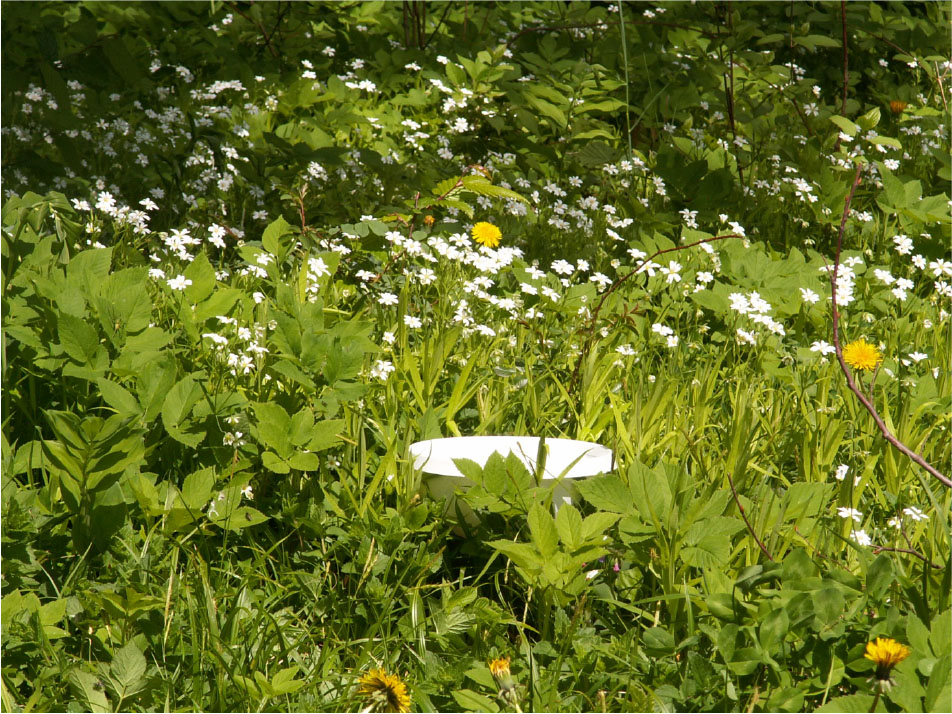
Figure 1.
Moericke trap
Per sample, the number of specimens was collected and marked during a 30-minute walk along the transect, sampled in the traps over 14 days.
All the samples were used to elaborate on the composition of the bee communities. The bee community in the study is characterized as a group of species coexisting in a defined area and competing for environmental resources (nesting places, flower plants as a source of nectar and pollen). The bee community includes both insects living in a designed area and those which fly here from neighbouring areas.
The composition of each community was determined by the number of samples (n), the number of species (S), the number of specimens (N), dominance (D), general species diversity (H’) [Shannon-Weaver 1963] and species equivalence (J’) [Pielou 1966].
To determine the dominance, the following classes were applied by Witkowski [1975]: eudominants > 10.0% of all specimens, dominants 5.1–10.0%, subdominants 2.1–5.0%, recedents 1.1–2.0% and subrecedents ≤ 1.0%.
The study applied correlation analysis to determine the dependence between the number of bee species (S) and equivalence (J’), number of bee species (S) and species diversity (H’) and between equivalence (J’) and species diversity (H’) in a defined research season. The calculations were conducted separately for both methods: transects and traps. The calculations employed non-parametric Spearman rank correlation, and the coefficient was interpreted with the use of the study by Ostasiewicz et al. [2011]. The p-values smaller than 0.05 indicate statistical significance. The calculations were conducted by means of MedCalcwer. 11.6.1.0. software.
The division and systematic order of the bees was adopted from Michner [2007], the bees nomenclature from Banaszak [2004] and plant species nomenclature from Mirek et al. [2020].
The findings
During two research seasons, 1,761 bee specimens were sampled that belonged to 126 species and six families (Table 1). Due to a significant participation of the honeybee (Apis mellifera), and thus possible distortion in quantitative analysis results, only its qualitative aspect was considered. Three bee families prevailed in four research areas located in a grassland environment: Apidae (44.9%), Andrenidae (18.7%) and Halictidae (16.9%). The percentage of specimens from Melittidae and Megachilidae families was similar: 9.4% and 8.7%, respectively, while Colletidae specimens were scarce, merely 1.5% (Table 1). The analysis of species diversity in individual families revealed the highest number of species among Megachilidae (33 species), Andrenidae (31 species), Apidae (28 species), Halictidae (22 species) and the lowest in Colletidae and Melittidae (6 species each) (Table 3).
Table 1.
The list of species and specimens and their dominance on research areas in Cisowsko-Orłowiński Landscape Park in 2018–2019
| No. | Areas | FI | ME | RE | XG | Total | % | ||||
|---|---|---|---|---|---|---|---|---|---|---|---|
| Species | t | p | t | p | t | p | t | p | |||
| 1. | Hylaeus cardioscapus Cock. | 1 | 1 | 0,06 | |||||||
| 2. | Hy. communis Nyl. | 1 | 1 | 2 | 0,11 | ||||||
| 3. | Hy. confusus Nyl. | 1 | 1 | 0,06 | |||||||
| 4. | Colletes cunicularius (L.) | 5 | 10 | 15 | 0,85 | ||||||
| 5. | C. hyalinatus Smith | 1 | 1 | 0,06 | |||||||
| 6. | C. similis Schck. | 2 | 2 | 4 | 0,23 | ||||||
| 7. | Andrena barbilaris (K.) | 2 | 2 | 0,11 | |||||||
| 8. | A. bicolor F. | 1 | 1 | 1 | 1 | 4 | 0,23 | ||||
| 9. | A. carbonaria (F.) | 1 | 1 | 0,06 | |||||||
| 10. | A. cineraria (L.) | 2 | 3 | 7 | 6 | 10 | 10 | 1 | 1 | 40 | 2,27 |
| 11. | A. clarkella (K.) | 2 | 2 | 0,11 | |||||||
| 12. | A. combinata (Christ.) | 2 | 2 | 4 | 0,23 | ||||||
| 13. | A. denticulata (K.) | 4 | 1 | 5 | 0,28 | ||||||
| 14. | A. dorasta (K.) | 1 | 1 | 2 | 0,11 | ||||||
| 15. | A. falsifica Perk. | 3 | 5 | 8 | 0,45 | ||||||
| 16. | A. flavipes Panz. | 3 | 2 | 4 | 1 | 10 | 20 | 1,14 | |||
| 17. | A. fulva (Müll.) | 3 | 2 | 2 | 3 | 1 | 3 | 1 | 15 | 0,85 | |
| 18. | A. fulvago (Christ.) | 1 | 1 | 1 | 1 | 4 | 0,23 | ||||
| 19. | A. gelriae Vecht. | 4 | 4 | 0,23 | |||||||
| 20. | A. gravida Imh. | 2 | 2 | 0,11 | |||||||
| 21. | A. haemorrhoa (F.) | 10 | 18 | 16 | 16 | 9 | 22 | 8 | 8 | 107 | 6,08 |
| 22. | A. hattorfiana (F.) | 2 | 2 | 1 | 5 | 0,28 | |||||
| 23. | A. helvola (L.) | 2 | 2 | 0,11 | |||||||
| 24. | A. jakobi Perk. | 1 | 1 | 0,06 | |||||||
| 25. | A. labialis (K.) | 1 | 1 | 0,06 | |||||||
| 26. | A. labiata (F.) | 6 | 2 | 2 | 2 | 12 | 0,68 | ||||
| 27. | A. nigriceps (K.) | 4 | 2 | 6 | 0,34 | ||||||
| 28. | A. nigroaenea (K.) | 1 | 3 | 2 | 6 | 0,34 | |||||
| 29. | A. nitida (Müll.) | 2 | 1 | 3 | 0,17 | ||||||
| 30. | A. ovatula (K.) | 1 | 1 | 1 | 3 | 0,17 | |||||
| 31. | A. praecox (Scop.) | 4 | 4 | 0,23 | |||||||
| 32. | A. subopaca Nyl. | 1 | 2 | 2 | 5 | 0,28 | |||||
| 33. | A. tibialis (K.) | 1 | 1 | 1 | 3 | 0,17 | |||||
| 34. | A. vaga Panz. | 2 | 8 | 1 | 11 | 0,62 | |||||
| 35. | A. varians (Rossi) | 1 | 1 | 2 | 0,11 | ||||||
| 36. | Panurgus banksianus (K.) | 3 | 1 | 4 | 0,23 | ||||||
| 37. | P. calcaratus (Scop.) | 8 | 8 | 1 | 12 | 12 | 41 | 2,33 | |||
| 38. | Halictus confuses perkinsii Blüth. | 4 | 2 | 1 | 1 | 8 | 0,45 | ||||
| 39. | H. leucaheneus arenosus Ebmer | 1 | 1 | 1 | 2 | 5 | 0,28 | ||||
| 40. | H. maculatus Smith | 5 | 9 | 14 | 0,8 | ||||||
| 41. | H. quadricinctus (F.) | 2 | 1 | 3 | 0,17 | ||||||
| 42. | H. rubicundus (Christ.) | 1 | 1 | 0,06 | |||||||
| 43. | H. sexcinctus (F.) | 20 | 5 | 28 | 5 | 58 | 3,29 | ||||
| 44. | H. subauratus (Rossi) | 3 | 4 | 1 | 14 | 6 | 28 | 1,59 | |||
| 45. | H. tumulorum (L.) | 1 | 4 | 5 | 5 | 10 | 3 | 28 | 1,59 | ||
| 46. | Lasioglossum albipes (F.) | 6 | 4 | 2 | 1 | 5 | 7 | 1 | 26 | 1,48 | |
| 47. | L. calceatum (Scop.) | 2 | 4 | 2 | 8 | 8 | 3 | 2 | 29 | 1,65 | |
| 48. | L. leucozonium (Schranck.) | 2 | 2 | 7 | 2 | 13 | 0,74 | ||||
| 49. | L. majus (Nyl.) | 7 | 8 | 1 | 11 | 7 | 34 | 1,93 | |||
| 50. | L. malachurum (K.) | 2 | 2 | 0,11 | |||||||
| 51. | L. morio (F.) | 1 | 8 | 9 | 0,51 | ||||||
| 52. | L. pauxillum (Schenck.) | 3 | 2 | 2 | 2 | 3 | 12 | 0,68 | |||
| 53. | L. sexnotatum (K.) | 2 | 2 | 0,11 | |||||||
| 54. | L. sexstrigatum (Schenck.) | 5 | 3 | 1 | 1 | 10 | 0,57 | ||||
| 55. | L. villosulum (K.) | 2 | 2 | 2 | 6 | 0,34 | |||||
| 56. | L. zonulum (Smith) | 1 | 1 | 0,06 | |||||||
| 57. | Sphecodes albilabris (F.) | 1 | 1 | 2 | 0,11 | ||||||
| 58. | Rophites canus Ever. | 1 | 1 | 2 | 4 | 0,23 | |||||
| 59. | R. quinquespinosus Spinola | 1 | 1 | 1 | 3 | 0,17 | |||||
| 60. | Melitta leporina (Panz.) | 7 | 2 | 10 | 2 | 4 | 7 | 1 | 33 | 1,87 | |
| 61. | M. nigricans Alfk. | 1 | 1 | 2 | 0,11 | ||||||
| 62. | M. tricincta K. | 2 | 2 | 0,11 | |||||||
| 63. | Dasypoda hirtipes (F.) | 20 | 1 | 25 | 11 | 23 | 2 | 1 | 83 | 4,71 | |
| 64. | Macropis europaea Warncke | 18 | 5 | 10 | 8 | 41 | 2,33 | ||||
| 65. | M. fulvipes (F.) | 2 | 2 | 4 | 0,23 | ||||||
| 66. | Trachusa byssina (Panz.) | 4 | 2 | 8 | 1 | 15 | 0,85 | ||||
| 67. | Anthidium punctatumLatr. | 1 | 2 | 3 | 0,17 | ||||||
| 68. | Proanthidium oblongatum (lll.) | 1 | 1 | 2 | 0,11 | ||||||
| 69. | Anthidiellum strigatum (Panz.) | 1 | 1 | 2 | 0,11 | ||||||
| 70. | Stelis punctulatissima (K.) | 1 | 1 | 0,06 | |||||||
| 71. | Heriades crenulatus Nyl. | 2 | 2 | 4 | 0,23 | ||||||
| 72. | Heriades truncorum (L.) | 1 | 1 | 3 | 5 | 0,28 | |||||
| 73. | Chelostoma maxillosum (L.) | 4 | 4 | 0,23 | |||||||
| 74. | Ch. rapunculi (Lep.) | 2 | 1 | 1 | 4 | 0,23 | |||||
| 75. | Osmia aurulenta (Panz.) | 2 | 2 | 0,11 | |||||||
| 76. | O. cerinthidis Mor. | 3 | 3 | 0,17 | |||||||
| 77. | O. emarginata Lep. | 1 | 1 | 2 | 0,11 | ||||||
| 78. | O. parietina Curtis | 2 | 8 | 1 | 11 | 0,62 | |||||
| 79. | O. rufa (L.) | 5 | 5 | 4 | 14 | 0,8 | |||||
| 80. | Hoplitis adunca (Panz.) | 3 | 1 | 4 | 0,23 | ||||||
| 81. | H. anthocopoides (Schenck.) | 1 | 2 | 3 | 0,17 | ||||||
| 82. | H. claviventris (Thoms.) | 2 | 2 | 0,11 | |||||||
| 83. | H. leucomelana (Smith) | 1 | 1 | 0,06 | |||||||
| 84. | H. papaveris (Duf.) | 3 | 1 | 4 | 0,23 | ||||||
| 85. | H. spinulosa (K.) | 1 | 10 | 11 | 0,62 | ||||||
| 86. | Megachile alpicola Alf. | 1 | 1 | 2 | 0,11 | ||||||
| 87. | M. argentata (F.) | 2 | 2 | 0,11 | |||||||
| 88. | M.centuncularis (L.) | 1 | 2 | 3 | 0,17 | ||||||
| 89. | M. circumcincta (K.) | 5 | 1 | 1 | 2 | 2 | 11 | 0,62 | |||
| 90. | M. ericetorum Lep. | 5 | 5 | 0,28 | |||||||
| 91. | M. lagopoda (L.) | 1 | 1 | 2 | 0,11 | ||||||
| 92. | M. ligniseca (K.) | 1 | 1 | 0,06 | |||||||
| 93. | M. maritima K. | 8 | 1 | 9 | 0,51 | ||||||
| 94. | M. willughbiella (K.) | 1 | 1 | 0,06 | |||||||
| 95. | M.versicolor Smith | 2 | 2 | 1 | 5 | 0,28 | |||||
| 96. | Coelioxys conoidea (lll.) | 4 | 4 | 0,23 | |||||||
| 97. | C.elongata Lep. | 3 | 1 | 2 | 6 | 0,34 | |||||
| 98. | C. quadridentata (L.) | 4 | 1 | 1 | 6 | 0,34 | |||||
| 99. | Epeolus variegatus (L.) | 5 | 2 | 4 | 2 | 13 | 0,74 | ||||
| 100. | Eucera longicornis (L.) | 1 | 1 | 2 | 0,11 | ||||||
| 101. | A. bimaculata (Panz.) | 2 | 2 | 4 | 8 | 0,45 | |||||
| 102. | A. furcata (Panz.) | 1 | 2 | 3 | 0,17 | ||||||
| 103. | A. plumipes (Pall.) | 2 | 5 | 1 | 8 | 0,45 | |||||
| 104. | Ceratina cyanea (K.) | 1 | 1 | 1 | 1 | 1 | 5 | 0,28 | |||
| 105. | Bombus confusus Schenck. | 1 | 3 | 4 | 0,23 | ||||||
| 106. | B. hortorum (L.) | 1 | 1 | 6 | 2 | 10 | 0,57 | ||||
| 107. | B. humilis lll. | 8 | 2 | 7 | 3 | 20 | 1,14 | ||||
| 108. | B. hypnorum (L.) | 3 | 3 | 0,17 | |||||||
| 109. | B. jonellus (K.) | 2 | 1 | 3 | 0,17 | ||||||
| 110. | B. lapidarius (L.) | 33 | 23 | 11 | 10 | 36 | 7 | 120 | 6,81 | ||
| 111. | B. lucorum (L.) | 29 | 6 | 40 | 16 | 13 | 7 | 19 | 5 | 135 | 7,67 |
| 112. | B. muscorum (F.) | 1 | 1 | 0,06 | |||||||
| 113. | B. pascuorum (Scop.) | 36 | 6 | 15 | 16 | 14 | 4 | 7 | 13 | 111 | 6,3 |
| 114. | B. pratorum (L.) | 10 | 5 | 1 | 1 | 18 | 1,02 | ||||
| 115. | B.ruderarius (Müll.) | 6 | 21 | 10 | 20 | 3 | 2 | 62 | 3,52 | ||
| 116. | B. semenoviellus Skor. | 1 | 1 | 0,06 | |||||||
| 117. | B. sylvarum (L.) | 42 | 6 | 13 | 3 | 41 | 8 | 31 | 8 | 152 | 8,63 |
| 118. | B. terrestris (L.) | 16 | 8 | 4 | 2 | 1 | 2 | 16 | 3 | 52 | 2,95 |
| 119. | B. (Ps.) barbutellus (K.) | 4 | 1 | 1 | 6 | 0,34 | |||||
| 120. | B. (Ps.) bohemicus (Seidl.) | 1 | 15 | 2 | 18 | 1,02 | |||||
| 121. | B. (Ps.) campestris (Panz.) | 2 | 8 | 1 | 1 | 2 | 2 | 16 | 0,91 | ||
| 122. | B. (Ps.) norvegicus Sp.-Schn. | 3 | 1 | 4 | 0,23 | ||||||
| 123. | B. (Ps.) rupestris (F.) | 2 | 5 | 1 | 8 | 0,45 | |||||
| 124. | B. (Ps.) sylvestris Lep. | 4 | 2 | 6 | 0,34 | ||||||
| 125. | B. (Ps.) vestalis (Geoffr.) | 2 | 2 | 0,11 | |||||||
| Number of species sampled by the use of transects and traps. | 387 | 136 | 333 | 118 | 290 | 108 | 297 | 92 | 1761 | ||
| Total number of species on research areas. | 523 | 451 | 398 | 389 | |||||||
Each research area had a different bee community structure. The honeybee (Apis mellifera) was not included in the structure of the communities.
Area 1, field (FI) – the bee community in this area included 78 species (523 specimens) (Table 1). Species diversity index came to 4.38 and equivalence J’ reached 0.64 (Table 2). Apidae and Andrenidae families dominated in the community. Specimens from these families constituted 63.6% of the community.
Table 2.
Biocenotic parameters of bee communities in plant areas of C-OLP
| Research areas | S | Σ | N | Σ | H’ | Σ | J’ | Σ | |
|---|---|---|---|---|---|---|---|---|---|
| FI | transect | 71 | 78 | 387 | 523 | 4.41 | 4.38 | 0.63 | 0.64 |
| trap | 34 | 136 | 2.98 | 0.41 | |||||
| ME | transect | 60 | 56 | 333 | 451 | 4.38 | 4.32 | 0.62 | 0.62 |
| trap | 21 | 118 | 3.18 | 0.37 | |||||
| RE | transect | 68 | 73 | 290 | 398 | 4.35 | 4.24 | 0.63 | 0. 60 |
| trap | 24 | 108 | 2.83 | 0.41 | |||||
| XG | transect | 61 | 68 | 297 | 389 | 4.29 | 4.18 | 0.61 | 0.57 |
| trap | 28 | 92 | 2.81 | 0.40 | |||||
Transect and Moericke white traps were applied in each area to prove effectiveness of various ways of sampling bees.
Transect method
387 specimens belonging to 71 species were sampled by means of this method. The H’ index for the bee communities sampled using this method reached 4.41, and J’ 0.63 (Table 2).
The Apidae family (18 species, 189 specimens) and Andrenidae family (18 species, 59 specimens) predominated in terms of both the size of the population and the number of species (Table 1). The most numerous species were B. sylvarum (10.9%), B. pascuorum (9.3%), B. lapidarius (8.5%), B. lucorum (7.5%) and Halictus sexcinctus and Dasypoda hirtipes (5.2% each) (Figure 2).
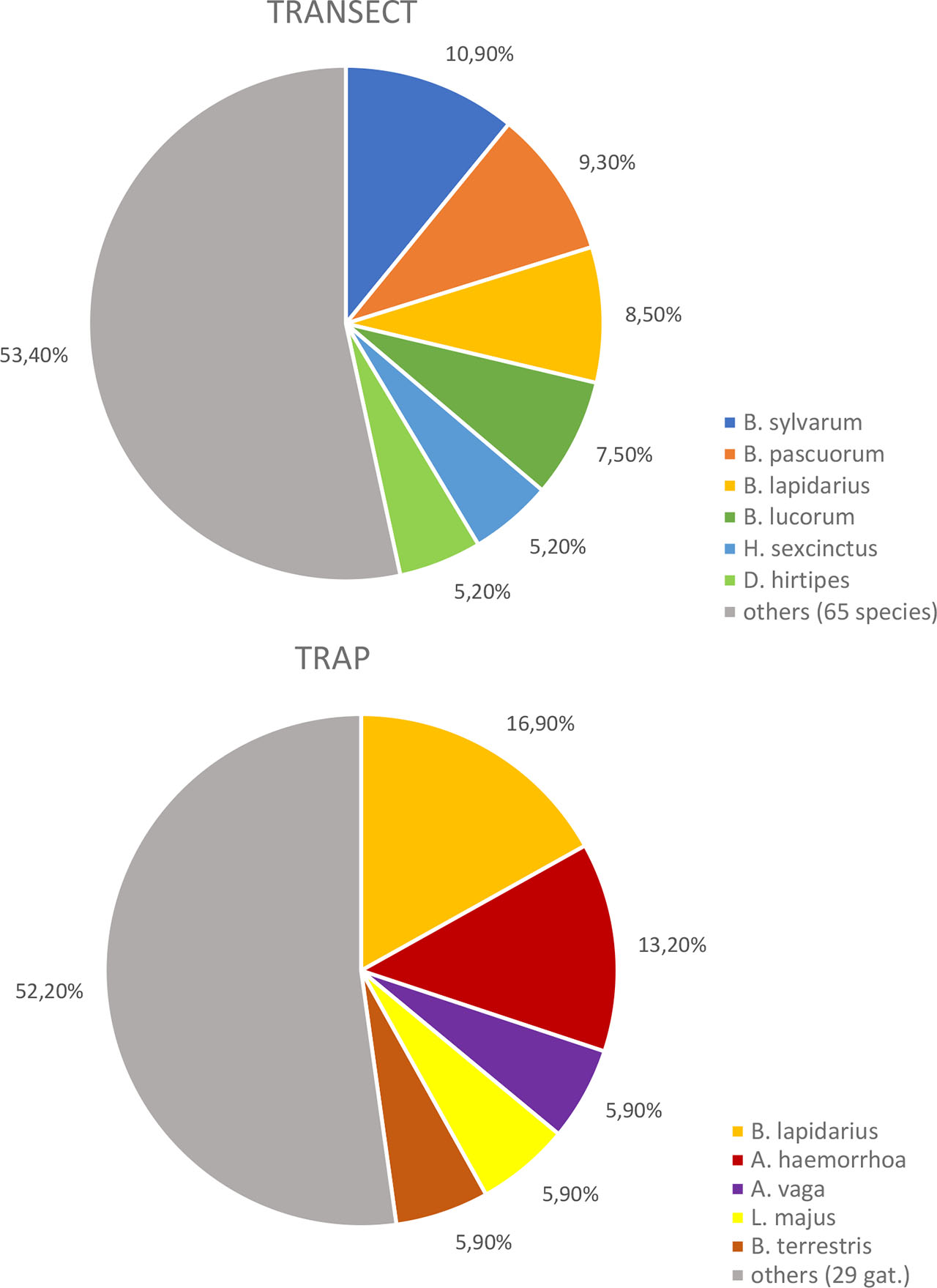
Figure 2.
Proportion of bees sampled by the use of two methods in the field (FI) of Cisowsko-Orłowiński Landscape Park
Trap method
136 specimens of 34 species were sampled by means of traps (Table 1), but they did not collect any representatives of the Colletidae family (Table 3). H’ and J’ indices reached 2.98 and 0.41, respectively (Table 2). The dominants were B. lapidarius (16.9%) and Andrena haemorrhoa (13.2%), with the codominance of Andrena vaga, Lasioglossum majus and B. terrestris (5.9% each) (Figure 2).
Table 3.
Number of bee species from individual families sampled by means of transect (t) and Moericke traps (p) on research areas of C-OLP
| Research areas | FI | ME | RE | XG | Total | ||||||||
|---|---|---|---|---|---|---|---|---|---|---|---|---|---|
| Families | t | p | t | p | t | p | t | p | |||||
| Colletidae | 1 | - | - | - | 6 | 1 | 1 | - | 6 | ||||
| Andrenidae | 19 | 11 | 9 | 4 | 16 | 8 | 17 | 5 | 31 | ||||
| Halictidae | 14 | 8 | 15 | 3 | 12 | 3 | 15 | 5 | 22 | ||||
| Melittidae | 2 | 2 | 4 | 4 | 6 | 2 | 2 | 1 | 6 | ||||
| Megachilidae | 17 | 6 | 11 | 2 | 14 | 1 | 12 | 4 | 33 | ||||
| Apidae | 19 | 8 | 22 | 8 | 15 | 9 | 15 | 13 | 28 | ||||
Area 2, meadow (ME) – 451 specimens from 56 species were sampled in the area. The value of H’ index came to 4.32, and J’ index 0.62 (Table 2).
Apidae (21 species, 220 specimens) and Halictidae (15 species, 70 specimens) prevailed (Table 1).
Transect method
60 species (333 specimens) were sampled in the meadow using this method. There were no species from the Colletidae family (Table 1, 3). H’ index for the community reached 4.38 and J’ came to 0.62 (Table 2). The dominant species were B. lucorum (12.0%), Halictus sexcinctus (8.4%), Dasypoda hirtipes (7.5%), B. ruderarius (6.3%) and Macropis europaea (5.4%) (Figure 3).
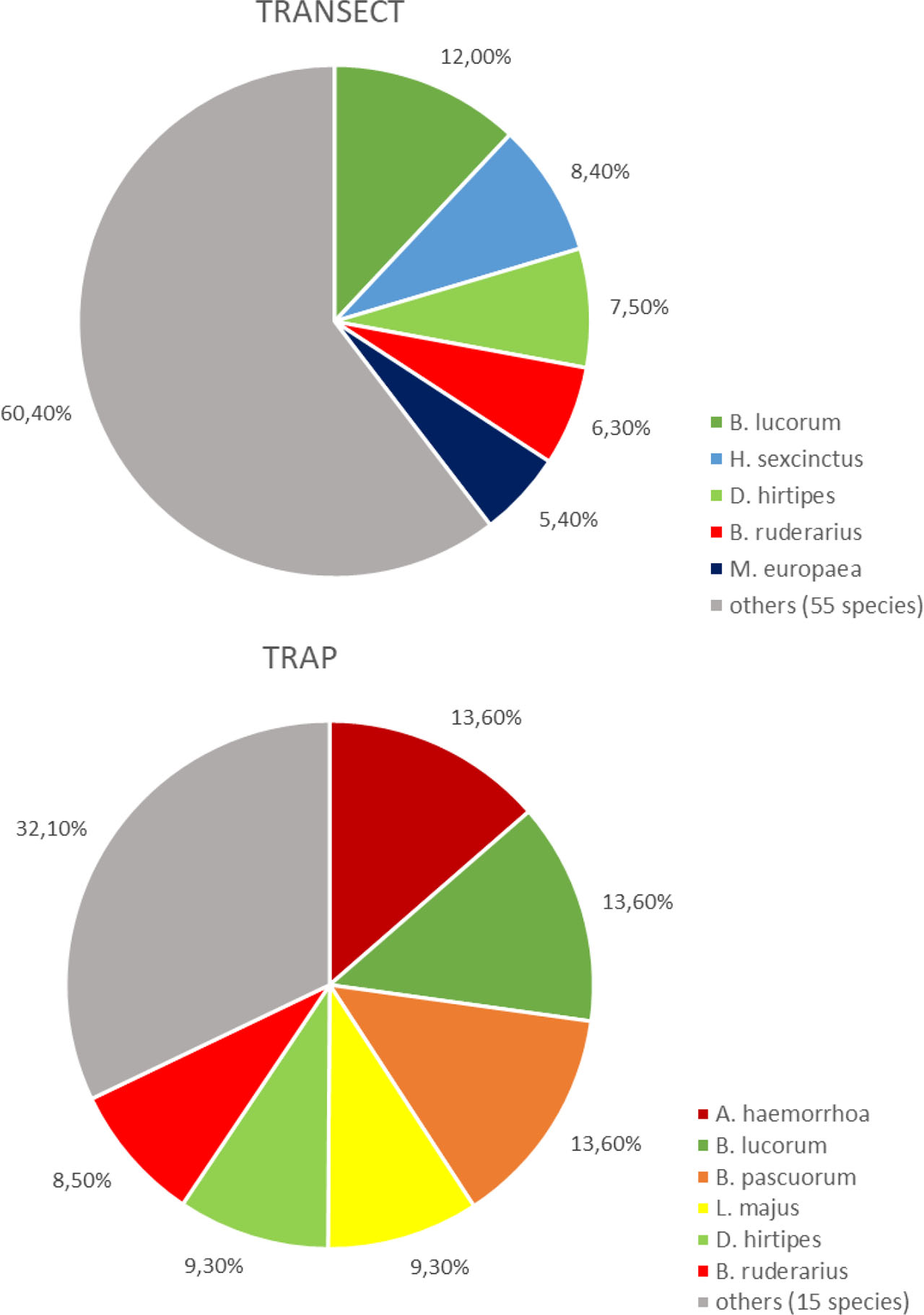
Figure 3.
Proportion of bees sampled by the use of two methods in the meadow (ME) of Cisowsko-Orłowiński Landscape Park
Trap method
The method sampled 118 specimens belonging to 21 species, also excluding species form the Colletidae family (Table 1, 3). The H’ and J’ indices reached 3.18 and 0.37, respectively (Table 2). The most common sampled species were A. haemorrhoa (13,6%), B. lucorum (13.6%), B. pascuorum (13.6%), Lasioglossum majus (9.3%), Dasypoda hirtipes (9.3%) and B. ruderarius (8.5%) (Figure 3).
Area 3, ruderal ecosystem (RE) – the species sampled in this area belonged to all the studied families: 398 specimens belonging to 73 species. The calculated values of H’ and J’ indices came to 4.26 and 0.60, respectively (Table 2).
As for the size of the population and the number of species, Adrenidae family (18 species, 80 specimens) and Apidae (17 species, 149 specimens) dominated (Table 1).
Transect method
In the ruderal ecosystem, 290 specimens belonging to 68 species were sampled and the most common were B. sylvarum (14.1%), D. hirtipes (7.9%) and B. ruderarius (6.9%) (Figure 4). Species diversity index H’ reached 4.35, and equivalent J’ 0.63 (Table 2).
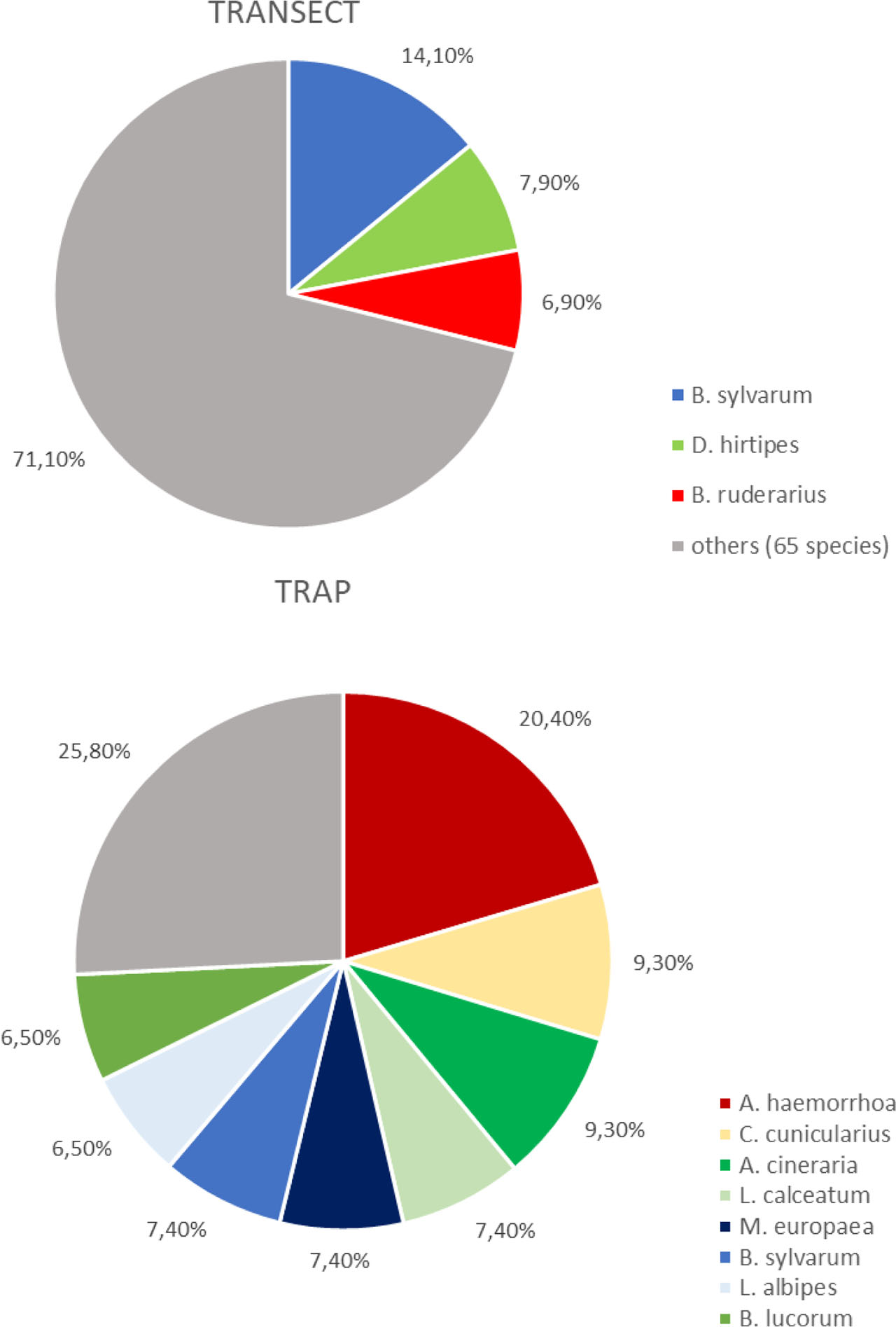
Figure 4.
Proportion of bees sampled by the use of two methods in the ruderal ecosystems (RE) of Cisowsko-Orłowiński Landscape Park
Trap method
The traps sampled 24 species, including 108 specimens (Table 1). The H’ and J’ indices reached 2.83 and 0.41, respectively (Table 2). The most common species were Andrena haemorrhoa (20.4%), Colletes cunicularius and A. cineraria (9.3% each). Lasioglossum calceatum, Macropis europaea and B. sylvarum (7.4% each), and Lasioglossum albipes B. lucorum (6.5% each) were also numerous (Figure 4).
Area 4, xerothermic grassland (XG) – the bee community in this area comprised 68 species (389 specimens). The species diversity index H’ came to 4.18 and equivalence J’ 0.57 (Table 2). The dominating bee families were Apidae (17 species, 179 specimens), Andrenidae (17 species, 81 specimens) and Halictidae (17 species, 79 specimens) (Table 1).
Transect method
By means of this method, 297 specimens belonging to 61 species were sampled in the area of xerothermic grassland. The calculated H’ and J’ indices came to 4.29 and 0.61, respectively (Table 2). The numerous samples of species included the Bombus type, that is B. lapidarius (12.1%), B. sylvarum (10.4%), B. lucorum (6.4%) and B. terrestris (5.4%) (Figure 5).
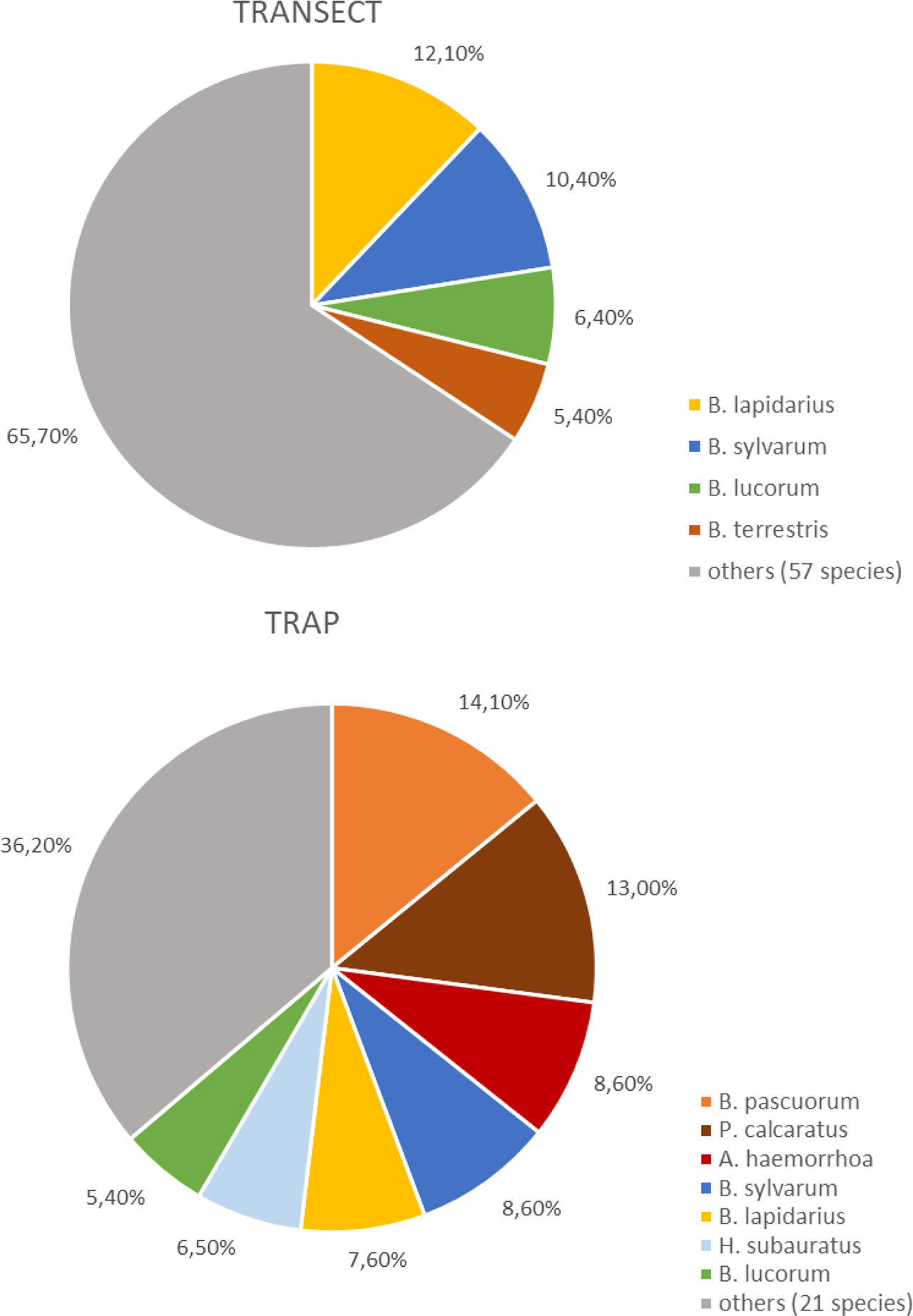
Figure 5.
Proportion of bees sampled by the use of two methods in the xerothermic grassland (XG) of Cisowsko-Orłowiński Landscape Park
Trap method
Altogether, 28 bee species with 92 specimens were sampled in the traps. They still did not include species from the Colletidae family (Table 3). The species diversity index H’ came to 2.81 and equivalence J’ reached 0.40 (Table 2). The commonly sampled species were B. pascuorum (14.1%), Panurgus calcaratus (13.0%), Andrena haemorrhoa (8.6%), B. sylvarum (8.6%), B. lapidarius (7.6%), Halictus subauratus (6.5%) and B. lucorum (5.4%) (Figure 5).
In the grassland habitats of C-OLP, the transect method was used to sample 1,307 bee specimens (74.2%) belonging to 122 species (honeybees excluded). The transect method mostly sampled bee species belonging to the following families: Andrenidae, Apidae, Megachilidae and Halictidae (Table 3). The traps sampled 454 specimens (25.8%) from 62 species. Three species were sampled in small numbers (1–2 specimens, in traps only). These included Andrena helvola, A. jacobi (Andrenidae) and Megachile willughbiella, belonging to the Megachilidae family (Table 1).
Spearman rank correlation coefficient revealed strong and positive correlation for H’, J’ and S variables. It applied to both the transect method and the traps, while the stronger correlation was demonstrated by Moericke traps.
It was found out that the number of species in all the research park areas in the research season was positively correlated, statistically significant with species diversity and equivalence. It applied both to the insects sampled by the use of transects and Moericke traps (Table 4).
Table 4.
Correlation coefficients calculated for transects and traps
| Variables | rt | rp |
|---|---|---|
| H’ & S | 0.816 | 0.882 |
| J’ & S | 0.361 | 0.501 |
| H’ & J’ | 0.665 | 0.762 |
Spearman rank correlation coefficient values were higher in the case of the traps. Very strong correlation (very strong dependence) was proved between bee species and species diversity in the traps (rp = 0.882) and in the transects (rt = 0.816). Moderate correlation (significant dependence) was proved between species equivalence and the bee species sampled in the traps (rp = 0.501). The correlation was strong (significant dependence) for other variables. The correlation was weak (clear dependence) only for the number of bee species and species equivalence of the insects sampled by means of transects (Table 4). Figures 6–11 include graphs with the regression lines.
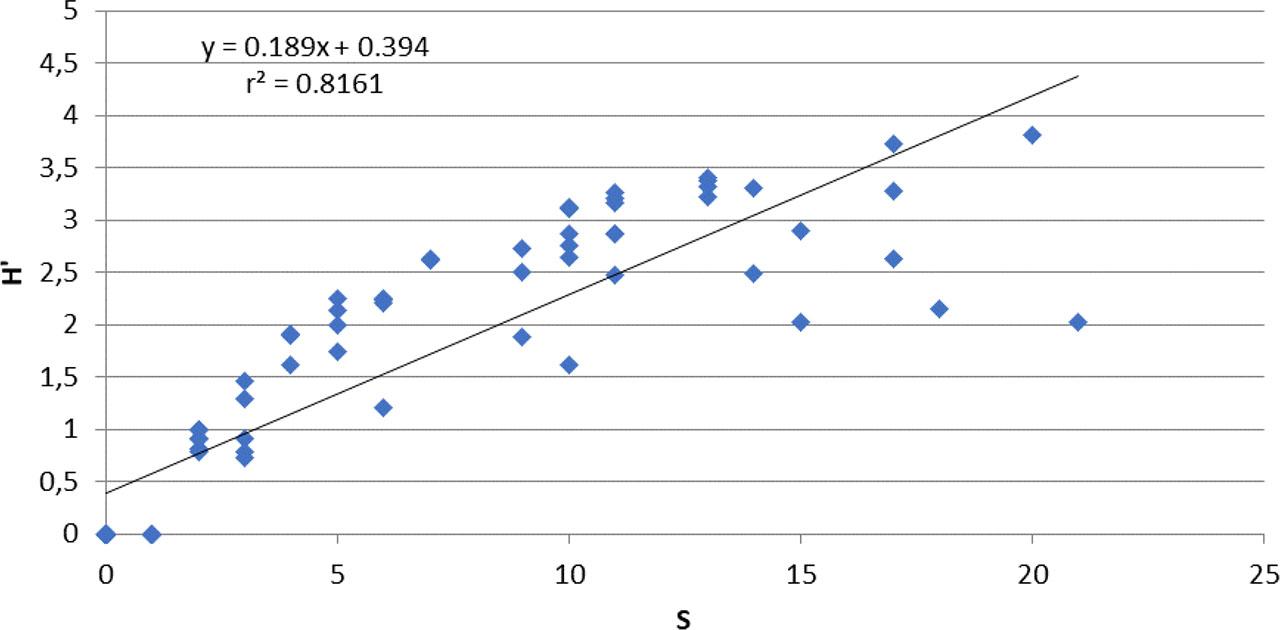
Figure 6.
Dependence between H’ and S for transects
H’ – species diversi ty
S – number of bee species
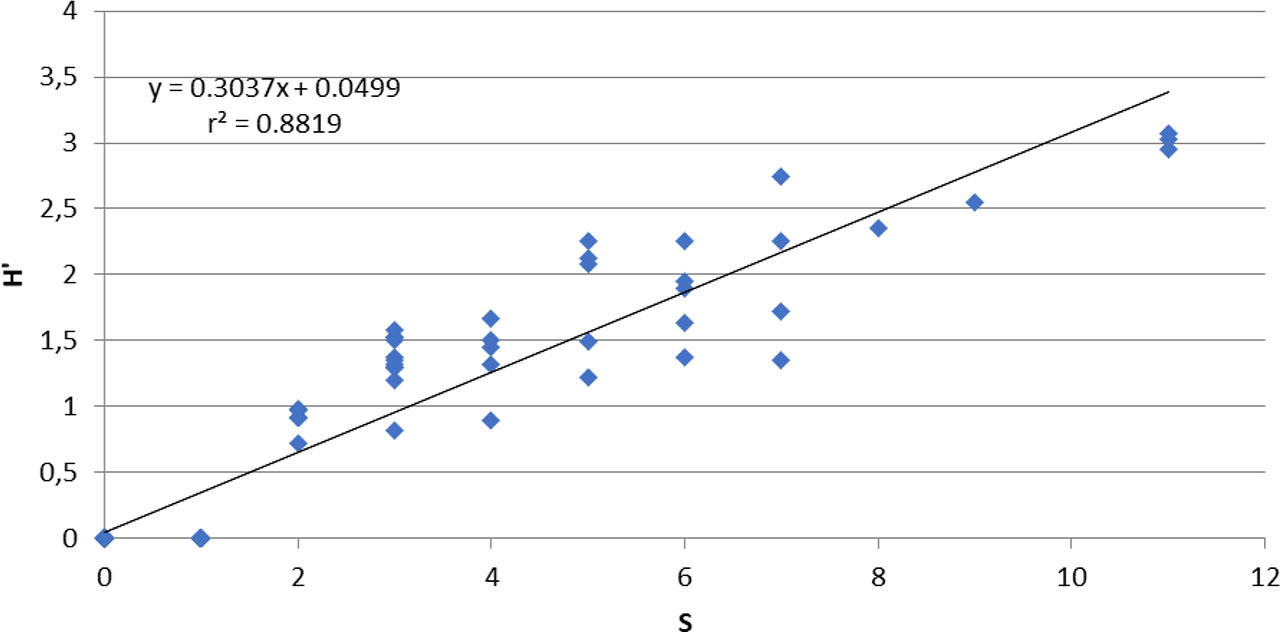
Figure 7.
Dependence between H’ and S for traps
H’ – species diversity
S – number of bee species
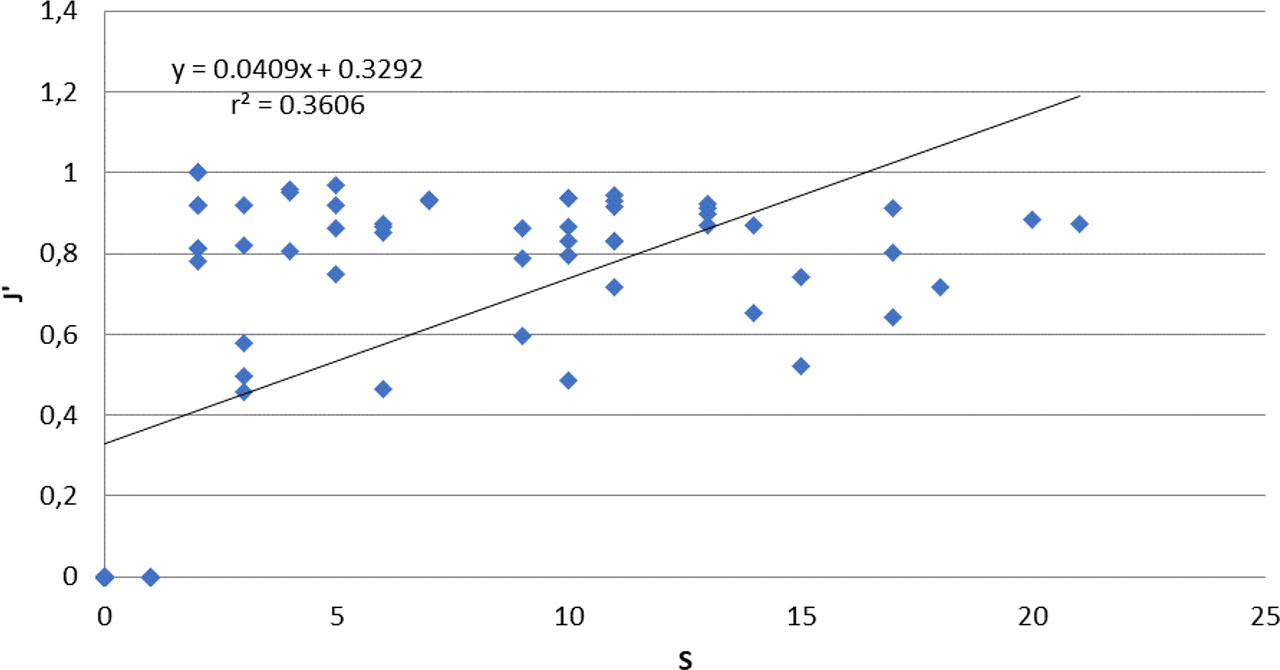
Figure 8.
Dependence between J’ and S for transects
J’ – species equivalence
S – bee species number
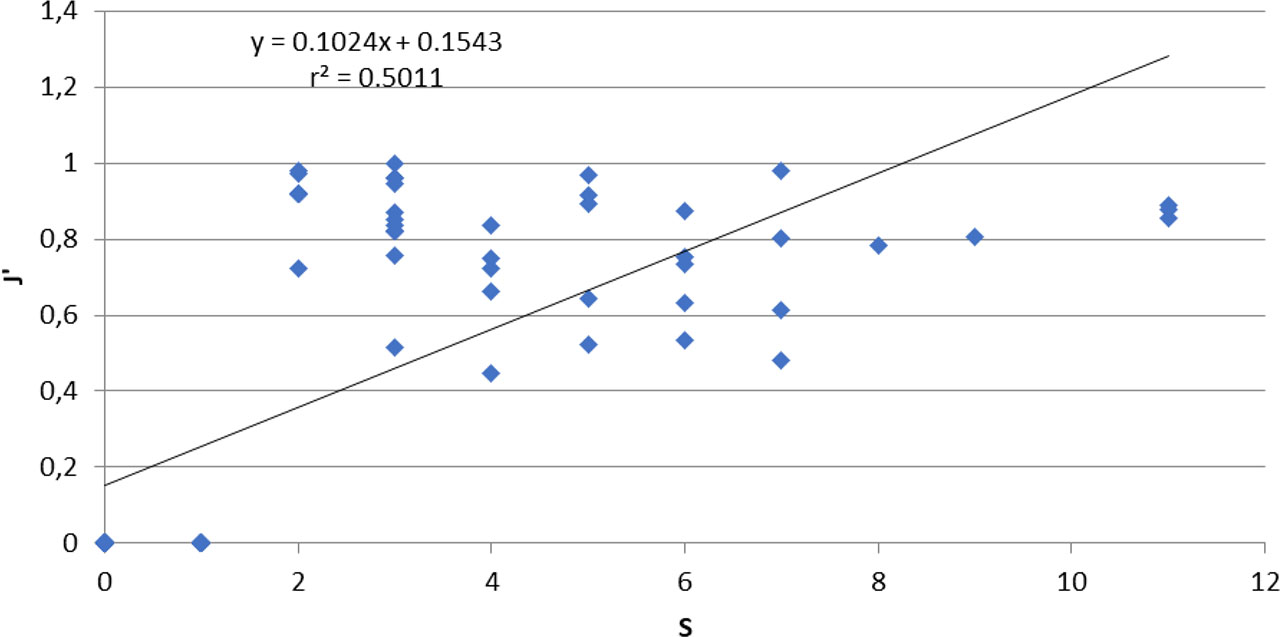
Figure 9.
Dependence between J’ and S for traps
J’ – species equivalence
S – bee spec ies number
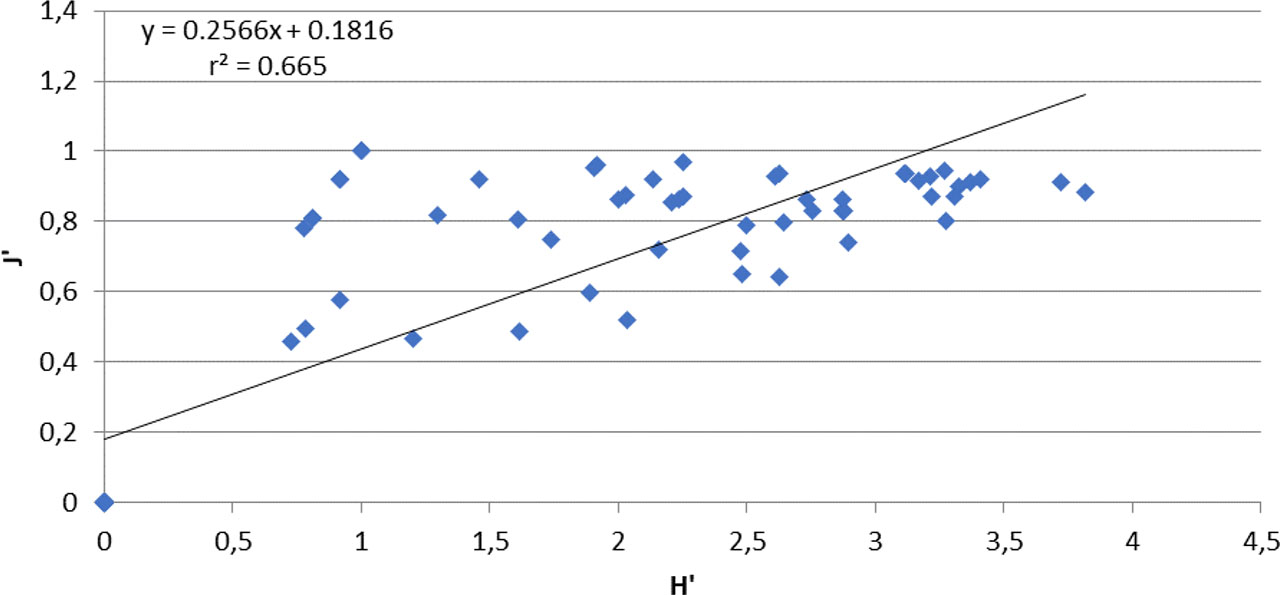
Figure 10.
Dependence between J’ and H’ for transects
J’ – species equivalence
H’ – species diversity
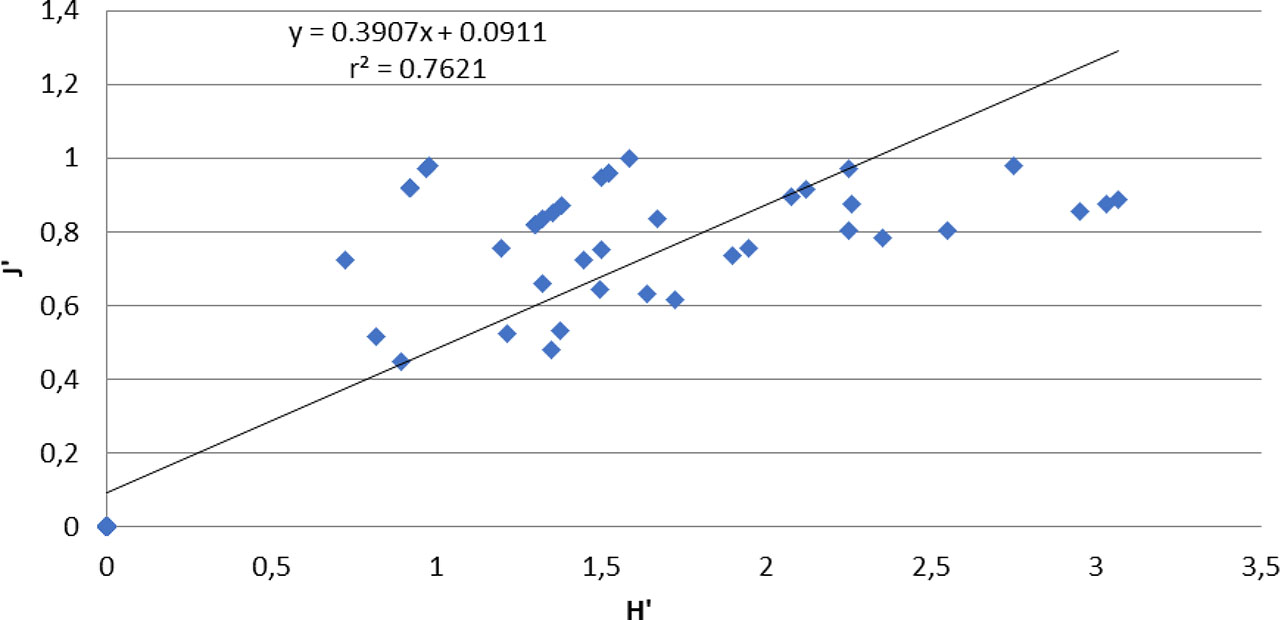
Figure 11.
Dependence between J’ and H’ for traps
J’– species equivalence
H’ – species diversity
The research findings revealed that the number of species and specimens in the communities (based on the numerical value of species and specimens) decreased in the research area gradient, starting from the field and meadow through the ruderal ecosystem to the xerothermic grassland. The system reflected the gradual increase in the overshadowing of the habitats, which followed the research assumption (Table 2).
DISCUSSION
Being a mosaic of open and forest habitats, the area of Cisowsko-Orłowiński Landscape Park constitutes one of the most important strongholds for insects, including palynivores. The grassland habitats in the park appeared to be an attractive place for insects, which is reflected in a large number of the species and specimens. 126 species inhabit the area, which make up 30% of all known bees in the area of Poland [Banaszak 2004]. The attractiveness of such habitats has also been demonstrated in research for additional insects, among others, for Chrysididae [Szczepko et al. 2013].
As the most important pollinators, bees provide valuable ecosystem service, and for that reason they play a key role in agriculture and natural habitat protection [Senapathi et al. 2015; Bänsch et al. 2021]. Decrease in species diversity of bees caused by various factors, among others, the use of pesticides, introduction of non-indigenous species, diseases or climate change [Lebuhn et al. 2013; Rasmont et al. 2015; Potts et al. 2016], together with steady increase in the demand for pollination services, emphasises the significance of these useful insects [Bommarco et al. 2013].
Most bee species are attracted to open sunny spaces covered with herbaceous flowering plants that provide food throughout the whole vegetation period. Suitable nesting and hibernation places also play a crucial role and should be protected [Steffan-Dewenter, Tscharntke 2001; Borański et al. 2019].
The bee communities in Cisowsko-Orłowiński Landscape Park are dominated mostly by species from the Apidae, Andrenidae and Halictidae families, making up 73.8% of all species communities. The majority of the insects belonged to Bombus and Andrena types, which prefer open areas. They included mostly bumblebees, that is, B. sylvarum, B. lucorum, B. lapidarius, A. haemorrhoa, D. hirtipes and H. sexcinctus.
Domination of the species of Bombus type results from their flight activity, which lasts throughout the whole vegetation season. Bumblebees begin their flight activity at 5°C (in the shade) and maintain it up to 31°C (in the sun). Due to their sensitivity to weather conditions, particularly to temperature, bumblebees demonstrate great ability to follow rapid changes in temperature (even minor fluctuation of 1°C) and air humidity [Oyen et al. 2016; Bevk, Prešern 2021; Ghisbain et al. 2023].
Other bees, for example the mason bee (Osmia spieces), become active only above 10°C and its activity ceases at 28°C [Vicens, Bosch 2000]. B. sylvarum dominates in the grassland areas of C-OLP. The species composition of their host plants indicates that the species is attracted to open areas, mostly fields and meadows, and the pollen plants growing there, mainly from the Fabaceae, Lamiaceae and Boraginaceae families [Rasmont et al. 2015]. B. sylvarum was also the most numerous species in the area of Ujście Warty National Park in the grassland habitats [Wendzonka 2020]. In the case of this species, the level of an extinction risk results, among others, from anthropogenic changes occurring in the environment. It is a species with a long tongue for which the most valuable source of pollen is plants from the Fabaceae family [Gammans 2011]. According to Biliński [2013], plants belonging to this family, like red clover, burclover, field bean or lupin, are disappearing from fields. Consequently, the population of long-tongue bumblebees (including B.sylvarum) is decreasing in nature. According to Nieto et al. [2014], approximately 23.6% of species of Bombus type are in danger of extinction, and 4.4% are close to extinction. Populations of more than 45% of bumblebees are decreasing. It is estimated that a third of all the species are in danger of extinction.
Successful protection of the bumblebee family depends on the continuity of a food supply, which is the sequence of various melliferous species of cultivated and wild plants [Pogorzelec 2019]. Unfortunately, in an agricultural landscape, apart from the abundance of flowering plants in spring, in other seasons there is not enough, or even no food, for bumblebees. Increasing lack of food (nectar and pollen) adversely affects the bodily functions of the insects and weakens their population [Filipiak et al. 2017]. Although pollen from different plant species can provide bees with a balanced diet, the knowledge of dietary preferences of various species is still scant and calls for further detailed studies. Dietary preferences of honeybees and bumblebees are well known. The protein content in pollen is particularly important to bees, and the pollen rich in protein is preferred by bumblebees [Vaudo et al. 2020]. Large population of B. lapidarius in the field and xerothermic grassland results from the fact that this species favours open habitats and flowering plants mostly with yellow petals [Pawlikowski, Pawlikowski 2012; Sikora, Kelm 2012]. According to Michołap et al. [2018] and Dubicka and Czechowski [2020], this is the dominant species, common in the area of Góry Stołowe National Park and in more than 200 areas in the Lubuskie region. The author of the study also sampled it as the dominant species in xerothermic reserves along the Nida River [Bąk 2010].
The research conducted with the two methods demonstrated that the transect method sampled three times as many bee specimens as Moericke traps. The conclusion seems vital for further research of this kind. Applying the combination of the two methods in the research enabled obtaining a more precise picture of biodiversity of these insects in the area of C-OPK. Undoubtedly, the trap method has more advantages. It enables sampling insects non-stop (both daily and seasonally), of a modest size and is also suitable for a variety of environments. It is easy to use and reliable [O’Connor et al. 2019; Hutchinson et al. 2022]. Its effectiveness does not depend on atmospheric conditions and a researcher’s experience and skills (as it does in the case of sampling by means of transects). Employing the method is particularly important in spring, with changing weather and short warm spells, when the bee’s flights take place [Buffington et al. 2021; Chinga et al. 2024].
In the present research, a smaller number of bee species and specimens were sampled with the trap method. However, more uncommon and less abundant insects, of smaller sizes, were sampled this way, for example, Andrena helvola, A. jacobi and Megachile willughbiella, 1–2 specimens of which were sampled in the field and ruderal ecosystems (traps only). Many researchers claim that the attractiveness of the traps depends on various factors, among others, on weather conditions, their location, the trap colour or how high it is hung [Haeseler 1972; Moreira et al. 2016; Acharyia et al. 2021; Jaques et al. 2023]. In the author’s ju dgement, the method should be further improved in the above-mentioned aspects.
The research findings reveal that each research area was marked with different population numbers, species abundance and species diversity (H’) and species equivalence (J’) indices. Analysing the studied bee communities in C-OLP, based on S and N values, it can be concluded that the number of species and specimens decreased in the research areas gradient, sta rting with the field and meadow through the ruderal ecosystem to the xerothermic grassland. The layout reflected gradual increase in overshadowing the habitats, which was one of the research assumptions. Also, the values of t he parameters mentioned above decreased beginning with the field and meadow throughout the ruderal ecosystem to the xerothermic grassland. Similar conclusions were drawn by Bąk-Badowska [2012] studying Apoidea communities in Świętokrzyski National Park and other landscape parks in the Kielce region. Studying bees in 54 sampling areas in these parks, the author observed a decreasing tendency in the number of bee species and specimens along with habitat overshadowing. Undoubtedly, the factor which contributed to the decrease in the bee population number and species diversity in the appointed areas of C-OLP was the process of overgrowth on the surface, mostly the xerothermic grassland, of bushes and trees, which resulted in the decrease in the number of attractive nesting places. This occurred in the ruderal ecosystem in C-OLP. Twerd and Banaszak [2013], who conducted research in the area of Góra Gipsowa Reserve — xerothermic plants reserve in the south-western Poland — concluded that the threat to proper functioning of ecosystems is posed by lack of agricultural use, that is regular grazing of breeding animals, infrequent mowing or grass burning. This leads to progressive plant succession towards tree communities, which consequently brings about changes to the bees’ fauna in the area. In their research, the authors obtained the numbers of bee species decreasing within a two-year period. Also, Banaszak and others [2010] doing research on the esker of Budzyńskie Lake in Wielkopolska National Park demonstrated that the number of bee species which inhabited the area in 1990s was 20% lower in comparison with 1970s. The process built up in the consecutive years which resulted from the overgrowing of xerothermic grassland. Similar results concerning overgrowing grassland areas and decrease in bee populations in this area were achieved by Sobieraj-Betlińska [2018, 2021], who carried out research in the xerothermic grassland covering the hill fort bank in Mietlica.
The xerothermic grassland in C-OLP is becoming overgrown with numerous bush species, which creates unfavourable living conditions for bees. The important thing is also the character of xerothermic grassland phenology and the climatic conditions prevailing there. Due to high air and soil temperature and water shortage, plants in the area finish blossoming faster, which also applies to the plants that provide nutrition for bees. Following strong changes in abiotic conditions, xerothermic grassland have been colonized by expansive native species, such as Arrhenatherum elatius and also invasive taxons of foreign plants. Invasive grass species compete and replace grassland species, which leads to the development of a permanent, almost single-species ecosystem [Symonides 1978; Hanczaruk, Bąba 2019].
It appears that both changing light conditions and inadequate food source in the studied plant communities have significant influence on the number of bee species and their population, as well as on species diversity and equivalence of the bee communities inhabiting the area. Similar research conducted by Kosior and Fijał [1992] in Za mość region concerning bee communities in open, ecotone and forest habitats proved that the degree of organization of these communities was the biggest in open, sunny habitats, and that diverse pollinator communities are more stable [Senapathi et al. 2021].
CONCLUSIONS
Grassland habitats in Cisowsko-Orłowinski Landscape Park are attractive to bees, which is testified by a large number of species and specimens sampled there.
The research findings revealed that transects proved more efficient in sampling bees than the traps. Thanks to this method more than three times as many specimens were sampled than by means of a Moericke trap.
Analysing the composition of each Apiformes community with the parameters, it was concluded that Spearman rank correlation coefficient demonstrated positive and strong correlation for H’, J’ and S variables. It referred to both the transect method and the traps.
It was concluded that the number of Apiformes species and specimens decreases along with overshadowing of the habitat.
The significant number of bee species and specimens in the grassland habitats proves such places are important for nesting, providing shelter and food for these useful insects.