
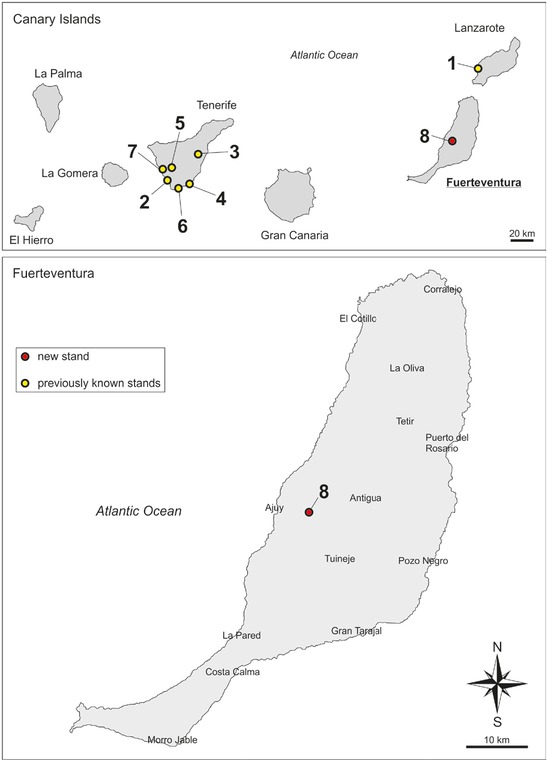
Figure 1
Distribution map of Chara connivens populations on the Canary Islands (Spain). Red circle: new stand; yellow circles: previously known stands. Stands: 1 – El Golfo, 2 – Las Cuevitas, 3 – Añocheza, 4 – Adeje, 5 –El Barranco del Infierno, 6 – Costa del Silencio, 7 – Armeñime, and 8 –El Barranco de las Peñitas. The number assigned to a given stand is consistent with the numbering used in Table 1.
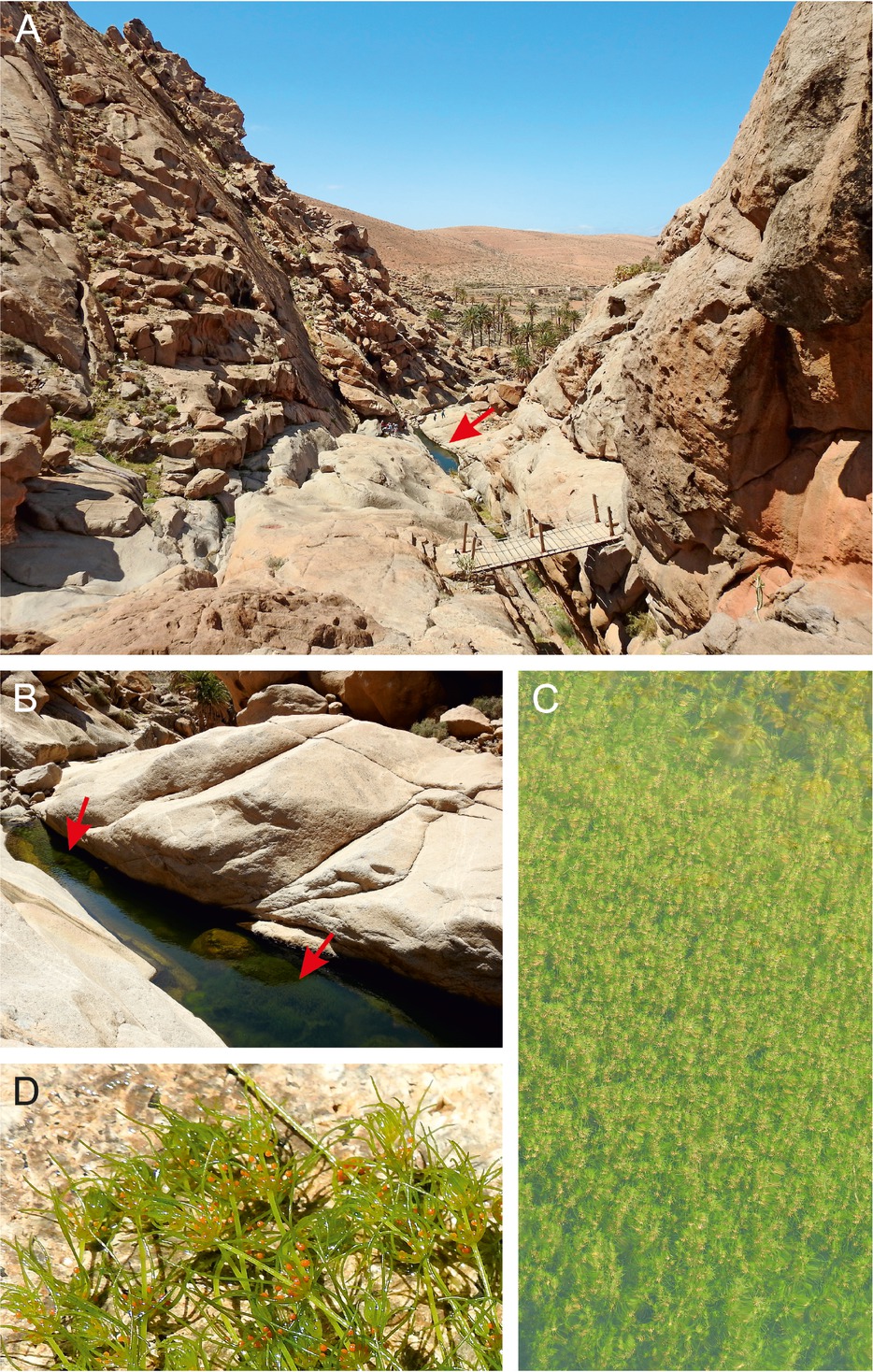
Figure 2
Habitat of Chara connivens on Fuerteventura. A – view of El Barranco de las Peñitas canyon (in western direction), with a partially water-filled rock crevice (red arrow); B – C. connivens meadows (red arrows); C – dense meadow of convergent stonewort; and D – fresh thalli of C. connivens from the stand. Photographs by A.M. Woyda-Ploszczyca
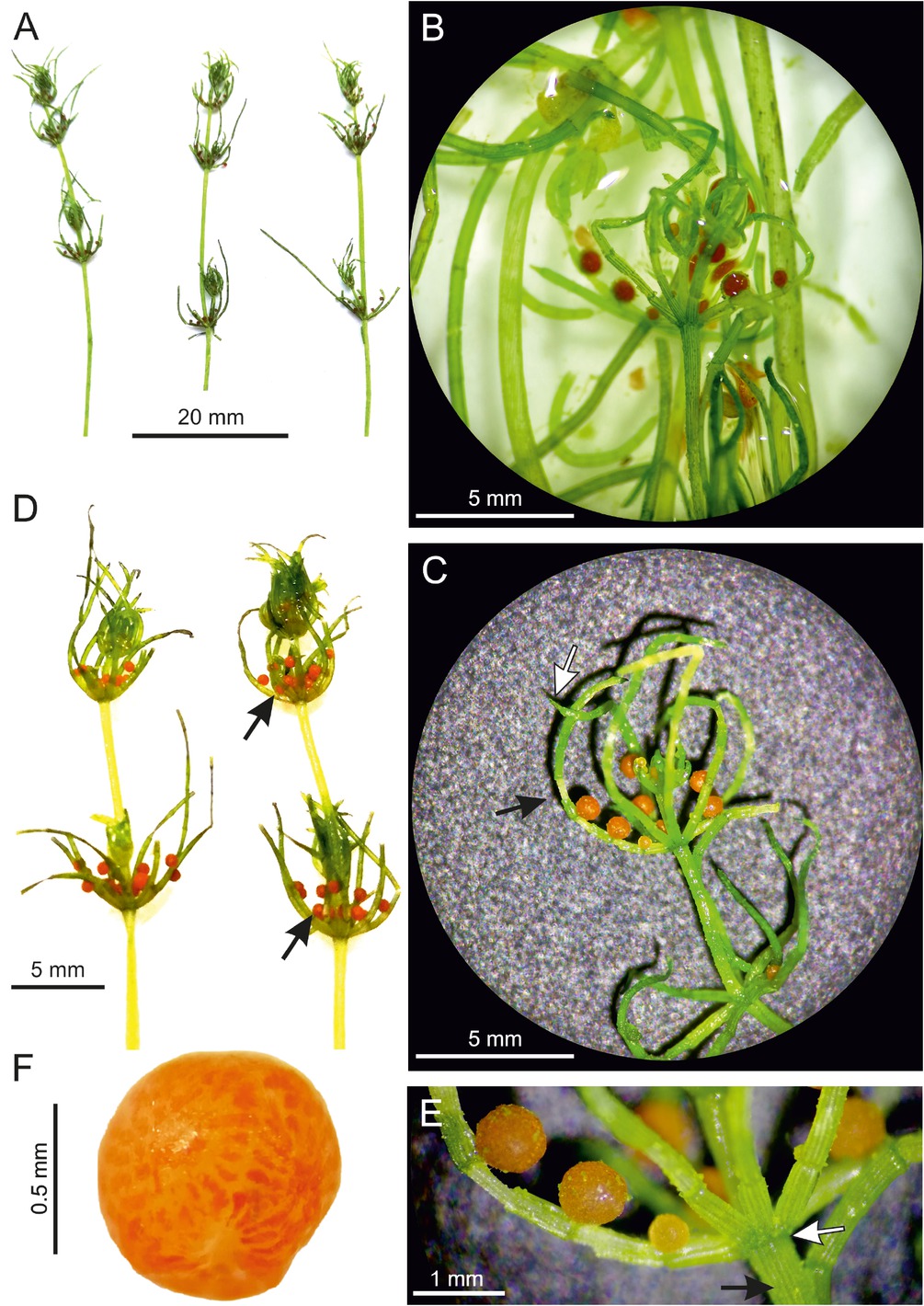
Figure 3
Male specimen of Chara connivens from the El Barranco de las Peñitas canyon (Fuerteventura Island). A – slender thalli; B – the upper part of the thallus (in the middle); C – an incurved branchlet (black arrow) and an ecorticate terminal segment of the branchlet (white arrow); D – slender thalli with visible male gametangia (antheridia); E – a node with a double whorl of rudimentary stipulodes (white arrow) and the main axis (stem) with triplostichous isostichous cortex (black arrow); and F – a single, typically orange-reddish male gametangium (antheridium). Photographs by A.S. Rybak
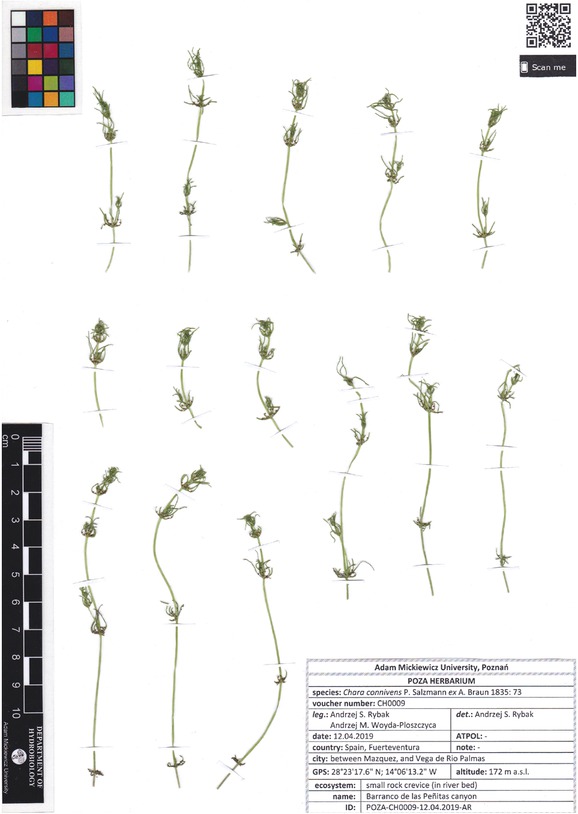
Figure 4
Herbarium specimen of Chara connivens from Fuerteventura Island (deposited in POZA herbarium). Prepared and scanned by A.S. Rybak
Table 1
Stands of Chara connivens on Canary Islands (Spain). The number assigned to a given stand is consistent with the numbering used in Figure 1
| Island | Stand | Habitat | Date | Collector(s) | Herbarium, voucher number | References |
|---|---|---|---|---|---|---|
| Lanzarote | 1. El Golfo | marine | 07.1975 | M.C. Gill Rodriguez | TFC Phyc., 2193 | Rodriguez et al. 1981 |
| Tenerife | 2. Las Cuevitas | marine | 12.1976 | E. Beltrán | TFC Phyc., 2195 | Rodriguez et al. 1981 |
| Ibid. | marine | 12.1978 | W. Wildpret E. Beltrán C. Rodriguez | TFC Phyc., 2196 | Rodriguez et al. 1981 | |
| 3. Añocheza | artificial pool | 04.1980 | W. Wildpret E. Beltrán C. Rodriguez | TFC Phyc., 2197 | Rodriguez et al. 1981 | |
| 4. Adeje | marine | 09.1982 | J.C. van Raam | JVR & L., 8201 | Raam & Gonzalez-Henriquez 1995 | |
| 5. El Barranco del Infl erno | river | 09.1982 | J.C. van Raam | JVR & L., 8202 | Raam & Gonzalez-Henriquez 1995 | |
| 6. Costa del Silencio | artificial pool | 09.1982 | J.C. van Raam | JVR & L., 8203 | Raam & Gonzalez-Henriquez 1995 | |
| 7. Armeñime | artificial pool | 09.1982 | J.C. van Raam | JVR & L., 8204 | Raam & Gonzalez-Henriquez 1995 | |
| Fuerteventura | 8. El Barranco de las Peñitas | intermittent river | 04.2019 | A.S. Rybak A.M. Woyda-Ploszczyca | POZA, CH0009 | (this paper) |
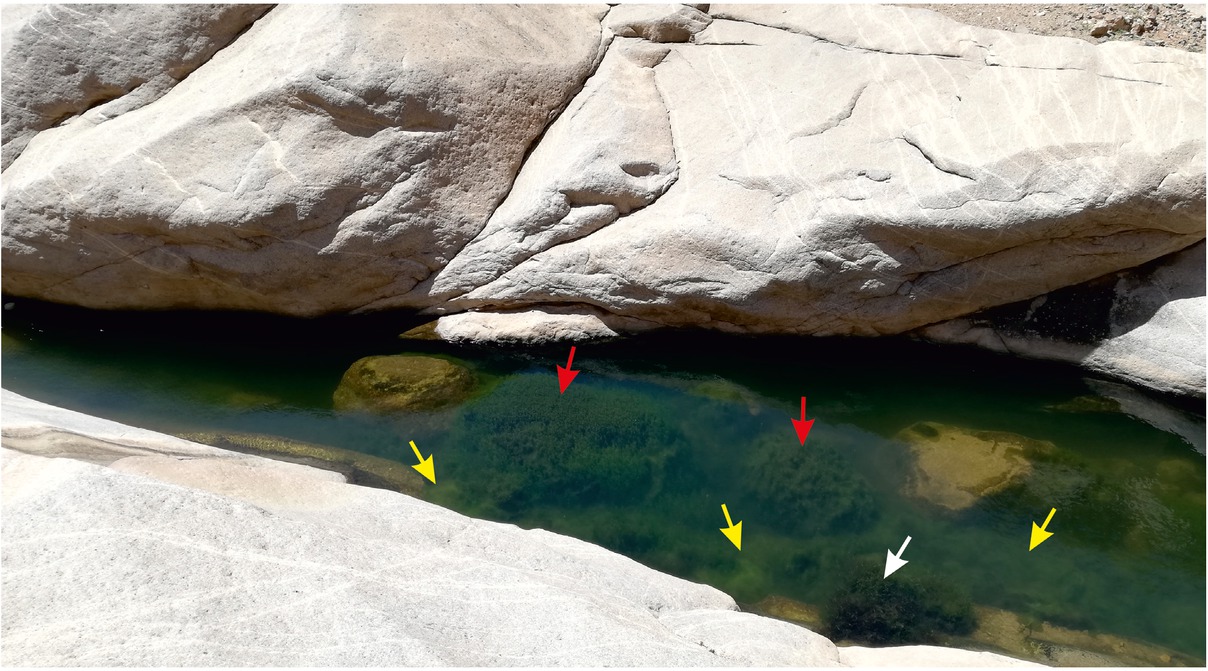
Figure 5
Chara connivens meadow (red arrows) accompanied by the “clouds” of Cladophora glomerata (yellow arrows) and shoots of Ruppia maritima (white arrow) covered with Rhizoclonium sp. filaments. Photograph by A.S. Rybak
Table 2
Physicochemical parameters of Chara connivens habitat. Number of repetitions: N = 6
| Parameter | Units | Minimum | Mean | Maximum |
|---|---|---|---|---|
| Depth of water | m | 0.8 | 1.6 | 1.6 |
| Temperature | oC | 19.3 | 19.3 | 19.3 |
| pH | – | 6.4 | 6.6 | 6.8 |
| Electrolytic conductivity | mS cm−1 | 9.8 | 10.1 | 10.3 |
| TDS | g l−1 | 6.6 | 6.6 | 6.6 |
| ORP | mV | 64.0 | 64.4 | 65.2 |
| Water color | Pt-Co mg l−1 | 14.0 | 20.1 | 25.0 |
| Turbidity | NTU | 0.6 | 0.7 | 1.0 |
| Oxygenation | % | 80.0 | 83.4 | 86.4 |
| Oxygen | mg l−1 | 7.0 | 7.4 | 7.8 |
| N-NO3 | 0.8 | 0.8 | 1.1 | |
| N-NH3 | 0.1 | 0.1 | 0.2 | |
| Fe-total | 0.06 | 0.07 | 0.07 | |
| PO4 | 2.7 | 2.7 | 2.7 | |
| SO4 | 168.0 | 196.0 | 216.0 | |
| NaCl | 2821.5 | 3206.5 | 3382.5 | |
| Salinity | PSU | 4.9 | 5.0 | 5.0 |