
Table 1.
Standard samples information
| Standard sample no. | Mn concentration (mg/mL) | Co concentration (mg/mL) | Ni concentration (mg/mL) |
|---|---|---|---|
| SS1 | 100.0 | 100.0 | 100.0 |
| SS2 | 300.0 | 300.0 | 300.0 |
| SS3 | 325.0 | 140.0 | 360.0 |
| SS4 | 120.0 | 130.0 | 330.0 |
| SS5 | 240.0 | 260.0 | 500.0 |
| SS6 | 180.0 | 150.0 | 350.0 |
| SS7 | 160.0 | 130.0 | 330.0 |
| SS8 | 140.0 | 110.0 | 310.0 |
| SS9 | 120.0 | 90.0 | 290.0 |
| MnSS1 | 100.0 | 0.0 | 0.0 |
| MnSS2 | 200.0 | 0.0 | 0.0 |
| MnSS3 | 300.0 | 0.0 | 0.0 |
| CoNiSS1 | 0.0 | 100.0 | 100.0 |
| CoNiSS2 | 0.0 | 200.0 | 200.0 |
| CoNiSS3 | 0.0 | 300.0 | 300.0 |
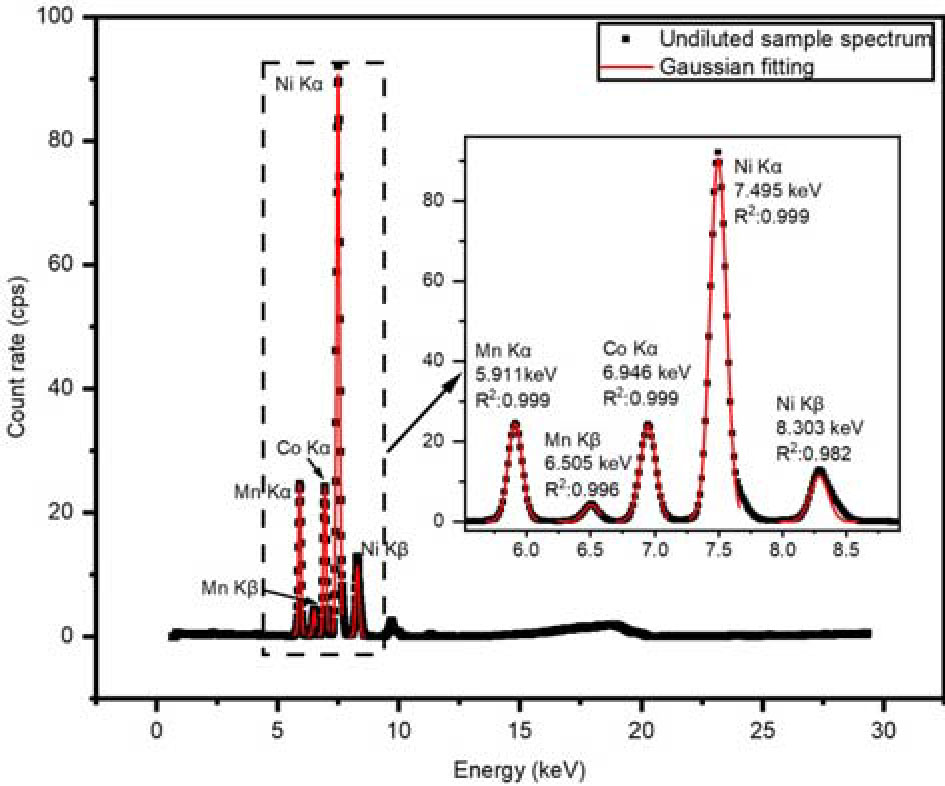
Fig. 1.
Sample energy spectrum of the test sample S1 (undiluted NCM ternary precursor solution).
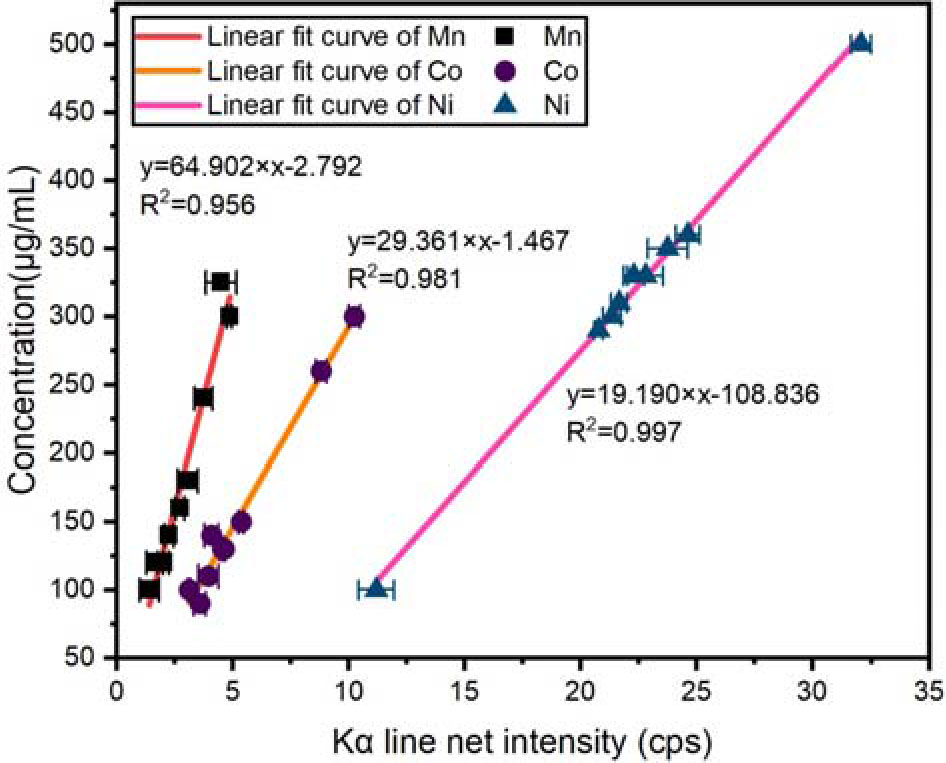
Fig. 2.
Mn, Co, and Ni calibration curves. The scatter points represent the elements of the standard samples SS1–SS9, and the straight lines are fitted curves. The data provided are in the form of mean ± SD, the number of measurements was three.
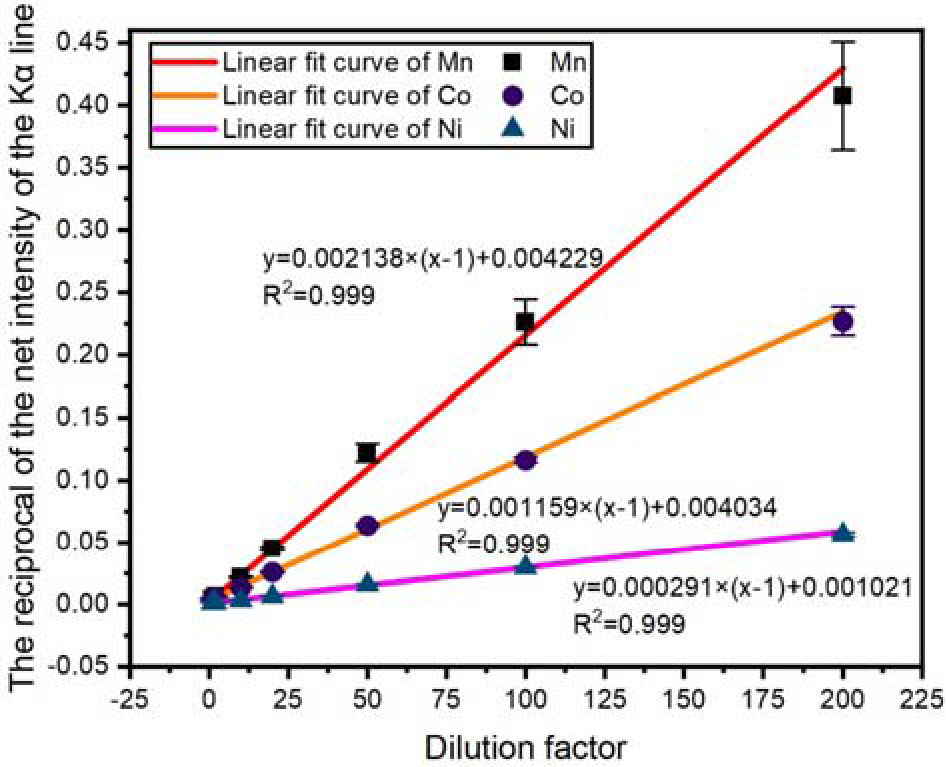
Fig. 3.
Dilution factor-characteristic X-ray intensity curves of Mn, Co, and Ni. The scatter points represent the elements of the test samples S1–S7. The straight lines are fitted using Eq. (7). The data provided are in the form of mean ± SD, and the number of measurements was three.
Table 2.
The results of the element content in the test samples using the improved matrix dilution method
| Sample no. | Dilution factor | Mn | Co | Ni | MRE (%) | |||
|---|---|---|---|---|---|---|---|---|
| mol (%) | RE (%) | mol (%) | RE (%) | mol (%) | RE (%) | |||
| S1 | 1 | 38.9 | 36.9 | 17.0 | 14.5 | 44.1 | 14.8 | 22.1 |
| S2 | 2 | 35.0 | 23.4 | 18.0 | 9.8 | 47.0 | 9.3 | 14.1 |
| S3 | 10 | 28.7 | 0.9 | 19.5 | 2.2 | 51.9 | 0.2 | 1.1 |
| S4 | 20 | 27.5 | 3.1 | 19.7 | 0.8 | 52.7 | 1.8 | 1.9 |
| S5 | 50 | 27.1 | 4.7 | 20.0 | 0.4 | 52.9 | 2.2 | 2.5 |
| S6 | 100 | 27.4 | 3.6 | 20.1 | 1.2 | 52.5 | 1.3 | 2.0 |
| S7 | 200 | 28.3 | 0.3 | 20.3 | 2.2 | 51.3 | 0.9 | 1.1 |
Table 3.
The results of the element content of the test samples using the traditional matrix dilution method
| Sample no. | Dilution factor | Mn | Co | Ni | MRE (%) | |||
|---|---|---|---|---|---|---|---|---|
| mol (%) | RE (%) | mol (%) | RE (%) | mol (%) | RE (%) | |||
| S1 | 1 | 38.9 | 36.9 | 16.9 | 15.3 | 44.3 | 14.5 | 22.2 |
| S2 | 2 | 35.0 | 23.1 | 18.1 | 9.0 | 46.9 | 9.4 | 13.8 |
| S3 | 10 | 28.8 | 1.3 | 19.4 | 2.4 | 51.8 | 0.0 | 1.2 |
| S4 | 20 | 27.5 | 3.1 | 19.7 | 0.8 | 52.7 | 1.8 | 1.9 |
| S5 | 50 | 26.2 | 7.8 | 20.4 | 2.4 | 53.4 | 3.1 | 4.4 |
| S6 | 100 | 26.8 | 5.5 | 20.6 | 3.6 | 52.5 | 1.4 | 3.5 |
| S7 | 200 | 28.7 | 0.9 | 19.8 | 0.7 | 51.6 | 0.4 | 0.7 |
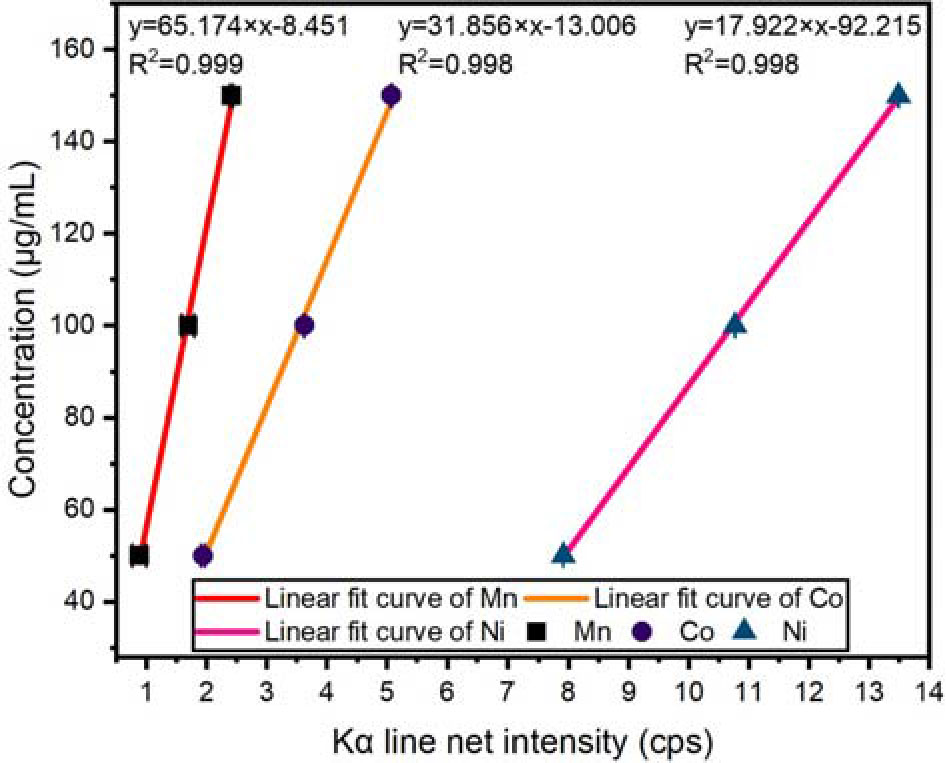
Fig. 4.
Calibration curves used to calculate the LOD and quantification of Mn, Co, and Ni. The scatter points represent the elements of the standard samples MnSS1– MnSS3 and CoNiSS1–CoNiSS3. The straight lines are fitted curves. The data provided are in the form of mean ± SD, the number of measurements was three.