
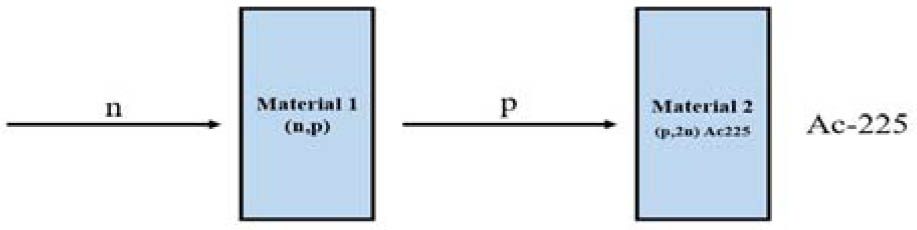
Fig. 1
Ac-225 generation process.
Table 1
Stages to find the optimum parameters for Ac-225 generation
| Simulation | |||
|---|---|---|---|
| Stage 1: Bombarding RaCl2 target with high energy protons | |||
| Steps | 1 | 2 | 3 |
| Vary proton energy | Vary RaCl2 target thickness | Find optimum conditions to produce Ac-225 | |
| Stage 2: Bombarding several materials with neutrons to generate high energy protons found in the optimum condition for stage 1 | |||
| Steps | 1 | 2 | 3 |
| Vary neutron energy | Vary material type and thickness | Find optimum conditions to generate high energy protons | |
| Stage 3: Combining results from stages 1 & 2 to simulate two hollow cylinders: the inner cylinder is a proton-producing target, and the outer cylinder is RaCl2 to produce Ac-225 | |||
| Steps | 1 | 2 | |
| Proton production (n,p) | Ac-225 production (p,2n) | ||
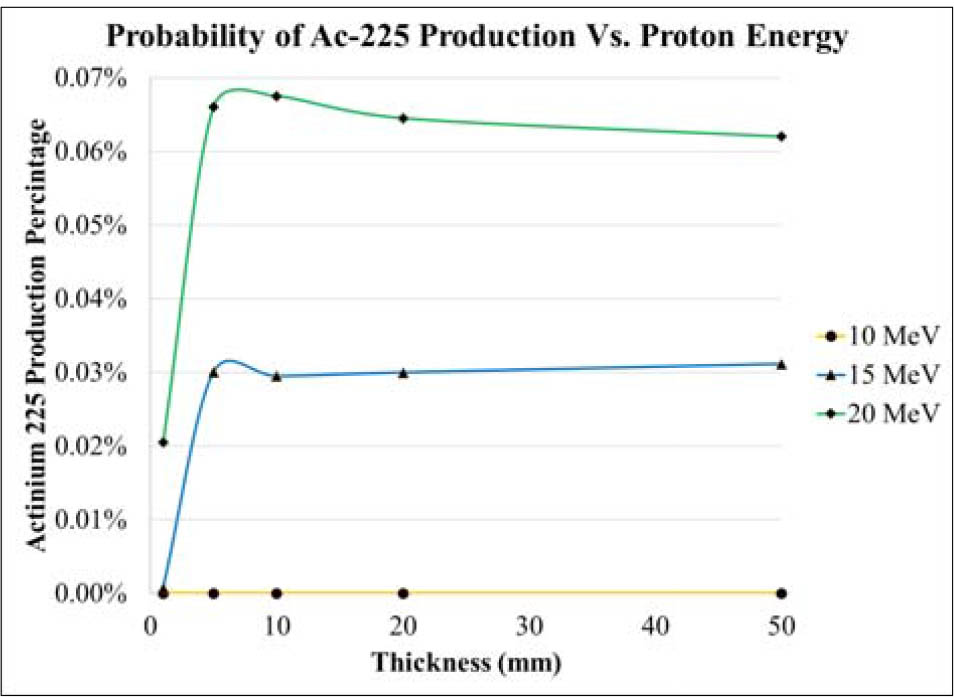
Fig. 2
Probability of producing Ac-225 from bombarding RaCl2 with high energy protons inside the cylinder target as a function of proton energy. The target density is 4.9 g/cm3. An isotropic point proton source was placed inside a RaCl2 cylinder with a 3 cm height and varying diameter (thickness) in an air volume.
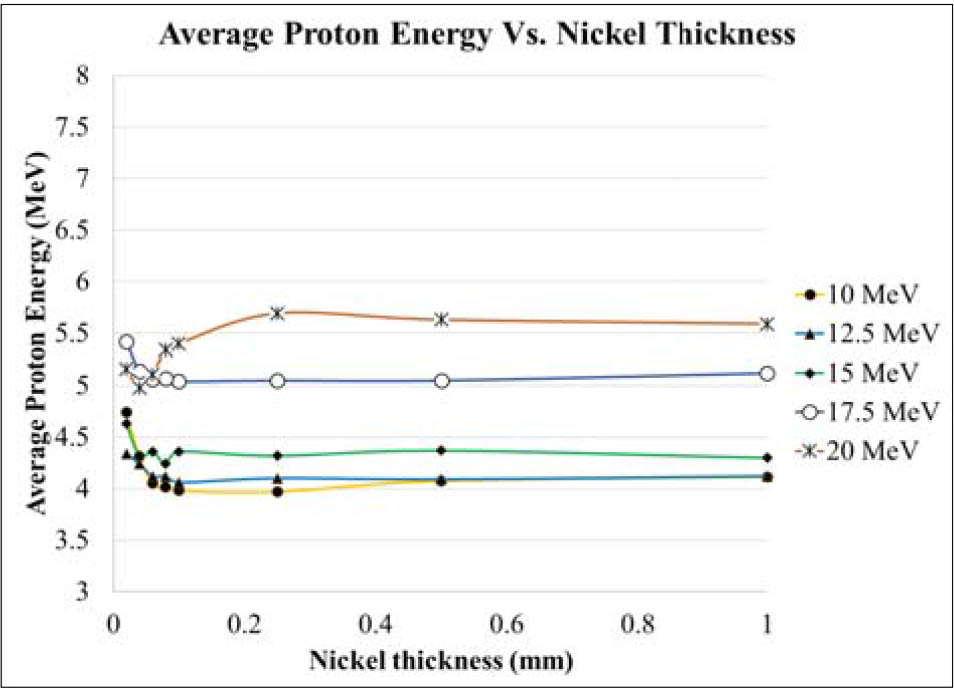
Fig. 3
Average proton energy generated from neutron beams interacting with nickel at several thicknesses.
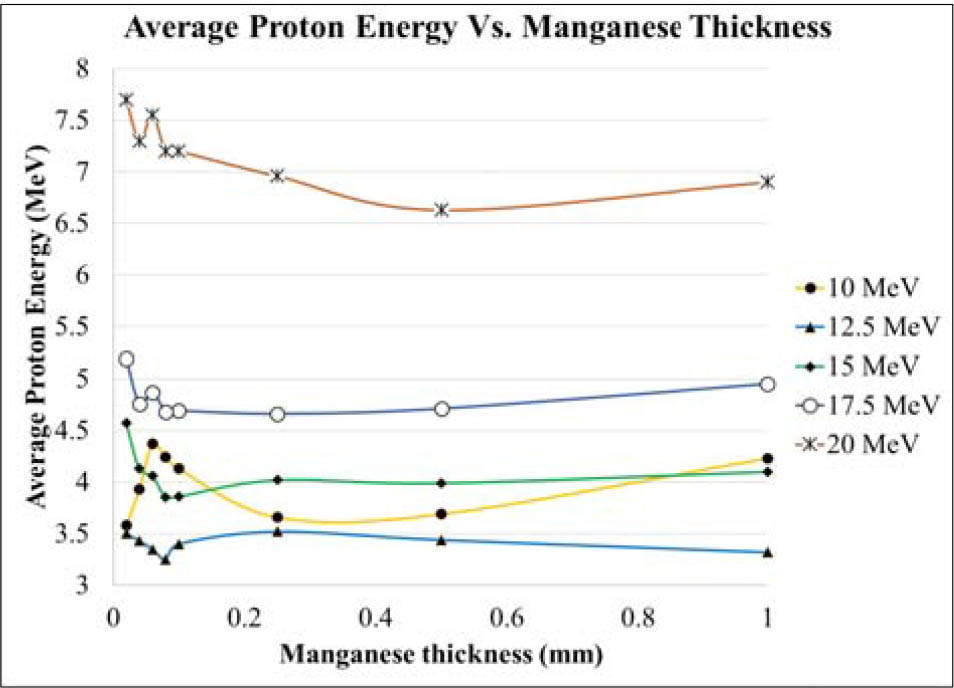
Fig. 4
Average proton energy generated from neutron beams interacting with manganese at several thicknesses.
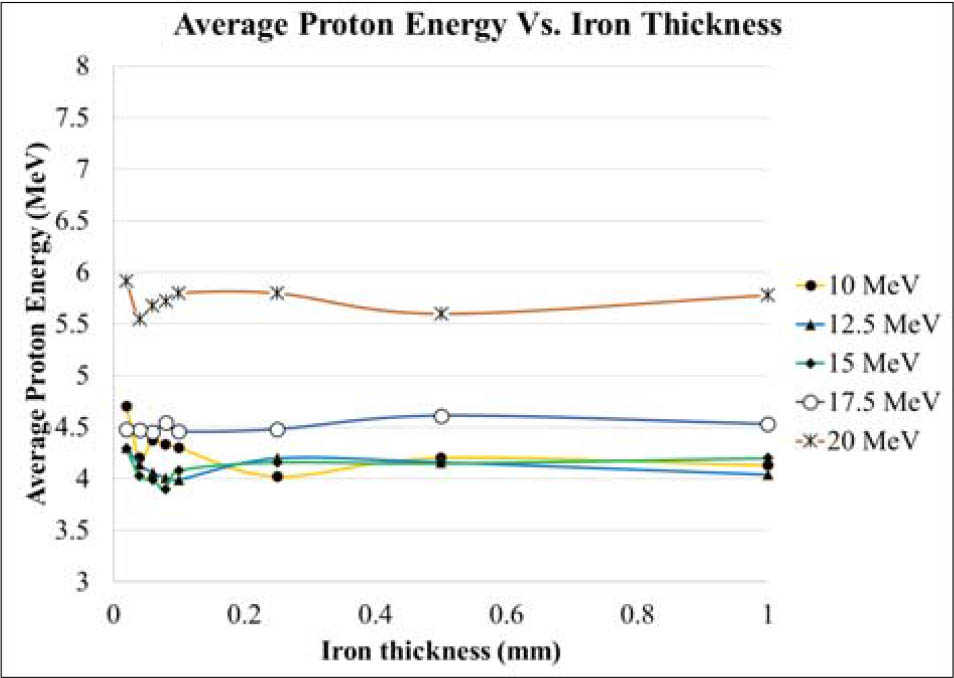
Fig. 5
Average proton energy generated from neutron beams interacting with iron at several thicknesses.
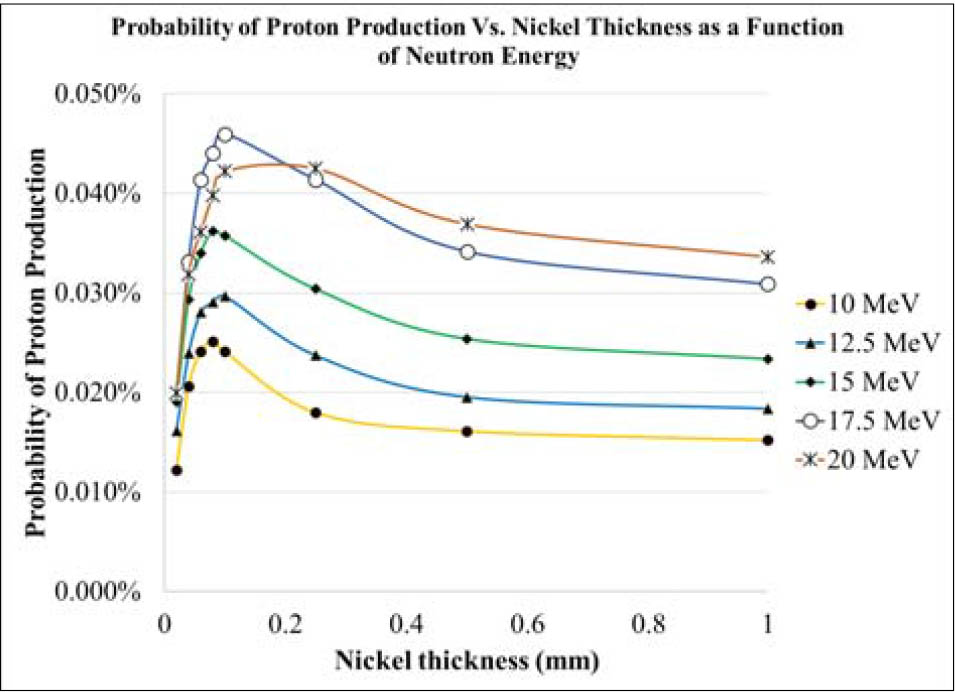
Fig. 6
Probability of proton production from neutrons incident on nickel at different thicknesses as a function of neutron energy. The target density is 8.9 g/cm3. An isotropic point neutron source was placed inside a RaCl2 cylinder with a 3 cm height and varying diameter (thickness) in an air volume.
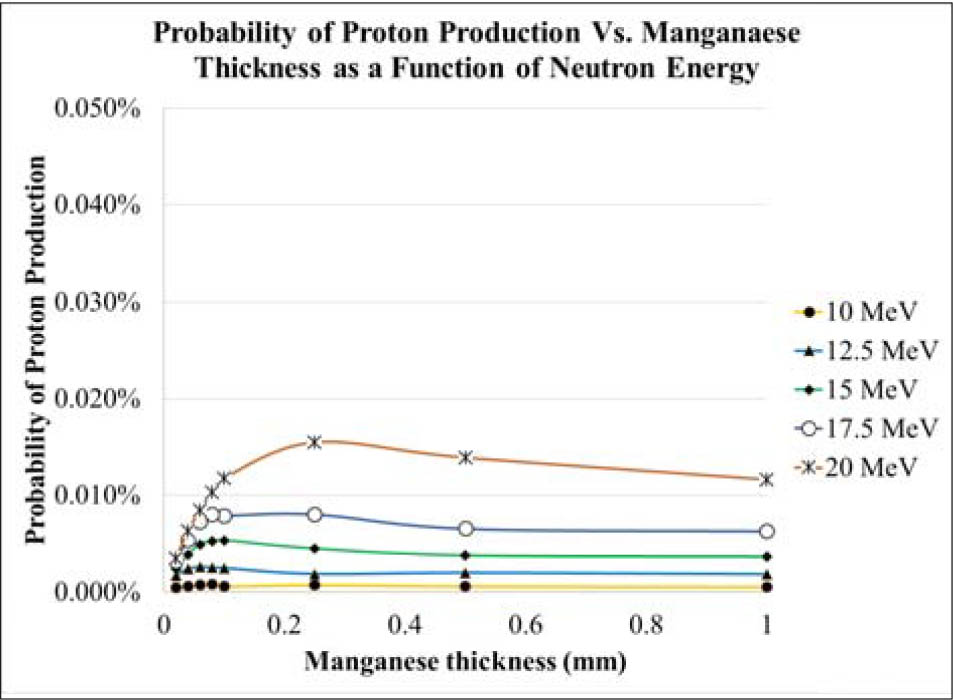
Fig. 7
Probability of proton production from neutrons incident on manganese at different thicknesses as a function of neutron energy. The target density is 7.43 g/cm3. An isotropic point neutron source was placed inside a RaCl2 cylinder with a 3 cm height and varying diameter (thickness) in an air volume.
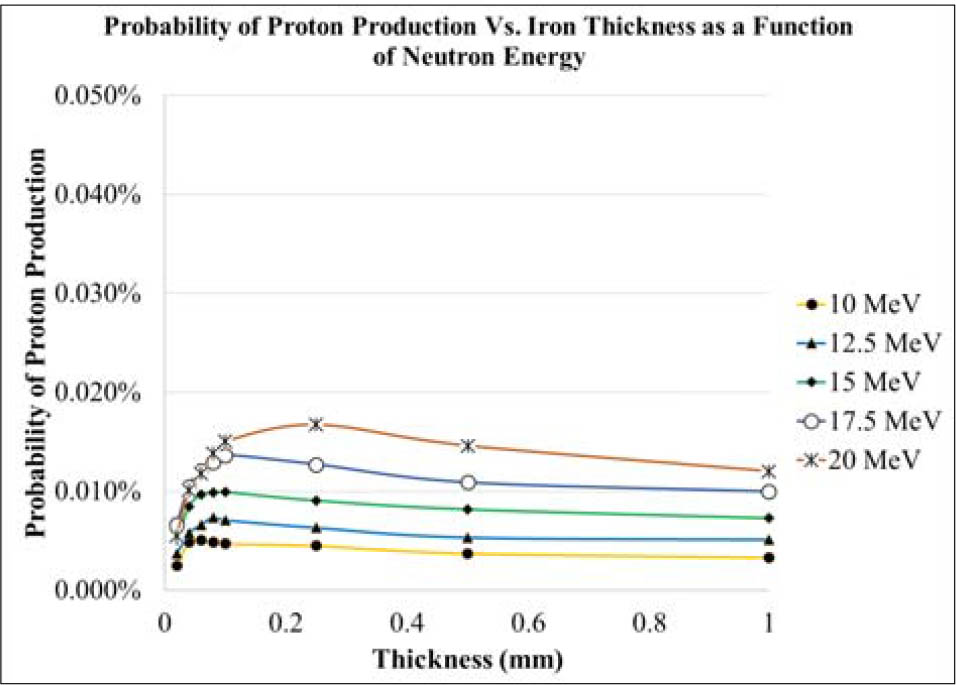
Fig. 8
Probability of proton production from neutrons incident on iron at different thicknesses as a function of neutron energy. The target density is 7.87 g/cm3. An isotropic point neutron source was placed inside an RaCl2 cylinder with a 3 cm height and varying diameter (thickness) in an air volume.
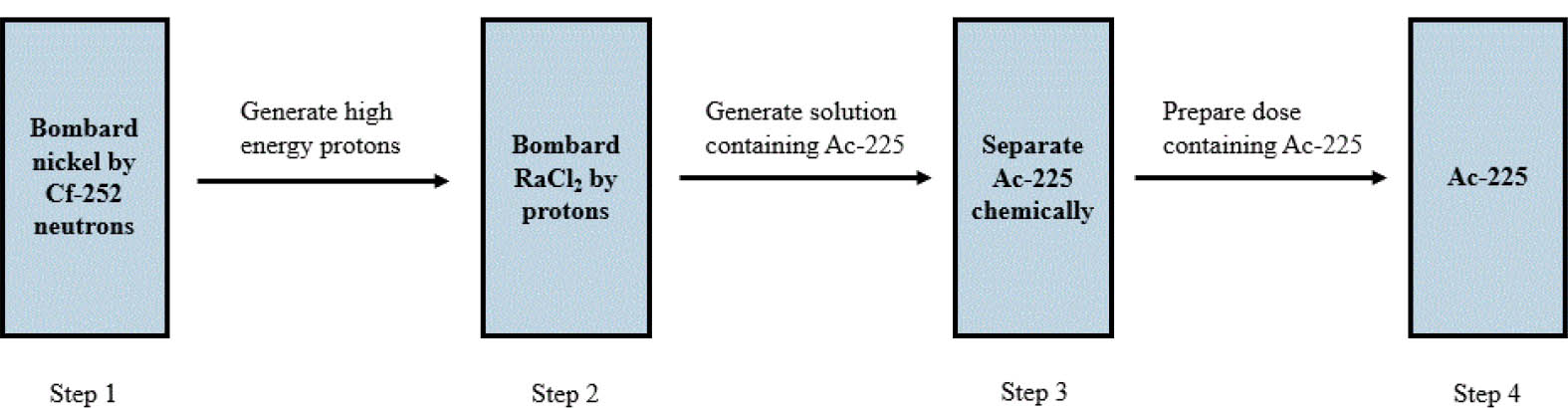
Fig. 9
Proposed Ac-225 generator.