

Introduction
The rapid shift from linear broadcasting to video on demand (VoD) is transforming how public service media (PSM) organisations fulfil their democratic and cultural mandates. In on-demand environments, audiences no longer encounter content through fixed schedules but through interfaces structured by rows, banners, and algorithmic cues. In this context, content prominence – the visibility granted to specific titles within platform interfaces – becomes a central mechanism through which cultural value is distributed. For PSM, this development is normatively significant. If universality, diversity, and cultural representation are core public value commitments, then the interface is no longer a neutral display but a strategic site where these commitments are operationalised or undermined. Regulatory debates on prominence and discoverability reflect growing concern that visibility, rather than mere availability, determines what audiences actually watch (García Leiva & Mazzoli, 2023; Iordache & Raats, 2023; Iordache et al., 2024; Lobato et al., 2024).
At the same time, empirical research has struggled to keep pace with this transformation. Studies of media diversity have long distinguished between supply-side diversity (what is made available) and exposure or consumed diversity (what audiences actually encounter and use) (Helberger, 2012; Helberger et al., 2016; Moreau & Peltier, 2004; Napoli, 1999, 2011). In digital environments, where choice is abundant yet attention is scarce (Helberger, 2012; Hindman, 2007; Napoli, 2011), this distinction becomes even more consequential. Recent VoD research has called for integrating catalogue analysis, interface studies, and audience metrics to understand how publishing strategies mediate circulation from availability to prominence and ultimately to consumption (Bengesser et al., 2024; Lobato et al., 2024). Yet most studies still focus either on catalogue composition or interface description, leaving the concrete relationship between prominence and viewing numbers underexplored.
Theoretically, prominence must be understood within the broader framework of affordances (Gibson, 1979; Nagy & Neff, 2015). VoD services are sociotechnical environments that enable and constrain particular forms of action. Prominence operates as a form of interface-based circulation power: It prioritises certain titles and, potentially, certain cultural forms. While some empirical evidence suggests correlations between content placement and streaming viewing (Thurman et al., 2023), this relationship is difficult to interpret causally. Visibility may influence audience attention, but it may also be endogenous to it, as already popular content is more likely to be granted prominence through editorial or algorithmic feedback loops (Webster, 2014).
For PSM, these questions are particularly pressing. Comparative research shows that European PSM organisations oscillate between differentiation – emphasising domestic and culturally specific programming – and mimicry of commercial VoD logics (D’Arma et al., 2021; Iordache & Raats, 2023). Yet, the sector still lacks systematic evidence on how prominence functions within PSM VoD services, and how it relates to viewing patterns. Likewise, there is limited understanding of how the diversity of content available in the catalogue differs from the diversity of content promoted and the diversity of content consumed.
Against these gaps, I address two research questions in this article:
To what extent does content prominence relate to viewership on a PSM VoD platform?
How does diversity vary across content available in the catalogue, content given interface prominence, and content consumed by audiences?
To answer these questions, I draw on longitudinal data from ERR’s VoD service. I examine how prominence, broadcast recency, and VoD premiere indicators relate to viewership (measured as the number of streaming visitors), and how patterns of visibility reshape diversity across content types, origins, and production years. By combining one year of daily catalogue, prominence, and viewership data, the study provides an empirically grounded account of prominence as both a technical affordance and a strategic editorial tool within PSM.
Empirical and theoretical framework
The study builds on a theoretical framework that integrates three interlinked concepts: the technical affordances of VoD platforms, prominence, and media diversity. The framework is situated within the context of transforming PSM and the case presented in the article – ERR – where questions of public mandate are increasingly negotiated through VoD services and digital publishing practices.
Technical affordances of VoD, prominence, and media diversity
The concept of affordances, introduced by Gibson (1979), describes how environments enable or constrain particular actions. Building on this perspective, Nagy and Neff (2015) have argued that affordances should also be understood as sociotechnical constructs that emerge through the interaction between technological properties, human agency, and social context. In this sense, VoD services are not neutral distribution channels but sociotechnical environments that offer specific possibilities for action; their use depends on how these possibilities are perceived, interpreted, and enacted by users within specific social and cultural contexts.
For instance, VoD viewing offers a personalised media experience, allowing users to control what and when they watch, thereby emphasising user freedom and active audiences. The auto-play feature, in addition to making whole seasons available at once, not only facilitates immediate and prolonged viewing but also shapes viewers’ habits and perceptions of series consumption (Markham et al., 2019). The immersive and escapist experience of frictionless viewing has a strong positive impact on user preferences for VoD (Evens et al., 2023). However, service architecture enables certain types of content visibility and actions while constraining others. For instance, VoD platforms promote content on prime shelves and employ interface designs that steer users towards perceiving the platform as a continuous, channel-like flow (Matthew, 2020). Additionally, VoD content presentation is predominantly structured by genres and periodic or functional categories. Ultimately, the technical affordances of VoD translate into systems of visibility that determine which titles or genres gain prominence, also shaping how audiences understand and perceive VoD services.
Content prominence refers to the visibility of content within the interface and functions as an operational tool shaping how easily audiences can encounter specific titles, notably through placements in key areas such as hero, top, or featured banners. The most visible area has been described as “prime space” (Bideau, 2020), analogous to prime time in linear broadcasting. Yet, prominence is a multidimensional concept that extends beyond placement, also encompassing the frequency and duration of a title’s appearance in highlighted areas (Bruun & Lassen, 2023; Kelly & Sørensen, 2021; Sørensen, 2025) and, in personalised interfaces, its presence in algorithmic recommendations and search results (García Leiva & Mazzoli, 2023).
The latter dimensions somewhat overlap with the concept of discoverability. However, while discoverability concerns the ease with which users can find content, prominence captures the degree of priority assigned to specific content by the platform itself (Hesmondhalgh & Lotz, 2020; Iordache et al., 2023; Lobato et al., 2024). Therefore, content prominence embodies a form of interface-based circulation power that refers to the ability to steer attention and shape cultural visibility. What is promoted within the interface often mirrors the strategic or commercial goals driving the organisation (Hesmondhalgh & Lotz, 2020). In the case of PSM, such prominence may also reflect the realisation of public service objectives.
Prominence is thus a strategic curatorial act, shaped by both human and algorithmic decision-making. It has measurable implications: Content that is more prominently positioned is more likely to be discovered, and ultimately more likely to be viewed (Hesmondhalgh & Lotz, 2020), creating a feedback loop where content’s popularity reinforces its visibility and viewership (Webster, 2014).
Media diversity has long been recognised as a key democratic principle ensuring that citizens have access to a broad range of sources and viewpoints to make balanced and well-considered decisions (Hartley et al., 2020; Helberger et al., 2016). For PSM, diversity is therefore not only an outcome of market plurality, but a core institutional responsibility tied to citizenship, inclusion, and cultural representation. However, the meaning of diversity has evolved alongside technological and institutional change. Early approaches treated diversity as a supply-side property, that is, the range of content types and sources made available (McQuail, 1992). Napoli (1999, 2011) challenged this perspective by arguing that true diversity should be assessed in terms of exposure, conceptualising it as the extent to which audiences consume a diverse array of content. A similar distinction has also been made, albeit using different terminology, between supplied and consumed diversity (Moreau & Peltier, 2004). This distinction is important because, despite the expansion of choice brought about by the digital era, audience attention often concentrates on familiar or preferred content (Helberger, 2012; Hindman, 2007; Napoli, 2011), producing a gap between supply-side and demand-side diversity. More recently, the emergence of interface-driven curated media environments has further refined the audience perspective. In digital platforms, the content to which users are exposed is no longer equivalent to the content they ultimately choose to consume. For example, in the context of VoD services, where content prominence plays a crucial role in determining discoverability, it becomes necessary to distinguish between the content to which audiences are exposed through the VoD interface and the content they actually watch – that is, consumed diversity. Recent approaches therefore call for distinguishing between exposure diversity, referring to the diversity of content presented on the interface, and consumption diversity, referring to the diversity of content with which users actually engage (Loecherbach et al., 2020; Mattis et al., 2024). Likewise, research on PSM VoD services has conceptualised exposure as the presentation of content within VoD interfaces, emphasising that the diversity of exposed content constitutes an important object of analysis in its own right (Bengesser & Sørensen, 2024; Sørensen, 2025). Bengesser and colleagues (2024) have further argued that publishing strategies mediate the entire circulation chain from catalogue presence to interface visibility and ultimately to consumption.
Building on this interface-oriented understanding of diversity, the article distinguishes three interlinked stages of diversity: available diversity, referring to the range of content available in the catalogue; exposure diversity, referring to the subset made visible through the interface (i.e., content prominence); and consumed diversity, referring to the content audiences watch.
While demand-side diversity is often conceptualised and operationalised at the level of individual users and their media repertoires (e.g., Helberger et al., 2016; Moe et al., 2021), in this study I examine consumed diversity at the aggregate audience level, corresponding to what Napoli (1999) termed horizontal diversity. I examine how editorial curation and audience choice together redistribute audience attention across content characteristics. This provides a perspective for assessing the public value of curated PSM VoD services. Rather than asking how diverse the content consumed by individual users is, I examine, at the aggregate audience level, whether the diversity available in the catalogue is preserved, amplified, or reduced as content moves through interface prominence to audience consumption.
Further, Stirling (2007) distinguished diversity across the aspects of variety (number of options), balance (distribution among them), and disparity (degree of difference). The assessment of diversity fostered by PSM should extend beyond variety, encompassing motivated balance between content types and sources (Ibrus et al., 2023). Therefore, in this article, the focus is placed on assessing variety and balance in order to evaluate PSM as both an enabler and a curator of diversity. In this context, content prominence should be recognised as a pivotal tool enabling the realisation of these strategic objectives.
By combining insights on affordances, prominence, and diversity, this framework introduces the concept of diversity transformation – the process through which content diversity is reshaped across the stages of availability, exposure, and consumption. At each stage, content is subject to a different selection mechanism: It is first selected for the catalogue, then editorial curation determines which titles receive prominence on the interface, while audience choices determine which titles are ultimately consumed. Within this framework, prominence is recognised as both a technical affordance and a strategic editorial intervention, positioning exposure diversity as the outcome of a complex interaction between catalogue composition, platform logics, interface design, curation, and user behaviour. The approach is particularly relevant for evaluating whether PSM VoD services fulfil their public mandate, as it enables operationalisation through empirical indicators such as diversity measures, prominence scores, and viewership metrics. It also makes visible how public service intentions are translated through platform-based visibility structures.
However, it should be noted that this approach risks overemphasising the role of the VoD platform interface and its affordances in shaping viewing behaviour. Recent research has highlighted that users are not simply passive recipients of prominence or platform design and may, in fact, be blind to or indifferent to the affordances presented. Instead, their consumption patterns are frequently shaped by “default” ways (Johnson et al., 2023) or ritual step-by-step processes (Iordache et al., 2023), which points back to Nagy and Neff (2015), who argued that the use of affordances depends on users’ interpretations, intentions, and the contexts in which interaction takes place. The impact of external influences also needs to be highlighted. Lüders and Sundet (2021) pointed out the role of peer recommendations. Similarly, Iordache and colleagues (2023) recognised external “nudges”, referring to off-platform promotions and reviews, and Johnson and colleagues (2023) emphasised the role of paratexts and word of mouth.
Transformation of PSM
The ongoing transformation of European PSM, driven by platformisation and the rise of on-demand media culture, entails a gradual shift from broadcast scheduling to digital publishing. Publishing practices have become the key instruments through which PSM realise their public objectives (Bruun & Lassen, 2023; Kelly & Sørensen, 2021), and VoD services are becoming the strategic entry points to PSM content (Bruun, 2023; Iordache & Raats, 2023). However, across comparative research, PSM strategies have been found to move between adaptation and innovation. D’Arma and colleagues (2021) and Donders (2019) have shown that although PSM organisations have rhetorically embraced platformisation, most continue to repurpose linear content for VoD, maintaining organisational silos and linear key performance indicators. Their online expansion remains largely reactive, driven by legitimacy concerns and constrained budgets rather than by coherent digital-first strategies. Further, building on Napoli (1998), D’Arma and colleagues (2021) described two responses to competitive threats: differentiation, emphasising domestic and culturally specific programming, and mimicry, through the adoption of commercial VoD features and practices. These strategies may coexist to meet audience expectations shaped by global streamers while safeguarding cultural distinctiveness and editorial accountability.
The transformation has also redefined professional roles and workflows. Bruun (2023) and Bruun and Lassen (2023) have shown how scheduling work has evolved into new forms of digital publishing, merging linear and on-demand operations through trans-programming models and interfaces acting as new “prime spaces” where editorial priorities are negotiated daily. Ultimately, PSM VoD publishing strategies illustrate a balancing act between strategic objectives, editorial autonomy, and audience expectations – all in an effort to sustain relevance, diversity, and universality.
Case of ERR
ERR is in transition towards becoming a digitally advanced broadcaster; however, it has not reached the stage of VoD-centric, online-only publishing, and data-integrated editorial practices observed in Nordic or Western European PSM organisations (Bruun, 2023; D’Arma et al., 2021; Iordache & Raats, 2023). ERR is witnessing shifts in audience preferences: Linear television remains strong but is declining, while the viewership of VoD is increasing. ERR’s VoD service Jupiter, launched in 2020, includes content from all ERR television channels and a limited selection of online-only content. The shift from catch-up service to a more advanced digital presence came relatively late. Despite this, Jupiter has become the most-used domestic VoD service in Estonia. Its popularity rivals Netflix, the sole global service with a considerable market share (Kantar Emor, 2025).
The design of Jupiter is relatively simple, beginning with a hero banner, followed by thematic rows that present titles using vertical posters (see Figure 1). The organising principle of content is thematic and genre-based, rather than channel-based. In addition to the homepage, content is displayed on dedicated presentation pages that group together series, television shows, and films. The structure of the thematic rows is fairly stable. Their number, focus, and order remained largely consistent during the studied period.
The content is presented in many different positions (across 76 thematic rows, comprising 2,800 positions in total), which suggests that a large and diverse range of content is being shown. Jupiter’s personalisation is limited to functional features such as Continue Watching and Watchlist, with no personalised recommendations or layouts. As only around 5 per cent of users engage with these features, their effect on the prominence indicator is marginal. All in all, this configuration enables analysis of how content prominence structures exposure diversity and how it relates to viewership and consumed diversity.
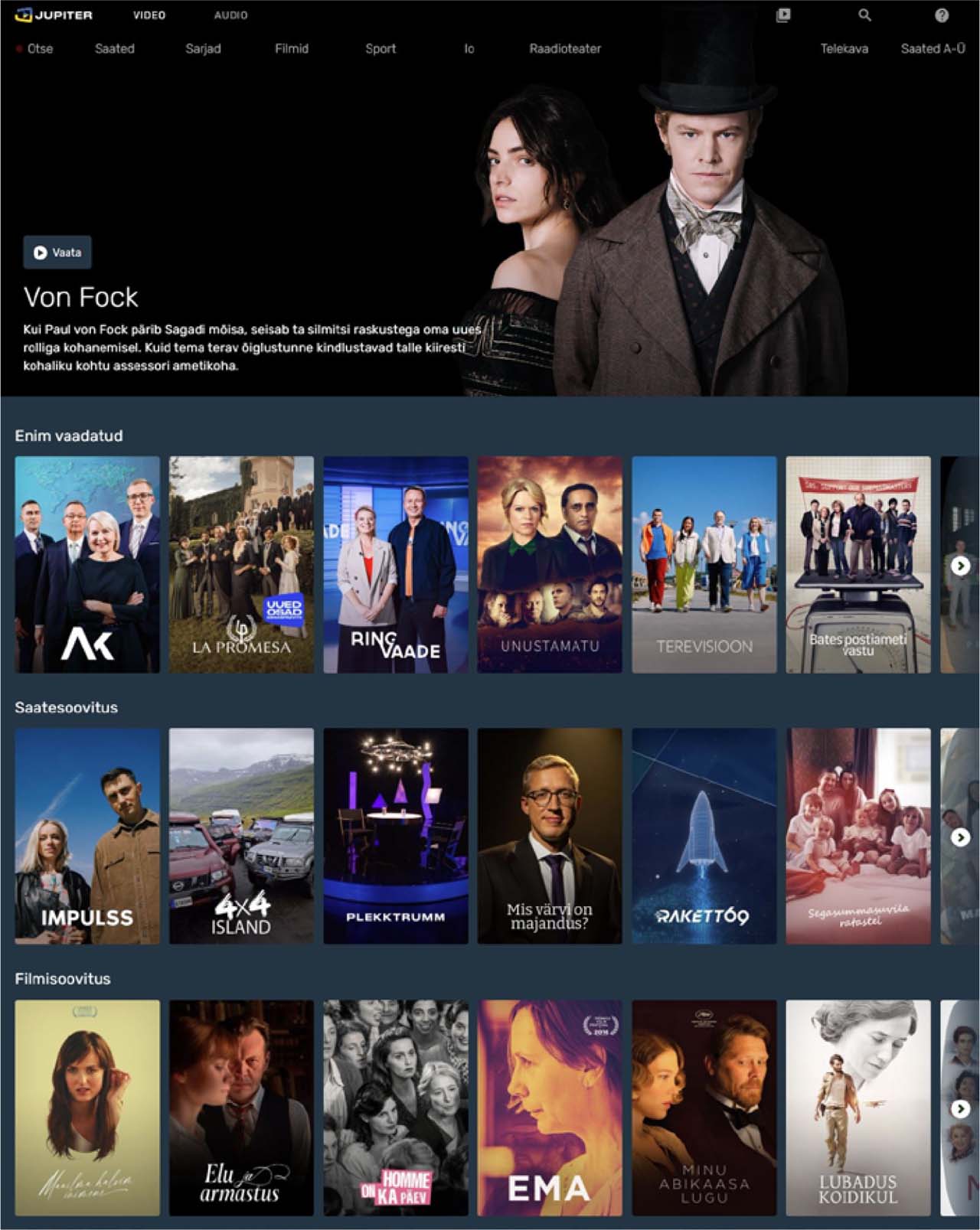
Figure 1
Upper part of the homepage of the ERR’s VoD service Jupiter
Comments: Screenshot taken in March 2025.
Data and methodology
This study focuses on the content published on ERR’s VoD service and draws on five data types: catalogue composition, content prominence, viewership, linear television scheduling data, and content metadata. These datasets were collected on a daily basis over a full year, from 1 June 2024 to 31 May 2025. In total, 365 daily datasets were compiled, capturing all titles available in ERR’s VoD catalogue during that period. For each title, four variables were calculated for every day it appeared in the catalogue:
number of streaming visitors, defined as the number of visitors who initiated playback of a title for at least one minute during the reporting period, as measured by Gemius Prism, the audience measurement system used by ERR for its web and app services;
prominence score, calculated based on the title’s positions on VoD presentation pages;
broadcast score, calculated based on the presence and temporal proximity of linear broadcasts;
premiere score, calculated based on the presence and temporal proximity of the premiere on VoD.
While previous studies have analysed publishing patterns and interface dynamics over time (e.g., Kelly & Sørensen, 2021; Sørensen, 2025; Thurman et al., 2023), no methodology for quantifying prominence could be identified that integrates content positions and their visibility across all presentation pages, and frequency and duration of prominence over a long period of time into a single metric. The current approach was developed in dialogue with the ERR VoD editorial team and media analysts to ensure that the scoring reflects the editorial logic.
The calculation of the prominence score is based on a matrix of position scores. The hero position, as the most visible area of the interface (Bideau, 2020; Sørensen, 2025) and identified in collaboration with the editorial team as the highest-priority editorial position, is assigned the maximum score of 1,000 points. Position scores then decrease gradually for positions located lower and further to the right. A larger score reduction occurs at the boundaries of the daily average “above-the-fold” area (Bideau, 2020), that is, at the point where the default visible area ends and the user must scroll down or move sideways to continue browsing. The daily average “above-the-fold” area was calculated as a weighted average across all screen resolutions used to access the VoD service, with weights based on their daily usage shares. The upper left side of the matrix is presented in Figure 2.

Figure 2
Excerpt from the position score matrix
Comments: The grey cells mark the average “above-the-fold” area, while the blue cells indicate where a greater score reduction occurs.
Since Jupiter’s content is displayed across multiple presentation pages, each position score is further weighted by the relative visibility of the page on that specific day, that is, by the share of that page’s views out of the total views across all presentation pages (homepage, television shows, series, films, etc.). The daily prominence score for a given title is then calculated as the sum of all weighted position scores it receives across different presentation pages and positions. The total prominence score PRi for title i is calculated as:
PL denotes the position score and V represents the relative visibility weight of the corresponding presentation page.While the specific scoring was designed for ERR’s VoD service, the general methodological approach is transferable to other VoD services by adapting the position scores and page visibility weights to the structure of the interface under study. As an initial operationalisation of prominence, the proposed methodology is intended to provide a framework that can be refined, validated, and adapted in future research.
Broadcast and premiere scores are calculated based on whether a title has appeared within the past seven days on linear television or as a premiere on VoD. The closer the broadcast or premiere date is to the measurement day, the higher the score.
Metadata categories describing the titles were sourced from ERR’s Provys TVoffice database. For the category of content type, ERR’s original classifications were consolidated into groups to align with the European Broadcasting Union’s reporting standards (Cimino, 2020):
news and politics
informative and documentary shows and series
life programmes
entertainment (including games and lifestyle shows)
infotainment (including breakfast TV)
scripted series
feature films
culture and arts
sport
music performances
For the category of origin, the countries were grouped into categories reflecting the cultural and geographical context relevant to Estonia:
Estonia (domestic, including ERR’s own production)
Nordics (Denmark, Finland, Iceland, Norway, and Sweden)
other EU countries
the UK
the US and Canada
rest of the world
co-productions
Production years were treated as a continuous variable and therefore not grouped.
Based on the variables, two datasets were compiled: one containing all daily values collected over the year, and another in which variables were aggregated to represent yearly performance. This allowed distinguishing between the immediate and long-term effects of the examined aspects on viewership.
To examine diversity transformation, the distributions of metadata categories were compared across three stages: availability (the catalogue structure, measured as the count of titles), exposure (the prominence structure, measured as the sum of prominence scores), and consumption (the viewership structure, measured as the sum of streaming visitors).
Further, correlation analyses were conducted to examine the relationships between viewership and prominence, broadcast, and premiere scores, followed by a linear regression analysis assessing their combined explanatory power for viewership.
Results
Over the course of twelve months, a total of 4,001 content titles appeared in the catalogue, of which 72 per cent were presented on the presentation pages (i.e., received prominence), while the remaining titles were available only through catalogue browsing or search. Overall, 99 per cent of all catalogue titles received viewership.
On an average day, however, 1,961 titles were available, of which 55 per cent were presented and only 36 per cent received viewership. The contrast between daily and annual figures (36% viewed on an average day versus 99% over the full year) indicates that audience attention accumulates across the observation period, as titles may be discovered and viewed at different points during the year.
Diversity transformation across metadata categories
The following analyses examine what this article conceptualises as diversity transformation: the process through which the diversity changes across the stages of availability, exposure, and consumption. By comparing these three stages across metadata categories, the analysis identifies in which categories, in which direction, and to what extent these changes occur.
First, the distributions of content types across different diversity stages are analysed. As shown in Figure 3, the catalogue contains a broad range of content types, with a particular emphasis on culture and arts, and factual (news, life, infotainment, informative and documentary) programming. However, a clear shift in priorities becomes visible in the prominence structure, that is, in the editorial decisions. For example, while series account for only 7 per cent of titles in the catalogue, they make up 21 per cent of the total prominence. At the same time, the visibility of culture and arts content (9% of the total prominence) is smaller compared to its share in the catalogue (16%). Viewers’ preferences, however, leave little doubt: Scripted content accounts for more than half of all viewership, divided evenly between series (27%) and feature films (27%). Compared to their share in the catalogue, infotainment and news also attract a notably higher share of viewership.
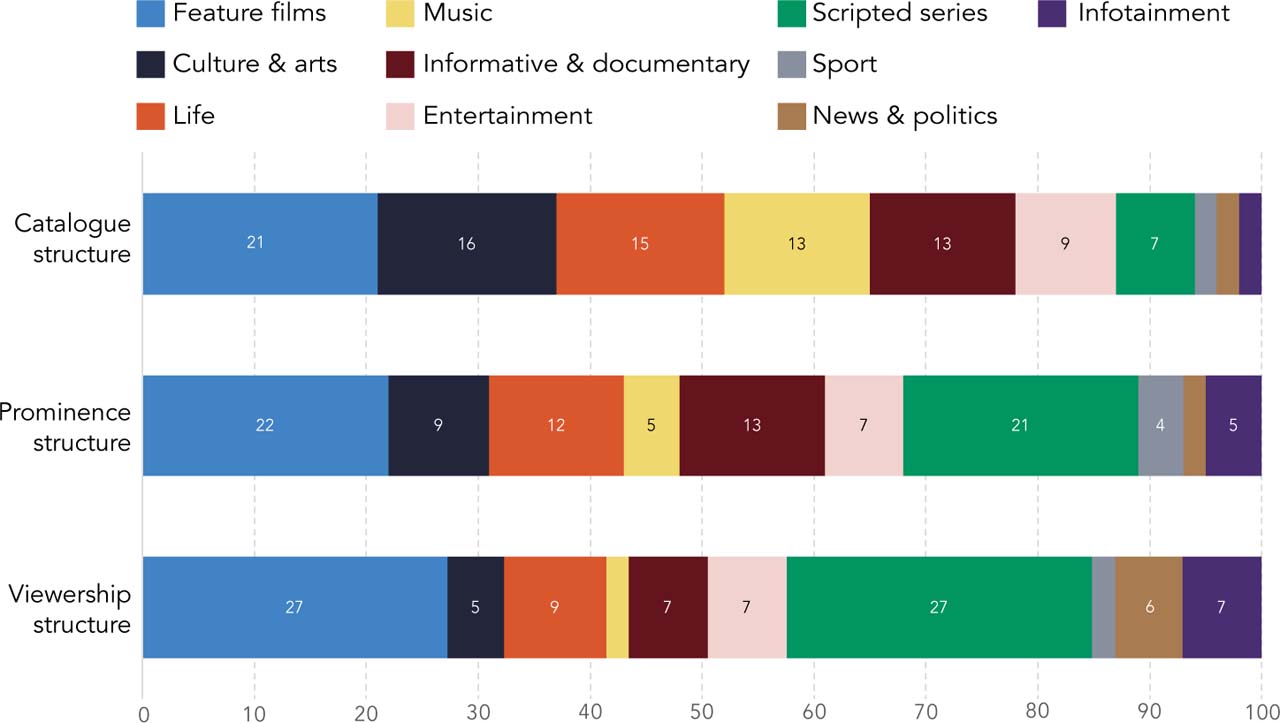
Figure 3
Distributions of content types across catalogue, prominence, and viewership on ERR’s VoD service, 2024–2025 (per cent)
Figure 4 demonstrates that in the catalogue, 65 per cent of titles have a domestic origin, whereas for prominence the figure decreases to 55 per cent and comprises less than half (46%) of viewership.
Similar to content types, it should be noted that the shift away from domestic content towards other origins begins at the stage of prominence and continues in the same direction with viewership figures. However, it is worth noting that in terms of origin, audience preferences are ultimately more diverse than the catalogue itself. This is due to the fact that content types and origins are interwoven, as scripted content is predominantly acquired from abroad, while factual and culture and arts content tends to be locally produced.
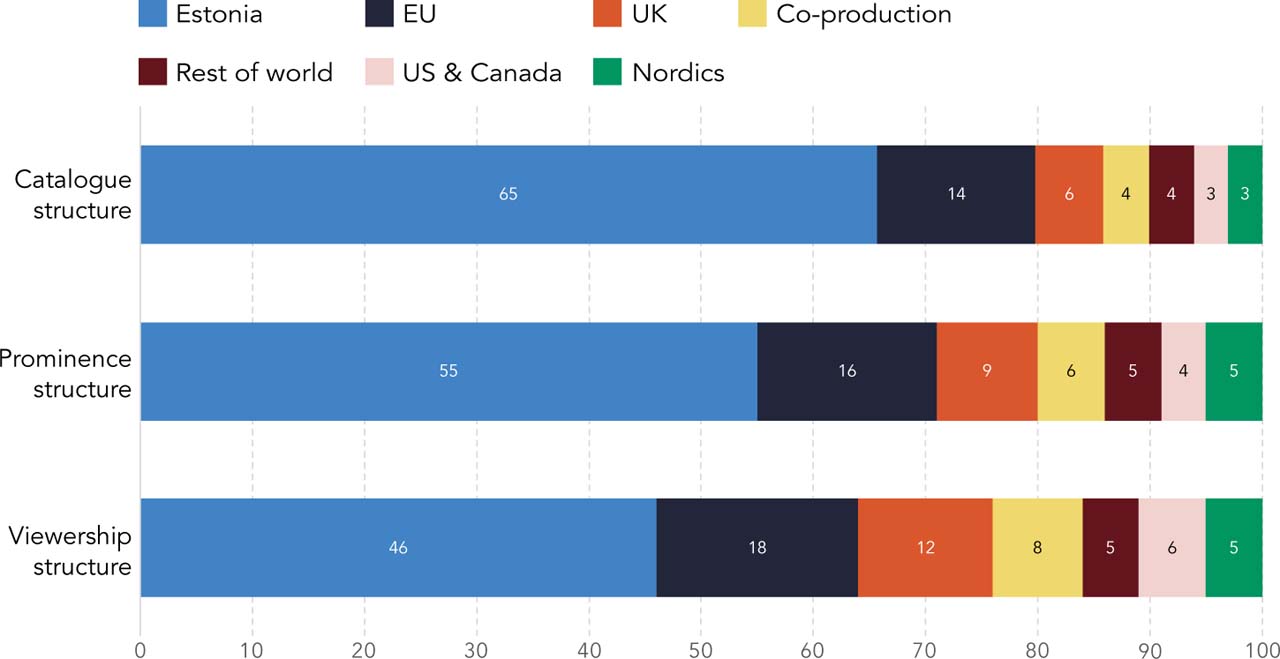
Figure 4
Distributions of content origins across catalogue, prominence, and viewership on ERR’s VoD service, 2024–2025 (per cent)
Figure 5 shows a strong concentration toward content produced in recent years across all diversity stages. However, the share of titles from the past three years varies significantly. Such content makes up 31 per cent of the catalogue, 47 per cent of the prominence, and 54 per cent of all viewership. Despite the concentration of viewership toward newer content, it is noteworthy that over 45 per cent of the total viewership was devoted to content older than three years. In comparison, a previous study on ERR showed that for linear television, this figure reached only 22 per cent, even though the linear programming and the VoD catalogue were similar in terms of production years (Lobanov & Ibrus, 2026).
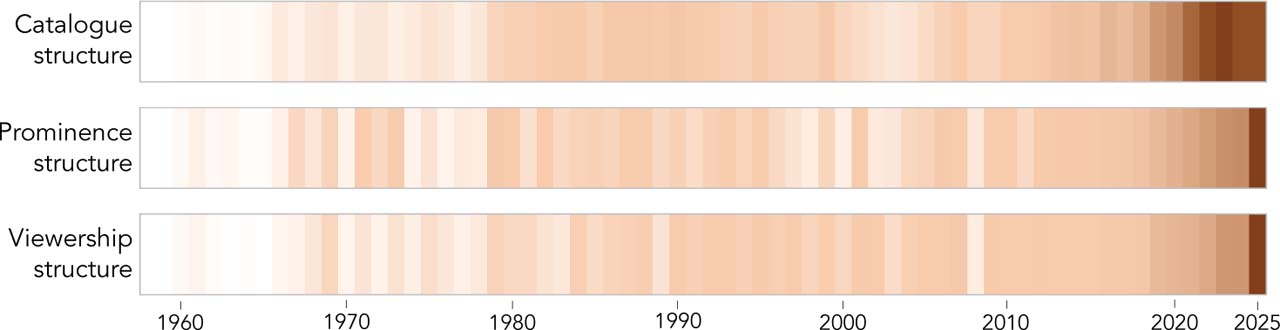
Figure 5
Distributions of production years across catalogue, prominence, and viewership on ERR’s VoD service, 2024–2025
Comments: Each vertical column represents a production year. Colour intensity indicates the share of catalogue, prominence, and viewership that the titles produced in that year received, ranging from lighter shades for lower shares (min 0%) to darker shades for higher shares (max 31%). A common colour scale is used across the three diversity stages to facilitate comparison.
To further illustrate these tendencies of diversity transformation, it is useful to examine the type of content most commonly promoted in the hero position on the homepage. The hero position is used almost exclusively to promote scripted content: 48 per cent of the prominence is allocated to series and 47 per cent to feature films, while all other content types individually account for no more than 1 per cent of the total prominence. In terms of origin, EU productions dominate (28%), followed by Estonian productions (18%), co-productions (15%), and titles from the UK and North America (14% each). Hero prominence is also concentrated on recent productions, with titles from 2020–2025 accounting for 62 per cent of the total prominence and productions from 2010–2019 for a further 25 per cent, whereas content produced before 2000 receives only marginal prominence. All in all, the contrast between the catalogue and the hero position makes the diversity transformation particularly visible.
Predictors of viewership
To examine the relative associations of prominence, broadcasting, premieres, and duration of availability with viewership, two multiple linear regression models were estimated (see Table 1).
Table 1
Multiple linear regression models predicting viewership on ERR’s VoD service, 2024–2025
| Model 1 | Model 2 | |||||
|---|---|---|---|---|---|---|
| R2 | 0.625 | 0.640 | ||||
| Adjusted R2 | 0.624 | 0.638 | ||||
| Variable | B | β | t | B | β | t |
| Constant | 384.904 | 4.29* | –11,747.546 | –1.45 | ||
| Prominence score | 0.179 | 0.501 | 41.22* | 0.170 | 0.474 | 38.22* |
| Broadcast score | −2.784 | −0.091 | −5.30* | –3.058 | −0.100 | –5.84* |
| Premiere score | 24.490 | 0.494 | 30.81* | 25.165 | 0.507 | 31.27* |
| Days available | −2.205 | −0.055 | −5.53* | –1.181 | −0.029 | –2.72* |
| Production year | — | — | — | 6.269 | 0.017 | 1.55 |
| Culture & arts | — | — | — | –975.719 | –.061 | –4.81* |
| Life | — | — | — | –1,014.978 | –.060 | –4.82* |
| Music | — | — | — | –990.152 | –.056 | –4.67* |
| Informative & documentary | — | — | — | –1,595.134 | –.090 | –7.39* |
| Entertainment | — | — | — | –482.683 | –.024 | –1.97 |
| Scripted series | — | — | — | 247.340 | .011 | 0.92 |
| Sport | — | — | — | –2,071.281 | –.055 | –5.41* |
| News & politics | — | — | — | –1,453.440 | –.031 | –3.00* |
| Infotainment | — | — | — | 1,508.670 | .033 | 3.20* |
| EU | — | — | — | 302.854 | 0.018 | 1.63 |
| UK | — | — | — | 568.886 | 0.024 | 2.25 |
| Nordics | — | — | — | 631.495 | 0.019 | 1.91 |
| US & Canada | — | — | — | 508.566 | 0.016 | 1.58 |
| Rest of world | — | — | — | –334.417 | −0.011 | –1.10 |
| Co-production | — | — | — | 1,068.057 | 0.038 | 3.68* |
The dependent variable was the number of streaming visitors per title. Model 1 included prominence score, broadcast score, premiere score, and days available. Model 2 additionally included production year, content type, and origin as control variables, allowing the associations between the main predictors and viewership to be examined while accounting for the metadata categories. Model 1 explains 62.5 per cent of the variance in viewership. Prominence (β = 0.50) and premiere score (β = 0.49) are the strongest positive predictors. Broadcast score (β = −0.09) shows a small negative coefficient, while duration of availability is also weakly and negatively associated with viewership (β = −0.05).
Adding the metadata categories in Model 2 increased the explained variance from 62.5 per cent to 64 per cent (ΔR2 = .015, ΔF(18, 3978) = 9.13, p < .001). Although the improvement is statistically significant, its magnitude is modest. More importantly, the coefficients for prominence (β = 0.47) and premieres (β = 0.51) remain largely unchanged. Broadcast score and duration of availability retain small negative coefficients (β = −0.10 and β = −0.03, respectively). Among the control variables, country of origin and content type are statistically significant as categorical predictor groups, whereas production year is not. Model 2 thus shows that the strong associations of prominence and premieres with viewership cannot be explained simply by differences in content type, country of origin, or production year.
The negative coefficients for broadcasting and duration of availability require some explanation. In the bivariate analysis, broadcast score was positively correlated with viewership and prominence (both r = 0.59), and particularly strongly with premieres (r = 0.79). The change in the broadcast coefficient when prominence and premieres are included simultaneously suggests overlapping explanatory information among the predictors and a possible suppression pattern. The negative broadcast coefficient should therefore not be interpreted as evidence that broadcasting reduces VoD viewing. Also, these associations may reflect overlapping editorial and scheduling logics, whereby content that has been recently broadcast or premiered often receives increased prominence on VoD.
Similarly, duration of availability has a weak positive bivariate correlation with viewership (r = 0.06), but its coefficient becomes slightly negative when prominence, broadcasting, premieres, and content characteristics are taken into account (β = −0.03 in Model 2). One possible explanation lies in the composition of the catalogue: Domestic productions often remain permanently available, whereas acquired content may be available for shorter periods while receiving greater editorial prominence and attracting more viewers. However, the small negative coefficient indicates that duration of availability has little independent explanatory value in the model, rather than suggesting that longer availability reduces viewership.
Taken together, the regression results identify prominence and premieres as the strongest predictors of viewership in the models examined.
Variations across temporal scales and metadata categories
Although the regression models identify the strongest predictors across the catalogue as a whole, the descriptive measures and bivariate correlations reveal substantial variations between content groups and time periods.
First, because the data were collected daily over the course of a year, the analysis allows prominence and viewership to be examined at both daily and annual levels. The correlation between prominence and viewership is moderate in the daily data (r = 0.57) and stronger in the annual data (r = 0.69). This difference is consistent with the cumulative nature of VoD viewing, whereby titles can receive prominence and attract viewers at different points during the observation period. An immediate effect of prominence would imply that viewers watch highlighted content on the same day it becomes visible to them. In practice, however, audience responses may also be delayed. Content made highly visible may be remembered but not immediately viewed; users may save it to their watchlists for later viewing, or they may encounter it at a point when its visibility has decreased but it remains available in sections relevant to them. However, because the two correlations are calculated at different levels of aggregation, their difference does not establish that long-term effects are stronger than immediate effects. Repeated exposure, memory effects, and delayed discovery are plausible mechanisms, but they cannot be directly identified from these correlations.
Duration of availability, by contrast, has only a very weak annual correlation with viewership (r = 0.06), differing from the findings of Thurman and colleagues (2023). Thus, a longer observation period gives more titles the opportunity to attract at least some viewership, but keeping an individual title available for longer does not necessarily mean that it will attract more viewers, particularly in a catalogue where a substantial share of older content remains permanently available but may receive little or no prominence. Taken together, these findings reveal a stronger association between prominence and viewership in annual than in daily data, alongside a very weak association between duration of availability and viewership.
Second, prominence and its association with viewing differ markedly across content types. Scripted series receive the highest average prominence score (174), followed by feature films (143), news (108), and informative content (106), compared with an overall average of 105 among presented titles. However, the correlation between prominence and viewership is above average for slightly different content types. For example, culture and arts content receives significantly less visibility (85) than average, yet the visibility it does receive is strongly correlated with viewership (r = 0.93). Scripted series receive the highest level of prominence, and this visibility is strongly correlated with viewership as well (r = 0.81). In contrast, feature films also receive high prominence, but the correlation between prominence and viewership is considerably weaker (r = 0.50). A different pattern emerges for music content, which receives little prominence (68), and its association with viewership is likewise weaker than for most other content types (r = 0.45). These patterns indicate that prominence does not translate into audience attention in the same way across content types. Editorial priorities and audience preferences sometimes align, but at other times diverge.
Strong correlations can be observed between viewership and broadcast score (r = 0.59), and between viewership and premiere score (r = 0.68) as well. News, infotainment, informative, and culture and arts content show stronger than average correlations with both indicators (r = 0.70–0.89), suggesting that audiences for these content types are highly responsive to what has recently aired or premiered, a pattern that is understandable given their topical and time-sensitive nature. By contrast, scripted series and feature films display much weaker associations (r = 0.42–0.56), implying that their on-demand audiences rely less on linear television cues and are guided by different viewing logics. In scripted content, the viewing value tends to endure longer, making its connection to current events or novelty less critical.
Third, differences in prominence are also evident across countries of origin. Acquired foreign content, available for a limited time, receives much more prominence than domestic productions (70) that usually remain permanently accessible. Content from North America and the UK, in particular, receives especially high prominence (228 and 151, respectively). The audience seems to respond positively to this higher visibility, as across most foreign groups the correlations between prominence and viewership are strong (r = 0.71–0.85). Another aspect of this trend is that the vast majority (89–97%) of foreign content in the catalogue is presented, while only 60 per cent of domestic content is highlighted over the course of a year.
Regarding broadcast and premiere scores, content from closer regions (Estonia, the EU, and the Nordics) shows stronger correlations with viewership, suggesting that audiences rely more on novelty when engaging with local and culturally proximate content. In contrast, content from more distant origins exhibits weaker correlations, indicating that novelty and broadcast exposure play a much smaller role in driving viewership for these regions.
These variations provide an important qualification to the aggregate regression findings. Although prominence and premieres emerge as the strongest predictors across the catalogue, the extent of visibility and the strength of their bivariate associations with viewership differ considerably across content types and countries of origin. The findings thus highlight the role of editorial decisions in determining which content becomes visible, while also revealing how the relationship between prominence and audience attention varies across content groups.
Conclusions and discussion
In this article I set out to analyse how content diversity unfolds on a PSM VoD service by linking catalogue composition, content prominence, and viewership, and by situating identified patterns within the editorial logics of ERR’s VoD team. I introduce the concept of diversity transformation, defined as the process through which diversity is reshaped across the stages of availability, exposure, and consumption, and provide a framework for evaluating how public service objectives materialise in platform environments.
The results confirm that available diversity does not automatically translate into consumed diversity, and that diversity is progressively reshaped as content moves from availability to viewership. While Jupiter’s catalogue is balanced, with strong cultural, factual, and domestic representation, its exposure on the interface is skewed, highlighting the role of editorial and interface-based prioritisation in shaping what becomes publicly visible. Scripted content (series and films) receives the highest share of prominence and attracts even more concentrated audience attention. This aligns with earlier findings that online attention clusters around a limited set of options rather than being evenly distributed (e.g., Hindman, 2007). Overall, in the case of content types, the analysis reveals a narrowing of diversity from catalogue to exposure and ultimately to consumption.
The identified origin-based patterns demonstrate how diversity can be shaped by the coupling of structural factors. In the case of ERR, this is reflected in the popularity of series and their origins. Scripted content is largely imported and time-limited, while factual and culture and arts content is typically locally produced and permanently available. These conditions seem to favour higher prominence for series and films, illustrating how structural constraints can indirectly shape interface exposure. Consequently, the increasing origin diversity observed in the study reflects the popularity of scripted content and, more importantly, the limited availability of domestically produced series.
These findings illustrate the process of diversity transformation, whereby the diversity of the catalogue is reshaped through editorial prominence and audience consumption. However, although aggregate analysis reveals how audience attention is distributed across metadata categories, it cannot determine whether individual viewers consume diverse repertoires. Future studies based on user-level viewing histories could examine whether aggregate diversity patterns coexist with homogeneous individual viewing patterns.
The temporal dimension reveals how VoD can both amplify and diversify attention patterns. The comparison between daily and annual figures shows that long-term availability is crucial to ensuring that a very high share of the catalogue eventually receives viewership. However, this should not be equated with a positive relationship between the duration of individual titles’ availability and their total viewership. Nevertheless, the affordances of VoD, including permanent accessibility, long-term availability, personalisation, watchlists, and thematic curation, create opportunities for discovery beyond the moment of initial prominence. Memory effects, repeated exposure, and delayed discovery remain plausible mechanisms that need further investigation.
While prominence, linear broadcasting recency, and VoD premiere recency scores are strongly and positively correlated with viewership, the multivariate models show that only prominence and premiere indicators retain strong positive unique effects. Broadcast score becomes a small negative predictor, indicating that its apparent impact is already captured by how recently the title premiered and how prominently it is placed in the interface. Prominence and premieres remain the strongest positive predictors after controlling for content type, country of origin, and production year in Model 2, with relatively little change in their coefficients. The two models estimated explain 62.5 per cent and 64.0 per cent of the variance in viewership, demonstrating that prominence and novelty are central but not exhaustive drivers of viewership. This is consistent with the literature on discoverability, which emphasises that default practices, social recommendations, and other off-platform nudges also shape what is actually watched (Lüders & Sundet, 2021; Iordache et al., 2023; Johnson et al., 2023). From a public communication perspective, this underscores the importance of examining prominence empirically, even in the absence of causal attribution, given the opacity of platform decision-making.
The analysis here offers nuances to the findings by Thurman and colleagues (2023). In ERR’s case, no meaningful correlation was found between the duration of availability and viewership, largely because many titles in Jupiter’s catalogue are permanently available yet attract uneven audiences. Once prominence, broadcast, and premiere scores are accounted for in the regression model, availability has only a weak negative effect. This suggests that permanence of availability is a necessary but not sufficient condition for gaining viewership. It enables discovery but does not guarantee it. In summary, although long-term availability is an important affordance of VoD, allowing almost all content to be discovered, achieving substantial audiences requires the combined effect of novelty and exposure (both platform- and linear-driven).
Although PSM VoD services such as Jupiter retain a strong stable position in the media landscape, audiences increasingly divide their viewing across commercial streaming services. This makes PSM VoD services all the more strategically important as they are among the few environments where PSM retain editorial circulation power. In increasingly platformised media systems, understanding how this power is exercised becomes essential for evaluating whether PSM values continue to shape audience exposure and consumption despite intensifying competition for attention.
However, the findings of this study foreground tensions that characterise the platformisation of PSM. First, there is a tension between PSM’s value framework that emphasises societal responsibility and diversity on the one hand, and audience expectations oriented toward on-demand consumption of scripted content on the other. The data suggest that editorial choices partly meet these expectations by giving more prominence to series, while cultural and arts content, although well-received when highlighted, is less consistently visible. This raises the normative question of whether PSM should use its circulation power to rebalance viewing patterns in favour of underexposed content. However, it remains unclear whether doing so would meaningfully diversify consumption or simply require audiences to search harder for preferred content.
Second, there is a tension between linear television and VoD prioritisation. The strong correlations between broadcast and premiere scores and viewership indicate that linear exposure remains an important driver of on-demand viewing, especially for factual content. Editorial practices remain closely attuned to linear rhythms yet simultaneously seek to differentiate the VoD service by promoting online-only and off–prime-time linear titles. Jupiter thus exemplifies what Bruun and Lassen (2023) described as the transformation of scheduling into publishing: a hybrid regime in which linear and on-demand cues interact in reinforcing loops. Additionally, this reveals a dual tension: Efforts to differentiate PSM VoD from linear television may increase similarity with commercial VoD services, while approaches grounded in PSM values distinguish the service from commercial streamers but simultaneously align it with linear television.
Third, although Jupiter is framed as both an “Estonian Netflix” and a PSM service, the study reflects the ongoing balancing of competing institutional, editorial, and audience-oriented objectives rather than a single, fully codified VoD strategy. In practice, content prominence can be shaped by a mix of explicit rules (e.g., prioritising new, domestic, or online-only titles) and ad hoc judgments (e.g., selecting hero titles based on personal assessment of quality or relevance). This underlines the importance of considering prominence to be not only a technical affordance but also a site where professional norms, institutional strategies, and resource constraints are negotiated.
The study suggests that PSM organisations such as ERR should treat prominence as a central instrument delivering public value rather than merely as a promotional tool. The concept of diversity transformation developed in the article can help to operationalise this shift. By systematically comparing availability, exposure, and consumed diversity, PSM organisations can identify where diversity is lost in the process of transformation. PSM distinctiveness in the VoD era does not lie in abandoning audience demand, but in consciously negotiating trade-offs between reach, relevance, and diversity through editorial circulation power. Without a clearly articulated digital publishing strategy, prominence decisions risk drifting toward commercially legible viewing logics, reducing credibility in how public service objectives are realised.
More broadly, the study suggests that policy and regulatory debates on prominence risk overestimating the effects of visibility guarantees alone: Visibility and long-term availability do not inherently produce diversified consumption without sustained monitoring and public-value–oriented assessment. PSM performance in platform environments, therefore, requires a shift from static measures of supply toward dynamic assessments of diversity.
Acknowledgements
I gratefully acknowledge Raigo Piibar from Estonian Public Broadcasting (ERR) for his assistance during the research process. The writing of this article was supported by the Estonian Research Council (grant PRG 1641).