

Introduction
Previous research in both the Nordic (Figenschou et al., 2021) and American (Martin, 2019) contexts has shown that the working class is systematically underrepresented in media as both producers of content and subjects of representation. Research primarily conducted in the US and UK has suggested that commercial media are shaped by consumerist incentives that privilege middle-class values, perspectives, and consumption practices (Deery & Press, 2017; Martin, 2019). It has also been observed in American and British advertising and lifestyle media that products and practices are often framed as either instruments for upward mobility or a means of avoiding association with the working class and the lack of ambition and taste ascribed to them (McAllister & Galarza, 2020).
Digital media were initially seen as a new avenue for more inclusive and democratic self-expression. Although this is true to a certain extent, recent research has pointed out how the Internet has also recreated many of the traditional hierarchies preceding it (Huang, 2024; Nagle, 2017). While there exists a considerable amount of research on how people from different class backgrounds use digital media (e.g., Lim & Loh, 2020) and how class is depicted in traditional media (e.g., Figenschou et al., 2021), research on how class is discussed and constructed online in the Nordic context remains lacking (Kolehmainen, 2017).
This study approaches class as a multidimensional phenomenon that is not only structured by economic scarcity but is also constituted by a process of building status through cultural practices and social networks (Bourdieu, 1984; Lizardo, 2006). In this context, it is important to understand class as a collection of meanings produced in language, media, and culture, as opposed to merely an objective position (Bourdieu, 1987). I argue that such an approach makes it possible to understand the enduring symbolic hierarchies of class in the context of Nordic welfare states, which persist despite historical improvements in the economic outlook of working-class professions (Chibber, 2022; Goldthorpe, 1969).
In this article, I examine how working-class culture is represented in Finnish-language Internet discourse through the semantic associations attached to leisure activities that are empirically characteristic of working-class groups. My research question is as follows:
What kinds of meanings are associated with working-class lifestyles on the Finnish-language Internet?
The research proceeds in two phases. In the first phase, nationally representative survey data are used to identify leisure activities that are statistically disproportionately engaged in by working-class occupational groups. This phase establishes objective class differences in leisure participation. In the second phase, the semantic associations of working-class leisure activities are examined using a word-embedding model trained on the Finnish Internet Parsebank dataset. In the second phase I thus analyse the meanings relating to working-class lifestyles in the context of the Finnish-language Internet.
Computational social science research has argued that word embeddings are a particularly well-suited method for extending Bourdieusian analysis, as it conceptualises meaning relationally and enables the construction of multidimensional social spaces beyond what is possible with traditional methods such as correspondence analysis (Kozlowski et al., 2019). Whereas survey research has traditionally examined the relationship between class position and cultural practices (Bourdieu, 1984; Purhonen et al., 2014), in this study I examine how cultural practices are situated within broader systems of meaning in online discourse. In this sense, the study extends class analysis from patterns of participation to patterns of symbolic representation, reflecting Bourdieu’s understanding of lifestyles as classificatory markers through which social differences are recognised and reproduced (Bourdieu, 1984). In doing so, this study uncovers new forms of implicit class-based biases relating to working-class lifestyles, thereby contributing to the discussion on how class hierarchies are both challenged and recreated on the Internet.
Class, culture, and media
Social class has retained its significance in explaining cultural hierarchies because objective markers of class, such as education level, income, and occupation, correlate strongly with social mobility, class identity, and lifestyle choices (Lehmann, 2012; Way & Malvini Redden, 2020). Economic structures thus in some ways define the cultural orientation of an individual regardless of their prior socialisation. For example, the limited opportunities for promotion, repetitive tasks, and a high degree of surveillance in terms of efficiency are significant factors in why manual manufacturing workers tend to have a largely instrumental attitude towards their work and seek well-being outside their workplaces (Chibber, 2022).
Bourdieu (1984) has famously criticised the notion that class is a completely objective category, arguing that class is constantly and implicitly redefined in cultural hierarchies. An abundance of economic resources does not guarantee class position; rather, individuals with varying degrees of success use economic capital to display legitimate taste in culture and thus acquire access to and status in social networks (Lizardo, 2006). Leisure activities and cultural tastes in this context become positional markers in social space, and by learning to read these markers, individuals are socialised into pre-reflexively knowing their place (Bourdieu, 1984).
The connection between culture and class has been demonstrated in survey research in the Finnish context: In addition to objective class markers such as education level, income, occupation, and class position of family members, cultural factors such as consumption habits, hobbies, lifestyles, and political beliefs have been shown to predict whether an individual relates to the working or the middle class (Erola, 2010; Purhonen et al., 2014). In terms of politics, for example, some occupationally working-class Finns identify as middle class and are also politically more conservative; in contrast, some Finns who are not in working-class occupations, for example, some farmers, entrepreneurs, white-collar workers, and managers, might identify as working class and in which case are likely to vote for left-wing parties (Tiihonen, 2021). In class research, this phenomenon has not been considered a sign of the declining relevance of class but as an indication that symbolic class remains relevant as people relate to class in more nuanced ways (Atkinson, 2010). For example, individuals may see their lower-class position as undeserved, and consequently, reliance on an objective class identity for lower-class individuals may serve to deny their sense of self-worth (Bottero, 2004). Thus, objective class indicators alone cannot sufficiently measure class positions and attitudinal orientations; instead, the symbolic meanings of class must also be considered (Tiihonen, 2021). I argue that class differences in leisure participation can be one way to approach both aspects of class.
Bourdieu’s (1984) conceptualisation of class has been used in various ways to study the constantly shifting cultural meanings relating to class. In a broad sense, the defining characteristic of class differences is the framing of middle-class culture, lifestyles, and attitudes as the expected and legitimate forms of culture in both public and academic discourse, whereas many activities popular among the working class may not even be defined as culture (Flemmen et al., 2018). The career-oriented attitude of loving one’s job, which is associated with the middle class and characteristic of white-collar occupations, has become the norm, whereas the dispassionate attitude of getting the job done that is associated with the working class, emerging from the nature of blue-collar work, is not seen as legitimate (Metzgar, 2021). Moral agency is also attributed differently according to class lines. For example, environmental consumer choices are recognised more often as characteristic of people in a higher-class position, while consumer choices that have an equally small ecological footprint are more often attributed to poverty and necessity when made by lower-class people (Kennedy & Horne, 2020). Skeggs (2004) has described this phenomenon as the middle class declaring themselves as the modern, cosmopolitan, and moral category while defining the working class as either the exact opposite of these values or romanticising them as the authentic Other to distance themselves from accusations of snobbery (see also Mapes, 2018). These forms of cultural class boundaries and stigmatisation have been observed in Finland as well (Kolehmainen, 2017). The working class in this context tends to either disparage middle-class culture they are not part of or show their cultural goodwill and sophistication by participating in culture not considered typical of people with a low level of education (Heikkilä, 2022). While much previous class research describes legitimate culture through contrasts between working-class and middle-class lifestyles, the broader construction of cultural legitimacy also involves actors beyond a strict definition of the middle class (Maguire & Matthews, 2012). Accordingly, this study does not treat the middle class as the sole source of legitimate culture, but rather as one important and numerically large group of cultural intermediaries and institutional gatekeepers.
The working class has significantly less representation in the media than the higher classes, as the working class faces difficulties in challenging the legitimate culture of the culturally privileged from their lower-class position (Deery & Press, 2017). Class has been demonstrated to be a significant explaining factor in people’s media consumption habits, such as a preference for or dislike towards news media, arguably because people in a higher-class position can relate more to the people and topics discussed in news programmes (Hovden & Rosenlund, 2021). One explanation for this is the lack of working-class people entering media professions, observed in Australia, for example (Attfield, 2020). This has been argued to extend the commercial goals of media organisations. For example, since the mid-1900s, American printed news media have shifted their focus to audiences with higher purchasing power for higher advertising revenue at the expense of the working class, as seen in the decline of labour journalism and the increased negative coverage of trade unions (Martin, 2019). The consumerist incentives of advertising significantly affect the classed nature of other advertising-supported media, and in such environments, the depiction of the working class is relatively rare and often non-sympathetic when it does occur (McAllister & Galarza, 2020). In the context of British entertainment media, depictions of the working class have become even more negative, as working-class individuals tend to be portrayed as irresponsible consumers, dependent on social welfare, vulgar, and old-fashioned (Deery & Press, 2017; Skeggs, 2004). Such stereotypes are leveraged in advertisements to convey the idea that a product can enable class mobility out of the working class or that a product can be a means to not be associated with the working class (McAllister & Galarza, 2020). Research in the Nordic printed-media context has confirmed that a similar decline in working-class representation has occurred in commercial but not labour-union–funded newspapers (Figenschou et al., 2021). However, it is possible that the negative depictions present in the Anglo-American context are not so prevalent in the Nordic countries, where trade unions have traditionally had a stronger role and higher approval.
The Internet was initially considered to be a promising avenue for marginalised people to both express themselves and network with like-minded individuals (Nagle, 2017). However, although smartphones have provided new and easier ways to gain knowledge and social networks on the Internet, an essential question remains: Who has the best predisposition, confidence, and equipment to publish content online, gain visibility, and leverage their social networks for commercial gain (Skeggs & Yulli, 2016)? There also exist significant differences in how people from different class backgrounds use the Internet. For example, people from lower-class backgrounds tend to use the Internet on their smartphones and for consuming entertainment, whereas people from higher-class backgrounds tend to use the Internet on a personal computer and for activities benefitting their careers, such as reading news, networking, and fostering self-development (Lim & Loh, 2020). Research in the Nordic context has shown that, despite the provided affordances for establishing friendships globally in online video games, the choice between leveraging such affordances and cooperating only with those who share one’s native language is divided along class lines (Lindell & Danielsson, 2017). Thus, as digital platforms build new algorithmic systems that make the status, reputation, and charisma of users visible, it is not surprising that the Internet has recreated and enhanced cultural hierarchies instead of challenging them (Mihelj et al., 2019).
Class is seen both in the objective consumption habits of people from different class backgrounds and in terms of how class is talked about online. Research on online representations of class remains scant, and the studies that do exist are primarily from non-Nordic countries. In the context of Chinese social media, it has been argued that the overall prevalence of entertainment- and marketing-related content influences conversation to align strongly with the views of the political and corporate elite (Sun et al., 2022). Furthermore, the style of humour prevalent in Chinese social media has been found to be characteristic of a disproportionally young, male, urban, and white-collar user base and thus often involves degrading women and migrant workers, whose presence is less prevalent in online platforms (Huang, 2024). Similar observations have been made in the UK. Specifically, X (formerly Twitter) users have been noted to frequently belittle concerns about issues affecting people in lower-class positions, who are known to not use the platform as frequently as middle-class professionals (Sloan, 2017). In addition, a lower-class identity has been observed to hold some positive connotations of confidence and attractiveness in the context of the term “chav” in British TikTok (Di Martino, 2022). In the Finnish online context, the term for “white trash” has been noted to appear particularly often in the context of consumer culture, possessing connotations of mundaneness, poverty, and excess consumerism (Kolehmainen, 2017).
Data and methods
Bourdieu (1987) emphasised that social classes should not be understood as fixed and self-evident entities but as analytical constructions grounded in real similarities in social position and condition. While such similarities make it possible to identify groups with characteristic lifestyles and practices, the meaning and social significance of these distinctions are constantly shaped through symbolic classification and representation. Following this logic, in the first phase of this study I employ occupational categories as a pragmatic strategy for identifying leisure practices associated with positions in social space, while in the second phase I examine how these practices are symbolically situated within broader systems of meaning through online discourse.
In the first research phase, I used the Participation in Leisure Activities survey dataset collected by Statistics Finland in 2017 (permission granted for use in scientific research; Statistics Finland decision no. TK/900/07.03.00/2024). The dataset has a relatively large sample size (N = 7,155) and high response rate (45%) and is nationally representative (Tilastokeskus, 2017). I specifically focused on respondents whose occupational category was known according to the International Standard Classification of Occupations (ISCO-08) classification scheme, thereby excluding respondents outside the active workforce (e.g., most students, children, and the elderly, all of whom were represented in the initial sample size). In line with the research interest of this study, I considered the survey questions that focused on which hobbies or other activities the respondents engaged in as well as what forms and kinds of media they consumed.
The first of the two groups studied in this article represents the working class, defined as respondents employed in ISCO-08 categories 5 (Service and Sales Workers), 7 (Craft and Related Trades Workers), 8 (Plant and Machine Operators and Assemblers), and 9 (Elementary Occupations). The second group consists of respondents employed in ISCO-08 categories 1 (Managers), 2 (Professionals), 3 (Technicians and Associate Professionals), and 4 (Clerical Support Workers). While the second group is referred to as the middle class for analytical convenience, it also includes more privileged professional and managerial occupations. The purpose of the classification is therefore to identify leisure activities disproportionately characteristic of working-class occupations relative to those in higher positions in the occupational structure.
Out of the original 7,155 survey respondents, 2,770 belonged to the occupational categories included in the present analysis (1,052 working-class and 1,718 middle-class respondents). Sampling weights supplied with the survey were applied when estimating participation rates in leisure activities so that the reported proportions better reflected the Finnish population. Application of sampling weights yielded weighted population counts of 1,441 for the working class and 1,751 for the middle class.
Next, survey-weighted proportions were calculated for each leisure activity and compared between occupational groups. Fourteen survey questions were chosen as relevant for the research, all of which asked the respondent to mark down media genres, events, and activities that they had regularly participated in or consumed during a given prior period. These questions contain 176 items that were chosen as variables. The comparison of weighted proportions for the two major groups yielded a ratio that expressed by what factor an activity was more common among the working class than among the middle class. A total of 59 leisure activities were more common among the working class compared to the middle class, reflecting a known pattern of a low overall rate of cultural participation among the working class (see Purhonen et al., 2014). To obtain a larger set of working-class leisure activities, activities that working-class respondents were slightly less likely to participate in (by no less than 25%) were also selected as working-class activities. From these survey items, those that had a very low rate of participation (< 1% in either working or middle class) were removed. Thus, out of the original 176 leisure activities, 85 were deemed disproportionately working class. While only two thirds of them were more popular among the working class, all of them were disproportionately more working class compared to all other leisure activities and thus acted as an operationalisation for activities characteristic of the working class. A single-word representation was assigned to each of these activities on a separate worksheet to reflect the activity in question as concisely and colloquially as possible (see Table 1).
Table 1
Search words with popularity ratio and rate of class participation
| Group | Translated word | Finnish word | Ratio | Working class (%) | Middle class (%) |
|---|---|---|---|---|---|
| Sports | Nordic walking | sauvakävely | 3.89 | 7.98 | 2.05 |
| Venues | film festival | elokuvafestivaali | 3.13 | 4.77 | 1.52 |
| Sports | ice hockey | jääkiekko | 3.07 | 7.33 | 2.39 |
| Sports | skateboarding | skeittaus | 3.04 | 12.73 | 4.18 |
| Crafts | sewing | ompelu | 2.76 | 16.43 | 5.95 |
| Sports | downhill skiing | laskettelu | 2.71 | 15.49 | 5.71 |
| Association | art association | taideyhdistys | 2.65 | 22.59 | 8.52 |
| Sports | bowling | keilaaminen | 2.32 | 7.26 | 3.13 |
| Music | rap gig | räppikeikka | 2.25 | 29.54 | 13.12 |
| Movies | horror movie | kauhuelokuva | 2.13 | 29.20 | 13.71 |
| Venues | karaoke bar | karaokebaari | 2.10 | 37.51 | 17.85 |
| Sports | martial arts | kamppailulaji | 2.03 | 7.33 | 3.62 |
| Music | schlager concert | iskelmäkonsertti | 1.95 | 32.22 | 16.57 |
| Music | hip-hop | hiphop | 1.91 | 66.32 | 34.81 |
| Sports | baseball game | pesäpallo-ottelu | 1.75 | 15.21 | 8.69 |
| Sports | football match | jalkapallo-ottelu | 1.75 | 25.80 | 14.74 |
| Sports | motor sports | moottoriurheilu | 1.71 | 15.70 | 9.19 |
| Music | popular song | viihdemusiikki | 1.60 | 42.42 | 26.47 |
| Movies | short film | lyhytelokuva | 1.59 | 24.77 | 15.56 |
| Outdoor | bird watching | lintubongaus | 1.55 | 9.86 | 6.38 |
| Venues | karaoke | karaoke | 1.55 | 37.61 | 24.25 |
| Games | billiards | biljardi | 1.48 | 61.89 | 41.81 |
| Sports | gymnastics | jumppa | 1.47 | 12.88 | 8.76 |
| Music | schlager | iskelmä | 1.45 | 42.42 | 29.32 |
| Sports | cycling | pyöräily | 1.43 | 47.41 | 33.14 |
| Crafts | knitting | neulominen | 1.41 | 17.29 | 12.26 |
| Movies | documentary film | dokumenttielokuva | 1.39 | 89.71 | 64.40 |
| Sports | football | jalkapallo | 1.36 | 4.77 | 3.52 |
| Venues | gig venue | keikkapaikka | 1.36 | 65.23 | 47.98 |
| Sports | running | juoksu | 1.34 | 55.92 | 41.70 |
| Venues | bar | baari | 1.34 | 82.78 | 61.57 |
| Music | drums | rummut | 1.32 | 27.77 | 21.06 |
| Music | jazz | jazz | 1.28 | 48.38 | 37.65 |
| Television | TV series | TV-sarja | 1.28 | 92.88 | 72.83 |
| Music | folk music | kansanmusiikki | 1.26 | 32.39 | 25.65 |
| Sports | roller skating | rullaluistelu | 1.26 | 1.91 | 1.52 |
| Venues | flea market | kirpputori | 1.26 | 61.77 | 49.21 |
| Movies | action movies | toimintaelokuva | 1.24 | 87.42 | 70.49 |
| Music | jazz concert | jazz-konsertti | 1.23 | 33.39 | 27.07 |
| Venues | dance pavilion | tanssilava | 1.23 | 49.74 | 40.30 |
| Music | guitar | kitara | 1.21 | 69.46 | 57.34 |
| Outdoor | fishing | kalastus | 1.20 | 29.56 | 24.67 |
| Crafts | weaving | kutominen | 1.19 | 5.33 | 4.49 |
| Music | blues concert | blues-konsertti | 1.19 | 29.07 | 24.39 |
| Television | film | elokuva | 1.19 | 92.05 | 77.27 |
| Venues | dance festival | tanssifestivaali | 1.17 | 4.59 | 3.94 |
| Sports | training | treeni | 1.12 | 52.45 | 46.92 |
| Venues | village festival | kyläjuhla | 1.11 | 49.98 | 44.86 |
| Music | gospel | gospel | 1.10 | 17.32 | 15.73 |
| Movies | comedy film | komediaelokuva | 1.09 | 72.75 | 66.48 |
| Music | kantele [traditional Finnish stringed instrument] | kantele | 1.09 | 2.77 | 2.54 |
| Music | funk | funk | 1.09 | 64.00 | 58.86 |
| Television | music | musiikki | 1.05 | 47.06 | 44.61 |
| Music | heavy metal concert | heavy-konsertti | 1.03 | 37.37 | 36.37 |
| Music | wind instrument | puhallinsoitin | 1.02 | 9.92 | 9.73 |
| Television | current affairs programme | ajankohtaisohjelma | 1.01 | 65.47 | 64.90 |
| Music | pop | pop | 1.00 | 67.06 | 67.38 |
| Television | children's programme | lastenohjelma | 1.00 | 22.11 | 22.14 |
| Television | entertainment | viihde | 1.00 | 65.20 | 65.12 |
| Crafts | painting | maalaus | 0.98 | 19.58 | 19.97 |
| Movies | sci-fi | scifi | 0.98 | 56.67 | 57.60 |
| Music | rock concert | rock-konsertti | 0.97 | 59.97 | 61.71 |
| Television | sports programme | urheiluohjelma | 0.97 | 48.50 | 49.75 |
| Television | movie | leffa | 0.96 | 48.39 | 50.20 |
| Television | documentary | dokumentti | 0.93 | 67.80 | 72.66 |
| Venues | amusement park | huvipuisto | 0.92 | 67.18 | 72.97 |
| Games | yard game | pihapeli | 0.91 | 56.12 | 61.76 |
| Music | string instrument | jousisoitin | 0.89 | 4.77 | 5.35 |
| Music | piano | piano | 0.89 | 44.80 | 50.37 |
| Sports | gym | kuntosali | 0.86 | 32.24 | 37.47 |
| Association | scouts | partio | 0.84 | 5.21 | 6.22 |
| Movies | drama film | draamaelokuva | 0.84 | 53.17 | 63.44 |
| Venues | cultural festival | kulttuurifestivaali | 0.83 | 19.82 | 23.84 |
| Venues | pop-up restaurant | ravintolapäivä | 0.83 | 29.08 | 35.10 |
| Association | sports association | urheiluseura | 0.82 | 28.09 | 34.39 |
| Games | board game | lautapeli | 0.82 | 73.57 | 89.40 |
| Television | news | uutiset | 0.82 | 65.33 | 79.40 |
| Music | rock | rock | 0.81 | 64.51 | 79.59 |
| Outdoor | walking with a pet | ulkoilutus | 0.80 | 39.69 | 49.82 |
| Television | cultural programme | kulttuuriohjelma | 0.79 | 37.26 | 47.34 |
| Games | crossword puzzle | ristisanatehtävä | 0.78 | 35.40 | 45.61 |
| Sports | ice hockey game | jääkiekko-ottelu | 0.78 | 19.44 | 24.84 |
| Venues | fair | messut | 0.78 | 35.41 | 45.35 |
| Music | electronic dance music | konemusiikki | 0.77 | 26.62 | 34.77 |
| Television | nature programme | luonto-ohjelma | 0.76 | 47.12 | 62.26 |
In the second phase of the research, I analysed the semantic associations of these activities with different class dichotomies. I employed Word2Vec, the most widely used word embedding algorithm, which uses a two-layered neural network architecture to measure the shared contexts of words (Kozlowski et al., 2019). I used a large Finnish Word2Vec model based on the skip-gram architecture pretrained by the research group TurkuNLP. The dataset used to train the model is called the Finnish Internet Parsebank and includes 9.5 million documents or 6.2 billion tokens initially collected by the research group between 2014 and 2016 through web indexing (Luotolahti et al., 2015). Additions to the dataset were made until 2023, including data from indexing done by the Common Crawl Foundation and texts acquired from Finnish-language Wikipedia pages. The web indexing reportedly aimed to acquire all text from the Finnish-language Internet available at the time, apart from non-substantive text such as menus, advertisements, and copyright announcements. Thus, the corpus includes a wide range of text formats, styles, and types, including news, blogs, discussion posts, and instructional texts (Luotolahti et al., 2023). While the dataset does not represent a clearly defined period, it does serve as a representation of all online Finnish-language use publicly available, especially during the mid-2010s.
Word embedding is an algorithm that creates a numeric representation of a text corpus in which each unique word is assigned a vector to signify its location in a high-dimensional space (Kozlowski et al., 2019). This method is based on the distributional hypothesis of meaning, namely that a word’s meaning is reflected by its context (Boutyline & Arseniev-Koehler, 2025). The most prominent weakness of word embedding is that words’ contextual similarity can reflect co-occurrence patterns that are not semantically meaningful, as exemplified by cases where words are part of a stable expression such as “French” and “fries”. Meaning is communicated by language instead of language being the form meaning is communicated in. Therefore, cosine similarities from word embedding should be treated as indicators of a potential relationship that needs to be analytically unpacked, challenged with alternate explanations, and tested for robustness (Boutyline & Arseniev-Koehler, 2025). To reduce polysemy, I adopted an approach in which concepts were operationalised as groups of multiple synonymous keywords (see Kozlowski et al., 2019).
I used two sets of word groups in my analysis. To construct the first one, representing working-class leisure activities, I organised the activities discovered in the survey phase into nine thematic groups according to the survey questions in which they were answered (see Table 1). Each activity term group was converted into a single representative vector by retrieving the embedding of every word in the group and computing a weighted average according to the rate at which they were more likely to be engaged in by the working class compared to the middle class. For example, the music activity group included both the word for hip-hop (with 91% more working-class listeners) and the word for rock music (with 19% more middle-class listeners), but the use of the ratios measuring distinctiveness among the working class (in this example, 1.91 and 0.81, respectively) as weights ensured that the word for hip-hop had 2.35 times more power compared to the word for rock music in the construction of the group vector for music. Thus, while the selection of activities included activities slightly more popular (< 25%) among the middle class and some that were more popular among the working class, the weighted averaging procedure ensured that activities most distinctive of the working class exerted proportionally greater influence on the resulting word vectors. To further assess the robustness of this operationalisation, the analysis was later replicated using only the 59 activities that were more prevalent among working-class respondents.
The second set of words representing class dichotomies consisted of groups each made from five opposing word pairs representing class. I analysed seven dichotomies that have been identified in previous sociological research as either dimensions of class or closely connected to the symbolic representation of class: affluence, cultivation, education, employment, gender, morality, and status (Kozlowski et al., 2019). While morality and gender are not conventionally understood as dimensions of class in themselves, they were included as complementary semantic dimensions because class-based evaluations and symbolic boundaries are often articulated implicitly through moral and gendered distinctions (Lamont, 2000; Skeggs, 2004). I initially chose the words for these dichotomies intuitively to broadly represent various meanings and interpretations associated with the dichotomy in colloquial language use. Words representing a higher class position, positive moral, and feminine connotations were assigned to the mathematically positive end of the axes while lower class, negative moral, and masculine words were assigned mathematically negative values (see Table 2). For every pair, the embedding of the negative pole was subtracted from that of the positive pole, resulting in a directional vector. Using distant synonyms for word groups can help mitigate the previously discussed risks posed by polysemy but also presents the risk of introducing irrelevant meanings (Boutyline & Arseniev-Koehler, 2025). To evaluate the quality of the axes, I compared the difference vectors of each individual word pair with one another within their class dichotomy group. The initial selection of words was modified based on the coherence measurement until each axis consistently aligned with all others in its group in terms of cosine similarity. Subsequently, the final axis word vectors were averaged to produce a single axis representing the overarching semantic direction shared by all pairs within the axis group, referred to as class dichotomies in the following sections.
Table 2
Original Finnish and translated English words organised into dichotomy groups
| Dichotomy | Translated (positive) | Translated (negative) | Finnish (positive) | Finnish (negative) |
|---|---|---|---|---|
| Affluence | rich | poor | rikas | köyhä |
| affluent | self-sufficient | hyvinvoiva | toimeentuleva | |
| wealthy | impoverished | varakas | vähävarainen | |
| opulent | indigent | ylellinen | puutteellinen | |
| privileged | underprivileged | etuoikeutettu | vähäosainen | |
| Cultivation | civilised | uncivilised | sivistynyt | sivistymätön |
| polite | rude | kohtelias | töykeä | |
| proper | improper | asiallinen | sopimaton | |
| refined | unrefined | hienovarainen | tyly | |
| mannerly | unmannerly | hyväkäytöksinen | huonokäytöksinen | |
| Education | educated | uneducated | koulutettu | kouluttamaton |
| learned | unlearned | oppinut | oppimaton | |
| capable | incapable | osaava | osaamaton | |
| acclaimed | modest | huomioitu | vaatimaton | |
| qualified | unqualified | pätevä | epäpätevä | |
| Employment | director | employee | johtaja | työntekijä |
| owner | worker | omistaja | työläinen | |
| management | staff | johto | henkilöstö | |
| bourgeois | worker | porvari | duunari | |
| foreman | labourer | työnjohtaja | työmies | |
| Status | prestigious | unprestigious | arvostettu | arvostamaton |
| esteemed | lowly | korkea-arvoinen | vähäpätöinen | |
| reputable | disreputable | hyvämaineinen | huonomaineinen | |
| known | unknown | tunnettu | tuntematon | |
| eminent | mundane | merkittävä | arkipäiväinen | |
| Morality | good | bad | hyvä | paha |
| moral | immoral | moraalinen | moraaliton | |
| ethical | unethical | eettinen | epäeettinen | |
| honest | dishonest | rehellinen | epärehellinen | |
| altruistic | selfish | epäitsekäs | itsekäs | |
| Gender | woman | man | nainen | mies |
| girl | boy | tyttö | poika | |
| feminine | masculine | feminiininen | maskuliininen | |
| mother | father | äiti | isä | |
| chick | dude | muija | äijä |
Once all term-group vectors and axis vectors were computed, I calculated the projection of the term-group vectors, representing lifestyles on the axis vectors that represented class dichotomies. This was carried out by calculating the cosine similarity between the activity group vector and the positive and negative vectors in the dichotomy axis. As the cosine similarity values used throughout the Results section are relational in nature, it is difficult to establish claims about the effect sizes they represent or clear thresholds for cosine similarity values. Rather, a larger cosine similarity between one end of the axis and another is interpreted as a relative bias association between the working-class leisure activities and the class dichotomies (e.g., Kozlowski et al., 2019). Owing to this, the main object of measurement in the second research phase is the direction of activity term groups in relation to the dichotomy group axes (see Boutyline & Arseniev-Koehler, 2025).
Results
In the first research phase, the statistical analysis revealed 85 survey items from 14 survey questions, all of which were from 25 per cent less likely to 50 per cent more likely to be found among the working class than among the middle class (see Table 1 for the full list of activity words and class participation). Accordingly, 85 words representing these activities (all single words in Finnish but not necessarily in English) act as an operationalisation of activities objectively popular among the working class.
When asked which associations or clubs the respondents had participated in during the last twelve months, three nonprofit or hobby-related associations proved disproportionately popular among the working class compared to the middle class, most prominently, art associations (165 %). Words representing these three associations formed the associations activity group.
The crafts activity group was formed based on activities from two survey questions asking what hobbies the responder has and which handicrafts they engage in. Six activities were disproportionately popular among the working class, with sewing (176%) being the most disproportionately working-class activity. Other textile-related crafts were also popular among the working class, such as knitting (41%).
The survey question asking if the respondents had played certain games during the last twelve months formed the basis for the games activity group. Four games emerged as somewhat popular among the working class, all of which were traditional outdoor or board games. One game, billiards, was 41 per cent more popular among the working class while three were slightly more popular among the middle class. For example, board games and yard games were overall more popular among the middle class (18% and 9%, respectively).
Seven movie genres formed the movies activity group, all provided by answers to the survey question: “What kind of movies do you tend to watch?” Horror movies were 113 per cent more popular and by far the most disproportionately working-class genre, with the next most disproportionate one being short films (59%).
Three survey questions formed the basis for the music activity group asking what kind of music the responder listens to, what kind of concerts they have attended, and what instruments they play. The 22 words forming this group were all widely recognised genres of music, of which attending hip-hop concerts were the most disproportionate among the working class (125%), followed by Finnish schlager music concerts (95%).
The outdoor activity group was formed from three activities all emerging from the survey question asking if the responder had practiced the following outdoor activities during the last twelve months. The most disproportionate working-class activity was bird watching (155%). Fishing had the second most favourable ratio towards the working class, being 20 per cent more popular among the working class.
17 activities formed the sports activity group. The activities were related either to sports themselves or sports events, listed under the following two survey questions asking if the responder had attended the following sports competitions or events during the last twelve months and which sports have they practiced around once a week during the last twelve months. Ice hockey was 207 per cent more popular and the most disproportionate working-class sport, followed by downhill skiing (171%).
A total of twelve activities – including foreign television series (28%) and foreign film (19%) – were extracted from the question asking which television programmes they had watched during the last twelve months. The words describing these activities formed the television activity group.
The final activity group, venues, comprised activities acquired from two questions asking if the responder had attended the following events during the last twelve months and if they had visited the following places during the last six months. Nine activities relating to festivals and businesses were acquired. The most disproportionate working-class venues were film festivals (213%) and karaoke bars (110%).
In the second research phase, I evaluated the semantic alignment of the nine word groups representing working-class leisure activities with seven class-based social axes (see Table 2 for the full list of axis pairs). The comparison of activity group vectors with axis term vectors yielded major differences in the axis orientation of activities, typically cosine similarity values around −0.10 and +0.10. These can be interpreted as coherent and meaningful cultural associations, especially in the case of the class dichotomies affluence, cultivation, morality, and status. In addition, subtler or even neutral associations emerged, indicating that there are times when the different ends of the class dichotomies are often semantically close rather than distinctive, such as in the case of education, employment, and gender (see Figure 1 and Table A1 in the Appendix).
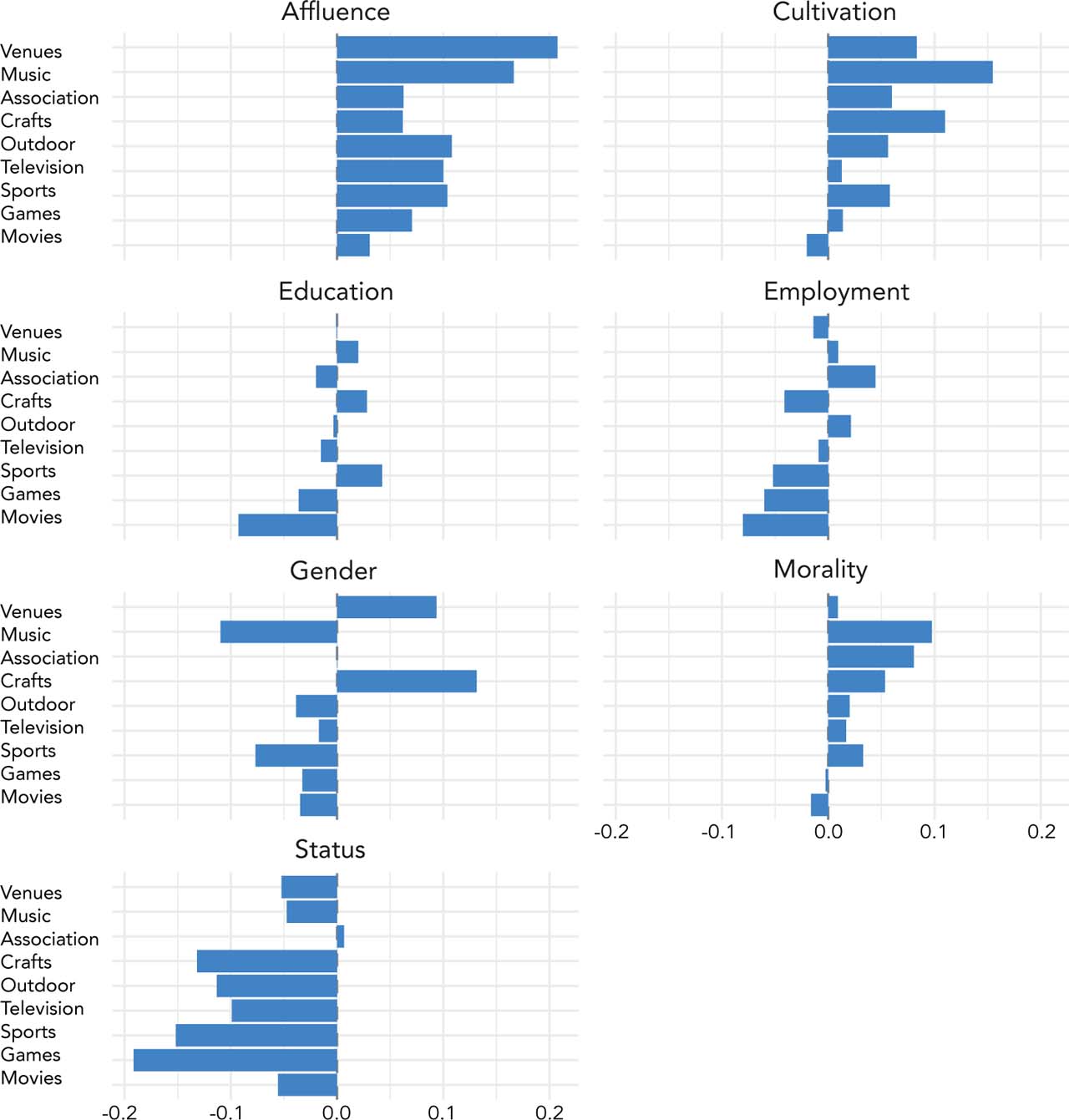
Figure 1
Working-class leisure activity groups by class-related dimension (cosine similarity)
Comments: The figure shows the semantic alignment of working-class leisure activity groups across seven class-related dimensions. Negative values indicate stronger alignment with the lower-class direction of a dimension, whereas positive values indicate stronger alignment with the higher-class end. For example, positive values on the affluence dimension indicate stronger associations with affluent rather than economically disadvantaged terms (see Tables 1 and 2 for the lists of words composing each word group).
The affluence axis was constructed from terms relating to the economic well-being and success of individuals. The strongest positive alignment exists with words relating to venues (+0.21), outdoor (+0.11), and music (+0.17) – typical of the working class. Working-class games, sports activities, crafts, and media are likewise associated with affluence but more moderately (e.g., crafts: +0.06). Overall, affluence is clearly positively associated with most working-class activities.
The cultivation axis was created from contrasts reflecting refinement, manners, social evaluation, and cultural capital. Working-class lifestyle activities are associated overall with the higher-class end of the axis. Venues and music both score highly (+0.07 and +0.16), suggesting that these culturally valued, disciplined activities are linguistically associated with refinement. The crafts group especially aligns positively (+0.11), which is consistent with the skill-intensive nature of crafts. However, practices related to entertainment media, associations, outdoor activities, and games show a weak alignment with both ends of the axis.
The education axis was formulated using words contrasted in terms of education level, competence, training, and expertise. Compared to the two previous class dichotomies, the associations between working-class lifestyles and education are much weaker and more mixed. Activities involving learned skills or techniques align positively: The sports (+0.04) and crafts (+0.03) groups fall on the educated/competent side of the axis to some degree. The movies (−0.09) activity group is the only one with a significant association, which is a negative one towards the less-educated side of the axis. The rest of the activities, while aligning on both sides of the axis, have weaker associations overall. This indicates that, although activities involving skill align with higher-class status and media-related activities align with lower-class status, working-class lifestyles overall do not exhibit a significant or one-sided class bias in terms of education compared to other types of class dichotomies.
The employment axis was created using words relating to workplace hierarchies and positions, aiming to capture distinctions between managerial and worker identities. The activity groups show an overall low degree of association with this axis, as most activities are only weakly linked to occupational roles. The associations group exhibits the only significant positive association (+0.04), with managerial identities aligning with the middle-class side of the axis; this is consistent with the bureaucratic and institutional connotations of civic organisations. The movies group is the only one showing significant association with the working-class side of the axis (−0.08), consistent with the overall pattern that popular media tend to be associated most closely with vocabulary describing workers rather than managers. The rest of the activity groups have weaker alignments with both sides of the axis, indicating that employment-related dichotomies are present but not a major organising principle in the semantic landscape of leisure practices. However, despite these associations being mostly weak, it is notable that activities are mostly associated with the working-class side of the employment dichotomy.
The gender axis was defined by various pairs relating to femininity and masculinity. The feminine side of the axis is associated mostly with crafts (+0.13) and venues (+0.09). The two most masculine activity groups are music (−0.11) and sports (−0.08). The other activity groups exhibit weaker associations with gendered dichotomies. Thus, while the model has clearly detected gendered assumptions concerning the most stereotypically masculine and feminine activities, most activity groups seem to consist of activities stereotypical of both genders, largely nullifying the effect of gender in evaluating the class associations of working-class leisure activities.
Morality is a significantly more coherent axis, like cultivation and affluence. This axis was constructed from words relating to ethical evaluations and connotations of prosocial behaviour. Four activity groups are aligned positively to some degree (sports: +0.03; crafts: +0.05; associations: +0.08; and music: +0.10), whereas the rest have relatively neutral alignments. The results seem to indicate that these four categories are associated with dedication, community, and self-improvement. The neutral association of all media and entertainment-related activities indicates that mass media entertainment does not share the same admiration and is largely associated with moral ambiguity.
The status axis, built from contrasts concerning prestige, recognition, and symbolic importance, distinguishes itself as the only dichotomy consistently associated with the lower side. An exception is associations, scoring neutrally (+0.01). All other activity groups show a negative association with status, with crafts (−0.13), games (−0.19), outdoor (−0.11), and sports (−0.15) being the most prominent. These values suggest that the bulk of working-class leisure practices are culturally encoded as mundane or low prestige rather than eminent, prestigious, or esteemed.
Overall, the results indicate that leisure activities favoured by the working class are not predominantly associated with markers of low socioeconomic position. Instead, these activities are consistently linked with semantic domains reflecting affluence, cultural cultivation, and morality. Apart from popular media consumption and a few explicitly everyday activities, working-class leisure practices are rarely framed as impoverished, uncultured, or morally suspect. This suggests that working-class identity in Finnish-language use is not constructed in direct opposition to middle-classness but incorporates elements traditionally associated with it.
At the same time, working-class leisure activities show weak or negative associations with the semantic dichotomies of education, employment position, and social status. Although working-class activities are represented as cultivated and morally positive, they are not associated with institutional forms of capital, such as formal education, occupational authority, or prestige. Working-class culture thus appears culturally legitimate but structurally disadvantaged, as it continues to be excluded from the mechanisms that convert cultural participation into social recognition and network-based advantages. Working-class leisure practices occupy a space of moral and cultural affirmation without corresponding gains in status or institutional power.
Moreover, the results indicate that entertainment-media–related working-class activities are consistently positioned at the lower end of most social dichotomies, suggesting that passive forms of cultural consumption (e.g., movies and TV shows) are linguistically associated with low prestige, weak cultivation, and limited symbolic value. In contrast, working-class activities involving skill, effort, or participation (e.g., sports, crafts, music, and outdoor activities) are more positively evaluated across multiple axes.
Word embedding does not offer a way to confirm why these patterns exist. Nevertheless, these observations can be explained by the framing of working-class culture through values of consumption, self-realisation, and refinement, even as continued class stratification persists through education, employment, and social status rather than through overt moral judgment or deprivation.
To assess the robustness of the findings, the analysis was repeated using only the 59 leisure activities that were more common among the working class. The overall pattern remained highly similar in both specifications (see Tables A1 and A2 in the Appendix). Although some individual associations changed in magnitude, working-class leisure activities remained positively associated with affluence and cultivation while showing negative associations with status. The most notable differences concerned a neutralisation of the association between working-class games and status (from −0.19 to −0.13). Additionally, the association between affluence and outdoor activities increased by 0.05, and the association between games and education, as well as morality, increased by 0.04 (see Table A2 in the Appendix). The robustness analysis thus supports the main findings and suggests that the original weighted activity groups captured a broadly similar semantic structure reflecting working-class lifestyles despite including activities that were not exclusively associated with them. The results of the robustness check confirmed that the expanded weighted groups of activity groups succeeded in depicting lifestyle practices of the working class across a wider set of domains and individual activities than the initial 59 more popular among the working class.
Conclusion and discussion
By combining statistical population-level patterns with word embedding, I was able to compare leisure activities with class-based linguistic associations. The first research phase uncovered empirical differences in leisure activities between occupational groups, while the second research phase explored the semantic structures associated with leisure activity words and class dichotomies. The results suggest that classed meaning-making on the Finnish-language Internet operates less through the overt denigration of working-class lifestyles than through distinctions that separate cultural legitimacy from prestige and authority. From a Bourdieusian perspective, leisure practices function not only as expressions of class position but also as symbolic markers through which social differences are classified and recognised (Bourdieu, 1984). The findings indicate that cultural legitimacy and symbolic prestige do not necessarily coincide in online representations of class. From this perspective, working-class culture is not rejected but neutralised. It is rendered morally acceptable and even aesthetically valued while remaining disconnected from cultural institutions, social networks, and symbolic authority.
Bourdieu (1984) has emphasised the distinction between economic and cultural capital, suggesting that the working class lacks both the material resources and the cultural dispositions associated with the middle and upper classes. The results of this study partially contradict this claim in the Nordic context. Working-class leisure is associated with affluence and cultivation, indicating that economic resources and culturally legitimate practices are not absent from working-class life. Therefore, working-class leisure activities may reflect associations with consumerist and aspirational lifestyles while still lacking some further forms of distinction that are essential for achieving a formal middle-class position. Furthermore, it is possible that the association of working-class lifestyles, affluence, and cultural cultivation is a relatively recent phenomenon affected by the emergence of online media or characteristic of the Nordic context with relatively stronger trade unions and lower levels of income inequality (Figenschou et al., 2021).
Working-class leisure activities exhibit weak semantic alignment with educational attainment and employment hierarchy. This does not indicate the absence of capital per se; rather, it points to the failure to gain recognition, position, and status through the economic and cultural capital possessed by the working class. The struggle for legitimacy may be less about moral worth or aesthetic competence than about access to institutional pathways that convert culture into status. As suggested by Goldthorpe (1969), rising affluence among the working class does not imply a convergence in norms, values, life chances, or respect towards working-class professions. Instead, consumerist individualism has been incorporated as the disposition from which differences aligning loosely with objective class positions are drawn (Atkinson, 2010). In this sense, the depiction of working-class culture aligns with the working-class attitude described in previous research: Workers instrumentally sell their labour to the highest bidder and pursue meaning and happiness through family life, entertainment, and consumer culture (Kolehmainen, 2017; Metzgar, 2021).
Previous research has often characterised working-class representation in commercial media as limited, stereotypical, or absent (e.g., Figenschou et al., 2021; Deery & Press, 2017). While the present study cannot measure or analyse this kind of representation directly, it provides insight into how working-class lifestyles are symbolically positioned within the Finnish-language Internet. Specifically, the findings suggest that Internet discourse may provide visibility and cultural legitimacy for working-class lifestyles while continuing to reproduce the forms of symbolic stratification identified in previous research (e.g., Huang, 2024; Kolehmainen, 2017).
Either because working-class individuals cannot pursue their preferred hobbies or because these hobbies may be perceived as overtly wasteful, the activities the working class partakes in are not associated with markers of a high level of education or a high position in the workplace; instead, they are associated with an overall low level of status, respectability, and prestige. Working-class people’s hobbies may be characterised by more leisurely as well as infrequent participation that does not lead to institutional recognition. This notion is reinforced by this study’s results concerning media activities. Words relating to media and entertainment are most consistently neutral or associated with the lower-class side of all dichotomies. As these activities arguably possess the strongest connotations with passive consumerism, these results demonstrate the notion that working-class hobbies may be used more to fulfil entertainment needs than to facilitate career advancement (e.g., Lim & Loh, 2020). However, the high association of sports with education and of associations with employment positions indicate some opportunities where working-class skills in sports and community organising can be converted into social capital as well.
The use of word embedding enables the analysis of cultural meaning at a scale and level of abstraction that would be difficult to achieve with qualitative methods alone. In this study, the method proved especially effective for identifying patterned alignments between leisure activities and class associations. One limitation of the study is the aggregation of leisure activities into broader thematic groups, which, while necessary to construct interpretable general activity vectors, may have concealed meaningful variation within categories. The results should thus be interpreted as describing class association with working-class preferences to broad domains of activities rather than each leisure practice under those domains. Additionally, the findings should be understood in a limited context, as word embeddings primarily capture regularities in language use rather than normative truths or lived experiences (Kozlowski et al., 2019). While linguistic regularities reflect cultural structures, they do not explain how meanings are produced, negotiated, or contested (Boutyline & Arseniev-Koehler, 2025). In this study, I adopted established procedures to minimise these risks, but the results would nevertheless benefit greatly from additional validation, especially with qualitative methods (e.g., Nelson, 2020).
Finnish has advantages and disadvantages for word embedding. As a language with a relatively small number of users and an overwhelming association with a single country, it provides an easily understandable context for this study. However, being an agglutinative language, Finnish poses a challenge for word embedding: Every word has tens of different forms depending on the context and therefore have differing, although very similar, positions in word-embedding matrices. On the other hand, the common use of compound words means that word embedding can signify very complex but specific meanings; as a result, the operationalisation of phenomena such as media genres or voluntary organisations could be carried out with word-level rather than document-level embeddings.
The findings suggest that contemporary working-class culture in Finland is neither overtly stigmatised nor structurally empowered. It is portrayed as affluent, cultured, and morally legitimate but remains weakly connected to the institutional levers of social mobility and especially high social status. This configuration challenges simplistic notions of class decline or cultural deficiency and instead highlights the prevalence of institutional cultural capital and social capital in key areas of distinction for the establishment of class differences. The study thus contributes to ongoing discourse about class and culture by demonstrating how cultural recognition and structural inequality can coexist. Furthermore, it highlights the potential of computational methods as a tool for uncovering such tensions, provided that the results are interpreted with theoretical care and methodological reflexivity.
Acknowledgements
This study is part of the research project funded by the Academy of Finland, “Cultures of the Working Class in the 2020s: Fragmentation, Reproduction, Boundaries, Politics (CuWoC)” (Project number 346784).
Appendices
Appendix
Table A1
Orientation of leisure activity groups to class dichotomy groups (cosine similarity)
| Activity | Dichotomy | Orientation |
|---|---|---|
| Association | Affluence | 0.062557208 |
| Cultivation | 0.059779695 | |
| Education | −0.0197259 | |
| Employment | 0.044406677 | |
| Gender | 0.00034219 | |
| Morality | 0.080520711 | |
| Status | 0.00660272 | |
| Crafts | Affluence | 0.061802228 |
| Cultivation | 0.109816761 | |
| Education | 0.028057788 | |
| Employment | −0.041170191 | |
| Gender | 0.131329885 | |
| Morality | 0.053453486 | |
| Status | −0.131689496 | |
| Games | Affluence | 0.070433944 |
| Cultivation | 0.013631693 | |
| Education | −0.036187229 | |
| Employment | −0.06009814 | |
| Gender | −0.032688195 | |
| Morality | −0.002434482 | |
| Status | −0.19153809 | |
| Movies | Affluence | 0.030714718 |
| Cultivation | −0.020234055 | |
| Education | −0.092730756 | |
| Employment | −0.080257342 | |
| Gender | −0.034778511 | |
| Morality | −0.016210935 | |
| Status | −0.055595419 | |
| Music | Affluence | 0.166265068 |
| Cultivation | 0.154711598 | |
| Education | 0.01995686 | |
| Employment | 0.009337826 | |
| Gender | −0.109756246 | |
| Morality | 0.097484729 | |
| Status | −0.047412569 | |
| Outdoor | Affluence | 0.107999172 |
| Cultivation | 0.056199341 | |
| Education | −0.003375327 | |
| Employment | 0.021318345 | |
| Gender | −0.038533197 | |
| Morality | 0.020035593 | |
| Status | −0.11310453 | |
| Sports | Affluence | 0.103761205 |
| Cultivation | 0.057960674 | |
| Education | 0.042364844 | |
| Employment | −0.051986586 | |
| Gender | −0.07675352 | |
| Morality | 0.032728725 | |
| Status | −0.15173822 | |
| Television | Affluence | 0.099946607 |
| Cultivation | 0.012609763 | |
| Education | −0.015116019 | |
| Employment | −0.009077579 | |
| Gender | −0.017084336 | |
| Morality | 0.016698499 | |
| Status | −0.098981395 | |
| Venues | Affluence | 0.207317062 |
| Cultivation | 0.083250307 | |
| Education | −0.000506039 | |
| Employment | −0.014026231 | |
| Gender | 0.093606271 | |
| Morality | 0.008941011 | |
| Status | −0.052335845 | |
| Music | Affluence | 0.166265068 |
| Cultivation | 0.154711598 | |
| Education | 0.01995686 | |
| Employment | 0.009337826 | |
| Gender | −0.109756246 | |
| Morality | 0.097484729 | |
| Status | −0.047412569 | |
| Outdoor | Affluence | 0.107999172 |
| Cultivation | 0.056199341 | |
| Education | −0.003375327 | |
| Employment | 0.021318345 | |
| Gender | −0.038533197 | |
| Morality | 0.020035593 | |
| Status | −0.11310453 | |
| Sports | Affluence | 0.103761205 |
| Cultivation | 0.057960674 | |
| Education | 0.042364844 | |
| Employment | −0.051986586 | |
| Gender | −0.07675352 | |
| Morality | 0.032728725 | |
| Status | −0.15173822 | |
| Television | Affluence | 0.099946607 |
| Cultivation | 0.012609763 | |
| Education | −0.015116019 | |
| Employment | −0.009077579 | |
| Gender | −0.017084336 | |
| Morality | 0.016698499 | |
| Status | −0.098981395 | |
| Venues | Affluence | 0.207317062 |
| Cultivation | 0.083250307 | |
| Education | −0.000506039 | |
| Employment | −0.014026231 | |
| Gender | 0.093606271 | |
| Morality | 0.008941011 | |
| Status | −0.052335845 |
Table A2
Results of robustness analysis: Orientation of leisure activity groups to class dichotomy groups (cosine similarity)
| Activity | Dichotomy | Orientation |
|---|---|---|
| Association | Affluence | 0.072251929 |
| Cultivation | 0.053814328 | |
| Education | −0.036454874 | |
| Employment | 0.06185564 | |
| Gender | 0.047388073 | |
| Morality | 0.05454912 | |
| Status | 0.011639787 | |
| Crafts | Affluence | 0.038537379 |
| Cultivation | 0.095380714 | |
| Education | 0.049223811 | |
| Employment | −0.04973556 | |
| Gender | 0.148837011 | |
| Morality | 0.051178891 | |
| Status | −0.135110357 | |
| Games | Affluence | 0.105454482 |
| Cultivation | 0.035953807 | |
| Education | 0.00366006 | |
| Employment | −0.026721218 | |
| Gender | −0.004602686 | |
| Morality | 0.036864151 | |
| Status | −0.13048934 | |
| Movies | Affluence | 0.041734419 |
| Cultivation | −0.015323146 | |
| Education | −0.087013525 | |
| Employment | −0.076077339 | |
| Gender | −0.047171549 | |
| Morality | −0.015014733 | |
| Status | −0.038711322 | |
| Music | Affluence | 0.159517222 |
| Cultivation | 0.156073422 | |
| Education | 0.019450091 | |
| Employment | 0.011994574 | |
| Gender | −0.107435493 | |
| Morality | 0.098501205 | |
| Status | −0.041291894 | |
| Outdoor | Affluence | 0.157238178 |
| Cultivation | 0.052213808 | |
| Education | −0.025358921 | |
| Employment | 0.017745528 | |
| Gender | −0.047371575 | |
| Morality | 0.019355173 | |
| Status | −0.075795381 | |
| Sports | Affluence | 0.099024842 |
| Cultivation | 0.058804745 | |
| Education | 0.044418103 | |
| Employment | −0.051447772 | |
| Gender | −0.078097326 | |
| Morality | 0.03166005 | |
| Status | −0.155620516 | |
| Television | Affluence | 0.130628238 |
| Cultivation | 0.041650044 | |
| Education | 0.003766689 | |
| Employment | −0.035332207 | |
| Gender | −0.014633951 | |
| Morality | 0.021487033 | |
| Status | −0.09738317 | |
| Venues | Affluence | 0.190249847 |
| Cultivation | 0.074633538 | |
| Education | −0.014939888 | |
| Employment | −0.028556477 | |
| Gender | 0.092274726 | |
| Morality | 0.008780566 | |
| Status | −0.057366524 |