

Introduction
Populist parties have been successful in leveraging social media platforms, benefiting from their capacity for direct, people-centred communication and algorithmic amplification of emotionally charged and simplified content (Ernst et al., 2017; Magin et al., 2024). Consequently, a growing body of research suggests that social media has facilitated the spread of populist communication by enabling politicians to bypass traditional journalistic gatekeepers and communicate directly with citizens (Ernst et al., 2017). Moreover, research has attributed part of the success of populist parties to their distinct mode of populist communication or performative style (e.g., Hameleers et al., 2017; Moffitt, 2016). At its core, populist communication constructs politics as a moralised struggle between “the people”, “elites”, and “dangerous outgroups”, simplifying complex political realities into antagonistic narratives (Reinemann et al., 2017).
This antagonistic framework of populist communication has an inherent emotional dimension, framing politics as a struggle between “good” versus “evil” and thereby appealing to emotions as a central mechanism of political persuasion (for a systematic review on the role of emotions in populist communication, see Bliuc et al., 2026). Previous research on populist communication has particularly highlighted the central role of negative emotional appeals, such as anger and fear, in reinforcing the antagonistic divide between “the people” and “elites” and “dangerous outgroups” (Caiani & Di Cocco, 2023; Hameleers et al., 2017; Salmela & von Scheve, 2017; Widmann, 2021). At the same time, a smaller body of research has highlighted the role of positive emotional appeals in populist communication, but these remain relatively underexplored empirically (see Bliuc et al., 2026). Populist actors appeal to positive emotions to reinforce collective identities, foster a sense of belonging, and strengthen affective attachment to “the people”, the nation, and charismatic leaders, while simultaneously portraying themselves as credible agents capable of restoring the “will of the people” (Albertazzi & Bonansinga, 2024; Bonansinga, 2025; Tietjen, 2023). Taken together, these insights suggest that emotional appeals serve a dual function in populist communication, mobilising support while reinforcing boundaries between collective ingroups and outgroups.
Nevertheless, several important empirical gaps remain. First, little empirical attention has been devoted to how members of the leadership of radical right-wing populist parties appeal to both negative and positive emotions in their social media communication. Second, limited empirical research has been devoted to how emotional appeals are directed toward different targets within the populist antagonistic framework that juxtaposes “the pure people” against “corrupt elites” and “dangerous outgroups”. Third, relatively little is known about how emotional appeals vary across social media platforms. Addressing these gaps requires moving beyond viewing populist communication as a monolithic phenomenon and examining how emotional appeals are shaped by individual actors, their relational targets, and the social media platforms on which the communication occurs. To this end, we examine the use of emotional appeals in the social media communication of the populist radical right Finns Party1 leadership on X (Twitter), TikTok, Facebook, and Instagram during the 2023 Finnish parliamentary election through three exploratory research questions:
RQ1. Which emotional appeals did members of the Finns Party leadership employ in their social media communication during the 2023 Finnish parliamentary election?
RQ2. Who did members of the Finns Party leadership target through their emotional appeals in their social media communication during the 2023 Finnish parliamentary election?
RQ3. How did emotional appeals and their targets vary across social media platforms among members of the Finns Party leadership during the 2023 Finnish parliamentary election?
To answer these questions, we conducted a quantitative content analysis of 524 social media posts published by six members of the party leadership during the three weeks preceding the 2023 Finnish parliamentary election. The Finnish context is particularly suitable for such an inquiry, as its open-list proportional representation system encourages candidate-centred campaigning, making social media a central arena for electoral competition and personalised self-presentation (Carlson & Strandberg, 2024). The focus on party leadership reflects both the growing personalisation of political communication (Van Aelst et al., 2012) and the central role of leaders as symbolic representatives of “the people” in populist communication (Moffitt, 2016). Consequently, we employ a single-case study design to examine the use of emotional appeals in the Finns Party’s social media communication during the 2023 Finnish parliamentary election. Although this is a single-case study, the Finns Party is a prominent and electorally successful member of the broader populist radical right party family (Arter, 2025) and has been identified as one of the most consistent users of populist communication in Finland (Jensen et al., 2026; Järviniemi, 2024). Consequently, the findings can provide tentative insights into how leaders of populist radical right parties employ emotional appeals in social media campaigning. This study thus contributes to research on emotional appeals in populist communication by examining 1) the use of positive and negative emotional appeals, 2) how these appeals are directed toward different targets within the populist antagonistic framework, and 3) how emotional appeals vary across social media platforms.
Theoretical framework
Populism as a discursive framework
In recent years, scholars have increasingly examined the rhetorical, emotional, and performative dimensions of populist communication (Moffitt, 2016). At the same time, populism remains a contested concept, characterised by a wide range of definitions and analytical approaches, reflecting its context-dependent manifestations across political systems, cultures, and ideological traditions (for an overview, see Herkman, 2022: 11–36). While this plurality has enriched the field, it has also contributed to fragmentation in how populism is conceptualised. Rather than attempting to reconcile these competing perspectives, this study adopts a discursive framework approach, conceptualising populism primarily as a mode of political communication (see Järviniemi, 2025; Reinemann et al., 2017). Within this framework, populist communication is characterised by an antagonistic “us versus them” narrative that constructs boundaries between the virtuous and homogeneous “people”, corrupt “elites”, and perceived “dangerous outgroups” (often referred to as “dangerous others” in the populism literature; Reinemann et al., 2017). From this perspective, populist communication is not confined to a particular ideology and can be adopted by political actors across the ideological spectrum (see Jensen et al., 2026; Järviniemi, 2025). The analytical strength of this framework lies in its flexibility, as “the people”, “elites”, and “dangerous outgroups” vary across political, ideological, and national contexts (de Vreese et al., 2018; Reinemann et al., 2017).
At the core of the populist discursive framework lies people-centrism, in which “the people” are constructed as the rightful locus of political authority (Järviniemi, 2025). However, this notion of “the people” is highly flexible and can be adapted to different ideological projects and contextual realities (de Vreese et al., 2018). Anti-elitist populism combines people-centrism with anti-elite discourse, portraying elites as betraying the “will of the people” (de Vreese et al., 2018; Jagers & Walgrave, 2007). Depending on the context, “elites” can be political, economic, cultural, intellectual, or judicial (de Vreese et al., 2018; Jagers & Walgrave, 2007; Mudde, 2017). Exclusionary populism constructs “dangerous outgroups” that are portrayed as threats to the collective identity of “the people” (Järviniemi, 2025). The identity of these outgroups is similarly fluid and shaped by ideological orientation and political context. In populist radical right communication, immigrants, ethnic minorities, groups portrayed as exploiting the welfare system, and individuals or groups with progressive political agendas (e.g., left-wing activists or advocates of multiculturalism) are frequently constructed as “dangerous outgroups” and portrayed as threats to cultural integrity, social cohesion, or economic stability (Herkman, 2022; Järviniemi, 2025; Reinemann et al., 2017).
Emotional appeals in populist communication
Research in political psychology and political communication has demonstrated that emotions play a fundamental role in shaping how citizens interpret political information, evaluate political actors, and engage in political behaviour (Brader, 2005; Marcus et al., 2000). Much of the literature on emotions in politics has traditionally relied on the two-dimensional valence model of emotions, which conceptualises positive and negative emotions as two independent and orthogonal dimensions (Marcus et al., 2000). However, more recent research has challenged this valence-based approach for overlooking important differences between emotions that share the same positive or negative valence, emphasising that discrete emotions of the same valence can trigger distinct cognitive appraisals and behavioural responses (see, e.g., Rico et al., 2017; Wagner, 2014).
We follow Brader’s (2005: 390) definition of emotional appeals as “communications intended to elicit an emotional response from some or all who receive them”. Building on this, a growing body of research recognises the central role of emotions in populist communication (see, e.g., Bliuc et al., 2026; Caiani & Di Cocco, 2023; Cartes-Barroso et al., 2025; Domínguez-García et al., 2025; Hameleers et al., 2017; Hloušek et al., 2024; Rico et al., 2017; Salmela & von Scheve, 2017; Tietjen, 2023; Widmann, 2021; Wirz, 2018). Populist actors consistently rely on emotional appeals as a central feature of their speeches, language, and overall presentation (Moffitt, 2016). Given the relational logic of the antagonistic populist discursive framework, emotional appeals are central both to the construction and consolidation of collective identities around the ingroup (consisting of “the people” and populist actors) and to the exclusion of perceived outgroups (consisting of “elites” and “dangerous outgroups”). Through these appeals, populist actors mobilise support, foster collective identities through shared grievances, and position themselves as authentic representatives of “the people” while attributing responsibility for societal grievances to “elites” and “dangerous outgroups” (Hameleers et al., 2017).
Turning to specific emotional appeals, research has particularly highlighted the role of anger in populist communication (e.g., Caiani & Di Cocco, 2023; Rico et al., 2017; Salmela & von Scheve, 2017; Widmann, 2021). Anger can be understood as an actor-oriented emotion, arising when individuals attribute adverse events to the deliberate actions of external actors rather than to their own behaviour or to uncontrollable circumstances (Wagner, 2014; Wirz, 2018). Anger has been conceptualised as a reaction to perceived vulnerabilities among citizens, often channelled in populist communication against corrupt “elites” and stigmatised “outgroups” (Caiani & Di Cocco, 2023; Rico et al., 2017; Salmela & von Scheve, 2017). However, through appeals to anger, populist actors may also engage with narratives that emphasise shame, moral wrongdoing, and social injustice (Caiani & Di Cocco, 2023; Salmela & von Scheve, 2017). In particular, within populist communication, narratives of humiliation and status loss may transform feelings of shame into anger toward those perceived to be responsible (Salmela & von Scheve, 2017).
Fear represents another central emotional appeal in populist communication (Bliuc et al., 2026). Fear is likely to emerge when individuals face threatening circumstances that lack a clearly identifiable source of responsibility, where individuals feel little or no control over the outcome (Wagner, 2014). Feelings of fear and insecurity have been closely tied to perceptions of economic instability, social disintegration, relative deprivation, and a sense of powerlessness (Salmela & von Scheve, 2017). According to Salmela and von Scheve (2017), the perceived “losers” of globalisation are particularly susceptible to fear and feelings of insecurity, because of perceived declining status, identity loss, and the erosion of traditional values. Moreover, fear has been shown to decrease partisan habits and increase individuals’ receptiveness to new information and persuasion (Scheller, 2019). Consequently, appeals to fear may enable populist actors to attract new supporters (Widmann, 2021).
Beyond anger and fear, other negative emotional appeals also reinforce the antagonistic logic of populist communication. For instance, contempt functions as an exclusionary emotion, characterised by a short-term derogation and long-term negative appraisal of another person’s character with the goal of socially excluding this other person (Fischer & Roseman, 2007). In populist communication, contempt is appealed to by signalling the perceived moral or intellectual inferiority of political opponents, for instance, as expressed through sarcasm, ridicule, irony, mockery, or stereotyping. Furthermore, appeals to sadness also feature in populist communication (Widmann, 2021). Sadness is an emotion connected to disappointment, failure, loss, and misfortune (Small & Lerner, 2008). Sad individuals have been shown to engage in more systematic processing of political information, while reducing reliance on prior biases (Small & Lerner, 2008). Consequently, populist actors may employ appeals to sadness to resonate emotionally with disillusioned citizens, cultivate a sense of shared grievance with “the people”, and potentially attract new supporters (Widmann, 2021).
At the same time, comparatively less empirical attention has been devoted to positive emotional appeals in populist communication, particularly within studies of populist radical right communication. Whereas left-wing populism has long drawn on positive emotional appeals to promote grassroots solidarity and engagement, emerging research indicates that populist radical right actors also use positive emotional appeals to mobilise support (see, e.g., Caiani & Di Cocco, 2023). However, positive emotional appeals in populist communication are not inherently inclusive. By strengthening attachment to the ingroup, they may simultaneously reinforce moral boundaries between ingroups and outgroups, thereby contributing to exclusionary forms of collective identity construction (Salmela & von Scheve, 2017).
Turning to positive emotional appeals, emotions such as enthusiasm, joy, love, pride, hope, and nostalgia can reinforce collective identities, foster a sense of belonging and unity of “the people”, and strengthen affective attachment to the nation and charismatic populist leaders (Albertazzi & Bonansinga, 2024; Bonansinga, 2025; Tietjen, 2023). Through such appeals, populist actors can simultaneously portray themselves as credible agents capable of restoring the “will of the people” and as protectors of this community. Enthusiasm is a prospective emotion that arises in response to cues that signal goal-congruent and desirable outcomes and reinforces commitment and motivation (Brader, 2005). Joy is a retrospective emotion, experienced when past developments are evaluated as consistent with one’s goals (Widmann, 2021). Love can be conceptualised as an enduring and affectively rich emotion that fosters sustained attachments to valued objects and entails a concern for the well-being and flourishing of that object (Tietjen, 2023). Similar to joy, pride is elicited by previous success and reflects an enhancement of one’s identity through attribution of credit to valued achievements, either one’s own or those of a group with which one identifies (Lazarus, 2001).
Hope represents a prospective and mobilising emotion (Wirz, 2018), elicited when individuals evaluate a future outcome as compatible with their personal goals, meaningful to them, realistically achievable yet uncertain, and expected to bring about an improved future (Chadwick, 2015). By connecting present grievances to expectations of a better future, hope thus serves as a powerful emotional appeal in electoral campaigning. Consequently, in populist communication, hope can connect dissatisfaction with the present to expectations of political renewal by portraying populist actors as capable of restoring the “will of the people” and correcting the failures of the political establishment. Nostalgia, commonly expressed as yearning for lost or idealised “good old days”, is another central emotional appeal in populist communication (Salmela & von Scheve, 2017; Smeekes et al., 2021). It is generally conceptualised as an ambivalent, though predominantly positive, emotion characterised by a sentimental longing for a personally meaningful and warmly remembered past (Sedikides et al., 2008). In populist communication, nostalgia is often used to evoke idealised visions of the past and historical narratives that glorify traditional, ethnically and culturally homogeneous communities and celebrate their past achievements (Salmela & von Scheve, 2017).
Moreover, populist communication is often associated with humorous rhetoric, including satire, sarcasm, irony, mockery, and ridicule, which can make political messages more accessible and engaging (Sakki & Martikainen, 2021). However, humour can serve both inclusive and exclusionary functions. Analysing the Finns Party’s 2019 election campaign video, Sakki and Martikainen (2021) showed how humorous ridicule of political opponents can simultaneously evoke enjoyment from the perceived humiliation, failure, or discomfort of political adversaries (i.e., schadenfreude) and reinforce feelings of contempt and superiority toward political opponents. Humour may thus frame derogatory or norm-violating content as acceptable, thereby masking or legitimising hostility toward political opponents or outgroups (Sakki & Martikainen, 2021). Accordingly, we distinguish between different uses of humour based on the emotional responses they seek to elicit. Humour that primarily entertains, engages, or fosters relatability is coded as an appeal to amusement, whereas derisive humour based on irony, ridicule, sarcasm, or mockery is coded according to the negative emotional response it seeks to evoke, such as contempt or anger (Sakki & Martikainen, 2021).
Populist communication and social media platforms
The affordances of social media have often been argued to align with the people-centrist dimension of populist communication, allowing political actors to cultivate direct, personalised, and seemingly unmediated connections with “the people” (Ernst et al., 2017). Consequently, a growing body of research suggests that social media platforms have facilitated the spread of populist communication by enabling politicians to bypass traditional journalistic gatekeepers and communicate directly with citizens (Ernst et al., 2017). At the same time, candidate-constituent interaction varies across platforms, reflecting differences in their technological affordances, user demographics, and broader sociocultural norms (see Nelimarkka et al., 2020). These differences in social media platforms provide political actors with opportunities for strategic self-presentation (Magin et al., 2024).
This is reflected in studies of populist communication on different social media platforms. For instance, research has shown that populist communication is more widespread on Facebook compared with other social media platforms (Ernst et al., 2017; Magin et al., 2024). This suggests that populist actors may perceive Facebook as a useful venue for populist communication, given its extensive reach, opportunities for direct interaction with citizens, and capacity for longer-form messages (Ernst et al., 2017). By contrast, X (Twitter) has more frequently been associated with elite discourse, and research suggests that right-wing populist actors have used the platform as a space for confrontation with political, journalistic, and institutional elites rather than for direct voter engagement (Schwartz et al., 2023).
Turning to Instagram and TikTok, recent research suggests that these platforms enable populist actors to cultivate a more personal, playful, and sympathetic image through self-personalisation and lifestyle-oriented content (Albertazzi & Bonansinga, 2024; Bonansinga, 2025; Schwartz et al., 2023). For instance, Bonansinga (2025) has shown how Marine Le Pen uses Instagram for “dedemonisation”, sharing curated glimpses of her private life to cultivate a more relatable and ordinary public image. At the same time, TikTok is underpinned by an engagement-driven algorithm that prioritises high-arousal content and has been linked to the amplification of far-right radicalisation (Shin & Jitkajornwanich, 2024). Moreover, emotionally intense content tends to achieve greater visibility on the platform, and recent studies find both positive and negative emotional appeals to be prominent in populist radical right communication on TikTok (Cartes-Barroso et al., 2025; Domínguez-García et al., 2025).
Against this backdrop, while previous research suggests that social media platforms may be used in distinct ways and that populist communication varies across them, less is known about how different emotional appeals are distributed across these platforms. Differences in emotional appeals across social media platforms may reflect a range of factors, including individual actor preferences and audience compositions.
The Finnish context: The political system and the Finns Party
Finnish politics has traditionally emphasised consensus and cooperation, with broad coalitions and relatively low levels of political conflict (von Schoultz & Strandberg, 2024). At the same time, Finland’s candidate-centred electoral system, where voters select individual candidates within multimember districts, encourages personalised campaigning and competition among candidates of the same party (von Schoultz & Strandberg, 2024). As a result, individual visibility and personalised communication play a central role in electoral competition (Van Aelst et al., 2012). Thus, Finland’s electoral environment provides a well-suited context for studying social media communication in electoral campaigns, a dynamic further reinforced by the country’s high Internet usage and candidates’ early adoption of digital platforms (Carlson & Strandberg, 2024; Newman et al., 2024). The Finns Party constitutes a particularly relevant case in this context, having positioned itself as a digital challenger to established parties by actively and innovatively using digital media platforms early on to bypass traditional media gatekeepers and mobilise supporters directly (Hatakka, 2018).
Founded as a challenger to the established party system in Finland, the Finns Party’s electoral breakthrough came in the 2011 parliamentary election, when it secured 19 per cent of the vote. In 2015, the party received nearly 18 per cent and entered government as the second-largest party in a centre–right coalition led by the Centre Party. Government participation proved to be a turning point, and in 2017, a leadership change brought Jussi Halla-aho to power, representing the party’s more radical right-wing faction. This shift triggered an internal split, as supporters of former leader Timo Soini formed Blue Reform, which remained in government until shortly before the 2019 election. Under Halla-aho, the Finns Party consolidated a more explicitly radical right, nativist, and fiscally conservative economic political agenda. In the 2019 election, the party received 17 per cent of the vote and again became the second-largest party in Finland. In 2021, Riikka Purra was elected party leader, under whose leadership the party further strengthened its radical right profile. This ideological consolidation has brought the Finns Party into closer alignment with other populist radical right parties across Europe, sharing core features such as nativism, authoritarianism, and anti-establishment populist communication (see Arter, 2025). In the 2023 election, the Finns Party increased its vote share to 20 per cent and joined a right-wing coalition government led by the National Coalition Party, again as the second-largest party.
Prior to the 2023 election, Finland was governed by a “red–green” coalition including the Social Democratic Party, the Centre Party, the Green League, the Left Alliance, and the Swedish People’s Party. The government was led by Prime Minister Sanna Marin and was notable for being headed by female leaders from all coalition parties. Traditionally, Finnish parties campaign without ruling out potential coalition partners. The 2023 election marked a departure from this norm (Kestilä-Kekkonen et al., 2024). In January 2023, the National Coalition Party announced its willingness to cooperate with any party, including the Finns Party. In response, the Greens, Social Democrats, and Left Alliance ruled out collaboration with the Finns Party, thereby contributing to a campaign environment in which competition increasingly resembled a contest between a right-leaning alternative centred on the National Coalition Party and the Finns Party, and a red–green coalition led by the Social Democrats (Wass et al., 2024). Public finances, national debt, healthcare reform, national security, and labour-based immigration were among the central issues of the 2023 election campaign (Kestilä-Kekkonen et al., 2024; Ylisalo, 2024). In 2023, the Finns Party focused on immigration, a longstanding issue for the party, linking it to debates on gang crime and school segregation, while simultaneously criticising the government’s handling of public finances and national debt (Kestilä-Kekkonen et al., 2024).
Research design
Data
Given Finland’s candidate-centred electoral system, the empirical analysis focuses on individual-level campaigning, where we examine the social media communication published on the public personal social media accounts of six members of the Finns Party leadership on X (Twitter), TikTok, Facebook, and Instagram. The selected politicians occupied key leadership positions within the party during or immediately following the study period, including party leader Riikka Purra; former party leader Jussi Halla-aho; vice party leaders Sebastian Tynkkynen and Mauri Peltokangas; and parliamentary group leaders Ville Tavio (until the 2023 parliamentary election) and Jani Mäkelä (after the 2023 parliamentary election).
The data were collected manually in April 2025 and consist of content published on these accounts during the 2023 Finnish parliamentary election campaign. The data collection focused on a three-week period leading up to election day, representing a high-attention phase of the electoral cycle, marked by an escalation in political messaging, increased media coverage, and intensified voter engagement. Accordingly, the data collection period began on 12 March 2023, included the advance voting period (22–28 March), and concluded on election day (2 April 2023).
The distribution of social media posts varied considerably across the selected politicians. Jani Mäkelä accounted for the largest share of posts (44%, n = 231) but generated comparatively low engagement. By contrast, Riikka Purra (23%, n = 122) and Sebastian Tynkkynen (17%, n = 91) attracted the highest levels of engagement. Ville Tavio (10%, n = 54), Mauri Peltokangas (3%, n = 18), and Jussi Halla-aho (2%, n = 8) contributed smaller shares of posting activity and received smaller shares of engagement. These differences should be considered when interpreting actor-level patterns. Posting activity also varied across platforms. X (Twitter) accounted for the majority of posts (60%, n = 317), followed by Facebook (26%, n = 135), Instagram (9%, n = 46), and TikTok (5%, n = 26). Consequently, platform-level differences should be interpreted with caution. The final dataset comprised 524 social media posts. A detailed overview of posting activity and engagement across actors and platforms is provided in the Supplementary Material file (available to download in the “Additional files”; see Appendix B, Figure B1 and Table B1).
Methodological approach
The analysis is based on a human-coded quantitative content analysis (for a full overview of the codebook and coding scheme, see Appendix A in the Supplementary Material). Manual content analysis is considered to provide greater interpretive validity than automated approaches by allowing coders to account for contextual, cultural, and linguistic nuances in communication (Aslanidis, 2018). This is particularly important when analysing emotional appeals. While automated and dictionary-based approaches have been employed in studies of populist communication (e.g., Caiani & Di Cocco, 2023; Widmann, 2021), they may be less well suited to identifying emotional appeals that rely on context, cultural references, or indirect forms of expression, such as contempt conveyed through irony, sarcasm, mockery, or ridicule.
In this study, we primarily focus on the linguistic dimension of populist communication, prioritising the textual and verbal content of social media communication. This approach reflects the understanding of populism as a discursive framework in which the moralised division between “the people”, “elites”, and “dangerous outgroups” is constructed (Reinemann et al., 2017). At the same time, we acknowledge that the audiovisual context in which linguistic elements appear shapes message interpretation (see Bonansinga, 2025), and we therefore treat audiovisual elements as a contextual layer to the discursive content. In the case of audiovisual content, all videos were viewed in full, and spoken content was transcribed during coding. Accordingly, linguistic elements, including post captions, spoken language, and on-screen text, served as the primary basis for coding emotional appeals. Audiovisual elements such as images, music, editing style, and visual symbolism were used as contextual cues that could inform interpretation when the textual content alone was insufficient to determine the emotional appeal or its target. This was particularly relevant on TikTok and Instagram, where audiovisual elements frequently complemented or reinforced the communicative message, but it was also considered when relevant for content published on X (Twitter) and Facebook.
Given the study’s focus on the linguistic dimension of communication and its inclusion of four social media platforms with distinct communicative formats, particular attention was devoted to the unit of analysis. Treating the entire social media post as the unit of analysis risks obscuring within-post variation, as social media posts often contain multiple argumentative statements that differ in both their targets and emotional appeals. This understanding also reflects how social media content is received, as different components of the same social media post may evoke distinct emotional responses among audiences (see Lindholm et al., 2026). A standardised unit of analysis is therefore necessary both to ensure comparability across social media platforms and to capture variation in emotional appeals within individual social media posts.
Research on populism has employed a variety of approaches to defining, analysing, and segmenting populist discourse (see Aslanidis, 2018). Building on this work, we adopt a logic of segmentation by dividing each social media post into Core Argumentative Units, defined as distinct argumentative expressions encompassing claims, ideas, or statements. The segmentation follows the principle that each unit should represent one internally coherent argumentative expression. Accordingly, sentences were grouped into the same unit when they conveyed a common argument, conceptual meaning, and emotional orientation. Segmentation was conducted collaboratively by both authors, with ambiguities resolved through discussion and consensus until a shared understanding of the segmentation principles was established. Ambiguities occurred most frequently in video-based content, particularly on TikTok, where longer videos and layered audiovisual elements occasionally made the coherence of arguments less apparent. Accordingly, the length of individual units of analysis varied according to the coherence of the argument being expressed. Consequently, longer and more argumentatively complex posts generated a larger number of units. This is considered a substantive feature of the data rather than a methodological artefact, as different components of the same message may contain distinct emotional appeals and targets. Applying this segmentation procedure resulted in a final dataset comprising 1,259 units of analysis derived from 524 social media posts.
Prior to coding, both authors completed a training phase using the codebook, during which coding instructions were reviewed, examples were discussed, and ambiguities were resolved through consensus. Intercoder reliability was subsequently assessed using Krippendorff’s alpha (Krippendorff, 2019). The initial reliability assessment yielded coefficients below the threshold for robust agreement, prompting refinement of the codebook and additional coder training. Reliability was then reassessed using a stratified subsample comprising approximately 10 per cent of the dataset (126 units of analysis derived from 42 social media posts), proportionally distributed across platforms and political actors. The second reliability assessment produced coefficients of α = .83 for emotional sentiment, α = .69 for emotional appeal, and α = .82 for target. Following Krippendorff (2019), coefficients above .80 indicate good reliability, while values above .667 are considered acceptable for drawing tentative conclusions. Although reliability was lower for the emotional appeal variable than for emotional sentiment and target, the coefficient remained above the accepted minimum threshold for drawing tentative conclusions (Krippendorff, 2019). The lower level of agreement reflects the challenge of distinguishing between conceptually related emotional appeals within the same emotional valence, rather than disagreement about whether a message contained an emotional appeal or whether that appeal was positive or negative. This is supported by the higher reliability obtained for emotional sentiment, indicating strong agreement regarding the overall emotional orientation of the coded units.
Coded variables
In the analysis, we use three coded variables: emotional sentiment, emotional appeals, and target (for an overview of the coding scheme and examples, see the Supplementary Material, Appendix A, Tables A1 and A2, and Coding scheme for targets).
Emotional sentiment is operationalised by coding each unit of analysis as neutral (absence of emotional sentiment), negative (the overall sentiment of the unit is negative), or positive (the overall sentiment of the unit is positive). This serves as a guiding variable: If a unit is coded as positive or negative, it is subsequently classified according to the second variable, emotional appeal.
Emotional appeals are operationalised based on prior research on populist communication, identifying several emotional appeals relevant to populist communication (see, e.g., Caiani & Di Cocco, 2023; Cartes-Barroso et al., 2025; Domínguez-García et al., 2025; Hameleers et al., 2017; Hloušek et al., 2024; Rico et al., 2017; Salmela & von Scheve, 2017; Widmann, 2021; Wirz, 2018). Negative emotional appeals include anger, contempt, fear and insecurity, and sadness, whereas positive emotional appeals encompass enthusiasm, joy, love, or pride, hope, nostalgia, and amusement. While enthusiasm, joy, love, and pride are distinct emotional appeals, they were combined into a single category because they share a common positive orientation toward desirable outcomes, achievements, and valued individuals, groups, or ideals, and because of the difficulty of distinguishing between them with sufficient intercoder reliability.
Target identifies the object toward which the actor seeks to direct the audience’s emotional response. Accordingly, the target refers to the specific individual, group, collective, actor, or institution to which the emotional appeal is directed, rather than the audience exposed to the message. Given that a single emotional appeal may be directed towards multiple targets, the coding scheme permitted multiple target classifications within the same unit of analysis, provided that these did not simultaneously include both ingroup and outgroup targets. The target is operationalised in line with previous research on populist communication (de Vreese et al., 2018; Jagers & Walgrave, 2007).
Ingroup targets consist of two categories. First, the people capture references to a collectively constructed ingroup presented as the homogeneous, legitimate, virtuous, or authentic people. Following Cranmer’s (2011) definition of people-centrism, this includes messages in which the political actor explicitly claims to defend the will of the people (advocacy), asserts accountability to them (accountability), legitimises their position by invoking the people (legitimacy), or refers directly or indirectly to a collective constructed as the ingroup (e.g., “the people”, “Finns”, “citizens”). Second, actors capture references to the party, its members, ideologically aligned actors, or the political actor themselves when these are presented as part of a shared ingroup. Such references often employ collective identifiers (e.g., “we”, “us”, or “our”) or self-referential language to construct a shared collective identity and to position political actors as authentic representatives and defenders of “the people”.
In contrast, outgroup targets include different elites or dangerous outgroups. Anti-elitism can target a broad range of actors and institutions, including political actors and parties (anti-politics), public institutions and bureaucracy (anti-state), international institutions (anti-international), journalists and media organisations (anti-media), research and cultural institutions or actors (anti-intellectual and anti-cultural), and economic actors and institutions such as corporations, unions, banks, or industries (anti-economic). These elites are depicted as self-serving and as opposing the interests of the ingroup (de Vreese et al., 2018; Jagers & Walgrave, 2007; Mudde, 2017). Dangerous outgroups include groups such as immigrants, ethnic minorities, groups portrayed as exploiting the welfare system, and individuals or groups with progressive political agendas (e.g., left-wing activists). These groups are typically constructed as threats to national identity, security, or economic well-being and are portrayed as undermining the unity and purity of the ingroup (de Vreese et al., 2018).
Finally, the category other captures emotional appeals directed toward identifiable targets that cannot be classified as either ingroup or outgroup actors within the populist antagonistic framework.
Results
Of the total units of analysis (N = 1,259), 52 per cent (n = 655) were coded as expressing negative sentiment, 31 per cent (n = 387) as positive sentiment, and 17 per cent (n = 217) as neutral sentiment. Consequently, the 217 units categorised as neutral were excluded from the subsequent analyses. We begin with answering the first research question (RQ1): Which emotional appeals did members of the Finns Party leadership employ in their social media communication during the 2023 Finnish parliamentary election? Figure 1 displays the distribution of emotional appeals across members of the Finns Party leadership.
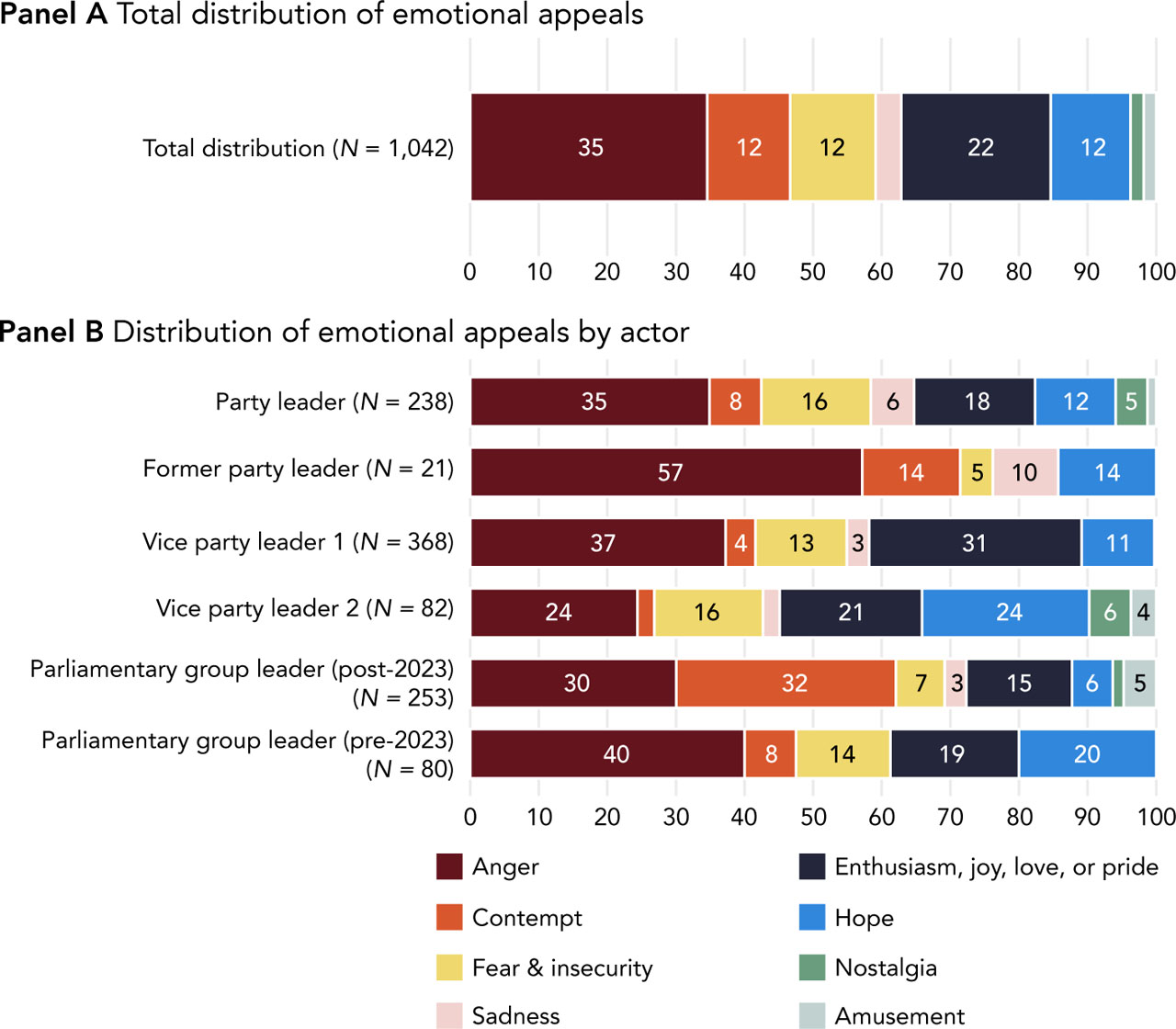
Figure 1
Distribution of emotional appeals across members of the Finns Party leadership (per cent)
The results show that the Finns Party leadership’s use of emotional appeals during the 2023 parliamentary election campaign was skewed toward negative emotional appeals. Overall, 63 per cent of all emotional appeals were negative, compared with 37 per cent positive appeals. Among the negative emotional appeals, anger was by far the most frequently employed (35%), followed by contempt (12%) and fear and insecurity (12%), whereas appeals to sadness were comparatively rare. Turning to the positive emotional appeals, the grouped category consisting of enthusiasm, joy, love, or pride was the most prevalent (22%), followed by hope (12%). By comparison, nostalgia and amusement were considerably less common. However, the aggregate distribution conceals substantial variation across individual politicians (see Panel B), suggesting that patterns of emotional appeals differ across individual political actors.
We now turn to the second research question (RQ2): Who did members of the Finns Party leadership target through their emotional appeals in their social media communication during the 2023 Finnish parliamentary election? Figure 2 presents the overall distribution of targets across members of the Finns Party leadership.
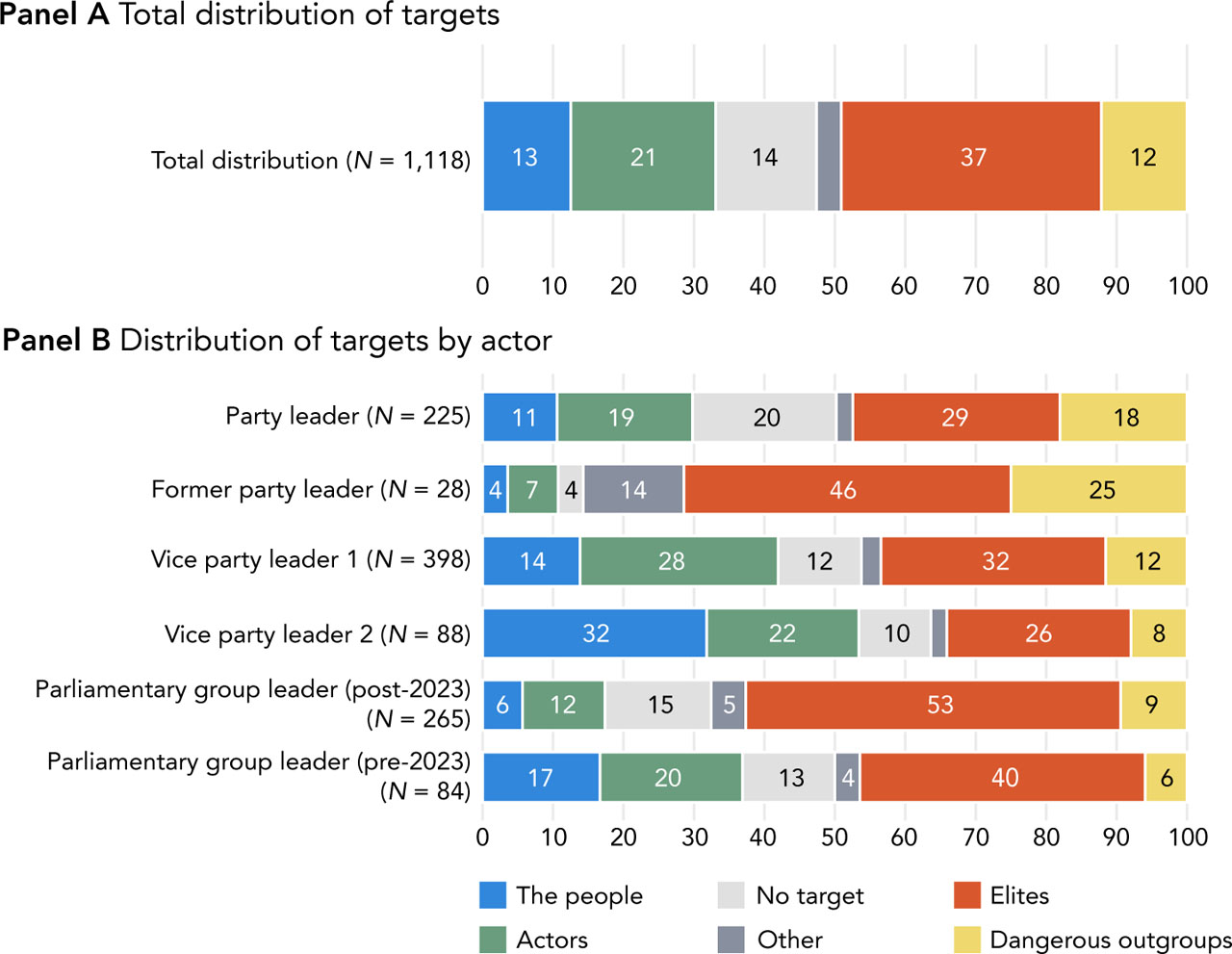
Figure 2
Distribution of targets across members of the Finns Party leadership (per cent)
Beginning with the distribution of targets, the results indicate that the targets of Finns Party politicians’ emotional appeals during the 2023 parliamentary election campaign were primarily directed toward elites (37%), with dangerous outgroups being a less frequent target (12%). By comparison, ingroup targets were primarily actors (21%) and, less frequently, the people (13%). Additionally, 14 per cent of emotional appeals had no identifiable target, and emotional appeals directed toward other groups were marginal. However, this aggregate pattern conceals substantial variation across individual politicians (see Panel B), with some relying more heavily on outgroup targeting and others making greater use of ingroup targeting. Moving from the overall distribution of targets to the relationship between specific emotional appeals and their targets, Table 1 presents the distribution of targets by emotional appeal.
Table 1
Distribution of target by emotional appeal (per cent (n))
| Emotional appeal | Ingroup | Outgroup | Other | ||
|---|---|---|---|---|---|
| The people | Actors | Elites | Dangerous outgroups | ||
| Anger | 0 (0) | 0 (0) | 79 (262) | 16 (53) | 5 (16) |
| Contempt | 0 (0) | 0 (0) | 82 (102) | 17 (21) | 2 (2) |
| Fear & insecurity | 0 (0) | 0 (0) | 40 (45) | 52 (59) | 8 (9) |
| Sadness | 0 (0) | 12 (1) | 50 (4) | 38 (3) | 0 (0) |
| Enthusiasm, joy, love, or pride | 33 (76) | 63 (143) | 0 (0) | 0 (0) | 4 (9) |
| Hope | 40 (51) | 58 (75) | 0 (0) | 0 (0) | 2 (3) |
| Nostalgia | 81 (13) | 19 (3) | 0 (0) | 0 (0) | 0 (0) |
| Amusement | 0 (0) | 100 (8) | 0 (0) | 0 (0) | 0 (0) |
The results reveal a clear pattern. Among the negative emotional appeals, elites were the primary targets of anger (79%) and contempt (82%). By comparison, dangerous outgroups were targeted in 16 per cent of anger appeals and 17 per cent of contempt appeals. Fear and insecurity differed from this pattern, as dangerous outgroups constituted the most common target (52%), followed by elites (40%). Sadness was infrequently directed toward specific targets and instead tended to signal broader perceptions of decline, loss, or dissatisfaction. In contrast, positive emotional appeals were directed almost exclusively toward ingroup targets. Appeals invoking enthusiasm, joy, love, or pride were directed primarily toward actors (63%) and the people (33%). Hope followed a similar pattern, with actors (58%) and the people (40%) constituting the primary targets. Although used infrequently, nostalgia was overwhelmingly directed toward the people (81%), while the empirically marginal amusement category (n = 8) was directed exclusively toward actors.
We now turn to cross-platform variation in emotional appeals and targets, addressing the third research question (RQ3): How did emotional appeals and their targets vary across social media platforms among members of the Finns Party leadership during the 2023 Finnish parliamentary election? Figure 3 presents the distribution of emotional appeals and targets by social media platform.
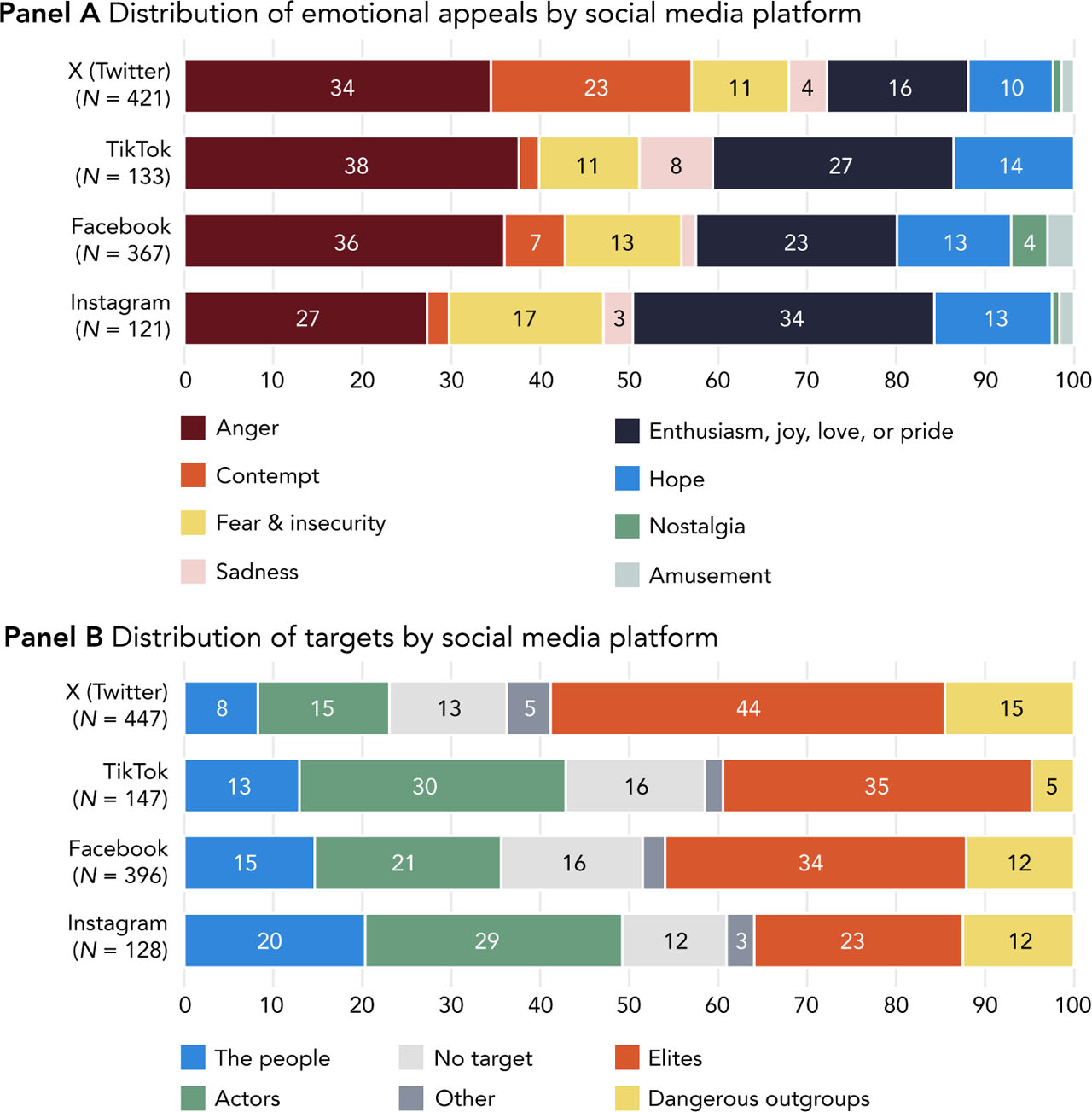
Figure 3
Distribution of emotional appeals and targets by social media platforms (per cent)
The results indicate variation in both emotional appeals and targets across social media platforms among members of the Finns Party leadership during the 2023 parliamentary election campaign. However, these differences should be interpreted with caution, as social media activity was unevenly distributed across political actors and platforms. TikTok had the highest share of anger appeals (38%), followed closely by Facebook (36%) and X (Twitter) (34%), while Instagram featured the lowest share of anger (27%). Contempt was most prominent on X (Twitter) (23%), whereas its use was considerably lower on Facebook (7%) and only marginal on Instagram and TikTok. Appeals to fear and insecurity were more common on Instagram (17%) and Facebook (13%) than on X (Twitter) and TikTok (both 11%). Across all platforms, sadness was rarely employed, although it appeared most frequently on TikTok (8%). Turning to positive emotional appeals, enthusiasm, joy, love, or pride constituted the dominant appeal on Instagram (34%). The share of these appeals was also relatively high on TikTok (27%), followed by Facebook (23%) and X (Twitter) (16%). Hope was most frequently used on TikTok (14%), with slightly lower but comparable levels on Instagram (13%) and Facebook (13%), and a smaller share on X (Twitter) (10%). Although nostalgia and amusement appeared across all platforms, their use was marginal.
The variation observed in emotional appeals was also reflected in the distribution of targets across platforms (see Panel B). Elites were the most common target on X (Twitter) (44%), TikTok (35%), and Facebook (34%), while they constituted a smaller share of targets on Instagram (23%). Ingroup targets were most prominent on Instagram, where actors accounted for 29 per cent and the people for 20 per cent of targets. TikTok also displayed a relatively high share of actor targets (30%), followed by Facebook (21%) and X (Twitter) (15%). The people were less common as a target across all platforms, ranging from 8 per cent on X (Twitter) to 20 per cent on Instagram. Dangerous outgroups constituted a smaller share of targets than elites on all platforms, ranging from 5 per cent on TikTok to 15 per cent on X (Twitter). Finally, the share of emotional appeals with no identifiable target ranged from 12 per cent on Instagram and 13 per cent on X (Twitter) to 16 per cent on both Facebook and TikTok.
Discussion and conclusion
In this study, we have examined the use of emotional appeals in the social media communication of the Finns Party leadership during the 2023 Finnish parliamentary election campaign. Drawing on a quantitative content analysis of 524 social media posts and 1,259 units of analysis across X (Twitter), TikTok, Facebook, and Instagram, we have investigated how emotional appeals were employed, which targets they were directed toward, and how these patterns varied across social media platforms. Building on theories of populist communication and its antagonistic logic centred on a moralised division between “the people”, “elites”, and “dangerous outgroups”, we addressed three exploratory research questions. This study thus provides new insights into the role of emotional appeals in populist radical right communication and how these appeals relate to different targets and social media platforms.
The results show that negative appeals were more prevalent than positive appeals in the social media communication of the Finns Party leadership, with anger, contempt, and fear and insecurity accounting for nearly two-thirds of all emotional appeals. This aligns with previous research showing that populist radical right communication often relies on emotionally charged, antagonistic, and conflict-oriented messaging (Caiani & Di Cocco, 2023; Rico et al., 2017; Wirz, 2018). The predominance of anger may also reflect the specific political context of the 2023 Finnish parliamentary election. The campaign unfolded amid growing concerns about rising living costs, public debt, and the state of public finances (Ylisalo, 2024), issues that the Finns Party, as an opposition party during the election campaign, consistently attributed to the incumbent “red–green” coalition government led by Prime Minister Sanna Marin. Hence, the Finns Party could frame the economic situation as resulting from the actions or mismanagement of identifiable political actors rather than from uncontrollable circumstances (Wagner, 2014; Wirz, 2018). Moreover, the framing of the election as a contest between a right-wing and a red–green bloc (Wass et al., 2024), may have further reinforced antagonism by providing a clear and salient outgroup against which anger could be mobilised. This pattern was broadly consistent across members of the party leadership, although the relative prevalence of negative emotional appeals varied, with some actors making greater use of positive emotional appeals.
Positive emotional appeals were also employed extensively, particularly in expressions of hope for electoral success, pride in national identity, praise of supporters and ordinary citizens, and portrayals of populist actors as credible representatives of “the people’s will”. This underscores the importance of examining positive emotions as well in populist radical right communication, as the findings suggest they may play an important role in fostering feelings of belonging and emotional attachment to charismatic leaders and shared collective identities (see, e.g., Albertazzi & Bonansinga, 2024; Bonansinga, 2025). Although the prevalence of enthusiasm, joy, love, and pride should be interpreted with some caution, as these conceptually related emotions were combined into a single category for reasons of conceptual similarity and intercoder reliability, their prominence is also substantively meaningful. These appeals were directed primarily toward people, supporters, and populist actors themselves, potentially reinforcing collective identity, shared purpose, and affective attachment to the party and its leadership. In the context of the 2023 election campaign, where the Finns Party entered the race with strong momentum and ultimately achieved its best electoral result to date, such appeals may have played an important mobilising role by strengthening perceptions of the party as a legitimate and credible representative of the popular will. The frequent use of hope further supports this interpretation. As a future-oriented and mobilising emotion, hope links present grievances to expectations of political change, making it particularly well suited to electoral campaigns in which populist actors present themselves as alternatives to the status quo (Bonansinga, 2025; Tietjen, 2023).
A central finding of this study is that emotional appeals are directed toward different targets within the populist antagonistic framework that juxtaposes “the people” against “corrupt elites” and “dangerous outgroups”. Negative appeals were overwhelmingly directed toward outgroups, particularly different elites and dangerous outgroups. Anger and contempt were predominantly aimed at elites, including the previous government and especially Prime Minister Sanna Marin, whose youth and gender were frequently invoked in a negative manner, as well as the media, the European Union, labour unions, bureaucrats, universities, and scientific institutions. Fear and insecurity, by contrast, were most often directed toward dangerous outgroups such as immigrants, religious minorities (e.g., Muslims), gangs, “radical green-leftists”, and gender minorities. This pattern reflects the nativist and exclusionary core in populist radical right communication, wherein outgroups are systematically constructed as threats to the cultural homogeneity, security, and integrity of the imagined national community. In contrast, positive appeals were primarily directed toward ideologically aligned actors (e.g., the Finns Party, party members, or Sweden Democrats) and toward “the people” (e.g., the Finnish people or the Finnish nation). Taken together, these findings support the conceptualisation of populist communication as a moralised and relational form of political communication in which emotional appeals contribute to the construction and maintenance of symbolic boundaries between allies and adversaries (de Vreese et al., 2018; Jagers & Walgrave, 2007).
The results also reveal variation in both emotional appeals and targets across social media platforms. X (Twitter) displayed higher levels of anger and contempt and a stronger focus on elite targets, whereas Instagram contained a larger share of positive emotional appeals and ingroup targets. Facebook and TikTok exhibited more mixed patterns, combining both negative and positive emotional appeals and a broader mix of targets. These findings broadly resemble patterns identified in previous research, which has associated X (Twitter) with elite-oriented political confrontation and Instagram with personalisation and image management (Bonansinga, 2025; Schwartz et al., 2023). However, whether these differences reflect deliberate strategic adaptation to platform-specific affordances and audiences or broader patterns of political communication on these platforms remains an open question that future comparative research across parties should address.
Future endeavours
The findings contribute to the growing literature on emotions in populist communication by demonstrating how emotional appeals are embedded within the antagonistic populist framework. In doing so, the study highlights the relational role of emotions in populist communication and suggests that different emotions perform different forms of boundary work. As the Finns Party represents a prominent case within the broader populist radical right party family (Arter, 2025), sharing core ideological features and communication strategies with comparable parties across Europe, the findings may offer tentative insights into how leaders of populist radical right parties employ emotional appeals in their social media communication. In particular, the observed pattern, wherein negative emotions target perceived adversaries while positive emotions reinforce ingroup identity, is broadly consistent with the antagonistic logic that characterises populist radical right communication across European contexts (de Vreese et al., 2018). Future comparative research should nonetheless examine whether these patterns hold across other populist radical right parties and national contexts.
Some limitations should be acknowledged when considering the generalisability of the findings. First, the present study follows a case-study logic, focusing on a single party during a specific election campaign, a context in which both antagonistic and mobilising emotional appeals may be particularly salient. Without examining other parties competing in the same election or populist parties in different political and electoral contexts, it is difficult to determine whether the observed patterns are specific to the Finns Party and populist radical right communication or reflect broader dynamics of social media campaigning during elections. Accordingly, comparative research across campaign and non-campaign periods, party families, ideological traditions, and national contexts is needed to assess the extent to which the findings generalise beyond this case study. Second, social media activity was unevenly distributed across both political actors and platforms, particularly on Instagram and TikTok, limiting the extent to which platform-specific and actor-specific differences could be interpreted. Consequently, the observed cross-platform variation should be understood as exploratory rather than as evidence of platform effects. Future research would benefit from more balanced platform samples and research designs that allow platform-specific dynamics to be disentangled from individual actor effects. Third, this study focused primarily on the linguistic dimension of social media communication. However, social media communication relies heavily on audiovisual content that can amplify or nuance emotional meaning (see, e.g., Albertazzi & Bonansinga, 2024; Bonansinga, 2025). Future research should therefore adopt multimodal approaches that integrate linguistic and visual dimensions of populist communication.
Taken together, future research should seek to clarify the extent to which the relationship between emotional appeals and their targets is shaped by the antagonistic logic of populist communication, electoral contexts, ideological positioning, individual communication styles, audience composition, and the characteristics of different social media platforms. Advancing this line of inquiry would contribute to a more comprehensive understanding of how emotions shape populist communication.
Acknowledgements
This work was supported by the Research Council of Finland (Grant No. 350947) and the Strategic Research Council within the Research Council of Finland (Grant No. 365659). We are grateful to the two anonymous reviewers for their thoughtful and constructive comments. We also thank Professor Kim Strandberg and Dr. Jenny Lindholm for their valuable feedback on earlier versions of this manuscript. Earlier versions of the manuscript were presented at the Finlandssvenska Forskarskolan seminar (22 September 2025, Åland Islands), the Behave seminar (11 February 2026, Helsinki), and Mevi-Päivät (7 May 2026, Vaasa). We thank the chairs, discussants, and participants at these events for their insightful comments and feedback.