

Introduction
Until the turn of the century, the democratic task of informing citizens about societal matters (Strömbäck, 2005) largely befell professional (mass) news media, since they enjoyed a key position as gatekeepers of information on politics and society (Tandoc, 2018). In recent years, however, they have faced competition from online alternative news sites (Pedersen et al., 2024), which have gained prominence across many Western media systems (Strömbäck, 2023). This is also the case in the Nordic countries, where they attract sizeable audiences (Brems, 2024a; Schulze, 2020). These alternative news media (hereafter “alternative media”) present themselves as a necessary counterbalance to alleged biases in mainstream news media (hereafter “mainstream media”) and explicitly call into question their trustworthiness (Holt et al., 2019; Ihlebæk et al., 2022).
Accordingly, research into alternative media has been particularly interested in studying the link between using alternative media and (lacking) trust in mainstream media. That citizens trust (mainstream) news media is often described as vital to democracy (e.g., Strömbäck et al., 2020), among other things because it is a prerequisite for establishing a shared sense of reality (Coleman, 2012) and because news media can only fulfil their role as watchdogs if citizens trust their reporting on powerholders’ (mis)conduct (van Dalen, 2020). How alternative media use is associated with trust in mainstream media can thus be considered an important indicator of the societal implications of the proliferation of alternative media. Recent studies have established that users of alternative media have lower trust in mainstream media than the rest of the population (e.g., Frischlich et al., 2023; Mourão et al., 2018; Schulze, 2020), and a Swedish study suggests that this relationship is mutually reinforcing: Low-trusting citizens orient themselves more towards alternative news, which in turn decreases trust in mainstream news (Andersen et al., 2021a). Based on prior research, alternative media can thus be viewed as a challenge to democracy, as use of them reflects disenchantment with mainstream media among parts of the population and may further fuel such sentiments.
This article extends existing knowledge about the relationship between alternative media use and trust in mainstream media in two central ways: First, alternative media exist on both sides of the political spectrum (e.g., Benkler et al., 2018; McDowell-Naylor et al., 2021), but most prior studies treat alternative media as one group (e.g., Andersen et al., 2021a; Frischlich et al., 2023) or only focus on right-wing alternative media (e.g., Schulze, 2020; but see Tsfati et al., 2024). However, right-wing alternative media are more hostile towards mainstream media than their left-wing counterparts (Brems, 2023; Tsfati et al., 2024). Therefore, a relevant question is whether use of both is associated with lower trust or if lower trust only pertains to or is more pronounced among users of right-wing alternative media. Investigating this can help clarify whether left-wing and right-wing alternative media pose equal problems for democracy (given that use of them may reflect or fuel dissatisfaction with mainstream media).
Second, most existing studies focus on (right-wing) alternative media users’ trust in mainstream media in general (as a notable exception, see Schulze, 2020). Yet, qualitative interviews with alternative media users showed that some users exempt specific mainstream news outlets from their general criticism of mainstream media (Brems, 2025). Furthermore, people generally tend to have higher trust in news media they use or align with ideologically (e.g., Newman et al., 2018), demonstrating that people do not have the same levels of trust in all mainstream outlets. This raises the important question of whether alternative media users’ lower trust pertains to all major mainstream news outlets or is confined to specific mainstream news outlets. Investigating this is important for understanding whether alternative media users disregard information from all mainstream sources of news or if there are some mainstream outlets whose information they trust.
To address these two gaps, the present study distinguishes between users of left-wing and right-wing alternative media (and cross-cutting users of both) and assesses their trust in mainstream media at the outlet-specific level (Strömbäck et al., 2020). To my knowledge, this is the first study to do so. The study draws on original survey data from a nationally representative sample of the adult Danish population (N = 1,518) and focuses on trust in seven Danish mainstream news outlets of different types (public service broadcasters, quality newspapers, tabloids) and with different ideological leanings (left-wing and right-wing).
The study contributes two novel empirical insights: First, the users of left-wing alternative media only have lower trust in (purportedly) right-leaning mainstream outlets, whereas the users of right-wing alternative media have lower trust in mainstream outlets regardless of their ideological leanings, indicating more generalised lower trust. Second, although the alternative media users have lower trust in mainstream media than the rest of the population, their trust is still fairly high in substantive terms, especially in public service news. I conclude the article by discussing potential explanations to these findings and their democratic implications vis-à-vis the characteristics of the Danish case and how the insights from the study may transfer to other media contexts.
Alternative news use and trust in mainstream media
As noted, it is already well-established that alternative media use is associated with lower trust in mainstream media. This can have several theoretical explanations. Following uses and gratifications theory, citizens rationally use news media to fulfil certain needs (e.g., Ruggiero, 2000); thus, citizens who find mainstream news coverage biased might turn to alternatives providing other facts and perspectives (Andersen et al., 2021a; Tsfati & Cappella, 2003). Selective exposure theory posits that citizens seek out news content confirming their prior attitudes (Stroud, 2011); thus, alternative media may appeal to citizens who already have lower trust in mainstream news because their explicit criticism of mainstream media (Figenschou & Ihlebæk, 2019) confirms that such attitudes are justified.
Taking a media effects perspective (Hetzel et al., 2022), continuous exposure to alternative media’s explicit criticism of mainstream media might cause their users to lose trust in mainstream media. It is also possible that selection and media effects are at play at the same time in a mutually reinforcing spiral (Slater et al., 2020), as indicated by the above-mentioned Swedish study (Andersen et al., 2021a). Finally, the relationship could be expected based on the theory of hostile media effects (Vallone et al., 1985). Users of alternative media take more left-wing and right-wing ideological stances (Brems, 2024a) and hold more positive and negative attitudes towards immigration, respectively (Schulze, 2020; Theorin & Strömbäck, 2020). When they have stronger political attitudes, they may be more prone to perceive mainstream news coverage as biased against their own views.
Is the relationship the same across left-wing and right-wing alternative media use?
A relationship between using alternative media and lower trust in mainstream media has been identified in many countries. In addition to the aforementioned Swedish study, which found an association over time between “alternative news orientation” and decreasing trust in mainstream news, and vice versa (Andersen et al., 2021a), a German study showed that lower trust in mainstream media was associated with greater likelihood of using alternative counter-news (Frischlich et al., 2023). These studies treated alternative media as one group. Other studies have focused specifically on right-wing alternative media use. Based on data from Austria, Finland, Germany, and Sweden, Schulze (2020) found that greater news scepticism predicted use of right-wing alternative media. While general trust in news was not a significant predictor, use of right-wing alternative media was predicted by lower trust in public service media and legacy news media and by higher trust in tabloid media (Schulze, 2020). In an American study, Mourão and colleagues (2018) showed that relying on news repertoires dominated by conservative news sources, including right-wing alternative news sites, was associated with lower trust in mainstream media.
A central question left unanswered by these studies is whether lower trust in mainstream media pertains to users of both left-wing and right-wing alternative media or only the latter. On the one hand, content analyses have identified criticism of mainstream media in both right-wing (e.g., Figenschou & Ihlebæk, 2019; Mayerhöffer, 2021; Müller & Freudenthaler, 2022) and left-wing alternative media (e.g., Cushion et al., 2021; Cushion, 2022), which gives reason to expect that the use of both is associated with lower trust in mainstream media. On the other hand, a Danish study showed that some right-wing alternative media voiced much more severe criticism of mainstream media than any left-wing alternative media (Brems, 2023). Similarly, right-wing alternative media are more hostile towards mainstream media in Sweden (Tsfati et al., 2024). These differences between left-wing and right-wing alternative media content give reason to expect that the association with lower trust might only pertain to or be stronger for use of right-wing alternative media, either based on selective exposure (citizens with lower trust seek out right-wing rather than left-wing alternative media because the former provide more severe media criticism) or media effects (citizens who use right-wing alternative media have lower trust due to exposure to more severe attacks on mainstream media’s credibility).
Furthermore, a prior study found that the relationship between using alternative media and supporting right-wing populist parties is stronger than the relationship between using alternative media and supporting left-wing populist parties (Müller & Bach, 2021). Another study showed that users of right-wing alternative media hold more populist attitudes than the rest of the population, whereas the equivalent was not the case for users of left-wing alternative media (Brems, 2024b). Since citizens with populist views are often sceptical of mainstream media (Schulz et al., 2018) similar differences might be found between left-wing and right-wing alternative media users’ trust in mainstream media.
To my knowledge, only a few studies have investigated this empirically. As a notable exception, a recent panel study from Sweden found that using right-wing alternative media led to lower trust in mainstream news over time, whereas this was not the case for using left-wing alternative media (Tsfati et al., 2024). Unlike this, a longitudinal field experiment based on American data found indications that both left-wing and right-wing partisan news exposure led to lower trust in mainstream news over time (Guess et al., 2021). Existing evidence is thus sparse and points in different directions. Therefore, I ask the following research question:
RQ1: Compared with the rest of the population, do users of both left-wing and right-wing alternative media have lower trust in mainstream news media?
Is the relationship the same across different mainstream news outlets?
Most existing studies have focused on the relationship between alternative media use and trust in mainstream media in general (but see Schulze, 2020), and to my knowledge, no prior studies have investigated the association between alternative media use and trust in mainstream media at the outlet-specific level. Therefore, we do not know whether the users have lower trust in all major mainstream news outlets or whether there are some mainstream news outlets they trust to the same extent as the rest of the population. In general, news users tend to have higher (lower) trust in news media whose ideological leanings they (do not) share (e.g., Newman et al., 2018: 18–19). While this tendency is much less pronounced than in the US, it can also, to some extent, be found in Denmark (Newman et al., 2018: 42–43; see also Andersen et al., 2021b). Users of alternative media are known to ideologically align with the alternative media they use (Brems, 2024a; Newman et al., 2018). On the one hand, it is thus possible that they only have lower trust in mainstream news outlets whose ideological leanings they do not share. On the other hand, users of alternative media could also be expected to have lower trust in mainstream media regardless of their ideological leanings because alternative media position themselves as correctives to the mainstream media system – not just specific mainstream outlets (Holt et al., 2019) – and are explicitly critical of mainstream media with both left and right leanings (e.g., Brems, 2023; Cushion et al., 2021). I therefore ask a second research question:
RQ2: Compared with the rest of the population, do users of left-wing and right-wing alternative media have lower trust in all major mainstream news outlets or only in mainstream news outlets with the opposite ideological leaning?
Defining trust in news
One of news media’s most important tasks is providing citizens the information they need to make sound political decisions and be self-governing (Schudson, 2008). By leaving information gathering to news media, citizens save time (Rosanvallon, 2008), but at the cost of uncertainty: Citizens cannot keep an eye on choices made in the news selection and production processes (Fawzi et al., 2021; Schudson, 1998: 195; Tsfati & Cappella, 2003; van Dalen, 2020). Therefore, when citizens trust the news, they run the risk of forming opinions and making political decisions based on inaccurate or insufficient information (van Dalen, 2020). Accordingly, trust can be defined as a relationship between a trustor (news user) and trustee (news media) (Strömbäck et al., 2020; Tsfati & Cappella, 2003; van Dalen, 2020), where the trustor is willing to be vulnerable to the trustee based on past experiences and positive future expectations (Fawzi et al., 2021; Hanitzsch et al., 2018).
Trust in news media can be measured at different levels of analysis ranging from news media in general at the highest level of abstraction to media types (e.g., newspapers, television), specific news media brands, journalists, and news content (e.g., coverage of specific topics) at lower levels of abstraction (Strömbäck et al., 2020; see also Fawzi et al., 2021). Due to limited research, it is not clear how trust in news media at the different levels of trust are related to each other (Strömbäck et al., 2020). However, prior studies indicate that it makes a difference what level trust is measured on. For instance, people tend to report higher trust in news outlets than in journalists (Andersen et al., 2021b) and trust specific news media they use more than news media in general (Newman et al., 2018).
Much research focuses on general news media trust (Strömbäck et al., 2020). This form of measurement has the limitation that it is ambiguous as to what “news media in general” refers to (Engelke et al., 2019; Mourão et al., 2018), and it does not take into account that people report diverging levels of trust in different news outlets, for instance, based on ideological leaning, as discussed above (Newman et al., 2018). Compared with this, measuring trust in specific news outlets has the advantage that it is clear what object of trust respondents are asked to evaluate, and it allows respondents to express diverging levels of trust in different mainstream media. Thus, this approach may give a more precise and nuanced picture of alternative media users’ trust in mainstream media.
The Danish case
Like other Nordic countries, Denmark is characterised by a strong public service media tradition (Hallin & Mancini, 2004). The two major public service broadcasters, DR and TV 2, are required to be neutral, and previous studies have shown that both are politically balanced (e.g., Albæk et al., 2015). Nonetheless, DR has often been accused of leaning to the left, and TV 2 to the right (Albæk et al., 2010). Newspapers severed their party-political ties and professionalised during the twentieth century (Hallin & Mancini, 2004), but traces of the party-press can still be found: Danish news users identify the quality newspaper Politiken and the tabloid Ekstra Bladet as left-leaning, and the quality newspapers Berlingske and Jyllands-Posten and the tabloid B.T. as right-leaning (Hjarvard, 2007). Content analysis of news articles from three of the newspapers found no left-wing or right-wing bias with respect to source balance and tone (Albæk et al., 2015), but other studies found that the quality newspapers’ ideological leanings are reflected in their opinion sections, to some extent also in their news selection and angles (e.g., Hjarvard, 2010). This context, where the major news outlets (purportedly) have ideological leanings, makes the Danish case well-suited for investigating whether alternative media users’ trust in mainstream media depends on the outlets’ ideological leanings.
Unlike many other countries, Denmark has not witnessed a decline in news media trust over the past decade (Andersen et al., 2021b), and trust is generally high, especially in public service broadcasters, which are trusted by approximately four in five Danes (Schrøder et al., 2022). However, the parts of the population identifying as left-wing and right-wing are more critical of mainstream media (Schrøder et al., 2021), creating grounds for expecting users of left-wing and right-wing alternative media to have lower trust in mainstream media than the rest of the population.
Mainstream media make room for right-wing populist positions and immigration-critical views (Bächler & Hopmann, 2017; Mayerhöffer, 2021), and public debate has a long-standing tradition of being inclusive of what may be seen as controversial (right-wing) points of view. This sets Denmark apart from neighbouring countries Germany and Sweden, where mainstream media have made limited room for far-right and populist right-wing actors and views (e.g., Heft et al., 2020), although this has changed in recent years. Furthermore, studies suggest that immigration coverage is more negative in Denmark. A comparative content analysis of Danish, Norwegian, and Swedish newspaper coverage of immigration found that “Swedish discourse has been more amicable towards immigrants, while the Danish has been harsher and more critical”, for instance, reflected in stronger emphasis on threat frames in Denmark (Hovden & Mjelde, 2019: 139). Another comparative study of media coverage of the refugee crisis in 2014–2015 in Sweden, Germany, the UK, Spain, and Italy similarly found that the Swedish press had the most positive coverage of refugees. The same study showed that both Swedish and German coverage predominantly used terms like “refugee” and “asylum seeker” (rather than “immigrant” or “illegal”) and discussed refugees as a threat to national security to a lesser extent than the other countries (Berry et al., 2015).
In the concluding discussion, I reflect on what these characteristics of the Danish case mean for the interpretation of the findings presented and their relevance in other media contexts.
Data
This study is based on an online survey administered to a quota sample representative of the adult Danish population (18+) with respect to gender, age, region, and education, collected by YouGov from their panel in Denmark between 17 January and 7 February 2023 – a non-election period. Online panels have the limitation that they can, naturally, only capture responses from the parts of the population with Internet access. However, Internet penetration is high in Denmark (97%), also among the oldest age group (91% for 75–84-year-olds; Agency for Digital Government, n.d.). 3,116 panellists were invited, and 2,735 completed the questionnaire (87.8%). 280 respondents were excluded due to speeding (completing the survey in less than half the median time spent by the rest of the respondents; for a comparable approach, see Frischlich et al., 2023). The survey included an experiment, and the present study only includes respondents who were not exposed to experimental treatment. 1 This resulted in a sample of N = 1,518. Ethical approval was obtained from the institutional review board before data collection.
Measurement and coding of variables
Dependent variables: Outlet-specific trust in mainstream media
Trust in mainstream media was measured at the brand level (Strömbäck et al., 2020) and tapped using the following item: “To what extent do you agree or disagree with the statements below? ‘I have trust in [news medium’s] coverage of news in general’”. Responses were measured on a Likert-scale (1 = “completely disagree”; 7 = “completely agree”). The item specifically inquired about trust in the outlets’ coverage of news, which creates alignment with the theoretical understanding of trust as willingness to rely on information from news media (Strömbäck et al., 2020).
The mainstream news outlets inquired about were the two national public service broadcasters, DR and TV 2, the three biggest quality newspapers, Politiken, Berlingske, and Jyllands-Posten, and the two biggest tabloids, Ekstra Bladet and B.T. All respondents were inquired about their trust in DR. To reduce the number of items each respondent had to answer, respondents were randomly assigned to three of the six other outlets – either TV 2 or Politiken, Jyllands-Posten or Berlingske, and Ekstra Bladet or B.T. This ensured that all respondents were inquired about trust in at least one public service broadcaster, one quality newspaper, one tabloid news outlet; and that all were inquired about at least one outlet (purportedly) leaning to the left and right, respectively. The items were rescaled (0–1, with 1 representing the highest level of trust). “Don’t know” responses were coded as missing and were excluded from the analysis.
In the analysis, each item tapping trust in coverage of news from a specific mainstream outlet was treated as an individual variable. The reason why DR, Politiken, and Ekstra Bladet were not combined into one left-leaning category and the four other outlets combined into one right-leaning category is that the outlets are different types (either public service, quality newspapers, or tabloids). As noted above, a prior study showed negative associations between alternative media use and trust in public service and legacy news media, but a positive association with trust in tabloids (Schulze, 2020). Therefore, combining the outlets across types might obscure the associations. As an exception, trust in news coverage from Berlingske and Jyllands-Posten were combined into one variable because both outlets are quality newspapers and both are right-leaning (i.e., they are the same type and have the same ideological leaning).
Independent variables
Alternative media use was measured using the list-frequency technique (Andersen et al., 2016). Respondents were asked how many days (0–7) during the past week they had used any of twelve alternative news outlets: Konfront, Solidaritet, and Netavisen Pio have been identified as left-wing alternative media, and 180Grader, 24NYT, Den Korte Avis, ditOverblik, Document, Folkets Avis, Indblik, Kontrast, and NewSpeek as right-wing alternative media in prior studies providing overviews of the Danish alternative media landscape (Blach-Ørsten & Mayerhöffer, 2021; Brems, 2023). The inclusion of more right-wing than left-wing outlets reflects a greater supply of the former (Blach-Ørsten & Mayerhöffer, 2021; Brems, 2023). Most respondents reported no or little use of alternative media, which made the variables for alternative media use heavily skewed. Therefore, alternative media use was treated as a categorical variable.
Respondents were coded as the following: use no alternative media (0), use only left-wing alternative media (1), use only right-wing alternative media (2), or use both left-wing and right-wing alternative media (3). Notably, the degree of mainstream media criticism varies across the included outlets, with the right-wing outlets Den Korte Avis, Document, and NewSpeek voicing more severe criticism (Brems, 2023). Even so, users of right-wing alternative media are treated as one group to avoid creating groups that are too small. The implications of this decision are discussed below.
Mainstream news use is positively associated with using alternative media (Brems, 2024a; Müller & Schulz, 2021) and with trust in news media (e.g., Mourão et al., 2018; Tsfati & Cappella, 2003), and it is therefore relevant to include as control. This was also measured using the list-frequency technique, and respondents were inquired about the same seven mainstream outlets as in the items about trust, as discussed above. Indices for use of public service news (DR, TV 2), quality newspapers (Politiken, Berlingske, Jyllands-Posten), and tabloids (Ekstra Bladet, B.T.) were generated by adding the number of days respondents reported using mainstream media from the given category and rescaled to 0–7.
Because people tend to trust media whose ideological leanings they identify with more (Newman et al., 2018), ideological orientation was also included as control, measured as left–right self-placement on an 11-point scale (0 = left-wing; 10 = right-wing). Respondents with missing values were excluded from the analysis. Political interest is positively associated with using alternative media (e.g., Brems, 2024a; Schulze, 2020) and positively and negatively associated with trust in different news topics (Tsfati et al., 2022). Therefore, a categorical variable for political interest was included as control (1 = very interested; 2 = somewhat interested; 3 = only a little interested; 4 = not at all interested; 5 = do not wish to answer). The latter was treated as a category of its own in order to keep these respondents (n = 17) in the analysis. In Denmark, living in the outer regions of the country is associated with a higher probability of using alternative media (Brems, 2024a), and people living in rural areas have lower trust in news media than people living in cities (Mandag Morgen, n.d.). Therefore, the study also controls for residence (1 = outer; 2 = rural; 3 = middle-range; 4 = city municipality; classified based on Kristensen et al., 2007). Finally, the following sociodemographic variables were included as controls: age (18–29; 30–39; 40–49; 50–59; and 60+), gender (male/female), and education (highest education level coded into six categories). Summary statistics for all variables are available in Appendix A, and the full questionnaire is available in the supplementary file.
Analytic approach
The variables for trust in the specific mainstream outlets were regressed on the variable for alternative media use and the controls outlined above in six separate OLS regression models: one for DR, one for TV 2, one for Ekstra Bladet, one for B.T., one for Politiken, and one for Berlingske and Jyllands-Posten combined. This makes it possible to compare the different (non-)user groups’ levels of trust in news coverage from the mainstream outlets controlled for background variables. A quadratic term for ideological orientation was included in all OLS regression models, since both more left-wing and more right-wing ideological orientation could be positively or negatively associated with trust in mainstream media. In some of the regression models, the assumption of homoscedasticity was not met, why all models were run with robust standard errors. Findings from the regression analyses will be presented in figures displaying the predicted average levels of trust for the different user-groups compared with non-users (i.e., the part of the population that does not use alternative media), controlled for background variables. The advantage of this approach is that the figures thus display the differences in levels of trust between the (non-)user groups (corresponding to the regression coefficients) while at the same time making it possible to assess the users’ levels of trust in substantive terms. Tables with full results from the regression models are available in Appendix B (Tables B1–B6).
In the survey, respondents were also inquired about their trust in the specific mainstream outlets’ news coverage of three specific topics: climate, immigration/integration, and economy. As a robustness check, the analyses were also run using respondents’ trust in coverage of the specific topics as a dependent variable instead of coverage of news in general. This made no substantial differences to the findings. These results are also available in Appendix B (Tables B1–B6).
Findings
In total, 588 respondents reported using alternative media, corresponding to 24 per cent of the full sample (or an estimated 23.4% of the adult Danish population when weighting data to match the population in terms of gender, age, education, and residence). The findings suggest that using only right-wing alternative media is much more widespread (n = 403, corresponding to an estimated 15.8% of the population) than using only left-wing alternative media (n = 81, corresponding to an estimated 3.2% of the population) or using both (n = 104, corresponding to an estimated 4.4% of the population). 2
The results from the six OLS regression models are displayed in Figure 1. Specifically, the figure displays the different alternative media user-groups’ predicted average levels of trust in coverage of news in general from the mainstream news outlets inquired about compared with the rest of the population (referred to as “non-users” throughout the rest of the analysis), controlled for background variables. The (purportedly) left-leaning outlets are placed in the left column, and the (purportedly) right-leaning outlets in the right column. The two public service broadcasters are placed in the top row, the quality newspapers in the middle row, and the tabloids in the bottom row.
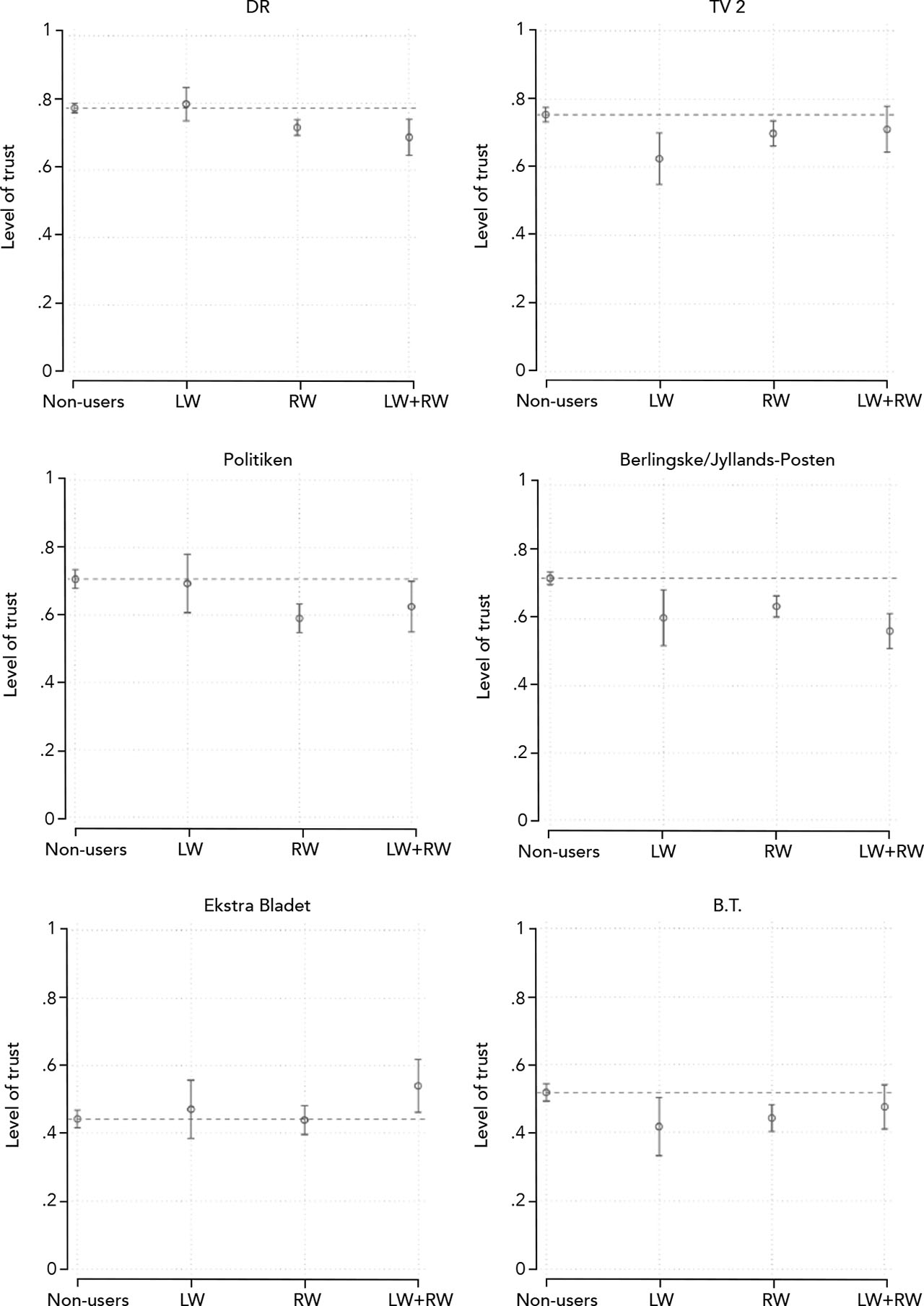
Figure 1
Predicted average levels of trust in news from specific mainstream outlets by alternative news use
Comments: DR: N = 1,305, R2 = .16. TV2: N = 646, R2 = .15. Politiken: N = 476, R2 = .26. Berlingske/Jyllands-Posten: N = 923, R2 = .16. Ekstra Bladet: N = 588, R2 = .19. B.T.: N = 554, R2 = .23. Controlled for age, gender, residence, education, ideological orientation, political interest, and mainstream news use (public service, quality newspapers, tabloids). Dashed lines mark the predicted average level of trust for non-users. CI error bars at 95%. Public service broadcasters are displayed in top row, quality newspapers in middle row, tabloids in bottom row; (purportedly) left-leaning outlets in left column, and (purportedly) right-leaning outlets in right column.
RQ1 asked whether users of both left-wing and right-wing alternative media have lower trust in mainstream media. In response to this, the findings displayed in Figure 1 show that, compared with non-users, the users who only use left-wing alternative media have significantly lower predicted average levels of trust in news from the (purportedly) right-leaning mainstream news outlets TV 2, Berlingske/Jyllands-Posten, and B.T., but not so in news from the (purportedly) left-leaning mainstream outlets DR, Politiken, and Ekstra Bladet. The users who only use right-wing alternative media have significantly lower predicted average levels of trust than non-users in news from all the investigated mainstream outlets except the left-leaning tabloid Ekstra Bladet. Similarly, when compared to non-users, cross-cutting users of both left-wing and right-wing alternative media also have lower predicted average levels of trust in news from all outlets except Ekstra Bladet, although the difference is not significant for TV 2 and B.T. Setting this user-group apart, they have significantly higher predicted average levels of trust in news from the tabloid Ekstra Bladet than non-users. In other words, all groups of alternative media users have lower trust in some, but not in all, mainstream outlets.
The findings presented so far also provide an answer to RQ2, which asked whether users of left-wing and right-wing alternative media have lower trust in news from all major mainstream outlets regardless of their ideological leanings or whether this depends on the outlets’ ideological leanings. As already indicated, the findings displayed in Figure 1 show that the users who only use left-wing alternative media follow a clear ideologically-partisan pattern: They have lower trust than non-users in news from mainstream outlets that have – or are accused of having – a right-wing ideological leaning, but when it comes to news from mainstream outlets with a (purported) left-leaning perspective, their levels of trust are not significantly different from non-users. Unlike this, the general tendency of the findings displayed in Figure 1 is that users who use right-wing alternative media (either solely or in combination with left-wing alternative media) do not follow an ideologically partisan pattern but tend to have lower trust in news from mainstream outlets regardless of their ideological leanings (with Ekstra Bladet as an exception). This indicates that users of right-wing alternative media have more generalised lower trust in mainstream news. 3
As noted above, a prior study found that three of the right-wing alternative media included in this study voice more severe criticism of mainstream media (Brems, 2023). This raises the question of whether it is the use of these specific right-wing alternative media that drives the pattern of more generalised lower trust among users of right-wing alternative media. To test this, the six OLS regressions were run again with another variable for alternative media use, where respondents who reported use of at least one of the three right-wing alternative media voicing more severe criticism were coded as a separate group. 4 This makes the user-groups small but can give an indication of any differences between users who only seek out more moderate right-wing alternative media and users of the right-wing alternative media that voice more severe mainstream media criticism. These results are available in Appendix B (see Table B7). For the users who only use right-wing alternative media, the patterns largely remain the same. The only noteworthy difference is that the users who exclusively use the right-wing alternative media that do not voice severe media criticism only have marginally and not significantly lower trust in news from purportedly right-leaning TV 2 than non-users (β = −0.01). This could indicate that these users’ lower trust is not as all-encompassing. However, they still have significantly lower trust in DR, Politiken, Berlingske/Jyllands-Posten, and B.T. A more notable difference emerges for the cross-cutting users: The cross-cutting users who do not use right-wing alternative media that voice severe media criticism do not have significantly lower or higher trust than non-users in DR (β = −0.02), TV 2 (β = 0.01), and Politiken (β = 0.02). This indicates that among the cross-cutting users, it is the use of right-wing alternative media that voice severe mainstream media criticism that drives the lower levels of trust. However, these findings must be read with the reservation that the cross-cutting user groups become very small when split (n = 38; n = 66).
Finally, two additional insights should be highlighted. First, the findings displayed in Figure 1 show that although the users of alternative media have relatively lower trust than non-users (in some outlets), they still have fairly high levels of trust in substantive terms: When looking at trust in the public service broadcasters and quality newspapers, none fall below the midpoint of the scale. Second, Figure 1 also shows a general tendency of both non-users and users of alternative media to have the highest predicted average levels of trust in news from public service broadcasters, comparatively lower (but still high) levels of trust in news from quality newspapers, and the lowest levels of trust in news from tabloids. This adds considerable nuance to our understanding of what news alternative media users rely on.
Conclusion and discussion
A key question within alternative media research is how exposure to these competitors to mainstream media is related to trust in mainstream news. Recent studies have established that using alternative media is related to lower trust in mainstream media (Andersen et al., 2021a; Mourão et al., 2018; Schulze, 2020), but most of them have assessed the users’ trust in mainstream media in general and either treated alternative media users as a collective group or focused exclusively on users of right-wing alternative media. To my knowledge, this study is the first to investigate alternative media users’ trust in mainstream media at the outlet-specific level while distinguishing between users of left-wing and right-wing alternative media.
The findings presented add important nuances to our understanding of the association between alternative media use and trust in mainstream media in two central ways. On the one hand, the results show that users of both right-wing and left-wing alternative media (and cross-cutting users of both) have lower trust in mainstream media than the rest of the population. Thus, while current alternative media research has been particularly concerned with right-wing alternative media’s critical and sometimes antagonistic position vis-à-vis mainstream media (e.g., Figenschou & Ihlebæk, 2019; Holt, 2020; Mayerhöffer, 2021) and disenchantment with mainstream media among their users (e.g., Ihlebæk & Holter, 2021; Schulze, 2020; Thorbjørnsrud & Figenschou, 2022), lower trust in mainstream media can also be observed among their left-wing counterparts. On the other hand, the results also reveal a notable difference between users of left-wing and right-wing alternative media: Compared with the rest of the population, users who exclusively seek out left-wing alternative media only have lower trust in (purportedly) right-leaning mainstream outlets, whereas users of right-wing alternative media have lower trust in mainstream outlets regardless of their ideological leanings. This has the important implication that left-wing alternative media users’ lower trust in mainstream media is seemingly not as all-encompassing and that these users have mainstream outlets to turn to which they trust to the same extent as the rest of the population. In contrast, users of right-wing alternative media seemingly have more generalised lower trust.
However, it should be noted that none of the user groups have lower trust in all mainstream outlets assessed. This is in line with qualitative studies showing that users of alternative media sometimes have specific mainstream media they are less critical of (Brems, 2025) and that some users aim their media criticism at coverage of specific news topics (Noppari et al., 2019; Thorbjørnsrud & Figenschou, 2022).
Potential explanations for the left–right difference
This study is based on cross-sectional data, which means that the causality of the relationship between left-wing and right-wing alternative media use and lower trust in (some) mainstream media cannot be determined. This makes it difficult to determine what accounts for the observed left/right difference. One possible explanation is that right-wing alternative media appeal more to parts of the population who already have more all-encompassing lower trust in mainstream news. Supporting this explanation, right-wing alternative media appeal to people who are ideologically right-wing and critical of immigration (Brems, 2024a; Schulze, 2020; Theorin & Strömbäck, 2020), and Danish right-wing voters are known to be more critical of journalists and mainstream media than left-wing voters (Andersen et al., 2021b).
Alternatively, it is conceivable that continuous exposure to the criticism of mainstream media found in alternative news outlets erodes mainstream media trust over time, as also indicated in prior studies (Andersen et al., 2021a; Tsfati et al., 2024). Following this, the more severe mainstream media criticism found in some Danish right-wing alternative outlets (Brems, 2023) could explain that users of right-wing alternative media have more generalised lower trust in mainstream media. Yet, as the additional analysis showed, the pattern of more generalised lower trust could not only be found among users of right-wing alternative media that voice severe mainstream media criticism but also to some extent among users who exclusively use right-wing alternative media that do not voice severe mainstream media criticism. This suggests that use of these specific right-wing alternative media can only account for part of the identified difference between left-wing and right-wing alternative media users’ trust patterns.
To better understand what accounts for the left/right difference, future studies could provide more comparative content analyses focusing on differences between left-wing and right-wing alternative media’s criticism of mainstream media, particularly whether the latter is more severe or more often takes aim at mainstream media in general and/or from both sides of the political aisle. Furthermore, future studies could make use of experiments or panel studies to investigate whether parts of the population with more generalised lower trust are more prone to seek out right-wing rather than left-wing alternative media (selective exposure explanation), and whether left-wing and right-wing alternative media use leads to dropping levels of media trust over time – and if so, whether they do so to different extents (media effects explanation).
Moreover, cross-country studies are needed to assess whether the difference between left-wing and right-wing alternative media users’ trust patterns is specific to the Danish case or may also be found in other media contexts. Speaking in favour of the latter, the tendency that right-wing voters are more critical of mainstream media has also been found in other countries like Germany and the US (Newman et al., 2021). Furthermore, the discrepancy between users of left-wing and right-wing alternative media might be even more pronounced in contexts like Sweden and Germany, where mainstream media have traditionally made less room for far-right and populist-right positions (Heft et al., 2020) and featured comparatively more positive coverage of immigration (Berry et al., 2015; Hovden & Mjelde, 2019): In these countries, citizens with negative attitudes towards immigration can be expected to feel that mainstream media are more hostile towards their beliefs (Vallone et al., 1985) and may therefore be less trustful of mainstream media. Conversely, left-leaning citizens might be more satisfied with mainstream media because coverage is more in line with their views. On the other hand, it is also possible that a partisan-ideological trust pattern like the one observed among Danish users of left-wing alternative media can be found for both left-wing and right-wing users in contexts like the US, where mainstream news outlets like MSNBC and Fox News are much more partisan than mainstream media in the Danish context and where mainstream media trust is more divided along partisan lines (Newman et al., 2021).
Implications for democracy in the Danish media system and beyond
As noted, society can only sustain a shared sense of political reality if citizens trust information relayed by news media (Coleman, 2012), and news media only have relevance as checks on powerholders if citizens trust them when they expose misconduct (van Dalen, 2020). Given the association with lower trust in mainstream media, use of left-wing and right-wing alternative media can thus be seen as problematic for democracy, albeit in different ways and to different extents.
If the observed associations are explained by media effects, right-wing alternative media could be considered more problematic than their left-wing counterparts, since the findings would suggest that exposure to them results in more generalised lower trust in mainstream media. However, left-wing alternative media could also be considered problematic, as the findings would suggest that they only cause lower trust in (purportedly) right-leaning mainstream media and thus potentially contribute to greater polarisation in media trust. If, on the other hand, the correlations are explained by selective exposure as discussed, and alternative media simply attract parts of the population who are already critical of mainstream media, alternative media could be understood as canaries in the coalmine of democracy. If use of them becomes more widespread, it could be a reflection of growing general disenchantment with mainstream media among parts of the population (right-wing alternative media) or of increasing polarisation in trust in mainstream media (left-wing alternative media).
While trust in (mainstream) news media is often described as a prerequisite for a well-functioning democracy (Strömbäck et al., 2020), it is also often emphasised that trust should not turn into naiveté (e.g., Hanitzsch et al., 2018; Schudson, 1998: 302; Usher, 2018). From this perspective, alternative media users’ lower trust could, rather than be a (reflection of a) democratic problem, also be interpreted as healthy scepticism towards news media, especially considering the findings that the users only have slightly lower trust than the rest of the population and still have fairly high levels of trust in absolute terms. Naturally, this is not easily determined, as defining the adequate level of news media trust in democratic societies is difficult (Schudson, 1998: 307). However, based on the findings presented here, Danish alternative media users’ trust in mainstream media can arguably not be characterised as alarmingly low.
This must be understood in light of the generally high trust in news media and strong public service tradition that characterises the Danish media context (Schrøder et al., 2022). Supporting this, the findings presented showed that the users – like the rest of the population – particularly have high trust in news from public service broadcasters. Furthermore, the users’ fairly high levels of trust might be influenced by the Danish culture of including what could be considered extreme points of view in mainstream public debate (Heft et al., 2020). Qualitative interview studies from Norway suggest that immigration-critical users of alternative media feel mainstream media stigmatise or silence immigration-critical actors (Ihlebæk & Holter, 2021; Thorbjørnsrud & Figenschou, 2022). When Danish mainstream media make room for controversial views, alternative media users might feel less marginalised.
The findings can thus be interpreted as an indication that the characteristics of the Danish media system make mainstream media more robust to the challenge from alternative media – whether because the generally high trust levels, strong position of public service broadcasters, and inclusion of non-centrist views limits severe discontent even among alternative media users or because the same factors make mainstream media less vulnerable to direct attacks on their credibility. Following this train of thought, alternative media users’ trust levels can be expected to be lower in contexts characterised by low general trust in news media and with no strong tradition for public service, such as the US (Steppat et al., 2023). In contexts like Sweden and Germany, where mainstream media coverage of immigration has been comparatively less harsh, trust levels can be expected to be lower among users of right-wing alternative media. Supporting this, data from Reuters Institute Digital News Report show very low trust in mainstream media among Swedish and American right-wing alternative media users (Newman et al., 2018).
At the same time however, the findings from the present study also emphasise that even in a case like Denmark, there is an association between alternative media use and lower trust in mainstream media, and despite inclusion of immigration-critical views, it appears to be more pronounced among users of right-wing alternative media. In future studies, an important path to pursue would be investigating when and under what media (and political) conditions alternative media use has a small or large impact on trust in mainstream media.
Limitations
Of course, the study is not without limitations. As already discussed, the study is based on cross-sectional data and thus cannot speak to causality. In addition to this, the study only focused on trust in different national news outlets. Including regional or local news might render other valuable insights. Analyses using trust in mainstream coverage of specific news topics were run as a robustness check and did not show substantially different findings. However, all three topics included were contested issues (climate, immigration/integration, economy). Interview studies suggest that some alternative media users’ criticism of biased mainstream media coverage particularly regard such contested topics (Noppari et al., 2019) and indicate that the users are less critical of coverage of topics like local news and traffic (Thorbjørnsrud & Figenschou, 2022). Investigating alternative media users’ trust in mainstream news coverage of a broader scope of topics could deepen understanding of how all-encompassing the users’ lower trust is by uncovering whether their lower trust only pertains to specific, contested topics and not to less-contested topics.
Finally, the measurement of alternative media use relied on self-reports, which may result in over-reporting (Prior, 2009) or under-reporting (Müller & Schulz, 2021). As such, it is possible that some respondents have reported using alternative media without being users, or that the measurement has not captured all users. Moreover, desirability bias could induce respondents to report higher trust than they really have. These issues could potentially make alternative news users’ levels of trust appear higher and make the differences between users and non-users appear smaller than they really are.
Despite these shortcomings, the study has provided valuable new empirical knowledge by uncovering notable differences between left-wing and right-wing alternative media users’ trust in mainstream media. Furthermore, the study has demonstrated the relevance of distinguishing between different groups of users of alternative media as well as between trust in specific mainstream news outlets. These are important insights on which future studies can build. Finally, the study has added the important nuance that alternative media users’ levels of trust are seemingly not alarmingly low in the case of Denmark and, more broadly, that the specific characteristics of the media systems that alternative media are a part of must be considered when assessing the democratic implications of their proliferation.
Notes
Appendices
Appendix A
Summary statistics
| Variable | M | SD | Min. | Max. | % | N | |
|---|---|---|---|---|---|---|---|
| Ideological orientation | 5.43 | 2.60 | 0 | 10 | 1,320 | ||
| Public service news use | 4.61 | 2.25 | 0 | 7 | 1,518 | ||
| Quality newspaper use | 1.06 | 1.48 | 0 | 7 | 1,518 | ||
| Tabloid news use | 2.35 | 2.47 | 0 | 7 | 1,518 | ||
| DR trust news in general | 0.76 | 0.23 | 0 | 1 | 1,471 | ||
| DR trust news climate | 0.72 | 0.25 | 0 | 1 | 1,423 | ||
| DR trust news immigration | 0.69 | 0.26 | 0 | 1 | 1,446 | ||
| DR trust news economy | 0.74 | 0.23 | 0 | 1 | 1,438 | ||
| TV2 trust news in general | 0.73 | 0.24 | 0 | 1 | 735 | ||
| TV2 trust news climate | 0.68 | 0.25 | 0 | 1 | 717 | ||
| TV2 trust news immigration | 0.67 | 0.26 | 0 | 1 | 726 | ||
| TV2 trust news economy | 0.71 | 0.24 | 0 | 1 | 718 | ||
| Politiken trust news in general | 0.66 | 0.26 | 0 | 1 | 518 | ||
| Politiken trust news climate | 0.65 | 0.28 | 0 | 1 | 500 | ||
| Politiken trust news immigration | 0.62 | 0.29 | 0 | 1 | 504 | ||
| Politiken trust news economy | 0.67 | 0.26 | 0 | 1 | 509 | ||
| EB trust news in general | 0.46 | 0.27 | 0 | 1 | 659 | ||
| EB trust news climate | 0.43 | 0.28 | 0 | 1 | 623 | ||
| EB trust news immigration | 0.43 | 0.27 | 0 | 1 | 640 | ||
| EB trust news economy | 0.43 | 0.27 | 0 | 1 | 635 | ||
| BT trust news in general | 0.49 | 0.26 | 0 | 1 | 603 | ||
| BT trust news climate | 0.48 | 0.26 | 0 | 1 | 577 | ||
| BT trust news immigration | 0.47 | 0.27 | 0 | 1 | 583 | ||
| BT trust news economy | 0.49 | 0.26 | 0 | 1 | 577 | ||
| Berlingske/JP trust news in general | 0.67 | 0.26 | 0 | 1 | 998 | ||
| Berlingske/JP trust news climate | 0.64 | 0.26 | 0 | 1 | 954 | ||
| Berlingske/JP trust news immigration | 0.62 | 0.27 | 0 | 1 | 977 | ||
| Berlingske/JP trust news economy | 0.70 | 0.25 | 0 | 1 | 967 | ||
| Gender | Female | 50.1 | 760 | ||||
| Male | 49.9 | 758 | |||||
| Age | 18–29 | 12.1 | 183 | ||||
| 30–39 | 13.8 | 209 | |||||
| 40–49 | 14.7 | 223 | |||||
| 50–59 | 20.7 | 314 | |||||
| 60+ | 38.8 | 589 | |||||
| Education | Lower secondary | 12.8 | 194 | ||||
| General upper secondary | 9.8 | 149 | |||||
| Vocational | 44.5 | 675 | |||||
| Short-cycle tertiary | 5.8 | 88 | |||||
| Medium-cycle tertiary | 18.0 | 273 | |||||
| Long-cycle tertiary | 9.2 | 139 | |||||
| Residence | Outer municipalities | 7.2 | 110 | ||||
| Rural municipalities | 25.9 | 393 | |||||
| Middle-range municipalities | 17.1 | 259 | |||||
| City municipalities | 49.8 | 756 | |||||
| Political interest | Not at all interested | 6.2 | 94 | ||||
| Only a little interested | 26.7 | 405 | |||||
| Somewhat interested | 43.3 | 657 | |||||
| Very interested | 22.7 | 345 | |||||
| Do not wish to answer | 1.1 | 17 | |||||
| Alternative news use | Use no alt. med. | 61.3 | 930 | ||||
| Use left-wing alt. med. | 5.3 | 81 | |||||
| Use right-wing alt. med. | 26.5 | 403 | |||||
| Use left-wing and right-wing alt med. | 6.9 | 104 | |||||
| Total (N) | 1,518 | ||||||
[i] Comments: The education category “vocational” includes the technically and commercially oriented upper secondary educations (in Danish, HTX and HHX). In the survey, the small islands Fanø, Læsø, Langeland, Samsø, and Ærø were collapsed into one category. Respondents belonging to this category were coded as outer municipalities, as four of the five islands belong to this category, according to Kristensen and colleagues (2007). Only half of the respondents were asked questions regarding trust in the specific outlets TV2, Politiken, Berlingske, Jyllands-Posten, Ekstra Bladet, and B.T. (randomly assigned to half of them).
Appendix B
Regression tables: OLS regression results, outlet-specific trust in mainstream news
Table B1
Trust in news from DR
| (News in general) | (Climate) | (Immigration) | (Economy) | |
|---|---|---|---|---|
| Alternative news use | *** | *** | *** | ** |
| Use left-wing alt. med. | 0.01 (0.03) | 0.02 (0.03) | −0.00 (0.04) | 0.01 (0.03) |
| Use right-wing alt. med. | −0.06*** (0.01) | −0.07*** (0.02) | −0.10*** (0.02) | −0.05*** (0.01) |
| Use left-wing and right-wing alt med. | −0.09** (0.03) | −0.03 (0.03) | −0.04 (0.03) | −0.05* (0.03) |
| Gender | ||||
| Male | −0.03* (0.01) | −0.04** (0.01) | −0.05*** (0.01) | −0.03* (0.01) |
| Age | ** | *** | *** | ** |
| 30–39 | 0.01 (0.03) | 0.00 (0.03) | −0.00 (0.03) | 0.04 (0.02) |
| 40–49 | 0.02 (0.02) | −0.01 (0.03) | 0.01 (0.03) | 0.03 (0.02) |
| 50–59 | −0.00 (0.02) | −0.02 (0.02) | −0.02 (0.03) | 0.03 (0.02) |
| 60+ | −0.05* (0.02) | −0.07** (0.02) | −0.08** (0.02) | −0.02 (0.02) |
| Education | ||||
| General upper secondary | 0.03 (0.03) | −0.02 (0.03) | −0.01 (0.03) | −0.00 (0.03) |
| Vocational | 0.02 (0.02) | 0.01 (0.02) | 0.03 (0.02) | 0.01 (0.02) |
| Short-cycle tertiary | 0.01 (0.03) | −0.03 (0.03) | 0.01 (0.03) | −0.02 (0.03) |
| Medium-cycle tertiary | 0.03 (0.02) | 0.02 (0.02) | 0.03 (0.03) | 0.02 (0.02) |
| Long-cycle tertiary | 0.01 (0.03) | −0.03 (0.03) | −0.01 (0.03) | −0.03 (0.03) |
| Residence (municipalities) | ||||
| Rural | 0.02 (0.02) | −0.01 (0.03) | 0.00 (0.03) | −0.02 (0.03) |
| Middle-range | 0.00 (0.03) | −0.00 (0.03) | 0.00 (0.03) | −0.02 (0.03) |
| City | 0.02 (0.02) | 0.00 (0.02) | −0.01 (0.03) | −0.01 (0.02) |
| Political interest | ** | * | * | |
| Only a little interested | 0.05 (0.04) | −0.01 (0.04) | 0.06 (0.04) | 0.02 (0.04) |
| Somewhat interested | 0.08* (0.04) | 0.00 (0.04) | 0.09* (0.04) | 0.05 (0.04) |
| Very interested | 0.06 (0.04) | −0.02 (0.04) | 0.06 (0.04) | 0.04 (0.04) |
| Do not wish to answer | −0.16 (0.09) | −0.01 (0.11) | 0.12 (0.12) | −0.14 (0.08) |
| Public service news use | 0.03*** (0.00) | 0.03*** (0.00) | 0.03*** (0.00) | 0.03*** (0.00) |
| Quality newspaper use | −0.00 (0.00) | 0.00 (0.00) | −0.00 (0.01) | 0.00 (0.00) |
| Tabloid news use | −0.00 (0.00) | −0.01* (0.00) | −0.01* (0.00) | −0.00 (0.00) |
| Ideology | 0.00 (0.01) | 0.01 (0.01) | 0.02 (0.01) | 0.00 (0.01) |
| Ideology # ideology | −0.00 (0.00) | −0.00** (0.00) | −0.00*** (0.00) | −0.00 (0.00) |
| Intercept | 0.63*** (0.06) | 0.70*** (0.06) | 0.59*** (0.06) | 0.66*** (0.06) |
| R-squared | 0.16 | 0.17 | 0.18 | 0.15 |
| N | 1305 | 1272 | 1290 | 1283 |
Standard deviations in parentheses. Reference categories: Alternative news use (use no alternative media), Gender (female), Age (18–29), Education (lower secondary), Residence (outer municipalities), Political interest (not at all interested). For entire categorical variables, levels of significance are based on joint F-tests for all categories simultaneously.
Table B2
Trust in news from TV2
| (News in general) | (Climate) | (Immigration) | (Economy) | |
|---|---|---|---|---|
| Alternative news use | ** | ** | *** | *** |
| Use left-wing alt. med. | −0.13** (0.04) | −0.14** (0.04) | −0.13** (0.05) | −0.17** (0.05) |
| Use right-wing alt. med. | −0.06* (0.02) | −0.06** (0.02) | −0.09*** (0.02) | −0.06** (0.02) |
| Use left-wing and right-wing alt med. | −0.04 (0.04) | −0.03 (0.04) | −0.03 (0.04) | −0.04 (0.04) |
| Gender | ||||
| Male | −0.02 (0.02) | −0.06** (0.02) | −0.05* (0.02) | −0.04* (0.02) |
| Age | * | *** | ||
| 30–39 | 0.02 (0.04) | 0.03 (0.04) | 0.01 (0.04) | 0.05 (0.04) |
| 40–49 | −0.02 (0.03) | −0.03 (0.04) | −0.05 (0.04) | 0.01 (0.04) |
| 50–59 | −0.05 (0.03) | −0.04 (0.03) | −0.07* (0.04) | 0.01 (0.03) |
| 60+ | −0.08* (0.03) | −0.06 (0.03) | −0.13*** (0.04) | −0.02 (0.03) |
| Education | * | * | ||
| General upper secondary | −0.00 (0.04) | −0.05 (0.05) | −0.05 (0.05) | −0.04 (0.04) |
| Vocational | 0.03 (0.03) | 0.02 (0.04) | 0.05 (0.04) | 0.00 (0.03) |
| Short-cycle tertiary | 0.00 (0.05) | 0.03 (0.05) | 0.01 (0.05) | −0.01 (0.05) |
| Medium-cycle tertiary | 0.00 (0.04) | −0.01 (0.04) | 0.03 (0.04) | −0.02 (0.03) |
| Long-cycle tertiary | −0.02 (0.05) | −0.10* (0.05) | −0.05 (0.05) | −0.06 (0.05) |
| Residence (municipalities) | ||||
| Rural | 0.01 (0.03) | −0.02 (0.04) | −0.00 (0.04) | −0.02 (0.03) |
| Middle-range | −0.03 (0.04) | −0.05 (0.04) | −0.03 (0.04) | −0.04 (0.04) |
| City | −0.02 (0.03) | −0.04 (0.04) | −0.01 (0.04) | −0.02 (0.03) |
| Political interest | * | ** | ||
| Only a little interested | 0.02 (0.05) | −0.03 (0.06) | 0.01 (0.05) | −0.03 (0.05) |
| Somewhat interested | 0.02 (0.05) | −0.03 (0.05) | −0.00 (0.05) | −0.01 (0.05) |
| Very interested | 0.02 (0.05) | −0.05 (0.06) | −0.03 (0.06) | −0.01 (0.05) |
| Do not wish to answer | −0.31** (0.11) | 0.14 (0.12) | 0.20** (0.07) | −0.00 (0.12) |
| Public service news use | 0.04*** (0.01) | 0.03*** (0.01) | 0.04*** (0.01) | 0.03*** (0.01) |
| Quality newspaper use | −0.01 (0.01) | 0.00 (0.01) | −0.00 (0.01) | −0.00 (0.01) |
| Tabloid news use | −0.01 (0.00) | −0.01 (0.00) | −0.00 (0.00) | −0.00 (0.00) |
| Ideology | 0.01 (0.01) | −0.00 (0.01) | 0.03 (0.01) | 0.01 (0.01) |
| Ideology # ideology | −0.00 (0.00) | −0.00 (0.00) | −0.00* (0.00) | −0.00 (0.00) |
| Intercept | 0.64*** (0.08) | 0.72*** (0.08) | 0.60*** (0.08) | 0.67*** (0.08) |
| R-squared | 0.15 | 0.14 | 0.17 | 0.11 |
| N | 646 | 635 | 642 | 635 |
Standard deviations in parentheses. Reference categories: Alternative news use (use no alternative media), Gender (female), Age (18–29), Education (lower secondary), Residence (outer municipalities), Political interest (not at all interested). For entire categorical variables, levels of significance are based on joint F-tests for all categories simultaneously.
Table B3
Trust in news from Politiken
| (News in general) | (Climate) | (Immigration) | (Economy) | |
|---|---|---|---|---|
| Alt. med. use categorical | *** | * | *** | ** |
| Use left-wing alt. med. | −0.01 (0.05) | 0.02 (0.05) | −0.01 (0.05) | 0.01 (0.05) |
| Use right-wing alt. med. | −0.12*** (0.03) | −0.09** (0.03) | −0.13*** (0.03) | −0.10*** (0.03) |
| Use left-wing and right-wing alt med. | −0.08* (0.04) | −0.00 (0.05) | −0.02 (0.05) | −0.03 (0.04) |
| Gender | ||||
| Male | −0.09*** (0.02) | −0.10*** (0.03) | −0.11*** (0.03) | −0.08*** (0.02) |
| Age | ||||
| 30–39 | −0.02 (0.04) | −0.04 (0.04) | −0.04 (0.04) | −0.00 (0.04) |
| 40–49 | 0.05 (0.04) | 0.02 (0.04) | 0.00 (0.04) | −0.01 (0.04) |
| 50–59 | −0.00 (0.04) | −0.02 (0.04) | −0.03 (0.04) | 0.02 (0.04) |
| 60+ | −0.04 (0.04) | −0.08* (0.04) | −0.08* (0.04) | −0.06 (0.04) |
| Education | ||||
| General upper secondary | 0.08 (0.05) | 0.01 (0.05) | −0.01 (0.05) | −0.00 (0.05) |
| Vocational | 0.03 (0.04) | −0.05 (0.04) | −0.04 (0.04) | −0.04 (0.04) |
| Short-cycle tertiary | 0.00 (0.05) | −0.10 (0.05) | −0.06 (0.06) | −0.07 (0.05) |
| Medium-cycle tertiary | 0.02 (0.04) | −0.05 (0.04) | −0.06 (0.04) | −0.05 (0.04) |
| Long-cycle tertiary | 0.01 (0.05) | −0.02 (0.05) | −0.04 (0.05) | −0.08 (0.05) |
| Residence (municipalities) | ||||
| Rural | 0.09 (0.05) | 0.04 (0.05) | 0.08 (0.05) | 0.09 (0.05) |
| Middle-range | 0.06 (0.05) | 0.08 (0.05) | 0.08 (0.05) | 0.10 (0.05) |
| City | 0.05 (0.05) | 0.04 (0.05) | 0.03 (0.05) | 0.08 (0.05) |
| Political interest | ** | |||
| Only a little interested | 0.12 (0.08) | −0.02 (0.07) | −0.00 (0.07) | −0.08 (0.08) |
| Somewhat interested | 0.13 (0.08) | −0.02 (0.07) | 0.02 (0.06) | −0.07 (0.08) |
| Very interested | 0.10 (0.08) | −0.05 (0.07) | −0.05 (0.07) | −0.08 (0.08) |
| Do not wish to answer | −0.13 (0.10) | −0.09 (0.16) | −0.13 (0.11) | −0.14 (0.16) |
| Public service news use | 0.03*** (0.01) | 0.02*** (0.01) | 0.03*** (0.01) | 0.03*** (0.01) |
| Quality newspaper use | −0.01 (0.01) | 0.01 (0.01) | −0.01 (0.01) | −0.00 (0.01) |
| Tabloid news use | 0.01 (0.00) | 0.00 (0.01) | 0.01 (0.01) | 0.01 (0.01) |
| Ideology | 0.02 (0.02) | 0.01 (0.02) | 0.01 (0.02) | 0.03 (0.02) |
| Ideology # ideology | −0.00* (0.00) | −0.00* (0.00) | −0.00* (0.00) | −0.00* (0.00) |
| Intercept | 0.47*** (0.11) | 0.72*** (0.10) | 0.69*** (0.10) | 0.69*** (0.11) |
| R-squared | 0.26 | 0.21 | 0.25 | 0.19 |
| N | 476 | 460 | 463 | 469 |
Standard deviations in parentheses. Reference categories: Alternative news use (use no alternative media), Gender (female), Age (18–29), Education (lower secondary), Residence (outer municipalities), Political interest (not at all interested). For entire categorical variables, levels of significance are based on joint F-tests for all categories simultaneously.
Table B4
Trust in news from Berlingske/Jyllands-Posten
| (News in general) | (Climate) | (Immigration) | (Economy) | |
|---|---|---|---|---|
| Alt. med. use categorical | *** | *** | *** | *** |
| Use left-wing alt. med. | −0.12** (0.04) | −0.12* (0.05) | −0.11* (0.05) | −0.14** (0.05) |
| Use right-wing alt. med. | −0.08*** (0.02) | −0.07*** (0.02) | −0.10*** (0.02) | −0.06*** (0.02) |
| Use left-wing and right-wing alt med. | −0.16*** (0.03) | −0.09** (0.03) | −0.11*** (0.03) | −0.12*** (0.03) |
| Gender | ||||
| Male | −0.05** (0.02) | −0.04* (0.02) | −0.05** (0.02) | −0.04* (0.02) |
| Age | ||||
| 30–39 | −0.01 (0.03) | −0.03 (0.03) | −0.01 (0.03) | 0.00 (0.03) |
| 40–49 | 0.04 (0.03) | 0.02 (0.03) | 0.03 (0.03) | 0.01 (0.03) |
| 50–59 | 0.03 (0.03) | −0.01 (0.03) | 0.02 (0.03) | 0.00 (0.03) |
| 60+ | 0.01 (0.03) | −0.04 (0.03) | −0.02 (0.03) | −0.02 (0.03) |
| Education | ||||
| General upper secondary | 0.05 (0.04) | −0.05 (0.04) | −0.04 (0.04) | 0.01 (0.04) |
| Vocational | 0.06* (0.03) | 0.00 (0.03) | 0.01 (0.03) | 0.04 (0.03) |
| Short-cycle tertiary | 0.04 (0.04) | −0.02 (0.04) | −0.02 (0.04) | −0.01 (0.04) |
| Medium-cycle tertiary | 0.06 (0.03) | −0.02 (0.03) | −0.00 (0.03) | 0.03 (0.03) |
| Long-cycle tertiary | 0.06 (0.04) | −0.04 (0.04) | −0.03 (0.04) | 0.00 (0.04) |
| Residence (municipalities) | ||||
| Rural | −0.03 (0.03) | −0.05 (0.03) | −0.02 (0.03) | −0.04 (0.03) |
| Middle-range | −0.03 (0.03) | −0.02 (0.04) | −0.01 (0.04) | −0.03 (0.03) |
| City | −0.02 (0.03) | −0.02 (0.03) | −0.02 (0.03) | −0.03 (0.03) |
| Political interest | * | |||
| Only a little interested | 0.03 (0.06) | −0.04 (0.05) | −0.02 (0.05) | −0.03 (0.05) |
| Somewhat interested | 0.01 (0.06) | −0.07 (0.05) | −0.05 (0.05) | −0.03 (0.05) |
| Very interested | 0.01 (0.06) | −0.11* (0.05) | −0.08 (0.05) | −0.03 (0.05) |
| Do not wish to answer | −0.23* (0.10) | −0.11 (0.13) | −0.03 (0.11) | −0.08 (0.11) |
| Public service news use | 0.03*** (0.00) | 0.03*** (0.00) | 0.03*** (0.00) | 0.03*** (0.00) |
| Quality newspaper use | 0.01** (0.01) | 0.02*** (0.01) | 0.02*** (0.01) | 0.02*** (0.01) |
| Tabloid news use | −0.00 (0.00) | −0.01 (0.00) | −0.01 (0.00) | −0.01* (0.00) |
| Ideology | 0.04** (0.01) | 0.05*** (0.01) | 0.06*** (0.01) | 0.03* (0.01) |
| Ideology # ideology | −0.00** (0.00) | −0.00** (0.00) | −0.00*** (0.00) | −0.00 (0.00) |
| Intercept | 0.43*** (0.08) | 0.57*** (0.08) | 0.47*** (0.08) | 0.57*** (0.07) |
| R-squared | 0.16 | 0.14 | 0.14 | 0.13 |
| N | 923 | 889 | 904 | 900 |
Standard deviations in parentheses. Reference categories: Alternative news use (use no alternative media), Gender (female), Age (18–29), Education (lower secondary), Residence (outer municipalities), Political interest (not at all interested). For entire categorical variables, levels of significance are based on joint F-tests for all categories simultaneously.
Table B5
Trust in news from Ekstra Bladet
| (News in general) | (Climate) | (Immigration) | (Economy) | |
|---|---|---|---|---|
| Alt. med. use categorical | ** | ** | ** | |
| Use left-wing alt. med. | 0.03 (0.05) | 0.01 (0.05) | 0.02 (0.04) | 0.02 (0.05) |
| Use right-wing alt. med. | −0.00 (0.03) | 0.01 (0.03) | 0.01 (0.03) | 0.05* (0.03) |
| Use left-wing and right-wing alt med. | 0.10* (0.04) | 0.17*** (0.05) | 0.17*** (0.04) | 0.17*** (0.05) |
| Gender | ||||
| Male | −0.01 (0.02) | −0.00 (0.02) | −0.00 (0.02) | −0.03 (0.02) |
| Age | ||||
| 30–39 | −0.03 (0.04) | −0.06 (0.04) | −0.05 (0.04) | −0.03 (0.04) |
| 40–49 | 0.03 (0.04) | −0.00 (0.04) | 0.01 (0.04) | 0.04 (0.04) |
| 50–59 | 0.01 (0.04) | −0.02 (0.04) | −0.01 (0.04) | 0.04 (0.04) |
| 60+ | −0.05 (0.04) | −0.03 (0.04) | −0.06 (0.04) | −0.01 (0.04) |
| Education | ** | * | *** | ** |
| General upper secondary | −0.11* (0.05) | −0.08 (0.05) | −0.12* (0.05) | −0.10 (0.05) |
| Vocational | 0.00 (0.04) | 0.01 (0.04) | 0.03 (0.04) | 0.01 (0.04) |
| Short-cycle tertiary | −0.00 (0.05) | 0.02 (0.06) | 0.03 (0.06) | −0.03 (0.06) |
| Medium-cycle tertiary | −0.08 (0.05) | −0.07 (0.05) | −0.05 (0.05) | −0.09 (0.05) |
| Long-cycle tertiary | −0.07 (0.05) | −0.07 (0.06) | −0.08 (0.05) | −0.09 (0.05) |
| Residence (municipalities) | * | * | ||
| Rural | −0.07 (0.04) | −0.11* (0.04) | −0.08 (0.05) | −0.03 (0.05) |
| Middle-range | 0.01 (0.04) | −0.03 (0.05) | −0.04 (0.05) | −0.00 (0.05) |
| City | −0.02 (0.04) | −0.06 (0.04) | −0.03 (0.04) | −0.00 (0.04) |
| Political interest | * | |||
| Only a little interested | 0.02 (0.06) | 0.09 (0.07) | 0.08 (0.05) | −0.03 (0.06) |
| Somewhat interested | −0.03 (0.06) | 0.03 (0.07) | 0.04 (0.05) | −0.07 (0.06) |
| Very interested | −0.04 (0.07) | 0.01 (0.08) | 0.02 (0.05) | −0.09 (0.06) |
| Do not wish to answer | −0.11 (0.13) | 0.13 (0.10) | 0.21* (0.10) | 0.03 (0.11) |
| Public service news use | 0.01 (0.01) | 0.01* (0.01) | 0.01* (0.01) | 0.01 (0.01) |
| Quality newspaper use | −0.01 (0.01) | −0.01 (0.01) | −0.01 (0.01) | −0.01 (0.01) |
| Tabloid news use | 0.04*** (0.00) | 0.03*** (0.01) | 0.03*** (0.00) | 0.03*** (0.00) |
| Ideology | 0.01 (0.02) | 0.02 (0.02) | 0.02 (0.02) | 0.01 (0.02) |
| Ideology # ideology | −0.00 (0.00) | −0.00 (0.00) | −0.00 (0.00) | −0.00 (0.00) |
| Intercept | 0.38*** (0.09) | 0.31** (0.11) | 0.28** (0.09) | 0.40*** (0.09) |
| R-squared | 0.19 | 0.17 | 0.19 | 0.16 |
| N | 588 | 558 | 572 | 568 |
Standard deviations in parentheses. Reference categories: Alternative news use (use no alternative media), Gender (female), Age (18–29), Education (lower secondary), Residence (outer municipalities), Political interest (not at all interested). For entire categorical variables, levels of significance are based on joint F-tests for all categories simultaneously.
Table B6
Trust in news from B.T.
| (News in general) | (Climate) | (Immigration) | (Economy) | |
|---|---|---|---|---|
| Alt. med. use categorical | ** | * | * | * |
| Use left-wing alt. med. | −0.10* (0.05) | −0.08 (0.05) | −0.11* (0.04) | −0.11* (0.05) |
| Use right-wing alt. med. | −0.07** (0.02) | −0.05 (0.03) | −0.07* (0.03) | −0.05 (0.03) |
| Use left-wing and right-wing alt med. | −0.04 (0.04) | 0.07 (0.04) | 0.01 (0.04) | 0.04 (0.04) |
| Gender | ||||
| Male | −0.02 (0.02) | −0.01 (0.02) | −0.01 (0.02) | −0.00 (0.02) |
| Age | * | * | ** | ** |
| 30–39 | 0.03 (0.04) | 0.05 (0.05) | 0.07 (0.05) | 0.08 (0.05) |
| 40–49 | −0.02 (0.04) | −0.00 (0.05) | −0.01 (0.04) | 0.02 (0.04) |
| 50–59 | −0.07 (0.04) | −0.07 (0.04) | −0.07 (0.04) | −0.06 (0.04) |
| 60+ | 0.01 (0.04) | 0.01 (0.04) | 0.02 (0.04) | 0.03 (0.04) |
| Education | * | * | ||
| General upper secondary | −0.04 (0.05) | −0.04 (0.05) | −0.04 (0.05) | −0.07 (0.04) |
| Vocational | −0.01 (0.03) | 0.02 (0.04) | −0.01 (0.04) | −0.04 (0.03) |
| Short-cycle tertiary | 0.04 (0.05) | 0.05 (0.06) | −0.00 (0.05) | −0.01 (0.05) |
| Medium-cycle tertiary | −0.07 (0.04) | −0.05 (0.04) | −0.07 (0.04) | −0.09* (0.04) |
| Long-cycle tertiary | −0.09* (0.05) | −0.09 (0.05) | −0.11* (0.05) | −0.10* (0.05) |
| Residence (municipalities) | ||||
| Rural | 0.02 (0.04) | 0.01 (0.04) | 0.00 (0.04) | 0.03 (0.04) |
| Middle-range | −0.00 (0.05) | −0.00 (0.05) | −0.01 (0.05) | 0.00 (0.05) |
| City | 0.01 (0.04) | 0.00 (0.04) | −0.01 (0.04) | −0.00 (0.04) |
| Political interest | *** | *** | *** | |
| Only a little interested | 0.03 (0.06) | −0.05 (0.07) | −0.03 (0.07) | −0.03 (0.07) |
| Somewhat interested | 0.05 (0.06) | −0.05 (0.07) | −0.03 (0.06) | −0.02 (0.07) |
| Very interested | 0.02 (0.06) | −0.10 (0.07) | −0.07 (0.07) | −0.05 (0.07) |
| Do not wish to answer | −0.27** (0.09) | 0.09 (0.14) | 0.30*** (0.08) | 0.47*** (0.13) |
| Public service news use | 0.01* (0.01) | 0.02** (0.01) | 0.01* (0.01) | 0.01* (0.01) |
| Quality newspaper use | −0.03*** (0.01) | −0.02* (0.01) | −0.02* (0.01) | −0.02** (0.01) |
| Tabloid news use | 0.03*** (0.00) | 0.03*** (0.00) | 0.03*** (0.00) | 0.03*** (0.00) |
| Ideology | 0.02 (0.01) | 0.03* (0.02) | 0.04* (0.02) | 0.02 (0.02) |
| Ideology # ideology | −0.00 (0.00) | −0.00 (0.00) | −0.00 (0.00) | −0.00 (0.00) |
| Intercept | 0.32** (0.10) | 0.33** (0.10) | 0.34*** (0.10) | 0.36*** (0.10) |
| R-squared | 0.23 | 0.18 | 0.20 | 0.19 |
| N | 554 | 535 | 537 | 532 |
Standard deviations in parentheses. Reference categories: Alternative news use (use no alternative media), Gender (female), Age (18–29), Education (lower secondary), Residence (outer municipalities), Political interest (not at all interested). For entire categorical variables, levels of significance are based on joint F-tests for all categories simultaneously.
Table B7
Trust in specific outlets if right-wing user-groups are split (news in general)
| (DR) | (TV2) | (Politiken) | (Berlingske/JP) | (Ekstra Bladet) | (B.T.) | |
|---|---|---|---|---|---|---|
| Alternative news use | ||||||
| LW | 0.01 (0.03) | −0.13** (0.04) | −0.01 (0.05) | −0.12** (0.04) | 0.03 (0.05) | −0.10* (0.05) |
| RW-less severe | −0.04* (0.02) | −0.01 (0.03) | −0.10** (0.04) | −0.07** (0.03) | −0.02 (0.03) | −0.09** (0.03) |
| LW+RW-less severe | −0.02 (0.04) | 0.01 (0.05) | 0.02 (0.06) | −0.12** (0.05) | 0.09 (0.06) | −0.07 (0.06) |
| RW-severe | −0.08*** (0.02) | −0.09** (0.03) | −0.13*** (0.03) | −0.10*** (0.02) | 0.01 (0.03) | −0.06* (0.03) |
| LW+RW-severe | −0.13*** (0.04) | −0.08 (0.05) | −0.15** (0.05) | −0.18*** (0.03) | 0.10 (0.05) | −0.02 (0.04) |
| Gender | ||||||
| Male | −0.03* (0.01) | −0.03 (0.02) | −0.08*** (0.02) | −0.05** (0.02) | −0.01 (0.02) | −0.02 (0.02) |
| Age | ||||||
| 30–39 | 0.01 (0.03) | 0.01 (0.04) | −0.02 (0.04) | −0.01 (0.03) | −0.03 (0.04) | 0.03 (0.04) |
| 40–49 | 0.02 (0.02) | −0.02 (0.03) | 0.05 (0.04) | 0.04 (0.03) | 0.03 (0.04) | −0.02 (0.04) |
| 50–59 | −0.01 (0.02) | −0.05 (0.03) | −0.01 (0.04) | 0.03 (0.03) | 0.01 (0.04) | −0.07 (0.04) |
| 60+ | −0.05* (0.02) | −0.08* (0.03) | −0.04 (0.04) | 0.01 (0.03) | −0.05 (0.04) | 0.02 (0.04) |
| Education | ||||||
| General upper secondary | 0.03 (0.03) | −0.00 (0.04) | 0.08 (0.05) | 0.05 (0.04) | −0.11* (0.05) | −0.05 (0.05) |
| Vocational | 0.02 (0.02) | 0.03 (0.03) | 0.03 (0.04) | 0.06* (0.03) | 0.00 (0.04) | −0.01 (0.03) |
| Short-cycle tertiary | 0.01 (0.03) | 0.01 (0.05) | 0.00 (0.05) | 0.04 (0.04) | −0.00 (0.05) | 0.04 (0.05) |
| Medium-cycle tertiary | 0.03 (0.02) | 0.00 (0.04) | 0.02 (0.04) | 0.06 (0.03) | −0.08 (0.05) | −0.07 (0.04) |
| Long-cycle tertiary | 0.01 (0.03) | −0.02 (0.05) | 0.00 (0.05) | 0.05 (0.04) | −0.06 (0.05) | −0.10* (0.05) |
| Residence (municipalities) | ||||||
| Rural | 0.02 (0.02) | 0.00 (0.03) | 0.10* (0.05) | −0.03 (0.03) | −0.07 (0.04) | 0.02 (0.04) |
| Middle-range | 0.00 (0.03) | −0.04 (0.04) | 0.07 (0.05) | −0.04 (0.03) | 0.01 (0.04) | −0.00 (0.05) |
| City | 0.02 (0.02) | −0.02 (0.03) | 0.06 (0.05) | −0.01 (0.03) | −0.02 (0.04) | 0.02 (0.04) |
| Political interest | ||||||
| Only a little interested | 0.05 (0.04) | 0.02 (0.05) | 0.11 (0.07) | 0.02 (0.06) | 0.02 (0.06) | 0.02 (0.06) |
| Somewhat interested | 0.08* (0.04) | 0.03 (0.05) | 0.12 (0.07) | 0.01 (0.06) | −0.03 (0.06) | 0.05 (0.06) |
| Very interested | 0.06 (0.04) | 0.02 (0.05) | 0.09 (0.08) | 0.00 (0.06) | −0.04 (0.07) | 0.02 (0.06) |
| Do not wish to answer | −0.15 (0.09) | −0.29* (0.11) | −0.13 (0.10) | −0.22* (0.10) | −0.11 (0.13) | 0.29*** (0.09) |
| Public service news use | 0.03*** (0.00) | 0.03*** (0.01) | 0.03*** (0.01) | 0.03*** (0.00) | 0.01 (0.01) | 0.01* (0.01) |
| Quality newspaper use | −0.00 (0.00) | −0.01 (0.01) | −0.00 (0.01) | 0.02** (0.01) | −0.01 (0.01) | 0.03*** (0.01) |
| Tabloid news use | −0.00 (0.00) | −0.01 (0.00) | 0.01 (0.00) | −0.00 (0.00) | 0.04*** (0.00) | 0.03*** (0.00) |
| Ideology | 0.00 (0.01) | 0.01 (0.01) | 0.01 (0.02) | 0.04** (0.01) | 0.01 (0.02) | 0.02 (0.01) |
| Ideology # ideology | −0.00 (0.00) | −0.00 (0.00) | −0.00* (0.00) | −0.00** (0.00) | −0.00 (0.00) | −0.00 (0.00) |
| Intercept | 0.63*** (0.06) | 0.65*** (0.08) | 0.48*** (0.10) | 0.43*** (0.08) | 0.38*** (0.09) | 0.32** (0.10) |
| R-squared | 0.17 | 0.16 | 0.27 | 0.16 | 0.19 | 0.24 |
| N | 1305 | 646 | 476 | 923 | 588 | 554 |