

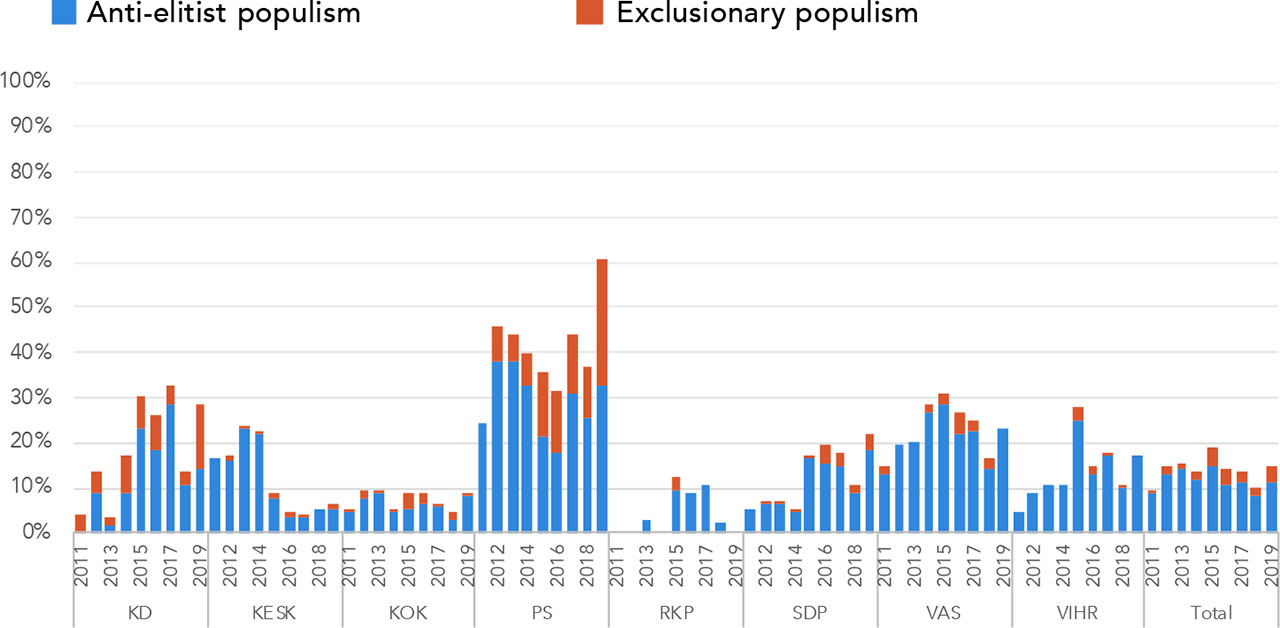
FIGURE 1
Populist political communication in the Finnish parliament during Question Time, 2011–2019
Comments: n = 13,079. KD = Christian Democrats (government 2011–2015, opposition 2015–2019); KESK = Centre Party (opposition 2011–2015, government 2015–2019); KOK = National Coalition Party (government 2011–2015, government 2015–2019); PS = Finns Party (opposition 2011–2015, government 2015–2017, opposition 2017–20199; RKP = Swedish People’s Party (government 2011–2015, opposition 2015–2019); SDP = Social Democratic Party (government 2011–2015, opposition 2015–2019); VAS = Left Alliance (government 2011–2014, opposition 2014–2019); VIHR = Green League (government 2011–2014, opposition 2014–2019).
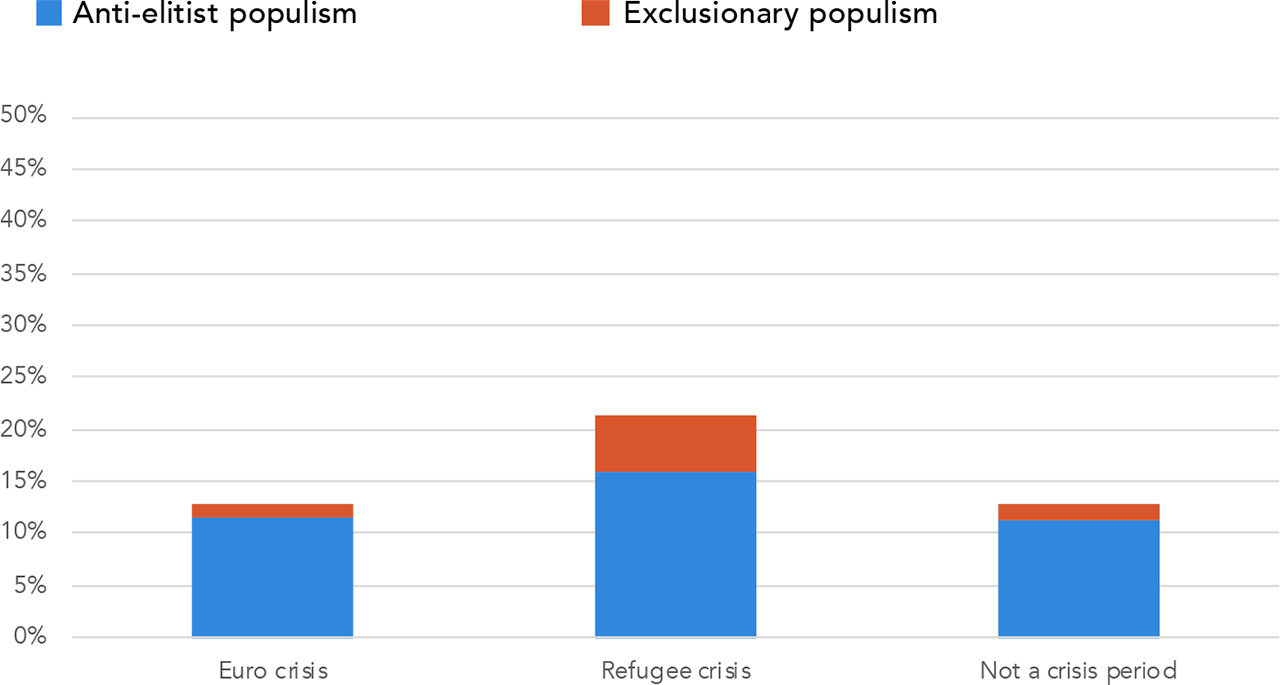
FIGURE 2
Proportion of populist communication during times of crisis and outside the crisis periods
TABLE 1
Effects of the crises and the control variables on populist communication (multiple regression analysis)
| B | St. Err. | Sig. | |
|---|---|---|---|
| Euro crisis | 0.465 | 1.511 | 0.758 |
| Refugee crisis | 9.890 | 2.180 | < 0.001 |
| Government position: Opposition | 11.884 | 1.195 | < 0.001 |
| Party status: Niche | 9.903 | 1.163 | < 0.001 |
| Constant | 26.623 | 0.66 | < 0.011 |
| Does the unit of interest include anti-politics statements (e.g., criticism of other politicians, parties, party-blocks, political parties in general, or politics in general)? |
| Does the unit of interest include anti-state statements (related to public institutions, such as public-service failure, systematic failure of public services, demands for a public service or an institution to be abolished, or criticism of the whole public service sector)? |
| Does the unit of interest include anti-international institutions (governmental and nongovernmental institutions such as the European Union, the United Nations, Greenpeace, etc.)? |
| Does the unit of interest include anti-media statements (e.g., criticism of journalists, newspapers, TV channels, social-media companies, or the whole media system)? |
| Does the unit of interest include anti-intellectual statements (e.g., criticism of research, researchers, universities and other research institutions, or the research community in general)? |
| Does the unit of interest include anti-culture statements (e.g., criticism of persons, cultural institutions, or forms of culture)? |
| Does the unit of interest include anti-economy statements (e.g., criticism of business owners, certain industries or trades, corporations, unions, banks, labour markets, or the whole economic system)? |
| Does the politician identify ethnic, sexual, or religious minorities as dangerous others? |
| Does the politician identify immigrants or foreigners as dangerous others? |
| Does the politician identify the extreme-rich minority or tax avoiders as dangerous others? |
| Does the politician identify any other form of dangerous others (e.g., people with certain lifestyles or political views)? |