

Introduction
This study explores how crises affect the usage of populist political communication and whether a crisis could be argued to trigger populist communication. Previous studies have shown how populist challengers in different European countries have mobilised support during a crisis (see Caiani & Graziano, 2019; Kriesi & Pappas, 2015; Lisi et al., 2019). However, less attention has been paid in previous research to the overall usage of populist communication among political actors during times of crisis (however, see Järviniemi, 2024). Therefore, I adopt an approach centred on analysing how crises influence the overall use of populist political communication. Additionally, the aim is to gather empirical insights into the relationship between populism and different crises, a topic that remains a subject of significant debate among scholars (for an overview, see Moffitt, 2015).
More specifically, my investigation focuses on the kind of crisis that is most likely to generate populist political communication. To this end, I compare two distinct external crises, namely the euro crisis and the refugee crisis, to determine which one offers the most fertile ground for this type of communication. Whereas the euro crisis could be categorised as a typical economic crisis for which several European populist parties could blame establishment figures such as the European Union and financial institutions (Kriesi & Pappas, 2015), the refugee crisis was and continues to be a social and a cultural crisis that facilitates the exclusion of asylum seekers and criticises decision-making on both the European and national levels (Modebadze, 2019; Perälä & Niemi, 2018). Both, therefore, encouraged the spread of both anti-elitist and exclusionary populism.
Previous research has revealed how both the euro and the refugee crises boosted European populist (mostly right-wing) parties. However, to date there is limited information about how non-populist parties may have used populist communication tactics during these periods. Hence, this study gives novel scientific insights into the extent and type of populist communication used during times of crisis, and by whom.
Automated–human content analysis was used to analyse communication among politicians in the main political arena and to assess the extent to which populist communication is used during times of crisis. The data consists of speeches form plenary debates conducted during the 2010s in Finland, allowing comparison of the two crises and of how populist communication was used before, during, and after them. Finland’s party system is characterised by a wide variety of political parties spanning the left–right spectrum. The 2010s also saw the rise of the Finns Party, a radical right-wing populist party that grew to become one of the country’s largest political forces. This diversity within the Finnish party system makes it an intriguing case for examining how populist communication is employed across different political parties. Furthermore, Finland weathered both the euro and the refugee crises more effectively, both economically and socially, than many other European nations. Thus, if a significant rise in populist communication is observed in Finland during times of crisis, it can be argued that an even more pronounced increase in such communication would occur in countries more severely affected by the crisis.
The findings indicate that crises do influence the use of populist communication, albeit to a different extent depending on the crisis: There was a marked rise in usage during the refugee crisis, but no statistically significant increase during the euro crisis. Party status and governmental role also influenced how and by whom populist rhetoric was employed. Additionally, the type of populist messaging shifted from predominantly anti-elitist to increasingly exclusionary during and after the refugee crisis. Thus, one could argue that specific phenomena such as the refugee crisis and factors such as party status and governmental role rather than crises in general should be considered potential triggers of populist communication.
Populist political communication
Plenty of approaches to and definitions of populism exist, which is unsurprising given that it is a global phenomenon and that scholars come from various disciplinary backgrounds and take different ontological perspectives (for an overiview, see Herkman, 2022). However, the ideational approach has become more dominant during the twenty-first century, particularly in the field of comparative politics (Mudde, 2017). Populism in this study is perceived as a type of political communication. However, I do not argue that populism is necessarily a sort of worldview or ideology: I consider it a rhetorical tool that can be used by anyone at any time regardless of their ideological profile or party background. Here, therefore, it is understood as a form of political communication rather than a feature of the actor sending the message (de Vreese et al., 2018). The benefits of this approach are, first, that it does not claim to have “glimpsed inside the populist’s head” and thereby to know the underlying motives behind someone’s behaviour (Aslanidis, 2016). Second, focusing on elements of populist discourse in textual data enables a solid methodological framework, which makes it possible to systematically identify and measure the usage of populist political communication. Consequently, the actors are not considered populist or non-populist; instead, their populist political communication is defined in terms of degree. Different types of populism can be identified, allowing changes in and developments of populist communication to be tracked across party lines, over time, and in different political arenas.
I argue that populist political communication is a discursive framework comprising two necessary elements: inclusion in the form of people-centrism and exclusion in the form of anti-elitism or “dangerous others” (Aslanidis, 2016; Grbeša & Šalaj, 2018). From the populist perspective, “pure, ordinary people” and their will should be the focal point of politics. The discursive vagueness of the term “the people” allows it to assume different meanings depending on the actor’s ideological positioning and the context (de Vreese et al., 2018). For example, actors sharing a nationalist political view may define the people in nativist terms, whereas those embracing leftist ideology may define them as a virtuous working class (Bernhard & Kriesi, 2019). Furthermore, in that populism essentially connotes a struggle among the people, the corrupt elite, and dangerous others, people-centrism needs an antithesis, namely anti-elitism or “dangerous others”. This provides different types of populist discursive frames, as described below.
Anti-elitist populism is a combination of people-centrism and anti-elitist discourse, whereby “the elite” are considered the antithesis of “the people”, working against their general will. Anti-elitist populism “refers to communication that explicitly condemns the establishment, the current power-holders, the incumbents and proponents of the existing, malfunctioning system” (de Vreese et al., 2018: 427–428). Elites may be political, cultural, economic, intellectual, or judicial, depending on the actor’s ideology and what fits into the national context and narrative (Aslanidis, 2016; de Vreese et al., 2018; Jagers & Walgrave, 2007).
Exclusionary populism excludes members of a specific population segment who do not share the same values as “the people”. The actor’s worldview and political context determine who belongs to the “dangerous others”. Exclusionary rhetoric is not apparent in every type of populism, although it is found among both the left wing (namely towards the extremely wealthy and tax avoiders) and the right wing (e.g., towards immigrants, asylum seekers, ethnic minorities, and welfare-state profiteers) (de Vreese et al., 2018; Hameleers, 2018).
Crisis and populism
The relationship between populism and crisis situations is discussed in a large and growing body of literature, and the relative importance of the latter is debated (for an overview, see Moffitt, 2015). Some scholars claim that a crisis is a necessary condition for populism to develop, whereas others who tend to support the Essex School’s discourse approach argue that crises facilitate the emergence of counter-hegemonic discourses such as populism (e.g., (Laclau, 2005). Proponents of the ideational approach to populism are less sure about how it relates to crises (e.g., Kaltwasser, 2012; Mudde, 2007). They claim, for example, that a crisis “provides a window of opportunity” (Caiani & Graziano, 2019: 1142) for populist actors to strengthen their support, but not that a crisis is a necessary condition for populism to emerge. On the other hand, some scholars do not see any relationship between populism and crises. Benjamin Arditi, for example, has rejected the idea, suggesting that populists in government could manage and maintain their positions without a crisis, which in itself could increase their popularity (Arditi, 2007: 63).
The purpose of this study is to examine the effects of different types of crisis on populist political communication. The argument put forward is that, although populism does not necessarily emerge from a particular external event such as the euro crisis or the refugee crisis, crises such as these might boost the usage of populist communication. Indeed, populism is not a new phenomenon in Western Europe, having been driven by the malfunctioning of representative democracy, as several scholars have claimed (Katz & Mair, 2018; Kriesi, 2014). For example, declining voter turnout, party membership, and party identification, as well as the increasing importance of supra- and international-level governance, have been identified as indicators of political alienation and of “a democratic regime where national parties have lost their representative function, which opened the door for populist protest” (Kriesi, 2014: 361). In other words, a single crisis is not a necessary condition for populism, but the more significant structural changes that have occurred in democratic regimes have made populism a relevant alternative for voters who feel alienated from the democratic decision-making process.
It is also possible that an external crisis such as those concerning the euro and refugees provides a springboard for populist communication to prosper. Such communication, with its polarising nature, becomes even more desirable during such crises because it conveys a positive self-concept of “the people”. It also enables someone to be blamed for specific crises, such as various elites, immigrants, or other out-groups who are portrayed as responsible for causing the crisis and handling it (Hameleers, 2018). This antagonistic nature of populist communication gains credibility, given the underlying structural problems of representative democracy and the ongoing erosion of the parties’ representational function (Katz & Mair, 2018). The representational issue was amplified during both the euro crisis and the refugee crisis, thereby providing a platform for populist political communication to be used by political actors who subscribe to a populist worldview or who see it as an opportunity to challenge the establishment to gain support. Thus far, previous studies have failed to examine the type of crisis that triggers this dynamic and feeds populist communication. Moreover, previous research has focused on populist actors and their messages (see, e.g., Caiani & Graziano, 2019; Kriesi & Pappas, 2015; Lisi et al., 2019), but it has failed to consider how other political actors may have used populist political communication during times of crisis.
Research problem
Political parties in many Western democratic regimes no longer serve as a link between different social groups and types of political decision-making, as they did 30–40 years ago. Declining party membership and decreasing voter turnout are symptoms of the more extensive structural problems that afflict representative democracy and of the alienation of politics, which have paved the way for populist actors to gain support (Katz & Mair, 2018; Kriesi, 2014).
The financial crisis of 2007–2009 originated in the US, caused by long-term low interest rates offered by the central bank, reckless mortgage lending, huge risk investments made by financial institutions, as well as severe shortcomings in banking supervision and regulatory loopholes (Patomäki, 2013: 5). In 2010, Ireland announced that it sought help from the European Union and the International Monetary Fund to pay off its debts. Portugal and Greece followed, and the eurozone countries were soon facing an unprecedented economic crisis as the debt problem spread to several of them during the following years. This coincided with an upswing in popularity of several populist parties in Europe (Kriesi & Pappas, 2015). The implication is that the euro crisis increased the demand for populist politics, which arguably also could have led to an increase in populist political communication among other parties that are not normally considered populist.
A few years later, when the worst fears of an economic crisis had started to fade, a different kind of crisis knocked on European doors. The “European refugee crisis” comprises a series of events that began in 2014–2015 as large numbers of refugees and migrants from the Middle East and Northern Africa sought asylum in Europe. It is estimated that approximately 1,260,000 asylum seekers arrived in the European Union in 2015 (Eurostat, 2016). This inflow of migrants triggered a crisis in the public debate related to national and European Union decision-making (Perälä & Niemi, 2018), strengthening anti-immigration sentiments in Europe and boosting the popularity of several radical right-wing populist parties (Modebadze, 2019). Thus, it would not be surprising if other political actors were to use either anti-elitist populist communication to blame the European Union for the situation or exclusionary populist communication to cater to the rising anti-immigrant sentiments among the populace.
These two situations provide an excellent opportunity to examine the usage of populist political communication during times of crisis, and to address the following research question:
To what extent do crises affect politicians’ usage of populist political communication?
The Finnish case
Finland’s multi-party system offers an intriguing case to examine the overall use of populist communication during the 2010s. From the 1970s until the 2011 parliamentary elections, Finland’s party system remained stable, with three dominant parties – the left-leaning Social Democratic Party, the conservative Centre Party, and the right-wing National Coalition Party – alternating power and leading both the government and opposition. However, the 2011 parliamentary election disrupted this balance when a populist right-wing party, the Finns Party, gained substantial support, particularly drawing voters from the Centre Party and Social Democratic Party, emerging as one of the largest political parties. Finland also has several smaller, stable parties that play a consistent role in the parliament. The fragmentation of the Finnish party system, with typically eight or nine parties represented in parliament, prevents any single party from dominating and has forced traditional mainstream parties to collaborate with smaller parties to form governing coalitions, meaning that during the 2010s, most Finnish parties held roles both in government and opposition.
Both the euro crisis and the refugee crisis impacted Finnish society. However, Finland managed these crises better, both economically and socially, than many other European countries, making it a crucial case for examining the use of populist political communication during such times (see, e.g., Pyrhönen & Wahlbeck, 2018; Ylä-Anttila & Ylä-Anttila, 2015; European Migration Network, 2016)). If populist communication increased in a country that was only moderately affected by these crises, it would be reasonable to assume that nations more severely impacted would have seen an even greater rise in populist rhetoric. Therefore, Finland can be considered a rather unlikely case for a surge in populist rhetoric during the euro and refugee crises, given that it was less affected than several other European nations.
In addition, the Finns Party was included in the government for the first time after the 2015 parliamentary election. As members of a coalition government, parties are generally forced to make compromises and sometimes accept and even carry the responsibility for decisions that are unpopular among their core voters. This makes it harder for governing populist parties to continue with their populist rhetoric, and leads to more inclusive and moderated rhetoric, also known as the inclusion-moderation thesis (see, e.g., Bernhard, 2020; Krause & Wagner, 2021). Because the Finns Party tends to be regarded as the genuine populist party in the Finnish parliament, one might expect the overall usage of populist communication during the refugee crisis to have not increased as much as in countries in which a populist party belonged to the opposition.
Research design
The aim of this study is to analyse the communication of politicians on the main political stage and to assess the extent to which populist communication was employed during the two periods of crisis. The dataset consists of speeches made during Question Time in the Finnish parliament between September 2011 and April 2019 (n = 13,079). This timeframe includes two parliamentary terms separated by a parliamentary election in early 2015. The data is provided by the Semantic Computing Research Group’s “Semantic Parliament” project (Hyvönen et al., 2022).
Question Time is rightly considered the most visible event in the Finnish parliament. It is broadcast live, and the debate usually centres around current political issues, which attract considerable media attention. During this time, opposition parties present questions to representatives of the governing parties, who are obliged to answer. Opposition parties are required to inform the speaker in advance who wishes to present the question from their party. Thus, the party’s parliamentary group decides the questions beforehand, meaning that it is as much the individual politicians who speak as the party. In addition, in that Question Time is the most visible event in the Finnish parliament, its audience comprises not only the governing parties but also, and to a greater extent, the media representatives and members of the public watching the debate (Pekonen, 2011: 109–110). The debate is therefore one of the most influential external communication channels for political parties outside of election times.
Question Time debates in the Finnish parliament provide an excellent opportunity to examine how political parties have reacted to crises in “real time”. The programme is a weekly one-hour event, in which parties and politicians must react to current political issues. The debates do not necessarily translate into policy outputs, but they do signal party preferences concerning which issues to emphasise (Cavalieri & Froio, 2022). They also provide a level platform for every party, thereby allowing examination of populist communication as a communication-orientated phenomenon in which all Finnish parliamentary parties are involved. This is an essential factor, given findings from previous research demonstrating how news media tend to use elite-driven sources during times of crisis (see, e.g., Dimitrova & Strömbäck, 2009; Harjuniemi et al., 2015; Perälä & Niemi, 2018), such that only certain politicians have the opportunity to voice their opinions in traditional media. Thus, using news media in this study would flout the principle of equality between parties. Using social media would be a suitable option were it not for problems related to the accessibility of old sources.
Dependent variable: populist communication
A combination of automated and manual content analysis was used to measure the occurrence of populist political communication in the plenary debates. The benefit of this approach is that it produces higher validity than purely automated text analysis because human coders are involved. In addition, the fact that automated text analysis was used to identify coding units of interest made the process less labour-intensive than purely manual content analysis (see Nguyen et al., 2020). The data was divided into smaller units, with each unit representing one speech during Question Time. This approach is justified both theoretically and methodologically. According to Paris Aslanidis (2018), the discursive elements of populist communication may not be evident in a single sentence or paragraph but are more likely to emerge in larger bodies of text. For instance, an actor might begin a speech with people-centric discourse, emphasising their commitment to defending ordinary people; however, as the speech progresses, they may introduce exclusionary discourses. This combination of inclusionary and exclusionary elements allows the speech to be identified as populist communication. Thus, considering an entire speech as a unit ensures that its full intent is captured. Methodologically, this approach is sound because speeches during Question Time in the Finnish parliament are limited to one minute, ensuring consistency in speech length.
Existing dictionary-based approaches to measuring populism have purported to capture populist communication by including words that encapsulate populist messages (for an overview, see Gründl, 2020). However, given the limited number of words in dictionaries, they omit populist messages not captured by the words that are included and thus produce somewhat misleading results. In addition, some of the approaches only include anti-elitist terms and leave out people-centric discourses (e.g., Rooduijn & Pauwels, 2011). However, as previously argued, it is impossible to classify something as populist communication without the presence of such discourses. Therefore, to increase the validity of this study, the dictionary approach was used only to find the units of interest, meaning speeches that include people-centric discourses and fulfil the necessary condition of populist communication. The units of interest were further coded as anti-elitist or exclusionary populism, or both, by means of manual content analysis.
The dictionary includes words that are normally used by Finnish politicians when they talk in the name of “the people”, referring to the importance of responding to what is portrayed as the people’s will or using “the people” to legitimise their claims. Existing English dictionaries were used as a starting point (Elçi, 2019; Gründl, 2020; Hameleers & Vliegenthart, 2020). They were translated into Finnish, and relevant synonyms were added. For theoretical considerations, some relevant people-centric Finnish terms were also added. Bigram and trigram analyses were conducted to make the entries more precise and to identify terms that were unnecessary. This yielded a list of word combinations, which were manually reviewed. The list revealed which words are most commonly combined and showed how certain words need to be close to another word to be considered people-centric. Thus, a newly modified dictionary was developed. Moreover, not all of the people-centric discourses were listed separately, as some were counted only if they appeared close to another word: The word majority had to occur close to words such as Finns, people, and citizens, for example. Hence, the dictionary was assembled both deductively and inductively, which is usually the case when a new dictionary is being constructed (Lind et al., 2019; see Appendix A for the dictionary of people-centric discourses). The dictionary yielded 5,955 speeches.
To increase the validity of the dictionary technique used, the automatically coded people-centric units were manually examined, and extraneous units were eliminated from the dataset. Thus, Mirjam Cranmer’s (2011) definition of people-centrism was applied, meaning that it is not sufficient to refer to the people, citizens, taxpayers, workers, and so on. The politician’s reference to the people was only taken into account if “a political actor claims that he or she defends the will of ‘the people’ (advocacy), is accountable to ‘the people’ (accountability) or legitimises his or her claim by referring to ‘the people’ (legitimacy)” (Cranmer, 2011: 292). However, these speeches were not yet considered populist, because “the people” needs its antithesis, which can be various elites or out-groups that are considered threats. Thus, the following step was to evaluate the speeches that were coded as people-centric to determine whether they contained exclusionary elements, in the form of anti-elitism or the exclusion of “dangerous others”.
Anti-elitism takes different forms depending on the actor and context. Therefore, a categorisation of different types of anti-elitism is needed. Anti-elitism can be anti-politics, -state, -international institutions, -media, -intellectual, -culture, and -economy (de Vreese et al., 2018; Jagers & Walgrave, 2007; Mudde, 2017; Rooduijn & Pauwels, 2011). Anti-politics constitutes criticism of other politicians, parties, party-blocs, political parties in general, or politics in general. Anti-state focuses on the failures of the state in producing public services. Anti-international institutions are critical of governmental and nongovernmental international institutions, such as the European Union, the United Nations, Greenpeace, and so on. Anti-media is criticism of the media. Anti-elitism can also be related to so-called elitist groups, which, according to populists, put their interests before those of the people; these groups can be individuals or institutions that, for example, represent the scientific, or intellectual community, the cultural elite, or the economic elite.
Like anti-elitism, the exclusion of “dangerous others” varies depending on the actor and context. Exclusionism can involve ethnic, sexual, or religious minorities, as well as immigrants and foreigners, when they are described as a threat to “the people.” Moreover, individuals who are extremely wealthy or those with specific lifestyles can also be subject to exclusionary populism (for a more comprehensive coding scheme, see Appendix B).
10 per cent of the units of interest were coded by two test coders to assess the accuracy of the coding book and to calculate its reliability; inter-coder reliability was 0.822 (Krippendorff’s alpha), indicating sufficient reliability. I coded the remaining data.
Following the coding process, the speeches were grouped by party and specific weeks. The proportion of speeches containing populist communication was then tallied. Therefore, the dependent variable is the percentage (ranging from 0 to 100) number of speeches per party per week that featured some form of populist communication.
Independent variables: the euro crisis and the refugee crisis
It is difficult to pinpoint exactly when a crisis begins and when it ends – and what turns an event into a crisis. For an event to be considered a crisis, it must be culturally and politically mediated and perceived as such (Moffitt, 2015). Thus, in this study, the time when the subject was widely discussed in the media determined the crisis period. One could argue that if a subject is intensely discussed in the media, it is probably also discussed and debated among politicians and perceived on the general level as a period of crisis. Therefore, the euro crisis and the refugee crisis were operationalised when the Finnish media extensively reported on these events.
The euro crisis had varying impacts on different countries at different times. 2012 is widely considered the pinnacle of the crisis as far as the European Union and Finland are concerned. Economic indicators imply that it hit Finland hard, but the country’s strong economy and generous welfare benefits mitigated the effects on Finnish voters compared with voters in other European countries (Ylä-Anttila & Ylä-Anttila, 2015). The tipping point was reached in 2012 when capital disappeared from the euro area and market interest rates on government bonds rose sharply. Even mainstream politicians such as Finnish Foreign Minister Erkki Tuomioja made statements about the possible demise of the Euro: “Finland had made contingency plans for the break-up of the euro” (Salla, 2021: 105). Greece was promised a second bailout package in 2012, and both Spain and Cyprus received bailout packages to avoid the total collapse of the eurozone. Meanwhile, the Finnish press, which had initially been supportive of the actions taken during the economic crisis, had begun to report more critically on the euro crisis, the European Union, and national politics (Railo, 2012). The media criticism was reflected among voters, and anti-European sentiments were expressed more frequently (Ylä-Anttila & Ylä-Anttila, 2015: 65–66). To validate the chosen timeframe, a couple of quantitative approaches were employed. A Google Trends search indicated that the term “euro crisis” was most frequently searched for in Finland during 2012. Additionally, a search using the term “euro crisis” in ParliamentSampo (a linked open data research infrastructure of Finnish parliamentary data based on some million speeches extracted from the minutes of the plenary sessions; see Semantic Computing Research Group, n.d.) revealed the number of parliamentary speeches containing the term – the results corresponded with the Google Trends data. Prior to 2010, there were only a few speeches that mentioned the euro crisis. In 2011, the number of such speeches increased to around 50. In 2012, the number of speeches mentioning the euro crisis surged to nearly 200, followed by a significant decline in subsequent years. It is thus clear that 2012 was the peak of the euro crisis in Finland, at least on a rhetorical level.
During the refugee crisis, Finland received approximately 32,000 asylum seekers in 2015, most of whom applied for asylum in Finland during the second half of the year (see Pyrhönen & Wahlbeck, 2018: 2–3). The event was one of the most extensively covered news stories in Finland between August 2015 and February 2016 (Perälä & Niemi, 2018). It was also extensively discussed and debated among Finnish politicians (Pyrhönen & Wahlbeck, 2018). During late 2015 and the beginning of 2016, the number of speeches including the term “refugee crisis” also surged in the Finnish parliament, according to a search for the term “refugee crisis” [Pakolaiskriisi] in ParliamentSampo. Hence, the period from August 2015 to February 2016 could be considered the peak of the refugee crisis in Finland.
Control variables
Previous studies have highlighted that factors such as governmental role and party status affect the use of populist communication (Bonikowski & Gidron, 2016; see also Dai & Kustov, 2022; Ernst et al., 2017; Krause & Wagner, 2021). Therefore, to assess how crises impact the use of populist rhetoric, a couple of control variables were included in the analysis. The purpose of these variables was to determine to what extent times of crisis influence the use of populist communication compared to the control variables. This comparison helps to ascertain whether crises act as triggers for populism or if other factors play a more crucial role.
Niche and mainstream political parties
As previous studies have highlighted (see, e.g., Ernst et al., 2017), certain political parties are more prone to using populist communication than others. Niche parties tend to use it more heavily than the more centrist and mainstream parties because of how well-suited it is for parties challenging the establishment (see Järviniemi, 2022: 233–234). Furthermore, Dai and Kustov (2022) highlighted that politicians with a lower chance of winning elections are more likely to employ populist rhetoric. Furthermore, Bart Bonikowski and Noam Gidron (2016: 1593) claimed that “populism is primarily a strategic tool of political challengers, and particularly who have legitimate claims to outsider status”. Thus, in the Finnish context, it can be expected that niche parties are more likely to use populist communication compared with mainstream parties, as niche parties are the ones challenging the establishment and have better claim to outsider status.
Finland has a multi-party governance system. Its traditional mainstream parties are the Social Democratic Party, the Centre Party, and the National Coalition Party (Karvonen, 2014). There is also a distinct ethnolinguistic party, primarily representing the Swedish-speaking minority: The Swedish People’s Party has been part of every government except one since 1979, having increasingly identified itself as a liberal party and moving away from its single-issue status, and it could therefore be considered a mainstream party. In the Finnish context, the Left Alliance and the Green League could be described as typical left-wing niche parties (see, e.g., Adams et al., 2006; Ernst et al., 2017), whereas the Finns Party, the Christian Democrats, and the Blue Reform could all be regarded more as part of the right-wing fringe than as mainstream parties because of their distance from the political centre.
Opposition and governing political parties
Populist communication is commonly targeted at alleged elites and the establishment. Parties that are members of a coalition government are generally forced to make compromises, and sometimes to accept and even take responsibility for decisions that are unpopular among their core voters. Consequently, it becomes difficult for them to criticise the political establishment because they are part of it. Opposition parties are not part of the establishment in the same way as the governing parties and are thus not as restricted in their use of use populist communication (Krause & Wagner, 2021). Furthermore, as argued above, populist communication is a strategic tool of political challengers (Bonikowski & Gidron, 2016). Therefore, it is likely that populist political communication is used more among opposition parties than among incumbent parties.
Almost every Finnish parliamentary party was in both the government and the opposition at one point during the time period under analysis; the one exception is the National Coalition Party, which was in government during the whole period.
Results – from crisis to crisis
Figure 1 illustrates the usage of populist communication in the Finnish parliament during Question Time from September 2011 to April 2019. It showcases the party-specific and total use of such communication and also presents the percentage breakdown of anti-elitist and exclusionary populism. Of the 13,079 speeches given during the aforementioned period, 13.6 per cent contained some form of populist communication: 85 per cent of this populism was anti-elitist and 15 per cent was exclusionary.
During the years analysed, the populist radical-right Finns Party used the most populist communication in the Finnish parliament, although the type of populism changed after the 2015 election when the party joined the government coalition: Having been mostly anti-elitist before, it became more exclusionary. The amount of populist communication used by the Finns Party also decreased somewhat during 2015 and 2016, but it increased again in 2017. The Finns Party split in June 2017, and a new party, Blue Reform, was established. Blue Reform continued in the government, and the crippled Finns Party, led by Jussi Halla-aho, became a part of the opposition.
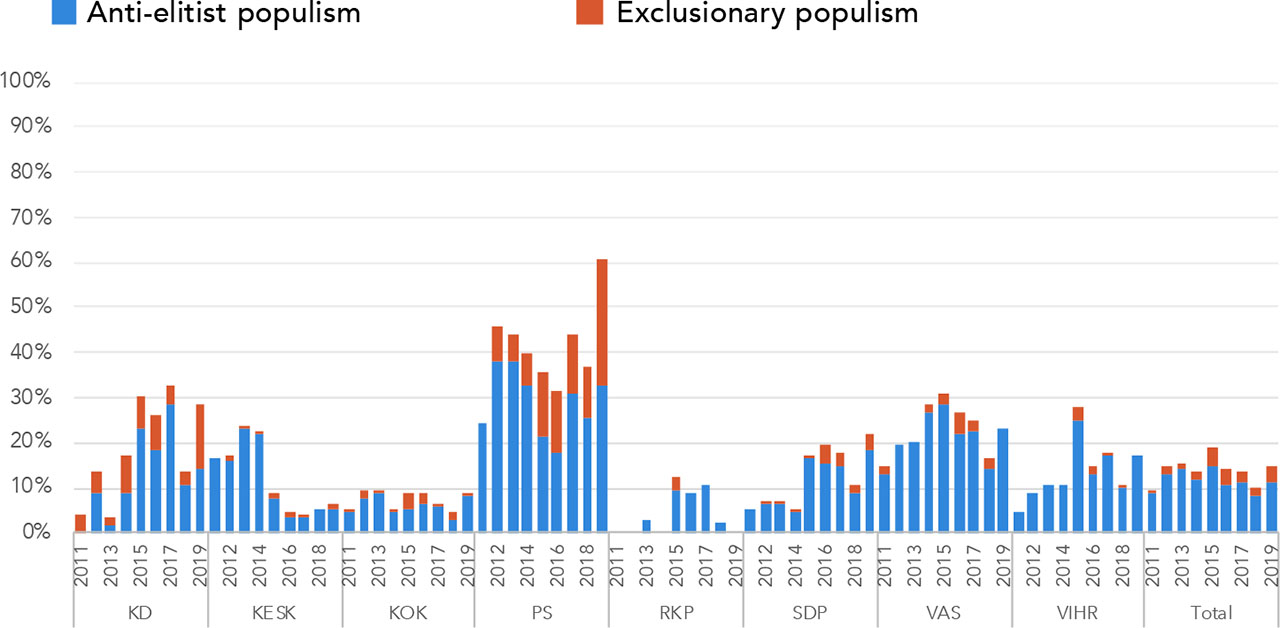
FIGURE 1
Populist political communication in the Finnish parliament during Question Time, 2011–2019
Comments: n = 13,079. KD = Christian Democrats (government 2011–2015, opposition 2015–2019); KESK = Centre Party (opposition 2011–2015, government 2015–2019); KOK = National Coalition Party (government 2011–2015, government 2015–2019); PS = Finns Party (opposition 2011–2015, government 2015–2017, opposition 2017–20199; RKP = Swedish People’s Party (government 2011–2015, opposition 2015–2019); SDP = Social Democratic Party (government 2011–2015, opposition 2015–2019); VAS = Left Alliance (government 2011–2014, opposition 2014–2019); VIHR = Green League (government 2011–2014, opposition 2014–2019).
As Figure 1 shows, the Finns Party is not the sole user of populist communication in Finnish politics. Almost all parties used populist rhetoric, the amount varying from year to year. The content of anti-elitist rhetoric is heavily influenced by the ideology of the party: Left-leaning parties tend to criticise economic elites, whereas right-leaning parties often blame the European Union or claim that the political system does not represent the interests of “the people”. However, parties on both the left and the right frequently accuse governing parties and their opponents of neglecting the needs and interests of the electorate. Exclusionary populism is more prevalent among right-wing parties, which target immigrants, foreigners, and various minority groups based on sexual orientation, ethnicity, and language. Left-leaning parties, in turn, tend to exclude the extremely wealthy.
One can conclude from Figure 1 that all Finnish parliamentary parties used populist communication during the period analysed, although to strongly varying extents. It is noticeable that the usual suspects, namely members of the Finns Party, were the heaviest users, but other parties also employed the rhetoric. In terms of total usage, there were a few noticeable spikes and changes during the period analysed. Interestingly, the type of populist communication changed somewhat from almost purely anti-elitist pre-2015 to include a fair amount of exclusionary rhetoric during and after 2015.
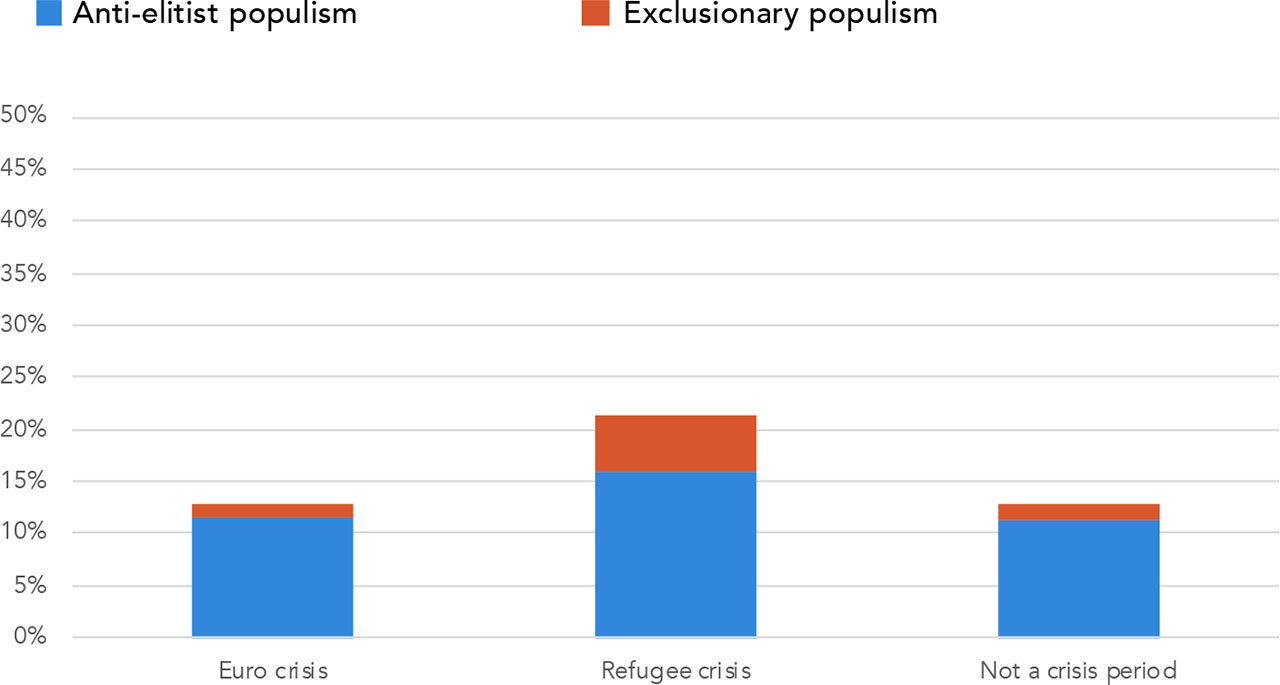
FIGURE 2
Proportion of populist communication during times of crisis and outside the crisis periods
Figure 2 depicts the overall usage of populist communication during the euro and refugee crises, as well as during non-crisis periods. Usage was 5 per cent higher during the refugee crisis than during the euro crisis when, interestingly, it was almost the same as in non-crisis periods. In addition, exclusionary populism featured more during the refugee crisis than during the euro crisis and the non-crisis periods.
A multiple regression analysis was conducted to evaluate the impact of the euro crisis and the refugee crisis on the use of populist communication by Finnish parliamentary parties. Several models were tested to ensure the robustness of the results presented here. For instance, different time periods for the euro crisis were tested to determine if the chosen timeframe affected the outcomes. After testing these various time periods, no significant changes were observed.
TABLE 1
Effects of the crises and the control variables on populist communication (multiple regression analysis)
| B | St. Err. | Sig. | |
|---|---|---|---|
| Euro crisis | 0.465 | 1.511 | 0.758 |
| Refugee crisis | 9.890 | 2.180 | < 0.001 |
| Government position: Opposition | 11.884 | 1.195 | < 0.001 |
| Party status: Niche | 9.903 | 1.163 | < 0.001 |
| Constant | 26.623 | 0.66 | < 0.011 |
As Table 1 shows, the effect of the refugee crisis is statistically significant, indicating an increase in the use of populist communication during the period. The Beta value is 9.890, implying that usage increased by 9.9 percentage points during the crisis. In contrast, the euro crisis is not statistically significant, implying that it did not affect the overall employment of populist communication: This is in line with the descriptive data shown in Figure 2. One plausible explanation for this is that during the euro crisis, the coalition comprised six parliamentary parties. As a result, most of the actors were part of the establishment and responsible for managing the crisis, limiting their ability to use populist rhetoric.
Table 1 also highlights the statistical significance of both governmental role and party type, and thus their influence on the usage of populist communication. Representatives of niche parties gave 9.9 per cent more speeches containing populist communication than their mainstream counterparts. Moreover, members of opposition parties gave 11.9 per cent more speeches featuring populist communication than members of incumbent parties. This aligns with the theoretical expectations highlighted above – that actors challenging the establishment are more prone to use populist communication (see, e.g., Bonikowski & Gidron, 2016; Dai & Kustov, 2022; Krause & Wagner, 2021)
Therefore, it appears that crises, and particularly the refugee crisis, served as catalysts encouraging political parties to use populist communication. However, as Table 1 highlights, other factors, such as the role of the government and status of the party, also significantly affect the usage of populist communication in Finnish parliament debates.
Concluding discussion
The aim in this article was to examine how crises affect the usage of populist communication. The results of the study show that the total usage increased during times of crisis. Interestingly, however, not all crises seem to affect usage equally: The refugee crisis had a significantly stronger effect than the euro crisis. Moreover, the type of populist communication changed from almost purely anti-elitist to include more exclusionary rhetoric, the substance of which depended strongly on the party: Left-wing parties excluded the extremely rich, and right-wing parties excluded immigrants as well as ethnic, sexual, and linguistic minorities. The fact that this trend began in 2015 implies that the ongoing refugee crisis might have played a role. The rhetoric from the radical right might have normalised among other right-wing parties, thereby making it more politically acceptable to use exclusionary language. On the other hand, exclusionary populism among the leftist parties could reflect the general acceptance that politicians use this kind of rhetoric as long as it fits their political worldview. Nevertheless, it is concerning that populist messaging has extended from targeting institutions to excluding specific population groups as well. This trend may be contributing to further polarisation within society, whereby exclusion becomes normalised in political rhetoric.
However, crises do not seem to be the only factors that affect the usage of populist communication. As predicted, opposition and niche parties were more likely to use populist communication than incumbent and mainstream parties. Indeed, as previously mentioned, it would be rather difficult for mainstream parties, and especially incumbent parties, to use populist communication. In coalition governments, parties are often forced to make compromises, sometimes accepting and even taking responsibility for decisions that are unpopular among their supporters. As a result, it becomes more difficult to criticise the establishment. Opposition parties do not face the same constraints (Meyer & Wagner, 2013), which likely facilitates the use of populist communication. Similarly, mainstream parties, even if not in the governing coalition, are part of the political establishment, whereas niche parties use populist rhetoric to challenge the establishment (Ernst et al., 2017). This finding underscores that populist communication is influenced not only by crises but also by a parties’ governmental role and status. The results add to the discussion on strategic usage of populist rhetoric (Bonikowski & Gidron, 2016; see also Dai & Kustov, 2022)
The nature and circumstances of a crisis also seem to affect the type and amount of populist communication that is employed. As mentioned above, Finnish parliamentary discourse before the refugee crisis was primarily characterised by anti-elitist populism. During it and afterwards, however, exclusionary populism became more prevalent among political parties, and especially in communications from the populist radical-right Finns Party. Given the nature of the refugee crisis and the Finnish context, it is rather unsurprising that populist communication became more common. Finland had not previously received as many immigrants as Sweden, for example, and therefore, exclusionary populism had not been an accessible rhetorical tool. In addition, the crisis provided an opportunity for parties to use populist communication to accuse the ruling parties and the European Union of mishandling the situation and failing to safeguard “the people”. Therefore, unlike the euro crisis, the refugee crisis provided a springboard from which to promote both exclusionary and anti-elitist populism.
The main theoretical implication to be drawn from this study is that crises present political parties with the opportunity to assign blame to those in power or marginalise particular groups by means of populist communication. Nonetheless, it would be misleading to view any particular crisis as a universal trigger of such communication. One might rather claim that certain events such as the refugee crisis may be responsible for provoking populist communication across party lines – and may also affect the type of communication used. To ensure a more comprehensive understanding of the impact of crises on the widespread use of populist communication, it would be useful in subsequent research to investigate numerous and varied types of crises and their effects. Furthermore, factors such as governmental position and party status appear to significantly impact the use of populist communication. Future studies should consider these factors when discussing the strategic use of populist rhetoric.
One question raised in this study concerns the validity of the inclusion-moderation thesis, which posits that populist actors become more moderate when in power (for an overview, see Schwörer, 2022). According to the findings reported here, the employment of populist communication by the populist radical-right Finns Party declined slightly when it assumed power, but the rhetoric that was used became more exclusionary. Despite the slight decline in amount, however, the party still used significantly more populist communication than the other governing parties, so that even while in government, it could still be considered a populist party. The inclusion-moderation thesis may thus require re-examination. However, it does seem to apply to other parties that are not typically viewed as populist. Hence, further research on populism as a communication-oriented phenomenon could enhance the current understanding of the inclusion-moderation thesis.
Given that this was a case study, the generalisability of the results is subject to certain limitations. In Finland, the refugee crisis led to an increase in populist rhetoric, while the euro crisis did not have the same effect. This points to two important observations. First, different crises impact populism to varying degrees: Some are more likely to fuel its rise, while others do not affect it. Second, context plays a crucial role: Both the euro and refugee crises were less severe in Finland compared with other European countries, likely not increasing the demand for populist alternatives among the population and influencing the level of populist communication by Finnish parties. In contrast, in countries where, for example, the euro crisis was more intense and demand for populist alternatives grew, populist messaging likely increased to a greater extent. Furthermore, since the Finns Party was part of the ruling government during the refugee crisis, this may have moderated their populist rhetoric. Therefore, in countries where populist parties were in opposition, an even more significant increase in populist communication is likely to have occurred.
Acknowledgements
I would like to express my deepest gratitude to the Semantic Computing Research Group, and in particular to Dr. Kimmo Elo, for their invaluable assistance in gathering the data for this article.
Appendices
Appendix A
Dictionary for people-centric discourses
The Finnish words have been lemmatised to capture all the different wordings. The English translations have not been lemmatised. Important to note, some of the Finnish lemmatisation captured words were not relevant – these were dropped from the analysis during the manual evaluation.
kansa (people)
koko (whole), tavalli (ordinary), kaikki (everyone), kaiki (everyone), suomalai (Finns, Finnish), eurooppalai (European), enemmistö (majority), äänest (vote, voting,), suom (Finland), valit (electorate), tahto (will), meitä (us), tue (to support), tuk (support), keskustel (discuss), valta (power), palaute (feedback, input), oma (our, own), jokai (everyone), etu (interest), kunt (municipal), kunn (municipal), halu (desire, wish), vastu (responsibility), vasta (to respond, miel (mind, mood, opinion), yhteiskun (society), vaati (demand), itse (self), palvel (to serve), turva (protection, security), vaikut (influence), osall (participate), jakautu (divide), rehelli (honest), kansa (national, people), alist (subdue), tietä (to know), kantaa (bear responsibility), kanna (support), miel (desire), ääne (to speak out loud), ääni (vote, voice), minä (I), meidän (our), demokra (democracy)
lähidemokra (local democracy)
kansanvalt (democracy)
kansanäänest (referendum)
kansalaispalaut (citizen consultation, feedback)
kansalaiskeskus (public discourse)
valtaväestö (majority)
rahva (common people, ordinary folks)
yhteiskun (society)
koko (whole), suomalai (Finnish, Finns), suom (Finland), kanta (native), jokai (everyone), äänest (to vote, voter), enemmistö (majority), ihmi (human, person)
yhteisö (community)
koko (whole), suomalai (Finnish, Finns), ihmi (human, person), jokai (everyone), äänest (to vote, voter), enemmistö (majority)
ihmi (human, person)
suom (Finland, Finnish, Finns), jokai (everyone), palvel (to serve), kunt (municipal), kunn (municipal), meitä (we), meidän, (our), vastu (responsibility), turva (protection, security), tärk (important), äänest (to vote, voter), alist (subdue), tavalli (ordinary), suomalai (Finnish, Finns), eurooppalai (European), valta (power, osa (a part of, to participate), kaikki (everyone), kaiki (everyone), oma (self), miel (mind, mood, opinion), yhte (common, society), vaati (demand), itse (self, independent), ääni (voice), turva (secure, security), vaikut (influence), osall (involve, participate), ihmi (person, human), rehelli (honest), enemmistö (majority), ääne (to vote), tahto (will), työ (labour, work), töi (labour, work)
maanmie (a Finn)
valitsijakun (electorate)
äänestäj (voter)
äänioikeu (someone who is entitled to vote)
veronmaksa (taxpayer)
maksumie (someone who is responsible to pay for public services)
asu (to live)
kunn (municipal), kunt (municipal), palvel (to serve, service), valinnanvapau (right to choose), itse (self), kaikki (everyone), kaiki (everyone), enemmistö (majority), jokai (everyone), ääni (voice, vote), ääne (to vote), osallist (to participate), tavalli (ordinary), maksa (to pay), hoit (to take care of), suom (Finland, Finnish, Finns), halu (desire), miel (mind, mood, opinion), yhtei (common, society), vaikut (influence)
suomalai (Finnish, Finns)
veronmaksa (taxpayer), demokra (democracy), etu (benefit), suom (Finland, Finnish, Finns), kanta (opinion), kanna (support), kansa (people), maksa (to pay), piikki (refers to someone who owns someone else money, “tab is open”), osa (part), enemmistö (majority), halu (to want, desire), mieli (mind, mood, opinion), tavalli (ordinary), jokai (everyone), vastu (responsibility), suur (big, large), yhteiskun (society), turva (secure, security), osa (part, participate), prosent (per cent), ihmi (human, person), asia (item, thing, issue), pitä (to hold), ääni (voice), äänest (to vote, voter), ääne (voter, to vote), mina (I), kaikki (everyone), isänmaa (patritotic), tärke (important), valta (power), meidän (our), oma (own), miel (opinion, mind, mood), yhtei (common, community), vaati (demand), itse (self, independent), palvel (service, to serve), turva (secure, security), vaikut (influence), osalli (participate), jakautu (divide), rehelli (honest), suomalai (Finnish, finns), kulttuuri (culture), väestö, (population), tahto (will), meitä (us), fiksu (smart)
työssäkäyv (employee)
työnteki (employee)
suomalai (Finnish, Finns), kansa (poeple), ihmi (human, person), enemmistö (majority), maksa (to pay), kaikki (everyone), äänest (to vote, voter), ääni (vote, voide), ääne (voter), tavalli (ordinary), koko (whole), etu (benefit), kanta (opinion), piikki (refers to someone who owns someone else money, “tab is open”), jokai (everyone)
duunari (blue-collar worker)
suomenkiel (Finnish)
enemmistö (majority), jokai (everyone), ihmi (human, person), kaikki (everyone), kaiki (everyone), kansa (pepole), väestö (population)
eurooppalai (European)
veronmaksa (taxpayer), kansa (people), tavalli (ordinary), enemmistö (majority), äänestäj (voter), työnteki (worker), työssäkäyv (worker)
enemmistö (majority)
kansa (people), suomalai (Finnish, Finn), suom (Finland), äänestäj (voter), veronmaksa (taxpayer), halu (desire), yhteikun (society), valta (power), asu (live), mieli (mind, mood, opinion), yhtei (common, society), pieni (small), iso (large), vaati (demand), äänest (to vote, voter), ääni (voice, vote), turva (secure, security), osallist (participate), enemmistö (majority), ihmi (human, person), vähemmistö (minority), valitsi (chose, elect, decide), tahto (will)
ruotsinkiel (Swedish)
ihmi (human, person), kaikki (everyone), kaiki (everyone), kansa (people), väestö (population), vähemmistö (minority)
Appendix B
To increase the validity of the dictionary technique used, the automatically coded people-centric units were manually examined, and extraneous units were eliminated from the dataset. Thus, Mirjam Cranmer’s (2011) definition of people-centrism was applied, meaning that it is not sufficient to refer to the people, citizens, taxpayers, workers, and so on. A politician’s reference to the people was only taken into account if “a political actor claims that he or she defends the will of ‘the people’ (advocacy), is accountable to ‘the people’ (accountability) or legitimises his or her claim by referring to ‘the people’ (legitimacy)” (Cranmer, 2011: 292).
Code scheme Anti-elitism
| Does the unit of interest include anti-politics statements (e.g., criticism of other politicians, parties, party-blocks, political parties in general, or politics in general)? |
| Does the unit of interest include anti-state statements (related to public institutions, such as public-service failure, systematic failure of public services, demands for a public service or an institution to be abolished, or criticism of the whole public service sector)? |
| Does the unit of interest include anti-international institutions (governmental and nongovernmental institutions such as the European Union, the United Nations, Greenpeace, etc.)? |
| Does the unit of interest include anti-media statements (e.g., criticism of journalists, newspapers, TV channels, social-media companies, or the whole media system)? |
| Does the unit of interest include anti-intellectual statements (e.g., criticism of research, researchers, universities and other research institutions, or the research community in general)? |
| Does the unit of interest include anti-culture statements (e.g., criticism of persons, cultural institutions, or forms of culture)? |
| Does the unit of interest include anti-economy statements (e.g., criticism of business owners, certain industries or trades, corporations, unions, banks, labour markets, or the whole economic system)? |
Code scheme Dangerous others
| Does the politician identify ethnic, sexual, or religious minorities as dangerous others? |
| Does the politician identify immigrants or foreigners as dangerous others? |
| Does the politician identify the extreme-rich minority or tax avoiders as dangerous others? |
| Does the politician identify any other form of dangerous others (e.g., people with certain lifestyles or political views)? |