

Visualization, AI-generated, Prompt GCO Medienagentur
Across industries, companies are integrating social and environmental considerations into their pricing structures. Airlines include carbon-offset programs, retailers offer climate-neutral delivery and restaurants impose living-wage fees to support fair compensation for their employees. These initiatives reflect a broader shift toward responsible business practices and align with growing consumer expectations for sustainability.
Higher costs for sustainability are not always accepted
Despite this alignment, companies frequently encounter negative reactions when they attach explicit surcharges to support these initiatives. Air-lines experience complaints about carbon fees, retailers receive pushback when environmental add-ons appear at checkout and restaurants face criticism of wellness or living-wage charges. At the same time, other companies successfully incorporate similar costs into their pricing with little or no customer resistance. For instance, Chipotle restaurants raised menu prices to support higher employee wages without major backlash. This raises an important question: Why does charging for sustainability sometimes lead to backlash, while at other times consumers seem to accept it? The critical difference lies in how the sustainability cost is presented to customers.
The gap between stated preferences and observed consumer behavior
Consumers increasingly expect companies to operate responsibly. Nonetheless, while they support sustainability in principle, they do not always respond positively when they feel the responsibility to fund it explicitly falls to them. Frequently, consumers object to the costs of responsible behavior when it appears as a distinct surcharge. The social and moral nature of these surcharges causes consumers to evaluate not only the cost itself, but also who they believe should bear it. Given that consumers view the company as primarily responsible for delivering sustainability, explicit sustainability surcharges can create the impression that the company is attempting to shift that responsibility onto them. Understanding this psychological dynamic is essential for managers designing pricing systems that incorporate sustainability-related costs.
Two pricing formats with distinct psychological implications
Companies typically adopt one of two approaches when integrating sustainability costs into pricing: partitioned pricing or all-inclusive pricing (see Figure 1).
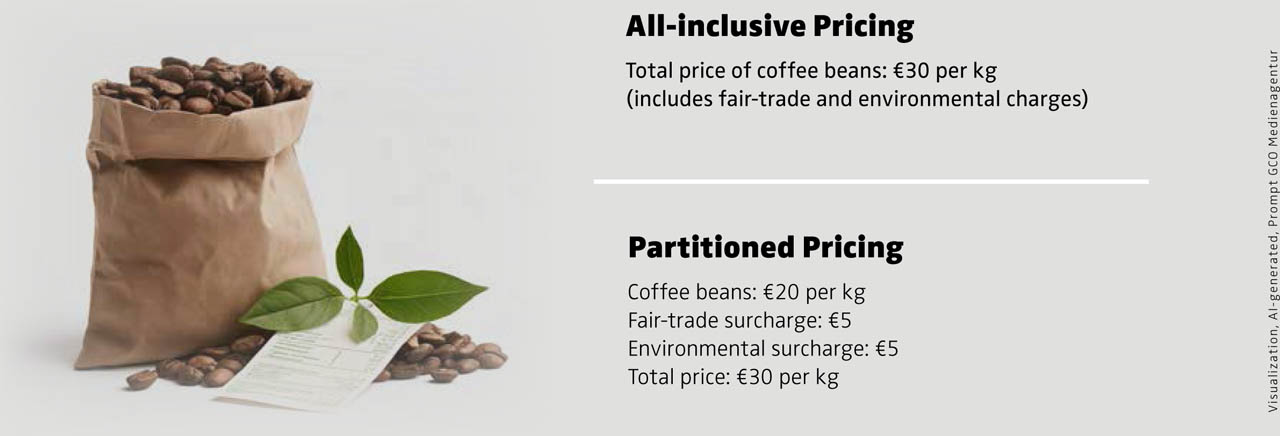
FIGURE 1
Examples of the two pricing formats
Although both formats communicate the same pricing information, they do not produce equivalent customer responses. Our research (see Box 1) shows that across multiple experimental studies examining carbon-offset fees, fair-trade charges and living-wage surcharges, all-inclusive pricing consistently led to higher purchase intentions, more favorable brand attitudes and greater receptivity to marketing messages. Partitioned pricing, by contrast, reliably suppressed purchase interest and increased consumer skepticism.
„While consumers support sustainability in principle, they do not always respond positively when they feel the responsibility to fund it explicitly falls to them.“
These consumer reactions appear counterintuitive. Consumers should prefer partition pricing, as it increases transparency and demonstrates the company's commitment to sustainability. Partition pricing also helps consumers align their purchases with their stated sustainability values. So, why does a seemingly transparent surcharge undermine trust? The answer lies in the interpretation consumers attach to this format.
„A separate line item for a sustainability cause signals that the company wants to highlight its socially responsible actions but is unwilling to bear the associated financial burden itself.“
Why separate surcharges often trigger negative attributions
When a sustainability fee is itemized, consumers frequently infer that the company is shifting responsibility for the social or environmental initiative onto them. This interpretation is not limited to the cost itself; it reflects a broader judgment about the company's underlying motives. A separate line item for a sustainability cause signals that the company wants to highlight its socially responsible actions but is unwilling to bear the associated financial burden itself.
BOX 1
Study testing the effect of different sustainability pricing formats on purchase intentions
This study employed a laboratory experiment to examine consumer reactions to pricing sustainability. 250 participants based in the United States were shown examples of flight tickets with carbon offset charges. Participants were randomly assigned to see the carbon offsets charged as either included in the total ticket price (all-inclusive pricing) or presented as a separate surcharge (partitioned pricing). The study measured participants' purchase intention for the flight ticket. Figure 2 summarizes the results, which indicate that consumers are significantly more likely to purchase a flight ticket when the carbon offset is included in the total ticket price rather than as a separate surcharge. A series of follow-up studies investigated the underlying psychological reasons for this preference, which are summarized below.
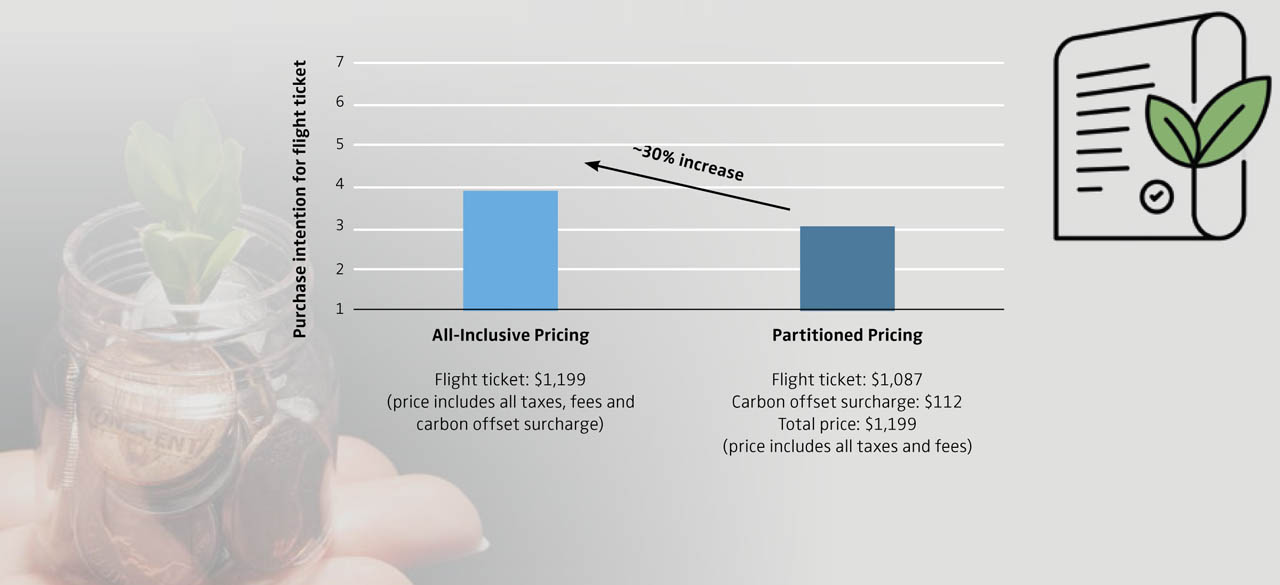
FIGURE 2
Purchase intention for a flight ticket with carbon offset charges varies by pricing format.
BOX 2
What works and what doesn't: Examples across industries
Price structure is not merely an economic decision, but a communication of responsibility. This dynamic manifests across a wide range of business contexts:
Food and Hospitality: Itemized wellness or living-wage fees often draw negative media attention and customer complaints, whereas menu-wide price increases to support employee welfare are typically accepted.
Travel and Transportation: Carbon-offset surcharges listed separately provoke objections, yet customers are more accepting of higher fares that already incorporate carbon-offset costs.
Retail and E-commerce: Environmental fees added at checkout are seen as burdensome, whereas prices that include sustainable packaging or climate-neutral delivery typically do not generate negative responses.
These examples demonstrate that the backlash is not rooted in opposition to sustainability itself, but in perceptions of who is being asked to pay for it.

Visualization, AI-generated, Prompt GCO Medienagentur
This perception weakens trust and prompts consumers to question the company's authenticity in its commitment to the cause. Rather than viewing the surcharge as an act of transparency, they view it as evidence that the company seeks reputational benefits without proportional internal investment. Consequently, purchase intentions decline, even among consumers who strongly support sustainability.
All-inclusive pricing avoids this inference. When sustainability costs are embedded into the total price, consumers are less likely to scrutinize the specific financial contribution and more likely to believe that the company is sharing responsibility for the initiative. This perception enhances credibility and signals a more intrinsic commitment to the cause.
When partitioned pricing does not backfire
Not all surcharges are interpreted through this lens. Partitioned pricing does not elicit negative reactions when the fee is designed to discourage harmful or excessive consumer behavior, such as a saturated fat surcharge, a soda surcharge, congestion charges or a plastic-bag fee. In these situations, consumers view the surcharge as a mechanism for shaping consumption and believe it is appropriate for them to bear the cost.
The negative effect of partitioned pricing is particularly evident in contexts where the surcharge funds pro-social or pro-environmental initiatives – domains in which consumers expect companies to shoulder primary responsibility.
Favor all-inclusive pricing when feasible
All-inclusive pricing is generally the most effective approach for presenting sustainability-related costs. It prevents consumers from interpreting the surcharge as a transfer of responsibility and avoids drawing attention to the cost of the sustainability initiative itself. This format strengthens perceptions of fairness and supports customer acceptance. Companies can still communicate their sustainability commitments through packaging, product descriptions or marketing materials without relying on itemized fees. All-inclusive pricing signals that the company views sustainability as an integral part of its value proposition, not an added burden on consumers.
When all-inclusive pricing is not possible, reframe surcharge communication
Regulatory requirements, industry norms or internal policies may require some companies to display sustainability fees separately. In these cases, companies can mitigate negative reactions by reframing how the surcharge is communicated. Three strategies have been shown to improve consumer responses.
„All-inclusive pricing communicates joint responsibility and authentic commitment.“
Emphasize the company's own contribution
Customers respond more positively when they know the company is also investing in the cause, rather than passing the entire cost to consumers.
Clarify the destination of the surcharge
Explaining that the funds support a specific external partner or certified organization increases trust and reduces suspicion.
Frame the surcharge in terms of benefits
Language that emphasizes the positive impact and how consumers and society can benefit from the additional fees can reduce the sense of an imposed cost.
These communication strategies do not eliminate all challenges associated with partitioned pricing, but they can substantially reduce the perception of responsibility shifting.
Sustainability pricing is both a financial decision and a strategic communication choice
Sustainability has become an integral expectation in the marketplace, and companies across sectors are investing in social and environmental initiatives. However, how these investments are priced has a decisive impact on customer reaction. Partitioned surcharges, although transparent, often signal that the company is attempting to shift responsibility onto consumers, undermining trust and reducing the likelihood of purchase. All-inclusive pricing avoids this inference and communicates joint responsibility and authentic commitment. For managers, the implication is straightforward: Sustainability pricing must be treated as both a financial decision and a strategic communication choice. Thoughtful pricing design enables companies to support their sustainability goals while preserving customer trust and reinforcing brand integrity.